- Product Description Description
- Table of Contents TOC
- List of Table & Figure LOT
- Get Free Sample PDF Sample PDF
Market Size, 2025
$3.54 BnMarket Estimate, 2026
$3.97 BnMarket Forecast, 2034
$9.85 BnCAGR, 2026–2034
12.04%Global Carbon Fiber Market Summary
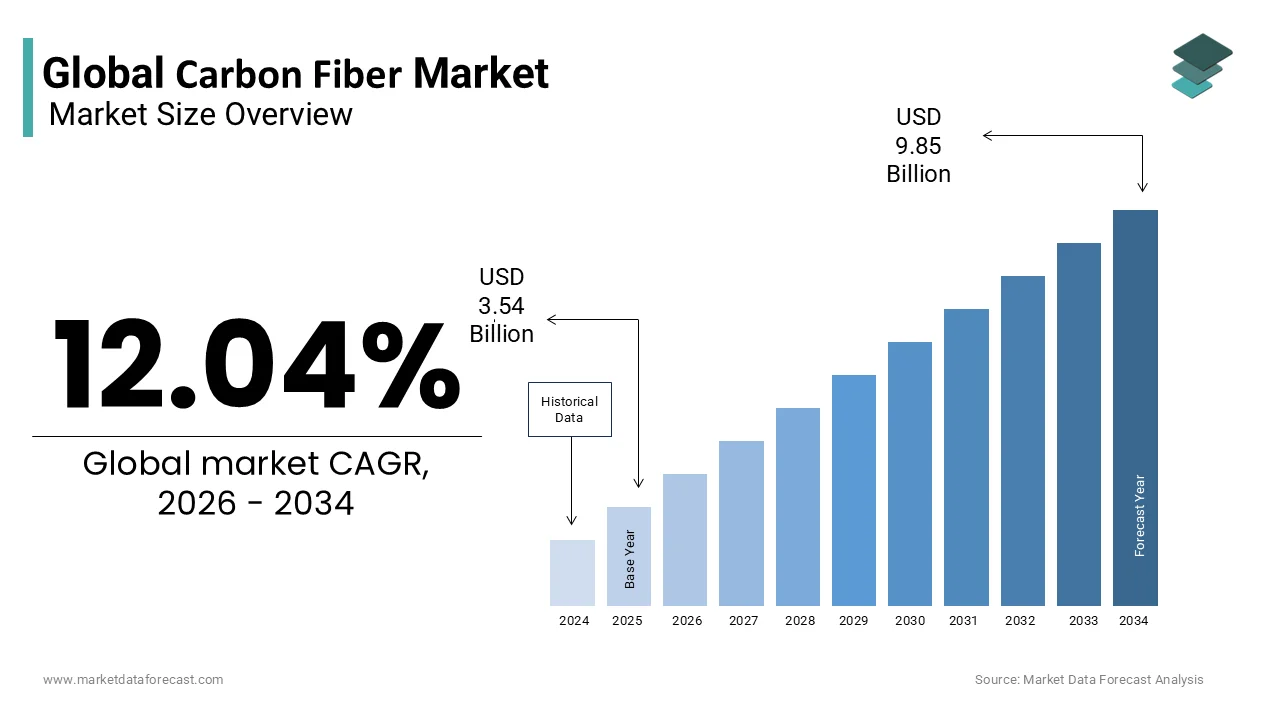
The global carbon fiber market was valued at USD 3.54 billion in 2025, is projected to reach USD 3.97 billion in 2026, and is expected to expand to USD 9.85 billion by 2034, growing at a CAGR of 12.04% from 2026 to 2034. The growth of the global carbon fiber market is driven by rising demand for lightweight and high-strength materials in aerospace, automotive, wind energy, and sports industries. Increasing adoption of carbon fiber composites for fuel efficiency, sustainability, and performance enhancement is further supporting market expansion.
Key Market Trends
- Expanding use of carbon fiber composites in aerospace and defense for lightweight structures.
- Rising demand for carbon fiber-reinforced materials in electric vehicles (EVs) is expected to improve efficiency.
- Increasing applications in wind turbine blades for renewable energy generation.
- Growth in the construction and infrastructure sectors is adopting carbon fiber for durability.
- Development of cost-effective PAN-based and recycling technologies to expand usage.
Segmental Insights
- Based on precursor, the polyacrylonitrile (PAN)-based precursor segment dominated the carbon fiber market in 2025, owing to its superior strength and high adoption in aerospace and automotive applications.
- Based on tow, the large tow segment captured a significant share in 2025, reflecting its use in industrial applications where cost efficiency and bulk production are key.
- Based on application, the aviation, aerospace & defense segment led the market with 44.6% share in 2025, driven by rising demand for lightweight, fuel-efficient aircraft materials.
Regional Insights
- Asia-Pacific was the top-performing region in the global carbon fiber market with a 38.4% share in 2025, supported by strong aerospace, automotive, and wind energy sectors.
- North America is showing robust growth, driven by aerospace advancements, defense spending, and EV adoption.
- Europe remains a significant market, supported by sustainability initiatives, lightweight automotive production, and aerospace innovation.
- Latin America is gradually expanding, supported by wind energy projects and industrial usage.
- Middle East & Africa are emerging markets, with growing investments in aerospace and renewable energy infrastructure.
Competitive Landscape
Leading players in the global carbon fiber market include Toray Industries Inc., Syensqo, Nippon Graphite Fiber Co. Ltd., Teijin Limited, Hexcel Corporation, ZOLTEK Corporation, Hyosung Advanced Materials, Advanced Composites Inc., Mitsubishi Chemical Carbon Fiber and Composites Inc., Formosa M Co. Ltd., and SGL Carbon. These companies are focusing on product innovation, capacity expansion, and cost-efficient production methods to strengthen their global presence.
Global Carbon Fiber Market Size
The global carbon fiber market size was valued at USD 3.54 billion in 2025 and is expected to reach USD 9.85 billion by 2034 from USD 3.97 billion in 2026. The market is projected to grow at a CAGR of 12.04%.
Carbon fiber is a high-performance material composed of thin and crystalline filaments of carbon atoms arranged in a graphite-like structure. Carbon fiber is renowned for its exceptional strength-to-density ratio, stiffness, and thermal stability. Unlike conventional materials, carbon fiber composites enable transformative weight reduction in aerospace, automotive, wind energy, and infrastructure systems without compromising structural integrity. According to the U.S. Department of Energy, replacing steel with carbon fiber in vehicle bodies can reduce mass by up to 60%, significantly improving fuel efficiency and electric vehicle range.
MARKET DRIVERS
Accelerated Adoption in Commercial Aviation for Fuel Efficiency and Emissions Reduction
The aerospace industry’s urgent need to reduce fuel consumption and meet stringent emissions targets has made it an important enabler of next-generation aircraft design, which drives the growth of carbon fiber market. Modern wide-body jets incorporate carbon fiber in wings, fuselages, and tail sections to achieve weight savings compared to aluminum-based structures. According to the study, aviation accounts for a portion of global CO₂ emissions, driving manufacturers to adopt lightweight composites to comply with the Carbon Offsetting and Reduction Scheme for International Aviation (CORSIA). The Boeing 787 Dreamliner, with a portion of its structural weight in carbon fiber, consumes less fuel per passenger than previous-generation aircraft.
Expansion of Wind Energy Infrastructure Requiring Longer, Lighter Blades
The global shift toward renewable energy has intensified its demand in wind turbine blade manufacturing for offshore installations where longer blades are essential for higher energy capture, which propels the growth of carbon fiber market. Vestas and Siemens Gamesa have adopted hybrid carbon-glass fiber designs in their 14–15 MW offshore models, achieving a reduction in blade mass while enhancing durability in harsh marine environments. The carbon fiber enables an increase in annual energy production per turbine due to improved aerodynamic efficiency and reduced drivetrain loads, making it indispensable for next-generation wind farms.
MARKET RESTRAINTS
High Production Costs and Energy-Intensive Manufacturing Processes
The complexity and multi-stage production process makes it prohibitively expensive for mass-market applications, which restricts the growth of carbon fiber market. This includes precursor synthesis, oxidation, carbonization, and surface treatment. According to the sstudy, the production of polyacrylonitrile (PAN)-based carbon fiber, the most common type, requires temperatures exceeding 1,000°C in inert atmospheres. This energy intensity translates into high operational costs. The precursor materials account for a portion of total production costs.
Limited Recycling Infrastructure and End-of-Life Management
The thermoset resin matrices used in most carbon fiber composites render them difficult to recycle, which hinders the growth of carbon fiber market. This difficulty leads to growing environmental concerns as composite waste accumulates. According to the study, notable metric tons of carbon fiber waste, primarily from aerospace, wind, and automotive sectors, were generated globally in 2023, with less share recovered. Traditional landfilling or incineration weakens sustainability claims, particularly as industries adopt circular economy principles. As per the University of Nottingham’s Composites Research Group, pyrolysis, the most viable recycling method, recovers fiber strength, limiting reuse in primary structures. Apart from these, the lack of standardized sorting and collection systems hampers large-scale recycling efforts. This infrastructure deficit poses a long-term risk to the material’s environmental license to operate, especially under tightening EU waste directives.
MARKET OPPORTUNITIES
Development of Low-Cost Alternative Precursors
Replacing polyacrylonitrile (PAN) with alternative precursors such as lignin, rayon, or pitch to reduce carbon fiber production costs and broaden industrial adoption is likely to promote new opportunities for the growth of carbon fiber market. According to the study, lignin, byproduct of the pulp and paper industry, could supply tons of potential precursor material annually, with production costs lower than PAN. Using lignin-based carbon fiber in vehicle components could reduce lifecycle emissions compared to PAN-based equivalents, which enhances both economic and environmental viability.
Integration into Hydrogen Economy Infrastructure
The emergence as an important material in the development of high-pressure hydrogen storage systems for fuel cell vehicles and industrial applications, is setting up new opportunities for the growth of carbon fiber market. Type IV hydrogen tanks, which use carbon fiber-enhanced polymer liners, are essential for storing hydrogen at 700 bar while maintaining safety and lightweight performance. Hyundai and Toyota have scaled production of fuel cell vehicles, with the Mirai and NEXO models relying on carbon-wound tanks for extended range.
MARKET CHALLENGES
Supply Chain Vulnerability to Precursor Availability and Geopolitical Factors
Heavy dependent on a limited number of polyacrylonitrile (PAN) precursor suppliers, degrades the growth of the carbon fiber market. As per the study, over 80% of high-quality PAN precursor is produced in Japan and South Korea, with Toray, Mitsubishi Chemical, and Hyosung dominating both precursor and final fiber production. This concentration poses risks during geopolitical disruptions or export restrictions. In addition, shipping delays in the Strait of Malacca led to an increase in precursor lead times, affecting downstream manufacturing schedules in Europe and North America, as per the research. Apart from these, fluctuations in acrylonitrile prices, derived from propylene, impact production costs.
Technical Barriers in Joining and Repair of Composite Structures
There are barriers in joining, welding, and field repair of compote structure due to their anisotropic properties and susceptibility to delamination and stress concentration, which challenges the growth of carbon fiber market. According to the study, a portion of maintenance time for composite aircraft structures is spent on inspection and repair rather than routine servicing. Traditional fastening methods introduce stress points, while adhesive bonding requires precise surface preparation and curing conditions. According to the study, improper repair techniques can reduce composite strength. Apart from these, non-destructive testing (NDT) methods such as ultrasonic scanning are time-consuming and require specialized expertise. As per the study, there is a growing shortage of certified composite repair technicians, with a portion shortfall in qualified personnel across EU maintenance facilities. These technical and human capital constraints impede widespread adoption, particularly in sectors requiring high maintainability.
REPORT COVERAGE
| REPORT METRIC | DETAILS |
| Market Size Available | 2025 to 2034 |
| Base Year | 2025 |
| Forecast Period | 2026 to 2034 |
| CAGR | 12.04% |
| Segments Covered | By Precursor, Tow, Application, and Region |
| Various Analyses Covered | Global, Regional, & Country Level Analysis; Segment-Level Analysis; DROC; PESTLE Analysis; Porter’s Five Forces Analysis; Competitive Landscape; Analyst Overview of Investment Opportunities |
| Regions Covered | North America, Europe, APAC, Latin America, Middle East & Africa |
| Market Leaders Profiled | Toray Industries, Inc., Syensqo, Nippon Graphite Fiber Co., Ltd., TEIJIN LIMITED, Hexcel Corporation, ZOLTEK Corporation, HYOSUNG ADVANCED MATERIALS, Advanced Composites Inc., Mitsubishi Chemical Carbon Fiber and Composites, Inc., Formosa M Co., Ltd., and SGL Carbon, and others |
SEGMENTAL ANALYSIS
By Precursor Insights
The polyacrylonitrile (PAN)-based precursor segment dominated the carbon fiber market by capturing substantial share in 2025. The growth of the polyacrylonitrile (PAN)-based precursor segment is boosted by PAN’s superior mechanical properties, including high tensile strength (up to 5,000 MPa) and modulus, which are essential for structural applications in aerospace, automotive, and wind energy. A portion of aerospace-grade carbon fiber is derived from PAN due to its consistent fiber alignment and thermal stability during carbonization. The material’s ability to form highly ordered graphitic structures under controlled pyrolysis makes it ideal for high-performance composites. Moreover, decades of process optimization have refined PAN-based fiber manufacturing, enabling tighter quality control and scalability. In aviation, where failure tolerance is minimal, this consistency is non-negotiable. Apart from these, major producers such as Toray, Mitsubishi Chemical, and Hexcel have invested heavily in proprietary PAN formulations, which creates technological moats.
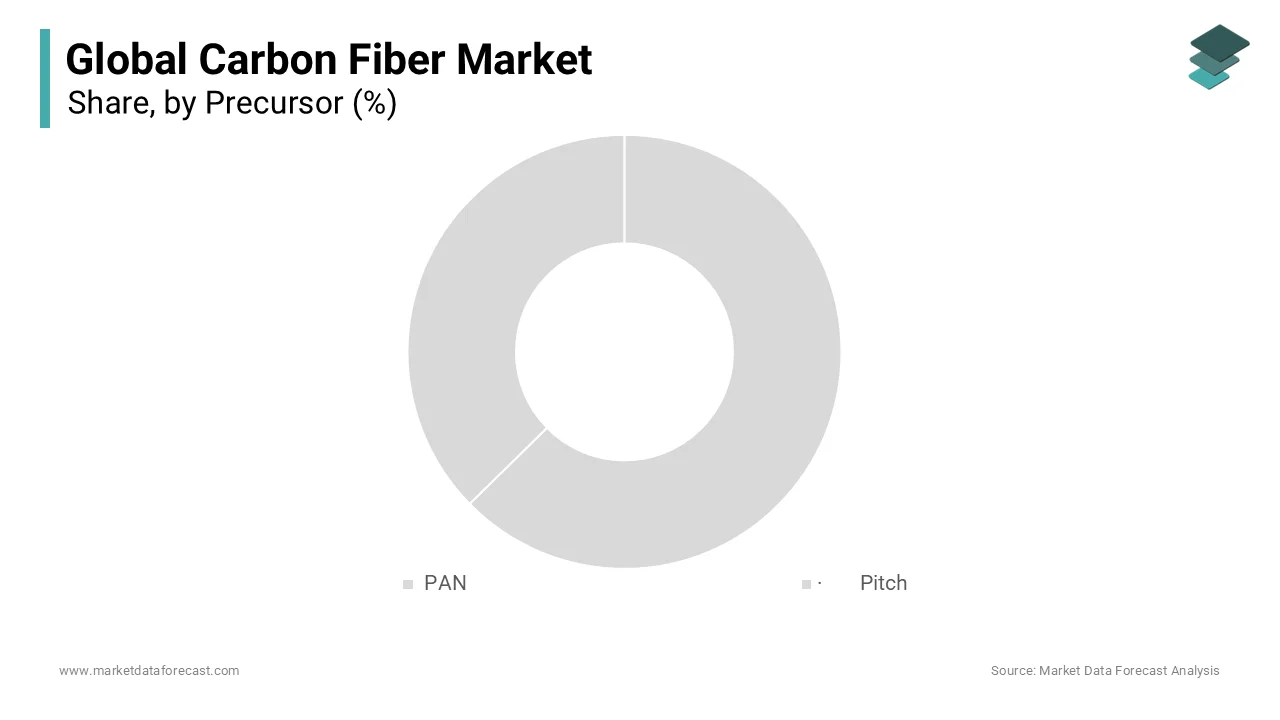
The pitch-based carbon fiber segment is estimated to register a CAGR of 10.8% from 2026 to 2034 owing to the rising demand for materials with exceptional thermal conductivity, electrical conductivity, and stiffness, properties inherent to mesophase pitch-derived fibers. Unlike PAN-based fibers, pitch-based carbon fibers exhibit ultra-high modulus (up to 900 GPa), which makes them ideal for specialized applications in aerospace components, satellite structures, and high-speed rotor systems. According to the study, pitch-based fibers are used in a portion of gyroscopic wheels in geostationary satellites due to their dimensional stability under rapid rotation. Apart from these, the automotive sector is exploring pitch-based composites for electric vehicle battery housings and heat dissipation systems.
By Tow Insights
The large tow segment led the carbon fiber market by capturing significant share in 2025. The growth of the large tow segment is attributed to its prominence in wind energy, automotive mass production, and pressure vessel manufacturing. Large tow, defined as carbon fiber bundles containing 24,000 filaments (24K) or more is favored in industrial applications where cost-efficiency, high deposition rates, and ease of handling outweigh the need for ultra-fine structural precision. The economic advantage of large tow is significant. As per the study, large tow enables a reduction in cycle time during compression molding.
The small tow segment is estimated to register the fastest CAGR of 9.4% from 2026 to 2034 owing to accelerated adoption in aerospace, defense, and high-performance sports equipment, which is due to its superior drapability, surface finish, and ability to withstand complex layups in curved or intricate geometries. Similarly, manufacturers use carbon fiber in elite sports equipment to maximize the stiffness-to-weight ratio. Thus, small tow is becoming indispensable for applications where performance precision outweighs cost considerations because increasing demand for next-generation stealth drones, hypersonic vehicles, and premium consumer goods.
By Application Insights
The aviation, aerospace & defense segment dominated the carbon fiber market by capturing 44.6% of the global market share in 2025 The growth of the aviation, aerospace & defense segment is driven by the material’s irreplaceable role in modern airframe design, where weight reduction directly translates into fuel efficiency, extended range, and lower emissions. The Boeing 787 Dreamliner and Airbus A350 XWB each incorporate carbon fiber by structural weight, which enables a reduction in fuel burn compared to aluminum-based aircraft, as per the study. In defense, the use of advanced composites in next-generation platforms such as the B-21 Raider and F-35, where stealth, strength, and low observability are paramount. Also, carbon fiber composites reduce radar cross-section when integrated with conductive resins.
The automotive application segment is likely to experience a CAGR of 11.6% from 2026 to 2034 due to the electric vehicle (EV) revolution, where lightweighting is important to extending battery range and improving energy efficiency. Replacing steel with carbon fiber can reduce vehicle mass, translating into an increase in driving range per charge, according to the study. Apart from these, Chinese automakers are adopting carbon fiber in roof panels and rear spoilers to enhance performance and aesthetics. As per study, carbon fiber-enhanced polymer (CFRP) hoods reduce frontal mass, which improves crash energy management. The push for lightweight materials is intensifying as governments are mandating fleet-wide emissions reductions.
REGIONAL ANALYSIS
Asia Pacific Carbon Fiber Market Insights
Asia Pacific was the top performer in the global carbon fiber market in 2025 and accounted for 38.4% of the global market share in 2025. Japan, home to Toray and Mitsubishi Chemical, the world’s two largest carbon fiber producers, accounts for a portion of high-performance fiber exports. China has rapidly expanded domestic capacity. India and Southeast Asia are emerging as secondary hubs, with India promoting carbon fiber for defense and renewable energy. Apart from these, South Korea’s focus on hydrogen mobility has spurred demand for carbon fiber in Type IV hydrogen tanks.
North America Carbon Fiber Market Insights
North America carbon fiber market 29.5% of the global market share in 2025, with the United States serving as the primary center for aerospace, defense, and automotive innovation. The growth of North America in the global market is propelled by strong federal investment in lightweight materials through agencies such as the Department of Energy and NASA. According to study, a portion of new commercial aircraft registered contained carbon fiber airframes. The U.S. has classified carbon fiber as a important material, with Lockheed Martin and Northrop Grumman relying on it for stealth bombers and space launch systems.
Europe Carbon Fiber Market Insights
Europe carbon fiber market growth is with Germany, France, and the United Kingdom forming the core of aerospace and industrial application demand. The region’s strength lies in its advanced manufacturing base and commitment to decarbonization. According to the study, Airbus consumed large metric tons of carbon fiber for A350 and A220 production, sourced from suppliers. Germany’s automotive industry is integrating carbon fiber into premium EVs, with Porsche and Mercedes-Benz using it in battery trays and chassis support. Carbon fiber composites reduce satellite launch mass, which enhances payload efficiency. Apart from these, the EU’s Circular Economy Action Plan has spurred investment in carbon fiber recycling.
Middle East and Africa Carbon Fiber Market Insights
Middle East and Africa carbon fiber market growth is likely to grow with limited but strategic development. Saudi Arabia is investing in carbon fiber as part of its Vision 2030 diversification plan, with NEOM and the King Abdullah University of Science and Technology (KAUST) funding research into lightweight materials for smart cities and renewable energy. A pilot carbon fiber production line is under development by leveraging petrochemical feedstocks. The region lacks specialized manufacturing infrastructure, which is limiting near-term growth despite long-term ambitions.
Latin America Carbon Fiber Market Insights
Latin America carbon fiber market growth is likely to grow with Brazil leading regional demand in aerospace and wind energy. Embraer uses carbon fiber in executive jets such as the Phenom 300, while wind farms are testing carbon-strengthened blades for higher efficiency. According to the study, installed offshore capacity is expected to surge, driving composite demand. Chile and Argentina are exploring carbon fiber for mining equipment and hydrogen storage, but infrastructure gaps remain.
COMPETITIVE LANDSCAPE
KEY MARKET PLAYERS
Some of the market players that are dominating the global carbon fiber market are
- Toray Industries, Inc.
- Syensqo
- Nippon Graphite Fiber Co., Ltd.
- TEIJIN LIMITED
- Hexcel Corporation
- ZOLTEK Corporation
- HYOSUNG ADVANCED MATERIALS
- Advanced Composites Inc.
- Mitsubishi Chemical Carbon Fiber and Composites, Inc.
- Formosa M Co., Ltd.
- SGL Carbon
TOP STRATEGIES USED BY THE KEY MARKET PLAYERS
Key players in the carbon fiber market are deploying vertical integration, capacity expansion, cost reduction through alternative precursors, strategic partnerships with end-users, and investment in recycling technologies to strengthen their competitive advantage. Companies are securing control over the entire value chain, from PAN precursor to finished composite, to ensure supply stability and quality consistency. Expansion of production facilities in Asia and North America is aligning with regional demand in aerospace and clean energy. Firms are developing lower-cost fiber grades for automotive and wind applications to broaden market reach. Collaborations with automakers, aircraft OEMs, and energy firms enable application-specific customization.
COMPETITION OVERVIEW
The carbon fiber market features a concentrated yet dynamic competitive landscape dominated by a few technologically advanced players, primarily from Japan, the United States, and South Korea. Competition is less price-driven and more focused on performance reliability, certification, and long-term supply assurance, particularly in aerospace and defense. Emerging producers in China and India are challenging incumbents by scaling production and reducing costs, though they often lag in high-grade fiber consistency. Intellectual property in precursor chemistry and thermal processing remains an important differentiator.
TOP PLAYERS IN THE MARKET
- Toray Industries is a global leader in carbon fiber innovation and a dominant force in the Asia Pacific market, where it operates major production facilities in Japan, South Korea, and Thailand. The company supplies high-performance PAN-based carbon fibers under the Torayca brand to aerospace, automotive, and wind energy manufacturers across the region. It established a joint R&D center with the University of Tokyo to accelerate the development of next-generation fibers with improved tensile strength and lower production costs.
- Mitsubishi Chemical plays a pivotal role in the Asia Pacific carbon fiber landscape through its DIALEAD™ brand, supplying advanced materials to aerospace, electronics, and transportation industries. The company has deepened its regional integration by partnering with Japanese and Southeast Asian manufacturers to co-develop carbon fiber-enhanced components for electric vehicles and robotics. It also strengthened its presence in hydrogen storage by supplying carbon fiber. The focus on sustainability and cost reduction positions Mitsubishi Chemical as a key enabler of scalable composite adoption across the region.
- Hyosung Advanced Materials has emerged as a strategic player in the Asia Pacific carbon fiber market by rapidly scaling production and targeting industrial applications beyond aerospace. The company also entered the hydrogen economy by developing carbon fiber for high-pressure storage tanks, partnering with Hyundai Motor to support its fuel cell vehicle rollout. Hyosung is positioning itself as a cost-competitive, regionally anchored supplier, which reduces Asia’s reliance on imported carbon fiber for renewable and transportation infrastructure.
MARKET SEGMENTATION
This research report on the global carbon fiber market has been segmented and sub-segmented based on application and region.
By Precursor
- PAN
- Pitch
By Tow
- Large Tow
- Small Tow
By Application
- Aviation, Aerospace & Defense
- Automotive
- Wind Turbines
- Sports & Leisure
- Construction
- Others
By Region
- North America
- Europe
- Asia-Pacific
- Latin America
- Middle East and Africa