- Product Description Description
- Table of Contents TOC
- List of Table & Figure LOT
- Get Free Sample PDF Sample PDF
Market Size, 2025
$95 BnMarket Estimate, 2026
$101 BnMarket Forecast, 2034
$164 BnCAGR, 2026–2034
6.25%Global Construction Chemicals Market Report Summary
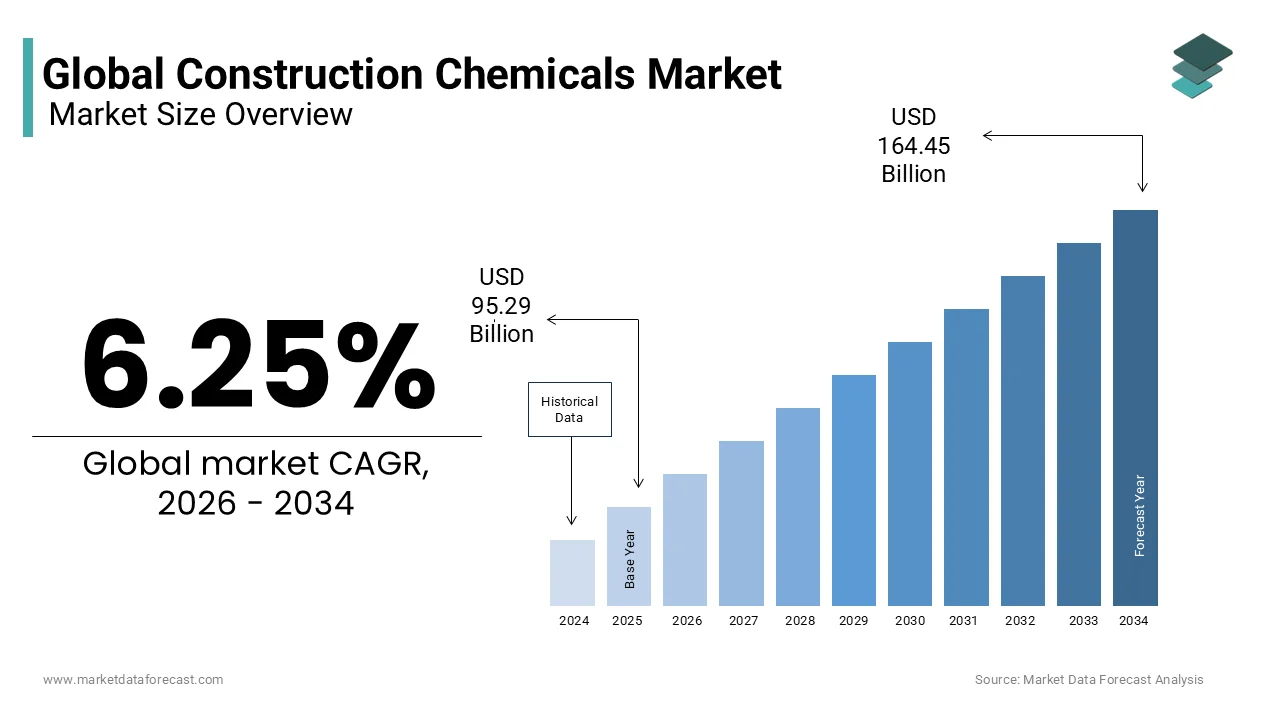
The global construction chemicals market was valued at USD 95.29 billion in 2025, is estimated to reach USD 101.25 billion in 2026, and is projected to reach USD 164.45 billion by 2034, growing at a CAGR of 6.25% during the forecast period from 2026 to 2034. The growth of the global construction chemicals market is driven by rapid urbanization, increasing infrastructure development, and rising investments in residential, commercial, and industrial construction projects. Growing demand for durable, sustainable, and energy-efficient buildings, along with advancements in construction technologies, is further supporting market growth. Additionally, increasing adoption of high-performance concrete, waterproofing solutions, repair materials, and protective coatings is accelerating the use of construction chemicals worldwide.
Key Market Trends
-
Rising investments in infrastructure development and urbanization are driving demand for construction chemicals globally.
-
Increasing adoption of sustainable and energy-efficient construction practices is supporting the use of advanced chemical solutions.
-
Growing demand for high-performance concrete, waterproofing systems, and protective coatings is expanding market opportunities.
-
Advancements in green building technologies and low-VOC construction materials are encouraging product innovation.
-
Increasing renovation, repair, and maintenance activities are contributing to steady market growth.
Segmental Insights
-
Based on end-use sector, the infrastructure segment dominated the global construction chemicals market by accounting for 37.3% of total demand in 2025. The segment's leadership is attributed to rising investments in transportation, bridges, tunnels, airports, railways, and public infrastructure projects requiring high-performance construction materials.
-
Based on product, the concrete admixtures segment held the largest share of the global construction chemicals market by accounting for 42.1% of total demand in 2025. The segment's dominance is driven by its ability to enhance concrete strength, durability, workability, and resistance to environmental conditions while improving construction efficiency.
Regional Insights
-
The global construction chemicals market is witnessing strong growth due to increasing construction activities, infrastructure modernization, and rising demand for sustainable building materials.
-
Asia Pacific dominated the global construction chemicals market by accounting for 43.5% of the global market share in 2025. The region's leadership is supported by rapid urbanization, large-scale infrastructure investments, expanding residential and commercial construction, and strong industrial development in countries such as China, India, Japan, and Southeast Asian economies.
-
North America remains a significant market due to increasing renovation projects, expanding commercial construction, and growing adoption of advanced construction technologies.
Competitive Landscape
The global construction chemicals market is highly competitive, with leading manufacturers focusing on product innovation, sustainable formulations, and expansion of high-performance construction solutions to strengthen their market positions. Companies are investing in research and development, strategic acquisitions, digital construction technologies, and environmentally friendly chemical products to meet the growing demand across infrastructure, residential, commercial, and industrial construction sectors. Key players operating in the global construction chemicals market include JSW, MAPEI S.p.A., Sika AG, Ashland, 3M, Arkema, Evonik Industries, Henkel AG & Co. KGaA, Dow, Thermax Limited, and Saint-Gobain.
Global Construction Chemicals Market Size
The global construction chemicals market size was valued at USD 95.29 billion in 2025 and is expected to reach USD 164.45 billion by 2034 from USD 101.25 billion in 2026. The market is projected to grow at a CAGR of 6.25%.
Construction chemicals are formulations engineered to enhance the performance, durability, and sustainability of building materials, particularly concrete, cement, and masonry. These products, including admixtures, sealants, waterproofing agents, and repair mortars play a critical role in modern construction by improving structural integrity, extending service life, and mitigating environmental degradation. As per the study, many large-scale infrastructure projects in the EU incorporate high-performance concrete admixtures to meet stringent durability standards under the Eurocodes. The UNEP 2023 Global Status Report for Buildings and Construction reveals that the building sector accounts for 37% of global energy-related CO₂ emissions, driving demand for low-carbon construction chemicals. Additionally, the European Commission’s Circular Economy Action Plan emphasizes that new public infrastructure projects use materials with verified lifecycle performance, accelerating the integration of advanced chemical solutions in construction workflows.
MAREKT DRIVERS
Urbanization and infrastructure modernization are pivotal forces propelling demand for construction chemicals across developed and emerging economies. According to the research, Europe’s urban population is projected to increase significantly by 2030, necessitating extensive housing, transportation, and utility infrastructure. This demographic shift is mirrored in capital investment; the European Investment Bank allocated substantial amountto transport, energy, and water infrastructure projects, many of which require high-performance concrete with chemical admixtures. For instance, the Brenner Base Tunnel project between Austria and Italy, one of Europe’s largest infrastructure undertakings, utilizes cubic meters of self-compacting concrete enhanced with superplasticizers to ensure durability in alpine conditions, as documented by the Austrian Federal Railways. Furthermore, as per a study, a notable share of the EU’s existing bridges and viaducts are over 50 years old, prompting widespread rehabilitation efforts where corrosion inhibitors and repair mortars are essential for structural longevity.
Stringent building regulations and sustainability mandates are increasingly shaping the adoption of advanced construction chemicals. The European Union’s Energy Performance of Buildings Directive (EPBD) revision of 2023 requires all new public buildings to be nearly zero-energy, compelling the use of materials that reduce thermal bridging and improve envelope efficiency. Construction chemicals such as insulating renders and air-entraining agents are now integral to meeting these standards. As per the study, a share of new commercial buildings in Germany and Scandinavia incorporate waterproofing membranes and crack-resistant coatings to comply with passive house certification. Additionally, the EU’s Environmental Product Declaration (EPD) framework mandates lifecycle transparency, prompting manufacturers to develop low-VOC sealants and carbon-cured concrete admixtures. As per a study, construction projects using chemical admixtures to reduce cement content achieved lower carbon footprint without compromising compressive strength, reinforcing their role in sustainable construction.
MAREKT RESTRAINTS
Volatility in raw material supply chains presents a significant restraint on the construction chemicals market. Many key ingredients, such as ethylene oxide, methacrylic acid, and styrene, are petroleum-derived and subject to geopolitical and logistical disruptions. According to a study, there has been an increase in the pConstruction Chemicals of ethylene oxide, a critical component in superplasticizers, due to energy shortages and reduced refinery output. This volatility directly impacts production costs and delivery timelines, with some manufacturers experiencing lead times extending beyond several weeks. Furthermore, the EU’s REACH regulation has restricted the use of certain phthalates and solvents, forcing formulators to seek alternative chemistries. A notable share of SMEs in the sector faced formulation recalibration costs significantly to comply with new substance restrictions, undermining profitability and innovation capacity in a highly competitive market.
Skilled labor shortage and inconsistent application practices impede the optimal performance of construction chemicals. Despite technological advancements, the efficacy of products like waterproofing membranes and repair mortars depends heavily on proper surface preparation and application technique. According to the European Centre for the Development of Vocational Training (Cedefop), the construction sector faces a deficit of skilled workers across the EU, particularly in specialized trades such as concrete finishing and chemical coating application. In France, a study found that a portion of waterproofing failures in basements were attributable to improper primer application or inadequate curing conditions. Similarly, as per a study, only few site supervisors had received formal training in chemical admixture handling, leading to suboptimal mix designs and reduced concrete durability. This gap between product capability and field execution diminishes return on investment and erodes trust in advanced chemical solutions.
MAREKT OPPORTUNITIES
Retrofitting and energy-efficient building retrofits present a major opportunity for construction chemicals manufacturers. As per the European Commission’s Renovation Wave Strategy, at least 35 million buildings must be renovated by 2030 to meet climate targets, creating vast demand for thermal insulation coatings, air barrier sealants, and moisture-resistant plasters. The strategy estimates that deep energy retrofits could reduce heating demand, with construction chemicals playing a central role in envelope enhancement. In Sweden, the K2030 initiative has already mobilized substantial amount for multifamily housing retrofits, where hydrophobic impregnations and insulating renders are standard components. Additionally, the use of crack-bridging sealants in façade rehabilitation extended maintenance cycles by several years, significantly lowering lifecycle costs. With a notable share of Europe’s current building stock constructed before 2000, the scale of retrofit potential is immense, offering a sustained growth avenue for chemical innovators.
Digitalization and smart material integration are unlocking new frontiers in construction chemistry. The rise of Building Information Modeling (BIM) and digital twins enables precise specification and tracking of chemical applications throughout a structure’s lifecycle. As per a study, a portion of large infrastructure projects include digital material passports that log the type, quantity, and performance data of construction chemicals used. This traceability enhances compliance with EU Green Public Procurement criteria and supports future maintenance planning. Moreover, companies are developing intelligent admixtures with embedded sensors to monitor concrete curing, chloride ingress, and structural stress in real time. The EU-funded SENSOCRETE project, led by ETH Zurich and involving partners in Spain and Germany, demonstrated that sensor-integrated repair mortars could detect micro-cracking up to six months before visible damage, enabling predictive maintenance. This convergence of chemistry and digital infrastructure is redefining performance expectations and creating premium value segments.
MAREKT CHALLENGES
Regulatory fragmentation across European markets poses a persistent challenge for construction chemicals manufacturers. While the Construction Products Regulation (CPR) establishes a harmonized framework for CE marking, national interpretations and additional technical requirements vary significantly. According to the research, many EU member states maintain supplementary testing protocols for waterproofing systems, creating compliance hurdles for pan-European distribution. In Italy, for example, regional building codes require third-party certification for all chemical injection grouts used in seismic retrofitting, a requirement not present in neighboring countries. As per a study, of manufacturers spend large amount annually to adapt product dossiers for different national markets. This administrative burden delays market entry and increases costs, particularly for SMEs aiming to scale across borders.
Accelerated degradation due to climate change impacts is emerging as a critical challenge for construction materials, necessitating more resilient chemical solutions. Rising temperatures, increased freeze-thaw cycles, and higher humidity levels are compromising the longevity of concrete and masonry structures. As per the European Environment Agency, the extreme weather events notably affects infrastructure, with coastal regions experiencing accelerated chloride-induced corrosion in reinforced concrete. In Denmark, field studies revealed that bridge decks exposed to de-icing salts and fluctuating temperatures exhibited higher spalling rates than those in stable climates. Similarly, the Mediterranean region faces increased thermal stress, with surface temperatures on façades exceeding 70°C, causing premature failure of polymer-based sealants. These environmental pressures demand next-generation construction chemicals with enhanced UV resistance, thermal stability, and adaptive curing mechanisms—capabilities that are still in developmental phases across much of the industry.
REPORT COVERAGE
| REPORT METRIC | DETAILS |
| Market Size Available | 2025 to 2034 |
| Base Year | 2025 |
| Forecast Period | 2026 to 2034 |
| CAGR | 6.25% |
| Segments Covered | By End-Use Sector, Product, and Region |
| Various Analyses Covered | Global, Regional, & Country Level Analysis; Segment-Level Analysis; DROC; PESTLE Analysis; Porter’s Five Forces Analysis; Competitive Landscape; Analyst Overview of Investment Opportunities |
| Regions Covered | North America, Europe, APAC, Latin America, Middle East & Africa |
| Market Leaders Profiled | JSW, MAPEI S.p.A., Sika AG, Ashland, 3M, Arkema, Evonik Industries, Henkel AG & Co. KGaA, Dow, Thermax Limited, and Saint-Gobain, and others |
SEGMENTAL ANALYSIS
By End-Use Sector Insights
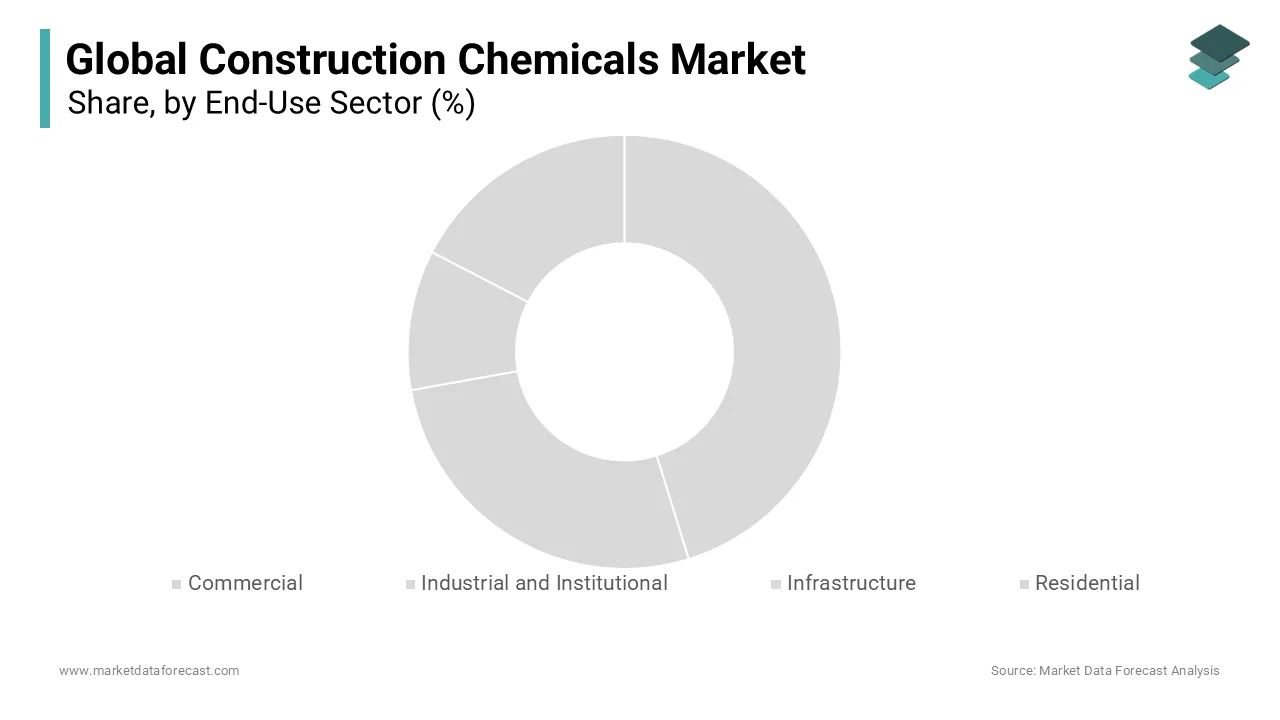
The Infrastructure sector stood as the largest consumer of construction chemicals globally by commanding a 37.3% share of total demand in 2025. This dominance is primarily fueled by large-scale investments in transportation, water, and energy networks that require high-performance materials to ensure durability under extreme mechanical and environmental stress. The European Investment Bank points out that substantial amount was allocated to transport infrastructure projects including rail tunnels, bridges, and highways, structures where corrosion inhibitors, shrinkage-reducing admixtures, and waterproofing membranes are indispensable. The Brenner Base Tunnel, currently under construction between Austria and Italy, utilizes cubic meters of concrete enhanced with polycarboxylate ether (PCE)-based superplasticizers to achieve self-compacting properties and extended service life, as documented by the project’s technical consortium. The aging infrastructure stock across developed economies, necessitating extensive rehabilitation, is another critical driver. In response, national governments are prioritizing structural preservation through advanced repair mortars and penetrating sealers. The UK’s National Highways agency, for instance, has committed to bridge maintenance between 2020 and 2026, with a portion of interventions involving chemical-based repair systems. Similarly, Germany’s Federal Ministry for Digital and Transport mandates the use of durable concrete admixtures in all Autobahn rehabilitation projects, ensuring compliance with 100-year design life standards. These long-term asset management strategies solidify infrastructure as the most chemically intensive sector in modern construction.
While Residential construction segment is emerging as the fastest-growing segment and is projected to expand at a CAGR of 6.8% from 2023 to 2030. This acceleration is driven by rising urban housing demand, particularly in high-density environments where material performance and space efficiency are paramount. According to research, Europe will require millions of new housing units to address shortages, with a notable share expected to be multi-story apartment buildings. These structures rely heavily on high-range water-reducing admixtures to enable pumped concrete in tall forms and crack-resistant coatings to prevent façade deterioration. In Sweden, the government’s initiative has incentivized the use of insulating renders and air barrier sealants in all new residential builds, contributing to an increase in chemical usage, as per the study. parallel force is the tightening of energy efficiency standards in residential buildings. France’s RE2020 regulation has already led to a rise in demand for insulating plasters in residential construction, according to the reseacrh. Additionally, off-site construction methods such as prefabricated concrete panels are dependent on specialized adhesives and grouts for modular assembly. As urbanization and regulatory pressures converge, the residential sector is rapidly evolving into a high-value chemical application domain.
By Product Insights
The Concrete Admixtures segment represented the largest product in the construction chemicals market by capturing a 42.1% of total global demand in 2025. This dominance is due to their fundamental role in modifying the properties of fresh and hardened concrete to meet structural, environmental, and logistical requirements. Superplasticizers, particularly polycarboxylate ethers (PCEs), are now standard in high-performance concrete, enabling water reduction while maintaining workability. The European Concrete Platform notes that ready-mix concrete used in major infrastructure projects incorporates PCE-based admixtures to achieve compressive strengths exceeding 80 MPa. The necessity for accelerated construction timelines further amplifies demand. In high-rise developments, early-strength admixtures allow formwork removal within 24 hours, reducing project duration, according to the study. The Shard in London, for example, utilized temperature-controlled curing admixtures to enable continuous vertical pours in cold weather, ensuring structural integrity. Moreover, sustainability mandates are reshaping admixture use. With a share of new public infrastructure specifying low-carbon concrete mixes, the role of chemical additives has transitioned from performance enhancement to environmental compliance, cementing their centrality in modern construction.
While Concrete Protective Coatings segment is the fastest-growing product and is projected to expand at a CAGR of 7.3% through 2034. This growth is propelled by increasing awareness of structural degradation and the economic imperative of lifecycle extension. According to the study, unchecked corrosion of reinforced concrete significant costs European economies annually in repair and downtime. Protective coatings, such as epoxy barriers, silane impregnations, and polyurethane topcoats, form the first line of defense, extending service life by several years in aggressive environments. The Øresund Bridge between Denmark and Sweden undergoes biannual reapplication of hydrophobic coatings to counteract chloride ingress from marine exposure, a practice now replicated in coastal infrastructure across the Mediterranean.
The proliferation of stringent durability standards in building codes is another driving factor. Germany and other EU countries have strict regulations and recommendations for corrosion protection in parking structures. In Italy, where seismic retrofitting is widespread, crack-bridging elastomeric coatings are now required on repaired façades to maintain integrity during tremors. Field data from the Swiss Federal Laboratories for Materials Science and Technology (Empa) shows that silane-based treatments reduce water absorption in concrete, preventing freeze-thaw spalling in alpine regions. Additionally, green building certifications such as BREEAM and LEED award points for durable, low-maintenance envelopes, incentivizing developers to invest in high-performance coatings. As asset owners shift from reactive to preventive maintenance, the demand for advanced protective systems is accelerating across both new and existing structures.
REGIONAL ANALYSIS
Asia Pacific Construction Chemicals Market Analysis
Asia Pacific led the global construction chemicals market with a 43.5% share in 2025. It is driven by unprecedented urbanization and state-backed infrastructure expansion. China and India alone account for a large share of regional demand, with China’s construction of substantial square meters of floor space annually. The country’s emphasis on high-speed rail, smart cities, and mega-projects like the Guangdong–Hong Kong–Macao Greater Bay Area has spurred demand for high-performance concrete admixtures and waterproofing systems. India’s National Infrastructure Pipeline, valued at $1.4 trillion, includes a number of projects requiring advanced chemical solutions for durability in tropical climates. The Indian Concrete Institute confirms that over 60% of large commercial buildings in Mumbai and Chennai now use corrosion-resistant admixtures due to saline air exposure.
Europe Construction Chemicals Market Analysis
Europe holds a significant market share at 24.6% and is distinguished by its focus on sustainability, regulatory compliance, and infrastructure renewal. The European Commission’s Green Deal and Circular Economy Action Plan have institutionalized the use of low-carbon admixtures and recycled-content binders in public projects. As per study, a portion of the EU’s building stock was constructed before 1945, creating sustained demand for repair mortars and protective coatings. Germany, France, and the Nordic countries are at the forefront of adopting digital material passports that track chemical usage for lifecycle management. According to study, the demand for low-VOC sealants grew notably, reflecting tightening indoor air quality standards. Europe’s mature but innovation-driven market continues to set benchmarks in performance and environmental stewardship.
North America Construction Chemicals Market Analysis
North America is anchored in large-scale infrastructure renewal and stringent building codes. The U.S. Infrastructure Investment and Jobs Act, allocating $1.2 trillion through 2026, includes $110 billion for bridges and roads, many of which require chemical rehabilitation. As per a study, a portion of U.S. bridges are structurally deficient or functionally obsolete, driving demand for corrosion inhibitors and overlay systems. In Canada, the National Research Council’s Net-Zero Challenge has prompted widespread adoption of insulating concrete forms and air barrier technologies in residential construction. On the contrary, the U.S. Green Building Council (USGBC) and its Leadership in Energy and Environmental Design (LEED) certification program focus on reducing the use of harmful construction chemicals and improving indoor air quality.
Middle East and Africa Construction Chemicals Market Analysis
Middle East and Africa collectively account for a notable share of the market, with growth concentrated in Gulf Cooperation Council (GCC) nations. Saudi Arabia’s Vision 2030 initiative includes $1 trillion in construction projects, including NEOM and the Red Sea Development, where extreme heat and sand erosion necessitate high-performance sealants and UV-resistant coatings. The UAE’s Estidama Pearl Rating System mandates the use of durable, low-maintenance materials, increasing demand for concrete densifiers and hydrophobic treatments. According to the Gulf Construction Review, chemical usage per square meter in Dubai’s high-rises higher than in standard builds due to environmental stressors. While Sub-Saharan Africa remains underdeveloped, urbanization in Nigeria and Kenya is beginning to stimulate demand for basic waterproofing and repair products.
Latin America Construction Chemicals Market Analysis
Latin America holds a small market share, characterized by uneven development and growing investment in public infrastructure. Brazil and Mexico are the primary markets, with Brazil launching several road and rail projects , many requiring chemical stabilization for expansive clay soils. Chile’s earthquake-prone geography has led to mandatory use of flexible sealants and crack-resistant coatings in all new buildings, as per the National Seismic Code. According to the research, poor housing conditions contribute to respiratory illnesses in urban Latin America, driving demand for mold-resistant coatings and moisture barriers in low-income housing. Though economic volatility limits consistent investment, urbanization and climate resilience needs are gradually elevating the region’s chemical intensity in construction.
COMPETITIVE LANDSCAPE
The competition in the construction chemicals market is defined by technological differentiation, regulatory agility, and proximity to end-user applications. While multinational corporations dominate through innovation and global reach, regional players are gaining ground by offering cost-effective, locally adapted solutions. The market is shifting from commoditized products to performance-based systems, where technical support and lifecycle value outweigh initial pricing. Regulatory pressures, particularly in Europe and parts of Asia, are favoring companies with transparent environmental data and low-carbon portfolios. Firms are increasingly embedding digital tools into their offerings, such as BIM-integrated product specifications and real-time curing monitors, to differentiate service delivery. Collaboration with government infrastructure programs, participation in sustainability certifications, and investment in application engineering are becoming critical levers of competitive advantage in this technically intensive and rapidly evolving sector.
KEY MARKET PLAYERS
The major players in the construction chemicals market are
- JSW
- MAPEI S.p.A.
- Sika AG
- Ashland
- 3M
- Arkema
- Evonik Industries
- Henkel AG & Co. KGaA
- Dow
- Thermax Limited
- Saint-Gobain
TOP PLAYERS IN THE MARKET
- BASF SE is a global leader in construction chemicals, leveraging its deep expertise in polymer science and chemical engineering to deliver high-performance solutions across the Asia-Pacific region. The company’s Master Builders Solutions portfolio includes advanced admixtures, waterproofing systems, and repair mortars widely used in mega-infrastructure projects such as India’s Mumbai Trans Harbour Link and China’s Hong Kong–Zhuhai–Macau Bridge. The company has also partnered with government agencies in Indonesia and Vietnam to support sustainable urban development through low-carbon concrete technologies. Its digital initiative, MasterLife Guard, integrates IoT-enabled sensors with chemical formulations to monitor concrete health in real time, reinforcing its position as an innovation-driven market enabler.
- Sika AG has established a dominant presence in the Asia-Pacific construction chemicals landscape through strategic expansion and deep integration into regional supply chains. Headquartered in Switzerland, Sika operates over 40 production facilities across China, India, South Korea, and Southeast Asia, enabling rapid response to local demand. The company has been instrumental in supplying high-performance sealants and bonding agents for high-rise developments in Singapore and Sydney, where building codes mandate superior weather resistance. Additionally, the company acquired a leading admixture manufacturer in Thailand to strengthen its foothold in ASEAN markets. Sika’s extensive training programs for contractors and engineers ensure proper application, enhancing product performance and customer loyalty across diverse construction ecosystems.
- Fosroc International Ltd. has carved a niche in the Asia-Pacific market through specialized solutions for extreme environmental conditions and complex industrial applications. A subsidiary of the Saudi Arabian conglomerate Manafco, Fosroc’s products are widely used in oil & gas facilities, power plants, and coastal infrastructure across India, Malaysia, and the UAE. Fosroc has also strengthened its technical service network, deploying mobile labs in Indonesia and Bangladesh to provide on-site formulation adjustments. Its collaboration with Japan’s Building Research Institute has led to the adaptation of crack-bridging technologies for seismically active zones. By combining localized technical support with high-performance chemistry, Fosroc has become a trusted partner in demanding construction environments.
TOP STRATEGIES USED BY KEY MARKET PLAYERS
Key players in the construction chemicals market are deploying integrated strategies to consolidate their competitive advantage. Companies are prioritizing R&D investment to develop sustainable, high-performance formulations aligned with green building standards and carbon reduction mandates. Expansion into emerging markets is being pursued through localized manufacturing and technical centers to ensure climate-specific product efficacy. Strategic acquisitions and joint ventures are enabling rapid entry into high-growth regions and access to niche technologies. Digital integration is gaining momentum, with firms introducing smart monitoring systems that link chemical performance to structural health. Additionally, companies are enhancing direct engagement with contractors and engineers through training programs and on-site technical support to ensure optimal application and build brand loyalty in a technically complex market.
MARKET SEGMENTATION
This research report on the global construction chemicals market has been segmented and sub-segmented based on product, distribution channel, and region.
By End-Use Sector
- Commercial
- Industrial and Institutional
- Infrastructure
- Residential
By Product
- Adhesives
- Anchors and Grouts
- Concrete Admixtures
- Concrete Protective Coatings
By Region
- North America
- Europe
- Asia-Pacific
- Latin America
- Middle East and Africa