- Product Description Description
- Table of Contents TOC
- List of Table & Figure LOT
- Get Free Sample PDF Sample PDF
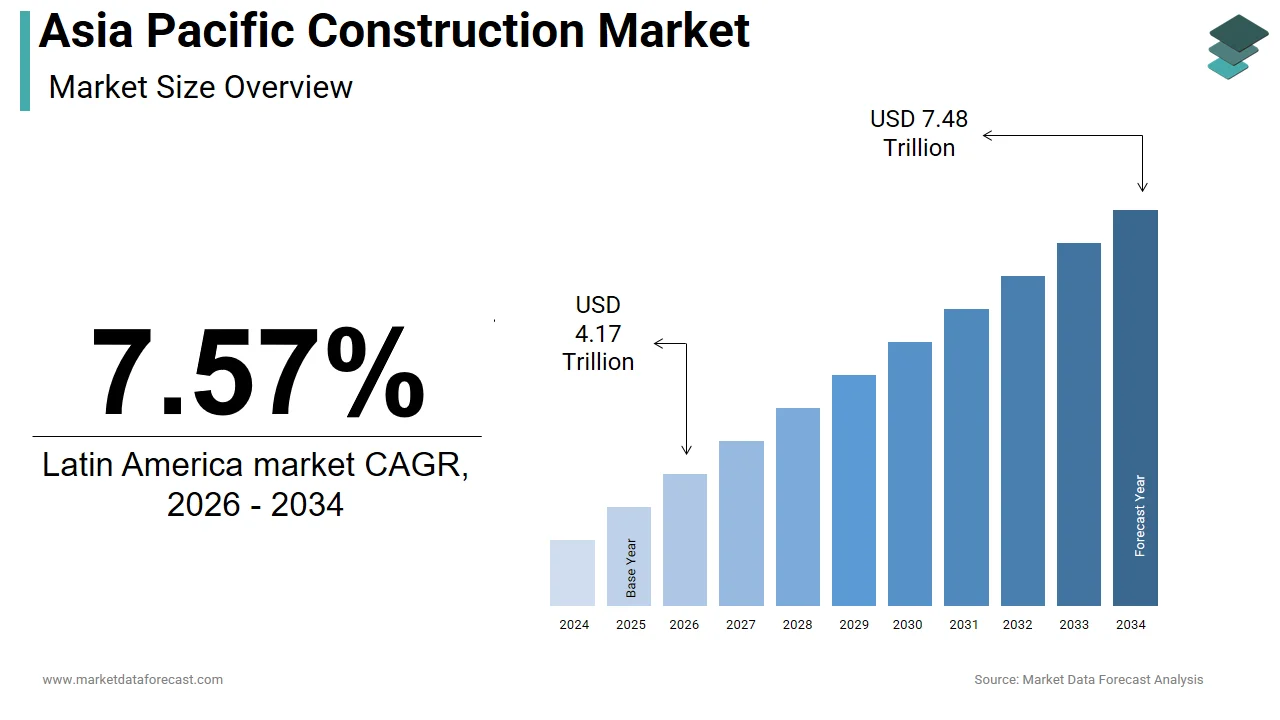
Market Size, 2025
$3.88 TnMarket Estimate, 2026
$4.17 TnMarket Forecast, 2034
$7.48 TnCAGR, 2026–2034
7.57%Asia Pacific Construction Market Size
The Asia Pacific construction market was valued at USD 3.88 trillion in 2025, is estimated to reach USD 4.17 trillion in 2026, and is projected to reach USD 7.48 trillion by 2034, growing at a CAGR of 7.57% from 2026 to 2034.
The construction of residential, commercial, industrial, and infrastructure development activities across countries are ranging from highly industrialized economies like Japan and South Korea to rapidly urbanizing nations such as India, Indonesia, and Vietnam. It is fundamentally shaped by demographic expansion, urban migration, and governmental prioritization of physical capital formation. As of 2023, over 56% of the region’s population resides in urban centers, a figure projected to rise to nearly 59% by 2030, according to the United Nations Department of Economic and Social Affairs. This urban shift directly fuels demand for housing, transportation networks, and civic infrastructure. Additionally, regulatory frameworks are increasingly emphasizing sustainable construction practices, with countries like Singapore mandating green building standards for all new developments. The construction sector in Asia Pacific also reflects deep regional disparities in technological adoption, labor productivity, and material sourcing.
MARKET DRIVERS
Rapid Urbanization and Housing Demand in Emerging Economies
The urbanization in major cities is expanding at unprecedented rates, which is attributed in fuelling the growth of the Asia Pacific construction market. As per the United Nations, the urban population in developing Asia is expected to grow by 1.1 billion between 2020 and 2050. In India alone, approximately 300 million people are anticipated to move into urban areas by 2050, requiring the construction of millions of new residential units. The Indian government’s Pradhan Mantri Awas Yojana has already facilitated the construction of over 28 million affordable homes since its inception in 2015, reflecting institutional recognition of the housing deficit. In the Philippines, urban population density in Metro Manila exceeds 47,000 people per square kilometer, one of the highest in the world, intensifying demand for vertical housing and mixed-use developments. This urban surge is further amplified by rising middle-class aspirations, with household spending on housing construction in Vietnam growing at an annual rate of 7.3% between 2018 and 2022, as reported by the General Statistics Office of Vietnam. These socio-demographic trends create sustained demand for construction services, particularly in low- and middle-income housing segments, which constitute over 60% of new residential projects in emerging Asia Pacific markets.
Government-Led Infrastructure Investment and Economic Stimulus
The public sector investment in infrastructure, with governments leveraging large-scale projects to stimulate economic activity and enhance connectivity, is accelerating the growth of the Asia Pacific construction market. Similarly, Japan’s Ministry of Land, Infrastructure, Transport and Tourism allocated ¥12.5 trillion (approximately $85 billion) for fiscal year 2023 to upgrade regional transport networks and disaster-resilient infrastructure. This state-driven momentum is mirrored in Southeast Asia, where Indonesia’s government has committed $450 billion for infrastructure through 2045, focusing on ports, railways, and the new capital city of Nusantara. Moreover, infrastructure spending is increasingly tied to post-pandemic recovery strategies; Australia’s 2023–2024 budget included $14.4 billion for road and rail projects to boost employment and regional connectivity. These initiatives not only generate immediate construction contracts but also catalyze private sector participation through public-private partnerships.
MARKET RESTRAINTS
Skilled Labor Shortages and Workforce Productivity Gaps
The persistent shortage of skilled labor and the associated decline in workforce productivity are hampering the growth of the Asia Pacific construction market. In Australia, the construction industry confronted a deficit of over 70,000 skilled workers in 2023, with the Australian Constructors Association warning of project delays and cost overruns. Japan is grappling with an aging population, and has seen its construction workforce shrink by 18% over the past decade, while the average age of site workers now exceeds 57 years, as reported by the Japan Federation of Construction Contractors. In India, although millions are employed in construction, less than 10% possess formal training, according to the National Skill Development Corporation, leading to inefficiencies and safety concerns. Furthermore, reliance on migrant labor in Gulf-influenced markets like Malaysia and Singapore introduces volatility, with policy changes affecting workforce availability.
Regulatory Fragmentation and Permitting Delays
The regulatory inconsistency and bureaucratic inefficiencies in developing economies, where approval processes lack standardization, are additionally declining the growth of the Asia Pacific construction market. Similarly, in the Philippines, the average time to secure building permits exceeds 150 days, with multiple agency clearances required from local and national bodies. This fragmentation increases project timelines and financing costs, discouraging both domestic and foreign investment. Environmental clearance delays are another bottleneck; in Australia, major infrastructure projects face an average approval lag of 2.3 years due to overlapping federal and state regulations, as reported by Infrastructure Australia. In China, while urban planning is centralized, local implementation varies, which leads to discrepancies in zoning enforcement and land use rights. These inconsistencies not only delay project commencement but also increase compliance risks and legal uncertainties.
MARKET OPPORTUNITIES
Adoption of Prefabrication and Modular Construction Techniques
The shift toward prefabricated and modular construction with the need for faster project delivery, improved quality control, and reduced on-site labor dependency is created new opportunities for the growth of the Asia Pacific construction market. Countries like Singapore and Japan have emerged as leaders in industrialized building systems, with Singapore mandating the use of Prefabricated Prefinished Volumetric Construction (PPVC) for over 70% of new public housing units since 2020, as stated by the Building and Construction Authority of Singapore. This approach has reduced construction timelines by up to 40% and minimized waste by 30%, according to the same authority. In Japan, over 15% of residential buildings are now constructed using modular techniques, supported by advanced robotics and standardized design protocols. The economic benefits are substantial: a McKinsey study found that modular construction can lower overall project costs by 15–20% when scaled effectively. In Australia, the modular construction market is projected to grow at a CAGR of 8.7% through 2030, fueled by demand for remote housing and healthcare facilities. Moreover, these methods align with sustainability goals, as off-site manufacturing reduces material waste and carbon emissions.
Green Building Certification and Energy-Efficient Construction
The growing institutionalization of green building standards is anticipated to grow in the coming years. As of 2023, over 12,000 buildings in the region were certified under green rating systems such as LEED, Green Mark, or CASBEE, with Singapore alone boasting more than 4,800 Green Mark-certified buildings, according to the Building and Construction Authority of Singapore. The city-state mandates energy efficiency benchmarks for all new constructions, requiring a minimum 30% reduction in energy use compared to standard buildings. In India, the Indian Green Building Council reports that over 7.5 billion square feet of green building space has been registered or certified, with a compound annual growth rate of 25% since 2018. Japan’s Ministry of Environment promotes the CASBEE certification system, under which 40% of new commercial buildings achieved a “Super Low Energy” rating by 2022. These standards are increasingly tied to financial incentives; in South Korea, green-certified buildings receive up to 20% higher floor area ratio allowances by encouraging developer participation. The economic case is compelling: the World Green Building Council estimates that energy-efficient buildings reduce operational costs by 20–30% over their lifecycle.
MARKET CHALLENGES
Volatility in Raw Material Supply and Pricing
The instability due to fluctuations in the availability and cost of essential building materials such as steel, cement, and timber is to hinder the growth of the Asia Pacific construction market in the coming years. In 2022, global steel prices surged by over 50% year-on-year, driven by energy crises and supply chain disruptions, significantly impacting procurement strategies across the region, as reported by the International Energy Agency. China, the world’s largest producer and consumer of steel, experienced domestic price volatility due to production cuts aimed at meeting carbon neutrality goals, affecting downstream markets in Southeast Asia. Cement prices in India rose by 22% between 2021 and 2023, according to the Indian Bureau of Mines, primarily due to increased coal costs and transportation bottlenecks. In Australia, timber prices spiked by 40% during the same period, influenced by reduced imports and domestic harvest restrictions. These fluctuations strain project budgets for small and medium-sized contractors with limited hedging capabilities.
Climate Resilience and Exposure to Natural Disasters
The geographical vulnerability to natural hazards shall pose a challenging factor for the growth of the Asia Pacific construction market. In 2023 alone, typhoons in the Philippines caused over $1.2 billion in damage to infrastructure, according to the National Disaster Risk Reduction and Management Council. Similarly, Bangladesh faces annual monsoon floods affecting 20–30% of its territory, undermining road and housing projects in low-lying areas. Coastal urbanization further amplifies risk; in Vietnam, 70% of economic activity is concentrated in flood-prone coastal zones, according to the Ministry of Natural Resources and Environment. Rising sea levels threaten major cities like Jakarta, where parts of the city are sinking at a rate of up to 25 centimeters per year, forcing the relocation of the national capital.
REPORT COVERAGE
| REPORT METRIC | DETAILS |
| Market Size Available | 2025 to 2034 |
| Base Year | 2025 |
| Forecast Period | 2026 to 2034 |
| Segments Covered | By Sector, Construction Type, Construction Method, Investment Source, and Region. |
| Various Analyses Covered | Global, Regional and Country-Level Analysis, Segment-Level Analysis, Drivers, Restraints, Opportunities, Challenges; PESTLE Analysis; Porter’s Five Forces Analysis, Competitive Landscape, Analyst Overview of Investment Opportunities |
| Countries Covered | India, China, Japan, South Korea, Australia, New Zealand, Thailand, Malaysia, Vietnam, Philippines, Indonesia, Singapore, Rest of APAC |
| Market Leaders Profiled | Larsen & Toubro (L&T), Megha Engineering & Infrastructures, Shapoorji Pallonji, Tata Projects, KEC International, and Others. |
SEGMENTAL ANALYSIS
By Sector Insights
The residential construction segment accounted in holding 38.2% of the Asia Pacific construction market share in 2024, with the region’s relentless demographic expansion and urban migration, which continue to strain housing capacity across both developed and emerging economies. The residential sector’s dominance is largely sustained by acute housing shortages in rapidly urbanizing nations, where population growth outpaces formal housing supply. In India, the housing backlog stood at 19.6 million units in 2023, with over 60% of this deficit concentrated in urban areas, according to the Ministry of Housing and Urban Affairs. Similarly, Indonesia faces a shortage of 13 million homes, as estimated by the Ministry of Public Works and Housing, driven by rising household formation and income mobility. Moreover, government-backed financing schemes such as Malaysia’s MyHome program and Thailand’s Baan Mankong initiative have expanded access to formal housing, stimulating construction activity.
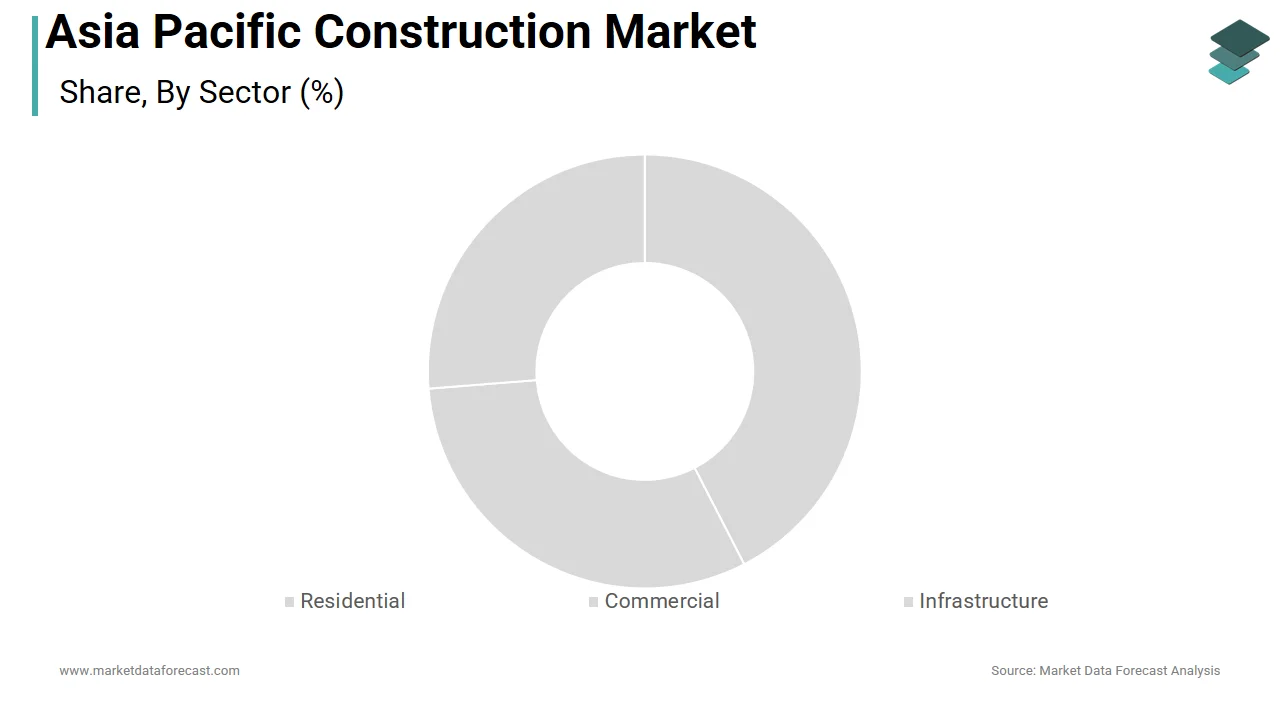
The infrastructure (transportation) construction segment is anticipated to expand with a CAGR of 7.8% during the forecast period, owing to the strategic national investments aimed at enhancing connectivity, reducing logistics costs, and supporting long-term economic integration. Transport infrastructure growth is being propelled by large-scale investments in rail and metro systems, particularly in response to urban congestion and the need for low-carbon mobility. This network supports regional integration and reduces intercity travel time, boosting economic productivity. India’s National Rail Plan envisions tripling its high-speed rail network by 2030, with 20,000 kilometers of dedicated freight and passenger corridors under development, as reported by the Ministry of Railways. Urban metro systems are also expanding rapidly: Southeast Asia’s metro rail network is expected to grow from 480 kilometers in 2020 to over 1,200 kilometers by 2030, as per the Asian Development Bank. These projects are not only capital-intensive but also catalyze ancillary construction in stations, depots, and associated real estate.
COUNTRY-LEVEL ANALYSIS
China Construction Market Insights
China was the top performer in the Asia Pacific construction market by accounting for 32.2% of the share in 2024. Despite recent slowdowns in the real estate sector, the country continues to lead in infrastructure investment, with the 14th Five-Year Plan allocating over $2.3 trillion for transportation, energy, and digital infrastructure through 2025, according to the National Development and Reform Commission. The government’s push for a "dual circulation" economic strategy emphasizes domestic connectivity, driving the expansion of high-speed rail, 5G networks, and smart cities. Urbanization remains a key lever, with 65.2% of the population living in cities as of 2023, up from 36% in 2000, as reported by China’s National Bureau of Statistics. This shift necessitates continuous housing and civic infrastructure development. Additionally, China leads globally in green building certification, with over 8,000 structures registered under the Three-Star Green Building standard.
India Construction Market Insights
India was ranked second in the Asia Pacific construction market by capturing 18.3% of the share in 2024. The National Infrastructure Pipeline (NIP) targets $1.4 trillion in capital expenditure between 2020 and 2025, with over 70% allocated to transportation, energy, and urban development, as detailed by the Ministry of Finance. Major projects like the Delhi-Mumbai Industrial Corridor and the Bharatmala highway network are accelerating connectivity and industrial clustering. Urbanization is progressing rapidly, with the urban population expected to reach 600 million by 2031, up from 480 million in 2021, as projected by the Ministry of Housing and Urban Affairs. This demographic shift is driving demand for affordable housing, commercial spaces, and public utilities. The Pradhan Mantri Awas Yojana has already facilitated the construction of over 28 million homes, significantly boosting residential activity.
Japan Construction Market Insights
Japan construction market is expected to grow with a prominent CAGR in the coming years. This demographic reality has shifted construction priorities toward adaptive reuse, seismic retrofitting, and elderly-friendly housing. However, major infrastructure investments continue, including the $85 billion Linear Chuo Shinkansen maglev project and the redevelopment of Tokyo’s waterfront for the 2025 International Expo. Japan also leads in prefabricated construction, with over 15% of residential buildings built using modular techniques, as reported by the Japan Housing Finance Agency. The country’s stringent building codes, shaped by frequent seismic activity, set global benchmarks for safety and durability. Moreover, the push for carbon neutrality by 2050 has accelerated the adoption of energy-efficient materials and smart building systems. As per the Architectural Institute of Japan, over 40% of new commercial buildings achieved a “Super Low Energy” rating in 2022.
Australia Construction Market Insights
Australia construction market growth is expected to grow significantly in the coming years as the country’s construction sector is characterized by high-value projects, strong regulatory standards, and increasing emphasis on sustainability and resilience. Urbanization is concentrated in major cities like Sydney, Melbourne, and Brisbane, where population growth is driving demand for housing and transport infrastructure.
COMPETITION OVERVIEW
The competition in the Asia Pacific construction market is intense and multifaceted, shaped by the convergence of state-backed enterprises, multinational contractors, and agile regional players. The market is characterized by a high degree of fragmentation in emerging economies, where numerous local firms compete for public tenders, while mature markets like Japan and Australia are dominated by a few technologically advanced conglomerates. Chinese state-owned enterprises wield significant influence through financing advantages and BRI-linked projects, enabling them to secure large infrastructure contracts across Southeast Asia. Indian and Japanese firms counter with superior project management and innovation in sustainable construction. Price competition is fierce, especially in residential and low-margin public works, but differentiation is increasingly achieved through digital capabilities, ESG compliance, and speed of delivery. Foreign contractors often form joint ventures with local partners to navigate regulatory complexities and gain market access. The rise of smart cities and green infrastructure has intensified competition for specialized expertise in BIM, modular construction, and energy-efficient design. As governments prioritize resilience and decarbonization, firms that integrate advanced technology and sustainability into their core operations are gaining a competitive edge.
KEY MARKET PLAYERS
Some of the noteworthy companies in the Asia Pacific construction market profiled in this report are
- Larsen & Toubro (L&T)
- Megha Engineering & Infrastructures
- Shapoorji Pallonji
- Tata Projects
- KEC International
TOP LEADING PLAYERS IN THE MARKET
- Larsen & Toubro is a dominant force in the Asia Pacific construction landscape, which is renowned for its execution of large-scale infrastructure and industrial projects. The company has been instrumental in delivering transportation, power, and urban development projects across India and select Southeast Asian markets. In recent years, L&T has intensified its focus on smart cities, metro rail systems, and renewable energy infrastructure, aligning with national development agendas. It has expanded its use of digital engineering, including Building Information Modeling (BIM) and drone-based site monitoring, to enhance project precision. In 2023, L&T secured multiple high-value contracts for India’s coastal defense infrastructure and offshore facilities, reinforcing its strategic sector presence. The company has also invested in modular construction and green building technologies, establishing sustainability as a core operational pillar.
- Shimizu Corporation is a leading Japanese construction enterprise with a significant footprint across the Asia Pacific, known for its innovation in sustainable and resilient infrastructure. The company has delivered landmark projects in transportation, high-rise construction, and underground development in Japan, Singapore, and Australia. Shimizu has pioneered the use of robotic construction systems and carbon-negative building materials, aligning with Japan’s 2050 net-zero goals. The company has also advanced its presence in Southeast Asia through partnerships on smart city developments in Vietnam and Thailand. Shimizu’s investment in digital twin technology and AI-driven project planning has enhanced efficiency and risk mitigation. It recently completed the Chuo Shinkansen tunneling phase using automated excavation systems, setting new benchmarks in precision engineering.
- China State Construction Engineering Corporation (CSCEC) is one of the most influential construction entities in the Asia Pacific, executing a vast portfolio of residential, commercial, and infrastructure developments. The company plays a central role in China’s urbanization and Belt and Road Initiative (BRI), delivering projects in transportation, airports, and smart cities across Southeast Asia and Oceania. CSCEC has been pivotal in constructing high-speed rail stations, industrial parks, and government complexes in countries like Malaysia, Indonesia, and the Philippines. The company has also advanced prefabricated building techniques, reducing construction timelines by up to 40% in urban housing projects. CSCEC has expanded its green building initiatives by achieving thousands of certifications under China’s Three-Star and international standards.
TOP STRATEGIES USED BY KEY MARKET PARTICIPANTS
Key players in the Asia Pacific construction market are deploying advanced digitalization, strategic partnerships, vertical integration, sustainability integration, and geographic expansion to strengthen competitiveness. Companies are adopting Building Information Modeling (BIM), artificial intelligence, and drone technology to enhance precision and reduce project timelines. Strategic joint ventures with local firms enable smoother regulatory navigation and faster project execution in emerging markets. Firms are vertically integrating by acquiring material suppliers and design consultancies to control costs and ensure supply chain resilience. Sustainability has become a core strategy, with leaders investing in green building certifications, carbon-neutral materials, and energy-efficient designs to comply with tightening regulations. Geographic diversification is also important, as major contractors expand into high-growth Southeast Asian nations to capitalize on infrastructure deficits. Additionally, companies are investing in modular and off-site construction to address labor shortages and improve quality control. Workforce upskilling through digital training platforms ensures readiness for smart construction methods. Public-private partnerships are increasingly pursued to secure large-scale government projects. These strategies collectively enable firms to enhance operational efficiency, mitigate risks, and maintain leadership in a highly competitive and evolving regional market.
RECENT MARKET DEVELOPMENTS
- In March 2023, China State Construction Engineering Corporation launched an AI-powered intelligent construction management platform across 150 major projects in China and Southeast Asia, enhancing real-time monitoring, safety compliance, and scheduling efficiency to strengthen operational control and project delivery standards.
- In July 2023, Larsen & Toubro signed a strategic partnership with Singapore’s Surbana Jurong to jointly develop smart urban infrastructure projects in India and Indonesia, combining engineering expertise with urban planning capabilities to expand its footprint in integrated township and sustainable city developments.
- In October 2023, Shimizu Corporation inaugurated a new regional innovation hub in Bangkok focused on developing carbon-negative building materials and robotic construction systems for deployment across Thailand, Vietnam, and Malaysia, which is reinforcing its leadership in sustainable and technology-driven construction.
- In January 2024, Lendlease, an Australian construction giant, completed the acquisition of a 51% stake in a Vietnamese real estate development firm to accelerate its entry into Ho Chi Minh City’s high-rise residential and mixed-use market by leveraging local market knowledge and regulatory experience.
- In May 2024, Hyundai Engineering & Construction formed a joint venture with an Indonesian state-owned enterprise to bid on infrastructure projects related to the new capital city of Nusantara by combining Korean technological expertise with local execution capacity to secure large-scale government contracts.
MARKET SEGMENTATION
This Asia Pacific construction market research report is segmented and sub-segmented into the following categories.
By Sector
- Residential
- Apartments / Condominiums
- Villas / Landed Houses
- Commercial
- Office
- Retail
- Industrial and Logistics
- Others
- Infrastructure
- Transportation Infrastructure (Roadways, Railways, Airways, etc.)
- Energy & Utilities
- Others
By Construction Type
- New Construction
- Renovation
By Construction Method
- Conventional On-Site
- Modern Methods of Construction (Prefabricated, Modular, etc.)
By Investment Source
- Public
- Private
By Country
- India
- China
- Japan
- South Korea
- Rest Of APAC