- Product Description Description
- Table of Contents TOC
- List of Table & Figure LOT
- Get Free Sample PDF Sample PDF
Market Size, 2025
$41.73 BnMarket Estimate, 2026
$52.81 BnMarket Forecast, 2034
$347.14 BnCAGR, 2026–2034
26.54%Global Consumer Telematics Market Size, Growth, Trends & Forecast (2026–2034)
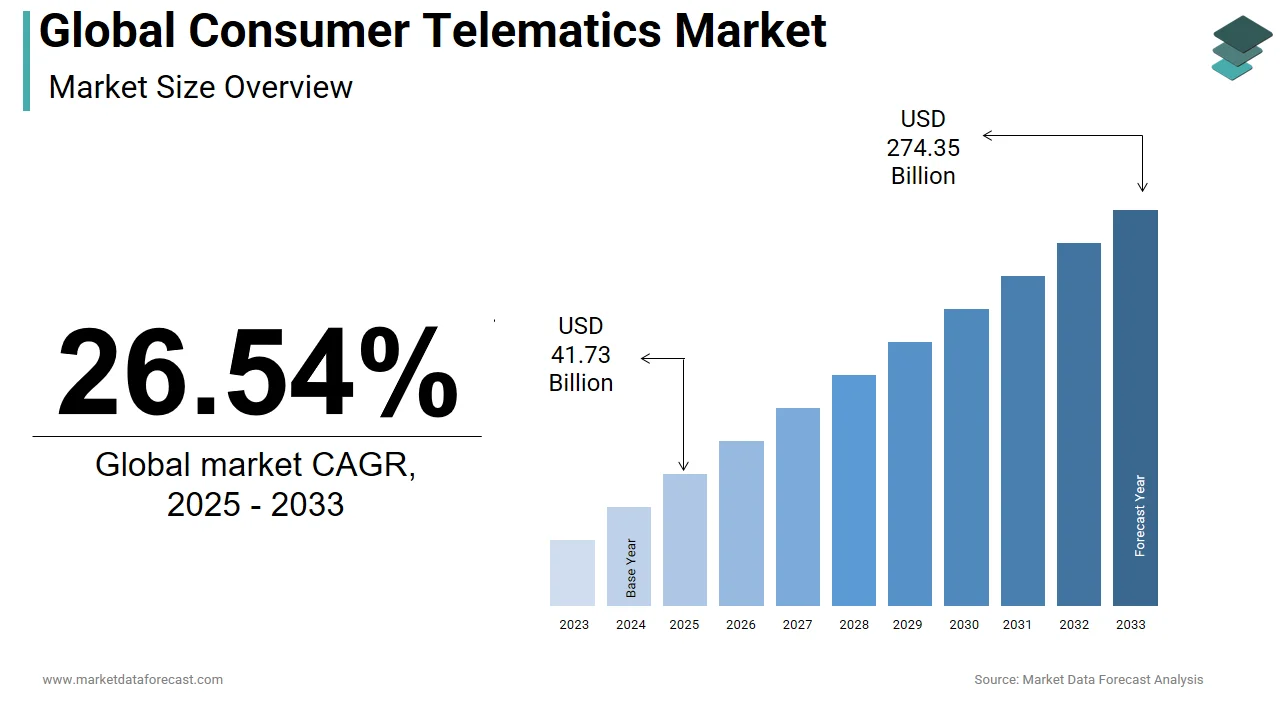
The global consumer telematics market size was valued at USD 41.73 billion in 2025, is anticipated to reach USD 52.81 billion in 2026, and is projected to scale up to USD 347.14 billion by 2034, registering a compound annual growth rate (CAGR) of 26.54% during the forecast period from 2026 to 2034. Driven by increasing demand for big data analytics, widespread smartphone penetration, lower connectivity costs, and favorable government regulations regarding vehicle safety and tracking, the consumer telematics industry continues to expand rapidly worldwide.
Key Executive Metrics (At-a-Glance)
- 2025 Base Valuation: USD 41.73 Billion
- 2026 Current Valuation: USD 52.81 Billion
- 2034 Forecast Valuation: USD 347.14 Billion
- Compound Annual Growth Rate (CAGR): 26.54% (2026–2034)
- Dominant Product Type: Embedded Systems (holding the major market share due to seamless factory-installed integration and reliable real-time connectivity)
- Dominant Application Segment: Navigation & Infotainment (supported by real-time GPS services, traffic info, and personalized on-board consumer experiences)
- Fastest-Growing Application Segment: Fleet Management & Insurance Telematics (propelled by rising safety demands, driver monitoring, and usage-based insurance models)
- Dominant Region: North America (leading market share backed by advanced automotive infrastructure and high telematics adoption rates)
Core Market Drivers
- Smartphone & High-Speed Internet Penetration: Surging availability of advanced communication networks and mobile device integration providing superior driving experiences.
- Regulatory Mandates for Safety: Government-backed eCall and vehicle tracking regulations in regions like Brazil and China reducing emergency response times and boosting safety compliance.
- Cloud & Big Data Analytics: Proliferation of cloud-based services and real-time data processing enabling personalized vehicle diagnostics and automated infotainment control.
Primary Market Restraints & Challenges
- Cybersecurity & High Costs: Increasing hacking and privacy concerns, expensive hardware equipment, and poor internet connectivity in developing economies dampening market growth.
Global Consumer Telematics Market Segmentation Breakdown
| Segment Category | Leading Sub-Segment (2025 Base) | Fastest-Growing Sub-Segment (2026–2034) |
|---|---|---|
| By Product Type | Embedded Systems (dominant volume leader integrated directly during automotive manufacturing) | Integrated Smartphones (driven by cost-effective app-based connectivity and brought-in-device solutions) |
| By Application | Navigation & Infotainment (holding the major revenue share through mapping and concierge services) | Insurance Telematics (fastest-growing category fueled by behavioral tracking and custom premium policies) |
| By Region | North America (leading regional market share backed by high-tech connected vehicle ecosystems) | Asia-Pacific (fastest-growing regional market driven by rising population, disposable incomes, and vehicle sales) |
Major Industry Players Profiled
Key enterprises shaping the competitive global consumer telematics market include TE Connectivity, STMicroelectronics, Robert Bosch GmbH, Continental AG, Delphi Technologies, Analog Devices Inc., NXP Semiconductors, Sensata Technologies Inc., Infineon Technologies AG, and Denso Corporation.
 Download Free Sample Report
Global Consumer Telematics Market Size
The global consumer telematics market was valued at USD 41.73 billion in 2025. The global market is predicted to reach USD 52.81 billion in 2026 and USD 347.14 billion in 2034, growing at a CAGR of 26.54 % from 2026 to 2034.
Telematics is a device used to transfer large amounts of information from one vehicle to the infrastructure of another. It monitors the vehicle using a GPS that records and maps the exact location of the vehicle, which also provides information about the speed. Telematics can also help provide information on vehicle management, such as the maintenance schedule, fuel monitoring and seat belt monitoring. Consumer telematics is segmented according to the fleet management system, improves driver safety and increases efficiency by providing delays on the road that help drivers redirect and save time and deliver products on time, which will also increase job satisfaction by better controlling daily routes, thereby reducing operating costs. The sensors send an alert message to the driver if there is a problem in the engine and other diagnostic issues. Consumer telematics is a technology and communication service that allows large amounts of data to transfer in and out of passenger vehicles in real time. This provides consumers with on-board services, global positioning system (GPS) navigation, traffic information, local search (for example, at gas stations or restaurants) and concierge services.
The global consumer telematics market is expected to grow over the forecast period due to the increasing demand for big data analytics and related services. Communication technologies and services that allow the transfer of large volumes of data in passenger vehicles in real time are called consumer telematics. Suppliers focus on consumer safety through superior vehicle tracking products and services.
MARKET DRIVERS
The global consumer telematics market is stimulated by the significant penetration of smartphones, the growing demand for a superior driving experience, lower connectivity costs, high-speed Internet technologies and favorable government regulations.
For example, in some regions such as Brazil and China, government legislation requires everyone to adopt telematics in vehicles, given the growing concern related to vehicle tracking and safety, which stimulates demand for telematic solutions for consumers in these regions. The increasing demand for Big Data analysis and related services is also an essential factor that influences market growth. The proliferation of cloud-based services to provide a personalized experience to the end-user is even foreseen to have a positive impact on market demand.
Fleet management evolves its advantages from technological progress. The next addition to fleet management includes aviation safety (OTA) and vehicle control, called drones. To increase truck safety, many countries have required eCall regulations which aim to set up a device in the vehicle that will automatically dial the safety number in the event of a traffic accident and will be coordinated with the services of local emergency. This eCall will reduce emergency response times by 40% in urban areas and by 50% in rural areas.
The large truck mirrors have been replaced by a system of cameras and digital displays that will improve driver safety. This system includes several individually wired cameras which protect against malfunctions. The images appear on digital screens mounted on the interior pillars on both sides of the windshield and in the center of where a mirror is usually located, as well as on the dashboard. The camera lenses are heated to protect against ice and frost. They also have a special coating that resists moisture. The new launch of the voice assistant allows users to control the temperature of the vehicle, and analyze the driver's needs according to the route and behavior to automatically exploit the music and navigation in the vehicle.
MARKET RESTRAINTS
The increase in piracy activity, the high cost of consumer telematics equipment and poor Internet connectivity in developing economies is expected to diminish market growth. The field of consumer telematics has subtly changed the nature of various industries. Car maintenance and extensive data enabled by telematics have improved customer service offerings. Telematics is likely to play a vital role in the future of the connected car market, as it will help the car manufacturer generate revenue over the life of the vehicle rather than at the time of sale.
REPORT COVERAGE
| REPORT METRIC | DETAILS |
| Market Size Available | 2025 to 2034 |
| Base Year | 2025 |
| Forecast Period | 2026 to 2034 |
| CAGR | 26.54% |
| Segments Covered | By Product Type, Application, End User, Distribution Channel, and Region |
|
Various Analyses Covered | Global, Regional & Country Level Analysis, Segment-Level Analysis, DROC, PESTLE Analysis, Porter’s Five Forces Analysis, Competitive Landscape, Analyst Overview on Investment Opportunities |
| Regions Covered | North America, Europe, APAC, Latin America, Middle East & Africa |
|
Market Leaders Profiled | TE Connectivity, STMicroelectronics, Littelfuse Inc., Robert Bosch GmbH, Continental AG, Delphi Technologies, Analog Devices Inc., NXP Semiconductors, Sensata Technologies Inc., Infineon Technologies AG, Denso Corporation, Autoliv Inc., Texas Instruments Incorporated, Hitachi Automotive Systems Americas Inc., Maxim Integrated, GMS Instruments BV, Broadcom, Piher Sensors & Controls, Quanergy Systems Inc., Innoviz Technologies LTD, Velodyne Lidar Inc. and Elmos Semiconductor AG, among others. |
REGIONAL ANALYSIS
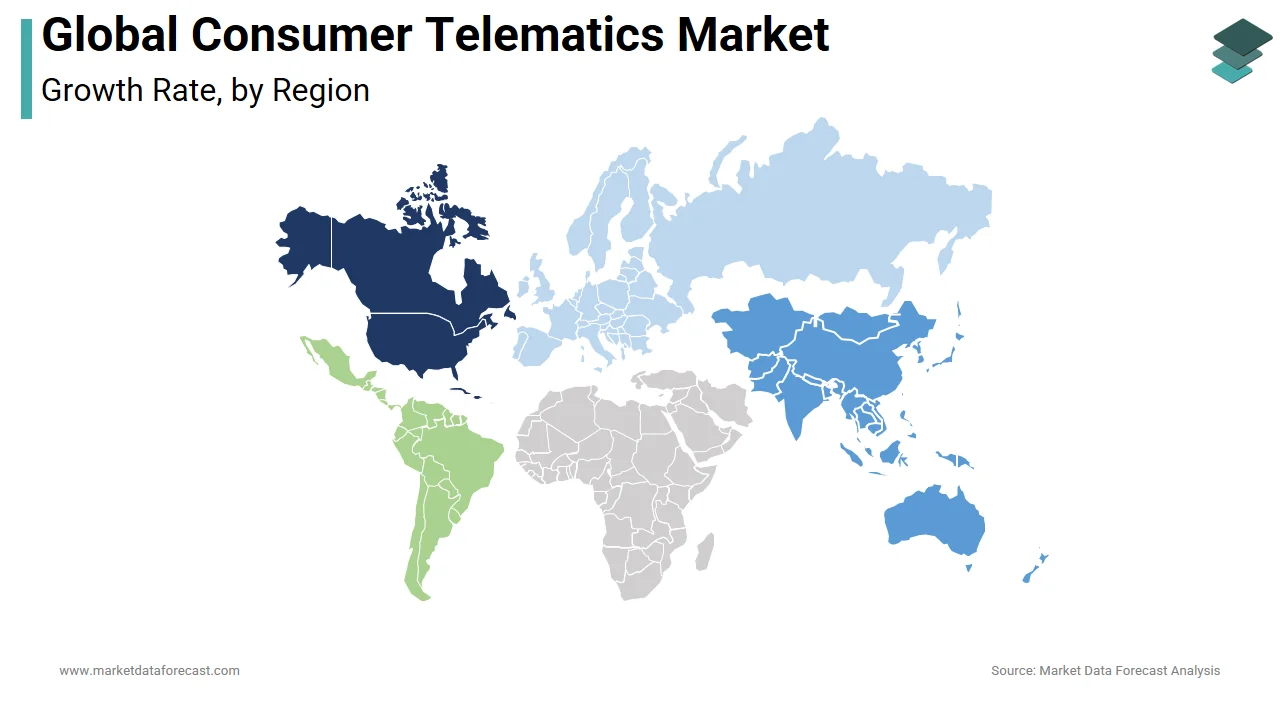
In the coming years, the Asia-Pacific is foreseen to become a leading automotive market in the future, which will boost the consumer telematics market in the region. The increase in sales is primarily due to the rise in population and the increase in disposable income. LAMEA consumer telematics market is also predicted to grow at a prominent pace, due to increasing government regulations for vehicles, as well as driver safety.
KEY PARTICIPANTS IN THE MARKET
Companies such as STMicroelectronics, Littelfuse Inc., Robert Bosch GmbH, Continental AG, Delphi Technologies, Analog Devices Inc., NXP Semiconductors, Sensata Technologies Inc., Infineon Technologies AG, Denso Corporation, Autoliv Inc., Texas Instruments Incorporated, Hitachi Automotive Systems Americas Inc., Maxim Integrated, GMS Instruments BV and Broadcom are playing a key role in the consumer telematics market.
MARKET SEGMENTATION
This report on the global consumer telematics market has been segmented and sub-segmented into the following categories.
By Product Type
-
Embedded Systems
-
Tethered Systems
-
Integrated Smartphones
By Application
-
Fleet Management
-
Vehicle Tracking & Monitoring
-
Emergency Calling
-
Navigation & Infotainment
-
Insurance Telematics
By End User
-
Automotive OEMs
-
Aftermarket
-
Fleet Operators
By Distribution Channel
-
Direct Sales
-
Distributors
-
Online Platforms
By Region
-
North America
-
The United States
-
Canada
-
Rest of North America
-
-
Europe
-
The United Kingdom
-
Spain
-
Germany
-
Italy
-
France
-
Rest of Europe
-
-
The Asia Pacific
-
India
-
Japan
-
China
-
Australia
-
Singapore
-
Malaysia
-
South Korea
-
New Zealand
-
Southeast Asia
-
-
Latin America
-
Brazil
-
Argentina
-
Mexico
-
Rest of LATAM
-
-
The Middle East and Africa
-
Saudi Arabia
-
UAE
-
Lebanon
-
Jordan
-
Cyprus
-