- Product Description Description
- Table of Contents TOC
- List of Table & Figure LOT
- Get Free Sample PDF Sample PDF
Market Size, 2025
$18.76 BnMarket Estimate, 2026
$19.87 BnMarket Forecast, 2034
$31.44 BnCAGR, 2026–2034
5.9%Global Copper Clad Laminates (CCL) Market Summary
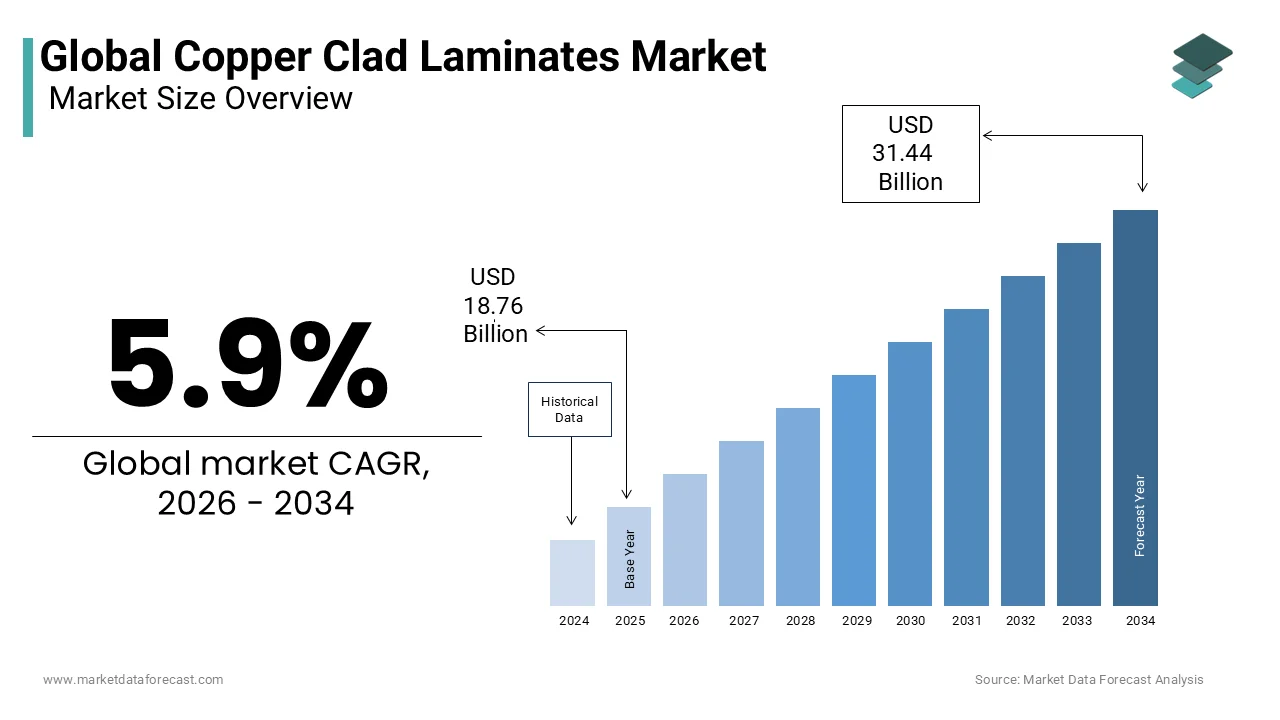
The global copper clad laminates market was valued at USD 18.76 billion in 2025, is estimated to reach USD 19.87 billion in 2026, and is projected to grow to USD 31.44 billion by 2034, registering a CAGR of 5.9% from 2026 to 2034. Growth is being driven by 5G infrastructure expansion, electric vehicle electronics integration, AI-driven data center investments, and advanced semiconductor packaging evolution.
Copper-clad laminates (CCLs) remain the foundational material for printed circuit boards (PCBs), combining dielectric substrates with copper foil to deliver electrical conductivity, signal integrity, and mechanical stability across telecom, automotive, computing, aerospace, and industrial systems.
Key Market Highlights
- 2025 Market Size: USD 18.76 Billion
- 2026 Estimate: USD 19.87 Billion
- 2034 Forecast: USD 31.44 Billion
- CAGR (2026–2034): 5.9%
- Largest Application: Communication Systems (32.7% share in 2025)
- Fastest-Growing Application: Vehicle Electronics (9.8% CAGR)
- Dominant Region: Asia-Pacific (62.6% share in 2025)
- Fastest-Growing Product Type: Flexible CCL (7.6% CAGR)
Quick Growth Drivers
- Global rollout of 5G base stations and millimeter-wave networks
- Rapid electrification of vehicles and ADAS integration
- AI infrastructure and hyperscale data center expansion
- Advanced semiconductor packaging (FOWLP, SiP, 2.5D/3D ICs)
- High-speed computing requiring ultra-low-loss laminates
Principal Restraints
- Copper and epoxy resin price volatility
- Environmental regulations restricting brominated flame retardants
- High reformulation costs for halogen-free materials
- Margin compression in commodity FR-4 segments
High-Value Opportunities
- Ultra-low-loss CCLs for AI and high-speed interconnects (112 Gbps+)
- Thin (<50µm) laminates for advanced packaging substrates
- Metal-core laminates for EV power modules
- RF-grade PTFE and hydrocarbon ceramic laminates for mmWave
- Halogen-free, high-Tg laminates aligned with global sustainability mandates
Key Market Challenges
- High-frequency material complexity (Dk/Df control at >30 GHz)
- Long product validation cycles (18–24 months)
- CTE mismatch and thermal reliability issues
- Geopolitical fragmentation affecting PCB and copper supply chains
- Dependency on Asia for high-end substrate manufacturing
Fastest-Growing Segments
By Application
- Vehicle Electronics: 9.8% CAGR — EV inverters, BMS, ADAS modules
- Communication Systems: Largest segment (32.7% share) driven by 5G infrastructure
By Product Type
- Rigid CCL: Largest segment — industrial, telecom, computing backplanes
- Flexible CCL: 7.6% CAGR — wearables, foldables, automotive dashboards
Regional Leadership & Dynamics
Asia-Pacific (62.6% Share – 2025 Leader)
Asia-Pacific dominates due to its position as the global electronics manufacturing hub. China leads in PCB production, while Taiwan, Japan, and South Korea specialize in HDI and IC substrates. Regional semiconductor expansion and local fab investments are accelerating specialty laminate demand.
North America (14.5% Share)
Focuses on high-value defense, aerospace, and AI computing applications. Strong demand for ultra-low-loss laminates in data centers and radar systems.
Europe
Automotive electronics and renewable energy systems drive demand. EV transition and CO₂ reduction mandates are accelerating high-power laminate adoption.
Latin America
Emerging assembly hub supported by nearshoring trends. Mexico’s automotive electronics manufacturing is a key growth node.
Middle East & Africa
Digital infrastructure investments in GCC countries and 5G rollouts are creating incremental demand, though local fabrication remains limited.
What Wins Commercially (Competitive Edge)
- Advanced low-loss dielectric materials (Dk <3.5, Df <0.005)
- Strong integration with PCB fabricators and semiconductor firms
- Vertical integration into copper foil and resin supply
- Halogen-free, environmentally compliant product lines
- Regionalized manufacturing to reduce geopolitical risk
Top Strategic Ask for Executives
- Invest aggressively in ultra-low-loss and AI-grade laminate R&D
- Diversify copper and resin sourcing strategies
- Expand Southeast Asia manufacturing footprint
- Strengthen OEM co-development partnerships
- Accelerate halogen-free product transition for regulatory compliance
Leading Players
Some of the companies that are playing a dominating role in the global copper clad laminates market include:
- Kingboard Laminates Holdings Ltd.
- Nan Ya Plastics Corporation
- Panasonic Corporation
- ITEQ Corporation
- Shengyi Technology Co., Ltd.
- Isola Group
- Rogers Corporation
- Doosan Corporation
Global Copper Clad Laminates Market Size
The global copper clad laminates market was valued at USD 18.76 billion in 2025, is estimated to reach USD 19.87 billion in 2026, and is projected to reach USD 31.44 billion by 2034, growing at a CAGR of 5.9% from 2026 to 2034.
Copper-clad laminates (CCLs) serve as the foundational substrate material in printed circuit boards (PCBs), integrating a dielectric layer bonded with copper foil to enable electrical conductivity and structural integrity in electronic devices. The demand for advanced CCLs has intensified due to the growing complexity of electronic systems in fields like telecommunications, automotive electronics, and high-performance computing. The evolution of 5G infrastructure, together with the proliferation of compact high-speed devices, has redefined material requirements, prompting manufacturers to pursue resin innovations like polyphenylene ether (PPE) and hydrocarbon-based ceramics. According to the study, a portion of multilayer PCBs in base station equipment now require mid-to-high Dk/Df performance CCLs to maintain signal integrity.
MARKET DRIVERS
Expansion of 5G Telecommunications Infrastructure
The global rollout of 5G networks is accelerating the growth of the copper-clad laminates market. It is essential for base stations, small cells, and millimeter-wave communication systems. These laminates must support signal frequencies exceeding 28 GHz while minimizing dielectric loss and thermal deformation. As per the Global System for Mobile Communications Association, by the end of 2023, over 230 5G networks were commercially operational worldwide, with more than 1.4 billion 5G connections established. China alone deployed over 2.2 million 5G base stations by mid-2023, each requiring high-performance CCLs such as PTFE or ceramic-filled hydrocarbon types. The transition from FR-4 to specialized laminates like Rogers RO4000 or Isola I-Tera is accelerating, driven by the need for materials with stable dielectric constants below 3.5 and dissipation factors under 0.005. This technological shift increases the average material value per PCB, which strengthens demand for advanced CCLs in radio frequency (RF) and microwave applications.
Rising Integration of Electronics in Automotive Systems
Modern vehicles rely on electronic control units (ECUs) to manage functions from driver assistance to powertrain operations, which boosts the expansion of the copper-clad laminates market. They require reliable and thermally robust copper-clad laminates. The shift toward electric vehicles (EVs) amplifies this demand, as power modules in inverters and onboard chargers require metal-core CCLs capable of dissipating heat up to 150°C. According to the research, global EV sales surpassed millions of units, a figure projected to surge annually by 2030. Each EV contains more PCB area than internal combustion engine vehicles, much of it relying on high-thermal-conductivity CCLs. Manufacturers like Panasonic and Sumitomo Electric have responded by scaling production of aluminum-backed and ceramic-filled laminates.
MARKET RESTRAINTS
Volatility in Copper and Epoxy Resin Prices
Price variations for electrolytic copper and specialty resins heavily influence the cost structure, restraining the expansion of the copper-clad laminates market. Copper, which accounts for a portion of CCL production cost, experienced price swings, as per research. Concurrently, epoxy resin prices surged due to supply chain disruptions and energy cost spikes in Europe, increasing input costs, according to a study. These volatilities compress manufacturer margins, especially for mid-tier CCL producers with limited vertical integration. Long-term supply contracts are difficult to maintain under such instability, which leads to delayed project rollouts in consumer electronics and industrial automation sectors. This economic uncertainty discourages investment in capacity expansion and R&D for next-generation materials.
Stringent Environmental Regulations on Halogenated Materials
The use of brominated flame retardants (BFRs) in conventional FR-4 CCLs is constraining the growth of the copper-clad laminates market. For instance, the European Union’s Restriction of Hazardous Substances (RoHS) and the Stockholm Convention on Persistent Organic Pollutants. As per the study, many countries have ratified the Convention, enforcing global phase-outs of polybrominated diphenyl ethers (PBDEs). This regulatory burden compels CCL manufacturers to reformulate resins using halogen-free alternatives like phosphorus-based or nitrogen-enriched compounds, which often entail higher production costs and complex curing processes. Transitioning to compliant materials requires significant capital investment in process reengineering and quality validation, which slows innovation cycles and increases time-to-market for new laminate grades.
MARKET OPPORTUNITIES
Growth in High-Performance Computing and AI Hardware
Artificial intelligence and data center expansion are creating new opportunities for the growth of the copper-clad laminates market. It is driving unprecedented demand for ultra-high-speed PCBs utilizing advanced copper-clad laminates with ultra-low dielectric loss. AI training clusters, such as those based on NVIDIA’s H100 GPUs, require interconnects operating at 112 Gbps, necessitating laminates with dissipation factors below 0.002. According to research, global data center capital expenditure surged, with hyperscalers like Google and Microsoft increasing investments in AI-optimized infrastructure. This trend drives demand for ultra-low-loss CCLs such as Mitsubishi Gas Chemical’s MCL-E-775XF and Isola’s Astra MT70, which support 5Gbps/mm signal density. Moreover, the shift toward 2.5D and 3D packaging in AI chips demands thin, dimensionally stable laminates with a coefficient of thermal expansion (CTE) matching silicon.
Adoption of Advanced Packaging in the Semiconductor Industry
The semiconductor industry’s transition to fan-out wafer-level packaging (FOWLP) and system-in-package (SiP) technologies is setting new opportunities for the growth of the copper-clad laminates market. It is also creating new applications for thin, high-reliability copper-clad laminates. These packaging methods require build-up films and modified epoxy substrates capable of withstanding multiple lamination cycles and fine-pitch circuitry below 10 microns. According to a study, the advanced packaging business expanded and is expected to grow in the coming years, driven by mobile, AI, and IoT applications. This expansion increases demand for ultra-thin CCLs (below 50 microns) with low warpage and high glass transition temperatures. Companies are investing in photosensitive dielectric films and carrier-less processing technologies to meet these demands. CCL manufacturers are positioned to enter higher-value segments previously dominated by semiconductor materials suppliers as traditional PCBs evolve into integrated interposers and redistribution layers.
MARKET CHALLENGES
Technological Complexity in High-Frequency Material Development
Designing copper-clad laminates for millimeter-wave applications involves overcoming intrinsic material trade-offs between dielectric constant stability, thermal conductivity, and mechanical durability. Achieving consistent performance above 30 GHz requires precise control over filler dispersion in resin matrices, often involving ceramic or silica particles at nanoscale levels. According to a study, even a small variation in filler distribution can alter the Dk value, leading to signal reflection and impedance mismatch in 5G beamforming arrays. Furthermore, laminates must maintain performance across temperature ranges without delamination, a challenge exacerbated by coefficient of thermal expansion (CTE) mismatches between copper and dielectric layers. These complexities extend product development cycles to 18–24 months and require substantial investment in analytical tools like time-domain reflectometry and vector network analysis, which limits access for smaller manufacturers.
Geopolitical Fragmentation in Supply Chains
Increasing supply chain fragmentation due to geopolitical tensions is impeding the expansion of the copper-clad laminates market. This is particularly between the U.S., China, and Taiwan, where a portion of global PCB manufacturing is concentrated. Export controls on semiconductor-related materials, such as those imposed by the U.S. Department of Commerce in October 2022, indirectly affect CCL shipments requiring advanced technical parameters. According to the research, a portion of high-frequency CCLs used in U.S. defense and aerospace systems is sourced from Asia, creating vulnerabilities in dual-use technology supply chains. Besides, China’s dominance in rare earth processing and copper refining, accounting for a portion of global refined copper output, as per the study, creates dependency risks. Companies are forced to pursue dual-sourcing strategies and regionalize production. These actions increase operational complexity and capital expenditure.
REPORT COVERAGE
| REPORT METRIC | DETAILS |
| Market Size Available | 2025 to 2034 |
| Base Year | 2025 |
| Forecast Period | 2026 to 2034 |
| Segments Covered | By Application, Product Type, and Region. |
| Various Analyses Covered | Global, Regional and Country-Level Analysis, Segment-Level Analysis, Drivers, Restraints, Opportunities, Challenges; PESTLE Analysis; Porter’s Five Forces Analysis, Competitive Landscape, Analyst Overview of Investment Opportunities |
| Countries Covered | Asia Pacific North America Europe Latin America Middle East & Africa |
| Market Leaders Profiled | Kingboard Laminates Holdings Ltd., Global Growth Insights, daedal-research.com, Nan Ya Plastics Corporation, Panasonic Corporation, ITEQ Corporation, Shengyi Technology Co., Ltd., Isola Group, Rogers Corporation, Doosan Corporation, Sytech Technology Co., Ltd. |
SEGMENTAL ANALYSIS
By Application Insights
The communication systems segment dominated the copper-clad laminates market by accounting for 32.7% of the market share in 2025. The exponential expansion of high-speed data networks and 5G infrastructure deployment worldwide is majorly contributing to the growth of the communication systems segment. The rollout of 5G base stations, which require advanced high-frequency CCL materials like modified epoxy and PTFE-based laminates, is also a driver for the communication systems segment. The Ericsson Mobility Report of November 2023 projected 5G subscriptions to total 1.6 billion by the end of 2023. The June 2023 report projected 1.5 billion 5G subscriptions by the end of 2023. Furthermore, the demand for high-thermal-conductivity and low-loss CCLs intensifies because of the proliferation of data centers, which is driven by cloud computing and AI workloads.
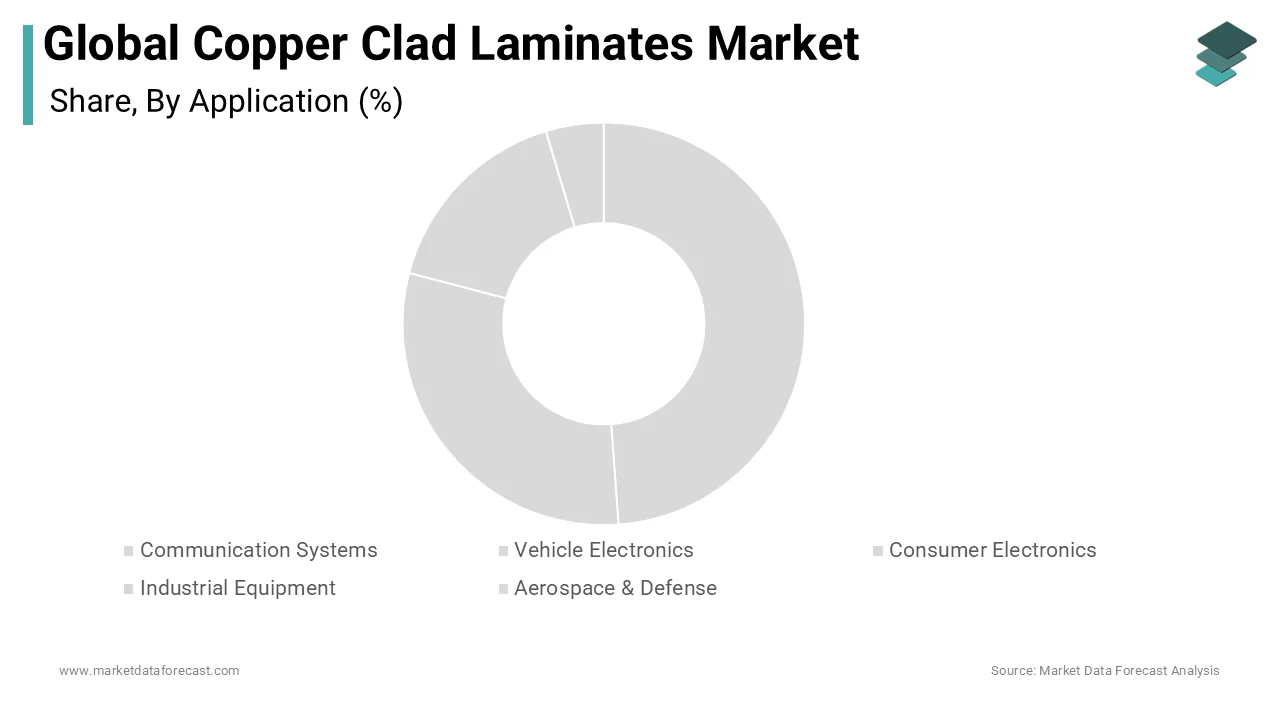
The vehicle electronics segment is expected to exhibit a noteworthy CAGR of 9.8% between 2025 and 2033 due to the global shift toward electric vehicles (EVs) and advanced driver-assistance systems (ADAS). According to a study, millions of EVs were sold, a year-on-year increase, with EVs requiring more PCBs than internal combustion engine vehicles. Power electronics such as inverters, onboard chargers, and battery management systems rely heavily on metal-core and high-Tg CCLs for thermal stability. These systems, radar, LiDAR, and camera modules, depend on high-frequency flexible and rigid-flex CCLs. Moreover, the rise of vehicle-to-everything (V2X) communication infrastructure increases demand for RF-grade laminates, which further boosts CCL usage in automotive applications.
By Product Type Insights
In 2025, the rigid copper clad laminates segment led the copper clad luminates market by occupying a substantial share in the global market. The entrenched reliance on rigid PCBs across industrial, computing, and telecommunications infrastructure has largely contributed to the domination of the rigid copper-clad laminates segment in the global market. The widespread use of FR-4 epoxy-based rigid laminates in multilayer boards for servers, routers, and power supplies emphasizes their indispensability. Furthermore, advancements in high-Tg and halogen-free rigid laminates to meet environmental and performance standards have extended their relevance in high-reliability applications, which strengthens their market prominence.
The flexible copper-clad laminates segment is predicted to witness the highest CAGR of 7.6% over the forecast period due to the miniaturization of electronics and the rising demand for wearable and foldable devices. Polyimide-based flexible CCLs enable lightweight and bendable circuits essential for such applications. Besides, the automotive sector is increasingly adopting flex CCLs in dashboard systems, sensors, and lighting, where space constraints and vibration resistance are important. According to the research, modern premium vehicles contain numerous electronic control units, many using flex circuits.
REGIONAL ANALYSIS
Asia-Pacific Copper Clad Laminate Market Insights
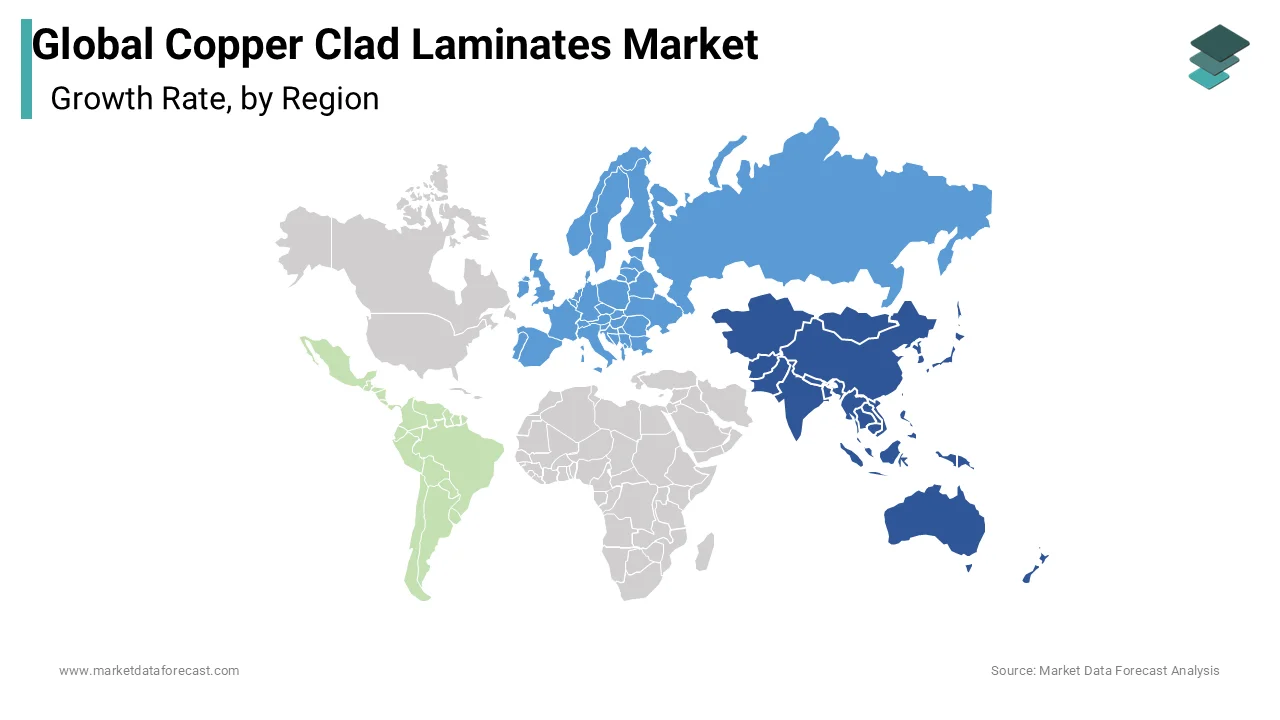
Asia-Pacific was the largest region in the copper-clad laminate market by capturing 62.6% of the global market share in 2025. The domination of Asia Pacific in the global market is propelled by the region’s role as the world’s manufacturing backbone for electronics. China alone produces a portion of the world’s PCBs, according to the study, with Guangdong and Jiangsu provinces hosting massive PCB clusters. Taiwan and South Korea are leaders in high-end HDI and IC substrate production, which drives demand for specialty CCLs. Japan’s Sumitomo Electric and Taiwan’s Kingboard Chemical are among the top CCL suppliers globally. The region’s robust semiconductor packaging expansion is fueled by the U.S.-China tech rivalry and local fab investments, which further intensifies CCL demand. As per the research, the Asia-Pacific accounted for a portion of global semiconductor manufacturing capacity.
North America Copper Clad Laminate Market Insights
North America is expanding consistently within the copper-clad laminate market witha 14.5% share in 202,4, owing to being a key hub for high-value and technologically advanced applications. The region’s strength lies not in volume but in innovation, particularly in defense, aerospace, and next-generation computing. Companies supply specialized laminates for radar, satellite, and avionics systems. Furthermore, the AI boom is reshaping data center infrastructure. Like, NVIDIA’s data center revenue surged, as per a study, driving demand for ultra-high-speed PCBs using low-loss CCLs.
Europe Copper Clad Laminate Market Insights
Europe is making continuous strides in the copper-clad laminates market due to its mature but technologically advanced industrial base. The region’s demand is concentrated in automotive, industrial automation, and renewable energy sectors. Germany, the industrial engine of Europe, produces a portion of the continent’s automotive electronics, as per the study. The EU is mandating a reduction in CO2 emissions by 2030. According to research, the shift to electric vehicles is accelerating, and a large number of EVs have been registered in Europe. This transition drives demand for high-power CCLs in inverters and battery systems. Apart from these, the EU’s Green Deal and Digital Decade policies are spurring investments in smart grids and 5G, both reliant on advanced PCBs.
Latin America Copper Clad Laminate Market Insights
Latin America is anticipated to be an attractive region in the copper-clad laminates market, with Brazil and Mexico leading regional demand. The region is emerging as an electronics assembly hub due to nearshoring trends and trade advantages, while not being a manufacturing powerhouse. Automotive electronics assembly in Monterrey and Guadalajara is driving PCB and CCL demand. Brazil, despite infrastructure challenges, is investing in smart city projects and 5G deployment.
Middle East & Africa Copper Clad Laminate Market Insights
The Middle East and Africa are likely to expand in the copper-clad laminates market during theforecast period, with growth concentrated in Gulf Cooperation Council (GCC) countries and South Africa. The UAE and Saudi Arabia are spearheading digital transformation through initiatives like Saudi Vision 2030 and the UAE’s AI Strategy 2031, investing heavily in smart infrastructure and data centers. South Africa remains the region’s electronics manufacturing base, producing consumer appliances and telecom equipment, though on a smaller scale. The rollout of 5G networks is underway. However, limited local PCB fabrication and CCL production constrain demand.
COMPETITIVE LANDSCAPE
KEY MARKET PLAYERS
Some of the prominent companies in the global CCL market
- Kingboard Laminates Holdings Ltd.
- Global Growth Insights
- daedal-research.com
- Nan Ya Plastics Corporation
- Panasonic Corporation
- ITEQ Corporation
- Shengyi Technology Co., Ltd.
- Isola Group
- Rogers Corporation
- Doosan Corporation
- Sytech Technology Co., Ltd.
TOP STRATEGIES USED BY KEY MARKET PARTICIPANTS
Key players in the copper-clad laminates market are deploying strategic initiatives to maintain technological prominence and expand regional influence. Vertical integration is a dominant strategy, with companies acquiring raw material suppliers to stabilize costs and ensure quality. Product differentiation through R&D is important, especially in developing low-loss, high-thermal-conductivity, and halogen-free laminates for 5G, EVs, and AI hardware. Firms are also forming joint ventures with PCB manufacturers and semiconductor companies to co-develop application-specific materials. Geographic expansion, particularly in Southeast Asia and India, allows proximity to growing electronics manufacturing hubs. Besides, sustainability initiatives, such as reducing VOC emissions and recycling copper foil, are becoming central to branding. Digital transformation in production, including AI-driven quality control and predictive maintenance, enhances efficiency. These strategies collectively enable companies to respond swiftly to evolving performance demands and supply chain dynamics.
COMPETITION OVERVIEW
The competition in the copper-clad laminates market is intense, characterized by technological differentiation and regional manufacturing advantages. While Asian firms dominate in volume and cost efficiency, North American and Japanese companies lead in high-performance specialty materials. The market is moderately consolidated, with several global players competing alongside regional manufacturers. Innovation in material science, especially for high-frequency, high-temperature, and flexible applications, is a key battleground. Companies are investing heavily in R&D to meet the evolving needs of 5G, electric vehicles, and AI infrastructure. Strategic partnerships with PCB fabricators and end-use OEMs are common to secure design-in advantages. Price burden from commoditized FR-4 products coexists with premium pricing for advanced laminates, creating a bifurcated competitive landscape. Environmental compliance and supply chain resilience are increasingly influencing customer preferences, which further shapes competitive dynamics across global and regional markets.
TOP LEADING PLAYERS IN THE MARKET
Isola Group
Isola Group is a leading global manufacturer of copper-clad laminates, with a strong footprint across Asia-Pacific, particularly in China, Japan, and South Korea. The company specializes in high-performance materials for advanced PCBs used in 5G, data centers, and automotive electronics. Isola has deep technical collaboration with Asian PCB fabricators and semiconductor packaging firms by supplying high-thermal-conductivity and low-loss dielectric materials. Isola has strengthened its responsiveness to regional demand in high-reliability and high-frequency segments by partnering with local distributors and investing in technical support teams across Southeast Asia.
Kingboard Chemical Holdings Limited
Kingboard Chemical is a dominant force in the Asia-Pacific copper-clad laminates market, headquartered in Hong Kong with extensive manufacturing operations across mainland China. The company is a key supplier of FR-4 and high-Tg laminates to major PCB producers. It has also prioritized sustainability, launching halogen-free and lead-free CCL products compliant with China’s environmental regulations. The company actively collaborates with Chinese telecom equipment makers like Huawei and ZTE, providing customized materials for high-layer-count backplane PCBs.
Panasonic Electric Works
Panasonic has long been a technology leader in high-end copper-clad laminates, particularly in Japan and South Korea, where its materials are used in semiconductor packaging, automotive sensors, and aerospace systems. The company is renowned for its ultra-low-loss and thermally conductive laminates, which support high-frequency applications in 5G and radar systems. It has also enhanced its production efficiency at its Kusatsu plant using smart manufacturing technologies. Panasonic continues to serve niche but high-value markets across Asia-Pacific by focusing on high-reliability, miniaturized, and energy-efficient materials, which maintains strong relationships with Tier-1 electronics OEMs.
MARKET SEGMENTATION
This research report on the Global Copper Clad Laminates Market is segmented and sub-segmented into the following categories.
By Application
-
Communication Systems
-
Vehicle Electronics
-
Consumer Electronics
-
Industrial Equipment
-
Aerospace & Defense
-
Others
By Product Type
-
Rigid Copper Clad Laminates
-
Flexible Copper Clad Laminates
By Region
-
Asia Pacific
-
North America
-
Europe
-
Latin America
-
Middle East & Africa