- Product Description Description
- Table of Contents TOC
- List of Table & Figure LOT
- Get Free Sample PDF Sample PDF
Market Size, 2025
$138.49 bnMarket Estimate, 2026
$154.28 BnMarket Forecast, 2034
$365.92 BnCAGR, 2026–2034
11.4%Global Critical Illness Insurance Market Report Summary
The global critical illness insurance market was valued at USD 138.49 billion in 2025 and is projected to grow from USD 154.28 billion in 2026 to USD 365.92 billion by 2034, registering a CAGR of 11.4% from 2026 to 2034. Market growth is driven by the rising prevalence of chronic and life-threatening diseases, increasing healthcare costs, and growing consumer awareness of financial protection against major illnesses. Expanding insurance penetration, digital policy distribution, and rising demand for supplemental health coverage are further supporting market growth. Insurers are also introducing customized products with broader coverage and flexible benefits to meet evolving consumer needs.
Key Market Trends
- Rising demand for supplemental health and critical illness insurance coverage.
- Increasing adoption of digital insurance platforms and online policy distribution.
- Growing prevalence of cancer, cardiovascular diseases, and other critical illnesses.
- Expansion of customized insurance plans with flexible coverage options.
- Increasing integration of AI, data analytics, and digital underwriting in insurance services.
Segmental Insights
- Based on product type, the disease insurance segment dominated the global critical illness insurance market in 2025 by accounting for 54.5% market share, driven by increasing demand for financial protection against major chronic and life-threatening diseases.
- Based on application and type, the cancer segment held the largest share of the market by capturing 42.4% in 2025, supported by the high global prevalence of cancer, rising treatment costs, and increasing awareness of specialized insurance coverage for oncology care.
Regional Insights
The global critical illness insurance market continues to expand across major regions, supported by increasing healthcare expenditure, growing insurance awareness, and evolving healthcare financing models.
- North America dominated the global market in 2025 by accounting for 34.3% share, driven by high insurance penetration, rising healthcare costs, advanced insurance products, and increasing consumer demand for supplemental health coverage.
- Europe held the second-largest position and is expected to maintain steady growth, supported by robust social welfare systems that complement private insurance offerings, increasing demand for personalized health coverage, and expanding private insurance participation.
- Asia-Pacific is projected to register the fastest growth during the forecast period, driven by expanding healthcare access, increasing health awareness, rising disposable incomes, growing middle-class populations, and rapid digitalization of insurance services across emerging economies.
Competitive Landscape
The global critical illness insurance market is highly competitive, with leading insurance providers focusing on product innovation, digital transformation, and customer-centric policy offerings. Market participants are investing in AI-powered underwriting, digital claims processing, personalized insurance products, and strategic partnerships to strengthen their market position. Expansion into emerging markets and continuous enhancement of customer experience continue to shape the competitive landscape.
Prominent companies operating in the global critical illness insurance market include AXA, Prudential Financial Inc., Liberty Mutual, Star Union Dai-ichi Life Insurance, Sun Life Insurance, Aegon, United Healthcare Services, Hua Xia Life Insurance Co., MetLife Services and Solutions, LLC, and Aflac Incorporated.
Global Critical Illness Insurance Market Size
The global critical illness insurance market was worth US$ 138.49 billion in 2025 and is anticipated to reach a valuation of US$ 365.92 billion by 2034 from US$ 154.28 billion in 2026, and it is predicted to register a CAGR of 11.4% during the forecast period 2026 to 2034.
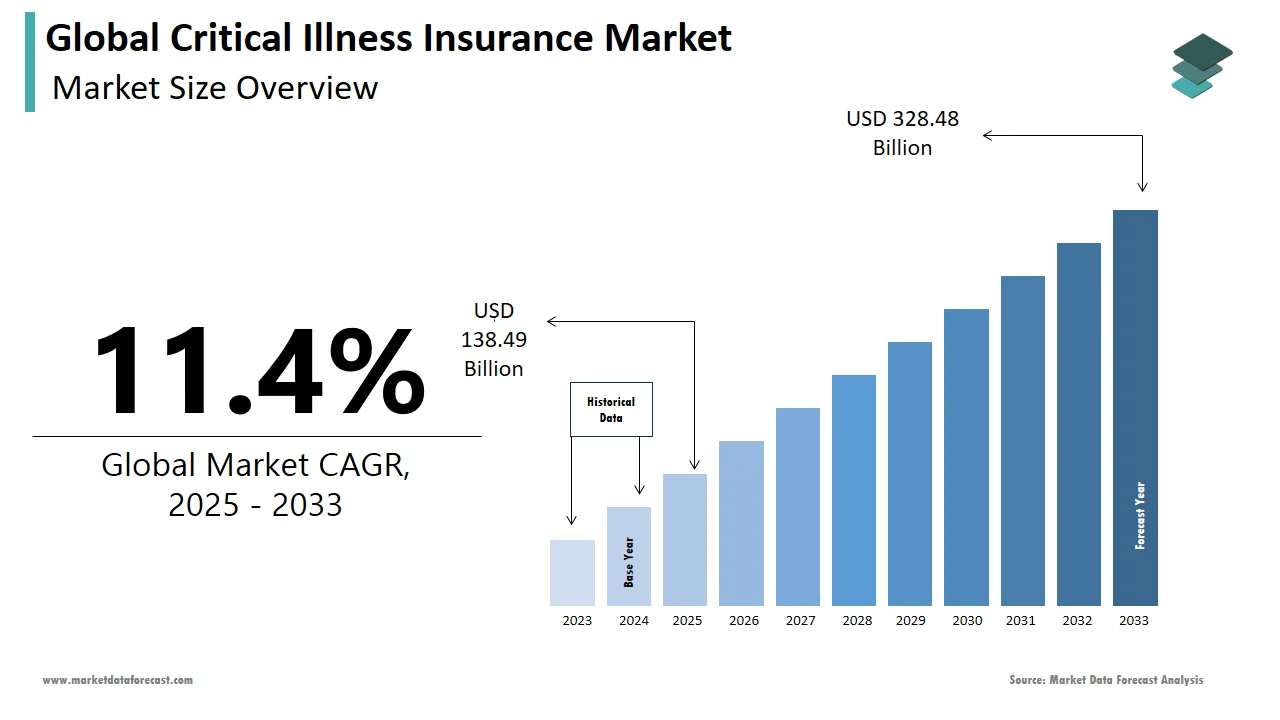
Critical illness insurance is designed to provide a lump sum payment upon the diagnosis of specific severe medical conditions such as cancer, heart attack, stroke, or organ failure. Unlike traditional health insurance, which covers medical expenses, this coverage offers financial flexibility, allowing policyholders to manage non-medical costs including income replacement, mortgage payments, and experimental treatments. The global landscape is shifting as rising healthcare costs and increasing prevalence of chronic diseases drive consumers to seek comprehensive financial protection. According to the World Health Organization, noncommunicable diseases are responsible for 71% of all deaths globally, with cardiovascular diseases and cancer being the leading causes. As per data from the American Cancer Society, approximately 1.9 million new cancer cases were diagnosed in the United States in 2023, highlighting the substantial risk exposure faced by individuals. The aging demographic in developed nations further amplifies demand as the probability of developing critical conditions increases significantly with age. Regulatory frameworks in regions like Europe and Asia are increasingly emphasizing consumer protection and transparency in insurance contracts, ensuring that policy terms are clear and claims processes are efficient. Insurers are leveraging advanced data analytics to refine underwriting models and offer personalized premiums based on individual health metrics. This evolution transforms critical illness insurance from a niche product into a fundamental component of holistic financial planning, addressing the economic vulnerability associated with life-altering medical events.
MARKET DRIVERS
Escalating Prevalence of Chronic and Life-Threatening Diseases
The rising incidence of chronic and life-threatening diseases is majorly driving the expansion of the critical illness insurance market as individuals seek financial safeguards against high treatment costs and income loss. According to the International Agency for Research on Cancer, the global number of new cancer cases is projected to reach 35 million by 2050, representing a significant increase from current levels due to population growth and aging. As per data from the Centers for Disease Control and Prevention, heart disease remains the leading cause of death in the United States, accounting for one in every five deaths annually, which underscores the pervasive risk exposure faced by the workforce. The financial burden of treating these conditions often extends beyond direct medical bills to include long-term rehabilitation and lifestyle adjustments that standard health insurance may not fully cover. According to industry analysis from the American Cancer Society, the average out-of-pocket cost for cancer patients can reach thousands of dollars annually even for insured patients, creating a compelling case for supplemental coverage. Consumers are increasingly aware that survival rates are improving due to medical advancements, meaning more people live with chronic conditions requiring ongoing financial support. This awareness drives demand for policies that provide immediate liquidity upon diagnosis, enabling patients to focus on recovery rather than financial stress. The correlation between disease prevalence and insurance uptake is particularly strong in urban areas where lifestyle factors contribute to higher risks of diabetes and cardiovascular issues.
Increasing Healthcare Costs and Gaps in Standard Coverage
The exponential rise in healthcare expenditures and the limitations of standard health insurance policies are driving individuals toward critical illness insurance as a necessary financial buffer, which is further contributing to the global market growth. According to the Kaiser Family Foundation, the average annual premium for employer-sponsored family health coverage in the United States reached 23968 dollars in 2023, with deductibles continuing to climb, thereby increasing the financial responsibility of patients. As per reports from the Commonwealth Fund, nearly half of adults in the US report having difficulty paying for healthcare costs, with many delaying or skipping necessary treatments due to expense. Standard health insurance typically covers hospital stays and physician visits but often excludes indirect costs such as travel for specialized care, home modifications, and lost wages during recovery. Critical illness insurance fills this gap by providing a tax-free lump sum that can be used at the discretion of the policyholder. According to industry analysis from McKinsey and Company, the complexity of modern medical treatments, including gene therapies and immunotherapies, often involves high co-payments and out-of-network provider costs which are not fully reimbursed by traditional plans. This financial vulnerability motivates middle and upper-income households to purchase supplemental coverage to protect their savings and assets. The unpredictability of medical billing further reinforces the value of a guaranteed cash benefit that ensures financial stability regardless of the specific medical pathway taken.
MARKET RESTRAINTS
Stringent Underwriting Standards and Pre-Existing Condition Exclusions
A significant restraint on the critical illness insurance market is the rigorous underwriting process that often excludes individuals with pre-existing conditions or elevated health risks, limiting the addressable market. According to data from the Society of Actuaries, underwriters rely heavily on medical history, genetic testing, and lifestyle assessments to determine eligibility, resulting in high rejection rates for older applicants or those with chronic conditions. As per reports from the National Association of Insurance Commissioners, policies frequently contain waiting periods ranging from 30 to 90 days and exclude specific conditions diagnosed within the first two years of coverage, which reduces the immediate utility for high-risk individuals. This selectivity creates a perception of unfairness among consumers who feel penalized for factors beyond their control, such as genetic predispositions. According to industry analysis from Frost and Sullivan, the complexity of policy definitions regarding what constitutes a critical illness can lead to claim denials if the condition does not meet specific severity criteria defined in the contract. For instance, a minor heart attack may not trigger a payout if it does not result in specific cardiac damage markers. This ambiguity discourages potential buyers who fear that their premiums will not result in benefits when needed most. The lack of standardized definitions across different insurers further complicates comparison shopping, making it difficult for consumers to make informed decisions. These barriers restrict market penetration, particularly among the demographics that need coverage the most.
Limited Consumer Awareness and Misunderstanding of Policy Benefits
The lack of widespread consumer awareness and frequent misunderstanding of how critical illness insurance differs from standard health coverage acts as a major barrier to market growth. According to a survey by LIMRA International, only 35% of Americans understand the specific benefits of critical illness insurance, with many confusing it with disability or life insurance products. As per data from the Insurance Information Institute, a significant portion of the population believes their existing health insurance provides sufficient protection against all financial risks associated with serious illness, leading to underinsurance. This knowledge gap is exacerbated by the complex terminology used in policy documents, which often confuses consumers regarding exclusions, waiting periods, and the definition of covered conditions. According to industry reports from J.D. Power, customers often express dissatisfaction after purchasing policies because they did not fully grasp the limitations until attempting to file a claim. The absence of mandatory education or counseling during the sales process means that many policies are sold without adequate explanation of their strategic role in financial planning. Marketing efforts often focus on fear rather than education, failing to clarify the unique value proposition of lump sum payments. This misinformation leads to low conversion rates and high lapse rates as policyholders realize the product does not meet their expectations. Until insurers invest in clearer communication and educational initiatives, the market will struggle to expand beyond already informed segments.
MARKET OPPORTUNITIES
Integration of Wellness Programs and Preventive Care Incentives
The integration of wellness programs and preventive care incentives presents a significant opportunity for the critical illness insurance market. According to research published in the Harvard Business Review, companies that incorporate wellness tracking and health coaching into their insurance products see a 15% reduction in claims frequency among participating policyholders. As per data from Vitality, a leading wellness technology provider, users who engage with health tracking apps and achieve fitness goals receive premium discounts and rewards, creating a mutually beneficial relationship between insurer and insured. This shift from pure risk transfer to active health management aligns with consumer preferences for proactive healthcare solutions. Insurers can leverage wearable device data to monitor vital signs and encourage healthy behaviors such as regular exercise and balanced nutrition. For instance, the market for connected health insurance is growing rapidly as technology enables real-time feedback and personalized recommendations. By rewarding healthy lifestyles, insurers can attract lower-risk customers and improve retention rates while policyholders benefit from improved health outcomes and lower costs. This model also provides valuable data for refining underwriting algorithms and developing more accurate pricing strategies. The potential to transform critical illness insurance into a holistic health partnership opens new revenue streams through ancillary services and partnerships with fitness and nutrition brands.
Expansion into Emerging Markets with Rising Middle Class
The rapid economic growth and expanding middle class in emerging markets offer substantial opportunities for the critical illness insurance sector as disposable incomes rise and health awareness increases. According to the World Bank, the middle class in Asia Pacific and Latin America has grown by over 200 million people in the last decade, creating a new base of consumers capable of affording supplemental insurance. As per data from the Swiss Re Institute, insurance penetration in emerging economies remains below 3% compared to over 10% in developed nations, indicating significant untapped potential. Governments in countries like India, China, and Brazil are promoting private insurance to alleviate pressure on public healthcare systems through tax incentives and regulatory reforms. According to industry reports from McKinsey and Company, digital distribution channels are enabling insurers to reach remote populations and offer affordable microinsurance products tailored to local needs. The increasing prevalence of lifestyle-related diseases in these regions due to urbanization and dietary changes further drives demand for financial protection. Local insurers are partnering with global reinsurers to develop products that address specific regional health risks such as tropical diseases or high rates of diabetes. This geographic expansion allows global players to diversify their revenue streams and reduce dependence on saturated mature markets. The combination of demographic trends and regulatory support positions emerging markets as the next frontier for critical illness insurance growth.
MARKET CHALLENGES
Complexity of Claims Adjudication and Fraud Detection
A major challenge facing the critical illness insurance market is the complexity of claims adjudication, which requires verifying detailed medical records and ensuring that diagnoses meet strict policy definitions. According to data from the Coalition Against Insurance Fraud, insurance fraud costs the industry billions of dollars annually, with critical illness claims being particularly susceptible to manipulation due to the high payout amounts. As per reports from the National Health Care Anti-Fraud Association, fraudulent claims often involve exaggerated symptoms, fabricated medical records, or collusion with healthcare providers to secure payouts for conditions that do not meet severity thresholds. Detecting such fraud requires sophisticated investigative resources and collaboration with medical experts, which increases operational costs and delays legitimate claims. According to industry analysis from Deloitte, the subjective nature of certain diagnoses such as early-stage cancer or mild stroke creates ambiguity that can be exploited by dishonest claimants. Insurers must balance the need for rigorous verification with the expectation of prompt payment to maintain customer trust. The lack of standardized electronic health records across different healthcare providers further complicates the verification process, leading to manual reviews and extended processing times. This inefficiency can result in customer dissatisfaction and legal disputes, damaging the reputation of the insurer. Developing automated fraud detection systems using artificial intelligence is resource-intensive and requires continuous updates to stay ahead of evolving fraudulent tactics.
Regulatory Variability and Compliance Burdens
The fragmented regulatory landscape, where varying laws and compliance requirements across different jurisdictions create significant operational challenges for insurers, which is further challenges the critical illness insurance market expansion. According to the International Association of Insurance Supervisors, regulatory frameworks for critical illness products differ widely in terms of required disclosures, capital reserves, and consumer protection measures. As per data from the European Insurance and Occupational Pensions Authority, insurers operating in multiple European countries must navigate distinct national regulations regarding policy wording and claims handling procedures, which increase administrative overhead. In emerging markets, regulatory bodies are still developing comprehensive guidelines, leading to uncertainty and frequent changes in compliance requirements. According to industry reports from PwC, the cost of regulatory compliance can account for up to 10% of an insurer's operating expenses, diverting resources from product innovation and customer service. Non-compliance can result in severe penalties, license revocation, and reputational damage, making it essential for companies to maintain robust legal and compliance teams. The lack of harmonization hinders the ability of insurers to scale products globally, as each market requires customized policy structures and approval processes. This regulatory fragmentation slows down time to market for new products and increases the complexity of managing a global portfolio. Insurers must constantly monitor legislative changes and adapt their operations accordingly to ensure continuous compliance and avoid legal repercussions.
REPORT COVERAGE
| REPORT METRIC | DETAILS |
| Market Size Available | 2025 to 2034 |
| Base Year | 2025 |
| Forecast Period | 2026 to 2034 |
| Segments Covered | By Product Type, Application, Type, and Region. |
| Various Analyses Covered | Global, Regional and Country-Level Analysis, Segment-Level Analysis, Drivers, Restraints, Opportunities, Challenges; PESTLE Analysis; Porter’s Five Forces Analysis, Competitive Landscape, Analyst Overview of Investment Opportunities |
| Regions Covered | North America, Europe, Asia Pacific, Latin America, Middle East & Africa |
| Market Leaders Profiled | AXA, Prudential, Liberty Mutual, Star Union Dai-ichi Life Insurance, Sun Life Insurance, Aegon, United Healthcare Services, Hua Xia Life Insurance Co., MetLife Services, and Solutions, LLC, Aflac Incorporated., and Others. |
SEGMENTAL ANALYSIS
By Product Type
The disease insurance segment dominated the market by holding 54.5% of the global market share in 2025, primarily because it offers targeted financial protection against specific life-threatening diagnoses such as cancer, heart attack, and stroke. According to data from the International Agency for Research on Cancer, cancer remains the leading cause of death globally, with over 19 million new cases diagnosed annually, which is creating a substantial demand for specialized coverage. As per reports from the American Heart Association, cardiovascular diseases account for nearly 18 million deaths each year, reinforcing the necessity for policies that provide lump sum payments upon diagnosis rather than just covering medical bills. This segment dominates because consumers perceive disease-specific policies as more transparent and easier to understand compared to broad medical insurance, which often involves complex deductibles and co-payments. According to industry analysis from Deloitte, the average payout for a critical illness policy is significantly higher than standard health insurance reimbursements, allowing patients to cover non-medical expenses such as mortgage payments and childcare. The simplicity of the trigger event, diagnosis of a covered condition, appeals to individuals seeking certainty in their financial planning. Furthermore, employers are increasingly offering disease insurance as part of voluntary benefits packages, recognizing its value in supporting employee financial wellness during health crises. This widespread adoption in both individual and group markets sustains the dominance of disease insurance as the core component of the critical illness sector.
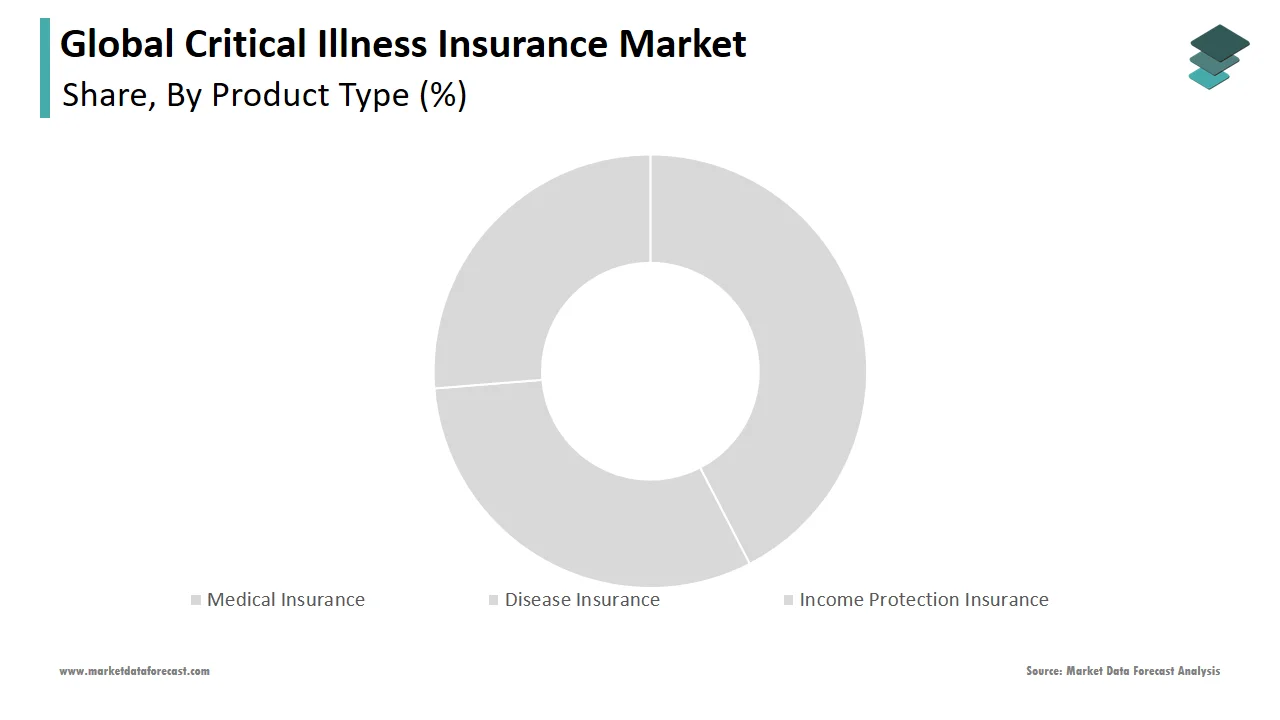
On the other end, the income protection insurance segment is estimated to showcase a promising CAGR of 8.2% during the forecast period owing to the increasing economic volatility and the rising cost of living, which fuels the need for wage replacement during long-term illness. According to data from the Bureau of Labor Statistics, the average duration of disability claims has increased by 15% over the last decade as chronic conditions require longer recovery periods, impacting household income stability. As per reports from the Council for Disability Awareness, one in four workers will experience a disability lasting three months or more before reaching retirement age, highlighting the significant risk of income loss. Unlike lump sum disease policies, income protection provides regular monthly payments, ensuring that policyholders can meet ongoing financial obligations such as rent, utilities, and loan repayments. According to industry analysis from McKinsey and Company, the gig economy and freelance workforce, which lacks traditional employer-sponsored sick leave, are increasingly purchasing individual income protection policies to safeguard their earnings. The flexibility of these policies to cover partial disabilities and mental health conditions further drives adoption among younger demographics. Governments in several European countries are also promoting private income protection to reduce reliance on public welfare systems. This structural shift toward protecting cash flow rather than just covering medical costs positions income protection as a critical growth engine in the evolving insurance landscape.
By Application and Type Insights
The cancer segment held the dominant position in the global market in 2025 with 42.4% of the global market share, primarily due to its high prevalence and the exorbitant costs associated with modern treatments. According to data from the World Health Organization, cancer is the second leading cause of death globally, with lung, breast, and colorectal cancers being the most common types. As per reports from the National Cancer Institute, the total annual cost of cancer care in the United States exceeds 200 billion dollars, placing immense financial strain on patients and families, even those with health insurance. Critical illness policies specifically designed for cancer provide immediate funds for experimental therapies, travel to specialized centers, and supportive care, which are often excluded from standard plans. For instance, the survival rate for many cancers has improved significantly, meaning patients live longer with the disease, requiring sustained financial support for management and monitoring. The emotional and psychological impact of a cancer diagnosis also drives demand for policies that offer financial peace of mind, allowing patients to focus on recovery. Insurers have responded by expanding coverage to include early-stage cancers and recurrence, which were previously excluded. This comprehensive approach ensures that cancer remains the primary driver of critical illness insurance purchases as consumers recognize it as the most financially devastating health event they may face.
On the other hand, the individual insurance segment is predicted to expand at a CAGR of 6.2% during the forecast period owing to the desire for personalized coverage and portability that group policies often lack. According to data from LIMRA International, the number of individuals purchasing standalone critical illness policies has increased by 20% in recent years as consumers seek control over their benefit levels and covered conditions. As per reports from the Insurance Information Institute, individual policies allow policyholders to tailor coverage amounts based on their specific financial obligations such as mortgage debt or children's education funds, which generic group plans do not address. The portability of individual insurance ensures that coverage remains intact regardless of employment status changes, providing continuous protection in an era of job mobility. According to industry analysis from Frost and Sullivan, the rise of digital insurance platforms has simplified the purchase process for individual policies, making them more accessible to younger and tech-savvy consumers. These platforms offer instant quotes and streamlined underwriting, reducing barriers to entry. Additionally, individual policies often include optional riders for specific conditions or wellness benefits, enhancing their appeal. The ability to lock in premiums at a younger age also provides long-term cost advantages. This trend toward personalization and independence from employer-sponsored benefits fuels the rapid expansion of the individual insurance segment.
REGIONAL ANALYSIS
North America Critical Illness Insurance Market Analysis
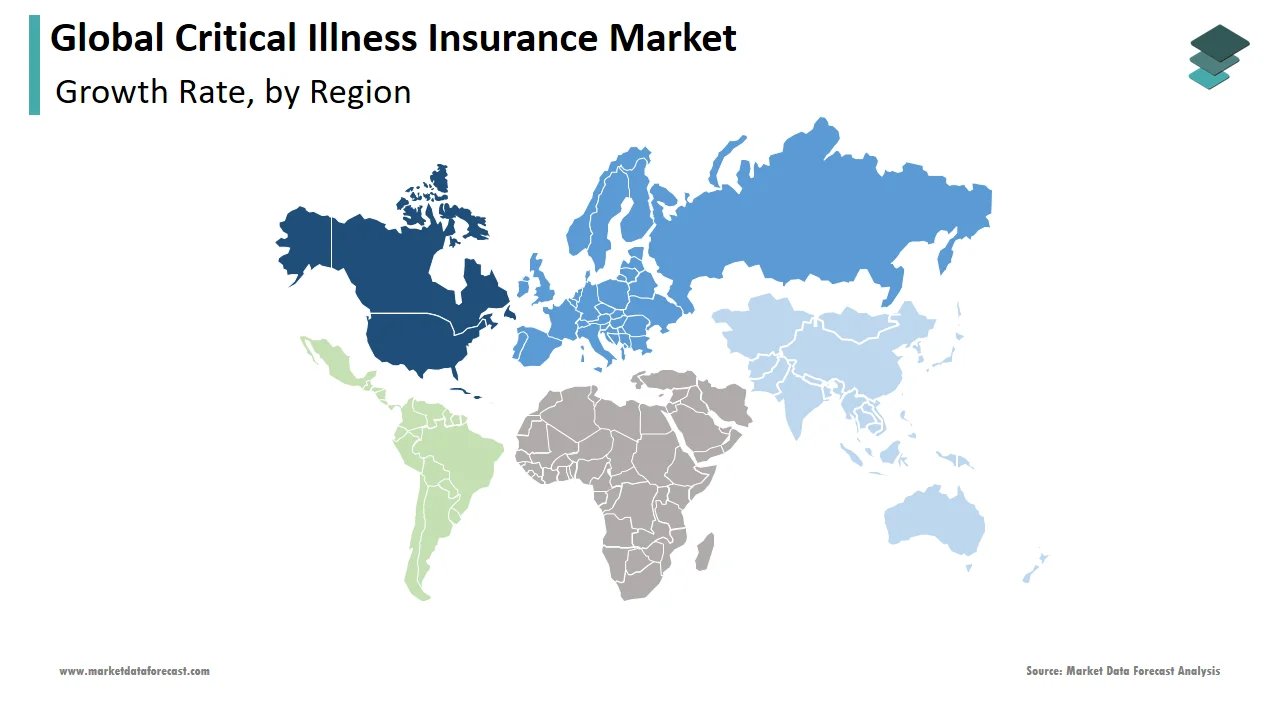
North America dominated the market by capturing 34.3% of the global market share in 2025. The dominance of North America in the global market can be credited to a mature insurance culture, high healthcare costs, and strong regulatory frameworks. According to data from the American Cancer Society, the United States has one of the highest cancer incidence rates globally, creating a robust demand for supplemental coverage. As per reports from the Kaiser Family Foundation, the high deductible nature of many US health plans means that patients face significant out-of-pocket expenses, making critical illness insurance an attractive financial safety net. Canada also contributes to regional growth through employer-sponsored group plans, which are widely offered as voluntary benefits. According to industry analysis from Deloitte, the presence of major insurers such as Aflac and MetLife ensures widespread distribution and brand recognition. The region benefits from advanced data analytics capabilities allowing insurers to price risks accurately and offer personalized products. Regulatory bodies ensure transparency in policy terms, building consumer trust. The aging baby boomer population further drives demand as they seek to protect their retirement savings from medical shocks. This combination of high risk exposure, financial vulnerability, and established distribution channels sustains North America's dominant position in the global market.
Europe Critical Illness Insurance Market Analysis
Europe is expected to maintain steady growth as it continues to integrate private insurance solutions with its robust social welfare systems to meet evolving consumer needs, strong social welfare systems that complement rather than replace private critical illness insurance. According to data from the European Insurance and Occupational Pensions Authority, countries like the United Kingdom, Germany, and France have well-developed private insurance sectors that fill gaps in public healthcare coverage. As per reports from Age UK, the rising incidence of cancer and heart disease among the elderly population has spurred demand for policies that cover care costs not provided by the National Health Service. The implementation of the General Data Protection Regulation has influenced how insurers collect and use health data, promoting privacy while enabling personalized pricing. According to industry analysis from Swiss Re, the market is shifting toward integrated wellness products that reward healthy behaviors, aligning with public health goals. Employers in Northern Europe increasingly offer critical illness coverage as part of comprehensive benefits packages to attract talent. The region's strict consumer protection laws ensure fair claims handling and clear policy wording, fostering trust. While public systems reduce the urgency for basic coverage, the demand for premium services and faster access to treatment drives the private market. This balanced approach ensures steady growth supported by high disposable incomes and health awareness.
Asia Pacific Critical Illness Insurance Market Analysis
Asia Pacific is anticipated to see the most significant regional market expansion as increased healthcare access and digitalization bring affordable insurance to millions of new policyholders, increasing health awareness, rising disposable incomes, and the expansion of the middle class in countries like China, India, and Japan. According to data from the World Health Organization, noncommunicable diseases are rising rapidly in Asia due to lifestyle changes and urbanization, creating a new base of potential policyholders. As per reports from the Life Insurance Council of Japan, critical illness riders are attached to over 60% of new life insurance policies, reflecting cultural preferences for bundled protection. In China and India, digital insurance platforms are democratizing access to critical illness products, allowing millions of previously uninsured individuals to purchase affordable coverage. According to industry analysis from McKinsey and Company, government initiatives to promote private insurance as a supplement to public healthcare are accelerating market penetration. The young demographic in Southeast Asia provides a long-term growth opportunity as individuals start planning for future health risks early. Local insurers are developing products tailored to regional diseases such as dengue or specific cancers prevalent in the area. This dynamic market is characterized by rapid innovation and aggressive marketing strategies that educate consumers on the importance of financial protection against serious illness.
Latin America Critical Illness Insurance Market Analysis
Latin America is projected to see continued growth as regional economic stabilization and the rise of digital financial services improve the accessibility of supplemental health products, and increasing penetration of private health insurance in countries like Brazil, Mexico, and Chile. According to data from the Inter-American Development Bank, the middle class in Latin America has expanded significantly, creating a population with the financial capacity to afford supplemental insurance. As per reports from the Brazilian Insurance Confederation, critical illness insurance is often sold as a rider to life insurance policies, leveraging existing distribution networks to reach broader audiences. The region faces a double burden of infectious and chronic diseases, increasing the perceived value of comprehensive coverage. According to industry analysis from S&P Global, local insurers are partnering with international reinsurers to manage risk and introduce innovative products. Regulatory reforms in several countries are improving transparency and consumer protection, encouraging greater trust in insurance products. The rise of telemedicine and digital health services is also integrating with insurance offerings, providing added value to policyholders. While economic volatility remains a challenge, the long-term trend toward formalizing healthcare financing supports market growth. Insurers are focusing on educating consumers about the benefits of critical illness coverage to overcome low awareness levels.
Middle East and Africa Critical Illness Insurance Market Analysis
The Middle East and Africa are expected to gradually expand their market reach as private healthcare demand grows and regional economic diversification strategies continue to unfold. According to data from the Saudi Arabian Monetary Authority, mandatory health insurance laws in countries like Saudi Arabia and the United Arab Emirates are driving demand for supplemental critical illness coverage among expatriates who seek additional financial security. As per reports from the African Insurance Organization, South Africa leads the continent in critical illness insurance penetration due to a well-developed financial services sector and high prevalence of HIV AIDS and other chronic conditions. The region relies heavily on imported insurance expertise and reinsurance capacity to manage large risks. According to industry analysis from Deloitte, insurers are developing products tailored to local health risks such as tropical diseases and diabetes, which are prevalent in the region. The growing awareness of health and wellness among the affluent population in the Middle East supports demand for premium critical illness policies. In Africa, mobile technology is enabling micro insurance solutions that provide basic critical illness coverage to low-income populations. While the market is small compared to other regions, the growth potential is significant as healthcare infrastructure improves and economic conditions stabilize.
COMPETITIVE LANDSCAPE
The competitive landscape of the critical illness insurance market features intense rivalry among established global insurers and specialized niche providers striving to differentiate through product innovation and service excellence. Major corporations leverage their extensive distribution networks and brand recognition to dominate the group benefits segment while agile competitors focus on personalized direct-to-consumer solutions. Innovation centers on integrating wellness technologies and preventive care incentives that reduce risk and enhance customer engagement beyond traditional indemnity models. Price competition is moderated by the specialized nature of the product, but insurers compete fiercely on coverage breadth, claim speed, and customer support quality. Intellectual property regarding proprietary underwriting algorithms and data analytics tools serves as a key differentiator for market leaders. Regulatory compliance across various jurisdictions creates barriers to entry, favoring large players with robust legal and compliance infrastructures. Customer loyalty is driven by trust, transparency, and the ease of the claims experience rather than price alone. Strategic alliances with healthcare ecosystems and employers further consolidate market positions by embedding insurance into broader health and financial wellness frameworks.
KEY MARKET PLAYERS
Some of the notable companies operating in the global critical Illness insurance market are
- AXA
- Prudential Financial Inc
- Liberty Mutual
- Star Union Dai-ichi Life Insurance
- Sun Life Insurance
- Aegon
- United Healthcare Services
- Hua Xia Life Insurance Co.
- MetLife Services and Solutions, LLC
- Aflac Incorporated
TOP PLAYERS IN THE MARKET
- Aflac Incorporated stands as a global leader in supplemental insurance, specializing in critical illness and cancer coverage that provides financial security during health crises. The company has built a robust reputation for rapid claims payment and customer-centric service, which distinguishes it in the competitive landscape. Recent strategic initiatives include expanding its digital platforms to offer seamless policy management and instant claim filing capabilities for policyholders. Aflac invests heavily in preventive wellness programs that encourage healthy lifestyles among insured individuals, reducing long-term risk exposure. The firm actively partners with employers to integrate critical illness coverage into voluntary benefits packages, enhancing accessibility for the workforce. Its commitment to corporate social responsibility and community health initiatives strengthens brand loyalty and trust. Aflac continues to innovate its product offerings by adding coverage for emerging health concerns, ensuring relevance in a changing healthcare environment.
- MetLife Inc maintains a strong presence in the critical illness insurance sector through its comprehensive portfolio of employee benefits and individual protection products. The company leverages its extensive global network to deliver tailored solutions that address the specific health risks of diverse populations. Recent actions involve integrating advanced data analytics and artificial intelligence into underwriting processes to provide more accurate pricing and personalized policy options. MetLife focuses on holistic well-being by combining critical illness coverage with mental health support and financial wellness tools. The corporation expands its reach through strategic collaborations with healthcare providers and technology firms to create integrated care ecosystems. MetLife prioritizes transparency in policy terms, ensuring that customers clearly understand their benefits and exclusions. This approach fosters long-term relationships and reduces dispute rates while enhancing the overall customer experience in times of medical need.
- Prudential Financial Inc contributes significantly to the critical illness market by offering robust protection plans that complement traditional life and health insurance products. The company emphasizes financial resilience, helping clients manage the economic impact of severe diagnoses through lump sum payments and income replacement options. Recent strategies include launching modular critical illness policies that allow customers to customize coverage based on their unique family histories and lifestyle factors. Prudential invests in digital education resources to improve consumer understanding of critical illness risks and the value of supplemental insurance. The firm utilizes predictive modeling to identify high-risk segments and develop targeted outreach campaigns. Prudential also focuses on streamlining the claims process through automation, reducing wait times for beneficiaries. Its dedication to innovation and customer empowerment positions it as a trusted advisor in personal financial planning and health protection.
TOP STRATEGIES USED BY KEY MARKET PARTICIPANTS
Key players in the critical illness insurance market primarily focus on product customization and modularity to meet the diverse needs of individual and group clients. Insurers invest heavily in digital transformation to streamline underwriting and claims processing using artificial intelligence and machine learning for faster decision-making. Strategic partnerships with healthcare providers and wellness platforms enable the integration of preventive care services into insurance offerings, promoting healthier lifestyles. Companies expand their distribution channels through direct-to-consumer digital platforms and employer-sponsored voluntary benefits programs to increase accessibility. Data analytics are utilized to refine risk assessment models and personalize premiums based on real-time health metrics from wearable devices. Marketing efforts emphasize financial wellness and education to bridge the awareness gap and demonstrate the value of lump sum benefits. Regulatory compliance and transparency remain central to building trust and ensuring sustainable growth in highly regulated markets.
MARKET SEGMENTATION
This research report on the global critical illness insurance market is segmented and sub-segmented into the following categories.
By Product Type
- Medical Insurance
- Disease Insurance
- Income Protection Insurance
By Application
- Cancer
- Heart Attack
- Stroke
- Others
By Type
- individual Insurance
- Family Insurance
By Region
- North America
- Europe
- Asia Pacific
- Latin America
- Middle East and Africa