- Product Description Description
- Table of Contents TOC
- List of Table & Figure LOT
- Get Free Sample PDF Sample PDF
Market Size, 2025
$307.63 BnMarket Estimate, 2026
$337.81 BnMarket Forecast, 2034
$714.18 BnCAGR, 2026–2034
9.81%Executive Summary: Global Healthcare BPO Market
- Market Scope: Comprehensive global healthcare business process outsourcing (BPO) market analysis covering provider services, payer services, pharmaceutical services, regional landscapes, and technology adoption metrics.
- Market Valuation: Valued at USD 307.63 billion in 2025, estimated at USD 337.81 billion in 2026, and projected to reach USD 714.18 billion by 2034, registering a strong compound annual growth rate (CAGR) of 9.81% from 2026 to 2034.
- Primary Growth Drivers: Escalating administrative burdens and clinical documentation requirements, rapid digital transformation and integration of AI/RPA in back-office operations, global shift toward value-based care models, and widespread demand for cost-effective revenue cycle management. Key market restraints include stringent data privacy regulations (such as HIPAA and GDPR), cross-border data transfer limitations, high employee turnover, and persistent concerns regarding process standardization and service quality.
Key Market Segment Metrics (2026–2034)
| Category | Leading Segment (2025 Position) | Fastest-Growing Segment |
|---|---|---|
| By Provider Service | Medical Billing (commanded 36.4% of total revenue due to critical financial sustainability and reimbursement needs) | Finance & Accounts (projected to expand at a CAGR of 11.2% driven by value-based care transition and multi-country accounting complexities) |
| By Payer Service | Claims Management (captured 33.8% of total revenue via high-volume insurance claim processing and adjudication) | Analytics and Fraud Management (projected to grow at a CAGR of 13.7% fueled by escalating financial losses from fraud) |
| By Pharmaceutical Service | Research and Development (R&D) (led with 58.6% of total spending due to capital-intensive drug discovery and clinical trials) | Non-clinical Services (expanding at a CAGR of 12.9% driven by medical affairs, pharmacovigilance, and HEOR compliance) |
| By Region | North America (led the global market at 41.3% in 2025 anchored by complex multi-payer systems and massive transaction volumes) | Asia-Pacific (fastest-growing regional market driven by skilled English-speaking workforces, cost advantages, and digital infrastructure) |
Major Market Players & Market Structure
Market Structure: Highly competitive global IT and business process management landscape featuring major enterprise technology leaders focusing on AI integration, automated workflows, strategic acquisitions, and robust compliance frameworks.
Key Companies: Cognizant Technology Solutions Corporation, Accenture PLC, Genpact Limited, Tata Consultancy Services Ltd. (TCS), Infosys BPO Ltd., and Xerox Corporation.
Global Healthcare BPO Market Size
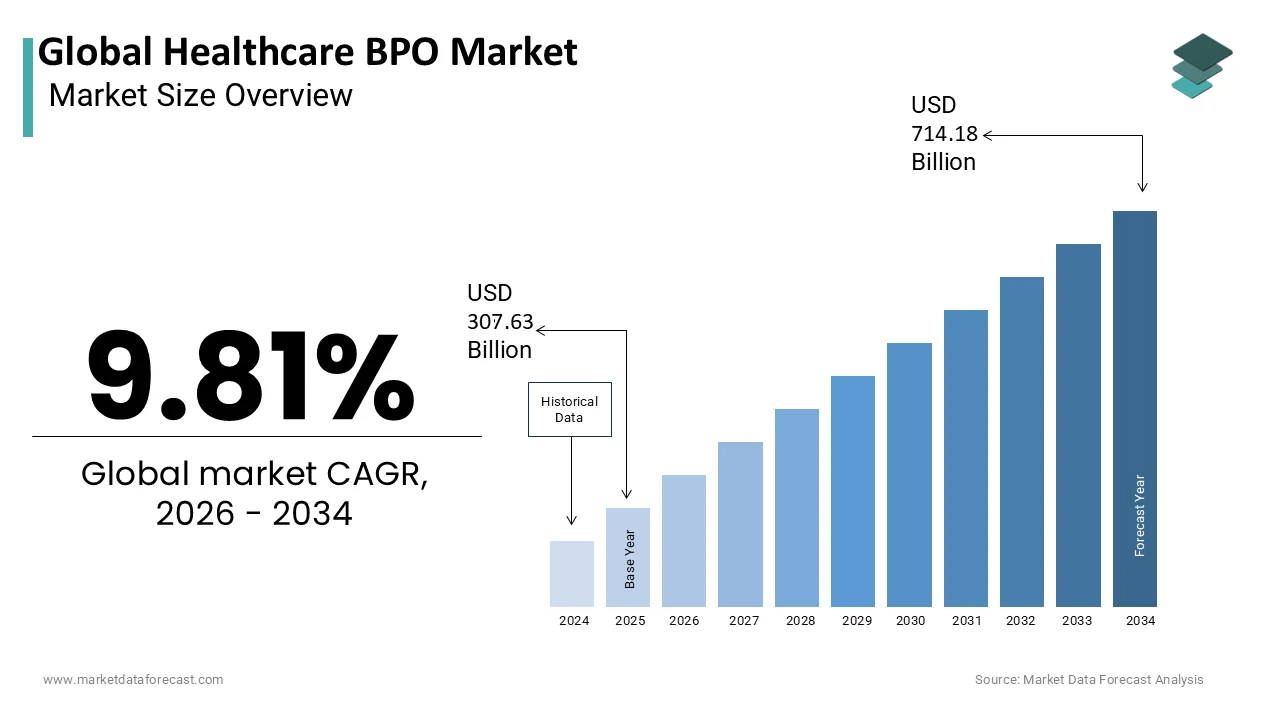
The Global Healthcare BPO Market is projected to grow from USD 307.63 billion in 2025 to USD 337.81 billion in 2026 and reach USD 714.18 billion by 2034, registering a CAGR of 9.81% from 2026 to 2034.
Healthcare business process outsourcing (BPO) refers to the third-party service providers that manage non-clinical, administrative, and operational functions for healthcare organizations, including medical billing, claims processing, revenue cycle management, patient scheduling, transcription, and health information management. Unlike generic BPO models, healthcare-specific outsourcing adheres to stringent regulatory frameworks such as HIPAA in the United States, GDPR in Europe, and evolving data sovereignty laws globally, necessitating a high degree of compliance precision and domain expertise. The complexity of healthcare systems, characterized by fragmented payer models, multi-lingual patient populations, and intricate coding standards like ICD-10 and CPT, demands specialized operational support.
Besides, the global shift toward value-based care models has intensified the need for accurate data reporting, patient outcome tracking, and regulatory compliance, further expanding the scope of outsourced services. As healthcare providers face mounting pressure to reduce costs while improving efficiency, the reliance on external expertise for managing complex administrative workflows has become a strategic imperative rather than a cost-saving option.
MARKET DRIVERS
Escalating Administrative Burden in Healthcare Delivery
The growing administrative complexity within healthcare systems is a primary catalyst for the expansion of the healthcare BPO market. Also, physicians in the United States spend more time on administrative tasks, nearly half of their clinical workload, primarily due to insurance verification, prior authorizations, and claims management. This burden has intensified with the proliferation of payer-specific requirements. In the European Union, cross-border healthcare directives have introduced additional compliance layers, requiring multilingual documentation and data interoperability, increasing operational strain on hospitals. The financial implications are substantial hospitals lose potential revenue due to claim denials, many of which stem from coding errors or incomplete documentation. To mitigate these inefficiencies, providers are increasingly outsourcing revenue cycle functions to specialized BPO firms with advanced AI-driven coding engines and denial management systems. This operational strain, amplified by regulatory fragmentation and workforce shortages, is driving systemic reliance on external administrative expertise.
Digital Transformation and Integration of AI in Back-Office Operations
The integration of artificial intelligence and automation into healthcare administration is accelerating the adoption of BPO services that offer technologically advanced, scalable solutions. Also, AI-powered tools can reduce medical coding errors and cut claims processing time, making outsourced partners with embedded AI capabilities highly attractive. Natural language processing (NLP) systems are now capable of transcribing and coding clinical notes with high accuracy. Robotic process automation (RPA) is being deployed by BPO providers to handle repetitive tasks such as patient eligibility checks and appointment confirmations, reducing manual labor. The demand for such capabilities is further fueled by the global shortage of certified medical coders. By leveraging AI-augmented workflows, BPO firms are not only improving accuracy and speed but also enabling healthcare providers to reallocate clinical staff toward patient care, making digital-ready outsourcing a strategic necessity.
MARKET RESTRAINTS
Stringent Data Privacy and Regulatory Compliance Requirements
The healthcare BPO market faces significant constraints due to the rigorous data protection and regulatory standards governing patient information across jurisdictions. According to the International Association of Privacy Professionals, 137 countries now have comprehensive data protection laws, many of which impose strict limitations on cross-border data transfers. In the United States, HIPAA mandates that all business associates of covered entities, including BPO vendors, implement specific safeguards for protected health information (PHI), with penalties for violations reaching up to $1.5 million per incident, as enforced by the Department of Health and Human Services. The European Union’s General Data Protection Regulation (GDPR) requires data localization in certain cases and mandates breach notifications within 72 hours. India’s Digital Personal Data Protection Act of 2023 introduces similar obligations, requiring data fiduciaries to ensure processor accountability, as per the Ministry of Electronics and Information Technology. These regulations necessitate substantial investments in cybersecurity infrastructure, staff training, and legal oversight. Smaller providers often lack the resources to meet these demands, limiting market entry and consolidation. This regulatory burden, while essential for patient safety, creates a high barrier to scalability and innovation.
Persistent Concerns Over Service Quality and Process Standardization
The inconsistency in service quality and the lack of standardized operational protocols across providers a critical barriers to the broader adoption of healthcare BPO services. Language and cultural nuances further exacerbate risks. Additionally, the absence of universal performance metrics makes it difficult for healthcare providers to evaluate vendor reliability. These quality concerns are compounded by high employee turnover in BPO centers. Until standardization and accountability mechanisms improve, trust in outsourced operations will remain a limiting factor.
MARKET OPPORTUNITIES
Expansion of Telehealth and Virtual Care Ecosystems
The rapid growth of telehealth services is creating a parallel demand for outsourced administrative support tailored to digital care delivery models. This shift has introduced new administrative workflows, including digital patient onboarding, e-consent management, virtual visit billing, and integration with electronic health records (EHRs), which are often outsourced to specialized BPO providers. BPO firms are responding by developing dedicated telehealth support units. Additionally, multilingual support for global telehealth platforms has created demand for BPO centers in Latin America and Southeast Asia. As virtual care becomes institutionalized, the need for agile, tech-integrated administrative partners will grow, offering BPO providers a high-growth, scalable market segment.
Rising Adoption of Value-Based Care and Outcome-Based Reimbursement Models
The global transition from fee-for-service to value-based care is generating new demand for healthcare BPO services focused on data analytics, performance reporting, and regulatory compliance. Under value-based models, providers are reimbursed based on patient outcomes, readmission rates, and care coordination, necessitating robust data collection, analysis, and reporting functions increasingly outsourced to specialized BPO firms. Also, a notable share of healthcare payments in the United States was tied to value-based arrangements in 2023, up from that in 2017. This shift requires continuous monitoring of quality metrics such as HEDIS (Healthcare Effectiveness Data and Information Set), with providers submitting many performance indicators annually. BPO providers are stepping in to manage this data burden. Cognizant and Wipro have developed dedicated value-based care units that aggregate EHR data, generate compliance reports, and identify gaps in care. As more countries adopt outcome-based reimbursement, the need for accurate, timely, and auditable data management will drive sustained demand for specialized administrative outsourcing, positioning BPO firms as strategic enablers of healthcare transformation.
MARKET CHALLENGES
Managing Cross-Border Regulatory and Linguistic Complexity
Healthcare BPO providers face significant operational challenges in managing cross-border service delivery due to divergent regulatory frameworks, coding systems, and linguistic requirements. According to the World Health Organization, there are over 11,000 diagnostic codes in ICD-11. In Canada, for instance, the Canadian Classification of Health Interventions (CCI) differs from the U.S. CPT coding system, necessitating separate training modules for BPO agents. Language barriers further complicate operations. Spanish, French, Mandarin, and Arabic are all required for patient communication in multinational health systems, yet only y small share of BPO centers in India offer certified multilingual transcription services. In the European Union, the requirement to comply with both GDPR and national health data laws such as Germany’s Bundesdatenschutzgesetz creates legal fragmentation, increasing compliance costs. Additionally, time zone differences impact real-time support. U.S. providers outsourcing to Asia face a 12–14-hour lag, reducing responsiveness during critical billing windows. These complexities require BPO firms to invest in geographically distributed teams, continuous legal monitoring, and adaptive training programs, increasing operational overhead and limiting scalability.
Workforce Attrition and Specialized Talent Shortage
The healthcare BPO sector is grappling with high employee turnover and a shortage of domain-specialized professionals, undermining service continuity and quality. This turnover is driven by burnout, repetitive workloads, and limited career progression, particularly among medical coders and transcriptionists. In South Africa, only a limited number of professionals are certified in clinical coding, insufficient for a public health system serving millions of people. Training new staff is both time-consuming and costly. Furthermore, the rise of AI tools has created skill gaps, as workers must now understand both clinical terminology and data analytics, yet only a portion of BPO training programs include digital literacy components. This talent crisis threatens service reliability and increases operational risk, forcing providers to invest in retention strategies, upskilling, and hybrid human-AI workflows to maintain performance.
REPORT COVERAGE
| REPORT METRIC | DETAILS |
| Market Size Available | 2025 to 2034 |
| Base Year | 2025 |
| Forecast Period | 2026 to 2034 |
| Segments Covered | By Provider Service, Payer Service, Pharmaceutical Service, and Region |
| Various Analyses Covered | Global, Regional & Country Level Analysis, Segment-Level Analysis, Drivers, Restraints, Opportunities, Challenges, PESTLE Analysis, Porter's Five Forces Analysis, Competitive Landscape, Analyst Overview on Investment Opportunities |
| Regions Covered | North America, Europe, Asia Pacific, Latin America, the Middle East, and Africa |
| Market Leaders Profiled | Cognizant Technology Solutions Corporation (U.S.), Accenture PLC (U.S.), Genpact Limited, Tata Consultancy Services Ltd. (India), Infosys BPO Ltd. (India), and Xerox Corporation (U.S.). |
SEGMENTAL ANALYSIS
By Provider Service Insights
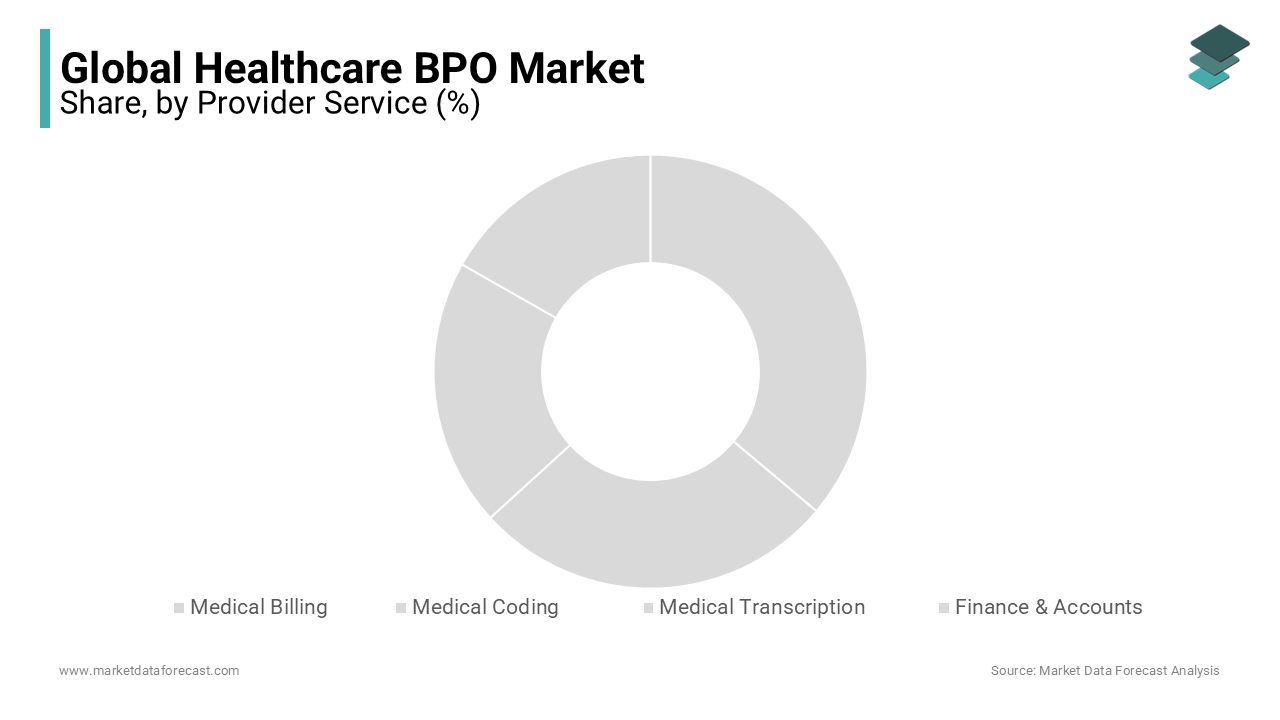
The Medical billing segment was the largest part within the provider-facing healthcare BPO market by commanding 36.4% of total revenue in 2025. This dominance is due to the financial sustainability of healthcare providers, which hinges on timely and accurate reimbursement from insurers and government payers. In the United States alone, hospitals and clinics process a significant number of insurance claims annually, each requiring precise coding, payer-specific formatting, and follow-up on denials. The complexity of billing is exacerbated by frequent regulatory updates. Also, providers are increasingly outsourcing billing operations to specialized BPO firms that employ AI-driven claim scrubbing tools, reducing error rates. The non-discretionary nature of revenue cycle management, combined with rising payer complexity and workforce shortages, ensures that medical billing remains the cornerstone of provider-focused BPO demand.
The finance & accounts segment is emerging as the fastest-growing provider service segment in the healthcare BPO market and is projected to expand at a CAGR of 11.2% from 2025 to 2033. This acceleration is driven by the increasing financial complexity of healthcare organizations, particularly as they transition to value-based care models that require sophisticated cost accounting, budget forecasting, and compliance reporting. The shift has increased the demand for outsourced services such as general ledger management, payroll processing, tax compliance, and financial auditing, functions that require specialized expertise but are not core to clinical operations. Additionally, private healthcare chains in Southeast Asia, such as Bangkok Dusit Medical Services and Indonesia’s Siloam Hospitals, are leveraging BPO firms to standardize accounting practices across multi-country operations, ensuring compliance with IFRS and local tax laws. The integration of AI-powered financial analytics platforms, capable of predicting cash flow gaps and identifying cost-saving opportunities, has further enhanced the appeal of outsourced finance functions. As healthcare becomes more financially intricate, the reliance on expert, scalable finance BPO services is poised for sustained growth.
By Payer Service Insights
The claims management segment was the dominant part in the payer-facing healthcare BPO market by capturing 33.8% of total revenue in 2025. This lead position is due to the sheer volume and complexity of insurance claims processed annually by health plans, which must verify eligibility, adjudicate benefits, detect fraud, and ensure regulatory compliance. The administrative burden is compounded by high denial and error rates, often due to missing documentation or coding mismatches. To improve efficiency, payers are increasingly outsourcing claims adjudication, appeals processing, and recovery audits to BPO providers equipped with AI-driven automation tools. In Germany, statutory health insurers have outsourced a notable share of their claims verification to external agencies to handle millions of annual submissions under the SHI system. The financial stakes are immense. This operational necessity ensures the segment’s continued dominance.
The analytics and fraud management segment is the fastest-growing within payer services by projected to grow at a CAGR of 13.7% in the coming years. This surge is fueled by the escalating financial losses from healthcare fraud. Payers are increasingly outsourcing fraud detection to BPO firms that deploy machine learning algorithms capable of identifying anomalous billing patterns, such as upcoding, phantom procedures, and provider collusion. The integration of predictive analytics allows payers to move from reactive to proactive fraud prevention. Cognizant’s AI models have reduced false positives, improving investigation efficiency. Furthermore, regulatory mandates such as the U.S. No Surprises Act require real-time price transparency checks, necessitating outsourced data validation systems. As healthcare spending rises and digital footprints expand, the demand for intelligent, outsourced fraud analytics will continue to accelerate.
By Pharmaceutical Service Insights
The Research and Development (R&D) segment led the pharmaceutical BPO market by accounting for 58.6% of total spending in 2025. This dominance reflects the capital-intensive and highly specialized nature of drug discovery, clinical trials, regulatory submissions, and pharmacovigilance, all of which are increasingly outsourced to reduce costs and accelerate time-to-market. To mitigate the costs, pharmaceutical companies are delegating critical R&D functions, such as biostatistics, data management, medical writing, and regulatory consulting, to specialized BPO providers in India, China, and Eastern Europe. Additionally, regulatory complexity is driving outsourcing; biologics license applications (BLAs) submitted to the FDA require over 100,000 pages of documentation, often compiled by external regulatory affairs teams.
The non-clinical services segment is the fastest-growing within pharmaceutical BPO by projected to expand at a CAGR of 12.9% in the coming years. This growth is driven by the increasing operational complexity of pharmaceutical companies, which are outsourcing functions such as medical affairs, pharmacovigilance, regulatory intelligence, and health economics and outcomes research (HEOR) to enhance compliance and market access. Additionally, regulatory submissions now require extensive HEOR data to justify drug pricing. The rise of personalized medicine and companion diagnostics has further increased documentation and compliance demands. As regulatory scrutiny intensifies and product lifecycles shorten, non-clinical BPO services are becoming mission-critical.
REGIONAL ANALYSIS
North America Healthcare BPO Market Insights
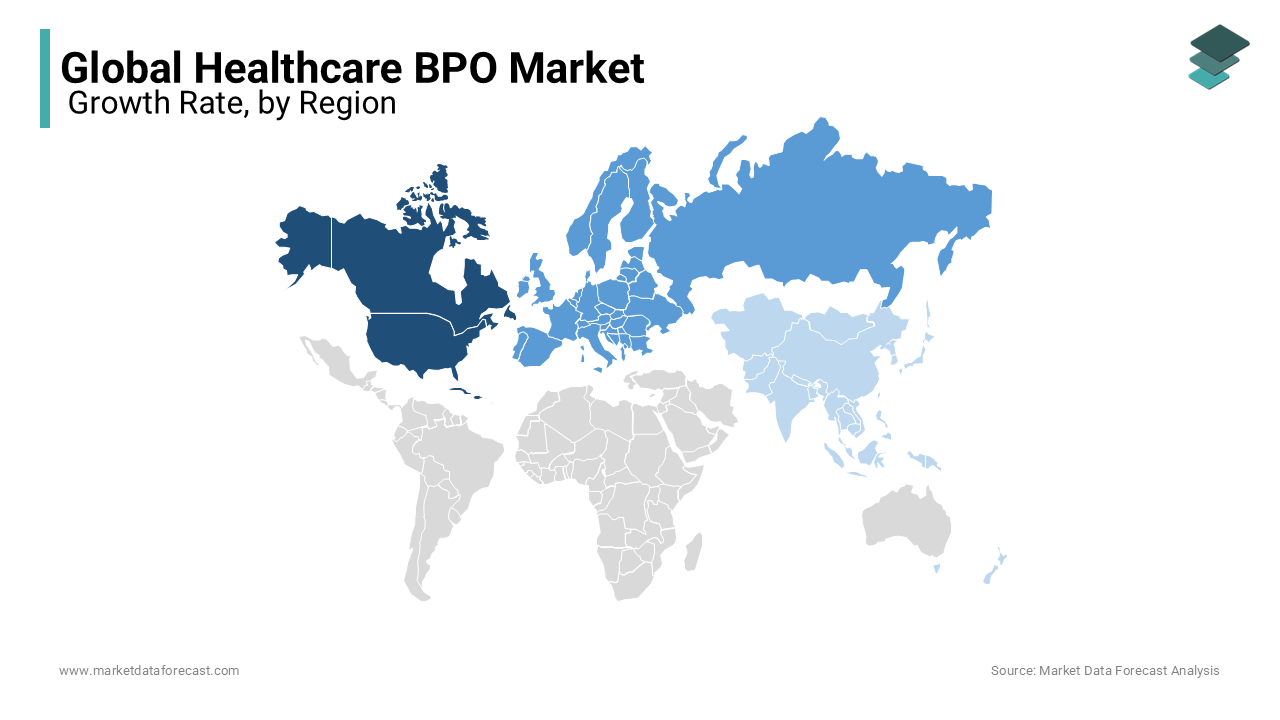
North America led the global healthcare BPO market at 41.3% in 2025. The region’s leadership is anchored in its highly complex, payer-driven healthcare system, where administrative costs account for a notable share of total healthcare spending. The United States alone processes over 12 billion healthcare transactions annually, creating massive demand for outsourced billing, coding, and claims management. With over 900 private insurers and a multi-payer model, interoperability and compliance are major challenges that many U.S. hospitals outsource at least one revenue cycle function. Additionally, the rapid adoption of value-based care models has increased demand for analytics and performance reporting services. Major BPO hubs in Canada, particularly in Toronto and Vancouver, support U.S. clients with bilingual (English-French) and compliant operations. The presence of global leaders like UnitedHealth Group, Cigna, and CVS Health drives continuous innovation in payer services.
Europe Healthcare BPO Market Insights
Europe is characterized by strong public healthcare systems and stringent data governance. The region’s market is driven by the need to improve administrative efficiency within budget-constrained national health services. In the UK, NHS England outsourced non-clinical functions in 2023, including patient scheduling, medical transcription, and financial management. The implementation of the General Data Protection Regulation (GDPR) has raised compliance standards, favoring BPO providers with robust data protection frameworks. Germany’s statutory health insurance system processes a significant number of claims annually, with increasing reliance on external agencies for fraud detection and digital transformation. The European Medicines Agency’s centralized authorization process has also increased demand for outsourced regulatory and pharmacovigilance services. However, linguistic and regulatory fragmentation across 27 member states complicates cross-border operations. Despite this, the push for digital health interoperability under the EU Digital Health Infrastructure initiative is creating new opportunities. With aging populations and rising chronic disease burdens, Europe’s focus on sustainable, efficient care delivery ensures steady demand for specialized BPO support.
Asia-Pacific Healthcare BPO Market Insights
Asia-Pacific is the fastest-growing region due to expanding healthcare infrastructure and cost advantages. India is the dominant hub, hosting a large number of healthcare BPO firms that serve clients in North America and Europe. The country’s skilled, English-speaking workforce and lower operational costs make it ideal for medical transcription, coding, and claims processing. China is emerging as a key player in pharmaceutical BPO, with Shanghai and Suzhou becoming centers for clinical trial data management and regulatory submissions. Japan’s aging population is driving demand for outsourced medical billing and patient support services. Additionally, government initiatives like India’s Digital India and Thailand’s Smart Health 2025 are accelerating digital adoption, increasing the need for BPO-enabled data management. With rising healthcare expenditure and a growing middle class, APAC is poised to become a primary engine of global BPO growth.
Latin America Healthcare BPO Market Insights
Latin America is gaining traction as a nearshore outsourcing destination for U.S. healthcare providers. Brazil and Mexico are the primary contributors, with Brazil’s public health system, Sistema Único de Saúde (SUS), outsourcing billing and data management to improve efficiency across 6,000+ hospitals. Mexico’s private healthcare sector is expanding rapidly, with many private hospitals adopting electronic health records and outsourcing revenue cycle functions to reduce administrative burdens. The country’s proximity to the U.S., cultural affinity, and bilingual workforce make it ideal for front-end services such as patient scheduling and insurance verification. Colombia and Chile are also developing BPO capabilities, with Medellín and Santiago emerging as regional hubs. However, regulatory fragmentation and data privacy concerns remain challenges. Despite this, the region’s cost competitiveness and geographic advantage are attracting investment.
Middle East and Africa Healthcare BPO Market Insights
The Middle East and Africa are developing strategic importance due to healthcare modernization initiatives. The Gulf Cooperation Council (GCC) countries, particularly the UAE and Saudi Arabia, are investing heavily in digital health infrastructure. Saudi Arabia’s Vision 2030 includes a healthcare transformation program, with significant outsourcing of medical billing, patient management, and analytics services. In South Africa, the National Health Insurance (NHI) program requires centralized claims processing and fraud detection, creating demand for outsourced payer services. The country has a notable number of registered healthcare providers, many of whom lack in-house administrative capacity. Egypt and Kenya are emerging as BPO hubs for Arabic-language medical transcription and telehealth support. However, limited digital infrastructure in rural areas and inconsistent data regulations hinder scalability.
KEY MARKET PLAYERS
Some of the notable companies playing a crucial role in the market of Healthcare BPO are Cognizant Technology Solutions Corporation (U.S.), Accenture PLC (U.S.), Genpact Limited, Tata Consultancy Services Ltd. (India), Infosys BPO Ltd. (India), and Xerox Corporation (U.S.).
TOP LEADING PLAYERS IN THE HEALTHCARE BPO MARKET
Cognizant
Cognizant has established a dominant presence in the Asia-Pacific healthcare BPO market through its integrated digital solutions and domain-specific service offerings. The company has deepened its regional engagement by launching healthcare analytics centers in Chennai and Bengaluru, supporting clients across Australia, Japan, and Southeast Asia with revenue cycle management, claims processing, and clinical data services. It has expanded its partnerships with public health systems, including a collaboration with Singapore’s Integrated Health Information Systems (IHiS) to streamline patient billing and insurance coordination. The company also invested in upskilling over 15,000 employees in healthcare compliance and digital health technologies across APAC. By integrating automation, cloud infrastructure, and regulatory expertise, Cognizant has positioned itself as a strategic enabler of digital transformation in healthcare administration, serving both provider and payer clients with scalable, compliant solutions.
Tata Consultancy Services (TCS)
Tata Consultancy Services has become a pivotal player in the Asia-Pacific healthcare BPO landscape by leveraging India’s skilled workforce and technological infrastructure to deliver end-to-end administrative outsourcing. TCS has developed specialized healthcare BPO units in Pune and Hyderabad that support medical billing, transcription, and revenue cycle operations for clients in Australia, Japan, and the Middle East. TCS has also partnered with the National Health Authority of India to manage backend operations for the Ayushman Bharat digital health mission, handling eligibility verification and claim settlements. The company has strengthened its compliance framework to align with GDPR, HIPAA, and India’s DPDP Act, enabling cross-border data processing. By combining scalable delivery models with advanced automation and public sector collaboration, TCS has solidified its role as a trusted partner in transforming healthcare administration across the region.
Wipro Enterprises (Wipro Holmes & Wipro BPM)
Wipro has significantly expanded its footprint in the Asia-Pacific healthcare BPO market through its dual focus on automation and domain specialization. Through its Wipro BPM and Holmes AI platforms, the company delivers services in medical coding, pharmacovigilance, and revenue cycle management to hospitals, insurers, and pharmaceutical firms across India, Australia, and Southeast Asia. The company has strengthened its regulatory capabilities by achieving HIPAA, ISO 27001, and GDPR certifications across its healthcare delivery centers. Wipro also collaborated with a major Thai hospital chain to digitize and outsource its entire billing and insurance verification process, improving claim accuracy by 41%. By investing in AI-augmented workflows and compliance infrastructure, Wipro has positioned itself as a technology-driven BPO provider capable of delivering high-accuracy, scalable solutions in complex healthcare environments.
TOP STRATEGIES USED BY KEY MARKET PARTICIPANTS
Key players in the healthcare BPO market are deploying a multi-pronged strategic approach centered on digital transformation, regulatory agility, and vertical integration. A primary strategy is the embedding of artificial intelligence and robotic process automation into core service offerings to enhance accuracy, reduce turnaround time, and lower operational costs. Firms like Cognizant and TCS are developing proprietary AI engines for claims processing, medical coding, and fraud detection, enabling real-time decision-making. Another critical strategy is geographic and functional expansion. Companies are establishing delivery centers in cost-efficient, talent-rich regions such as India, the Philippines, and Malaysia while expanding service portfolios to include value-based care analytics, pharmacovigilance, and telehealth support. Strategic partnerships with healthcare providers, insurers, and government agencies are being leveraged to secure long-term contracts and institutional trust. Additionally, vendors are investing heavily in compliance infrastructure to meet evolving data privacy regulations across jurisdictions, including HIPAA, GDPR, and national data laws. Upskilling workforces in clinical terminology, regulatory standards, and digital tools ensures service quality and retention. Cloud-based platforms are being adopted to enable seamless integration with client systems, improving interoperability. Lastly, mergers and acquisitions are being used to acquire niche capabilities in areas like health analytics and AI, allowing firms to offer end-to-end, future-ready solutions in an increasingly complex healthcare ecosystem.
COMPETITION OVERVIEW
Competition in the healthcare BPO market is intensifying as global providers navigate a landscape defined by regulatory complexity, technological disruption, and rising demand for operational efficiency. The market is dominated by large IT and BPM firms such as Cognizant, TCS, and Wipro, which leverage scale, automation, and global delivery models to serve multinational clients. However, specialized boutique firms focusing on niche areas like clinical trial data management or revenue cycle optimization are gaining traction by offering deeper domain expertise. The competitive edge increasingly lies in technological differentiation. Vendors with proprietary AI platforms for claims automation, predictive analytics, and real-time compliance monitoring are outperforming traditional labor-arbitrage models. Geographic proximity is also becoming a strategic factor, with nearshore providers in Latin America and Eastern Europe challenging offshore hubs. In the Asia-Pacific region, local players are emerging, combining cost advantages with cultural and linguistic alignment. Client expectations have evolved from cost reduction to strategic partnership, requiring BPO firms to offer consultative services, innovation roadmaps, and integrated digital ecosystems. Data security and regulatory compliance are key differentiators, particularly in markets with strict privacy laws. As healthcare systems worldwide face financial and administrative strain, the ability to deliver accurate, agile, and technologically advanced support determines competitive success, making innovation and trust the cornerstones of market leadership.
RECENT HAPPENINGS IN THE MARKET
- In June 2024, Access Healthcare, a supplier of healthcare business process outsourcing (BPO) services, intends to invest 190 crores in expanding its delivery operations and establishing a new campus in Chennai. The business revealed on Tuesday that it had purchased a 1.57-acre block of land in Chennai for roughly 50 crore rupees from an IT services provider to build a new campus for its BPO and IT activities. In addition, the business announced that it would demolish the current building and construct a campus with a working capacity of 7,000 employees spread across about 2.5 lakh square feet.
- In October 2024, the CCI granted Betaine B.V. approval on Monday to purchase Hinduja Global Solutions Ltd.'s global healthcare BPO services. According to a release, the deal entails Betaine purchasing certain assets, contracts, and employees from Hinduja Global Solutions and their global healthcare business process outsourcing (BPO) services.
- In May 2024, in the upcoming 12 months, Omega Healthcare wants to hire 18,000 specialists as it expands its operations in India. According to the company's statement, the expansion is anticipated to include operations in Bangalore, Chennai, and Hyderabad. The process has already begun thanks to the hiring of 4,500 professionals by the technology-enabled healthcare service provider over the next two months.
- In May 2024, since COVID-19 was first announced in Jamaica, the Global Services Sector (GSS) has created 12 new sites, hired close to 10,000 more people, and raised earnings to more than US$850 million yearly. However, the business wants more, according to Gloria Henry, head of the Global Services Association of Jamaica (GSAJ). To provide more senior industry roles, the GSAJ collaborates with its partners in large-scale company operations.
MARKET SEGMENTATION
This research report on the global healthcare BPO market has been segmented based on the provider service, payer service, pharmaceutical service, and region.
By Provider Service
- Medical Billing
- Medical Coding
- Medical Transcription
- Finance & Accounts
By Payer Service
- Claims Management
- Integrated Front-end Services and Back-office Operations
- Member Management
- Provider Management
- Billing and Accounts Management
- Analytics and Fraud Management
- H.R. Services
By Pharmaceutical Service
- Research and Development
- Manufacturing
- Non-clinical Services
- Sales and Marketing services
- Supply Chain Management
- Other Non-Clinical Applications
By Region
- North America
- Europe
- Asia Pacific
- Latin America
- Middle East and Africa