- Product Description Description
- Table of Contents TOC
- List of Table & Figure LOT
- Get Free Sample PDF Sample PDF
Market Size, 2025
$233.7 MnMarket Estimate, 2026
$243.8 MnMarket Forecast, 2034
$335.5 MnCAGR, 2026–2034
4.1%Executive Summary: Global Crop Oil Concentrates Market
- Market Scope: Comprehensive global evaluation of the agricultural crop oil concentrates (COC) industry, covering formulation variations, active spray applications, surfactant concentrations, crop types, and regional commercial farming landscapes.
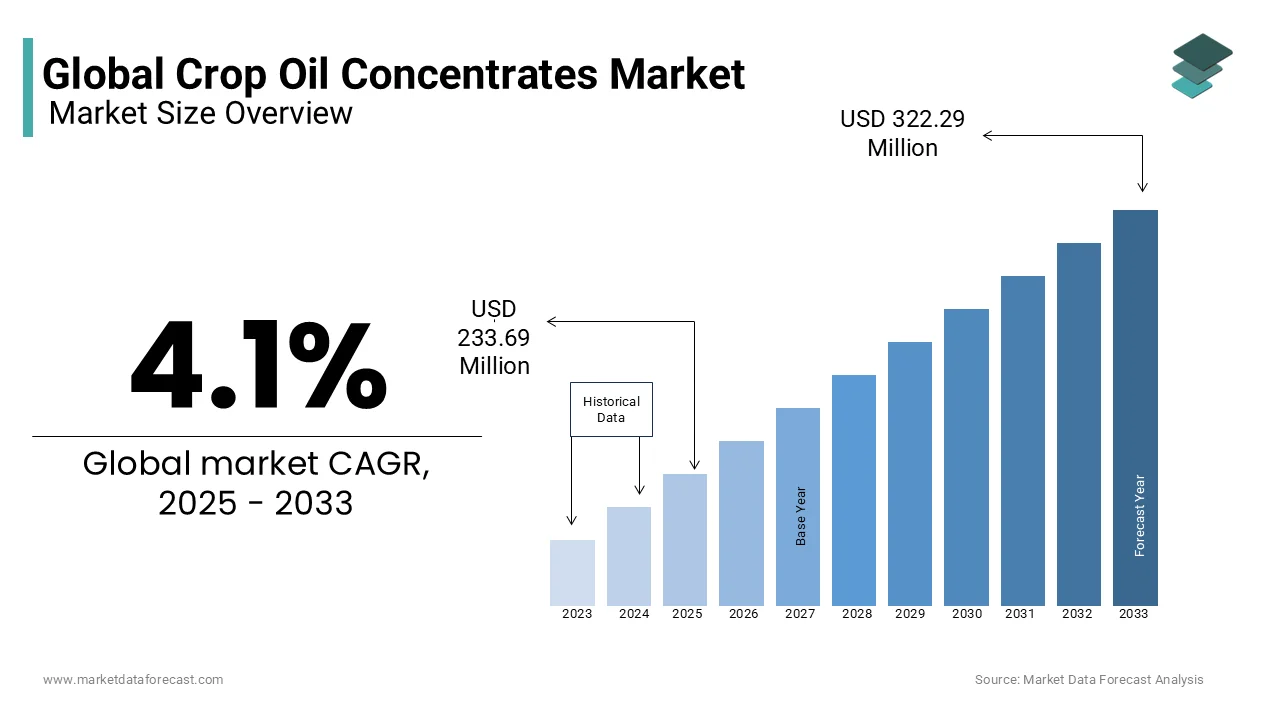
- Market Valuation: Valued at USD 233.69 million in 2025, reaching USD 243.79 million in 2026, and projected to expand up to USD 335.50 million by 2034, registering a steady CAGR of 4.1% from 2026 to 2034.
- Primary Growth Drivers: High preference for concentrated surfactant oils acting as activators/stabilizers to boost surface contact and penetration; mass adoption of glyphosate-tolerant biotech crops; and the necessity to minimize pesticide volume use per hectare. Market restraints include raw material price volatility, phytotoxic risks from petroleum-based oils, and intensifying substitution competition from vegetable oil concentrates and non-ionic surfactants.
Key Market Segment Metrics (2026–2034)
| Category | Leading Segment (Base Position) | Fastest-Growing Segment |
|---|---|---|
| By Application | Herbicides (dominates market share owing to widespread weed management and weak-acid herbicide enhancement) | Fungicides (experiencing rapid growth due to increasing parasitic fungal threats and leaf penetration needs) |
| By Crop Type | Cereals & Grains (holds significant base volume share through extensive staple food cultivation) | Oilseeds & Pulses (scaling rapidly via commercial demand for soybeans, canola, cotton, and sunflower crops) |
| By Surfactant Concentration | Between 15% and 25% (standard formulation standard across conventional paraffin-based petroleum oil blends) | More than 25% High-Surfactant Oils (growing fast through high-performance tank-mixing requirements) |
| By Region | North America (leads global market value driven by strong local agrochemical producer footprints) | South America / Latin America (projected as the fastest-growing market due to broad biotech crop adoption) |
Major Market Players & Market Structure
Market Structure: Fragmented yet competitive agrochemical adjuvant sector featuring specialized chemical manufacturers, agricultural input distributors, and customized tank-mix solution providers leveraging precision drone technology and bio-based formulations.
Key Companies: Wilbur-Ellis Company LLC, KALO, Innvictis Crop Care, Winfield United, Loveland Products Inc, Precision Laboratories, Plant Health Technologies, Brandt Consolidated Inc, Croda International, and Helena Agri-Enterprises.
 Download Free Sample Report
Global Crop Oil Concentrates Market Size
The global crop oil concentrates market size was valued at USD 233.69 million in 2025 and is anticipated to reach USD 243.79 million in 2026 and USD 335.50 million by 2034, growing at a CAGR of 4.1% from 2026 to 2034.
Corporal oil concentrate is used in agricultural chemicals to improve penetration of waxy cuticles and leaf tops and reduce spray volume loss due to evaporation. These products normally contain at least 80% oil and 15% emulsifier. Premium products contain 20% emulsifiers for high performance. Agricultural concentrates are mainly used for pesticides, herbicides, and fungicides. Crop oil concentrate is a blend of surfactants derived from petroleum-based oils. Crop oil concentrate has important properties that increase the strength and quality of herbicides. It is also an important substance that is used in disinfectants. Farmed milk concentrates are creating more demand in the agricultural industry due to their phytosanitary properties.
Also, since the effect of pesticide spraying increases, concentrates are also used for pesticide applications. Crop oil concentrates are obtained from paraffin-based petroleum oils, which makes them considered petroleum-based oils. It is different from vegetable oil concentrates with similar functions. The crop oil concentrate is applied in 1% by volume herbicide. Herbicides are used primarily to prevent the growth of unwanted plant species, including weed species. Crop oil concentrate can increase the effectiveness of weakly acid herbicides like Classic, Accent, Basa Gran, Chase, etc. The Crop Oil Concentrates market is driven primarily by the growing need to reduce pesticide use per hectare, increasing preference for common pesticides, and rising adoption of herbicide-tolerant crops.
MARKET DRIVERS
The market for crop oil concentrates is driven by the growing preference for highly concentrated surfactant oils in the agricultural industry. High-surfactant oils act as activators or stabilizers to enhance the physical properties of various spray solutions. Surfactants play an important role in this activity because they increase the surface contact between the two liquids, thus increasing the rate of penetration of various spray solutions. In addition, the crop oil concentrate is a viable solution for pesticides and fungicides. It is a fungicide that is used more and more especially for various crops. Parasitic fungi are one of the dangerous fungi that cause serious damage to crops.
The growth oil concentrate increases the penetration rate of the fungicide by reducing the surface tension between the fungicide spray and the plant leaves. The herbicide and pesticide activity that is grown in agriculture is also one of the driving forces behind crop oil concentrates. In the agricultural industry, weed species and unwanted plants are essential because they grow faster on farmland and reduce soil fertility. The tremendous increase in the crop oil concentrate industry during the foreseen period is due to the massive acceptance of glyphosate-tolerant crops and the huge demand for conventional pesticides that require tank mixing aids. In addition to this, the huge need to minimize the use of pesticides per hectare of land will further highlight the growth of the crop oil enrichment industry, according to the forecast schedule.
As the demand for herbicides and fungicides grows around the world, market participants will have a beneficial opportunity in the global market for crop oil concentrates during the foreseeable period. The use of fungicides and pesticides is on the rise as the agricultural industry faces problems of land degradation that affect crop yields. This provides a better market scenario for manufacturers in the global crop oil concentrate market. Besides, the increasing adoption of herbicide-tolerant crops presents significant opportunities for key players operating in the crop oil concentrate market during the forecast period. Due to its leading role in increasing the efficiency of pesticides and the growth of the generic pesticide market, the agricultural condensed oil market has seen significant growth due to factors such as high acceptance and others. Technological advancements, including the adoption of drones and other precision agriculture methods in the field of crop protection and nutrition, will provide enormous growth potential for the market for crop oil concentrates.
MARKET RESTRAINTS
However, the growing negative impact of crops on petroleum-based oils is hampering the global market for crop oil concentrates. Fluctuations in raw material prices and intensifying competition with plant-based concentrates are supposed to limit the overall growth of the crop oil concentrates market. The use of non-ionic surfactants and other adjuvants, such as vegetable oil concentrates, to be used in place of crop oil concentrates is a major limitation to market growth.
REPORT COVERAGE
| REPORT METRIC | DETAILS |
| Market Size Available | 2025 to 2034 |
| Base Year | 2025 |
| Forecast Period | 2026 to 2034 |
| CAGR | 4.1% |
| Segments Covered | By Application, Type of Crop, Surfactant Concentration, and Region. |
| Various Analyses Covered | Global, Regional & Country Level Analysis, Segment-Level Analysis, DROC, PESTLE Analysis, Porter’s Five Forces Analysis, Competitive Landscape, Analyst Overview on Investment Opportunities |
| Regions Covered | North America, Europe, APAC, Latin America, Middle East & Africa |
| Market Leaders Profiled | Wilbur-Ellis Company LLC, KALO, Innvictis Crop Care, Winfield United, Loveland Products Inc, Precision Laboratories, Plant Health Technologies, Brandt Consolidated Inc, Croda International,l and Helena Agri-Enterprises and Others. |
SEGMENTAL ANALYSIS
By Application Insights
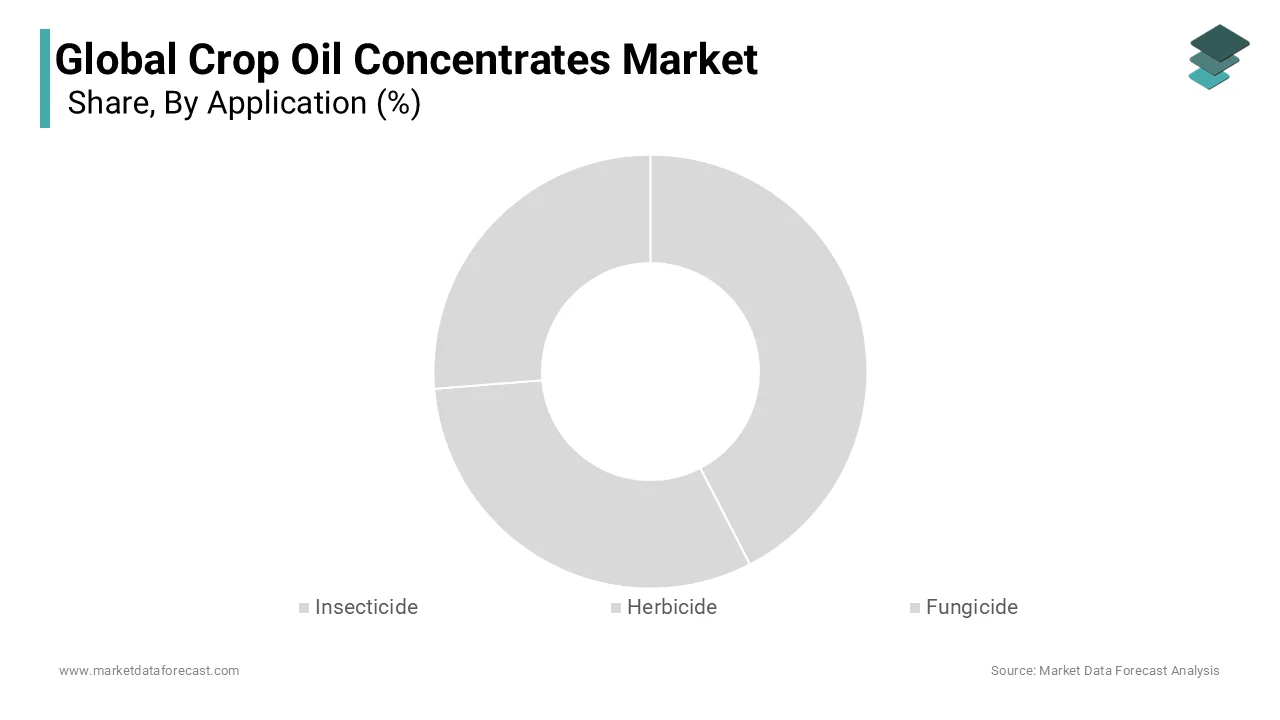
The world market for crop oil concentrates is segmented into pesticides, herbicides, and fungicides. The herbicide sector is supposed to experience profitable growth duringthe foreseeablen period. This is due to the increased area under cultivation of herbicide-tolerant crops and the high tolerance of weeds to herbicide formulations.
By Type of Crop Insights
The crop Oil Concentrates market is segmented into oilseeds and legumes, cereals and grains, and fruits and vegetables. The oilseeds and legumes segment held the second-largest share in 2020. This is driven by growing demand for crops such as cotton, canola, soybeans, and sunflowers in the developing world and growing importance as a commercial crop for commercial purposes. Industrial. The production of oil crops such as copra, cottonseed, and palm kernel has increased significantly over the years.
By Surfactant Concentration Insights
The market is segmented into 15% to 25%, less than 15%, and more than 25%. COC is a blend of surfactants and excellent agricultural spray oils that have no phytotoxicity. Different concentrations are used depending on the required application.
REGIONAL ANALYSIS
North America Market Analysis
North America leads the global crop oil concentrates market by showing the highest value share due to the high position of local agricultural condensed oil producers. After South Asia, North America also has a significant share in the global market value, and the main reason is the growth of the agricultural industry in the region.
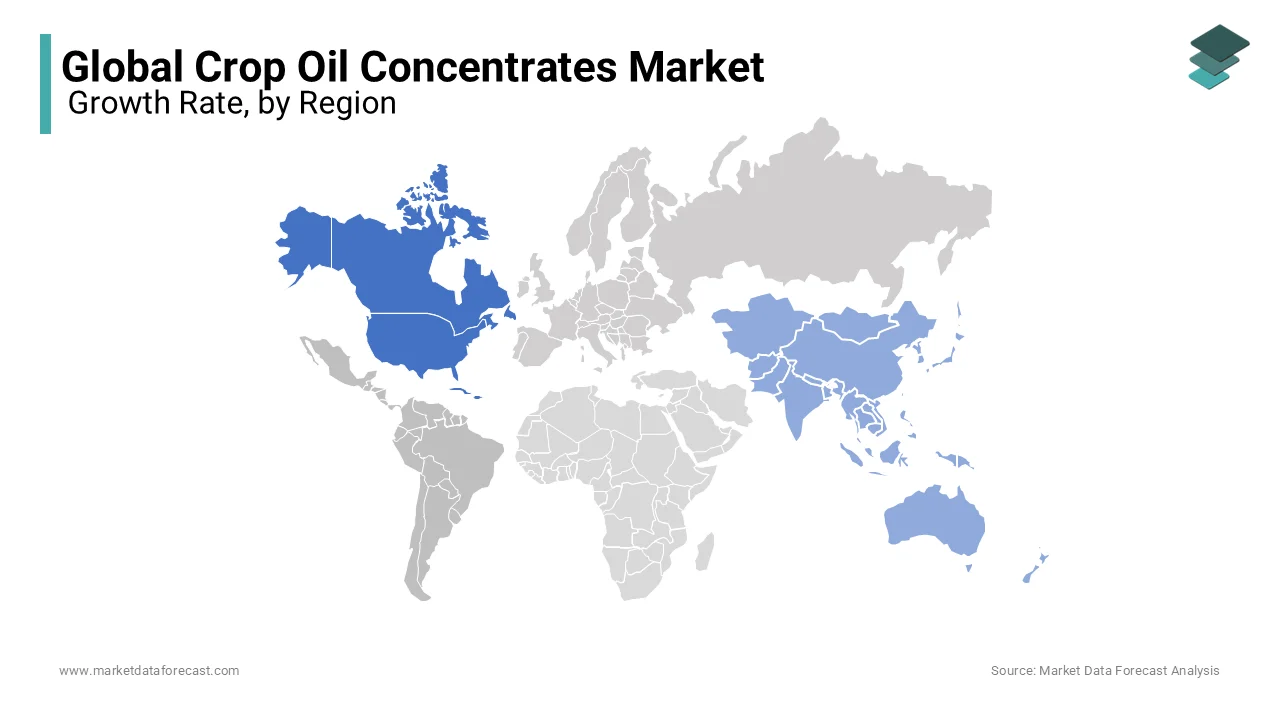
South America is foreseen to be the fastest-growing market during the conjecture period. Market growth in South America is driven by the increasing adoption of glyphosate-tolerant biotech crops such as corn and soybeans. Also, the regulatory framework for supplements is quite inconsistent in this region compared to North America and Europe. Therefore, industry players are taking advantage of this market to launch new supplements, including Crop Oil Concentrates.
KEY MARKET PLAYERS
These are the market players that are dominating the global crop oil concentrate market.
- Wilbur-Ellis Company LLC
- KALO
- Innvictis Crop Care
- Winfield United
- Loveland Products Inc
- Precision Laboratory
- Plant Health Technologies
- Brandt Consolidated Inc
- Croda International
- Helena Agri-Enterprises.
RECENT MARKET NEWS
- In October 2019, Kemin Crop Technologies launched a new concentrated crop oil product. The company has now introduced vegetable oil-based contact fungicides, TetraCURB Organic and TetraCURB Concentrate, to make agricultural ingredients.
- In October 2019, BioWorks Inc., a provider of nutritional and biological control products, launched a new concentrated crop oil product. SuffOil-X Spray Oil Emulsion is provided for the Canadian market, helping to protect crops from mites, fungi, insects, and more.
MARKET SEGMENTATION
This research report on the global oil concentrates market is segmented and sub-segmented into the following categories.
By Application
- Insecticide
- Herbicide
- Fungicide
By Crop Type
- Oil seeds & pulses
- Cereals & grains
- Fruits & vegetables
By Surfactant concentration
- Between 15% and 25%
- Less than 15%
- More than 25%
By Region
- North America
- Europe
- Asia Pacific
- Latin America
- Middle East & Africa