- Product Description Description
- Table of Contents TOC
- List of Table & Figure LOT
- Get Free Sample PDF Sample PDF
Market Size, 2025
$2.75 BnMarket Estimate, 2026
$3 BnMarket Forecast, 2034
$6.02 BnCAGR, 2026–2034
9.1%Global Cryotherapy and Cryosurgery Market Size, Growth, Trends & Forecast (2026–2034)
The global cryotherapy and cryosurgery market was valued at USD 2.75 billion in 2025, is anticipated to reach a valuation of USD 3.00 billion in 2026, and is projected to expand up to USD 6.02 billion by 2034, growing at a compound annual growth rate (CAGR) of 9.1% from 2026 to 2034. Propelled by the rising incidence of cancer, growing awareness of dermatological treatments, and continuous technological innovations in minimally invasive procedures, the market demonstrates robust expansion.
Key Executive Metrics (At-a-Glance)
- 2025 Base Valuation: USD 2.75 Billion
- 2026 Current Valuation: USD 3.00 Billion
- 2034 Forecast Valuation: USD 6.02 Billion
- Compound Annual Growth Rate (CAGR): 9.1% (2026–2034)
- Dominant Technique Segment: CryoProbe (Significant growth from precision tissue treatments)
- Dominant Application Segment: Cancer Therapy (Largest sector, with skin diseases as the fastest-growing)
- Dominant Device Segment: Cryogun (Dominates overall market sales share)
- Leading Regional Market: North America (Holding nearly 69% of global cryotherapy centers)
Core Market Drivers
- Minimally Invasive Advantages: Minimal postoperative risk, reduced blood loss, shorter hospital stays, and lower chances of damaging healthy tissues compared to traditional surgery.
- Rising Chronic Diseases & Skin Awareness: Increasing prevalence of cancers (prostate, cervical, liver) and heightened awareness of skin disorders requiring targeted cryogenic removal.
Primary Market Restraints & Challenges
- Clinical Evidence Gaps: Limited long-term scientific data regarding cryosurgery's efficacy for certain early-stage cancers.
- Potential Complications & Restrictions: Uncontrolled freezing risks leading to nerve damage, scarring, swelling, and safety restrictions regarding use in children, pregnant women, or hypertension patients.
Global Cryotherapy and Cryosurgery Market Segmentation Breakdown
| Segment Category | Leading Sub-Segment (2025 Base) | Growth Dynamics |
|---|---|---|
| By Technique | CryoProbe | Substantial growth via high-pressure argon gas or liquid nitrogen needle-like applicators. |
| By Type | Cryosurgery | Most common treatment type; icepack therapy growing rapidly for acute trauma. |
| By Application | Cancer Therapy | Most widely used sector, while skin disease applications expand rapidly due to technological upgrades. |
| By Devices | Cryogun | Dominates overall sales share due to widespread application in cancer and dermatology. |
Major Industry Players Profiled
Key global market leaders include Galil Medical, Inc., HealthTronics, Inc., KryoLife, Inc., Medtronic, GRAND Cryo LLC, Impact Cryotherapy, Erbe USA, Wallach Surgical Devices, MedGyn Products, Inc., and CoolTouch, Inc.
 Download Free Sample Report
Global Cryotherapy and Cryosurgery Market Size
The global cryotherapy and cryosurgery market size was valued at USD 2.75 billion in 2025, and it is expected to reach USD 6.02 billion by 2034 from USD 3 billion in 2026, growing at a CAGR of 9.1%. This growth is expected from 2026 to 2034.

Cryotherapy and cryosurgery are medical technologies that utilize extreme cold temperatures to destroy abnormal or diseased tissue through controlled freezing processes. This therapeutic approach serves as a minimally invasive alternative to traditional surgery for treating various conditions, including skin lesions, cancers,s and chronic pain. According to the World Health Organization, cancer remains a leading cause of death globally, ly with an estimated 10 million deaths in 2,020 which drives the demand for effective and less invasive treatment modalities like cryosurgery. Healthcare providers increasingly adopt cryotherapy devices due to their precision and ability to preserve surrounding healthy tissue. Regulatory bodies support the adoption of these devices by recognizing their clinical efficacy and safety profiles.
MARKET DRIVERS
Rising Prevalence of Skin Cancers and Lesions
The increasing incidence of skin cancers is expanding the patient base requiring effective and cosmetically friendly treatment options, which is driving the growth of the cryotherapy and cryosurgery market. Dermatologists frequently employ cryosurgery for basal cell carcinoma, squamous cell carcinoma, ma and actinic keratosis due to its high success rate and minimal scarring. As per the Skin Cancer Foundation, more than 5.4 million cases of non-melanoma skin cancer are treated in the United States each year, which creates consistent demand for cryotherapy devices in dermatology clinics. Additionally, the British Association of Dermatologists states that skin cancer diagnoses have increased by 60% over the past decade due to aging populations and increased UV exposure. These trends drive healthcare facilities to invest in advanced cryosurgery equipment to manage the growing volume of cases efficiently. The procedure offers a quick outpatient solution that appeals to patients seeking convenience and aesthetic preservation. Manufacturers respond by developing portable and precise cryoprobes that enhance clinical workflow and patient comfort. The correlation between rising skin cancer rates and device adoption remains strong as practitioners prioritize treatments that balance efficacy with quality of life.
Preference for Minimally Invasive Procedures
The growing patient preference for minimally invasive interventions,ons by shifting treatment paradigms away from open surgical operations, ions is additionally accelerating the growth of the cryotherapy and cryosurgery market. Patients increasingly seek procedures that involve smaller incisions, reduced pain,n and faster recovery times, es which cryosurgery effectively provides. These clinical benefits drive adoption among both patients and healthcare providers who aim to optimize resource utilization and improve satisfaction. Hospitals benefit from reduced bed occupancy rates and lower staffing requirements for post-operative care. Insurance providers often favor these procedures due to lower overall costs, which encourages reimbursement coverage.
MARKET RESTRAINTS
High Cost of Advanced Cryosurgery Equipment
The elevated acquisition and maintenance costs, by limiting access for smaller healthcare facilities and developing regions, are hindering the growth of the cryotherapy and cryosurgery market. Advanced cryosurgery systems require sophisticated cooling mechanisms, imaging integration,n and precision controls, ls which result in high initial investment requirements. Additionally, the World Bank states that healthcare expenditure per capita in low-income countries remains below 100 dollars annually, which restricts the ability of these nations to procure expensive medical technologies. This price disparity creates unequal access to modern treatments and slows market penetration in emerging economies. Facilities often delay upgrades due to budget constraints, leading to reliance on older,r less efficient methods. The high cost of disposable cryoprobes further adds to the operational expense burden. Manufacturers face pressure to reduce prices, but research and development expenses remain substantial.
Lack of Reimbursement Policies in Certain Regions
The inconsistent reimbursement frameworks, creating financial uncertainty for providers and patients in various jurisdictions, are another factor limiting the growth of the cryotherapy and cryosurgery market. Many insurance plans do not fully cover cryosurgery procedures, especially for newer indications or off-label uses, which discourages adoption. The reimbursement rates for cryoablation vary significantly by state and procedure type,e leading to confusion and administrative burdens for healthcare providers. Furthermore, the private insurers in Europe exclude experimental cryotherapy treatments from coverage, which limits patient access to innovative applications. Providers hesitate to invest in equipment without guaranteed revenue streams from insured procedures. The lack of standardized coding for newer cryogenic applications further complicates billing processes.
MARKET OPPORTUNITIES
Expansion into Pain Management Applications
The penetration into the pain management sector by addressing the global crisis of chronic pain and opioid dependence is expected to escalate new opportunities for the growth of the cryotherapy and cryosurgery market. Cryoanalgesia offers a non-addictive alternative for treating nerve-related pain by temporarily disabling pain signals without permanent damage. Additionally, the World Health Organization states that opioid overdoses cause more than 70000 deaths annually in North America, prompting healthcare systems to seek safer pain relief methods. These public health concerns drive demand for cryotherapy devices that can provide long-lasting relief through targeted nerve freezing. Clinics specializing in pain management are increasingly adopting cryoablation for conditions such as trigeminal neuralgia and back pain. The procedure offers a minimally invasive option with fewer side effects than systemic medications. Companies that develop specialized probes for nerve targeting can capture this growing segment. The opportunity lies in educating physicians about the efficacy of cryoanalgesia and securing insurance coverage for these indications.
Technological Integration with Imaging Systems
The advancements in image-guided cryosurgery, by enhancing procedural accuracy and safety for complex internal tumors, are another factor to promote the growth of the cryotherapy and cryosurgery market. Integrating cryoprobes with real-time imaging modalities such as MRI and ultrasound allows physicians to monitor ice ball formation and ensure complete tumor coverage. Moreover, the Journal of Magnetic Resonance Imaging publishes research indicating that real-time thermal monitoring reduces the risk of damage to adjacent healthy organs during cryosurgery. These technological improvements enable the treatment of previously inoperable tumors and expand the clinical utility of cryotherapy. Manufacturers can differentiate their products by offering seamless integration with existing hospital imaging infrastructure. The demand for hybrid operating rooms equipped with advanced visualization tools is rising globally. This synergy between imaging and cryogenics appeals to surgeons seeking greater control and confidence during procedures.
MARKET CHALLENGES
Risk of Tissue Damage and Complications
The potential complications related to unintended tissue damage are raising safety concerns among clinicians and patients, which is likely to slow the growth of the cryotherapy and cryosurgery market. Improper application of extreme cold can lead to nerve injury, bleeding,g or damage to surrounding healthy structures, es which may result in legal liabilities. Additionally, urinary incontinence occurs in patients undergoing prostate cryosurgery, which affects quality of life and patient satisfaction. These risks necessitate extensive training and expertise, which limits the number of qualified practitioners. Hospitals must invest in simulation training and proctoring programs to ensure safe implementation. Negative outcomes can damage the reputation of the technology and deter adoption. Manufacturers face the challenge of designing failsafe mechanisms and better temperature sensors to mitigate these risks. The fear of complications also influences insurance underwriting and patient consent processes.
Limited Awareness Among General Practitioners
The insufficient awareness and training among general practitioners and community healthcare providers is attributed to limiting the growth of the cryotherapy and cryosurgery market. Many primary care physicians are unfamiliar with the latest indications and benefits of cryosurgery, leading to underutilization of the technology. This knowledge gap results in missed opportunities for early intervention and directs patients toward more invasive traditional surgeries. Specialists often bear the burden of educating referring doctors, which slows down patient flow. Manufacturers must invest in educational outreach and partnership programs to bridge this information deficit.
REPORT COVERAGE
| REPORT METRIC | DETAILS |
| Market Size Available | 2025 to 2034 |
| Base Year | 2025 |
| Forecast Period | 2026 to 2034 |
| Segments Covered | By Technique, Type, Application, Devices, and Region |
| Various Analyses Covered | Global, Regional & Country-Level Analysis, Segment-Level Analysis, Drivers, Restraints, Opportunities, Challenges; PESTLE Analysis; Porter's Five Forces Analysis, Competitive Landscape, Analyst Overview of Investment Opportunities |
| Regions Covered | North America, Europe, Asia Pacific, Latin America, Middle East & Africa |
| Market Leader Profiled | Galil Medical, Inc., HealthTronics, Inc., KryoLife, Inc., Medtronic, GRAND Cryo LLC |
SEGMENTAL ANALYSIS
By Technique Insights
The cryoprobe segment was the largest, holding 55.6% of the cryotherapy and cryosurgery market share in 2025 due to its precision and versatility in treating internal tumors and deep tissue lesions. This technique allows for controlled delivery of extreme cold directly to the target area while minimizing damage to surrounding healthy structures. These clinical outcomes drive widespread adoption in hospitals and specialized clinics. The ability to monitor temperature in real time ensures safety and efficacy during complex procedures. Manufacturers focus on developing thinner and more flexible probes to access difficult anatomical locations. Healthcare providers prefer cryoprobes for their reliability and consistent performance in diverse surgical settings.
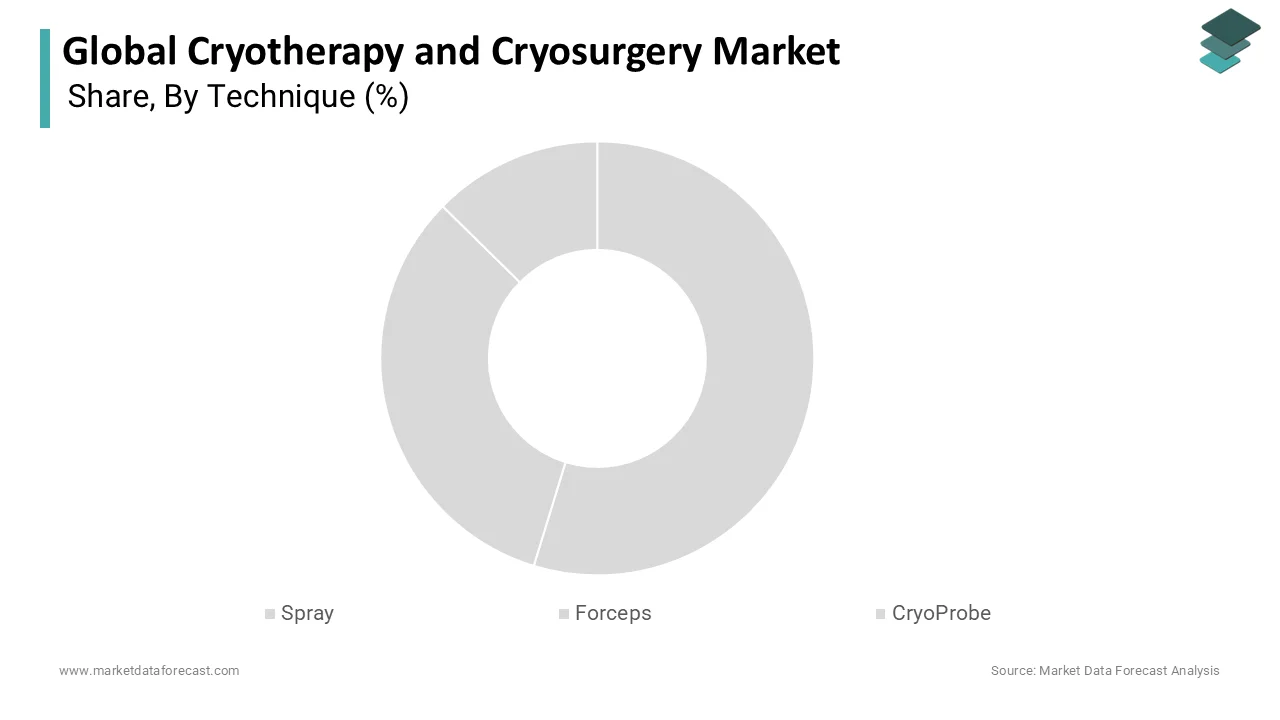
The spray segment is projected to grow at the fastest CAGR of 8.5% throughout the forecast period due to its ease of use in dermatology and outpatient settings. Cryospray devices allow for rapid treatment of superficial lesions such as warts, actinic keratoses,s and skin tags without the need for direct contact. The non-contact nature of spray application reduces the risk of cross-contamination, which is a significant advantage in high-volume clinics. Technological advancements have improved the consistency of spray patterns by ensuring uniform freezing.
By Type Insights
The cryosurgery segment was the largest, holding 57.7% of the Cryotherapy and Cryosurgery Market share in 2025, with its established role in treating malignant and benign tumors across multiple medical specialties. This therapeutic type involves the deliberate destruction of tissue using extreme cold and is widely recognized for its efficacy in oncology, urology,y and gynecology. These statistics drive continuous investment in cryosurgical infrastructure by hospitals. The procedure offers a viable alternative for patients who are not candidates for traditional surgery due to comorbidities. Reimbursement policies generally favor cryosurgery due to its proven outcomes and cost-effectiveness. Manufacturers prioritize this segment because it represents the core revenue stream for cryogenic equipment.
The cryogenic chamber therapy segment is expected to grow at the fastest CAGR of 12.2% from 2026 to 2034 due to rising interest in whole body cryotherapy for wellness and sports recovery. This type involves exposing the entire body to extremely cold air for short periods to reduce inflammation and muscle soreness. These trends expand the market beyond traditional medical settings into consumer health. Athletes and fitness enthusiasts seek cryogenic therapy for its purported benefits in enhancing performance and accelerating repair. The visibility of celebrities and athletes using these chambers further boosts public awareness and acceptance. Manufacturers are developing safer and more user-friendly chambers to cater to this growing demographic.
By Application Insights
The cancer therapy segment accounted for 48.6% of the Cryotherapy and Cryosurgery Market share in 2025 due to the high prevalence of malignancies and the need for effective minimally invasive treatment options. Cryoablation is widely used for prostate, liver, kidney, eye, and lung cancers, ers where it offers tumor control with preserved organ function. As per the World Health Organization, cancer incidence is expected to rise by 50% by 2040, which will significantly increase the demand for ablative therapies like cryosurgery. Additionally, the American Society of Clinical Oncology states that cryoablation is recommended as a first-line treatment for small renal masses in patients who are poor surgical candidates. These clinical guidelines drive adoption in major medical centers. Hospitals prioritize cancer therapy applications because they address a critical unmet need in oncology.
The skin disease segment is expected to grow at the fastest CAGR of 9.8% from 2026 to 2034 with the increasing diagnosis of benign and premalignant skin conditions. Cryotherapy is the gold standard for treating warts, actinic keratosis, and seborrheic keratosis due to its simplicity and effectiveness. Actinic keratosis affects more than 58 million Americans, which creates a massive pool of patients requiring regular treatment. Moreover, the British Journal of Dermatology states that the incidence of non-melanoma skin cancer has doubled in the past two decades due to aging populations and UV exposure. These epidemiological trends drive frequent visits to dermatology clinics. Primary care physicians are also increasingly trained to perform cryotherapy for common skin lesions, which expands access. The low cost and quick turnaround of skin disease treatments make them attractive for high-volume practices. Patients prefer cryotherapy for skin conditions because it avoids scarring and requires no anesthesia.
By Devices Insights
The probes segment was the largest, capturing 34.2% of the Cryotherapy and Cryosurgery Market share in 2025 with their essential role in internal ablation procedures. Cryoprobes are reusable or single-use devices that deliver refrigerant directly to the target tissue under imaging guidance. These functional advantages drive consistent demand from surgical centers. Manufacturers invest heavily in probe design to improve thermal conductivity and flexibility. The segment leads because probes are consumable or semi-consumable items that generate recurring revenue. Hospitals must maintain an inventory of various probe sizes to handle different clinical scenarios.
The cryogun segment is anticipated to grow at the fastest CAGR of 10.5% from 2026 to 2034 due to its widespread use in dermatology and minor surgical procedures. Cryoguns are handheld devices that deliver a controlled spray of refrigerant for treating superficial lesions. These adoption rates drive rapid market expansion. The compact size and lower cost of cryoguns make them accessible to a wider range of healthcare providers. Technological improvements have enhanced the precision of spray delivery, reducing waste.
COUNTRY LEVEL ANALYSIS
North America Cryotherapy And Cryosurgery Market Analysis
North America was the top performer in the global cryotherapy and cryosurgery market,y accounting for 35.4% of the share in 2025, with advanced healthcare infrastructure and high adoption of minimally invasive techniques. The United States accounts for the largest share due to favorable reimbursement policies and a high prevalence of cancer and skin diseases. As per the American Cancer Society, over 1.9 million new cancer cases are diagnosed annually in the US, which drives demand for effective ablation therapies. Additionally, the Centers for Medicare and Medicaid Services states that coverage for cryosurgical procedures has expanded to include newer indications,s which encourages provider adoption. The presence of major medical device manufacturers in the region fosters innovation and rapid commercialization of new products. High healthcare expenditure per capita allows hospitals to invest in advanced cryosurgical systems. The strong regulatory framework ensures safety and efficacy, which builds consumer trust. Academic medical centers play a key role in training physicians and conducting clinical trials.
Europe Cryotherapy And Cryosurgery Market Analysis
Europe cryotherapy and cryosurgery market accounted for 23.2% of the share in 2025, with strict regulatory standards and a growing emphasis on cost-effective healthcare solutions. Germany, France, and the United Kingdom lead regional adoption due to well-established healthcare systems and high awareness of minimally invasive treatments. As per the European Society of Radiology, the use of image-guided cryoablation has increased by 20% in major European hospitals as part of efforts to reduce hospital stays. These factors drive demand for precise and efficient cryogenic devices. Reimbursement varies by country but generally supports established procedures. The aging population in Europe contributes to a higher incidence of chronic conditions requiring intervention. Manufacturers focus on complying with the Medical Device Regulation, which ensures high quality standards. The region benefits from strong research collaborations and clinical expertise.
Asia Pacific Cryotherapy And Cryosurgery Market Analysis
Asia Pacific cryotherapy and cryosurgery market growth is likely to grow at the fastest CAGR during the forecast period with improving healthcare access and rising disease prevalence. China, Japan, and India lead regional growth due to large populations and increasing investment in medical infrastructure. As per the World Health Organization, cancer incidence in Asia is projected to increase by 40% by 2030, which creates urgent demand for affordable treatment options like cryosurgery. Additionally, the Asian Society of Clinical Oncology states that government initiatives in China have subsidized the purchase of medical equipment for rural hospitals, which boosts adoption of cryogenic devices. The rising middle class is also driving demand for aesthetic dermatological procedures,s including cryotherapy for skin lesions. Local manufacturers are entering the market with cost-competitive products. Medical tourism in countries like Thailand and Singapore further stimulates demand for advanced treatments.
Latin America Cryotherapy And Cryosurgery Market Analysis
Latin America cryotherapy and cryosurgery market growth is likely to grow with economic stabilization and healthcare reforms. Brazil and Mexico lead regional adoption due to larger healthcare budgets and growing private insurance coverage. Additionally, the Brazilian Ministry of Health states that public hospitals are increasingly incorporating minimally invasive techniques to manage patient volumes efficiently. These efforts drive demand for cost-effective cryosurgical solutions. The presence of international device distributors improves access to technology in major cities. However, economic volatility and currency fluctuations pose challenges for consistent procurement. Private clinics in urban centers are early adopters of advanced cryotherapy for aesthetic and oncological purposes.
Middle East and Africa Cryotherapy And Cryosurgery Market Analysis
The Middle East and Africa cryotherapy and cryosurgery market growth is driven by healthcare modernization efforts. The United Arab Emirates and South Africa lead regional adoption due to investment in world-class medical facilities and medical tourism. Additionally, the African Union reports that initiatives to combat cervical cancer have led to the introduction of cryotherapy devices in primary care clinics in several countries. These public health programs drive demand for simple and effective cryogenic tools. The region faces challenges related to skilled workforce shortages and infrastructure gaps in rural areas. However, partnerships with global manufacturers are helping to bridge these gaps. The focus on reducing the burden of disease through preventive and minimally invasive care supports market development.
COMPETITIVE LANDSCAPE
The competitive landscape of the Cryotherapy and Cryosurgery Market features intense rivalry among established medical device giants and specialized niche players striving for technological superiority. Major manufacturers compete on multiple fronts, including device precision, ease of use,e clinical evidence, and brand reputation to capture physician loyalty. Companies invest significantly in clinical trials to demonstrate superior outcomes and safety profiles compared to alternative therapies. Strategic alliances with distributors and healthcare providers accelerate market penetration in both developed and emerging regions. Price competition remains moderate due to the specialized nature of the equipment, but value-based purchasing is becoming more common. Manufacturers also compete on service quality by offering extensive training and technical support. Regulatory compliance drives competition as companies race to obtain approvals for new indications.
KEY MARKET PLAYERS
Some of the companies that are playing a dominating role in the Global Cryotherapy and Cryosurgery Market include:
- Impact Cryotherapy
- Galil Medical, Inc.
- HealthTronics, Inc.
- KryoLife, Inc.
- Medtronic
- GRAND Cryo LLC
- Erbe USA
- Wallach Surgical Devices
- MedGyn Products, Inc.
- CoolTouch, Inc.
TOP LEADING PLAYERS IN THE MARKET
- Medtronic plc maintains a strong presence in the cryotherapy sector through its extensive portfolio of ablation technologies for oncology and cardiology. The company focuses on integrating advanced imaging guidance with cryoablation systems to enhance procedural precision and safety. Recent initiatives include launching next-generation cryoprobes designed for minimally invasive liver and lung tumor treatments. Medtronic collaborates with leading hospitals to conduct clinical trials that validate the efficacy of its devices in complex anatomical regions. The brand emphasizes training programs for interventional radiologists to ensure proper utilization of its technology. Strategic partnerships with imaging companies allow for seamless integration of cryoablation workflows.
- Boston Scientific Corporation strengthens its cryotherapy and cryosurgery market position by developing innovative cryoballoon technologies primarily for cardiac arrhythmia treatment. The manufacturer integrates smart mapping software with its cryoablation catheters to provide real-time feedback during procedures. Boston Scientific invests in educational platforms that train electrophysiologists on the latest cryoablation techniques and best practices. The company also focuses on reducing procedure times through improved device design and usability. Collaborations with academic institutions support ongoing research into new therapeutic applications for cryogenic energy. These strategies help Boston Scientific attract clinicians who seek reliable and efficient tools for managing complex heart conditions.
- Stryker Corporation accelerates its growth in the cryosurgery market by offering robust equipment for dermatological and orthopedic applications. The company leverages its strong brand reputation in surgical instruments to promote portable cryoguns and probes. Stryker integrates digital health solutions that track device usage and maintenance needs to optimize clinic efficiency. The company partners with dermatology associations to promote awareness of cryotherapy benefits for early-stage skin cancers. These initiatives strengthen its competitive stance by addressing the needs of outpatient clinics and private practices. Stryker continues to innovate in material science to improve the durability and performance of its cryogenic devices.
TOP STRATEGIES USED BY KEY MARKET PARTICIPANTS
Key players in the Cryotherapy and Cryosurgery Market employ several strategic approaches to maintain competitiveness and drive growth. Product innovation remains central as manufacturers develop thinner and more flexible probes that access difficult anatomical locations with greater precision. Companies invest heavily in research and development to integrate real-time temperature monitoring and imaging compatibility into their devices. Strategic partnerships with hospitals and academic centers facilitate clinical trials that generate robust evidence for new indications. Vertical integration strategies help secure supply chains for critical components such as refrigerants and sensors. Manufacturers also focus on comprehensive training programs to educate physicians on safe and effective cryoablation techniques. Collaborative ventures with imaging firms enable seamless workflow integration, which enhances procedural efficiency.
GLOBAL CRYOTHERAPY AND CRYOSURGERY MARKET NEWS
-
In November 2024, Florida's largest liquid nitrogen distributor, the Cryo Group, LLC, acquired the assets of InCryo Systems, Inc., making it the premier vertically integrated provider of cryogenic solutions in the Southeastern United States, with the vision to make Cryo Group a leading provider of cryogenic solutions to a diverse portfolio of industries like agriculture, food, and beverage, medical, aerospace and automotive.
-
In April 2024, Thermo Fisher launched next-generation cryotransmission electron microscopes to support advanced research and acceleration of drug discovery, potential cures, and diagnostic research, including a suite of sample handling and automation technologies, through an electron microscope at the Center for Cellular and Molecular Biology (CCMB)
MARKET SEGMENTATION
This market research report on the global cryotherapy and cryosurgery market has been segmented and sub-segmented based on technique, Type, application, devices, and region.
By Technique
- Spray
- Forceps
- CryoProbe
By Type
- Cryosurgery
- Icepack Therapy
- Cryogenic Chamber Therapy
By Application
- Cancer Therapy
- Skin Disease
By Devices
- Cryogun
- Probes
- Cryogen
By Region
- North America
- Europe
- Asia-Pacific
- Latin America
- Middle East and Africa