- Product Description Description
- Table of Contents TOC
- List of Table & Figure LOT
- Get Free Sample PDF Sample PDF
Market Size, 2025
$0.77 BnMarket Estimate, 2026
$0.95 BnMarket Forecast, 2034
$5.26 BnCAGR, 2026–2034
23.8%Executive Summary: Global Crypto Asset Management Market
- Market Scope: Comprehensive market analysis of the global crypto asset management industry covering solution types (custodian, wallets), application formats (web-based, mobile), end-user categories (individual, enterprise/institutions), and regional landscapes across North America, Europe, Asia-Pacific, Latin America, and the Middle East & Africa.
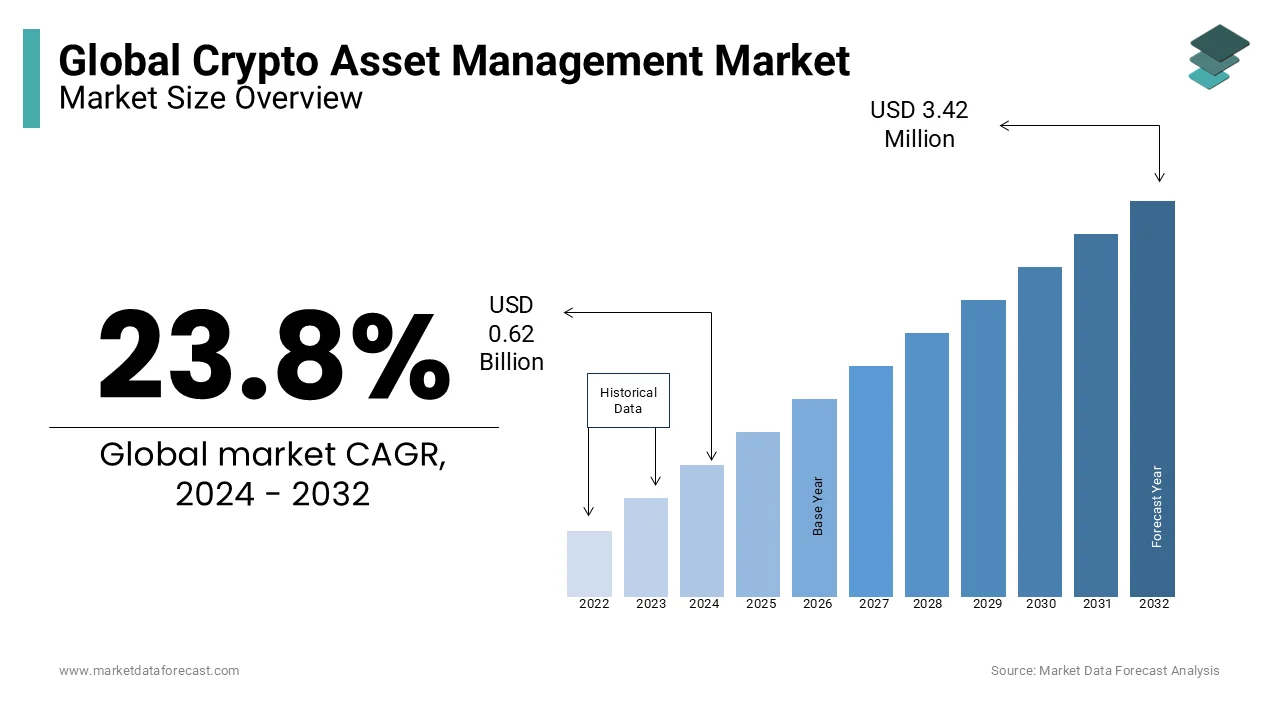
- Market Valuation: Valued at USD 0.77 billion in 2025, estimated at USD 0.95 billion in 2026, and projected to reach USD 5.26 billion by 2034, registering an impressive CAGR of 23.8% (2026–2034).
- Primary Growth Drivers: Rapid global digitalization and institutional trust in cryptographic assets; rising start-up culture fueling the creation of diverse cryptocurrencies; and growing integration of blockchain/distributed ledger technologies within the BFSI sector for secure cross-border payments and treasury operations.
Key Market Segment Metrics (2026–2034)
| Category | Leading Segment / Position | Growth Dynamics |
|---|---|---|
| By Solution | Custodian & Wallets (Custody solutions lead institutional asset security and regulatory compliance) | High demand for secure institutional custody and digital wallets |
| By Application Type | Web-based & Mobile Applications | Accelerating shift toward mobile-friendly crypto management platforms |
| By End-User | Enterprise (Institutions, Retail, and e-Commerce) & Individuals | Growing institutional investment in crypto-banking and asset tracking |
| By Region | North America (dominates global market share led by the United States and Canada in Bitcoin commerce and exchange volume) | Asia-Pacific is generating immense revenues driven by new cryptocurrency initiatives in China and Japan. |
Major Market Players & Market Structure
Market Structure: Highly competitive, technology-driven fintech landscape characterized by specialized digital custodians, crypto asset management platforms, and financial infrastructure providers scaling cross-border operations.
Key Companies: BitGo, Coinbase, Crypto Finance AG, Exodus Movement Inc., Olymp Capital, Digital Asset Custody Company, Inc., Iconomi Ltd., itbit, Ledger SAS, METACO, Vo1t, Xapo, and SFOX Inc.
 Download Free Sample Report
Global Crypto Asset Management Market Size
The global crypto asset management market was valued at USD 0.77 billion in 2025. The market is estimated at USD 0.95 billion in 2026 and is projected to reach USD 5.26 billion by 2034, growing at a CAGR of 23.8% from 2026 to 2034.
Crypto asset management is the professional practice of buying, selling, tracking, and securing digital currencies and tokenised assets to grow an investment portfolio. This market addresses the critical need for professional custody, risk management, and portfolio optimisation in a highly volatile decentralised ecosystem. According to data published by Triple-A, the global cryptocurrency consumer base reached approximately 420 million users in 2023, accelerating the worldwide demand for decentralised digital infrastructure. According to the Bank for International Settlements, cross-border payments executed through the Project mBridge blockchain platform lower transaction costs by 40% to 50% relative to traditional correspondent banking benchmarks. These facts underscore the growing integration of digital assets into mainstream financial infrastructure, driving demand for professional management services. Regulatory bodies worldwide are establishing frameworks to protect investor interests while fostering innovation in digital finance. The market encompasses hardware security modules, multi-signature wallets, and algorithmic trading platforms, ensuring asset integrity. Institutional participation increases as pension funds and endowments seek exposure to uncorrelated returns. Technological advancements in zero-knowledge proofs enhance privacy and compliance capabilities for managed portfolios. The evolution from speculative trading to long-term wealth preservation defines the current market trajectory.
MARKET DRIVERS
Institutional Adoption Accelerates Demand for Professional Custody
Increasing participation by institutional investors significantly fuels the crypto asset management market growth. This growth creates an urgent demand for enterprise-grade custody and management solutions. The Securities and Exchange Commission approved multiple spot Bitcoin exchange-traded funds in January 2024, unlocking billions in capital from traditional finance entities previously restricted from direct crypto exposure. According to a global survey from Fidelity Digital Assets, 90% of institutional investors who are interested in digital assets expect to have an allocation in their portfolios within the next five years. The shift necessitates robust infrastructure capable of meeting stringent regulatory compliance and audit requirements, unlike retail-focused platforms. Institutions require insurance coverage against theft and loss, which specialised crypto asset managers provide through qualified custodians and cold storage facilities. The entry of major banks offering crypto services validates the asset class, encouraging further corporate treasury allocations. Professional management firms offer tailored reporting and tax optimisation services essential for complex institutional balance sheets. The scale of institutional capital inflows drives the development of sophisticated derivatives and structured products managed by experts. Regulatory clarity in key jurisdictions reduces legal uncertainty, enabling larger allocations. This trend transforms crypto asset management from a niche service to a core component of modern investment infrastructure.
Technological Advancements Enhance Security and Operational Efficiency
Rapid innovation in blockchain security protocols and automation tools accelerates the crypto asset management market expansion. This expansion happens by addressing historical concerns regarding safety and complexity. As per the National Institute of Standards and Technology, the updated Special Publication 800-140B revised testing guidelines for the Cryptographic Module Validation Program to align institutional security policy requirements with international ISO/IEC benchmarks. As per CoinDesk Indices, the CoinDesk Solana Benchmark Rate aggregates trading activity across multiple digital asset platforms to calculate a single reference price in U.S. dollars. The technical improvements build trust among risk-averse investors who previously avoided digital assets due to fear of exchange collapses. Automated rebalancing algorithms allow managers to maintain target allocations efficiently without manual intervention, reducing human error and operational costs. Smart contract auditing services ensure code integrity, preventing exploits that could drain managed funds. Integration with traditional portfolio management software enables seamless monitoring of hybrid asset classes. Advanced analytics provide real-time insights into market trends and liquidity conditions, supporting informed decision-making. The availability of institutional-grade APIs facilitates integration with existing financial systems. These technological strides lower barriers to entry for professional managers and enhance service reliability.
MARKET RESTRAINTS
Regulatory Uncertainty Creates Compliance Burdens
Ambiguous and fragmented regulatory landscapes limit crypto asset management market growth. This slowdown happens by imposing high compliance costs and legal risks on service providers. According to the Financial Action Task Force, 43% of assessed global jurisdictions remain only partially compliant with the anti-money laundering and counter-terrorist financing standards governing virtual asset service providers. As per guidelines finalised by the European Banking Authority, banks operating inside the European Union must assign a 1,250% risk weight to unbacked holdings of cryptocurrencies like Bitcoin and Ether. The regulatory fragmentation forces firms to maintain separate legal entities and compliance teams for each jurisdiction, increasing overhead significantly. Sudden policy changes can disrupt business models, as seen when certain countries banned specific crypto activities overnight, causing forced liquidations. Lack of clear tax guidance complicates reporting for clients, leading to potential liabilities for managers. Legal uncertainties deter traditional financial institutions from partnering with crypto firms, limiting distribution channels. The threat of enforcement actions creates reputational risks affecting client acquisition and retention. Managers must constantly monitor legislative developments, diverting resources from product innovation. These constraints slow market maturation and limit scalability for global operators.
High Volatility Discourages Conservative Investor Participation
Extreme price fluctuations in digital assets constrain the crypto asset management market expansion. This limitation happens by deterring risk-averse investors and complicating portfolio stability. According to Cboe Global Markets, the Cboe IBIT Volatility Index provides a forward-looking 30-day measure of implied turbulence specifically derived from options tracking the iShares Bitcoin Trust. Moreover, according to the JPMorgan Chase Institute, cryptocurrency ownership and portfolio involvement rates scaled up to 20% within the Millennial demographic relative to lesser penetration among older generations. The volatility makes it difficult for asset managers to guarantee consistent returns or preserve capital during market downturns. Conservative investors such as retirees and endowments often have mandates prohibiting exposure to assets with such erratic behaviour. High volatility increases margin requirements for leveraged strategies, reducing capital efficiency for managed accounts. Frequent price swings trigger stop-loss orders, leading to unintended exits and realised losses. Managers face challenges in valuing illiquid altcoins accurately during stress periods, affecting net asset value calculations. The perception of crypto as speculative rather than investable persists among mainstream financial advisors. These factors limit the total addressable market to those with higher risk tolerance.
MARKET OPPORTUNITIES
Tokenisation of Real World Assets Expands Service Offerings
Emerging tokenisation trends present significant opportunities for crypto asset managers to diversify beyond native cryptocurrencies into tangible asset classes, which is anticipated to drive the growth of the crypto asset management market. According to the Boston Consulting Group, the global tokenisation of illiquid financial and real-world assets is projected to expand into a 16 trillion-dollar business opportunity by 2030. As per BlackRock CEO Larry Fink, the widespread tokenization of financial securities represents the next generation for markets by establishing instantaneous transaction settlement and reduced administrative fees. Crypto asset managers can leverage their existing infrastructure to custody and trade these tokenised securities, offering clients diversified exposure. This expansion reduces reliance on volatile native tokens, providing more stable fee income streams. Institutional investors familiar with traditional assets find tokenised versions easier to understand and integrate into existing portfolios. Regulatory frameworks for security tokens are clearer than utility tokens, reducing legal ambiguity for managers. Partnerships with real estate firms and private equity funds create new revenue channels through issuance and management fees. The ability to offer 24/7 trading for traditionally illiquid assets enhances liquidity premiums. This strategic pivot positions crypto managers as comprehensive digital wealth partners.
Integration of Decentralised Finance Protocols Enhances Yield Generation
Incorporation of decentralized finance mechanisms unlocks potential for asset managers to generate superior yields for clients through automated strategies, which is expected to propel the crypto asset management market expansion. According to analytical data compiled by DeFiLlama, the total value locked across global decentralized finance networks hit 138 billion dollars following a post-election market surge before pulling back to 88 billion dollars. Moreover, as per the Ethereum Foundation, consensus layer validators earn annualized base staking rewards yielding under 3%. Crypto asset managers can build structured products that automatically compound these yields while managing smart contract risks through diversification. This capability attracts yield-seeking investors in low interest rate environments looking for alternatives to traditional bonds. Automated market maker strategies allow managers to earn trading fees by providing liquidity to decentralized exchanges. Governance token accumulation provides additional upside potential from protocol success. Transparent on-chain data allows for real-time performance verification, building client trust. Integration with traditional finance bridges enables seamless fiat on-ramps and off-ramps for yield distributions. These innovations differentiate professional managers from passive holding strategies.
MARKET CHALLENGES
Cybersecurity Threats Persist Despite Technological Improvements
Ongoing security vulnerabilities challenge the crypto asset management market stability. This challenge exposes managed assets to sophisticated hacking attempts and insider threats. According to the Chainalysis Crypto Crime Report, illicit actors stole about $ 1.7 billion from cryptocurrency platforms in 2023, down from $3.7 billion the previous year. As per the Federal Bureau of Investigation, financial losses related to cryptocurrency fraud reached over 5.6 billion dollars in 2023, representing a 45% surge in monetary damages compared to the previous calendar year. The breache damage client trust irreparably, leading to mass withdrawals and reputational ruin for affected managers. Private key management remains a single point of failure if multi-signature protocols are not strictly enforced. Phishing attacks targeting employee credentials bypass technical safeguards, requiring constant vigilance and training. Insurance coverage for digital assets is limited and expensive, leaving managers exposed to catastrophic losses. Recovery of stolen funds is nearly impossible due to the irreversible nature of blockchain transactions. Regulatory penalties for inadequate security measures add financial burden to incident response efforts. Managers must balance user convenience with rigorous security protocols, which often conflict with ease of use.
Talent Shortage Impedes Service Quality and Innovation
An acute shortage of skilled professionals specialising in blockchain technology and digital asset management challenges operational scalability and service delivery, which in turn holds back the crypto asset management market. According to the World Economic Forum, financial technology engineers are expanding rapidly within global labor markets, ranking as the top fastest-growing employment role through the end of the decade. As per workforce analytics published by LinkedIn, highly technical artificial intelligence and engineering positions demand an average of 90 to 120 days to fill due to intensive skill screening protocols. The talent gap forces managers to rely on outdated systems or outsource critical functions, increasing operational risks. Competition for qualified personnel drives up compensation costs, squeezing profit margins for smaller firms. Lack of standardized certification programs makes it difficult to verify candidate expertise reliably. High turnover rates in the volatile crypto industry disrupt continuity of care for client portfolios. Training internal staff requires significant time investment during which market opportunities may be missed. Knowledge silos develop when key employees leave, taking proprietary strategies with them. These human capital constraints limit the ability of firms to innovate and expand service offerings effectively.
REPORT COVERAGE
| REPORT METRIC | DETAILS |
| Market Size Available | 2025 to 2034 |
| Base Year | 2025 |
| Forecast Period | 2026 to 2034 |
| Segments Covered | By Solution, Application Type, End-user, and Country |
| Various Analyses Covered | Global, Regional, and Country-Level Analysis, Segment-Level Analysis, Drivers, Restraints, Opportunities, Challenges; PESTLE Analysis; Porter’s Five Forces Analysis, Competitive Landscape, Analyst Overview of Investment Opportunities |
| Regions Covered |
|
| Market Leaders Profiled | BitGo, Coinbase, Crypto Finance AG, Coinbase Global Inc, Exodus Movement Inc., Olymp Capital, BlackRock Inc, Digital Asset Custody Company, Inc., Fidelity Digital Assets, Iconomi Ltd., itbit, Ledger SAS, METACO, Vo1t, Xapo and SFOX Inc. |
SEGMENTAL ANALYSIS
By Solution Insights
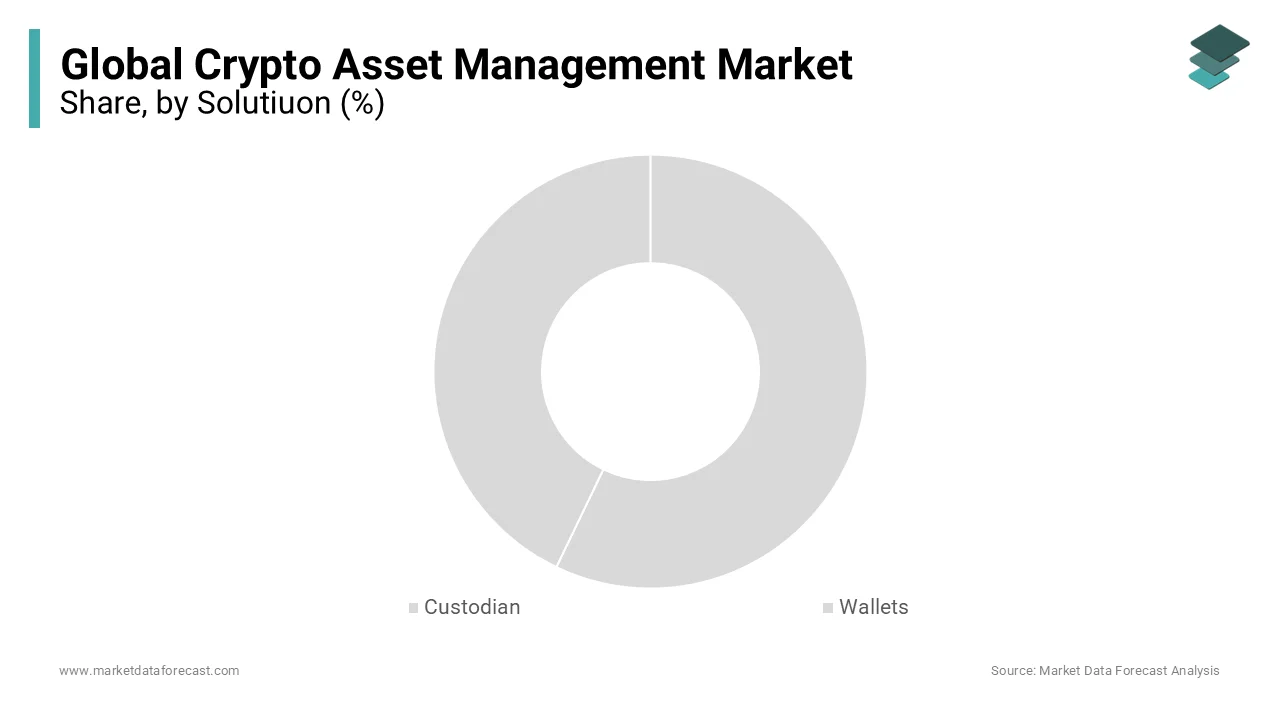
The custodian services segment dominated the crypto asset management market and accounted for a substantial share in 2025. This dominance of the segment was driven by the fact that regulatory frameworks increasingly require segregated and insured storage for institutional client funds. According to the Securities and Exchange Commission, the agency formally rescinded Staff Accounting Bulletin No. 121, thereby eliminating severe balance sheet accounting rules that prevented public banks from holding digital assets. In addition, as per the Office of the Comptroller of the Currency, national banks and federal savings associations are legally permitted to offer cryptocurrency custody services by safeguarding the unique cryptographic keys associated with digital assets. The regulatory clarity encourages pension funds and endowments to allocate capital only through verified custodial channels rather than self-custody. Institutional investors prioritise insurance coverage against theft, which specialised custodians provide through comprehensive policies covering hot and cold storage failures. The complexity of private key management exceeds the technical capabilities of most traditional finance teams, necessitating outsourced expertise. Custodians offer audit trails and reporting standards compatible with existing accounting software, facilitating seamless integration into corporate balance sheets. High-profile exchange collapses have reinforced the necessity of independent third-party custody, reducing counterparty risk significantly. The trust established by regulated custodians serves as the foundational layer for all other institutional crypto services, including trading and lending.
Substantial investments in advanced security protocols by custodial providers sustain their market leadership by mitigating historical fears of digital asset theft. As per the National Institute of Standards and Technology, the FIPS 140-3 cryptographic standard defines multiple security levels for validating hardware modules to ensure structural integrity across digital ecosystems. According to Chainalysis, aggregate funds stolen from global cryptocurrency platforms decreased by approximately 54.3% in 2023 to settle at 1.7 billion dollars. The disparity in safety records drives institutional migration toward professional custody solutions offering multi-signature authorisation and geographic distribution of key shards. Custodians implement real-time monitoring systems detecting anomalous transaction patterns, preventing unauthorized transfers before execution. Regular third-party penetration testing validates security posture, providing transparency to clients regarding vulnerability management. The ability to recover access through social recovery mechanisms or backup protocols addresses the critical issue of lost keys. Insurance premiums for custodied assets are significantly lower than self-insured holdings, reducing overall cost of ownership for large portfolios. These robust security measures create a moat that pure software wallets cannot easily replicate for high net worth individuals.
The wallet solutions segment is on the rise and is expected to be the fastest-growing segment in the market, witnessing a CAGR of 22.5% from 2026 to 2034. This swift expansion is propelled by increasing demand for self-sovereignty and direct control over digital assets. According to the Ethereum Foundation, the total volume of daily active accounts interacting across the mainnet infrastructure surged past the 1.2 million threshold during peak structural operations. As per MetaMask, monthly active users surpassed 30 million, reflecting widespread adoption of non-custodial interfaces for managing diverse token portfolios. Users prefer wallets that allow seamless interaction with decentralised finance protocols without relying on intermediary approval processes. The development of account abstraction technology simplifies user experience by enabling social login and gasless transactions, removing technical barriers for mainstream adoption. According to Ledger, the hardware wallet manufacturer reduced its baseline headcount by 12% to preserve corporate capital amid challenging digital asset market conditions. Interoperability standards such as WalletConnect enable single sign-on experiences across multiple blockchain ecosystems, enhancing utility. Privacy features, including zero-knowledge proofs, attract users concerned about financial surveillance and data tracking. The modular nature of modern wallets allows integration of identity verification and payment rails, creating super app functionalities.
Deep integration with decentralised finance ecosystems accelerates wallet adoption by transforming them from simple storage tools into comprehensive financial hubs. According to DeFiLlama, the aggregate total value locked across all tracked decentralized finance smart contracts peaked at 138 billion dollars following an intense market expansion. As per Uniswap Labs, the automated protocol deployed its native mobile application across Android and iOS platforms to expand decentralized portal options for international mobile interface users. The trend empowers wallets to capture value through swap fees, staking rewards, and governance participation directly within the application. Advanced wallets now offer portfolio tracking analytics, providing real-time insights into yield farming performance and impermanent loss. Cross-chain bridging capabilities embedded within wallets enable seamless asset movement between different blockchains, reducing friction for multi-chain strategies. Notification systems alert users to profitable opportunities or security risks, enhancing proactive management. The emergence of intent-based architectures allows wallets to execute complex transactions across multiple protocols with single-click simplicity. Developers prioritize mobile-first designs, ensuring accessibility for users in emerging markets where smartphones are primary computing devices. These functional expansions drive daily engagement and retention rates higher than traditional banking applications.
By Application Type Insights
The web-based platforms led the crypto asset management market and captured a significant share in 2025. This leading position of the segment was attributed to its ability to support complex analytical tools and multi-user administrative controls required by institutions. As per the Society for Worldwide Interbank Financial Telecommunication, the global financial cooperative enables the automated integration of central bank digital currencies and digital assets alongside legacy financial messaging nodes through the ISO 20022 communication format. According to Bloomberg, the native digital asset analytical interface aggregates active market pricing feeds for the top 50 cryptocurrencies to facilitate risk management within multi-asset workflows. These platforms offer superior screen real estate for viewing detailed charts, order books, and risk metrics simultaneously, which is critical for high-frequency trading strategies. Enterprise-grade web solutions provide role-based access control, allowing firms to segregate duties between traders, compliance officers, and executives securely. Application programming interface connectivity enables automated data flow into existing enterprise resource planning systems, ensuring accurate financial reconciliation. Cloud-based architecture ensures high availability and scalability during periods of extreme market volatility, preventing system outages. Regular software updates can be deployed centrally without requiring user intervention, maintaining security patches and feature consistency. The ability to generate customizable reports for auditors and regulators strengthens the case for web-based dominance in professional settings.
Robust security implementations inherent to web-based platforms favor their adoption among risk-averse professional investors and corporate treasuries. According to the International Organisation of Securities Commissions, global regulatory metrics enforce comprehensive compliance principles targeting cross-border digital asset market intermediaries and investment structures. Moreover, as per sources, organizations that deploy remote browser isolation technologies experience a 70% reduction in cyberattacks that compromise end-user enterprise infrastructure. Institutions prefer web environments where IT departments can enforce network policies, firewall rules, and endpoint detection systems to prevent unauthorised access. Session management features automatically log out inactive users, reducing exposure to hijacking attempts in shared office spaces. Encryption standards for data in transit and at rest meet stringent banking requirements, ensuring confidentiality of sensitive portfolio information. Audit logs capture every user action, providing immutable records for forensic analysis in case of disputes or breaches. Integration with single sign-on providers streamlines authentication while maintaining central control over user permissions. These enterprise-grade security features make web-based platforms the preferred choice for managing significant capital allocations.
The mobile applications segment is likely to experience the fastest CAGR of 24.8% during the forecast period due to the ubiquitous nature of smartphones and demand for instant market access. According to studies, smartphone device ownership scales to 91% among surveyed United States adults, shaping the broader deployment landscape for digital consumer software. In addition, as per Coinbase, the platform deployed its standardized international exchange architecture and derivatives matching systems to enable unified spot trading for global institutional clients. Push notification features alert users to price movements, enabling rapid response to volatility without constant screen monitoring. Biometric authentication methods such as fingerprint and facial recognition provide secure yet frictionless login experiences, enhancing user satisfaction. Mobile apps integrate seamlessly with payment processors, allowing instant fiat on-ramps and off-ramps for quick liquidity needs. Social trading features embedded in mobile platforms facilitate community engagement and copy trading strategies appealing to younger demographics. Gamification elements such as rewards and badges increase retention rates by making portfolio management engaging and interactive. Offline mode capabilities allow users to view cached portfolio data even without internet connectivity, ensuring continuous awareness.
Continuous innovation in mobile user experience design attracts new entrants to the crypto market by simplifying complex concepts into intuitive interfaces. According to sources, software interfaces utilizing dynamic micro-animations during background verification phases experience a 10% to 15% drop-off mitigation relative to static application loading screens. In addition, as per AppTweak, mobile banking and digital wallet platforms dominate the leading ranks of downloaded global finance applications. Swipe gestures and visual charts replace complex order types, making trading accessible to novices with limited financial literacy. Educational modules integrated within mobile apps guide users through basic concepts of blockchain and wallet security, reducing anxiety. Voice command features allow hands-free portfolio checks and trade executions, enhancing accessibility for diverse user groups. Augmented reality tools visualise portfolio performance trends, providing immersive insights into asset allocation. Personalization algorithms tailor content and recommendations based on individual risk profiles and investment goals. Seamless integration with wearable devices enables health and wealth tracking convergence, appealing to holistic lifestyle management trends. These UX advancements lower barriers to entry, driving mass adoption among non-technical users.
By End User Insights
In 2025, the enterprise users segment held the majority share in the crypto asset management market because corporations increasingly allocate portions of treasury reserves to digital assets for inflation hedging and balance sheet diversification. According to the Securities and Exchange Commission, MicroStrategy officially adopted Bitcoin as its primary treasury reserve asset to maximise long-term value for corporate shareholders. As per Coinbase, 60% of Fortune 500 executives state that their organizations are actively developing corporate blockchain initiatives. Enterprises require sophisticated management tools to handle large-volume transactions while maintaining strict internal controls and audit trails. Corporate adoption drives demand for white-label custody solutions and institutional-grade trading desks offering deep liquidity. Payroll disbursement in stablecoins reduces foreign exchange costs for multinational corporations with remote global workforces. Supply chain finance initiatives utilize blockchain tokens to enhance transparency and accelerate settlement times with suppliers. Regulatory compliance modules help enterprises navigate varying international laws regarding digital asset classification and taxation. The scale of enterprise capital inflows provides stability to the market, reducing reliance on volatile retail sentiment. Professional service firms develop specialized advisory practices catering to corporate clients entering the digital asset space.
Integration of blockchain technology for operational efficiency drives enterprise adoption of crypto asset management platforms beyond mere investment purposes. According to the World Economic Forum, comprehensive digital trade facilitation strategies scale global efficiency by reducing international trade costs by up to 25%. As per studies, 71% of banking executives acknowledge that they lack the critical institutional skills necessary to deploy tokenization projects. Crypto asset management tools facilitate the issuance and tracking of utility tokens representing loyalty points or access rights, enhancing customer engagement programs. Real estate firms utilize tokenization platforms to fractionalize property ownership, enabling broader investor participation and liquidity. Intellectual property rights management benefits from immutable timestamping and royalty distribution via smart contracts. Energy companies trade renewable energy certificates on blockchain networks, ensuring provenance and preventing double counting. These operational use cases create sticky demand for management infrastructure as businesses embed digital assets into core workflows. Vendor partnerships expand as enterprises seek end-to-end solutions covering creation, management and retirement of tokenised assets.
The individual users segment is expected to exhibit a noteworthy CAGR of 26.2% between 2026 and 2034 owing to the democratization of finance and the accessibility of user-friendly investment platforms. According to the World Bank Global Findex, approximately 1.7 billion adults worldwide remain classified as unbanked, without access to a formal account at a traditional financial institution or mobile money provider. As per Triple-A, global cryptocurrency user ownership scaled up to 420 million individuals, driven by macroeconomic factors like localized currency devaluations. Retail investors seek autonomy over their financial destiny, escaping capital controls and restrictive monetary policies imposed by central banks. Fractional investment features allow individuals to purchase small amounts of high-value assets like Bitcoin, making entry affordable for low-income earners. Social media influencers and online communities provide education and signal sharing, accelerating knowledge transfer and confidence building. Peer-to-peer lending platforms enable individuals to earn yield on idle crypto holdings outperforming traditional savings accounts. Remittance services using crypto rails reduce fees and increase speed for migrant workers sending money home. The ease of opening accounts without credit checks or minimum balance requirements removes traditional gatekeeping barriers.
High technological literacy among younger generations accelerates individual adoption of crypto asset management tools as digital natives embrace decentralised ecosystems. According to a survey, 55% of Gen Z individuals are actively delaying major personal life decisions due to prolonged financial strain. As per studies, 32% of Gen Z respondents participate in or actively evaluate digital prediction markets and sports betting applications. These users demand seamless mobile experiences, gamified interfaces and social integration features that traditional brokerages often lack. Non-fungible token collecting and gaming economies introduce new users to wallet management and private key security organically. Decentralised autonomous organisations allow individuals to participate in governance decisions, fostering a sense of ownership and community. Educational resources provided by platforms empower users to conduct independent research and verify claims, reducing reliance on intermediaries. Privacy-focused coins appeal to individuals concerned about data monetisation and surveillance capitalism. The cultural shift toward digital ownership extends beyond finance to art and identity, reinforcing long-term engagement. Peer influence within online networks creates viral growth loops driving rapid user acquisition for management platforms.
REGIONAL ANALYSIS
North America Crypto Asset Management Market Analysis
North America was the top performer in the global crypto asset management market and occupied the largest share in 2025. This supremacy was supported by robust regulatory frameworks and high institutional participation. According to the Securities and Exchange Commission, the official regulatory approval of 11 spot Bitcoin exchange-traded funds in January 2024 allowed national exchanges to list and trade shares linked directly to the underlying cryptocurrency. As per the Digital Chamber, small and mid-sized blockchain technology innovators face an uneven playing field due to compliance asymmetries across fragmented regional regulatory frameworks. The presence of major financial hubs like New York and Toronto facilitates access to deep liquidity pools and professional talent. Clearer tax guidelines from the Internal Revenue Service provide certainty for individual and corporate investors, encouraging long-term holding strategies. Advanced cybersecurity infrastructure supports secure custody operations, protecting large asset volumes from threats. High smartphone penetration and digital literacy rates drive retail adoption of mobile management apps. Collaboration between traditional banks and crypto firms creates hybrid products appealing to conservative investors. Political lobbying efforts by industry groups shape favorable legislation promoting market growth. The region leads in developing regulatory sandboxes allowing testing of novel management solutions under supervision.

Europe Crypto Asset Management Market Analysis
Europe maintains a strong presence in the crypto asset management market because of the harmonised regulations and a focus on sustainability. The European Union Markets in Crypto Assets regulation provides a unified licensing framework across member states, reducing fragmentation and compliance costs. According to a survey by the European Central Bank, 9% of adults across the eurozone owned cryptocurrency assets, with domestic adoption rates ranging from a baseline low of 6% up to a localized high of 15%. Strong data privacy laws under the General Data Protection Regulation influence the development of privacy-preserving management tools. Green energy initiatives promote mining and staking operations using renewable sources, aligning with environmental, social, and governance criteria. Established banking sectors in Switzerland and Germany integrate crypto services, offering trusted entry points for institutional clients. Cross-border payment efficiencies within the Eurozone drive adoption of stablecoin management solutions for businesses. Academic research centers contribute to cryptographic advancements, enhancing security protocols for managed assets. Consumer protection agencies monitor market practices, ensuring fair treatment of retail investors. The region serves as a gateway for Asian and Middle Eastern firms seeking regulated European market access.
Asia-Pacific Crypto Asset Management Market Analysis
Asia-Pacific is a high-growth region in the crypto asset management market. This expansion is fueled by a large population base and rapid digital adoption. According to the Chainalysis Global Crypto Adoption Index, India ranks first in grassroots cryptocurrency adoption, followed closely by the United States and Pakistan within global retail transaction frameworks. As per the Monetary Authority of Singapore, the Project Guardian sandbox program brings together international financial institutions to pilot asset tokenisation and multi-currency institutional fund deployments. High mobile internet penetration enables millions of unbanked individuals to access crypto wallets for savings and payments. Government restrictions in some countries drive users toward decentralized management tools, bypassing local controls. Vibrant gaming and non-fungible token ecosystems introduce young demographics to digital asset ownership and management. Family offices in Hong Kong and Singapore allocate significant capital to crypto funds seeking diversified returns. Infrastructure improvements in blockchain interoperability facilitate cross-border trade and settlement efficiency. Local exchanges partner with global custodians, enhancing security standards for retail users. Cultural acceptance of digital value transfer accelerates integration of crypto into daily commerce.
Latin America Crypto Asset Management Market Analysis
Latin America is growing steadily in the crypto asset management market. Local financial trouble and weakening national currencies are driving people to use digital assets. The International Monetary Fund notes that high inflation rates in Argentina and Venezuela drive citizens to adopt stablecoins and Bitcoin for wealth preservation. According to Bitso, Mexico remains the platform's largest retail digital market, accounting for over 70% of the company's 9 million-strong customer base. Remittance corridors utilising crypto rails reduce fees for migrants sending money to families, improving household incomes. Limited access to traditional banking services in rural areas makes mobile crypto wallets essential for financial inclusion. Governments explore central bank digital currencies, prompting development of compatible management infrastructure. Local startups innovate in peer-to-peer lending and microinsurance using crypto collateral, expanding service offerings. Regulatory ambiguity in some nations creates opportunities for decentralized management protocols operating without central authority. Community-driven education initiatives empower users to manage assets securely despite a lack of formal financial literacy. Partnerships with telecommunications providers enable crypto top-ups and bill payments, integrating digital assets into daily life.
Middle East and Africa Crypto Asset Management Market Analysis
The Middle East and Africa region is an emerging frontier in the crypto asset management market. This new position is supported by strategic government initiatives and youthful demographics. The United Arab Emirates has established a comprehensive virtual asset regulatory authority, attracting global crypto firms to set up regional management hubs. According to the African Development Bank, the annual trade finance deficit across the continent ranges between 74 billion and 92 billion dollars due to constrained correspondent banking infrastructure. High youth population in Nigeria and Kenya drives adoption of crypto earning platforms and freelance payment solutions. Oil-rich nations explore blockchain for transparent sovereign wealth fund management and commodity tokenisation. Religious compliance features in crypto products appeal to Islamic finance principles, expanding the addressable market. Infrastructure investments in fibre optics and 5G networks improve connectivity, enabling reliable access to management platforms. Diaspora communities utilise crypto for efficient remittances, bypassing expensive traditional corridors. Government pilots in land registry and identity management create a foundation for a broader tokenised asset ecosystem. Local exchanges collaborate with international custodians, enhancing security and trust for a growing investor base.
COMPETITIVE LANDSCAPE
The competition within the crypto asset management market is characterized by intense rivalry between established financial institutions, emerging fintech startups, and specialized blockchain natives. Key participants compete primarily on security, reliability, regulatory compliance, and user experience rather than price alone due to the high value of managed assets. Major players invest heavily in cybersecurity infrastructure, including hardware security modules and insurance policies to protect against theft and hacking attempts. Strategic partnerships with traditional banks and payment processors help bridge the gap between fiat and digital currencies, enhancing accessibility. Companies strive to obtain licenses in multiple jurisdictions, navigating complex regulatory landscapes to offer global services seamlessly. Innovation in product offerings such as staking derivatives and tokenized real-world assets differentiates providers in a crowded marketplace. Intellectual property protection for proprietary trading algorithms and custody technologies creates barriers to entry for new competitors. Geographic expansion into emerging markets provides growth avenues for leaders seeking to capture early adopter bases. The competitive dynamics are further influenced by transparency initiatives where proof of reserves builds trust among skeptical investors. Maintaining uptime during high volatility periods is a critical differentiator as system failures lead to immediate reputational damage. Companies that successfully balance innovation with rigorous risk management gain significant advantages in retaining institutional capital.
KEY MARKET PLAYERS
The leading companies operating in the global crypto asset management market include:
- BitGo
- Coinbase
- Crypto Finance AG
- Coinbase Global Inc.
- Exodus Movement Inc.
- Olymp Capital
- BlackRock Inc.
- Digital Asset Custody Company, Inc.
- Fidelity Digital Assets
- Iconomi Ltd.
- itBit
- Ledger SAS
- METACO
- Vo1t
- Xapo
- SFOX Inc.
TOP PLAYERS IN THE MARKET
- Coinbase Global Inc serves as a foundational infrastructure provider offering comprehensive custody and trading solutions for institutional and retail clients. The company recently expanded its Prime services to include advanced staking capabilities and multi-asset support, enhancing portfolio management options. It actively pursues regulatory clarity by engaging with policymakers globally, ensuring compliant operations across diverse jurisdictions. Coinbase invests heavily in security protocols, maintaining insurance coverage for digital assets held in cold storage. Its integration with traditional financial systems facilitates seamless fiat on-ramps and off-ramps for users. The platform provides robust analytics tools enabling clients to monitor performance and manage risk effectively. Strategic partnerships with major banks extend reach into conventional wealth management channels. Continuous product innovation includes layer two scaling solutions reducing transaction costs for active traders. These efforts solidify its reputation as a trusted gateway for mainstream crypto adoption.
- BlackRock Inc leverages its massive scale and institutional trust to dominate the crypto asset management landscape through exchange-traded fund offerings. The firm launched spot Bitcoin exchange-traded funds, providing regulated exposure to digital assets for traditional investors seeking diversification. It collaborates with Coinbase for custody services, ensuring secure storage of underlying assets while focusing on distribution and client service. BlackRock utilizes its Aladdin technology platform to integrate crypto data into broader portfolio risk management frameworks for institutional clients. The company advocates for clear regulatory standards promoting market stability and investor protection globally. Its entry validates the asset class, encouraging other financial giants to develop similar products. Educational resources help advisors understand crypto dynamics, facilitating informed client discussions. The firm explores tokenization of real-world assets expanding utility beyond native cryptocurrencies. These actions bridge the gap between decentralized finance and traditional investment management.
- Fidelity Digital Assets combines decades of traditional finance expertise with specialized blockchain infrastructure to serve institutional investors. The company offers enterprise-grade custody solutions with multi-signature security and geographic key distribution, ensuring maximum asset protection. It provides trading execution services with deep liquidity pools, minimizing slippage for large block transactions. Fidelity develops proprietary research reports analyzing market trends and valuation models, guiding institutional allocation decisions. The firm integrates crypto services into its existing wealth management platforms, allowing seamless access for high-net-worth individuals. Recent expansions include support for additional digital assets and staking rewards, enhancing yield opportunities. Compliance teams work closely with regulators to maintain the highest operational standards and transparency. Technology investments focus on automation and reporting efficiency, reducing administrative burdens for clients. This holistic approach positions Fidelity as a premier partner for conservative institutional entry into digital assets.
TOP STRATEGIES USED BY THE KEY MARKET PARTICIPANTS
Key participants in the crypto asset management market employ several strategic approaches to maintain their competitive edge and drive sustainable growth. Innovation in security protocols remains a primary focus as companies develop advanced custody solutions using multi-party computation and hardware isolation. Strategic mergers and acquisitions allow firms to acquire specialized technology stacks and expand their geographic licensing footprint rapidly. Partnerships with traditional financial institutions facilitate integration of crypto services into existing wealth management platforms, enhancing distribution reach. Companies prioritize regulatory engagement and compliance to build trust with institutional investors and navigate evolving legal frameworks globally. Investment in educational content and customer support helps onboard non-technical users, reducing friction and increasing retention rates. Diversification into staking, lending, and yield generation products creates additional revenue streams beyond simple trading fees. Focus on environmental sustainability addresses concerns regarding energy consumption, attracting socially conscious institutional capital. These strategies collectively enable market leaders to adapt to rapid technological changes and meet increasing demand for secure digital asset management.
MARKET SEGMENTATION
This research report on the global crypto asset management market has been segmented and sub-segmented based on the solution, application type, end-user, and region.
By Solution
- Custodian
- Wallets
By Application Type
- Web-based
- Mobile
By End-user
- Individual
- Enterprise (Institutions, Retail and e-Commerce)),
By Region
- North America
- Europe
- Asia Pacific
- Latin America
- Middle East and Africa