- Product Description Description
- Table of Contents TOC
- List of Table & Figure LOT
- Get Free Sample PDF Sample PDF
Market Size, 2025
$3.41 BnMarket Estimate, 2026
$3.89 BnMarket Forecast, 2034
$11.09 BnCAGR, 2026–2034
14%Executive Summary: DDoS Protection and Mitigation Market
- Market Scope: Comprehensive global DDoS protection and mitigation market analysis covering rising cyberattack frequencies, cloud computing adoption, IoT expansion, enterprise cybersecurity investments, and business continuity safeguards.
- Market Valuation: Valued at USD 3.41 billion (2025), estimated at USD 3.89 billion (2026), and projected to reach USD 11.09 billion by 2034, registering a robust CAGR of 14% (2026–2034).
- Primary Growth Drivers: Escalating DDoS attack sophistication, cloud infrastructure expansion, strict cybersecurity regulations, and growing enterprise threat-detection spending. Key challenges include high deployment costs, cybersecurity professional shortages, and evolving attack techniques.
Key Market Segment Metrics (2026–2034)
| Category | Leading Segment (Position) | Fastest-Growing Segment |
|---|---|---|
| By Component, Vertical & Region | Solutions segment (held largest market share in 2025) & BFSI segment (dominated by application due to high cyber threat exposure) & North America (largest regional market) | Services component segment (projected to witness the fastest growth) & Asia-Pacific (expected to record strong growth driven by digital transformation) |
| By Regional Leadership | North America (accounted for largest regional market owing to early tech adoption, strong vendor presence, and enterprise investments) | Asia-Pacific (fastest-growing regional market powered by rapid enterprise digitalization and expanding data center infrastructure) |
Major Market Players & Market Structure
Market Structure: Highly competitive global cybersecurity ecosystem featuring major cloud security and network infrastructure leaders driving advanced threat mitigation, hybrid/cloud-based defense systems, and government botnet resilience compliance.
Key Companies: NETSCOUT, Akamai Technologies, Imperva, Radware, Corero Network Security, Cloudflare, Link11, Nexusguard, A10 Networks, Fortinet, Huawei Technologies, Verisign, Sucuri, SiteLock, Flowmon Networks, StackPath, DOSarrest Internet Security, NSFOCUS, and Seceon.
Global DDoS Protection and Mitigation Market Size
The global distributed denial of service (DDoS) protection and mitigation market was valued at USD 3.41 billion in 2025. The global market is projected to grow from USD 3.89 billion in 2026 to USD 11.09 billion by 2034, witnessing a compound annual growth rate (CAGR) of 14% from 2026 to 2034.

DDoS protection and mitigation constitute a specialized ecosystem of hardware appliances, software solutions, and cloud-based services designed to detect, analyze, and neutralize distributed denial-of-service attacks before they disrupt critical digital infrastructure. These systems function as essential cyber resilience layers that distinguish malicious traffic floods from legitimate user requests using behavioral analytics, signature matching, and real-time threat intelligence feeds. According to Cloudflare’s 2024 Threat Report, application layer attacks increased by 138% year over year globally, reflecting a strategic shift toward sophisticated low-and-slow methods that evade traditional volumetric defenses. According to the National Cyber Security Centre in the United Kingdom, ransomware gangs now frequently employ DDoS attacks as leverage during extortion negotiations, with 59% of surveyed organizations reporting such dual-threat incidents in 2023. Furthermore, as per Akamai’s State of the Internet report, the gaming industry alone experienced over 4.5 billion attack attempts in a single quarter, demonstrating how sector-specific targeting drives continuous innovation in mitigation technologies. This market is defined not merely by bandwidth capacity, but by its adaptive intelligence capabilities that must evolve faster than adversarial tactics across an increasingly interconnected global network where downtime translates directly into financial loss and reputational damage.
MARKET DRIVERS
Escalating Sophistication of Application Layer Attacks
The shifting focus of attackers from simple volumetric floods to complex application layer assaults that mimic legitimate user behavior and bypass conventional network defenses is majorly contributing to the expansion of the global DDoS protection and mitigation market. According to Radware’s Global Application and API Protection Report, HTTP flood attacks grew by 247% in 2023 as adversaries exploited business logic vulnerabilities rather than raw bandwidth consumption. These attacks require minimal resources to execute yet can cripple web applications by exhausting server processing capacity, making them attractive for financially motivated criminals and hacktivists alike. As per Imperva’s Bad Bot Report, automated bot traffic accounted for 49.6% of all internet traffic in 2023, with malicious bots specifically designed to probe application weaknesses while evading detection through residential proxy networks and browser fingerprint spoofing. Traditional scrubbing centers optimized for terabit-scale volumetric mitigation often fail to identify these subtle application-level threats, necessitating the deployment of advanced behavioral analysis engines at the edge. Consequently, organizations are compelled to upgrade legacy infrastructure with intelligent platforms capable of distinguishing human users from sophisticated bots, creating sustained demand for next-generation protection solutions that integrate machine learning and real-time threat intelligence.
Regulatory Compliance and Cyber Insurance Mandates
Financial and regulatory pressures are transforming DDoS protection from discretionary security spending into mandatory compliance infrastructure across regulated industries, which is further fuelling the DDoS protection and mitigation market expansion. According to the European Union Agency for Cybersecurity, the NIS2 Directive, effective January 2023, requires essential entities to implement appropriate technical measures, including DDoS resilience, with penalties reaching 10 million euros or 2% of global turnover for noncompliance. In the United States, the Securities and Exchange Commission’s cybersecurity disclosure rules mandate public companies report material cyber incidents within 4 business days, increasing board-level accountability for service availability. As per Marsh’s Cyber Risk Management Survey, 72% of cyber insurance policies now explicitly require proof of DDoS mitigation capabilities as a precondition for coverage, with premiums rising 35% annually for organizations lacking adequate protections. Financial institutions face additional scrutiny under Basel III operational risk frameworks that quantify potential losses from service disruptions. These overlapping regulatory and contractual obligations create structural demand drivers independent of threat landscape fluctuations because organizations must demonstrate due diligence regardless of actual attack frequency, making DDoS protection integral to legal compliance and insurability rather than optional security enhancement.
MARKET RESTRAINTS
High Costs of Premium Mitigation Services for SMEs
Enterprise-grade DDoS protection remains financially prohibitive for small and medium enterprises despite their vulnerability to targeted attacks, which is a significant impediment to the global market. According to the Uptime Institute’s Global Data Center Survey, comprehensive always-on DDoS mitigation services cost between 3,000 and 8,000 dollars monthly for mid-sized businesses, representing 15% to 25% of typical IT security budgets. Many SMEs operate on annual cybersecurity budgets below 50,000 dollars, forcing difficult tradeoffs between DDoS protection and other critical security controls like endpoint detection or employee training. As per the National Cybersecurity Alliance, 60% of small companies that experience significant cyberattacks go out of business within 6 months, yet only 28% have any form of dedicated DDoS defense due to cost constraints. Cloud providers offer basic protection, but premium features like custom rule sets and dedicated support carry substantial surcharges. This pricing structure creates a protection gap where economically vulnerable organizations remain exposed despite facing similar threat vectors as larger enterprises. Until vendors develop scalable tiered pricing models aligned with SME revenue profiles, market penetration will remain concentrated among well-funded corporations, leaving a substantial addressable segment underserved and perpetuating systemic cyber risk concentration.
False Positive Rates Disrupting Legitimate Business Operations
Overly aggressive mitigation algorithms generate false positives that block legitimate users, causing direct revenue loss and customer dissatisfaction that sometimes exceeds the attack impact itself, which is further hampering global market expansion. According to Google Cloud’s Customer Experience Research, 43% of online consumers abandon purchases after encountering access errors, with 68% never returning to sites that incorrectly blocked them during security events. E-commerce platforms report false positive rates between 2% and 5% during active mitigation, which translates to thousands of lost transactions hourly during peak sales periods. As per Forrester’s Security Decision Maker Survey, 57% of organizations have disabled or relaxed DDoS protections during critical business windows due to previous false positive incidents, undermining their overall security posture. Machine learning models trained on limited datasets struggle to distinguish legitimate traffic spikes from attacks, especially for businesses with seasonal patterns or viral content. Tuning sensitivity requires specialized expertise many organizations lack, leading to either excessive blocking or dangerous permissiveness. This fundamental tension between security efficacy and business continuity creates adoption friction, particularly for revenue-sensitive digital businesses where availability directly correlates with income, making perfect accuracy economically essential yet technically elusive.
MARKET OPPORTUNITIES
Integration with Zero Trust Architecture Frameworks
Zero trust adoption creates unprecedented opportunity to embed DDoS protection directly into identity-centric security models rather than treating it as a separate perimeter defense. According to Zscaler’s Zero Trust Maturity Report, organizations implementing zero trust principles reduced successful DDoS attack impacts by 67% compared to traditional architectures because microsegmentation contains the blast radius and continuous verification prevents unauthorized resource consumption. As per Microsoft’s Digital Defense Report, integrating DDoS signals with conditional access policies enables dynamic risk-based authentication that challenges suspicious sessions before they consume application resources. Cloud-native platforms increasingly offer unified consoles combining web application firewalls, bot management, and DDoS mitigation with identity providers, creating consolidated value propositions. This convergence addresses longstanding operational silos where network security teams managed DDoS separately from identity teams, missing correlation opportunities. Vendors offering integrated zero trust DDoS solutions can capture budget consolidation trends as CISOs seek platform simplification. By positioning mitigation as an enabler of secure digital transformation rather than a standalone insurance policy, providers unlock adjacent revenue streams tied to broader modernization initiatives, accelerating beyond reactive threat response cycles.
API Security Convergence Creating Unified Protection Platforms
Rapid API proliferation exposes new attack surfaces that traditional DDoS solutions cannot adequately protect, which is creating an opportunity for converged API and DDoS security platforms. According to Salt Security’s State of API Security Report, API traffic grew 201% in 2023, with 94% of organizations experiencing API-related security incidents, including business logic abuse indistinguishable from application layer DDoS attacks. As per Gartner’s API Strategy Research, by 2025, less than 50% of enterprise APIs will be properly protected against automated abuse because most organizations deploy separate tools for API gateways and DDoS mitigation, creating visibility gaps. Attackers exploit this fragmentation using credential stuffing and parameter manipulation that consume backend resources without triggering volumetric thresholds. Vendors integrating API discovery, schema validation, and rate limiting with DDoS telemetry can offer holistic protection against modern hybrid attacks. This convergence aligns with developer security trends where API-first architectures demand security embedded in CI/CD pipelines rather than bolted on post-deployment. Organizations seeking to reduce tool sprawl will prioritize unified platforms, creating premium pricing power for vendors delivering genuine integration versus superficial bundling.
MARKET CHALLENGES
Adversarial AI Accelerating Attack Evolution Cycles
Attackers leveraging artificial intelligence and machine learning are compressing innovation cycles faster than defenders can update detection signatures, which is creating persistent asymmetry and challenging the global market. According to IBM’s X-Force Threat Intelligence Index, AI-generated attack scripts increased by 300% in 2023, enabling novices to launch sophisticated campaigns previously requiring expert knowledge. Generative AI tools create polymorphic attack patterns that mutate in real time, evading static signature databases while reinforcement learning algorithms optimize attack parameters based on defender responses. As per Darktrace’s State of AI Cybersecurity Report, autonomous attack systems can adapt to mitigation countermeasures within seconds, rendering manual tuning obsolete during active incidents. Defenders face a computational disadvantage because training defensive models requires massive labeled datasets, while attackers need only find one weakness. Commercial AI services lower barriers further, democratizing advanced attack capabilities. This acceleration forces vendors into perpetual R&D arms races consuming margins, while customers face constant upgrade pressure. Without breakthrough advances in autonomous defense or international cooperation limiting offensive AI proliferation, the market risks becoming an unsustainable treadmill where protection effectiveness continuously degrades relative to evolving threats despite increasing expenditure.
Geopolitical Fragmentation Complicating Global Traffic Routing
Increasing data sovereignty regulations and geopolitical tensions fragment the global internet infrastructure that DDoS mitigation fundamentally depends upon for distributed scrubbing capacity. According to the European Data Protection Board, 38 countries enacted data localization laws between 2020 and 2023, restricting cross-border traffic flows essential for global anycast networks to absorb and filter attacks efficiently. As per Cloudflare’s Transparency Report, government-mandated traffic routing requirements increased 180% since 2021, forcing providers to maintain separate regional scrubbing centers with redundant capacity, reducing economies of scale. Geopolitical conflicts have led to intentional BGP hijacking and submarine cable disruptions, creating unpredictable routing paths that undermine mitigation reliability. Sanctions regimes prevent multinational providers from serving certain jurisdictions, creating safe havens for attack origination. This fragmentation increases operational costs while decreasing collective resilience because attacks concentrate on remaining open pathways. Vendors must navigate contradictory compliance requirements across jurisdictions while maintaining global coverage promises. Without multilateral agreements preserving internet interoperability for security purposes, geopolitical balkanization will continue eroding the foundational assumptions enabling effective global DDoS protection.
REPORT COVERAGE
| REPORT METRIC | DETAILS |
| Market Size Available | 2025 to 2034 |
| Base Year | 2025 |
| Forecast Period | 2026 to 2034 |
| Segments Covered | By Component, Application, Deployment Mode, Organization Size, Vertical, and Region. |
| Various Analyses Covered | Global, Regional, and Country-Level Analysis, Segment-Level Analysis, Drivers, Restraints, Opportunities, Challenges; PESTLE Analysis; Porter’s Five Forces Analysis, Competitive Landscape, Analyst Overview of Investment Opportunities |
| Countries Covered |
|
| Market Leaders Profiled | NETSCOUT, Akamai Technologies, Imperva, Radware, Corero Network Security, Cloudflare, Link11, Nexusguard, A10 Networks, Fortinet, Huawei Technologies, Verisign, Sucuri, and Others. |
SEGMENTAL ANALYSIS
By Component Insights
The services segment dominated the market by accounting for the highest share of the global market in 2025 due to widespread enterprise preference for outsourced managed security over capital-intensive hardware deployments. According to Deloitte’s Global Cybersecurity Outlook, 78% of organizations now rely on managed security service providers for DDoS mitigation, citing skills shortages and operational complexity as primary motivators. The average enterprise faces a cybersecurity talent gap of 3.4 million professionals globally as per the ISC2 Workforce Study, making in-house 24/7 monitoring economically unfeasible for most organizations outside the Fortune 500. Managed services convert unpredictable capital expenditure into predictable operational costs, aligning with CFO preferences for subscription models. As per Gartner’s Magic Quadrant for WAAP, 65% of new DDoS protection contracts in 2023 were fully managed cloud services rather than appliance purchases, reflecting a structural shift toward OPEX consumption. Service providers achieve economies of scale through shared scrubbing centers serving hundreds of customers simultaneously, reducing per-customer costs below self-operated alternatives. This economic efficiency, combined with access to specialized expertise unavailable internally, establishes services as the default choice for organizations prioritizing outcomes over asset ownership, thereby sustaining segment leadership through fundamental business model advantages rather than technological superiority alone.
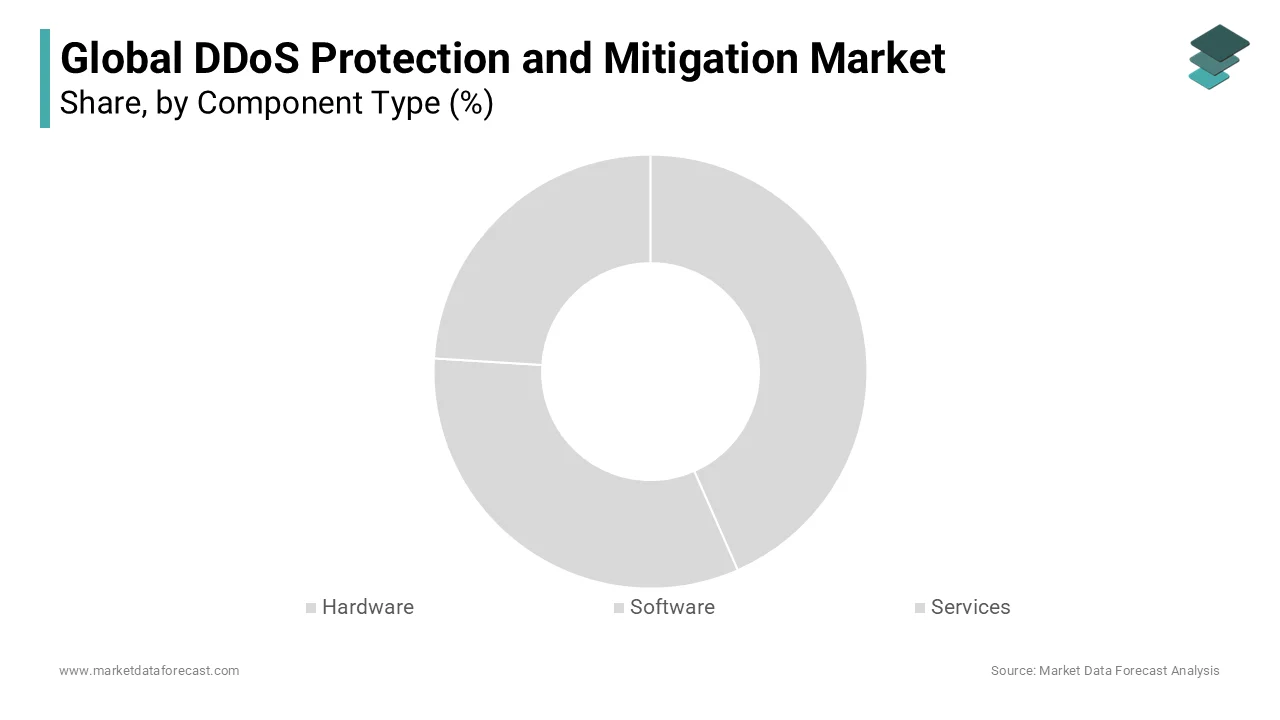
On the other side, the software solutions segment is expected to showcase a CAGR of 16.5% over the forecast period owing to the rapid cloud migration and containerization trends incompatible with traditional hardware appliances. According to Flexera’s State of the Cloud Report, 94% of enterprises use cloud services, with 85% adopting multi-cloud strategies requiring software-defined protection portable across heterogeneous environments. Hardware appliances cannot protect workloads distributed across AWS, Azure, and Google Cloud simultaneously, whereas virtualized software agents integrate natively with cloud provider APIs, enabling consistent policy enforcement. As per the CNCF Annual Survey, Kubernetes adoption reached 84% among enterprises in 2023, creating massive demand for container-aware DDoS protection that scales automatically with microservices architecture. Traditional network layer defenses fail to protect east-west traffic between containers, necessitating software solutions embedded within orchestration platforms. Cloud-native software can be deployed in minutes versus months for hardware provisioning, accelerating time to value during active threats. This architectural alignment with modern infrastructure paradigms ensures software growth outpaces legacy hardware regardless of overall market conditions, because cloud adoption is an irreversible structural trend reshaping the entire security stack.
By Application Area Insights
The network-level DDoS protection segment led the market by accounting for the major share of the global market in 2025 and maintains market leadership because volumetric attacks targeting bandwidth saturation remain the most common and immediately disruptive threat vector across all industries. According to Netscout’s Worldwide Infrastructure Security Report, volumetric attacks accounted for 62% of all DDoS incidents in 2023, with peak attack volumes regularly exceeding 2 terabits per second. These attacks target foundational connectivity, making them existential threats that must be mitigated before any application layer defense becomes relevant. As per Arbor Networks’ ATLAS Threat Intelligence, UDP reflection and amplification attacks continue dominating volume statistics because attackers exploit misconfigured DNS, NTP, and Memcached servers to generate massive traffic floods cheaply. Internet service providers and data center operators mandate network-level protection as a prerequisite for peering agreements, creating baseline demand independent of individual enterprise security maturity. Hardware scrubbing centers optimized for terabit-scale mitigation remain essential infrastructure that software alone cannot replicate due to physical throughput limitations. This dependency on specialized high-capacity infrastructure ensures network protection retains primacy as the gateway through which all other security layers depend for viability during large-scale assaults.
On the other hand, the application-based protection segment represents the fastest-growing segment and is estimated to register a CAGR of 19.4% over the forecast period in the global market owing to the direct correlation between application availability and revenue generation in digital commerce. According to Baymard Institute research, every minute of e-commerce downtime costs retailers an average of 9,000 dollars in lost sales, with conversion rates dropping 74% when page load times exceed 3 seconds during partial degradation. Unlike network attacks causing complete outages, application layer assaults degrade user experience subtly, making detection harder and business impact more insidious. As per Akamai’s State of Online Retail Performance Report, 53% of mobile users abandon sites taking longer than 3 seconds to respond, creating immediate revenue leakage from Slowloris and HTTP flood attacks. Black Friday and Prime Day events see application attack volumes spike 300% above baseline as competitors and extortionists target peak revenue windows. E-commerce platforms cannot tolerate false positives blocking legitimate shoppers during high-traffic periods, necessitating sophisticated behavioral analysis beyond simple rate limiting. This direct revenue attribution justifies premium investment in application protection, unlike network defenses viewed as an insurance cost, ensuring accelerated growth through measurable ROI linkage.
By Organization Size Insights
The large enterprises segment led the market by holding the major share of the global market in 2025 due to their expansive attack surfaces spanning multiple geographies, business units, and digital channels that attract sophisticated adversaries. According to Verizon’s Data Breach Investigations Report, organizations with over 1,000 employees experience 3.5 times more DDoS incidents annually than smaller firms because they present higher-value targets for extortion and competitive disruption. Global corporations operate dozens of public-facing applications, APIs, and partner integrations, each representing potential entry points requiring coordinated protection policies. As per the Ponemon Institute’s Cost of Cyber Crime Study, large enterprises spend an average of 27.4 million dollars annually on cybersecurity, with DDoS protection comprising 12% to 15% of total budget, reflecting risk-proportional allocation. Complex organizational structures necessitate centralized governance platforms managing heterogeneous environments across cloud providers and on-premises data centers. Procurement processes favor comprehensive platform vendors over point solutions, creating consolidation effects benefiting established players. Brand reputation risks amplify financial impacts, making board-level oversight mandatory. This combination of elevated threat exposure, substantial budgets, and governance complexity ensures large enterprises remain the primary revenue source, sustaining market leadership through structural demand concentration.
However, the small and medium enterprises segment is estimated to grow at a CAGR of 20.2% over the forecast period in the global market owing to cloud platforms democratizing enterprise-grade DDoS protection previously accessible only to large corporations. According to the AWS Small Business Survey, 78% of SMEs now use cloud infrastructure with built-in DDoS protection included in base pricing, eliminating historical cost barriers. Microsoft Azure and Google Cloud offer automatic baseline mitigation for volumetric attacks at no additional charge, covering 90% of common threats faced by smaller organizations. As per Clutch’s SMB Technology Trends Report, 64% of SMEs increased cybersecurity spending in 2023, with cloud-native security tools receiving the highest priority due to low implementation overhead. Pay-as-you-go pricing models align costs with actual usage rather than committed capacity, matching SME cash flow patterns. Self-service portals reduce dependency on expensive consultants, enabling rapid deployment without specialized expertise. This accessibility revolution transforms DDoS protection from a luxury good to a standard utility for digitally operating SMEs. Growth accelerates as cloud adoption deepens and awareness increases through industry associations and government outreach programs targeting historically underserved segments.
REGIONAL ANALYSIS
North America DDoS Protection and Mitigation Market Analysis
North America dominated the market by commanding 36.8% of the global market share in 2025. The dominance of North America in the global market can be credited to a concentrated technology sector presence and stringent regulatory enforcement. According to the U.S. Securities and Exchange Commission, new cybersecurity disclosure rules effective December 2023 compel public companies to report material DDoS incidents within 4 business days, creating unprecedented board-level accountability and driving executive sponsorship for protection investments. Canada’s Personal Information Protection and Electronic Documents Act amendments impose mandatory breach reporting, including availability compromises, expanding compliance scope beyond data confidentiality. As per the Cybersecurity and Infrastructure Security Agency’s Joint Cybersecurity Advisory, critical infrastructure sectors face escalating nation-state DDoS threats, prompting federal funding for mitigation upgrades across energy, healthcare, and financial services. Silicon Valley tech giants and cloud providers headquartered regionally drive early adoption of emerging technologies like AI-powered behavioral analysis. A mature cyber insurance market with 85% penetration among mid-sized enterprises creates contractual demand drivers absent elsewhere. This combination of regulatory pressure, technological innovation, and financial incentives sustains North American leadership through structural advantages reinforcing incumbent vendor positions while attracting continued investment.

Europe DDoS Protection and Mitigation Market Analysis
Europe held the second largest share of the global DDoS protection and mitigation market in 2025 due to the comprehensive regulatory harmonization and strong data privacy traditions shaping protection approaches. According to the European Union Agency for Cybersecurity, the NIS2 Directive transposition deadline of October 2024 expands covered entities from 10,000 to over 150,000 organizations across essential sectors, mandating DDoS resilience measures with supervisory authority oversight. GDPR Article 32 requires appropriate technical measures ensuring service availability, interpreted by data protection authorities to include DDoS protection for personal data processing systems. As per ENISA’s Threat Landscape Report, European organizations experienced 28% more application layer attacks in 2023 than the global average, reflecting sophisticated adversarial focus on regulated sectors. Strong labor protections limit 24/7 in-house security operations, driving managed service adoption rates exceeding 80% among mid-market firms. Cross-border data flow restrictions under the Schrems II ruling necessitate regional scrubbing centers, increasing local infrastructure investment. This regulatory density creates predictable demand patterns favoring vendors with established European compliance expertise and local data residency capabilities, distinguishing the competitive landscape from less regulated regions.
Asia-Pacific DDoS Protection and Mitigation Market Analysis
Asia-Pacific accounts for a notable share of the global market in 2025 and is exhibiting the highest growth velocity driven by rapid digitalization and gaming industry concentration. According to the Asian Development Bank, the digital economy's contribution to regional GDP is projected to reach 1 trillion dollars by 2030, with e-commerce and fintech sectors expanding 15% annually, creating vast new attack surfaces. South Korea and Japan host major gaming studios experiencing disproportionate DDoS targeting, with Nexon and Nintendo reporting attack volumes exceeding 500 gigabits per second during product launches as per KISA threat intelligence. China’s Cybersecurity Law and Data Security Law mandate critical information infrastructure operators implement DDoS protection, with the Ministry of Public Security conducting regular compliance inspections. As per the APAC Cybersecurity Alliance, regional skills shortages exceed 2.6 million professionals, accelerating managed service adoption, particularly among ASEAN emerging markets. Mobile-first consumer behavior increases the application layer attack surface as users access services through resource-constrained devices vulnerable to Slowloris techniques. Government initiatives like Singapore’s Cybersecurity Masterplan and India’s National Cyber Security Strategy allocate public funding for critical infrastructure protection. This convergence of digital growth, gaming concentration, and state-led security investment propels Asia-Pacific toward eventual market leadership through sheer scale and velocity of transformation.
Latin America DDoS Protection and Mitigation Market Analysis
Latin America represents a healthy CAGR in the global market and demonstrates accelerating adoption driven by financial sector modernization and increasing cybercrime sophistication. According to the Organization of American States Inter-American Committee Against Terrorism, cyberattacks against Latin American financial institutions increased 300% between 2020 and 2023, with DDoS frequently used as a distraction during fraud operations. Brazil’s General Data Protection Law imposes breach notification requirements similar to GDPR, creating compliance-driven demand among 1.5 million covered entities. As per Fortinet’s Latin America Cybersecurity Report, 67% of regional organizations experienced ransomware attacks involving DDoS extortion in 2023, exceeding global averages due to lower defensive maturity. Mexico’s nearshoring boom attracts manufacturing investment, bringing OT environments online and requiring converged IT-OT DDoS protection previously absent. Chile and Colombia emerged as regional fintech hubs with central bank digital currency pilots demanding resilient infrastructure. Limited local expertise drives reliance on international managed service providers with LATAM operations. Economic volatility constrains budgets but also increases motivation for cost-effective cloud-based protection over capital-intensive alternatives. This transitional dynamic creates opportunities for vendors offering flexible consumption models aligned with regional economic realities while addressing genuine threat escalation.
Middle East and Africa DDoS Protection and Mitigation Market Analysis
The Middle East and Africa market is characterized by extreme heterogeneity between advanced Gulf states and developing African nations. According to the Gulf Cooperation Council Cybersecurity Council, Saudi Arabia and the UAE invested over 5 billion dollars collectively in national cybersecurity infrastructure between 2020 and 2023, including sovereign DDoS scrubbing centers supporting Vision 2030 digital transformation agendas. South Africa’s POPIA enforcement actions against financial services firms for availability failures created a precedent extending DDoS obligations beyond traditional critical infrastructure. As per Check Point’s Middle East and Africa Cyber Attack Report, regional organizations face 1,800 weekly attacks on average, with 43% involving DDoS components, reflecting geopolitical tensions and hacktivism. The African Union’s Convention on Cyber Security and Personal Data Protection ratification by 15 member states begins harmonizing baseline requirements across a fragmented regulatory landscape. Oil and gas sector concentration creates high-value targets, with Aramco and ADNOC maintaining world-class protection capabilities influencing regional vendor ecosystems. Tourism-dependent economies like Egypt and Morocco prioritize hospitality sector resilience, protecting booking platforms from seasonal extortion campaigns. This diversity requires segmented go-to-market strategies balancing premium offerings for Gulf sovereign wealth funds with affordable solutions for African SMEs navigating different stages of digital maturity.
COMPETITIVE LANDSCAPE
Competition in the DDoS protection and mitigation market is characterized by network scale advantages and intelligence feedback loops rather than feature parity alone. Established players compete primarily through global infrastructure breadth, proprietary threat datasets, and automated response capabilities refined over decades of attack observation. New entrants face substantial barriers, including the capital intensity of scrubbing center deployment, cold-start problems in training detection algorithms, and trust deficits among risk-averse enterprises. Differentiation occurs through vertical specialization such as gaming or financial services, where domain knowledge enables superior false positive reduction compared to horizontal platforms. Consolidation trends favor vendors offering integrated security stacks, reducing tool sprawl for CISOs managing budget constraints. Open source and free tier offerings commoditize basic volumetric protection, pushing competition toward advanced application layer defense and managed services where expertise commands premiums. Geopolitical considerations increasingly influence vendor selection as data sovereignty requirements fragment global markets, creating regional strongholds for local providers. This dynamic rewards companies demonstrating sustained investment in both infrastructure and intelligence while penalizing those relying solely on technology licensing without operational scale.
KEY MARKET PLAYERS
The leading companies operating in the global DDoS protection and mitigation market include:
- NETSCOUT
- Akamai Technologies
- Imperva
- Radware
- Corero Network Security
- Cloudflare
- Link11
- Nexusguard
- A10 Networks
- Fortinet
- Huawei Technologies
- Verisign
- Sucuri
TOP PLAYERS IN THE MARKET
- Cloudflare contributes globally through its vast Anycast network spanning over 300 cities that absorbs and mitigates attacks at the edge before they reach customer infrastructure. The company recently enhanced its autonomous defense systems using machine learning to detect application layer attacks without manual tuning or signature updates. Cloudflare offers free baseline DDoS protection to millions of websites, democratizing access to enterprise-grade security while collecting threat intelligence that improves paid offerings. Recent partnerships with cloud providers enable native integration, reducing deployment friction for multi-cloud environments. By combining massive network scale with continuous innovation in automated detection, Cloudflare shapes industry standards and influences attacker behavior through collective immunity effects that benefit the entire internet ecosystem beyond its direct customer base alone.
- Akamai leverages one of the world’s largest distributed edge platforms to provide DDoS protection integrated with web application firewall and bot management capabilities. The company recently expanded its Prolexd service capacity to exceed 15 terabits per second, addressing growing volumetric threats targeting financial services and gaming sectors. Akamai’s acquisition of Linode enables hybrid cloud protection bridging on-premises and cloud environments under unified security policies. Research publications from Akamai’s threat intelligence team inform industry best practices and regulatory guidance globally. By embedding protection within content delivery infrastructure serving 30 percent of global web traffic, Akamai achieves unparalleled visibility into emerging attack patterns, enabling proactive defense evolution that maintains relevance across shifting threat landscapes and technology transitions.
- Imperva strengthens global DDoS resilience through an integrated application data and network security platform protecting digital assets throughout their lifecycle. The company recently launched ThreatRadar Bot Management, integrating behavioral analytics with DDoS mitigation to address sophisticated application layer attacks mimicking legitimate users. Imperva’s research on bad bot traffic influences e-commerce security standards and payment card industry guidelines worldwide. Strategic focus on API security addresses the growing attack vector where traditional network defenses fail. Partnerships with managed security service providers extend reach to mid-market segments lacking internal expertise. By unifying protection across application data and infrastructure layers, Imperva reduces tool sprawl for enterprises seeking consolidated vendors while maintaining specialized depth in defending complex business logic against evolving adversarial tactics targeting revenue-generating digital channels.
TOP STRATEGIES USED BY KEY MARKET PARTICIPANTS
Key participants prioritize network scale expansion through organic infrastructure buildouts and strategic acquisitions to increase absorption capacity and reduce latency globally. Companies invest heavily in artificial intelligence and machine learning research to automate threat detection, reducing dependency on manual signature updates during fast-moving attacks. Leading firms pursue platform consolidation, integrating DDoS protection with web application firewalls, bot management, and API security, creating unified value propositions that simplify vendor management. Market leaders establish research divisions publishing threat intelligence reports that enhance brand authority and influence industry standards while generating proprietary data improving product efficacy. Participants increasingly offer tiered pricing models, including free baseline protection to build user bases and collect telemetry feeding defensive algorithms. Strategic partnerships with cloud providers and telecommunications carriers enable embedded distribution reaching customers at the infrastructure level rather than competing as an overlay solution. These multifaceted strategies collectively strengthen competitive positioning through ecosystem integration, technological differentiation, and community trust building rather than price competition alone.
MARKET SEGMENTATION
This research report on the global DDoS protection and mitigation market has been segmented and sub-segmented based on component, area of application, mode of deployment, size of organization, vertical, and region.
By Component Type
- Hardware
- Software
- Services
By Application
- Network
- Application-Based
- Database
- Endpoint
By Deployment Mode
- Cloud
- Hybrid
- On-Premises
By Organization Size
- SMEs
- Large Enterprises
By Vertical
- Government and Defence
- BFSI
- Manufacturing
- Energy and Utilities
- It and Telecommunications
- Health Care
- Education
- Retail
By Region
- North America
- Europe
- Asia-Pacific
- Latin America
- Middle East and Africa