- Product Description Description
- Table of Contents TOC
- List of Table & Figure LOT
- Get Free Sample PDF Sample PDF
Global Web Application Firewall Market Size
The global web application firewall market was worth USD 6.03 billion in 2024. The global market is predicted to reach USD 7.05 billion in 2025 and USD 24.62 billion by 2033, growing at a CAGR of 16.92% during the forecast period. The increasing use of the Internet and web-related applications is driving the growth of the global web application firewall market.

Web Application Firewall is a protection layer employed for HTTP applications. In general, these rules protect against common attacks such as SQL injection and cross-site scripting (XSS). The proxy generally protects the client, while WAF protects the server. WAF can be provided in the form of server, filter, and device plugins. Web application firewalls can be network-based or host-based, typically implemented through a proxy and placed in front of one or more web applications. In real time or near real time, the web application firewall analyzes each request using a rule base to monitor traffic before it reaches web application and filter out potentially harmful traffic or traffic patterns. A web application firewall is a common security control that companies use to protect web applications from zero-day attacks, phishing, known vulnerabilities, and attackers.
MARKET DRIVERS
The growing demand for information security in today's Internet world is expected to be a key driver of the global market for web application firewalls.
The increasing dependence of various industries on the Internet and concerns about security and cyber theft are key factors contributing to the growth of the global web application firewall market. The key factors driving this market growth are technological innovations in product offerings, increased adoption of cloud-based solutions, and increased application areas across all industries. Web application firewalls help organizations prevent multiple vulnerabilities because the advances in technology they develop lead to a variety of threats and attacks. The Web Application Firewall market is foreseen to experience significant growth during the outlook period. The web application firewall detects and prevents cross-site scripting (XSS) attacks, SQL injection attacks, buffer overflows, and session hijacking. The web application firewall helps companies that offer products or services online. With the digitization and growth of online stores, many organizations are moving their business models to online businesses, creating weaknesses that attackers and hackers can attack. Also, the market is expected to revitalize in the coming years as the adoption of government regulations related to cloud-based computing technologies and cybersecurity increases. Businesses are investing heavily in deploying web application firewalls on-premises or in the cloud to track data shared between organizations. Additionally, technological innovations in product offerings and growing applications across all industries are believed to revitalize the market during the predicted period. The web application firewall is primarily used by organizations with online banking and retail platforms to protect operations and protect sensitive consumer data. It is also driving the market with the widespread adoption of firewalls in the healthcare sector.
Web application firewall helps prevent unauthorized access to critical medical networks and electronic patient records through Wi-Fi-enabled equipment and other connected devices. Additionally, various technological advances, such as the emergence of virtual cloud resources, are driving other growth factors. Cloud-based Web application firewall solutions provide organizations with a variety of services such as access control, bot detection and application, application program interfaces (APIs), threat intelligence, and malware detection to monitor the flow of data. Along with extensive research and development (R&D) activities, other factors, including the improvement of the information technology (IT) infrastructure, are expected to further advance the market. The increasing number of cyberattacks and fraud cases on the Internet appears to be a major factor driving the growth of the market. The increasing importance of web applications, increasing instances of web attacks, and government regulations are driving the growth of the web application firewall market.
MARKET RESTRAINTS
Factors such as a lack of skilled labor and the presence of an integrated UTM solution are likely to act as market constraints. Performance is another limiting factor, as these tools frequently inspect all inbound and outbound traffic at the application layer. The high cost of implementing device-based WAF and competition from embedded UTM solutions are limiting the web application firewall market. Additionally, many companies are facing issues related to cyber-attacks on hacking systems, another driving force in the web application firewall market. Executives' limited knowledge of web application firewalls is also a major factor impeding the growth of the global web application firewall market.
REPORT COVERAGE
| REPORT METRIC | DETAILS |
| Market Size Available | 2024 to 2033 |
| Base Year | 2024 |
| Forecast Period | 2025 to 2033 |
| CAGR | 16.92% |
| Segments Covered | By Deployment, End-use, and Region |
|
Various Analyses Covered | Global, Regional & Country Level Analysis, Segment-Level Analysis, DROC, PESTLE Analysis, Porter’s Five Forces Analysis, Competitive Landscape, Analyst Overview on Investment Opportunities |
| Regions Covered | North America, Europe, APAC, Latin America, Middle East & Africa |
|
Market Leaders Profiled | Barracuda Networks, Inc., Akamai Technologies, Inc., F5 Networks, Inc., Citrix Systems, Inc., Fortinet, Inc., Imperva, Inc., Qualys Inc., Applicure Technologies Ltd., Radware Ltd Cloudflare, Inc., and Others. |
SEGMENTAL ANALYSIS
By Deployment Insights
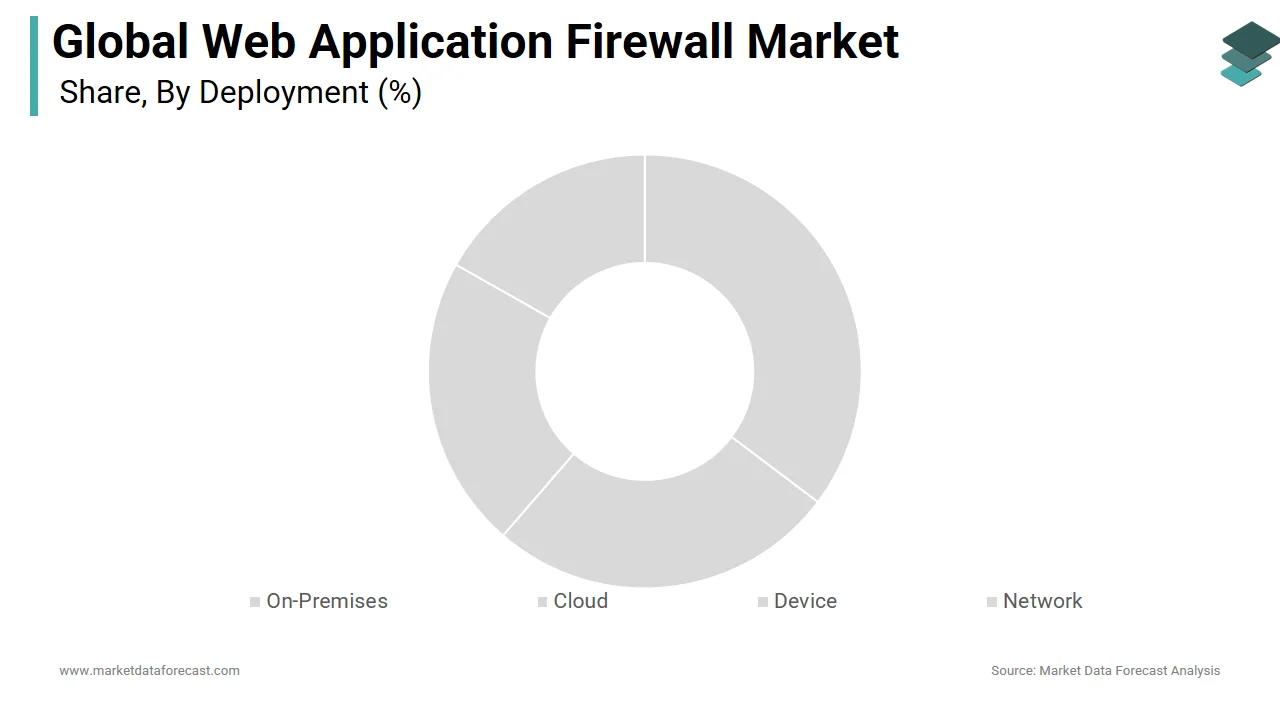
The on-premises has the largest share of the web application firewall market size in 2024. However, cloud-based deployment offers optimized scalability and flexibility when it comes to security protection. Therefore, these benefits are driving the popularity of cloud based WAF solutions during the conjecture period. Additionally, this implementation enables bot detection, threat intelligence capabilities, and web application-linked access control. Also, these cloud-based solutions protect your virtual private network from malware, new cyber threats, phishing, and ransomware. It is also designed to provide application programming interface security with Distributed Denial of Service (DDoS) mitigation.
By End-Use Insights
Currently, BFSI occupies a large share of the global web application firewall market and is also expected to grow at a notable CAGR over the forecast period. Furthermore, the stringent regulations on cybersecurity laws of prominent countries to provide security in a variety of fields, including healthcare, BFSI, and government agencies, are estimated to create significant opportunities in the WAF market.
REGIONAL ANALYSIS
The North American web application firewall market is leading the way with more security vendors. Due to advanced countries such as the United States and Canada, North America is the most advanced region in the adoption of cybersecurity technology and infrastructure.
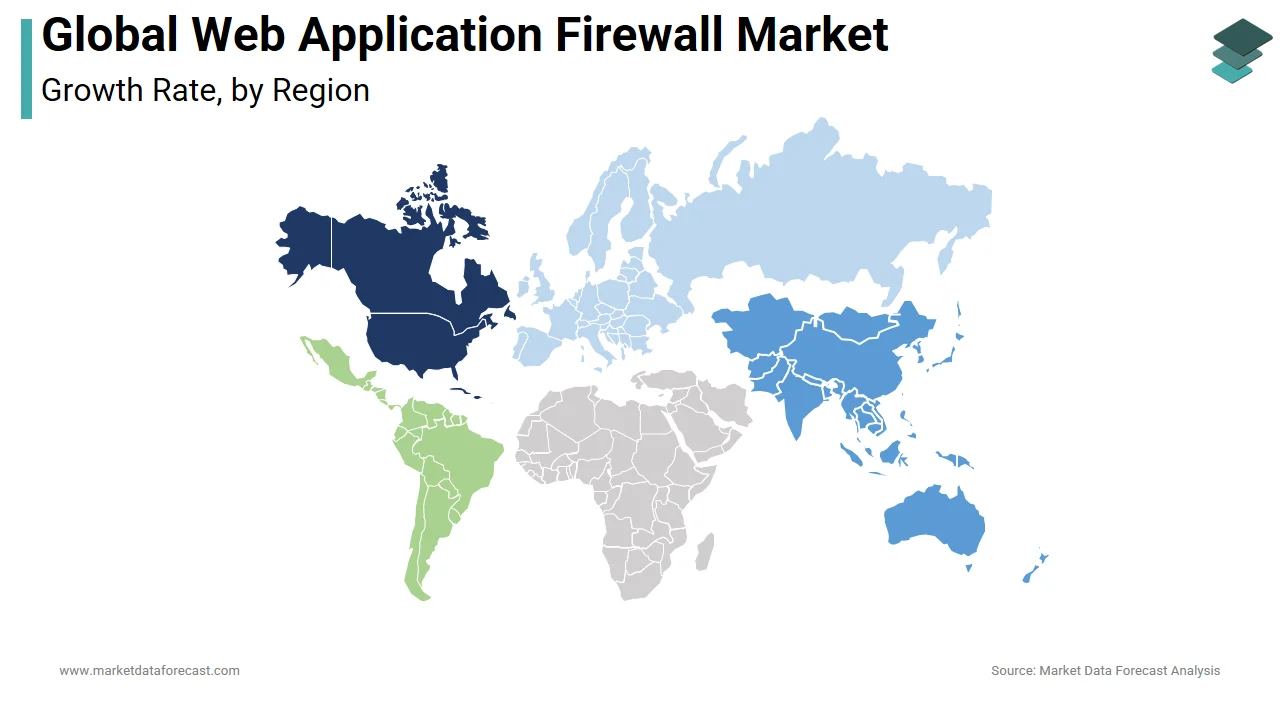
The Asia Pacific region is growing significantly in the web application firewall market as web and mobile application adoption and practices increase in India and China.
Europe web application firewall market has the second largest revenue share in the global business, followed by the Latin American, Middle Eastern, and African markets.
KEY MARKET PLAYERS
Key players operating in the global web application firewall industry include Barracuda Networks, Inc., Akamai Technologies, Inc., F5 Networks, Inc., Citrix Systems, Inc., Fortinet, Inc., Imperva, Inc., Qualys Inc., Applicure Technologies Ltd., Radware Ltd, and Cloudflare, Inc.
MARKET SEGMENTATION
This research report on the global web application firewall market has been segmented and sub-segmented based on the deployment, end-use, and region.
By Deployment
- On-Premises
- Cloud
- Device
- Network
By End-Use
- E-Commerce
- BFSI
- Government
- Education
- Medicine
- Telecommunications, etc
By Region
- North America
- Europe
- Asia-Pacific
- Latin America
- The Middle East and Africa