- Product Description Description
- Table of Contents TOC
- List of Table & Figure LOT
- Get Free Sample PDF Sample PDF
Market Size, 2025
$34.45 BnMarket Estimate, 2026
$39.96 BnMarket Forecast, 2034
$131.01 BnCAGR, 2026–2034
16%Global Enterprise Flash Storage Market Size, Growth, Trends & Forecast (2026–2034)
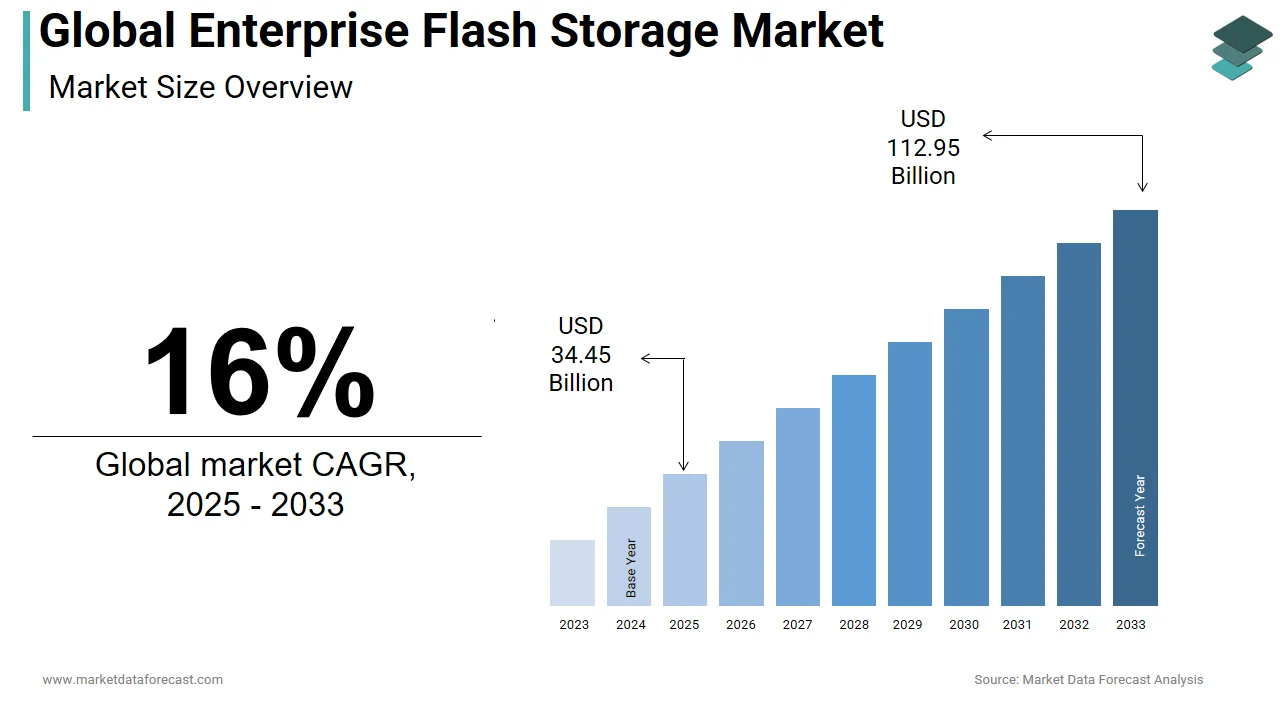
The global enterprise flash storage market was valued at USD 34.45 billion in 2025, is predicted to reach USD 39.96 billion in 2026, and is expected to surge to USD 131.01 billion by 2034, registering a compound annual growth rate (CAGR) of 16% during the forecast period from 2026 to 2034. Propelled by explosive data generation, corporate migration toward cloud data centers, and the critical need for low-latency, high-performance input/output (I/O) operations, the market is undergoing a rapid technological transformation.
Key Executive Metrics (At-a-Glance)
- 2025 Base Valuation: USD 34.45 Billion
- 2026 Current Valuation: USD 39.96 Billion
- 2034 Forecast Valuation: USD 131.01 Billion
- Compound Annual Growth Rate (CAGR): 16.0% (2026–2034)
- Dominant Array Type: All-Flash Arrays (AFA) for optimal performance and data density
- Dominant Industry Vertical: IT & Telecom and BFSI
- Dominant & Fastest-Growing Regional Market: North America (leading in tech deployment) and Asia-Pacific (APAC) (fastest-growing due to government-backed IT upgrades in India and China)
Core Market Drivers
- Data Center Cloud Migration: More than 72% of businesses shifting workloads from on-premises to cloud data centers, demanding high-density, scalable storage solutions.
- High-Speed Infrastructure Needs: Enterprise applications, real-time analytics, and customer databases requiring rapid random I/O operations and robust data security.
- Space & Energy Efficiency: Advancements in high-density flash technologies allowing businesses to minimize data center footprints, power usage, and cooling overhead costs over time.
Primary Market Restraints & Challenges
- Capital Expenditure & High Costs: Enterprise flash arrays remain more expensive upfront than traditional mechanical hard disk drives (HDDs), posing a budget hurdle for small and medium-sized enterprises (SMEs) and start-ups.
Global Enterprise Flash Storage Market Segmentation Breakdown
| Segment Category | Leading Sub-Segment (2025 Base) | Fastest-Growing Sub-Segment (2026–2034) |
|---|---|---|
| By Type | All-Flash Array (AFA) | Hybrid Flash Array & NVMe-accelerated solutions |
| By Industry Vertical | IT & Telecom & BFSI | Healthcare & Government/Defense |
| By Region | North America | Asia-Pacific (APAC) |
Major Industry Players Profiled
Key global market leaders shaping the competitive landscape include [Dell Technologies](https://www.dell.com/en-in/lp), [NetApp](https://www.netapp.com/), Pure Storage, HPE (Hewlett Packard Enterprise), IBM, Hitachi Data Systems, Tintri, Kaminario, Tegile Systems, and Reduxio.
 Download Free Sample Report
Global Enterprise Flash Storage Market Size
The global enterprise flash storage market was worth USD 34.45 billion in 2025. The global market is predicted to reach USD 39.96 billion in 2026 and USD 131.01 billion by 2034, growing at a CAGR of 16% from 2026 to 2034.
Flash Storage is a type of data storage technology based on electrically programmable high-speed memory. These storage solutions write data and perform random I / O operations at variable speed. Enterprise flash storage solutions are used in various industry applications mainly due to benefits such as faster application performance, future-proof infrastructure, improved performance, and capacity, among others.
Growth in enterprise-generated data, along with increasing adoption of cloud technology, is expected to drive the enterprise flash storage market. Flash storage adoption continues to grow in enterprise data centers around the world, in addition to the power consumption, performance, scalability, and manageability benefits that drive the rate of storage adoption. It is predicted that more than 72% of businesses will migrate to cloud data centers from on-premises data centers.
The growth of the computing device market has been advancing over the past two decades. In the business world, data storage is a decisive and essential element. Enterprise applications, media, analytics, database, and many others are crucial in data growth of any organization. The data also includes details about customers and employees, company finances, and project information. Today, businesses use flash memory chips instead of hard drives to store data. In businesses, SSDs made up of flash memory for mass storage of data or files is called enterprise flash storage. Flash storage generally provides an alternative to storage on hard drives (HDD) or other media. Enterprise flash storage offers faster I / O operations.
MARKET DRIVERS AND RESTRAINTS
Businesses often use flash storage technology to store their data. Many factors determine the enterprise flash storage market, such as data security and protection. Data is an essential part of any organization, which is why they are constantly working on the adoption of SSD to protect their data. This is the main factor affecting the overall growth of enterprise flash storage.
To maintain and store data, you need flash storages and corporate flash storages are slightly more expensive than hard drives. The cost of flash storage is the primary factor restricting the growth of the enterprise flash storage market. Most small and medium businesses face this challenge, especially start-ups.
MARKET TRENDS
The market has evolved considerably since then, and the use of storage devices has spread to almost all areas of the data center and has entered various areas of IT.
Hard drives are not sold out in the market and still have a considerable share. The computing industry relied heavily on hard drives to store data before the evolution of the cloud and online drives. The growth rate of flash storage devices is significantly higher in the market. This transformation is occurring slowly, but an efficient solution for physically storing data provides more data security than any other online database used for storage.
The advancements in high-density flash technologies have strengthened all-flash storage solutions, which provide improved performance and extended capacity in a fraction of the data center space. As IT industry data volumes continue to grow, businesses can achieve significant cost savings over time by simplifying management and reducing space, power, and cooling costs.
REPORT COVERAGE
| REPORT METRIC | DETAILS |
| Market Size Available | 2025 to 2034 |
| Base Year | 2025 |
| Forecast Period | 2026 to 2034 |
| CAGR | 16% |
| Segments Covered | By Type, Industry, and Region |
|
Various Analyses Covered | Global, Regional & Country Level Analysis, Segment-Level Analysis, DROC, PESTLE Analysis, Porter’s Five Forces Analysis, Competitive Landscape, Analyst Overview on Investment Opportunities |
| Regions Covered | North America, Europe, APAC, Latin America, Middle East & Africa |
|
Market Leaders Profiled | Dell-EMC, NetApp, Pure Storage, HPE, IBM, Tintri, Hitachi Data Systems, Kaminario, Tegile Systems, Reduxio, and Others. |
REGIONAL ANALYSIS
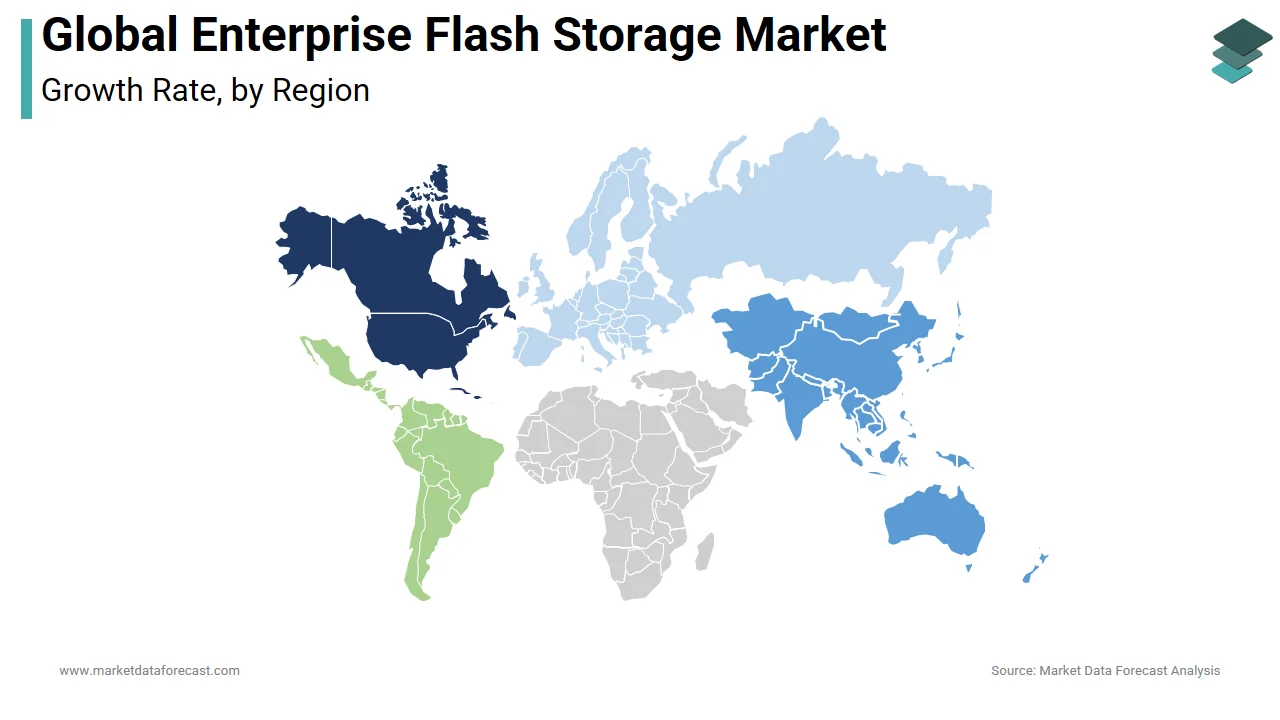
Based on geography, North America is likely to hold the commanding portion of the worldwide market, owing to the presence of well-developed companies and the adoption of various innovative technologies in the locale. Europe is also expected to gain a substantial market share through the introduction of new technologies and applications. APAC is expected to be the fastest growing enterprise flash storage market, due to government initiatives to upgrade technologies from emerging economies such as India and China.
The enterprise flash storage markets in Latin America and MEA are also expected to experience high growth rates in the coming period due to an increase in demand for data storage security.
KEY PLAYERS IN THE MARKET
The companies that are prominent in the global Enterprise Flash Storage market are Dell-EMC, NetApp, Pure Storage, HPE, IBM, Tintri, Hitachi Data Systems, Kaminario, Tegile Systems, and Reduxio.
RECENT HAPPENINGS IN THE MARKET
- In May 2020, Dell Technologies Inc. announced the introduction of the new Dell EMC PowerStore addition to its mid-range enterprise all-flash storage. The solution offers new sets of features, such as its ability to run applications on storage hardware and a free upgrade. It is said to be at least seven times faster and three times slower than other Dell EMC storage arrays because it is designed with faster NVMe protocol and additionally supports storage class memory through Intel Optane hard drives.
- In 2019, Equinix Inc., a global interconnect and data center provider, announced the expansion of Platform Equinix with the construction of the company's fourth International Business Exchange data center in Singapore, called SG4. This new facility is likely to offer a premium data center and interconnect services to help organizations with their cloud adoption and IT transformation initiatives while boosting Singapore's digital infrastructure.
MARKET SEGMENTATION
The global enterprise flash storage market is segmented and sub-segmented based on the type, industry, and region.
By Type
- All-Flash Array
- Hybrid Flash Array
By Industry
- IT & Telecom
- BFSI
- Healthcare
- Automotive
- Government and Defense
By Region
- North America
- Europe
- Asia-Pacific
- Latin America
- The Middle East and Africa