- Product Description Description
- Table of Contents TOC
- List of Table & Figure LOT
- Get Free Sample PDF Sample PDF
Market Size, 2025
$18.26 BnMarket Estimate, 2026
$19.72 BnMarket Forecast, 2034
$36.5 BnCAGR, 2026–2034
8%Executive Summary: Global Enterprise Video Market
- Market Scope: Comprehensive analysis of corporate communication hubs, streaming platforms, and collaboration infrastructure across multiple components, deployment models, applications, and end-use industries.
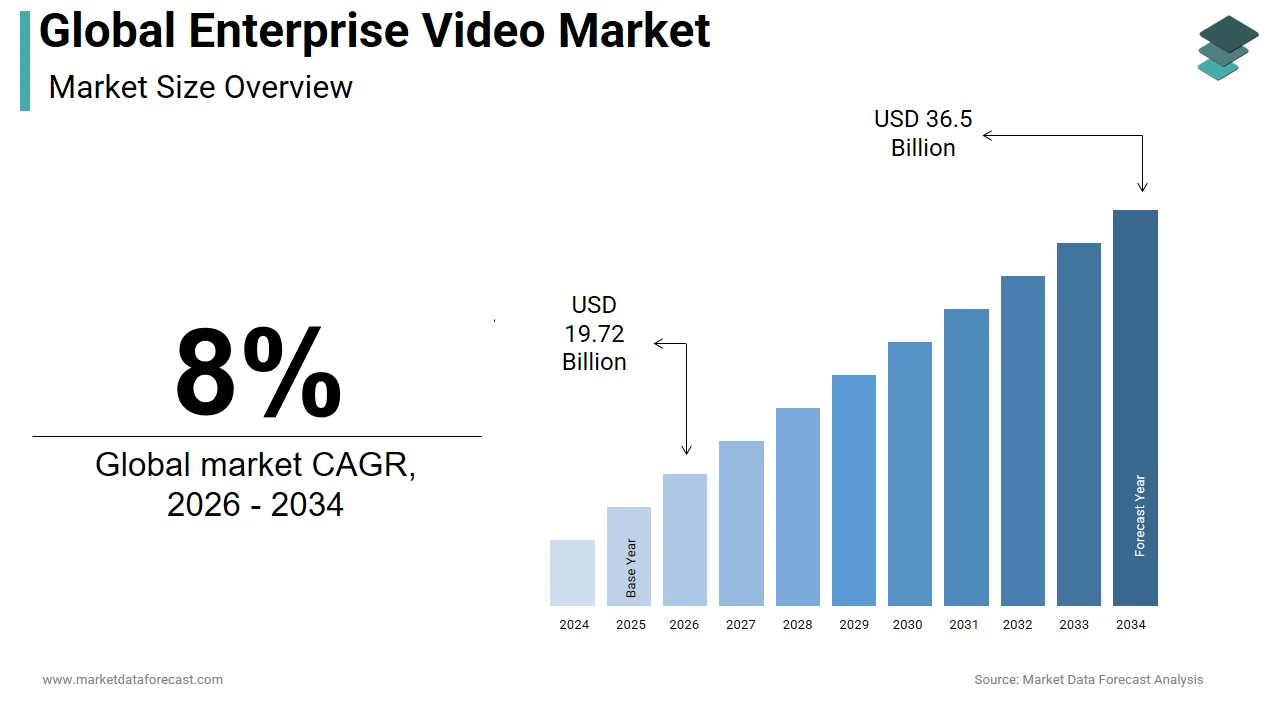
- Market Valuation: Valued at USD 18.26 billion in 2025, estimated at USD 19.72 billion in 2026, and projected to reach USD 36.5 billion by 2034, expanding at a compound annual growth rate (CAGR) of 8% from 2026 to 2034.
- Primary Growth Drivers: Shift toward hybrid/remote work structures, rising demand for video-on-demand for internal communications, incorporation of robust data encryption and privacy standards, and increasing telehealth investments.
Key Market Segment Metrics (2026–2034)
| Category | Leading Segment Focus | High-Impact Focus |
|---|---|---|
| By Component | Solutions (Video Conferencing, Video Content Management, Webcasting) | Services (Integration, Managed, & Professional Services) |
| By Deployment Mode | Cloud-Based Deployment | On-Premises Deployment |
| By Application | Corporate Communications & Training & Development | Marketing & Client Engagement |
| By Organization Size | Large Enterprises | Small & Medium Enterprises (SMEs) |
| By End-Use Industry | IT & Telecom, BFSI, & Healthcare & Life Sciences | Education, Retail, & Media & Entertainment |
Regional Analysis & Competitive Landscape
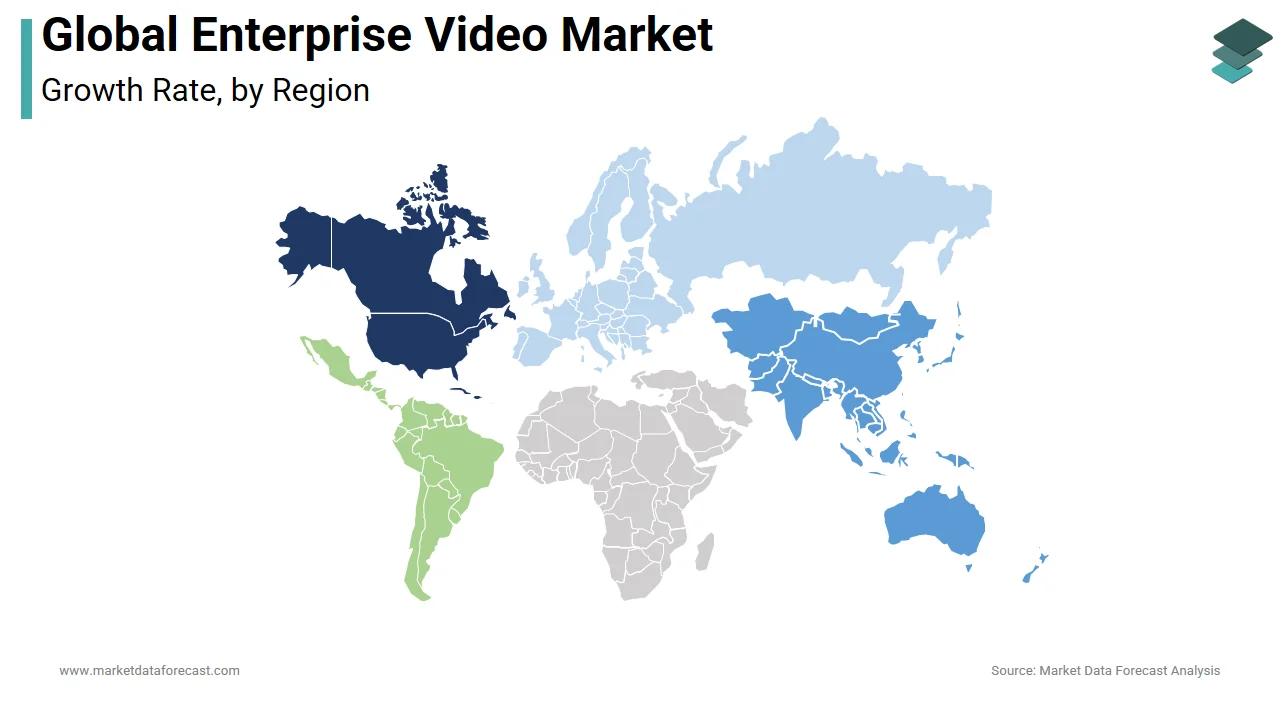
Regional Performance: North America and Europe lead the global market due to widespread corporate adoption and stringent compliance standards. Asia-Pacific is primed for significant growth driven by developing communication service sectors in countries like India and China, alongside Japan and Australia.
Market Challenges: High implementation and maintenance costs, technical equipment complexities, slow internet connections in rural or developing regions, and technology adoption hurdles.
Key Companies Profiled: Cisco Systems, Inc., Polycom, Microsoft Corporation, International Business Machines Corporation (IBM), Verizon Communications Inc., Huawei Technologies Co. Ltd., Hewlett-Packard (HP), Computer Sciences Corporation (CSC), Avaya Inc., and Alcatel-Lucent SA.
 Download Free Sample Report
Global Enterprise Video Market Size
The global enterprise video market was valued at USD 18.26 billion in 2025. The market is estimated at USD 19.72 billion in 2026 and is projected to reach USD 36.5 billion by 2034, growing at a CAGR of 8% from 2026 to 2034.
The enterprise video platform is a communications and entertainment hub for stakeholders, suppliers, employees, partners, and the external public. Corporate or enterprise video contributes to effective communication for organizations. Unlike social media platforms like YouTube, commercial videos are aimed at a limited number of people. Corporate video has a wide range of applications in corporate communications and for training and development purposes.
These video solutions act as a bridge between internal and external stakeholders, improve overall customer engagement, and ensure professional growth. Corporate video has also become a critical component of a company's content marketing strategy for internal and external operations.
Online streaming volumes have skyrocketed in recent years, and the number of active users has risen in the last five years. Enterprise video conferencing continues to be the most popular and impactful segment of this market, as it enables companies to consistently, efficiently, and quickly transmit and activate messages, train employees and assistants, and facilitate collaboration.
MARKET TRENDS
Video solutions like conferencing have made healthcare support easy. These solutions are available both on-site and in the cloud and, therefore, cost-effective, making them reasonable for healthcare organizations and patients. The main factors driving market growth are the general upward trend and increasing spending on IT healthcare for telemedicine services. This is supported by the greater efforts of national governments to improve their health infrastructure. Forbes estimated that approximately 65% of interactions with health centers occurred through telemedicine services in 2018. However, factors such as slow Internet connections and financial difficulties are hindering market growth. Also, the complexities involved in the operation of this video conferencing equipment, low knowledge of the technology, and public acceptance are other factors acting as market challenges.
MARKET DRIVERS AND RESTRAINTS
The global enterprise video market is experiencing strong demand for more efficient solutions due to the growing popularity of video-on-demand services for internal communications.
Leading companies like Microsoft and IBM are focused on providing superior and efficient professional video solutions to their customers. Growing organizations and increased demand for on-demand solutions are expected to stimulate this market. However, the high cost of implementation and the need for technical assistance are the main factors that can hinder the growth of this market.
The main driver behind the adoption of enterprise video content management solutions is the inclusion of data encryption and data privacy. The enterprise videos also meet the security standards for recording management, enabling businesses to implement them without any concern. In addition, this enterprise video content management solution allows users to access their important data remotely from their mobile and tablet applications.
REPORT COVERAGE
| REPORT METRIC | DETAILS |
| Market Size Available | 2025 to 2034 |
| Base Year | 2025 |
| Forecast Period | 2026 to 2034 |
| CAGR | 8% |
| Segments Covered | By Component, Deployment Mode, Delivery Technique, Application, Organization Size, End-Use Industry, and Region |
|
Various Analyses Covered | Global, Regional, & Country Level Analysis, Segment-Level Analysis, DROC, PESTLE Analysis, Porter’s Five Forces Analysis, Competitive Landscape, Analyst Overview on Investment Opportunities |
| Regions Covered | North America, Europe, APAC, Latin America, Middle East & Africa |
|
Market Leaders Profiled | Verizon Communications Inc., Polycom, Microsoft Corporation., International Business Machines Corporation (IBM), Huawei Technologies Co. Ltd., Hewlett-Packard (HP), Computer Sciences Corporation (CSC), Cisco Systems, Inc., Avaya Inc. and Alcatel-Lucent SA and Others. |
REGIONAL ANALYSIS
North America and Europe were two of the main markets in the global enterprise video business in the review period. Market dominance in these regions is attributed to the widespread adoption of video communication among the leading companies in this region. Asia-Pacific is expected to experience significant market penetration over the next five years due to the growth of the communications services industry in developing countries such as India and China. As for the country, the United States and Canada are two of the largest corporate video markets in North America. Germany, the United Kingdom, France, and Spain are the main regional markets in Europe. India, China, Japan, and Australia are the drivers of the corporate video market in the Asia-Pacific market.
KEY MARKET PLAYERS
The global enterprise video market is consolidated, with six companies holding 50% of the market share. Cisco Systems, Inc. and Polycom were the largest players in the enterprise video market.
Some of the competitors in the worldwide market are Verizon Communications Inc., Polycom, Microsoft Corporation., International Business Machines Corporation (IBM), Huawei Technologies Co. Ltd., Hewlett-Packard (HP), Computer Sciences Corporation (CSC), Cisco Systems, Inc., Avaya Inc., and Alcatel-Lucent SA.
RECENT MARKET HAPPENINGS
-
In June 2019, LogMeIn Inc. confirmed its partnership with Dolby Laboratories to improve its existing version of GoTo Room video conferencing software that can offer virtual conference rooms with both Dolby hardware and LogMeIn GoToMeeting software.
-
In March 2019, InPlayer shook hands with Kaltura Video Technology as a prominent partner to offer a deeper integration with the Kaltura platform.
-
In February 2019, Kaltura introduced a new video technology that enables customers to expand their video experiences by leveraging partner products and technologies that are integrated into the Kaltura platform.
MARKET SEGMENTATION
This research report on the global enterprise video market has been segmented and sub-segmented based on the delivery method, end-user, application, component, and region.
By Component
• Solutions:
o Video Conferencing
o Video Content Management
o Webcasting
• Services:
o Integration & Deployment
o Managed Services
o Professional Services
By Deployment Mode
- On-Premises
- Cloud
By Delivery Technique
- Downloading/Traditional Streaming
- Adaptive Streaming
- Progressive Downloading
By Application
- Corporate Communications
- Training & Development
- Marketing & Client Engagement
By Organization Size
- Large Enterprises
- Small & Medium Enterprises (SMEs)
By End-Use Industry
- Information Technology (IT) & Telecom
- Banking, Financial Services, and Insurance (BFSI)
- Healthcare & Life Sciences
- Media & Entertainment
- Education
- Retail & Consumer Goods
- Others (Transportation & Logistics, Government, Manufacturing)
By Region
- North America
- Europe
- Asia-Pacific
- Latin America
- The Middle East and Africa