- Product Description Description
- Table of Contents TOC
- List of Table & Figure LOT
- Get Free Sample PDF Sample PDF
Market Size, 2025
$17.64 BnMarket Estimate, 2026
$19.88 BnMarket Forecast, 2034
$51.73 BnCAGR, 2026–2034
12.7%Global Streaming Devices Market Size, Growth, Trends & Forecast (2025–2034)
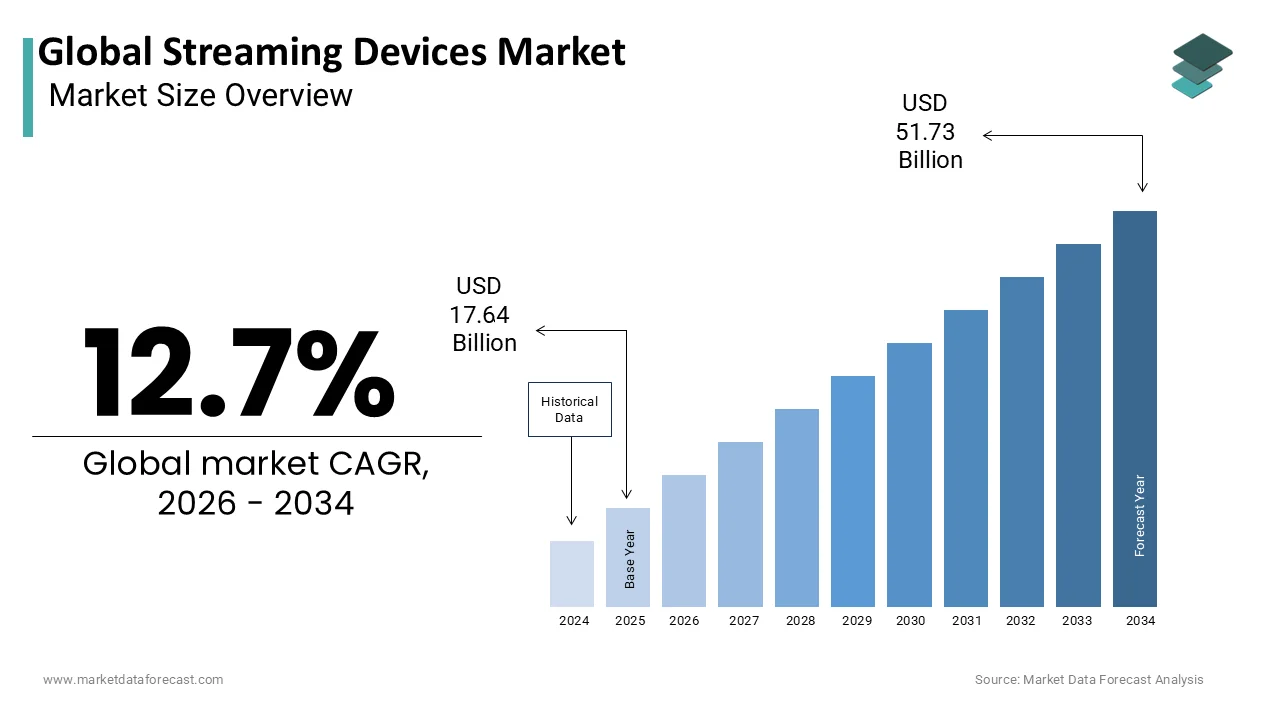
The global streaming media devices market was valued at USD 17.64 billion in 2025, is estimated at USD 19.88 billion in 2026, and is anticipated to reach a valuation of USD 51.73 billion by 2034, registering a compound annual growth rate (CAGR) of 12.7% during the forecast period from 2026 to 2034. Driven by surging high-speed internet penetration, widespread adoption of smart TVs and mobile devices, and consumer shifts toward over-the-top (OTT) media services, the market continues to experience significant global expansion.
Key Executive Metrics (At-a-Glance)
- 2025 Base Valuation: USD 17.64 Billion
- 2026 Current Valuation: USD 19.88 Billion
- 2034 Forecast Valuation: USD 51.73 Billion
- Compound Annual Growth Rate (CAGR): 12.7% (2026–2034)
- Leading Component Segment: Hardware (led by mid-range pricing between USD 51 to 150)
- Leading Application Segment: Gaming Consoles (noted for high processing capability and graphics)
- Leading Regional Market: North America (highest market share supported by early adoption and major key players)
- Fastest-Growing Region: Asia-Pacific (propelled by rising disposable incomes, cloud solutions, and internet penetration)
Core Market Drivers
- Rise of OTT & Original Content: Consumer shift toward digital platforms like Netflix, Amazon Prime, and Hulu for movies, web shows, and live-streaming.
- Technological Integration: Incorporation of cloud gaming, voice-enabled AI control, and support for high-definition 4K/8K resolutions.
- Expansion of Connectivity: Rollout of high-speed broadband and 5G networks enabling seamless, uninterrupted video and interactive content streaming.
Primary Market Restraints & Challenges
- Data Security Risks: Growing concerns regarding cyber-attacks, data breaches, and the theft of sensitive consumer payment or profile information.
- Intense Competition & Fragmentation: Competition from affordable smart TVs alongside content fragmentation and service licensing complexities.
Global Streaming Devices Market Segmentation Breakdown
| Segment Category | Leading Sub-Segment | Fastest Growing Segment |
|---|---|---|
| By Component | Hardware (largest contributor, driven by mid-range devices) | Software (gaining traction via interactive live-streaming integrations) |
| By Application | Gaming Consoles (leading share due to heavy processing capabilities) | TV (rapid growth driven by user-friendly interfaces and low cost) |
| By End-User | Residential | Commercial (expanding via live-streaming marketing and communication) |
| By Region | North America (dominant market share) | Asia-Pacific (fastest-growing regional market) |
Major Industry Players Profiled
Key companies shaping the global streaming devices market include Apple Inc., Roku Inc., ASUSTeK Computer Inc., D-Link Corporation, Hi-Media Technology Limited, Koninklijke Philips N.V., LG Electronics, Western Digital, and Sony Corporation.
Global Streaming Devices Market Size
The size of the global streaming media devices market was worth USD 17.64 billion in 2025. The global market is anticipated to grow at a CAGR of 12.7% from 2026 to 2034 and be worth USD 51.73 billion by 2034 from USD 19.88 billion in 2026.
Current Scenario of the Global Streaming Devices Market
The demand for streaming devices has been growing rapidly over the last few years, and this trend is predicted to fuel further during the forecast period and boost the global market growth. The increased internet penetration, the rising application of mobile devices and smartphones and the availability of internet connection in daily devices such as smart TVs are encouraging the adoption of streaming systems or gadgets. Apart from this, the support of 4k and 8k resolution, multi-platform access and incorporation of gaming consoles are attractive factors for a large customer base. Besides this, the effect of voice-enabled technology on smart home applications and IoT devices is surging their adoption. As per a recent study, more than 38% of all TVs are used for streaming. Also, there are around 1.8 billion video streaming services and subscriptions.
MARKET DRIVERS
The production of original content, the growing popularity of live-streaming and hybrid business models are propelling the growth of the streaming devices market.
The rapid shift from consumers towards online services or platforms for movies, web shows, and mini-series is propelling the streaming devices market. In addition, the availability of high-speed broadband internet has elevated standard cable TV to a new level. Netflix, Amazon Prime, and Hulu are examples of online streaming services that have captivated TV consumers and revolutionized the over-the-top (OTT) viewing experience.
The integration of cloud gaming and technological developments are further promoting the growth of the streaming devices market.
The cloud has largely penetrated the gaming industry which enables customers to stream high-quality games on handy or mobile devices. For example, smartphones, tablets and laptops. And, with strong network connectivity the adoption rate surges. Hence, it removes the requirement for the usual hardware updates of the console/PC/laptop. Similarly, deriving the maximum of cloud technology in the gaming field will influence the need and involvement of multiple players for various other games. The incorporation of voice control and artificial intelligence (AI) have brought revolutionized changes in the way steaming is happening. A simple voice command in the connected entertainment devices gives an individualized media experience. Viewers have control of their smart televisions, speakers and streaming systems smoothly with the help of voice recognition for content searching, changing channels or adjusting the volume. Thus, together all the factors are fuelling the market expansion.
MARKET RESTRAINTS
The rising data security and privacy risks are limiting the growth of the streaming devices market.
The cybercriminals see the online streaming industry as the most attractive market to steal personal and financial information and interest categories. They store millions of subscribers' data which involve email addresses, bank details, payment mode information, names, ages, and contact numbers. The growth in subscriptions since the coronavirus has shown a large number of consumers are exposed to cyber-attacks has surged significantly. For instance, a few hours after the launch of Disney + thousands of customers’ accounts were infiltrated by hackers, and their login details were changed.
MARKET OPPORTUNITIES
Technological advancements are predicted to offer several growth possibilities to the market participants in the global streaming services market.
The streaming devices market is anticipated to grow tremendously due to technological advancements. The progress in artificial intelligence, 5G network, blockchain, Virtual Reality (VR) and Augmented Reality (AR) and interactive content and live streaming will substantially boost the product’s customer experience. The increased rollout of the 5G network in the United States, India, China and some European countries will increase the demand for interrupted video streaming. Also, the time spent by people nowadays on one platform, channel, movie, TV series or any other service has greatly decreased. So, the consumption of interactive content like live events and performances at their home will provide potential opportunities for the market.
MARKET CHALLENGES
The intense competition from affordable smart TVs and content fragmentation is a notable challenge to the global streaming devices market.
Young and middle-aged people with sufficient spending power are more interested in smart TVs than using portable or handy devices for their entertainment. This trend is highly prevalent in emerging countries like India where migration to urban cities and growing working-class population is witnessing greater use of affordable smart TVs. Additionally, another problem for streaming device producers and customers is the fragmentation of content and service licensing agreements.
REPORT COVERAGE
| REPORT METRIC | DETAILS |
| Market Size Available | 2025 to 2034 |
| Base Year | 2025 |
| Forecast Period | 2026 to 2034 |
| Segments Covered | By Component, By Application, By End-User |
|
Various Analyses Covered | Global, Regional & Country Level Analysis, Segment-Level Analysis, DROC, PESTLE Analysis, Porter’s Five Forces Analysis, Competitive Landscape, Analyst Overview of Investment Opportunities |
| Regions Covered | North America, Europe, APAC, Latin America, Middle East & Africa |
|
Market Leaders Profiled | Apple Inc., Roku Inc., ASUS Tek Computer, Inc., D-Link Corporation, Hi-Media Technology Limited, Koninklijke Philips N.V., LG Electronics, Western Digital, Sony Corporation |
SEGMENTAL ANALYSIS
Global Streaming Devices Market Analysis By Component
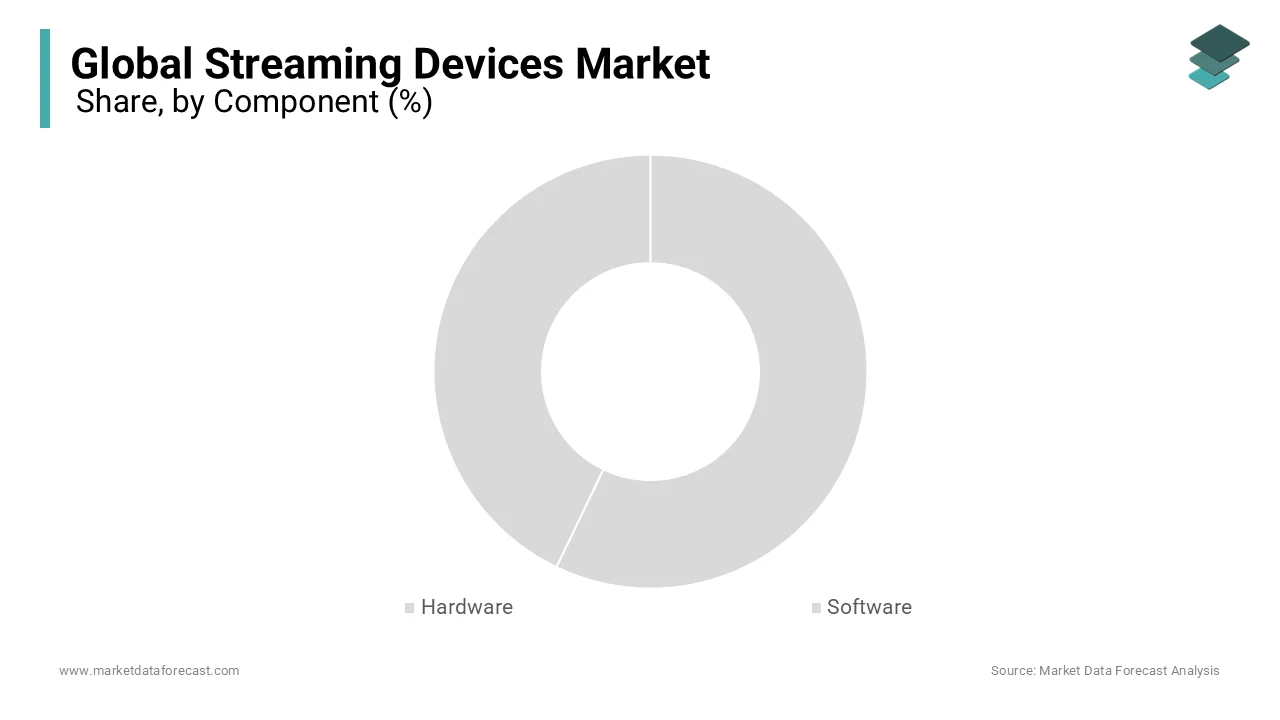
The hardware segment is the biggest contributor to the streaming devices market and is estimated to move forward at a higher CAGR in the coming years. Under this segment, the mid-range price section is the highest extractor for this. This ranges between 51 to 150 dollars. The major players are Sony, Microsoft, Amazon and Roku. Whereas the software segment is quickly gaining popularity and is expected to grow further in the future. The companies are developing their platform or collaborating with producers to make effortless service incorporation. This can be linked to the trend of interactive live-streaming from static video.
Global Streaming Devices Market Analysis By Application
The gaming consoles segment is projected to hold the leading share in the streaming devices market during the forecast period. This is because they have extremely high processing capability and graphics for streaming devices and they have the largest acceptance rate among young people. This encourages developers to provide customers with an immersive and one-of-a-kind game and entertainment experience. On the other hand, TV is predicted to have rapid growth in the streaming devices market in the projection period because of sophisticated features, user-friendly interfaces, simplicity of usage and low cost. Also due to their superior interfaces and app support, widely used media streaming services such as Roku Ultra, Apple TV, and Amazon Fire TV will promote the adoption of streaming media devices in the future.
Global Streaming Devices Market Analysis By End-User
The commercial segment is forecasted to have an upward trend in the streaming devices market during the estimation period. Because live streaming allows businesses to communicate with potential customers, it is becoming increasingly popular. This aids organizations in establishing a relationship with customers by providing them with a personalized experience with the brand. It enables them to demonstrate the product development and release process to their audience. In the healthcare industry, for example, live broadcasting supports surgeons in performing surgery under the supervision of an offshore panel of doctors.
REGIONAL ANALYSIS
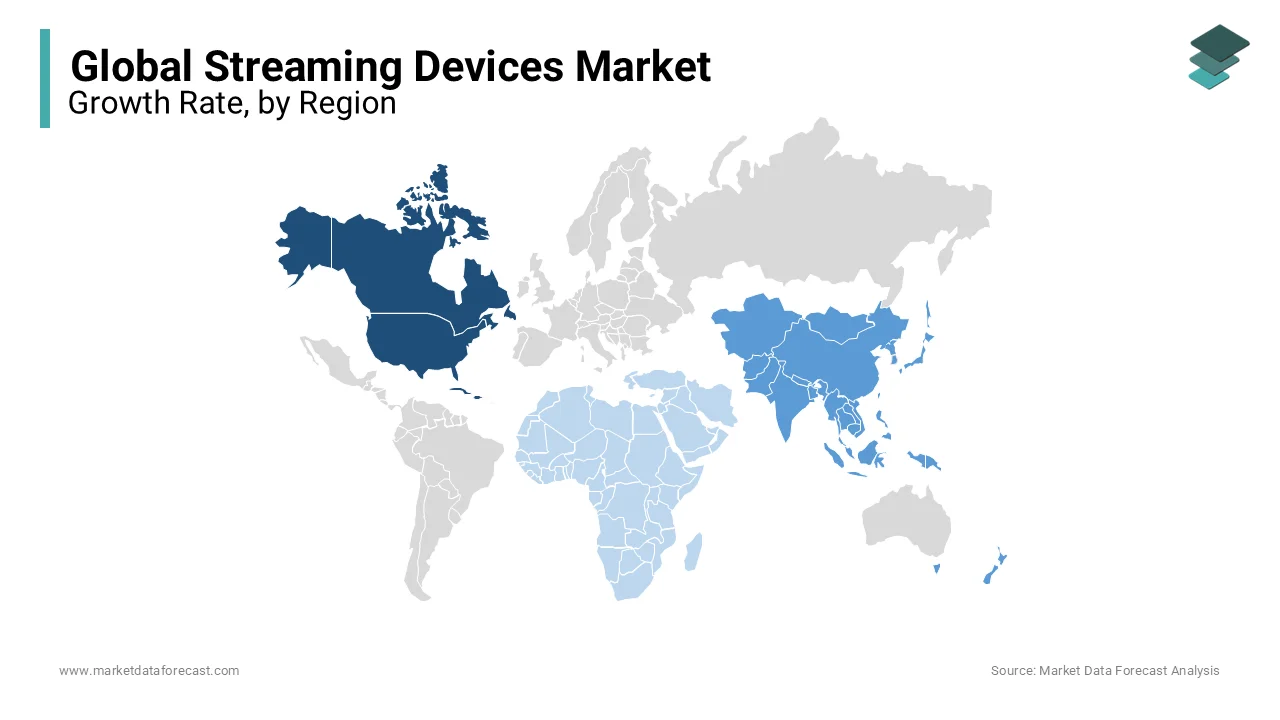
North America led the market in 2023 and is expected to have a major share of the streaming devices market during the forecast period. This is because most key industry players invest heavily in developing such media devices to provide enhanced features, sophisticated capabilities and high resolution. Furthermore, the region has the early mover’s advantage in adoption and the younger generation is increasingly shifting towards OTT services which is driving demand for these devices in this area. According to a survey, the number of innovative titles has crossed 800K alone in the United States and the volume of streaming platforms consistently increases.
Asia Pacific is predicted to register the highest CAGR and be the fastest-growing region in the streaming devices market in the coming years. Moreover, the regional industry is believed to rise due to rising demand for cloud-based solutions and services and increased internet penetration. Additionally, APAC’s growing spending power and noticeable young population are increasing the need for on-demand streaming services. Also, there is a strong focus by companies on facilitating their customer in their local language is driving up market demand in the region. Like, in India, every state has multiple online movie or TV show streaming service providers.
Europe is anticipated to capture a prominent share of the global streaming devices market during the forecast period. It has strongly emphasized both cloud methods and streaming entertainment services, which are propelling regional market growth. In Germany, the progressive transition in viewing patterns has resulted in more consumption of TV content through streaming devices and services. More than 60% of surveyed participants were connected TV (CTV) devices in 2022, and this figure has more than doubled in the immediate last four years. Whereas in France, animated content holds over 24 per cent of demand in 2023. It is the second biggest share of animation in the region.
Latin America streaming devices market is likely to grow at a rapid pace in the next few years. As of now the growing viewership of over-the-top (OTT) platforms among the Latin American population are primarily due to the flexibility, choice and convenience. Also, the extensive use of smart devices for web surfing and watching long or short videos is driving South America’s market progress. Further, the subscription-based business model is highly prevalent and accounts for a significant customer base.
Middle East and Africa are strongly believed to witness tremendous growth in the streaming devices market owing to the sharp rise in the Subscription Video on Demand (SVOD). It is expected to surpass 28 million subscribers by 2028 from 15 million in 2023. As per industry experts, in 13 Arabic nations, Netflix will remain dominant in the coming years despite domestic operators growing quickly in the region.
KEY PARTICIPANTS IN THE GLOBAL STREAMING DEVICES MARKET
Apple Inc., Roku Inc., ASUS Tek Computer, Inc., D-Link Corporation, Hi-Media Technology Limited, Koninklijke Philips N.V., LG Electronics, Western Digital and Sony Corporation are some of the notable players in the global market.
RECENT HAPPENINGS IN THE GLOBAL MARKET
- In May 2025, Amazon unveiled its more powerful Fire TV Stick 4K in India. This provides fast streaming of 4k movie content with ultra-high-definition picture quality. It also comes with Dolby Atmos Audio, Dolby model and HDR10+.
- In May 2025, Google at the Google I/O developer conference launched the new model of its Android operating system for TVs and Android TVs.
MARKET SEGMENTATION
This research report on the global streaming devices market has been segmented and sub-segmented based on component, application, end-user and region.
By Component
- Hardware
- Software
By Application
- TV
- Gaming Consoles
By End-User
- Commercial
- Residential
By Region
- North America
- Europe
- Asia-Pacific
- Latin America
- Middle East and Africa