- Product Description Description
- Table of Contents TOC
- List of Table & Figure LOT
- Get Free Sample PDF Sample PDF
Market Size, 2025
$18.81 BnMarket Estimate, 2026
$26.31 BnMarket Forecast, 2034
$386.26 BnCAGR, 2026–2034
39.91%Europe 5G Fixed Wireless Access Market Size, Growth, Trends & Forecast (2026–2034)
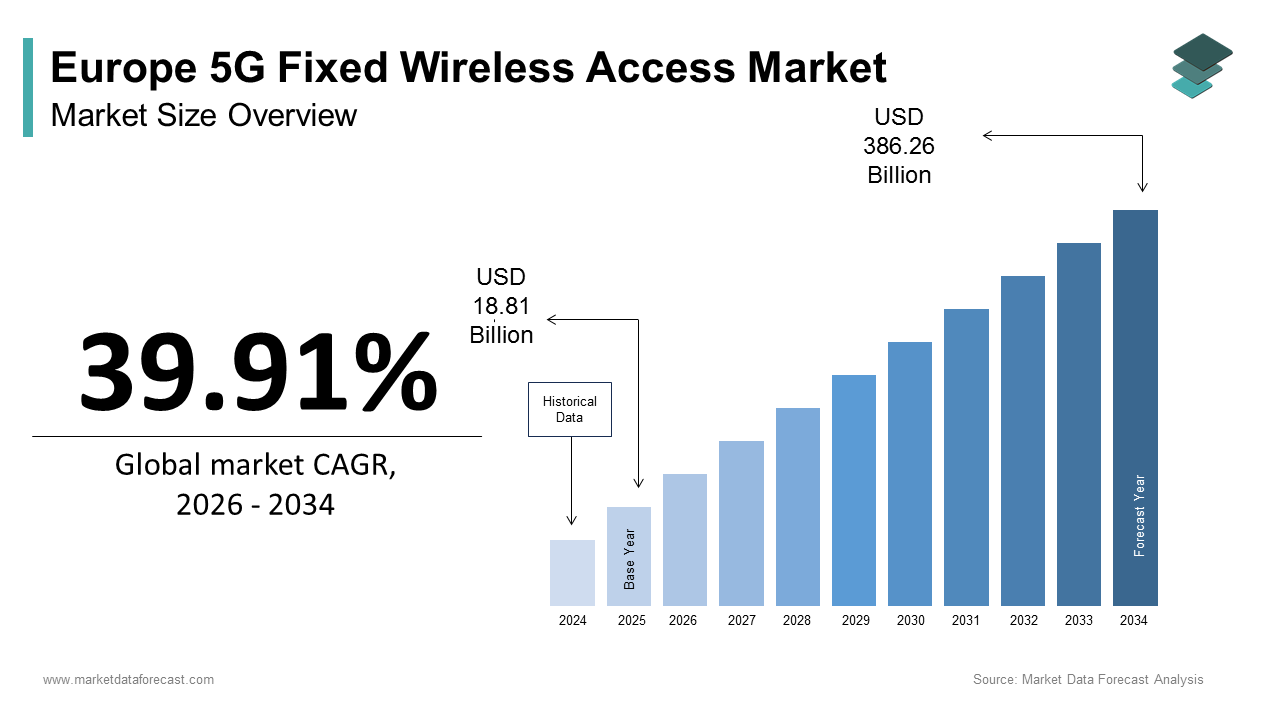
The Europe 5G fixed wireless access market size was calculated to be USD 18.81 billion in 2025, reached USD 26.31 billion in 2026, and is anticipated to be worth USD 386.26 billion by 2034, growing at a compound annual growth rate (CAGR) of 39.91% during the forecast period from 2026 to 2034. Driven by national broadband targets under the Digital Decade policy, structural shifts toward remote work and cloud services, and the need for scalable alternatives to fiber, the market is experiencing exponential expansion across urban and rural sectors.
Key Executive Metrics (At-a-Glance)
- 2025 Base Valuation: USD 18.81 Billion
- 2026 Current Valuation: USD 26.31 Billion
- 2034 Forecast Valuation: USD 386.26 Billion
- Compound Annual Growth Rate (CAGR): 39.91% (2026–2034)
- Dominant Territory Market: Urban areas (capturing 52.6% share in 2026 due to fiber congestion, high population density, and demand for redundancy)
- Key Growth Segments: Hardware offerings, rural territories, industrial applications, and managed connectivity services
Core Market Drivers & Growth Triggers
- Digital Decade Policy: Binding EU targets requiring gigabit connectivity for all households by 2030, accelerating demand for rapid, non-invasive wireless broadband deployment.
- Remote Work & Cloud Adoption: Symmetrical high-bandwidth demands from hybrid workforces and distributed corporate environments exceeding legacy copper network capabilities.
Primary Market Restraints & Challenges
- Spectrum Fragmentation: Divergent national licensing frameworks and auction delays across European member states impeding economies of scale and cross-border deployment.
- Interference & Infrastructure Barriers: Unlicensed Wi-Fi congestion, legacy LTE out-of-band emissions, and sparse millimeter-wave deployment in urban cores.
Europe 5G Fixed Wireless Access Market Segmentation Breakdown
| Segment Category | Largest Segment / Leader | Fastest-Growing Segment |
|---|---|---|
| By Offerings | Hardware (Accounted for 63.5% share in 2025 via foundational CPE, radio units, and base station infrastructure) | Services (Projected at a 28.4% CAGR driven by recurring managed connectivity, security, and QoS guarantees) |
| By Territory | Urban (Captured 52.6% share in 2026, leveraging high density and bypassing fiber congestion) | Rural (Growing at a 31.7% CAGR supported by targeted public funding and cost-effective last-mile deployment) |
| By Application | Residential (Held majority share in 2025 due to home internet demand amid remote work normalization) | Industrial (Estimated at a 34.2% CAGR fueled by Industry 4.0 automation, private networks, and AGVs) |
| By Region | Western & Northern Europe (Leading markets anchored by robust telecom investment and strategic municipal rollouts) | Central & Eastern Europe (Expanding rapidly through industrial retrofitting and targeted broadband gap initiatives) |
Major Industry Players Profiled
Key corporations shaping the Europe 5G fixed wireless access market include Ericsson, Nokia, Huawei Technologies, Samsung Electronics, Qualcomm, Telefonaktiebolaget LM Ericsson, ZTE Corporation, Cisco Systems, Intel Corporation, Verizon Communications, Deutsche Telekom, and Vodafone Group.
Europe 5G Fixed Wireless Access Market Size
The Europe 5G fixed wireless access market size was calculated to be USD 18.81 billion in 2025 and is anticipated to be worth USD 386.26 billion by 2034, growing from USD 26.31 billion in 2026 at a CAGR of 39.91% during the forecast period.
5G Fixed Wireless Access (FWA) refers to the delivery of high-speed broadband internet to homes and businesses through 5G cellular networks instead of traditional fiber or copper infrastructure. This technology leverages mid-band and millimeter wave spectrum to provide low-latency, multi-gigabit connectivity without physical cabling, making it particularly valuable in underserved or topographically complex regions. As per research, the European Commission reports that a significant portion of households, particularly in rural areas, still lack access to high-speed fixed broadband compared to urban areas, undermining goals for universal connectivity. The Body of European Regulators for Electronic Communications (BEREC) confirms that a substantial number of European municipalities lack adequate fiber infrastructure plans, primarily due to economic constraints and geographic difficulties. Concurrently, official bodies estimate that achieving comprehensive fiber coverage for all households requires extensive road excavation, constituting a major, long-term construction effort across Europe. In this context, 5G FWA emerges not as a temporary substitute but as a strategic alternative aligned with Europe’s Digital Decade objectives, enabling rapid, scalable, and less invasive broadband deployment while supporting work-from-home education and telehealth imperatives across diverse geographies.
MARKET DRIVERS
Accelerated National Broadband Targets Under the Digital Decade Policy
The European Union’s Digital Decade Compass sets a binding target that all European households must have access to gigabit connectivity by 2030, which creates urgent demand for scalable alternatives and thereby drives the growth of the Europe 5G fixed wireless access market. Coverage data indicate that a notable portion of residential locations across the European Union lacks access to high-capacity fixed networks, with disparities particularly evident outside urban centers. Certain nations are adopting 5G Fixed Wireless Access (FWA) as a key approach for fulfilling connectivity objectives in geographically challenging areas. Policy frameworks and national strategies are increasingly incorporating 5G FWA to address broadband gaps, often by prioritizing spectrum availability in regions with limited infrastructure. Financial institutions are supporting initiatives that combine fiber networks with wireless last-mile solutions, emphasizing the economic advantages of hybrid approaches. The deployment of wireless alternatives is viewed as a way to accelerate network rollout timelines and meet digital connectivity goals, reducing the reliance on extensive civil works.
Surge in Remote Work and Cloud-Based Service Adoption
The structural shift toward distributed work models and cloud-reliant applications has intensified demand for symmetrical high-bandwidth residential connections, which further boosts the expansion of the Europe 5G fixed wireless access market. 5G FWA increasingly fulfills this demand. Remote work has become a standard, regular practice for a significant portion of the European workforce, marking a sharp increase from pre-pandemic trends. Daily reliance on video conferencing and real-time collaboration tools has become widespread among employed individuals. The high bandwidth demands of modern remote work applications often exceed the capabilities of older internet technologies, causing a bottleneck in certain locations. Telecommunications providers are actively introducing 5G fixed wireless access plans designed to meet the high-speed requirements of remote workers and digital nomads. The low latency offered by 5G fixed wireless access in dense areas has positioned it as a competitive alternative to traditional fiber for cloud-based applications. Furthermore, the European Data Protection Supervisor has emphasized secure edge computing integration, which 5G FWA enables through localized data routing—reducing reliance on distant data centers. This convergence of behavioral change and technical capability positions FWA as a resilient solution for the post-pandemic digital lifestyle, independent of traditional wireline economics.
MARKET RESTRAINTS
Spectrum Allocation Fragmentation Across Member States
The absence of harmonized 5G spectrum allocation for FWA across European countries impedes economies of scale and complicates cross-border deployment strategies, which acts as a major restraint for the Europe fixed wireless access market. National regulators have diverged in their licensing and usage conditions for the 3.4–3.8 GHz 5G band, despite the recommended framework from the European Conference of Postal and Telecommunications Administrations. The availability of contiguous, high-capacity spectrum for fixed wireless access services varies considerably among European nations. Certain regulatory frameworks, including restrictions on power levels or indoor usage requirements, may limit the performance capability of fixed wireless services in some areas. Operators in particular regions face strict electromagnetic field exposure thresholds that can result in a smaller effective cell range compared to neighboring jurisdictions. The deployment of advanced, multi-gigabit fixed wireless services has been influenced by delays in auctioning higher-frequency spectrum bands in some countries, leading to a reliance on alternative, less optimal frequencies. These inconsistencies increase device certification costs and prevent unified network planning, forcing vendors to customize radio units per country. Fragmented regulations will keep hindering cross-border service launches and raising operational costs until the EU strengthens coordination under the Radio Equipment Directive.
Limited Millimeter Wave Infrastructure in Urban Cores
Millimeter wave 5G, the most potent enabler of high-performance Fixed Wireless Access, remains sparsely deployed in European cities due to restrictive urban planning policies and high deployment costs, which hinder the expansion of the Europe 5G fixed wireless access market. High-frequency signal propagation is heavily impacted by environmental obstacles and building materials, requiring a higher density of infrastructure for consistent coverage. Urban planners and municipal authorities are increasingly implementing strict aesthetic and zoning guidelines that restrict the deployment of antennas on historic structures and street-level furniture. Municipal approval processes for small cell installations are often individual, lengthy, and administratively complex, which can hinder deployment timelines. The higher energy requirements per unit of data in dense, high-frequency networks may conflict with local environmental and energy-efficiency goals. Local sustainability initiatives and green, power-conscious mandates for network infrastructure can discourage the dense deployment of high-frequency nodes. Consequently, operators prioritize sub 6 GHz bands for FWA, sacrificing peak throughput for coverage reliability. MMW FWA will be restricted to select business areas, rather than reaching mass residential areas, unless public-private investments and streamlined permitting are adopted.
MARKET OPPORTUNITIES
Integration with Energy-Efficient Smart Building Systems
5G FWA offers a strategic opportunity to serve as the connectivity backbone for next-generation smart buildings that prioritize energy autonomy and real-time grid interaction. This integration is expected to propel the growth of the Europe 5G fixed wireless access market. Regulations for public infrastructure are shifting focus toward operational efficiency, prompting the integration of advanced, connected building management systems. The modernization of existing commercial structures is fostering a broader adoption of technologies that require consistent and fast data transmission. Retrofitting initiatives are encouraging the integration of localized power generation and storage solutions within urban infrastructure. The widespread renovation of building stock is increasing the reliance on smart, responsive, and data-driven management tools. These assets rely on continuous telemetry for grid balancing, a function 5G FWA supports through time-sensitive networking and network slicing. Partnerships between telecommunications providers and real estate developers are facilitating the implementation of private 5G fixed wireless access (FWA) technology within office environments. These localized 5G networks are being utilized to enable dynamic energy management, which can lead to reduced peak electricity consumption in pilot locations. The certification of 5G FWA technology according to established power quality protocols supports its direct integration with building management systems. This synergy between digital infrastructure and decarbonization policy creates a durable use case beyond consumer broadband, positioning FWA as an enabler of sustainable urban development.
Expansion into Industrial and Rural Enterprise Connectivity
5G FWA is gaining traction as a mission-critical connectivity solution for industrial facilities and rural enterprises lacking fiber options, which provides potential prospects for the Europe 5G fixed wireless access market. A large number of Tier 2 and Tier 3 automotive manufacturing sites located in Central and Eastern Europe face significant digital infrastructure challenges, operating in regions where the expense of establishing high-speed fiber connectivity is prohibitive. These sites increasingly adopt Industry 4.0 applications such as predictive maintenance and automated guided vehicles that demand sub 20 millisecond latency, achievable via private 5G FWA networks. Agricultural processing sites in Eastern Europe are utilizing independent 5G network technology to facilitate immediate temperature tracking and automated material handling. Logistics hubs across Germany are incorporating specialized wireless connectivity to support automated warehouse operations and service guarantees. Fifth-generation fixed wireless access is increasingly serving as a faster deployment alternative for industrial Internet of Things applications compared to traditional wired installations. Reshoring driven by the EU’s Chips and Critical Raw Materials Acts makes this enterprise segment a high-value, low-churn alternative to unpredictable consumer markets for FWA.
MARKET CHALLENGES
Interference from Dense Wi-Fi and Legacy Wireless Systems
The proliferation of unlicensed wireless devices in the 5 GHz and 6 GHz bands creates significant co-channel interference that degrades 5G FWA performance in suburban and multi-dwelling environments. Consequently, this poses a serious barrier to the Europe 5G fixed wireless access market. The widespread adoption of advanced residential routers increases potential coexistence issues with cellular network frequencies. Measurements indicate that signal quality for certain wireless services may degrade during peak usage times. This reduction in signal quality can adversely impact the effective throughput of fixed wireless access, highlighting performance challenges in shared environments. Compounding the issue, legacy LTE networks in the 3.5 GHz band, still active in several Eastern European countries, generate out-of-band emissions that desensitize 5G receivers. Regulatory bodies have been slow to enforce stricter emission masks or dynamic frequency coordination, leaving operators to implement costly adaptive beamforming and interference cancellation algorithms. FWA performance will remain inconsistent until spectrum management addresses unlicensed congestion, especially in high-density areas where users expect fiber-like reliability.
High Customer Acquisition Costs in Competitive Urban Markets
High-speed fiber/cable availability in European cities makes 5G FWA a tough sell, hindered by price-conscious consumers and loyal users, which constrains the expansion of the Europe 5G fixed wireless access market. Many urban residents frequently utilize long-term, combined service packages for television, internet, and mobile connectivity from established providers. Moving consumers away from these existing, bundled service agreements often necessitates significant promotional expenditures and incentives. Acquiring new customers for specialized wireless services in high-density areas can involve higher marketing costs compared to acquiring them in less densely populated regions. The high acquisition expense is linked to overcoming established consumer habits and competitive inertia in dense markets. Additionally, consumers often perceive wireless as inherently less reliable despite technical parity, necessitating extensive education campaigns. The European Advertising Standards Alliance has also tightened rules on speed claims, prohibiting theoretical maximums without contextual disclaimers, further limiting promotional impact. Absent regulatory mandates for open access or wholesale FWA, new entrants find it difficult to scale profitably in saturated urban areas, causing investment to shift toward easier rural opportunities and delaying overall market maturity.
REPORT COVERAGE
| REPORT METRIC | DETAILS |
| Market Size Available | 2025 to 2034 |
| Base Year | 2025 |
| Forecast Period | 2026 to 2034 |
| CAGR | 39.91% |
| Segments Covered | By Offerings, Territory, Application, And Region |
| Various Analyses Covered | Global, Regional & Country Level Analysis; Segment-Level Analysis; DROC, PESTLE Analysis; Porter’s Five Forces Analysis; Competitive Landscape; Analyst Overview of Investment Opportunities |
| Regions Covered | UK, France, Spain, Germany, Italy, Russia, Sweden, Denmark, Switzerland, Netherlands, Turkey, and the Czech Republic |
| Market Leaders Profiled | Ericsson, Nokia, Huawei Technologies, Samsung Electronics, Qualcomm, Telefonaktiebolaget LM Ericsson, ZTE Corporation, Cisco Systems, Intel Corporation, Verizon Communications, Deutsche Telekom, Vodafone Group |
SEGMENTAL ANALYSIS
By Offerings Insights
In 2025, the hardware segment remained the largest segment in the Europe 5G Fixed Wireless Access market by accounting for a 63.5% share. The supremacy of the hardware segment is driven by the foundational requirement for customer premises equipment (CPE), radio units, and base station infrastructure to enable service delivery. Deployment strategies in specific Eastern European regions show a pattern of prioritizing direct installation of advanced outdoor customer premises equipment, often bypassing older, intermediate broadband infrastructure. The deployment of 5G fixed wireless access devices across Europe has increased significantly, with varied hardware configurations affecting the price point of these units. The adoption of higher frequency bands and enhanced antenna technologies in network hardware contributes to increased component complexity and manufacturing costs. The implementation of national security standards for network equipment is driving the integration of advanced, secure hardware components. Regulatory requirements concerning network security appear to influence the upgrade cycles and technical specifications of edge devices. Hardware will remain central to market economics so long as policy prioritizes spectrum expansion and coverage densification.
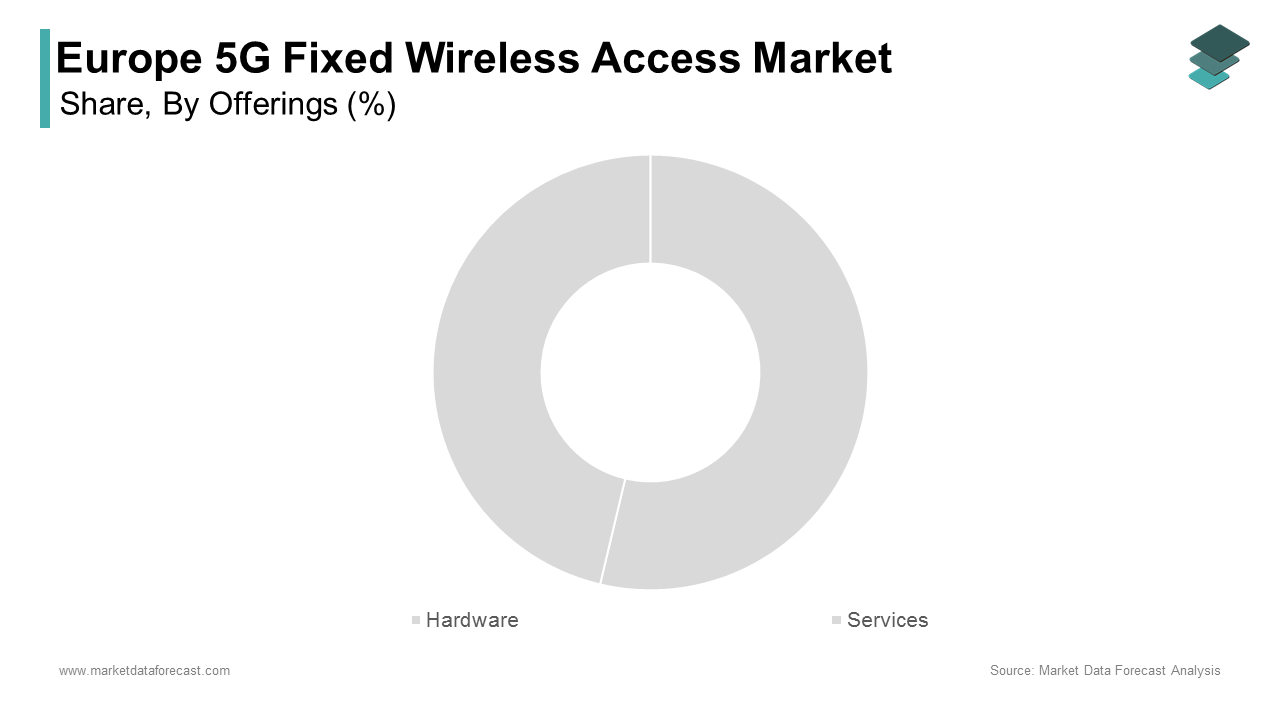
The services segment is likely to experience the fastest CAGR of 28.4% from 2026 to 2034 due to the shift from one-time hardware sales to recurring revenue models centered on managed connectivity, security, and quality of service guarantees. Service providers are incorporating value-added services, such as security features and data protection, into fixed wireless access packages to enhance service value. Certain telecommunications offerings are targeting the remote workforce by providing enhanced connectivity options, such as priority traffic management and guaranteed uptime. Regulatory updates regarding digital security are influencing providers to integrate threat detection and ongoing software maintenance into their subscription models. The inclusion of enhanced features and premium service levels is driving a shift toward higher-tier pricing structures for broadband services. Fixed wireless access packages are evolving from basic connectivity to comprehensive digital solutions that cater to specific user needs, like security and remote work capabilities. The European Data Protection Board has also emphasized data localization, prompting operators to partner with regional cloud providers for edge caching, adding another service layer. This evolution transforms FWA from a commodity access product into a differentiated digital experience platform, fueling sustained service revenue growth.
By Territory Insights
The urban areas segment led the Europe 5G Fixed Wireless Access market by capturing a share of 52.6% share in 2026. The leading position of the urban areas segment is attributed to high population density, fiber congestion, and demand for redundancy in critical business districts. A significant majority of the European population is concentrated within a relatively small percentage of the total land area, which facilitates increased network densification and spectral efficiency. In major European cities, established fiber infrastructure often experiences capacity constraints during periods of high demand, resulting in lower throughput for a portion of multi-dwelling residences. 5G Fixed Wireless Access (FWA) serves as a less invasive alternative for connectivity, allowing users to bypass traditional last-mile installation hurdles. Extended installation timelines for fiber services are a key driver for consumers to seek alternative high-speed wireless solutions. Local authorities are supporting network expansion by utilizing existing urban infrastructure, such as streetlights, to host small cell technology. The European Urban Agenda further encourages wireless solutions to avoid repeated road excavation, aligning FWA with sustainable city planning. These structural advantages ensure urban zones remain the core commercial battleground despite higher competition.
The rural territory segment is on the rise and is expected to be the fastest-growing segment in the market by witnessing a CAGR of 31.7% during the forecast period, owing to targeted public funding and the economic impracticality of fiber extension in low-density regions. Agricultural policy frameworks are increasingly directing funding toward enhancing digital infrastructure within rural and farming areas to facilitate modernization, such as integrating automated machinery. Government-supported initiatives are reducing the cost barriers for residents in sparsely populated areas, which encourages higher adoption rates of wireless broadband technology. Fixed Wireless Access (FWA) is being utilized as a cost-effective alternative to laying fiber optic cables in challenging, low-density, or difficult-to-access terrains. The deployment of cellular-based, high-speed internet solutions often presents a more economically viable infrastructure investment for remote areas compared to traditional, ground-based fiber installation. Moreover, the European Rural Parliament advocates for wireless as a tool for demographic retention, linking connectivity to telehealth and remote education access. These converging policy and economic forces position rural FWA as the most dynamic territorial frontier.
By Application Insights
The residential segment held the majority share of the Europe 5G Fixed Wireless Access market in 2025 because of the widespread need for reliable home internet amid persistent fiber gaps and remote work normalization. The rise in hybrid work arrangements has created a growing demand for reliable, high-speed internet connections capable of supporting video conferencing and cloud-based collaboration tools. Older, copper-based DSL networks are increasingly struggling to meet the connectivity requirements for modern remote work, highlighting an infrastructure gap. In regions where fiber-optic coverage is limited, fixed wireless access (FWA) services are rapidly expanding as a residential broadband alternative. Regulatory bodies are raising broadband performance standards, which in turn influences the adoption of FWA technologies in rural or underserved areas that lack adequate cable infrastructure. Many users are shifting from mobile data tethering to dedicated FWA solutions to secure more stable bandwidth and avoid data cap restrictions. Equipment design also caters to residential aesthetics, with indoor CPEs resembling Wi-Fi routers and supporting mesh integration. The proliferation of peri-urban housing construction without pre-installed conduits has positioned FWA as a critical, enduring, and temporary connectivity choice, securing its ongoing market leadership.
The industrial segment is predicted to witness the highest CAGR of 34.2% from 2026 to 2034. The swift growth of the industrial segment is fueled by the convergence of Industry 4.0 digitization and the logistical challenges of retrofitting legacy factories with wired networks. Automotive suppliers in Slovakia and Hungary, key nodes in the EU’s battery supply chain, are deploying private 5G FWA to connect automated guided vehicles and real-time quality inspection cameras without trenching production floors. 5G Fixed Wireless Access (FWA) streamlines the setup process for industrial networking, leading to faster operational readiness in manufacturing environments. Industrial applications leverage this technology to enhance connectivity for container tracking and logistical sensors across expansive terminal areas, improving network dependability. Regulatory efforts to reserve dedicated local 5G spectrum for industrial use are facilitating the adoption of private cellular networks. Unlike residential use, industrial FWA demands ultra-reliable low-latency communication, driving innovation in network slicing and edge compute integration, making it the highest value growth vector in the market.
COMPETITION OVERVIEW
The Europe 5G Fixed Wireless Access market features intense rivalry among global infrastructure vendors and regional telecom operators vying for technological leadership and public sector contracts. Competition is shaped by divergent national regulatory frameworks, spectrum availability, and fiber penetration levels, which create fragmented go-to-market strategies. Incumbent mobile operators leverage existing tower assets to deploy FWA rapidly, while challenger ISPs use it to bypass traditional broadband entry barriers. Equipment suppliers differentiate through power efficiency, latency performance, and ease of installation, particularly in rural and multi-dwelling contexts. Price sensitivity among residential users drives bundling and subsidy models, whereas industrial clients demand SLA backed reliability and private network integration. The absence of standardized performance metrics allows marketing claims to vary widely, influencing consumer trust. Meanwhile, geopolitical considerations affect vendor selection in critical infrastructure projects, heightening scrutiny on supply chain security. Innovation in antenna design, spectrum aggregation, and AI-driven network management serves as the primary battleground for sustainable competitive advantage.
KEY MARKET PLAYERS
A few major players of the Europe 5G fixed wireless access market include
- Ericsson
- Nokia
- Huawei Technologies
- Samsung Electronics
- Qualcomm
- Telefonaktiebolaget LM Ericsson
- ZTE Corporation
- Cisco Systems
- Intel Corporation
- Verizon Communications
- Deutsche Telekom
- Vodafone Group
Top Strategies Used by the Key Market Participants
Key players in the Europe 5G Fixed Wireless Access market focus on developing energy-efficient customer premises equipment that meets EU eco design directives while delivering gigabit performance. They invest in network slicing and edge computing integration to differentiate residential from enterprise service tiers. Strategic partnerships with national postal and telecom operators enable rapid last-mile deployment without new civil infrastructure. Companies also prioritize spectrum optimization through dynamic frequency sharing and beam management algorithms to mitigate interference in dense environments. Additionally, they offer managed service bundles including security, parental controls, and cloud backup to increase average revenue per user. Regulatory engagement remains central as firms collaborate with BEREC and national agencies to shape favorable licensing and coexistence rules for mid-band and millimeter wave FWA operations across diverse European terrains.
Leading Players in the Market
- Ericsson plays a pivotal role in the Europe 5G Fixed Wireless Access market by supplying end-to-end radio access network solutions that enable high-capacity residential and industrial connectivity. The company has deployed its Street Macro and Radio Dot systems across urban centers in Italy, Spain, and Sweden to support dense FWA rollouts. Recently, Ericsson partnered with Vodafone to launch gigabit-capable FWA services in rural Portugal using mid-band spectrum. It also enhanced its 5G Core with network slicing capabilities tailored for fixed wireless quality of service. Through collaboration with the European Commission on the 5G Infrastructure Association, Ericsson contributes to standardization efforts that accelerate FWA adoption while maintaining interoperability across borders.
- Nokia is a key enabler of 5G Fixed Wireless Access in Europe through its AirScale radio portfolio and FastMile customer premises equipment designed for both sub-6 GHz and millimeter wave bands. The company has supported Deutsche Telekom’s nationwide FWA expansion with beamforming CPEs that improve indoor coverage. It also works closely with national regulators to optimize spectrum sharing frameworks. Nokia’s integration of cognitive analytics into its network management suite allows real-time interference mitigation, a critical advantage in congested urban environments across Western Europe.
- Huawei contributes to the Europe 5G Fixed Wireless Access market through its high-performance 5G CPEs and Massive MIMO AAU units that deliver multi-gigabit speeds with extended range. Despite geopolitical constraints, the company maintains technical partnerships in Eastern and Southern Europe where cost-efficient deployment is prioritized. Huawei recently introduced its 5G SmartCare platform, which uses AI to predict and resolve FWA service degradation before user impact. It also co-developed low-power outdoor CPEs with Greek operator Cosmote for island connectivity. The firm actively participates in ETSI working groups to align FWA specifications with European energy efficiency and cybersecurity standards, ensuring long term relevance in regulated markets.
MARKET SEGMENTATION
This research report on the Europe 5G fixed wireless access market has been segmented and sub-segmented based on offerings, territory, application, and region.
By Offerings
- Hardware
- Services
By Territory
- Urban
- Semi-Urban
- Rural
By Application
- Residential
- Commercial
- Industrial
- Government
By Region
- UK
- France
- Spain
- Germany
- Italy
- Russia
- Sweden
- Denmark
- Switzerland
- Netherlands
- Turkey
- Czech Republic
- Rest of Europe