- Product Description Description
- Table of Contents TOC
- List of Table & Figure LOT
- Get Free Sample PDF Sample PDF
Market Size, 2025
$78.30 BnMarket Estimate, 2026
$83.86 BnMarket Forecast, 2034
$145.17 BnCAGR, 2026–2034
7.10%Europe Adhesive Tapes Market Size, Growth, Trends & Forecast (2026–2034)
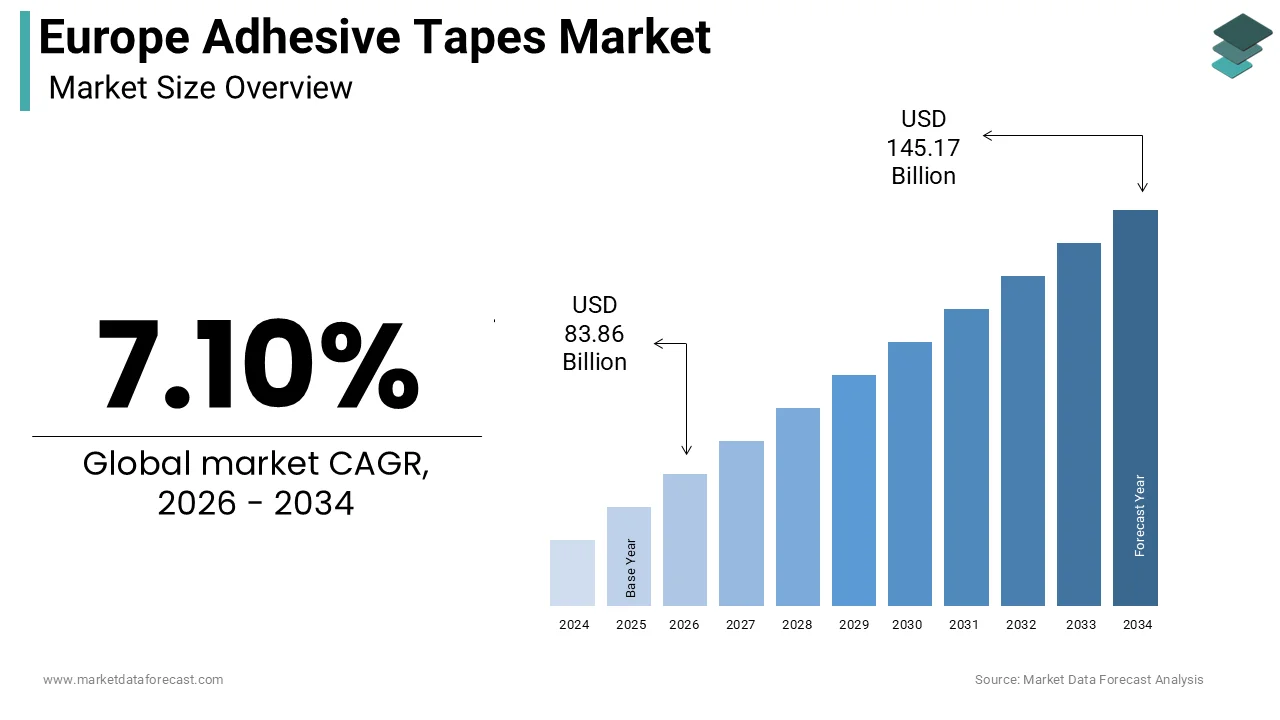
The Europe adhesive tapes market size was calculated to be USD 78.30 billion in 2025, reached USD 83.86 billion in 2026, and is anticipated to be worth USD 145.17 billion by 2034, growing at a compound annual growth rate (CAGR) of 7.10% during the forecast period from 2026 to 2034. Driven by e-commerce logistics expansion, automotive lightweighting mandates, and strict sustainability protocols under the European Green Deal, the market reflects a vital transformation toward advanced functional and bio-based adhesive solutions.
Key Executive Metrics (At-a-Glance)
- 2025 Base Valuation: USD 78.30 Billion
- 2026 Current Valuation: USD 83.86 Billion
- 2034 Forecast Valuation: USD 145.17 Billion
- Compound Annual Growth Rate (CAGR): 7.10% (2026–2034)
- Dominant Regional Market: Germany (holding a 26.4% share in 2025, anchored by industrial manufacturing, automotive prowess, and machinery)
- Key Growth Segments: Acrylic & Silicone (resin types), Polypropylene & Paper (materials), Packaging & Wind Energy (end-use)
Core Market Drivers & Growth Triggers
- E-Commerce Logistical Surge: Exponential parcel volume growth necessitating automated, high-strength corrugated box sealing tapes.
- Automotive Lightweighting: Substitution of mechanical fasteners with high-performance foam and film tapes to comply with rigorous EU carbon emission targets.
Primary Market Restraints & Challenges
- Raw Material Volatility: Severe price fluctuations in petrochemical-derived monomers and supply chain instabilities impacting converter profit margins.
- Regulatory & Recycling Pressures: Stringent plastic waste rules, single-use directives, and sorting infrastructure limitations concerning adhesive contamination.
Europe Adhesive Tapes Market Segmentation Breakdown
| Segment Category | Largest Segment / Leader | Fastest-Growing Segment |
|---|---|---|
| By Resin Type | Acrylic (Held 45.3% share in 2025 due to exceptional environmental resistance and longevity) | Silicone (Projected at a 7.8% CAGR driven by EV battery thermal management and insulation) |
| By Material | Polypropylene / PP (Held 42.3% share in 2025 as the standard economical carton-sealing medium) | Paper (Projected at an 8.2% CAGR fueled by circular economy mandates and recyclable packaging switches) |
| By End Use | Packaging (Captured 45.8% share in 2025 backed by e-commerce fulfillment lines and automated dispatch) | Wind Energy (Projected at a 9.5% CAGR driven by offshore turbine blade protection and renewable capacity rollouts) |
| By Region | Germany (Held 26.4% share in 2025, anchored by industrial prowess, automotive assembly, and high standards) | Italy, France, and Spain (Expanding via renewable projects, luxury manufacturing, and regional infrastructure investments) |
Major Industry Players Profiled
Key corporations shaping the Europe adhesive tapes market include 3M Company, Tesa SE, Avery Dennison Corporation, Nitto Denko Corporation, Scapa Group Plc, Lohmann GmbH & Co. KG, Saint-Gobain Performance Plastics, Intertape Polymer Group, Berry Global Inc., and LINTEC Corporation.
Europe Adhesive Tapes Market Size
The Europe adhesive tapes market size was calculated to be USD 78.30 billion in 2025 and is anticipated to be worth USD 145.17 billion by 2034, from USD 83.86 billion in 2026, growing at a CAGR of 7.10% during the forecast period.
The adhesive tapes are a diverse array of pressure-sensitive adhesive solutions applied to substrates such as polypropylene, polyester, paper, and foil, serving critical functions in packaging, automotive assembly, construction, and electronics. The rigorous regulatory framework driven by the European Green Deal mandates shifts toward circular economy principles and reduced carbon footprints. As per Eurostat data, the European Union generated approximately 189 million tonnes of packaging waste in 2023, with paper and cardboard accounting for 41% of this total, creating an immense downstream demand for high-performance sealing tapes to secure these materials during logistics. Furthermore, the European Automobile Manufacturers Association reported that 13.4 million cars were produced in the EU in 2023, each requiring hundreds of meters of specialized tapes for wiring harnesses, trim attachment, and noise damping, underscoring the industrial dependency on these products. According to the European Construction Sector Observatory, construction activity across the region showed resilience with a growth in building permits issued in 2023, driving requirements for mounting and insulation tapes in energy-efficient buildings. The definition extends beyond simple commodity items to include advanced functional tapes that offer thermal conductivity, electrical insulation, and flame retardancy.
MARKET DRIVERS
Expansion of E-Commerce Logistics and Corrugated Packaging Demand
The exponential growth of the e-commerce sector, which has fundamentally altered packaging requirements and driven unprecedented demand for corrugated box sealing solutions, is majorly propelling the growth of Europe adhesive tapes market. As consumers increasingly shift toward online shopping, the volume of parcels requiring secure, tamper-evident, and durable sealing has surged, directly correlating with tape consumption. The surge necessitates robust packaging systems where acrylic and hot-melt adhesive tapes are the standard for closing corrugated cartons to withstand rough handling during last-mile delivery. The trend toward automated packing lines in fulfillment centers further accelerates the adoption of machine-grade tapes that offer consistent performance at high speeds. Additionally, the rise of cross-border trade within the single market increases the average distance parcels travel, demanding higher bond strength to prevent box failure. Retailers are also investing in branded tapes for marketing purposes, adding a layer of value beyond mere functionality.
Lightweighting Initiatives in the Automotive and Aerospace Sectors
The intensifying industry-wide mandate for vehicle lightweighting to meet stringent European emission standards and improve fuel efficiency, leading to the substitution of mechanical fasteners, is additionally fuelling the growth of Europe adhesive tapes market. Automakers and aerospace manufacturers are increasingly utilizing high-performance foam and film tapes to bond interior trim, exterior moldings, and battery components in electric vehicles, as these materials offer substantial weight savings compared to screws, rivets, and welds. As per the European Commission, new CO2 emission targets for cars and vans require a 15% reduction in emissions by 2025 and 37.5% by 2030 compared to 2021 levels, pressuring manufacturers to reduce vehicle mass by every possible gram. Adhesive tapes distribute load more evenly than point-fasteners, allowing for the use of thinner gauge metals and composites without compromising structural integrity. The shift toward electric mobility specifically drives demand for thermally conductive tapes that manage heat in battery packs while providing electrical insulation. Furthermore, tapes enable faster assembly times and automation, reducing labor costs in high-wage European markets. The ability of tapes to dampen vibration and reduce noise also enhances passenger comfort, a key selling point for premium European brands. This technological transition ensures a steady and growing demand for specialized industrial tapes that support the evolution of sustainable transportation.
MARKET RESTRAINTS
Volatility in Raw Material Prices and Supply Chain Instability
The extreme volatility in the prices of key raw materials, particularly petrochemical-derived monomers for acrylic adhesives and resin tackifiers, severely impacts profit margins and pricing stability. The volatility in raw material prices and supply chain instability is hampering the growth of Europe adhesive tapes market. The production of pressure-sensitive adhesives relies heavily on derivatives of crude oil and natural gas, making the sector highly susceptible to geopolitical tensions, energy price spikes, and supply chain disruptions. According to the European Chemical Industry Council, feedstock costs for the chemical sector in Europe fluctuated by up to 35% in 2023 due to energy crises and global logistical bottlenecks, forcing manufacturers to frequently adjust product prices. This unpredictability makes long-term contracting difficult and squeezes margins for converters who cannot always pass costs immediately to end-users. Furthermore, the shortage of specific raw materials like ethyl acrylate and butyl acrylate during peak demand periods has led to production delays and allocation constraints. The reliance on imported raw materials from Asia and the Middle East exacerbates exposure to freight rate fluctuations and currency exchange risks. Small and medium-sized tape converters often lack the purchasing power to hedge against these price swings, leading to market consolidation where only large integrated players can survive.
Stringent Environmental Regulations Regarding Plastic Waste and Microplastics
The increasingly rigorous regulatory environment targeting plastic waste, single-use plastics, and microplastic pollution, which threatens the viability of conventional synthetic tape substrates, is hindering the growth of Europe adhesive tapes market. The European Union's Single-Use Plastics Directive and the evolving Packaging and Packaging Waste Regulation impose strict limits on non-recyclable materials and mandate higher recycled content, challenging the widespread use of polypropylene and polyester backing films. According to the European Environment Agency, microplastics from degraded synthetic materials are a growing concern, with regulations tightening around products that shed particles during use or disposal. Many standard adhesive tapes render paper packaging unrecyclable if they are not easily separable or if the adhesive residue contaminates the recycling stream, leading to pressure from waste management firms to develop fully recyclable or compostable alternatives. Compliance with these shifting regulations requires significant investment in research and development to reformulate adhesives and source bio-based backings, increasing operational costs. The complexity of verifying recyclability across different national waste streams within the EU adds another layer of difficulty. Companies face the risk of stranded assets if their current product portfolios become non-compliant, forcing a rapid and costly transition that may slow down overall market expansion in the short term.
MARKET OPPORTUNITIES
Development of Bio-Based and Fully Recyclable Tape Solutions
The rapid development and commercialization of bio-based and fully recyclable adhesive tapes that align with the European Union's ambitious circular economy goals and net-zero targets are creating new opportunities for the growth of Europe adhesive tapes market. According to the European Bioplastics Association, the production capacity for bioplastics in Europe is set to triple by 2028, providing a robust supply base for sustainable tape backings and adhesives. Manufacturers who pioneer "mono-material" solutions, where the tape and the substrate are chemically compatible for recycling, can capture significant market share from eco-conscious corporations aiming to meet sustainability pledges. Furthermore, government incentives under the Green Deal support the innovation of bio-based chemicals, lowering the entry barrier for R&D. Companies introducing water-activated paper tapes with starch-based adhesives or clear bio-PP tapes are already seeing accelerated adoption in the e-commerce sector. This shift not only opens new revenue streams but also future-proofs businesses against impending plastic taxes and regulatory bans.
Integration of Functional Smart Tapes in Electronics and Energy Storage
The integration of smart and functional properties into tape formats, specifically tailored for the booming electric vehicle (EV) and renewable energy sector,s is ascribed to bolster new opportunities for the growth of Europe's adhesive tapes market. Beyond simple bonding, there is a growing demand for tapes that offer thermal management, electrical conductivity, flame retardancy, and even sensing capabilities, essential for the safe and efficient operation of battery packs and solar panels. Innovations such as phase-change material tapes that regulate temperature or self-healing tapes that repair minor damages autonomously are gaining traction in high-tech applications. The expansion of offshore wind farms in the North Sea also drives demand for heavy-duty protective tapes that resist saltwater corrosion and UV degradation. Manufacturers capable of engineering multi-functional films that reduce assembly steps while enhancing performance can command higher margins and lock in strategic contracts with energy giants. This technological evolution transforms tapes from passive commodities into critical components of the green energy infrastructure, opening a high-value niche that leverages Europe's leadership in clean tech innovation.
MARKET CHALLENGES
Complexity of Recycling Infrastructure and Contamination Issues
The fragmented and inconsistent recycling infrastructure across member states, which complicates the effective recovery of taped packaging and creates contamination issues in recycling streams. While innovative recyclable tapes exist, the reality is that many existing sorting facilities lack the technology to detect or separate specific adhesive types, leading to the rejection of entire batches of paper or plastic recyclables due to tape contamination. According to the Confederation of European Paper Industries, contamination rates in paper recycling streams remain a critical issue, with non-separable adhesives causing machinery jams and reducing the quality of recycled pulp. The lack of harmonized standards across the EU regarding what constitutes a "recyclable" tape creates confusion for manufacturers and consumers alike, hindering the widespread adoption of green solutions. In some regions, tapes must be removed manually before recycling, a labor-intensive process that is economically unfeasible at scale. Developing tapes that perform well during use yet release cleanly during recycling requires complex chemical engineering that is difficult to scale cost-effectively. Until recycling technologies advance to handle diverse adhesive chemistries and EU-wide harmonization is achieved, the industry faces a significant hurdle in validating the sustainability claims of its products and achieving true circularity.
Intense Competition from Alternative Joining Technologies
The continuous advancement of alternative joining technologies, such as laser welding, ultrasonic bonding, and liquid structural adhesives, threatens to displace tapes in high-value industrial applications. In sectors like automotive and aerospace, engineers are constantly evaluating new methods that offer superior strength-to-weight ratios or faster curing times, potentially marginalizing traditional pressure-sensitive tapes. According to the European Association of Adhesives and Sealants, the market for liquid structural adhesives is growing at a faster pace in certain automotive segments due to their ability to fill gaps and bond dissimilar materials more effectively than some tape formats. Laser welding offers a clean, fastener-free joint that eliminates the need for any intermediate material, posing a direct threat to tape usage in assembly lines. The perception that tapes may degrade over time under extreme environmental conditions compared to cured liquids or welded joints also limits their adoption in critical structural roles.
REPORT COVERAGE
| REPORT METRIC | DETAILS |
| Market Size Available | 2025 to 2034 |
| Base Year | 2025 |
| Forecast Period | 2026 to 2034 |
| CAGR | 7.10% |
| Segments Covered | By Resin Type, Material, End Use, And Region |
| Various Analyses Covered | Global, Regional & Country Level Analysis; Segment-Level Analysis; DROC, PESTLE Analysis; Porter’s Five Forces Analysis; Competitive Landscape; Analyst Overview of Investment Opportunities |
| Regions Covered | UK, France, Spain, Germany, Italy, Russia, Sweden, Denmark, Switzerland, Netherlands, Turkey, and the Czech Republic |
| Market Leaders Profiled | 3M Company, Tesa SE, Avery Dennison Corporation, Nitto Denko Corporation, Scapa Group Plc, Lohmann GmbH & Co. KG, Saint-Gobain Performance Plastics, Intertape Polymer Group, Berry Global Inc., LINTEC Corporation |
SEGMENTAL ANALYSIS
By Resin Type Insights
The acrylic resin segment was the largest by holding 45.3% of the Europe adhesive tapes market share in 2025 due to its inherent ability to withstand harsh environmental conditions without degrading, a requirement for European industries operating under strict longevity and safety standards. This resilience makes acrylic tapes the preferred choice for exterior building applications, such as sealing windows and mounting facade panels, where failure is not an option. Furthermore, the automotive industry relies on acrylics for exterior trim attachment because they do not crack in cold European winters or soften excessively in summer heat. The chemical structure of acrylic polymers allows for customization to meet specific adhesion needs while resisting plasticizer migration, ensuring long-term reliability. As European regulations continue to emphasize durable and low-maintenance infrastructure, the unmatched environmental resistance of acrylic resins secures their dominant market position.
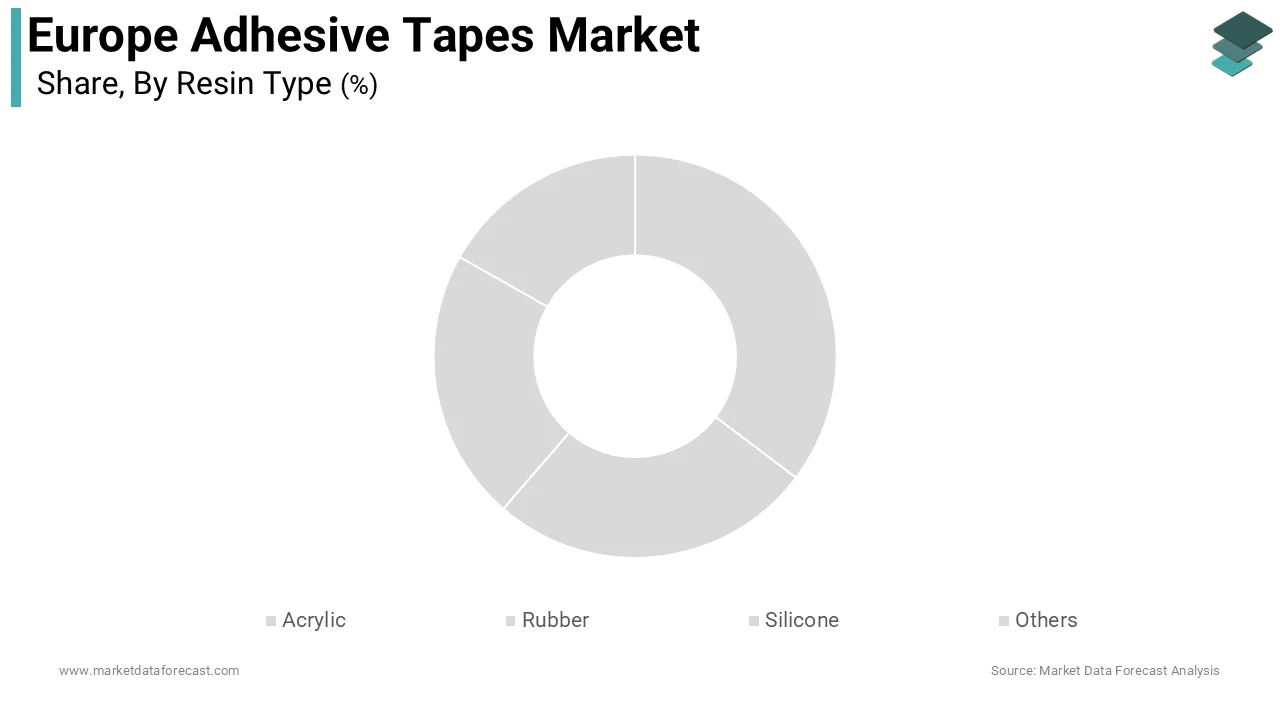
The silicone resin segment is expected to witness the fastest CAGR of 7.8% during the forecast period, owing to the explosive expansion of the electric vehicle (EV) market in Europe, where silicone tapes are indispensable for thermal management and electrical insulation within battery packs. Silicones possess exceptional thermal conductivity and dielectric strength, allowing them to dissipate heat generated by battery cells while preventing short circuits, a safety imperative that other resins cannot match at extreme operating temperatures. According to the European Automobile Manufacturers Association, EV sales in Europe surpassed 3.2 million units in 2023, representing a 30% increase from the previous year, directly correlating with a surge in demand for specialized battery assembly tapes. Each EV battery pack requires meters of thermally conductive silicone tape to ensure uniform temperature distribution and prevent thermal runaway, a feature that becomes more critical as battery densities increase. Furthermore, silicones maintain their flexibility and adhesion properties across a wide temperature range from minus 50 to plus 200 degrees Celsius, ensuring reliability in varying climatic conditions across the continent. The push for local battery manufacturing under the European Battery Alliance further amplifies this demand, creating a robust supply chain for high-performance silicone solutions.
By Material Insights
The Polypropylene (PP) segment was the largest by holding 42.3% of the Europe adhesive tapes market share in 2025, with its status as the default material for carton sealing tapes, driven by the relentless growth of the e-commerce sector and the corresponding need for secure, economical packaging solutions. Polypropylene films offer an optimal balance of tensile strength, clarity, and printability at a lower cost compared to polyester or PVC, making them ideal for high-volume automated packing lines. The material's resistance to moisture and tearing ensures that packages remain intact during complex supply chain journeys, reducing product damage and returns. Furthermore, PP tapes can be easily customized with brand logos and handling instructions, serving as a marketing tool for retailers. The established recycling infrastructure for polypropylene in many European countries also supports its continued use, although challenges remain regarding separation from paper streams.
The paper segment is anticipated to grow at the fastest CAGR of 8.2% from 2026 to 2034, owing to the intensifying consumer and corporate demand for fully recyclable and compostable packaging materials that align with circular economy principles. Major e-commerce players and retail brands in Europe are committing to removing all single-use plastics from their supply chains by 2025, driving a massive switch from plastic film tapes to paper alternatives. The development of reinforced paper tapes with glass fiber strands has also expanded their application to heavier loads, overcoming previous strength limitations. Furthermore, government incentives for using mono-material packaging encourage manufacturers to adopt paper solutions to avoid upcoming plastic taxes. As the regulatory landscape tightens and eco-consciousness becomes a mainstream purchasing criterion, the demand for paper tapes is set to outpace all other material segments.
By End-Use Insights
The packaging segment accounted in holding 45.8% of the Europe adhesive tapes market share in 2025, owing to the exponential expansion of the e-commerce ecosystem, which has fundamentally increased the number of individual parcels requiring secure sealing and labeling. Every online order typically involves multiple layers of tape for box closure, reinforcement, and label attachment, creating a direct correlation between online sales volume and tape consumption. According to Eurostat, the number of online shoppers in the EU reached 300 million in 2023, with the average frequency of purchase increasing to 18 times per year, generating billions of additional packages annually. This surge has compelled logistics providers to scale up their operations, investing in automated sorting and packing facilities that consume vast quantities of adhesive tape. The rise of quick-commerce and same-day delivery services adds another layer of complexity, requiring tapes that set instantly to keep pace with rapid dispatch times. Furthermore, the trend toward smaller, more frequent shipments rather than bulk buying increases the surface-area-to-volume ratio of packaging, thereby increasing tape usage per unit of goods sold.
The wind energy segment is projected to register the fastest CAGR of 9.5% in the coming years, owing to the European Union's ambitious targets to drastically increase renewable energy capacity, particularly in the offshore sector, where conditions are harshest and tape requirements are most demanding. The EU aims to install at least 300 gigawatts of offshore wind capacity by 2050, requiring a massive rollout of new turbines that rely on advanced adhesive tapes for blade protection, lightning strike mitigation, and structural bonding. Each turbine blade, which can exceed 100 meters in length, requires hundreds of square meters of specialized tapes to protect the leading edge from erosion caused by rain, hail, and salt spray, extending the operational life of the asset. The shift toward floating wind farms in deeper waters also introduces new challenges that require highly durable adhesive solutions capable of withstanding dynamic loads and corrosive marine environments.
REGIONAL ANALYSIS
Germany Adhesive Tapes Market Analysis
Germany was the outperformer in the Europe adhesive tapes market by capturing 26.4% of the market share in 2025, with its position as the continent's industrial powerhouse, a robust automotive sector, and a leading manufacturing hub for packaging machinery. The high demand for precision-engineered industrial tapes is used in automotive assembly, electronics, and heavy machinery. The country is home to several global tape manufacturers and converters, fostering a competitive environment that drives innovation in specialty products. The strong export orientation of German industry means that a significant portion of the produced goods requires premium packaging tapes for international shipment. Furthermore, Germany's leadership in the Energiewende (energy transition) has spurred demand for tapes used in solar panel and wind turbine production. The stringent German standards for quality and durability ensure that the market favors high-end products over commodity items.
Italy Adhesive Tapes Market Analysis
Italy's adhesive tapes market was ranked second by holding 14.6% of the market share in 2025, with its vibrant manufacturing base in ceramics, tiles, furniture, and fashion, all of which are significant consumers of specialized adhesive tapes. The need for masking tapes in surface finishing processes and protective tapes for high-value design products during transport is driving the growth of the market. Additionally, the luxury fashion and leather goods sectors utilize delicate protective tapes to prevent scratches and damage to finished products, driving demand for low-tack and residue-free solutions. The construction renovation boom in Italy, supported by government superbonus incentives, has also boosted the consumption of building and construction tapes for insulation and sealing. The emphasis on design and aesthetic perfection in Italian manufacturing ensures a preference for high-quality tape solutions that do not compromise product finish.
France Adhesive Tapes Market Analysis
France's adhesive tapes market growth is likely to grow with its strong aerospace, aviation, and nuclear energy sectors, alongside a robust agricultural and food processing industry that drives packaging tape demand. The French market is notable for its high consumption of specialty tapes used in aircraft assembly and maintenance, given the presence of major aerospace giants like Airbus. The nuclear energy sector, a cornerstone of French power generation, also utilizes specialized radiation-resistant tapes for cable bundling and maintenance, creating a stable niche demand. In the consumer sector, the large agricultural output of France necessitates extensive use of packaging tapes for food distribution and export, particularly for fresh produce and wine. The government's push for industrial sovereignty and re-industrialization is encouraging local manufacturing, which in turn boosts domestic tape consumption. Furthermore, the growing renovation market in France, aimed at improving energy efficiency in old buildings, is increasing the uptake of insulation and sealing tapes.
United Kingdom Adhesive Tapes Market Analysis
The United Kingdom adhesive tapes market growth is likely to grow with a mature logistics sector, a strong pharmaceutical industry, and a resilient construction market that drives steady demand for various adhesive tape types. The pharmaceutical industry, a key pillar of the UK economy, requires high-purity and validated tapes for medical device assembly and drug packaging, adhering to strict regulatory standards. The construction sector, despite some slowdowns, continues to drive demand for duct tapes, masking tapes, and vapor barriers, particularly in the social housing and infrastructure segments. The UK's island geography also necessitates robust packaging for exports, ensuring tapes must withstand humid maritime conditions. Additionally, the presence of specialized tape converters serving niche markets like electronics and defense contributes to the market's depth.
Spain Adhesive Tapes Market Analysis
Spain's adhesive tapes market growth is likely to grow with a booming tourism sector, a strong automotive manufacturing base, and a thriving agricultural export industry that collectively fuel demand for packaging and industrial tapes. According to the Spanish National Statistics Institute, the tourism sector recovered to pre-pandemic levels in 2023, stimulating the hospitality industry's need for maintenance, repair, and operational tapes. The automotive sector, with major plants operated by global manufacturers, remains a significant consumer of assembly tapes for wiring, trim, and sound damping. Furthermore, Spain is a leading exporter of fresh fruits and vegetables, requiring specialized cold-chain tapes and breathable packaging films to preserve product quality during long-distance transport. The construction sector is also experiencing a revival, driven by urban renewal projects and infrastructure investments, boosting sales of building tapes.
COMPETITION OVERVIEW
The competition in the Europe adhesive tapes market is characterized by a dynamic mix of large multinational corporations and specialized regional players vying for dominance through technological innovation and sustainability credentials. Global giants leverage their extensive research budgets and broad product portfolios to offer comprehensive solutions across multiple industries, while local firms compete on agility and deep customer relationships in niche sectors. The rivalry intensifies as companies race to develop eco-friendly products that meet evolving regulatory standards regarding plastic waste and volatile organic compound emissions. Price competition remains significant in commodity segments like standard packaging tape,s prompting manufacturers to optimize production costs through automation and economies of scale. Conversely, the high-performance industrial sector sees competition based on technical superiority and custom engineering capabilities, where trust and reliability are paramount. The emergence of new applications in renewable energy and electric mobility has opened fresh battlegrounds where early movers can secure lucrative long-term contracts.
KEY MARKET PLAYERS
A few major players of the Europe adhesive tapes market include
- 3M Company
- tesa SE
- Avery Dennison Corporation
- Nitto Denko Corporation
- Scapa Group Plc
- Lohmann GmbH & Co. KG
- Saint-Gobain Performance Plastics
- Intertape Polymer Group
- Berry Global Inc
- LINTEC Corporation
Top Strategies Used by Key Market Participants
Key players in the Europe adhesive tapes market primarily focus on product innovation driven by sustainability goals to comply with strict European environmental regulations and consumer demands. Companies actively invest in research and development to create bio-based adhesives and recyclable backing materials that support the circular economy. Leading firms are increasingly verticalizing their supply chains to secure raw material availability and mitigate price volatility risks associated with petrochemical derivatives. Manufacturers also prioritize digitalization of production facilities to enhance operational efficiency and enable customized small-batch production for diverse client needs. Furthermore, key participants form long-term partnerships with original equipment manufacturers to co-develop tailored bonding solutions that integrate seamlessly into automated assembly lines. These combined efforts allow market leaders to maintain competitive advantages and adapt rapidly to shifting industrial requirements.
Leading Players in the Europe Adhesive Tapes Market
- Tesa SE operates as a premier German manufacturer and a global leader in self-adhesive solutions with deep roots in the European industrial landscape. The company contributes significantly to the global market by providing innovative bonding technologies for automotive, printing, and consumer applications that set industry benchmarks for performance. Recently, Tesa has strengthened its market position by launching advanced bio-based tape portfolios designed to support the circular economy and meet stringent EU sustainability goals. They have expanded their production capabilities in Europe to ensure supply chain resilience and reduce carbon emissions associated with logistics. The company actively collaborates with automotive OEMs to develop lightweighting solutions that replace mechanical fasteners with high-strength adhesive tapes.
- Saint-Gobain is a French multinational corporation that plays a pivotal role in the Europe adhesive tapes market through its extensive range of construction and industrial masking solutions. The company contributes globally by integrating adhesive technologies into its broader building materials ecosystem, offering comprehensive systems for insulation and facade protection. Recent actions to strengthen their position include the acquisition of specialized tape manufacturers to broaden their product portfolio in high-performance exterior applications. Saint-Gobain has also initiated major sustainability programs aimed at reducing the environmental footprint of its adhesive products through water-based formulations. They leverage their vast distribution network across Europe to deliver tailored solutions for large-scale infrastructure projects.
- Berry Global Inc stands as a dominant force in the Europe adhesive tapes market, particularly in the packaging segment, where it supplies vast quantities of carton sealing and protective tapes. The company contributes to the global market by utilizing its massive scale to provide cost-effective and reliable adhesive solutions for logistics and e-commerce giants. Recently, Berry Global has strengthened its market position by investing in advanced recycling technologies to create tapes with high recycled content, aligning with European plastic reduction mandates. They have optimized their manufacturing processes to improve efficiency and reduce waste generation across their European facilities. The company actively engages with retailers to develop custom-branded tape solutions that enhance package security and brand visibility.
MARKET SEGMENTATION
This research report on the Europe adhesive tapes market has been segmented and sub-segmented based on resin type, material, end use & region.
By Resin Type
- Acrylic
- Rubber
- Silicone
- Others
By Material
- Polypropylene
- Paper
- Polyvinyl Chloride
- Others
By End Use
- Packaging
- Automotive
- Building and Construction
- Others
By Region
- UK
- France
- Spain
- Germany
- Italy
- Russia
- Sweden
- Denmark
- Switzerland
- Netherlands
- Turkey
- Czech Republic
- Rest of Europe