- Product Description Description
- Table of Contents TOC
- List of Table & Figure LOT
- Get Free Sample PDF Sample PDF
Market Size, 2025
$15.24 BnMarket Estimate, 2026
$16.25 BnMarket Forecast, 2034
$27.18 BnCAGR, 2026–2034
6.64%Europe Adhesives Market Size, Growth, Trends & Forecast (2026–2034)
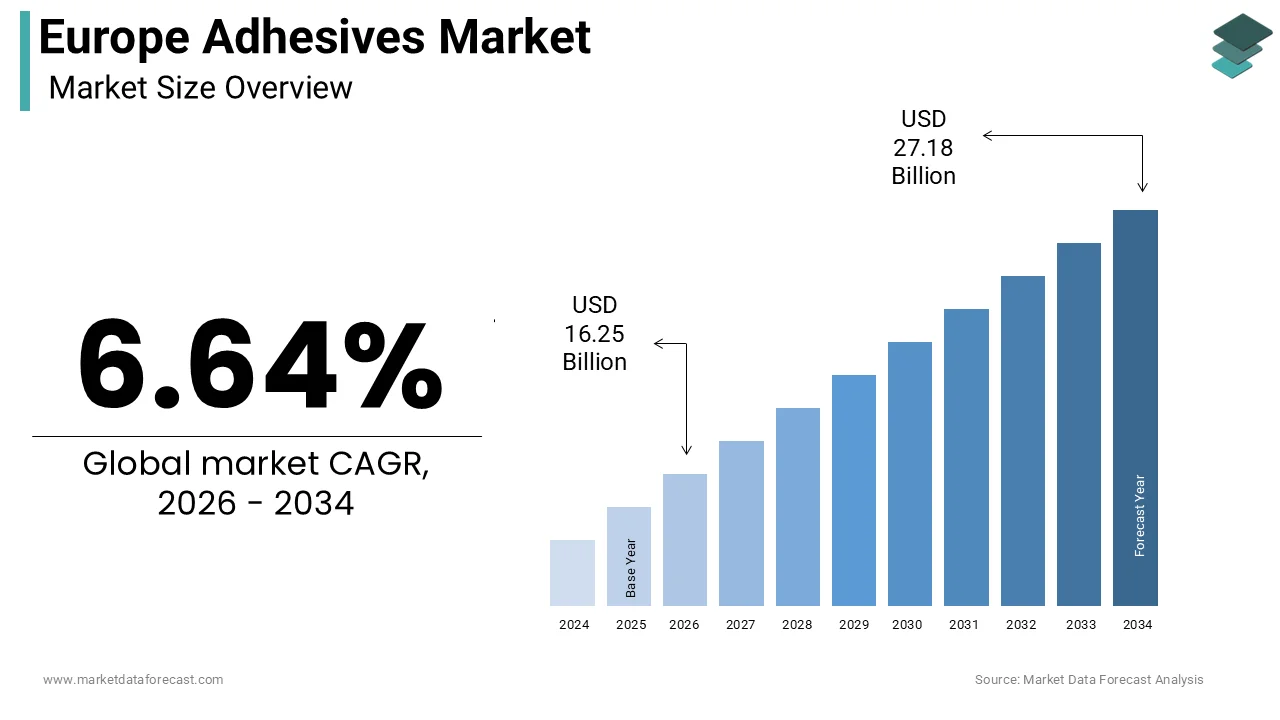
The Europe adhesives market size was calculated to be USD 15.24 billion in 2025, reached USD 16.25 billion in 2026, and is anticipated to be worth USD 27.18 billion by 2034, growing at a compound annual growth rate (CAGR) of 6.64% during the forecast period from 2026 to 2034. Driven by vehicle lightweighting mandates, sustainable packaging transitions, and strict environmental compliance under the European Green Deal, the market reflects a vital technological evolution toward bio-based, water-borne, and high-performance structural bonding agents.
Key Executive Metrics (At-a-Glance)
- 2025 Base Valuation: USD 15.24 Billion
- 2026 Current Valuation: USD 16.25 Billion
- 2034 Forecast Valuation: USD 27.18 Billion
- Compound Annual Growth Rate (CAGR): 6.64% (2026–2034)
- Dominant Regional Market: Germany (holding a 24.4% share in 2025, anchored by automotive manufacturing, mechanical engineering, and green construction)
- Key Growth Segments: Polyurethane & Epoxy (resin types), Water-borne & UV-Cured (technologies), Building & Construction & Healthcare (end users)
Core Market Drivers & Growth Triggers
- Automotive Lightweighting Revolution: Substitution of traditional mechanical fasteners with structural adhesives to bond dissimilar materials (aluminum, carbon fiber, and high-strength steel) for enhanced EV and ICE fuel efficiency.
- Sustainable Packaging Ecosystem: E-commerce growth and European Green Deal mandates accelerating the adoption of water-borne laminating agents and bio-based adhesives.
Primary Market Restraints & Challenges
- Raw Material Cost Volatility: Severe price fluctuations in petrochemical derivatives (ethylene, propylene, VAM) and energy-intensive European production constraints.
- Complex Chemical Regulations: Heavy compliance burdens imposed by the REACH framework, diverting R&D resources toward administrative testing and approvals.
Europe Adhesives Market Segmentation Breakdown
| Segment Category | Largest Segment / Leader | Fastest-Growing Segment |
|---|---|---|
| By Resin Type | Polyurethane (Held 28.3% share in 2025 due to exceptional versatility across automotive, construction, and footwear) | Epoxy (Projected at a 7.8% CAGR driven by wind energy blade manufacturing and electronics miniaturization) |
| By Technology | Water-borne (Held 34.8% share in 2025 backed by stringent VOC regulations and eco-friendly packaging shifts) | UV-Cured (Projected at an 8.4% CAGR fueled by instantaneous curing, high speed, and electronics assembly) |
| By End User | Building and Construction (Captured 30.4% share in 2025 driven by the European Green Deal building renovation wave) | Healthcare (Projected at a 9.2% CAGR driven by aging demographics and medical device innovation) |
| By Region | Germany (Held 24.4% share in 2025, anchored by auto production, engineering, and green construction funds) | France, Italy, and UK (Expanding via aerospace composites, luxury design manufacturing, and life sciences) |
Major Industry Players Profiled
Key corporations shaping the Europe adhesives market include Henkel AG & Co. KGaA, 3M Company, Arkema S.A., Sika AG, H.B. Fuller Company, Avery Dennison Corporation, BASF SE, Dow Inc., Huntsman Corporation, and Wacker Chemie AG.
Europe Adhesives Market Size
The Europe adhesives market size was calculated to be USD 15.24 billion in 2025 and is anticipated to be worth USD 27.18 billion by 2034, from USD 16.25 billion in 2026, growing at a CAGR of 6.64% during the forecast period.
The adhesives are bonding agents essential for joining substrates across diverse industrial sectors, including automotive, construction, packaging, and electronics. These substances function by creating surface attachment through mechanical interlocking or chemical bonding, enablers for modern manufacturing efficiency and product durability. Polymer dispersions and emulsions constitute the largest product group within this landscape, commanding over 45% of the total volume share as per industry data from FEICA. Furthermore, the packaging sector alone consumed 42 million tons of materials in the European Union in 2024 by creating substantial downstream demand for high-performance bonding solutions, as reported by IndexBox.
MARKET DRIVERS
Surging Demand from the Automotive Lightweighting Revolution
The imperative for vehicle lightweighting to meet stringent European emission standards in the automotive sector is leveraging the growth of Europe adhesives market. Manufacturers increasingly replace traditional mechanical fasteners and welding with structural adhesives to bond dissimilar materials such as carbon fiber, aluminum, and high-strength steel, thereby reducing overall vehicle mass and enhancing fuel efficiency. Structural adhesives enable weight reductions of up to 20% compared to conventional joining methods, a critical factor for automakers striving to comply with the European Union target of reducing carbon dioxide emissions by 55% by 2030. Electric vehicle production necessitates thermally conductive adhesives for battery management systems by creating a niche yet rapidly expanding subsector within the broader market. This transition away from heavy mechanical components toward integrated adhesive assemblies fundamentally alters the material composition of modern automobiles by securing long term demand for high-performance bonding agents.
Expansion of the Sustainable Packaging Ecosystem
The e-commerce sector and evolving consumer preferences for eco-friendly materials have propelled the packaging industry into a dominant position, as adhesive consumption is propelling the growth of Europe adhesives market. Modern flexible packaging solutions increasingly rely on laminating adhesives that facilitate the bonding of multiple layers while ensuring recyclability and reducing plastic waste. Regulatory pressures, such as the European Green Deal mandate that all packaging be reusable or recyclable by 2030, force converters to adopt water-based and solvent-free adhesive technologies that do not contaminate recycling streams. The European paper packaging market faces steady demand despite cost pressures, with operating rates expected to stabilize around 84 to 85%, sustaining the need for high-speed bonding agents, according to Arkap insights. Bio-based adhesives derived from renewable resources are gaining traction, with the European segment valued at 5.95 billion in 2025 and projected to expand significantly, as per LinkedIn analysis. Food safety regulations further dictate the use of non-toxic adhesives for direct and indirect food contact applications, driving innovation in formulation chemistry. The flexible packaging materials market continues to experience price volatility, yet the underlying volume demand remains resilient due to the essential nature of packaged goods in the European supply chain, as reported by Converting Quarterly.
MARKET RESTRAINTS
Volatility in Petrochemical Raw Material Costs
The fluctuating prices of key petrochemical feedstocks, by creating margin pressure and supply chain instability for manufacturers is hindering the growth of Europe adhesives market. The production of synthetic adhesives relies heavily on derivatives such as ethylene, propylene, styrene, and butadiene, whose costs are intrinsically linked to crude oil prices and regional energy availability. A specific shortfall of approximately 500,000 metric tons of vinyl acetate monomer (VAM) in Europe has exacerbated supply constraints by affecting not only adhesives but also paints and coatings sectors, according to industry reports. These raw material cost instabilities force manufacturers to frequently adjust pricing strategies, often leading to reduced demand from price-sensitive end users in construction and general industrial applications. The European flexible packaging market observed continued price volatility in the first quarter of 2025 driven by these upstream raw material fluctuations and logistics challenges, as noted by Converting Quarterly. Energy-intensive production processes in Europe face additional burdens from high electricity and natural gas prices, further compounding the cost structure compared to global competitors. Supply chain disruptions stemming from geopolitical tensions and logistical bottlenecks amplify these cost pressures, making long-term planning difficult for market participants.
Stringent Regulatory Compliance and Chemical Restrictions
The complex of chemical regulations in Europe, particularly the REACH framework, imposes substantial compliance burdens and is additionally degrading the growth of Europe adhesives market. The Registration, Evaluation, Authorization, and Restriction of Chemicals regulation requires extensive testing and documentation for substances used in adhesive formulations, increasing time to market and operational costs. This regulatory flood creates an increased workload for the collective industry, diverting resources from research and development toward compliance administration, according to Afera technical reports. The simplification of REACH remains a topic of debate, with industry bodies like FEICA advocating for streamlined processes to maintain competitiveness without compromising safety standards. Small and medium-sized enterprises often lack the financial capacity to navigate these intricate regulatory pathways, potentially stifling innovation in niche adhesive segments. Furthermore, the constant evolution of restricted substance lists forces formulators to continuously reformulate products, incurring significant research expenses and risking performance compromises. The administrative burden associated with maintaining compliance across multiple European jurisdictions slows down the introduction of novel adhesive technologies compared to less regulated regions.
MARKET OPPORTUNITIES
Rise of Bio-Based and Circular Economy Solutions
The accelerating transition toward a circular economy for the development and adoption is expected to create new opportunities for the growth of the Europe adhesives market. Consumers and corporate buyers increasingly demand products with reduced carbon footprints, driving formulators to replace petroleum-derived ingredients with renewable alternatives such as starch, lignin, and soy protein. The furniture and woodworking sectors are where formaldehyde-free bioadhesives are gaining preference due to indoor air quality concerns. The packaging industry offers vast potential for compostable adhesive solutions that align with the European Union's strategy for plastics in a circular economy. Collaborations between chemical giants and biotech startups are fostering the creation of high-performance adhesives that match or exceed the properties of traditional synthetic counterparts. Government incentives and grants for sustainable manufacturing further encourage investment in bio-based research and production facilities.
Integration of Smart Manufacturing and Digitalization
The advent of Industry 4.0 and the digitalization of manufacturing processes through enhanced precision and efficiency is expected to escalate the growth of Europe adhesives market. Smart factories utilize automated dispensing systems and real-time monitoring sensors to optimize adhesive application by reducing waste and ensuring consistent bond quality in high-volume production lines. The European electronic adhesives market is surging due to industrial digitalization and the revolution in electric vehicle production, which demands precise bonding for miniaturized components, as reported by Industry Today. Advanced data analytics enable predictive maintenance of application equipment and formulation adjustments based on real-time environmental conditions, maximizing throughput and minimizing downtime. The trend toward lightweighting in automotive and aerospace sectors requires adhesives with tailored rheological properties that can be precisely controlled via digital dispensing technologies. Digital twins and simulation software allow manufacturers to test adhesive performance virtually before physical prototyping, accelerating product development cycles. The integration of artificial intelligence in quality control systems ensures that every bonded joint meets rigorous safety standards, crucial for sectors like automotive and medical devices.
MARKET CHALLENGES
Supply Chain Fragility and Geopolitical Instability
The supply chain fragility and geopolitical instability, which disrupt the flow of essential raw materials and finished goods is one of the challenges for the growth of Europe adhesives market. The region's heavy reliance on imported petrochemical feedstocks makes it vulnerable to global trade tensions, shipping delays, and political conflicts that can abruptly sever supply lines. Geopolitical tensions in Eastern Europe and the Middle East continue to impact energy prices and transportation routes, creating an unpredictable operating environment for chemical manufacturers. The shortage of specific raw materials like vinyl acetate monomer illustrates how localized production issues can cascade into broader market disruptions affecting multiple downstream industries. Companies are forced to hold higher inventory levels and diversify supplier bases, which increases working capital requirements and operational complexity. The lack of resilience in just-in-time supply chains exacerbates the impact of any single point of failure, making the entire ecosystem susceptible to external shocks. Restoring stability requires significant investment in local production capabilities and strategic stockpiling, which may not be feasible for all market participants.
Intense Competition and Pricing Pressure
The intense competition among established global giants and agile regional players, leading to sustained pricing pressure and margin erosion, is an additional challenge for the growth of Europe adhesives market. Major corporations leverage economies of scale and vertical integration to offer competitive pricing, making it difficult for smaller entities to compete on cost alone. The presence of numerous substitute products and the commoditization of standard adhesive grades force manufacturers to constantly innovate to maintain market share. Price volatility in the global adhesives market, driven by fluctuating raw material costs, compels companies to engage in aggressive pricing strategies to secure long term contracts with key accounts in the automotive and packaging sectors. The saturation of mature markets in Western Europe limits organic growth opportunities, prompting firms to engage in price wars to capture volume from competitors. Customers increasingly demand value-added services and customized solutions without commensurate price premiums, squeezing manufacturer profitability. The threat of new entrants from low-cost regions in Asia further intensifies the competitive landscape, pressuring European producers to differentiate through technology and service rather than price.
REPORT COVERAGE
| REPORT METRIC | DETAILS |
| Market Size Available | 2025 to 2034 |
| Base Year | 2025 |
| Forecast Period | 2026 to 2034 |
| CAGR | 6.64% |
| Segments Covered | By Resin Type, Technology, End User, And Region |
| Various Analyses Covered | Global, Regional & Country Level Analysis; Segment-Level Analysis; DROC, PESTLE Analysis; Porter’s Five Forces Analysis; Competitive Landscape; Analyst Overview of Investment Opportunities |
| Regions Covered | UK, France, Spain, Germany, Italy, Russia, Sweden, Denmark, Switzerland, Netherlands, Turkey, and the Czech Republic |
| Market Leaders Profiled | Henkel AG & Co. KGaA, 3M Company, Arkema S.A., Sika AG, H.B. Fuller Company, Avery Dennison Corporation, BASF SE, Dow Inc., Huntsman Corporation, Wacker Chemie AG |
SEGMENTAL ANALYSIS
By Resin Type Insights
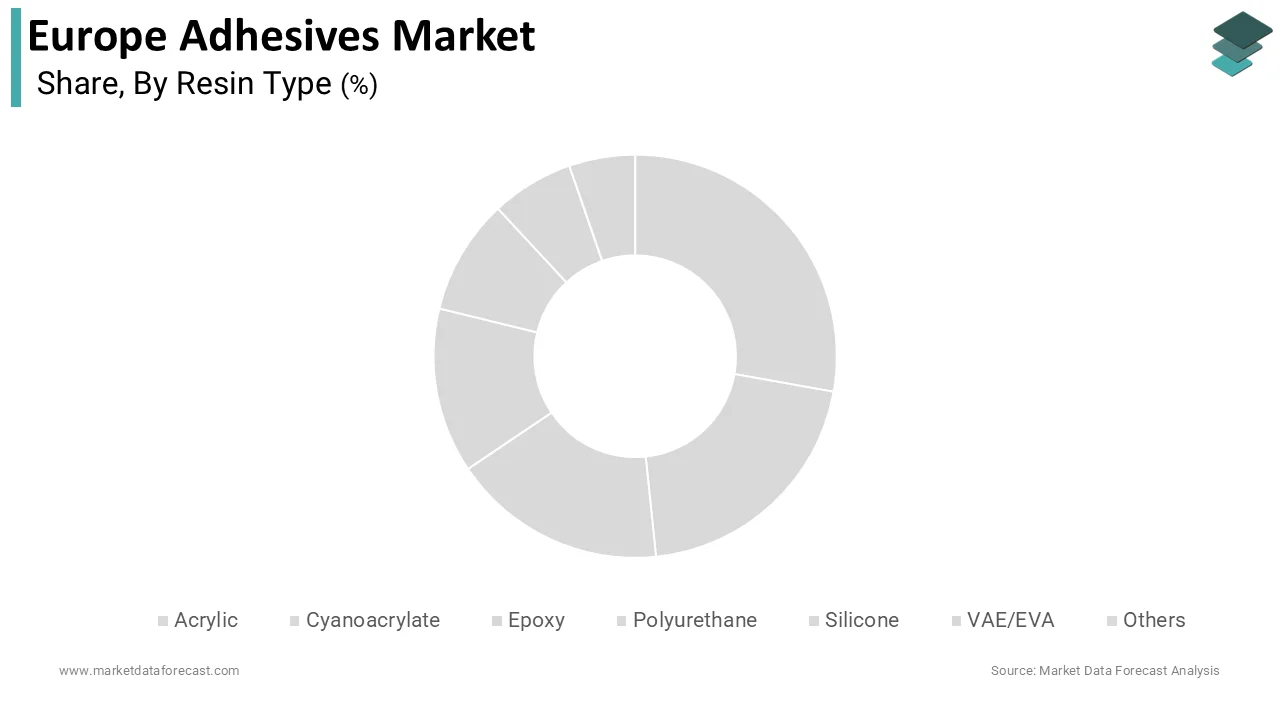
The polyurethane resins segment was the largest by holding 28.3% of the Europe adhesives market share in 2025, with their exceptional versatility in bonding diverse substrates ranging from metals and plastics to wood and composites, making them indispensable across automotive, construction, and footwear sectors. The primary driver for this leadership is the surging demand for structural bonding in vehicle lightweighting initiatives, where polyurethane adhesives replace heavy mechanical fasteners. European automotive manufacturers increasingly utilize these resins to bond carbon fiber reinforced polymers and aluminum alloys, achieving weight reductions of up to 25% compared to steel bodies, as per data from the European Automobile Manufacturers Association. Furthermore, the construction sector relies heavily on polyurethane sealants and adhesives for energy-efficient building envelopes, with the European Union mandating that all new buildings be nearly zero energy by 2030. The footwear industry also contributes significantly, with over 1.8 billion pairs of shoes produced in Europe requiring durable polyurethane-based bonding solutions for sole attachment, as stated by the European Footwear Industry Confederation.
The epoxy resins segment is expected to grow at the fastest CAGR of 7.8% from 2026 to 2034, owing to the rapid expansion of the wind energy sector and the electronics manufacturing industry within the region. The European wind power industry installed 19 gigawatts of new capacity in 2024, creating massive demand for epoxy-based structural adhesives used to bond turbine blades, which must withstand extreme environmental stresses, according to WindEurope statistics. Simultaneously, the miniaturization of electronic components necessitates high-performance epoxy encapsulants and underfills that provide thermal management and mechanical protection. Additionally, the aerospace sector is increasingly adopting epoxy composites for next-generation aircraft, with Airbus aiming to increase the use of composite materials to 53% in new models by 2030. The superior chemical resistance and high tensile strength of epoxy formulations make them the preferred choice for these critical high-value applications, ensuring sustained double-digit growth trajectories in specialized niches.
By Technology Insights
The water-borne technology segment accounted in holding 34.8% of the Europe adhesives market share in 2025, with the stringent environmental regulations and the shift toward sustainable manufacturing practices. The European Union's aggressive stance on Volatile Organic Compound emissions has forced industries to abandon solvent-based systems in favor of aqueous formulations. The packaging industry, which consumes nearly 45% of all adhesives in Europe, has largely transitioned to water-borne laminating adhesives to ensure the recyclability of paper and cardboard products, aligning with the EU Packaging and Packaging Waste Regulation. Furthermore, the furniture industry in countries like Germany and Italy has achieved a 90% conversion rate to water-borne technologies for panel lamination to meet indoor air quality standards defined by the E1 emission class according to the European Panel Federation. Consumer preference for eco-friendly products has also accelerated this trend, with European consumers willing to pay a premium for goods produced with low-emission adhesives. The continuous improvement in drying efficiency and bond strength of water-borne formulations has eliminated previous performance gaps, securing their status as the technological standard for the foreseeable future.
The UV-cured technology segment is likely to witness the fastest CAGR of 8.4% throughout the forecast period, owing to the technology's unique ability to offer instantaneous curing, which dramatically enhances production line speeds and reduces energy consumption in manufacturing processes. The electronics and optical industries are the primary catalysts for this growth, as the miniaturization of devices requires precise, heat-free bonding solutions that UV curing provides exclusively. Additionally, the medical device industry increasingly utilizes UV-curable adhesives for assembling catheters, syringes, and diagnostic equipment due to their biocompatibility and rapid processing times, which support high-volume sterile manufacturing. Energy efficiency is another pivotal driver, as UV curing consumes up to 70% less energy than thermal curing ovens, aligning perfectly with European industrial decarbonization goals. The introduction of LED UV systems has further reduced operational costs and expanded application possibilities, making this technology the preferred choice for high-speed automated assembly lines across diverse sectors.
By End-User Industry Insights
The building and construction sector was the largest by holding 30.4% of the Europe adhesives market with the extensive renovation wave initiated by the European Green Deal, which aims to double the annual energy renovation rate of residential and non-residential buildings by 2030. The imperative to upgrade building envelopes has spurred massive consumption of sealants and adhesives for insulation systems, window installation, and flooring applications. The widespread adoption of External Thermal Insulation Composite Systems (ETICS) across Germany, France, and Poland requires high-performance polymer-modified cementitious adhesives, with over 150 million square meters of facade area insulated annually, according to the European Insulation Manufacturers Association. Furthermore, the shift toward prefabricated construction methods has increased the reliance on structural adhesives for off-site assembly, reducing on-site labor and improving build quality. Stringent safety regulations regarding fire resistance and structural integrity further mandate the use of specialized high-grade adhesives, cementing the construction sector's position as the primary consumption hub.
The healthcare industry segment is expected to witness the fastest CAGR of 9.2% from 2026 to 2034, owing to the aging European demographic and the subsequent surge in demand for advanced medical devices and disposable healthcare products. By 2030, it is estimated that 25% of the European population will be aged 65 or older, driving a 20% increase in the consumption of wound care dressings, transdermal patches, and surgical tapes that rely on pressure-sensitive adhesives, according to European Commission demographic forecasts. The minimally invasive surgery trend has also revolutionized device design, necessitating biocompatible adhesives for bonding sensors, catheters, and implantable devices where traditional sutures are impractical. Innovation in hydrogel and silicone adhesive technologies has enabled the development of pain-free removal products, enhancing patient compliance and expanding market applications. Additionally, the rise of point-of-care diagnostic devices requires precise micro-dispensing of adhesives for fluidic channel bonding, a niche that is expanding at double-digit rates.
REGIONAL ANALYSIS
Germany Adhesives Market Analysis
Germany's adhesive market was the largest contributor by holding 24.4% ofthe share in 2025, with the automotive manufacturing and mechanical engineering serves as the primary engine for this dominance. As the largest car producer in Europe, Germany generated 4.1 million passenger cars in 2024, creating immense demand for structural adhesives used in body-in-white assembly and electric vehicle battery packaging, according to the German Association of the Automotive Industry. The country's "Industrie 4.0" initiative has further accelerated the adoption of advanced adhesive dispensing technologies, optimizing production efficiency and material usage. Moreover, Germany leads in sustainable building renovations, with the government allocating 15 billion euros annually for energy-efficient construction projects that heavily utilize high-performance sealants and insulating adhesives. The presence of global adhesive giants headquartered in the country fosters continuous innovation and rapid commercialization of new formulations.
France Adhesives Market Analysis
France's adhesive market growth is likely to be driven by its world-leading aerospace sector and sophisticated luxury goods industry. The nation hosts Airbus, the largest aircraft manufacturer in Europe, which drives significant demand for high-specification epoxy and film adhesives used in composite airframe construction. In 2025, Airbus delivered 750 commercial aircraft, each requiring several hundred kilograms of advanced adhesives to ensure structural integrity and weight reduction, as reported by the French Aerospace Industries Association. Beyond aviation, the French luxury fashion and cosmetics sectors contribute uniquely to the market, utilizing specialized adhesives for leather goods, footwear, and premium packaging applications. The LVMH and Kering groups alone generate over 150 billion euros in revenue, sustaining a niche but high-value demand for aesthetic and durable bonding solutions, according to the French Fashion Federation. Additionally, the nuclear energy sector, which provides 70% of the country's electricity, requires radiation-resistant adhesives for maintenance and component assembly.
Italy Adhesives Market Analysis
Italy's adhesive market growth is likely to be driven by the renowned design-led manufacturing sector,s including furniture, ceramics, and automotive. The "Made in Italy" brand commands a premium in global markets by necessitating high-quality adhesives that ensure durability and aesthetic perfection in finished products. The automotive sector, led by Ferrari, Lamborghini, and Fiat, drives demand for lightweight structural adhesives, with Italy producing 1.3 million vehicles in 2024 that increasingly incorporate carbon fiber components bonded with advanced epoxies, according to ANFIA data. The ceramics industry, another pillar of the Italian economy, consumes vast quantities of tile adhesives and grouts, with exports reaching 6.5 billion euros in 2025, as reported by Confindustria Ceramica.
United Kingdom Adhesives Market Analysis
The United Kingdom adhesives market growth is likely to grow with a strong life sciences sector and a persistent demand for construction and infrastructure maintenance. The National Health Service's ongoing modernization programs require vast quantities of disposable medical products, each reliant on pressure-sensitive adhesives for functionality. In the construction domain, the UK government's commitment to building 300,000 new homes annually by 2030 sustains robust consumption of masonry adhesives, sealants, and flooring compounds, according to the Home Builders Federation. The offshore wind energy sector is another growth driver, with the UK targeting 50 gigawatts of capacity by 2030, necessitating massive volumes of marine-grade structural adhesives for turbine foundation and blade assembly, as stated by RenewableUK. The automotive sector, though facing transition challenges, continues to utilize advanced adhesives for premium vehicle production, particularly in the luxury segment represented by Jaguar Land Rover.
Spain Adhesives Market Analysis
Spain's adhesive market growth is likely to grow with the robust automotive assembly operations and the expanding renewable energy sector. The tourism sector, which attracted 85 million visitors in 2025, stimulates continuous demand for adhesives in hotel construction, renovation, and maintenance of leisure facilities, as reported by the Spanish Confederation of Travel Agencies. The solar energy boom in Spain, with 7 gigawatts of new photovoltaic capacity installed in 2024, creates a specialized demand for conductive adhesives and sealing compounds used in panel manufacturing and installation as per the Spanish Photovoltaic Union. The packaging industry also plays a vital role, supporting the country's massive agricultural exports of fruits, vegetables, and wines, which require reliable sealing and labeling adhesives to maintain product integrity during transport.
COMPETITION OVERVIEW
The competition in the Europe adhesives market is characterized by intense rivalry among established multinational corporations and agile regional specialists who vie for dominance through technological differentiation. Major players leverage their extensive research and development capabilities to introduce high-performance products that address specific industrial needs, such as lightweighting in automotive and energy efficiency in construction. The market landscape features a mix of broad-line suppliers offering comprehensive portfolios and niche operators focusing on specialized applications like medical devices or electronics. Competitive pressure drives continuous innovation in sustainable formulations as companies strive to meet stringent environmental regulations and evolving consumer preferences for eco-friendly solutions. Pricing strategies remain critical due to raw material cost fluctuation,s forcing firms to balance profitability with market share retention. Strategic alliances and joint ventures are common tactics used to expand geographic reach and share technological expertise.
KEY MARKET PLAYERS
A few major players of the Europe adhesives market include
- Henkel AG & Co. KGaA
- 3M Company
- Arkema S.A
- Sika AG
- H.B. Fuller Company
- Avery Dennison Corporation
- BASF SE
- Dow Inc
- Huntsman Corporation
- Wacker Chemie AG
Top Strategies Used by Key Market Participants
Key players in the Europe adhesives market predominantly employ mergers and acquisitions to consolidate their positions and access novel technologies rapidly. Companies frequently pursue vertical integration strategies to secure raw material supplies and mitigate cost volatility associated with petrochemical feedstocks. Product innovation remains a central pillar where firms invest heavily in research and development to creatbio-baseded and low-emission formulations. Strategic partnerships with automotive and aerospace manufacturers enable co-development of customized solutions that meet rigorous performance standards. Expansion into emerging Eastern European markets allows established entities to capture growth opportunities in developing industrial sectors. Digital transformation initiatives are increasingly adopted to optimize supply chain efficiency and enhance customer engagement through data-driven insights. Sustainability leadership acts as a differentiator where corporations commit to carbon neutrality goals and circular economy principles to align with regulatory frameworks.
Leading Players in the Europe Adhesives Market
- Henkel stands as a preeminent force in the Europe adhesives market through its extensive portfolio of consumer and industrial bonding solutions. The company leverages its German heritage to drive innovation in sustainable adhesive technologies that align with European environmental mandates. Henkel actively develops bio-based formulations and water-borne systems to reduce the carbon footprint of its product lines significantly. Recent strategic actions include the expansion of its production facilities in Eastern Europe to enhance supply chain resilience and meet rising local demand. The corporation invests heavily in research and development to create high-performance structural adhesives for the automotive and aerospace sectors. Its commitment to circular economy principles positions it as a leader in recyclable packaging adhesives. Henkel collaborates with key industry partners to co-develop customized solutions that address specific customer challenges in electronics and construction. These initiatives reinforce its global reputation for quality and technological superiority while solidifying its dominance in the regional landscape.
- Sika AG operates as a specialized chemical company with a profound impact on the Europe adhesives market, particularly in construction and industrial applications. The Swiss-headquartered firm focuses on high-performance sealing and bonding systems that ensure structural integrity in modern infrastructure projects. Sika recently intensified its efforts to acquire niche technology firms that possess advanced polymer expertise to broaden its product capabilities. The company plays a critical role in the global market by supplying adhesives for wind turbine blades and electric vehicle battery assembly. Its recent actions involve launching new low-emission adhesive ranges that comply with stringent European volatile organic compound regulations. Sika emphasizes digitalization in its service offerings by providing customers with advanced application tools and technical support platforms. The firm actively participates in industry consortia to shape future standards for sustainable building materials. These strategic moves enhance its competitive edge and ensure its solutions remain at the forefront of engineering excellence worldwide.
- Bostik serves as a major contributor to the Europe adhesives market as a subsidiary of the French industrial giant Arkema. The company specializes in innovative adhesive solutions for construction, industry, and consumer markets with a strong emphasis on sustainability. Bostik has recently launched several bio-sourced adhesive products derived from renewable raw materials to meet the growing demand for eco-friendly alternatives. Its global presence is strengthened by a robust distribution network that ensures the timely delivery of specialized bonding agents to diverse sectors. The firm actively engages in partnerships with automotive manufacturers to develop lightweighting solutions that improve vehicle fuel efficiency.
MARKET SEGMENTATION
This research report on the Europe adhesive market has been segmented and sub-segmented based on resin type, technology, end use & region.
By Resin Type
- Acrylic
- Cyanoacrylate
- Epoxy
- Polyurethane
- Silicone
- VAE/EVA
- Others
By Technology
- Hot Melt
- Reactive
- Solvent-borne
- UV Cured
- Water-borne
By End User
- Aerospace
- Automotive
- Building and Construction
- Footwear and Leather
- Healthcare
- Packaging
- Others
By Region
- UK
- France
- Spain
- Germany
- Italy
- Russia
- Sweden
- Denmark
- Switzerland
- Netherlands
- Turkey
- Czech Republic
- Rest of Europe