- Product Description Description
- Table of Contents TOC
- List of Table & Figure LOT
- Get Free Sample PDF Sample PDF
Market Size, 2025
$44.17 BnMarket Estimate, 2026
$53.47 BnMarket Forecast, 2034
$246.68 BnCAGR, 2026–2034
21.06%Europe Advanced Analytics Market Summary
The Europe advanced analytics market was valued at USD 44.17 billion in 2025, is estimated to reach USD 53.47 billion in 2026, and is projected to reach USD 246.68 billion by 2034, growing at a CAGR of 21.06% from 2026 to 2034. Growth is driven by increasing deployment of predictive, prescriptive, and machine learning-based analytics across finance, healthcare, manufacturing, governance, and sustainability programs, alongside expanding investments in data infrastructure, AI governance, and high-performance computing ecosystems across Europe.
Key Insights
- Regulatory & Institutional Drivers: Market expansion is reinforced by EU policy frameworks and sectoral compliance mandates that require the adoption of risk analytics, explainable AI, fraud detection, climate scenario modeling, cybersecurity monitoring, and operational resilience analytics across financial services, energy networks, and public administration. Significant public investment in shared data spaces, federated research environments, and sovereign computing capacity further accelerates enterprise-scale analytics deployment across the region.
- Market Segmentation: In 2025, the cloud deployment segment held the largest share due to scalability, data residency alignment, and cost-efficient implementation for organizations lacking in-house infrastructure, while on-premise analytics is gaining traction in regulated, latency-sensitive, and sovereign data environments. By type, predictive analytics dominated the market owing to its widespread use in risk modeling, maintenance optimization, and demand forecasting, whereas prescriptive analytics is expected to register the fastest growth as industries shift toward real-time optimization, digital twins, and autonomous decision systems.
- Key Growth Drivers: Growth is propelled by the integration of advanced analytics into financial risk management, climate transition planning, healthcare outcomes optimization, supply-chain resilience, Industry 4.0 automation, and ESG disclosure frameworks. Additional momentum stems from federated learning architectures, ethical AI governance models, cross-border research initiatives, and public-private innovation programs that institutionalize analytics adoption at scale.
Challenges
Expansion is constrained by fragmented data governance, cross-border transfer restrictions, and heterogeneous privacy interpretations, alongside talent shortages in specialized data science roles, legacy system interoperability gaps, and the increasing burden of algorithmic explainability, auditability, and documentation requirements under the EU AI Act — which extend deployment timelines, particularly for smaller and mid-sized enterprises.
Major Market Players
Key companies operating in the Europe advanced analytics market include: AVEVA Group Limited, RapidMiner, Inc., Experian Information Solutions, Inc., IBM Corporation, Microsoft Corporation, Oracle Corporation, Teleperformance Group, Altair Engineering, Inc., SAP SE, SG Analytics Pvt. Ltd., Alteryx, Intel Corporation, and Others.
Europe Advanced Analytics Market Size
The Europe advanced analytics market was valued at USD 44.17 billion in 2025, is estimated to reach USD 53.47 billion in 2026, and is projected to reach USD 246.68 billion by 2034, growing at a CAGR of 21.06% from 2026 to 2034.
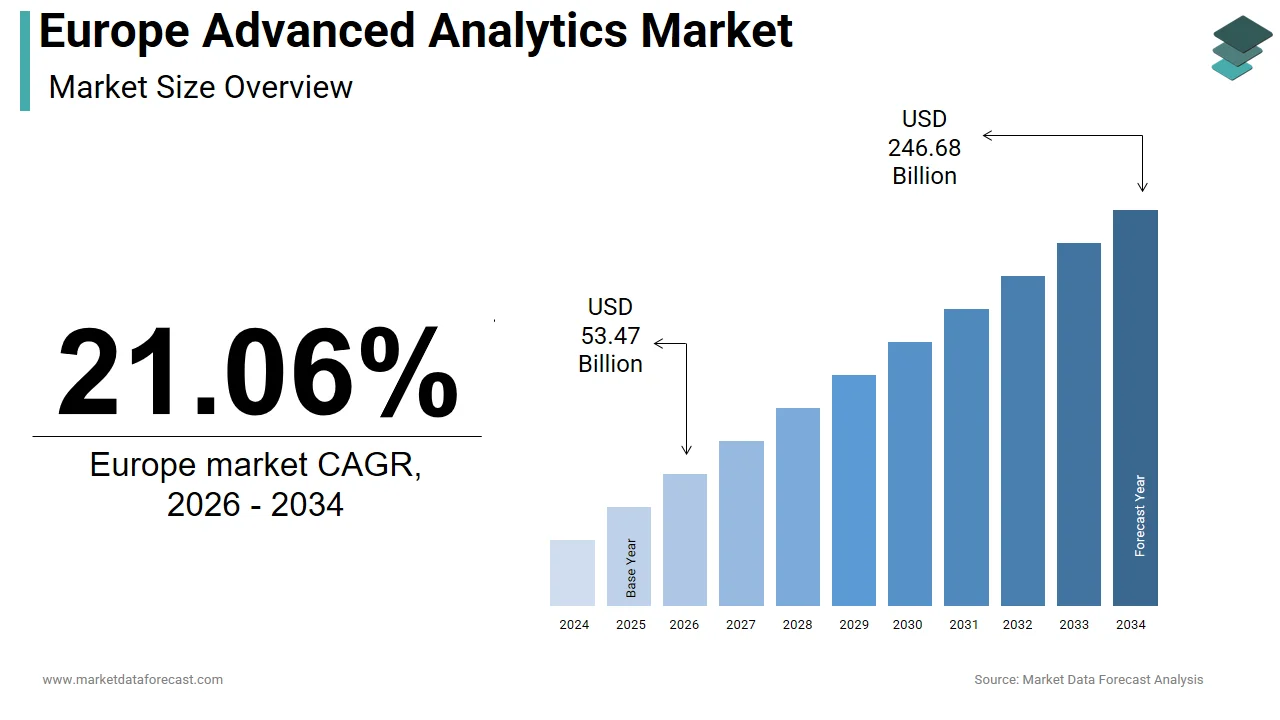
Advanced analytics refers to a suite of sophisticated data science methodologies, including predictive modeling, machine learning, natural language processing, and prescriptive simulation, that enable organizations to derive actionable intelligence from structured and unstructured data sources. This capability is increasingly embedded across healthcare, finance, manufacturing, and public services to drive evidence-based decision-making. A majority of large enterprises are utilizing data analytics tools, with a significant portion moving beyond simple descriptive reporting into more advanced techniques. There has been a substantial financial commitment directed toward developing shared data spaces and analytics infrastructure across several key areas, including health, energy, and manufacturing sectors. Organizations have widely deployed algorithmic decision systems, as indicated by the high volume of submitted data processing impact assessments. High-performance computing resources have been strategically expanded to support complex analytics workloads. This confluence of policy investment, compute capacity, and regulatory oversight defines Europe’s distinctive trajectory in advanced analytics, one grounded in innovation, sovereignty, and human-centric governance.
MARKET DRIVERS
Regulatory Mandates for Data-Driven Risk Management in Financial and Energy Sectors
European Union regulatory frameworks increasingly require institutions to implement advanced analytics for systemic risk identification and operational resilience, which in turn accelerates the growth of the Europe advanced analytics market. Regulatory frameworks are increasingly requiring major financial institutions to implement advanced monitoring systems that identify unusual transaction patterns to ensure compliance with updated payment and anti-money laundering standards. The use of sophisticated learning models for assessing credit risk has become a standard practice among large-scale banking organizations, with formal validation processes becoming a necessary component of internal oversight. Entities responsible for essential infrastructure are now expected to utilize analytical tools that anticipate potential security threats to align with modern cybersecurity directives. Prominent energy providers have adopted modeling techniques to predict demand and supply fluctuations, facilitating the smoother incorporation of variable power sources into the national grid. Grid operators are utilizing automated intelligence to better balance energy loads, which helps in managing the operational expenses associated with grid instability. These compliance imperatives transform advanced analytics from a strategic differentiator into a non-negotiable operational requirement across regulated industries.
Public Sector Investment in AI-Enabled Healthcare and Social Services
National governments across the region are institutionalizing advanced analytics to improve public health outcomes and optimize welfare delivery, which further fuels the expansion of the Europe advanced analytics market. Several European nations are incorporating predictive modeling into their healthcare systems to forecast patient flows and manage resources. Health organizations are also employing collaborative machine learning methods to enhance the early identification of severe conditions. Furthermore, public insurance entities are using natural language processing to expedite the processing of complex benefit applications and decrease administrative backlogs. Regulatory changes are trending towards standardized data frameworks to enable the sharing of health data across national boundaries. The inclusion of automated analysis in healthcare administration seems to support quicker decision-making while maintaining supervision. Expanding public digital budgets make advanced analytics crucial for building responsive and equitable European governance.
MARKET RESTRAINTS
Fragmented Data Governance and Cross-Border Data Flow Restrictions
Divergent national interpretations of the General Data Protection Regulation and sector-specific data localization laws hinder the growth of the Europe advanced analytics market. This impedes the practical implementation of advanced analytics, despite the EU’s ambition for a single market for data. Large organizations frequently encounter difficulties when moving information across international borders for data analysis because regulatory oversight remains fragmented. Variations in national legislation create a landscape where some regions impose strict requirements for individual permission on specialized data, while others allow for more flexible research applications. Logistics entities often manage isolated data systems within individual countries to ensure they meet specific local privacy regulations. Legal decisions regarding international data transfers limit the ability of regional firms to utilize global cloud infrastructure and advanced computing resources. This regulatory fragmentation increases compliance costs and dilutes the statistical power of pan-European models.
Shortage of Specialized Data Science Talent Across Non-Core Tech Economies
The region faces a pronounced imbalance in advanced analytics talent with severe shortages in Southern and Eastern member states limiting enterprise adoption beyond pilot projects, which poses a major obstacle to the Europe advanced analytics market. There is a significant and growing gap between the demand for specialized data expertise and the number of qualified professionals available in the labor market. Certain regions are experiencing particularly high vacancy rates for advanced technical roles, such as those focused on machine learning. Despite offering competitive compensation packages that exceed standard technology salaries, many organizations struggle to attract and retain data scientists. Geographic disparities exist in the ability to fill technical positions, with some areas facing more acute recruitment challenges than others. The persistence of unfilled roles suggests that wage incentives alone may not be sufficient to resolve the structural shortage of data talent. Vocational education systems remain misaligned with industry needs. As per sources, a smaller share of EU member states offer accredited micro credentials in causal inference or time series forecasting. Consequently, many firms rely on external consultants, increasing project costs. Without coordinated upskilling and mobility frameworks, this talent gap will constrain the scalability of advanced analytics outside innovation hubs.
MARKET OPPORTUNITIES
Integration of Advanced Analytics in Green Transition and Climate Resilience Planning
The European Green Deal is enabling demand for advanced analytics to model decarbonization pathways and climate adaptation strategies across sectors, which is anticipated to serve new growth opportunities for the Europe advanced analytics market. Digital twin technology is becoming a standard tool across various regions to model urban heat patterns and determine the most effective locations for vegetation. Predictive modeling and machine learning assist in managing water levels and identifying necessary structural improvements to coastal and river defenses. Regulatory frameworks now require international suppliers to provide detailed data on the environmental impact of their goods. Automated accounting platforms are increasingly utilized by industrial sectors to improve the accuracy of reporting indirect emissions within supply chains. Open-access satellite data allows for the creation of sophisticated tools to anticipate and prepare for extreme weather events. Significant financial resources are being directed toward ensuring that technological innovation supports long-term ecological goals.
Expansion of Federated Learning in Cross-Institutional Healthcare Research
The region is pioneering privacy-preserving analytics architectures that enable collaborative model development without centralizing sensitive patient data and generate fresh prospects for the European advanced analytics market expansion. International medical research groups are increasingly adopting decentralized computing frameworks to conduct collaborative studies across different jurisdictions. These frameworks are being applied to various complex medical fields, including the study of brain disorders, cancers, and uncommon conditions. Distributed networks allow for the training of diagnostic models on medical imaging data while maintaining the privacy of individual patient records. Specialized healthcare networks use secure computational methods to derive insights from small, geographically separated patient groups. Regulatory frameworks are establishing certified data environments to ensure that collaborative health analytics remain compliant with regional privacy standards. These initiatives demonstrate how Europe’s stringent privacy principles can coexist with cutting-edge innovation by reengineering the analytics workflow itself rather than relaxing data protection standards. This approach positions Europe as a global leader in ethical AI with replicable governance models.
MARKET CHALLENGES
Algorithmic Accountability and Explainability Requirements Under the AI Act
The European Union’s Artificial Intelligence Act imposes stringent transparency obligations on high-risk analytics systems, which complicates deployment in critical domains, and negatively impacts the growth of the Europe advanced analytics market. Regulatory guidance across critical sectors increasingly mandates human-interpretable explanations for individual decisions from predictive models. The inability of complex AI models to meet technical documentation requirements for feature attribution is delaying operational implementation for financial institutions. Independent algorithmic impact assessments and bias audits are becoming standard for AI supporting high-stakes functions like clinical trial design. Compliance and validation cycles for advanced analytics applications are significantly extended on average, indicating more rigorous internal processes in regulated industries. These provisions boost trust; however, they establish major time and expense obstacles, primarily affecting smaller businesses that lack specialized AI ethics resources. This regulatory rigor may inadvertently favour large incumbents and slow innovation velocity in high-impact applications.
Data Quality and Interoperability Deficits in Legacy Industrial Systems
Many European enterprises struggle to feed clean structured data into advanced analytics pipelines due to fragmented legacy infrastructure, despite strategic ambitions, which ultimately slows down the expansion of the Europe advanced analytics market. A notable number of production facilities in certain regions rely on control systems implemented before the year 2000 that lack standardized data output protocols. A majority of mid-sized manufacturers have yet to achieve real-time sensor data integration across all their production lines, often depending on manual log entries or batch exports. This data poverty compromises model accuracy. Moreover, sector-specific standards such as OPC UA remain inconsistently implemented. Advanced analytics cannot achieve enterprise-wide transformation until industrial data ecosystems reach a baseline level of interoperability.
REPORT COVERAGE
| REPORT METRIC | DETAILS |
| Market Size Available | 2025 to 2034 |
| Base Year | 2025 |
| Forecast Period | 2026 to 2034 |
| Segments Covered | By Deployment, Type, Application, Industry, and Country. |
| Various Analyses Covered | Global, Regional, and Country-Level Analysis, Segment-Level Analysis, Drivers, Restraints, Opportunities, Challenges; PESTLE Analysis; Porter’s Five Forces Analysis, Competitive Landscape, Analyst Overview of Investment Opportunities |
| Countries Covered | UK, France, Spain, Germany, Italy, Russia, Sweden, Denmark, Switzerland, Netherlands, Turkey, Czech Republic, and the Rest of Europe. |
| Market Leaders Profiled | AVEVA Group Limited, RapidMiner, Inc., Experian Information Solutions, Inc., IBM Corporation, Microsoft Corporation, Oracle Corporation, Teleperformance Group, Altair Engineering, Inc., SAP SE, SG Analytics Pvt. Ltd., Alteryx, Intel Corporation, and Others. |
SEGMENTAL ANALYSIS
By Deployment Insights
The cloud deployment segment remained the prominent segment in the Europe advanced analytics market by capturing a 63.7% share in 2024. The prominence of the cloud segment is because of scalable infrastructure, rapid deployment, and cost efficiency, particularly for enterprises lacking in-house data engineering capabilities. Larger businesses in the region extensively use cloud-based analytics platforms, while smaller and medium-sized enterprises show the quickest growth in adopting these technologies. Officially recognized cloud analytics services under a specific compliance framework adhere to data sovereignty rules. Major international cloud providers have established local data storage regions to facilitate data residency for public sector organizations, and cloud analytics platforms have demonstrated an ability to lower infrastructure maintenance expenses for public health organizations while allowing for more frequent software updates. This combination of economic agility, regulatory alignment, and technical scalability solidifies cloud as the default deployment model across most sectors. The European strategy for data emphasizes decentralized yet interoperable analytics ecosystems, which cloud platforms uniquely enable. Initiatives are underway to mandate secure cloud gateways among member states to facilitate cross-border health data analytics. One regional public health institute has successfully implemented a cloud-based predictive analytics service for several neighboring agencies, avoiding the need to centralize data. The manufacturing sector has seen the deployment of cloud-orchestrated edge analytics, linking a significant number of production facilities with real-time intelligence. A substantial majority of high-performance computing workloads are utilizing hybrid cloud interfaces, enabling researchers to seamlessly scale operations from local computing clusters to larger-scale resources. This architectural alignment with Europe’s vision of trusted data sharing ensures cloud deployment remains central to public and private analytics strategies alike.
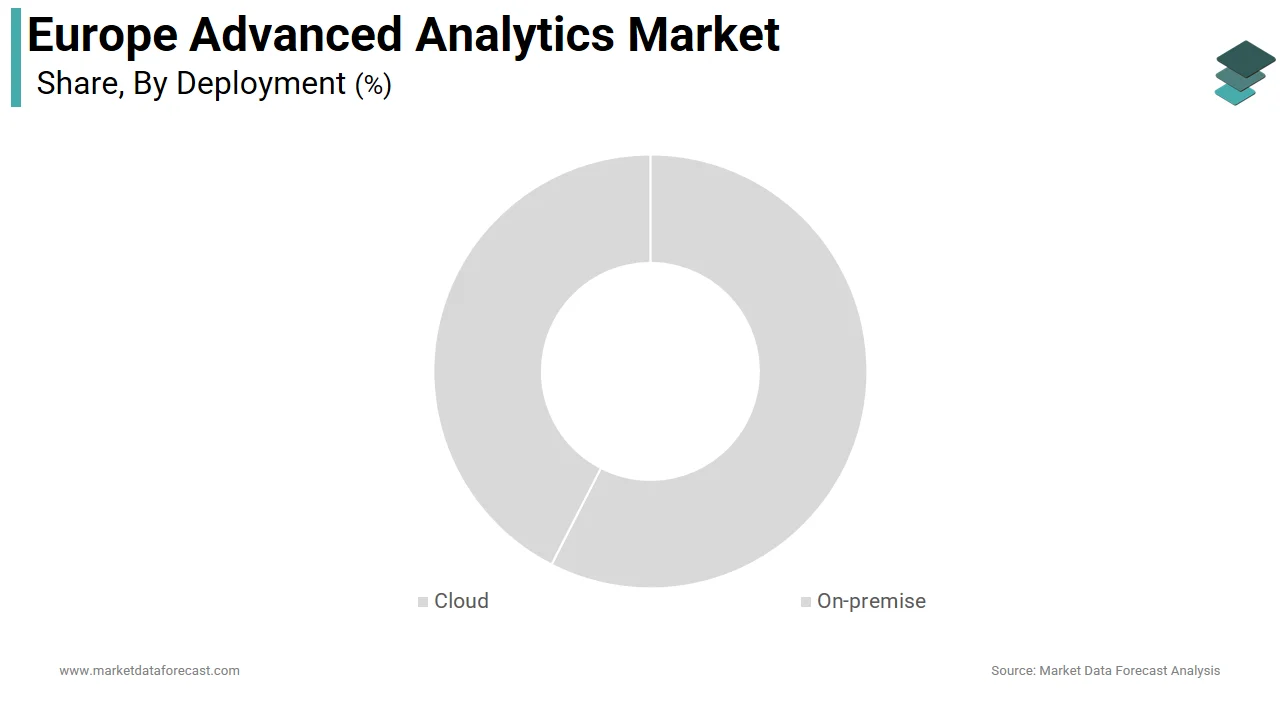
The on-premises deployment segment is predicted to witness the highest CAGR of 12.3% from 2025 to 2033 due to heightened concerns over algorithmic sovereignty and the need for ultra-low latency processing in regulated and safety-critical operations. Financial regulatory bodies have established requirements for critical trading surveillance systems to run on infrastructure that is physically separate and located on-site, a measure designed to enhance data containment. In the industrial sector, the use of predictive models for essential facilities is increasingly classified as critical, necessitating local execution of these models as a result of updated security legislation. Across defense organizations, there is a widespread practice of deploying tactical analytics on robust, localized server hardware, aiming to maintain operational functionality even when access to external navigation systems is unavailable or compromised. These imperatives reflect a strategic shift where data control outweighs cost convenience, particularly as sovereign AI hardware such as the European Processor Initiative’s RISC-V chips becomes commercially available. Industrial and public safety applications are increasingly relying on on-premises analytics powered by edge AI and private cellular networks. Private cellular networks are increasingly utilized within industrial and logistical environments to facilitate low-latency operations for automated processes and quality control. Localized computing allows manufacturing facilities to execute complex analytical models directly on hardware, reducing reliance on external cloud connectivity. On-premise predictive systems are being deployed in geographically isolated areas to maintain critical functions when traditional satellite or remote signals are inconsistent. Regional initiatives are providing financial support to enhance the development of independent data processing and analytics infrastructure. The proliferation of latency-sensitive and mission-critical applications is driving a resurgence in on-premise solutions, a trend rooted in modern operational requirements rather than a mere preference for legacy systems.
By Type Insights
The predictive analytics segment captured the majority share of 38.6% of the Europe advanced analytics market in 2024. The leading position of the predictive analytics segment is attributed to widespread applicability in forecasting demand, detecting fraud, optimizing maintenance, and personalizing customer experiences. Institutions categorized as systematically important within the European banking system utilize predictive models for evaluating credit risk. The frameworks used to validate these credit risk models have been standardized under current guidelines. In the retail sector, major grocery chains in Western European countries have observed a reduction in costs associated with inventory due to the application of predictive demand sensing techniques. Additionally, public health agencies leveraged predictive epidemiology throughout the respiratory virus season, achieving hospital admission forecasts. The maturity of open source libraries such as scikit learn and XGBoost, combined with regulatory acceptance of model risk management protocols, has institutionalized predictive analytics as the foundational layer of enterprise intelligence. European regulatory bodies have formalized predictive analytics as a core component of compliance infrastructure. The European Insurance and Occupational Pensions Authority requires all Solvency II-compliant insurers to use predictive models for catastrophe risk modeling, with back testing mandated quarterly. In energy, the Agency for the Cooperation of Energy Regulators stipulates that transmission system operators must implement predictive imbalance forecasting to participate in real-time markets. The regulatory embedding transforms predictive analytics from a competitive tool into a baseline operational requirement across high-stakes sectors.
The prescriptive analytics segment is estimated to register the fastest CAGR of 14.1% during the forecast period, owing to a shift from anticipating outcomes to recommending optimal actions under complex constraints. The European Commission’s Destination Earth initiative uses prescriptive climate models to simulate policy interventions such as carbon tax levels or reforestation scenarios to identify pathways achieving net zero by 2050. Logistics networks are increasingly utilizing advanced routing systems to adjust delivery fleet movements in response to immediate environmental and operational changes. The integration of real-time data regarding traffic conditions and labor resources allows for more fluid adjustments to distribution patterns. These technological shifts in transport management contribute to a reduction in environmental impacts during the final stages of the delivery process. Energy infrastructure managers are adopting sophisticated planning tools to analyze vast numbers of potential equipment upgrades. Strategic investment frameworks now leverage automated evaluations to balance reliability requirements with cost-efficiency goals. This transition from insight to action is further enabled by advances in reinforcement learning and digital twin integration, which allow systems to simulate millions of decision sequences in seconds. Prescriptive analytics is becoming indispensable in systems that require real-time decision optimization without human intervention. In manufacturing, ABB’s robot cells in Sweden use prescriptive motion planning to minimize cycle time while avoiding collisions in shared workspaces. The European Space Agency’s Hera mission to a near-Earth asteroid relies on onboard prescriptive analytics to adjust the trajectory based on real-time sensor feedback during proximity operations. These applications demand not just prediction but actionable optimization under uncertainty. The European Processor Initiative’s upcoming neuromorphic chips are specifically designed to accelerate prescriptive workloads at the edge. Europe's growing dominance in autonomous tech, like smart grids and surgical robots, hinges on prescriptive analytics, which provides the crucial intelligence for flexible, goal-focused action.
By Application Insights
The operations and supply chain segment dominated the Europe advanced analytics market and accounted for a 32.4% share in 2024. The dominance of the operations and supply chain segment is driven by urgent post pandemic imperatives to build resilient just-in-case supply networks and optimize energy-intensive industrial processes. The European Commission’s Chips Act and Critical Raw Materials Act have intensified demand for supply chain visibility solutions capable of mapping tier three supplier risks. Additionally, energy costs under the EU ETS have driven analytics adoption in process optimization. Industrial energy use makes up a significant part of the EU's final consumption, establishing operations analytics as a key strategic tool for boosting competitiveness and achieving decarbonization goals. Emerging patterns in product lifecycle management indicate a developing need for accessible information systems to monitor material flows and environmental impacts across value chains. Exploratory initiatives are increasingly using sophisticated data analysis techniques to simulate reverse logistics and product regeneration feasibility, with specific sectors leveraging advanced platforms for improved traceability and end-of-life recovery accuracy. Regulatory frameworks are recognizing the pivotal role of advanced data analytics in facilitating systemic circularity goals. This regulatory push transforms supply chain analytics from a cost center into a compliance and sustainability engine, driving deeper adoption across manufacturing and retail.
The finance and accounting segment is anticipated to witness the fastest CAGR of 13.6% from 2025 to 2033. The rapid expansion of the finance and accounting segment is propelled by stringent regulatory reporting demands, real-time risk monitoring, and the need for granular climate-related financial disclosures. Comprehensive reporting frameworks for credit data allow financial institutions to perform more sophisticated assessments of their lending portfolios. Regulatory mandates for disclosure are encouraging asset managers to adopt standardized methodologies for calculating the carbon footprint of their holdings. The integration of automated calculation engines is becoming more common as firms seek to meet specific environmental reporting requirements. Advanced technologies are being utilized within claims processing to improve the accuracy of fraud detection and increase the speed of disbursements. New sustainability directives are leading a broad range of organizations to align their environmental data with traditional financial reporting. The requirement for data consistency is driving a greater need for specialized tools that can reconcile and verify diverse information sets. This convergence of financial rigor and ESG accountability is reshaping finance from a back-office function into a strategic analytics hub. Post-pandemic volatility has elevated the need for continuous financial risk assessment beyond periodic reporting cycles. A notable pattern has emerged where major financial entities are incorporating intraday liquidity stress tests into their standard operations. The implementation of real-time counterparty exposure dashboards has shown an observed reduction in the frequency of settlement failures within specific securities networks. Within corporate treasury divisions, there is an increasing reliance on technology that utilizes machine learning to automate the matching of incoming payments with corresponding invoices, significantly reducing manual reconciliation efforts. Additionally, the European Insurance and Occupational Pensions Authority’s revised guidelines on asset liability management require insurers to run stochastic scenario analyses daily rather than quarterly. These operational shifts demand analytics that operate at the speed of transaction flows, not month-end closes.
By Industry Insights
The BFSI segment led the Europe advanced analytics market and held a share of 29.7% in 2024. The supremacy of the BFSI segment is credited to the industry’s data richness, regulatory intensity, and direct reliance on risk modeling for core operations. Financial institutions broadly utilize extensive data monitoring systems to handle a substantial volume of daily activity reports aimed at ensuring financial integrity. A significant portion of the insurance industry employs systems that determine pricing models based on remotely collected data from insured assets. Consequently, advanced data analytics platforms have become a standard component of operations within numerous regulated financial service organizations. Furthermore, capital markets firms leverage natural language processing to analyze earnings calls and regulatory filings for alpha generation. Recognizing that model integrity is crucial for financial stability, the industry has integrated analytics deeply into its operational and regulatory structure. European financial regulators have mandated the incorporation of climate scenarios into risk frameworks, transforming analytics into a systemic stability tool. Large-scale evaluations of financial stability have shifted toward analyzing how environmental factors might impact the assets held by major banking institutions. Financial organizations are increasingly adopting sophisticated internal modeling tools to better understand how their corporate lending activities align with changing climate realities. These analytical frameworks now integrate high-resolution geographic data to identify potential vulnerabilities at the level of specific physical facilities. There is a growing trend of mapping broad loan portfolios to granular site data to improve the accuracy of risk assessments for corporate borrowers. Banking strategies are evolving to incorporate detailed mapping technologies that bridge the gap between global economic shifts and localized physical risks. The Network for Greening the Financial System, which includes all major EU central banks, requires members to publish climate scenario results annually using standardized methodologies. Additionally, the EU Taxonomy Regulation compels financial products to disclose alignment with sustainable activities, driving demand for green revenue classification models. This regulatory architecture ensures that advanced analytics is not optional but foundational to the future of European finance.
The healthcare segment is likely to experience the fastest CAGR of 15.2% from 2025 to 2033. The swift growth of the healthcare segment is fuelled by the European Health Data Space initiative interoperability mandates and urgent workforce optimization needs amid demographic pressure. Across numerous regions, a pattern has emerged where advanced management systems are being widely adopted within healthcare facilities to optimize patient flow and resource allocation. In the field of medical innovation, there is a clear trend of collaborative, multi-entity initiatives focusing on leveraging shared data analysis methodologies to improve the efficiency of developmental processes. Specific medical facilities have seen success in implementing systems designed to predict and rapidly address critical patient conditions, leading to improved patient outcomes in specialized care units. The significant shift in funding priorities suggests a broader transition within healthcare analytics, moving from individual, limited scope projects toward the establishment of an integrated, widespread operational infrastructure. Europe’s fragmented healthcare systems are leveraging privacy-preserving analytics to overcome data silos without violating GDPR. A growing number of collaborative networks are leveraging a distributed computational approach to analyze health information from small patient populations. Researchers are demonstrating the use of robust encryption methods to enable cross-border studies while keeping sensitive patient information secure within national boundaries. Data initiatives are enabling the secure analysis of a large volume of complete genetic sequences across different national data repositories through the use of distributed computing methods. These architectures demonstrate how Europe’s regulatory constraints can cause technical innovation in ethical AI. This model will scale to routine care, creating a unique, globally relevant paradigm for health analytics.
COUNTRY-LEVEL ANALYSIS
Germany Advanced Analytics Market Analysis
Germany was the top performer in the Europe advanced analytics market and captured a 24.2% share in 2024. The dominance of the German market is driven by its world-class manufacturing base,e digital sovereignty policy,s and robust public research infrastructure. Germany actively participates in the expanding network of European Digital Innovation Hubs, with several centers focusing specifically on the application of artificial intelligence in industrial contexts. The Gauss Centre for Supercomputing provides leading-edge, high-performance computing resources, including Europe's first operational exascale supercomputer, to a broad community of academic and corporate researchers. Moreover, the German government has significantly increased its financial commitment to its national AI Strategy, allocating substantial funds through 2025 to promote research in trustworthy and application-oriented analytics. Major German manufacturers, such as Siemens and Bosch, are implementing large-scale AI-powered predictive maintenance solutions across their production lines, which have demonstrably improved efficiency and significantly reduced unexpected operational disruptions. Additionally, the Federal Office for Information Security mandates on-premises analytics for critical infrastructure under the IT Security Act,ct ensuring sustained investment in sovereign capabilities. This combination of industry depth,th policy coherence,nce and technical excellence secures Germany’s leadership position.
United Kingdom Advanced Analytics Market Analysis
The United Kingdom was the next prominent country in the Europe advanced analytics market and held a 17.9% share in 2024. Despite Brexit, the UK maintains global leadership in financial and health analytics through institutions like the Alan Turing Institute and the NHS AI Lab. The Financial Conduct Authority has established a mature regulatory environment for new financial technologies, using various innovation pathways and an "always open" regulatory sandbox to facilitate safe development and provide guidance on the use of advanced technologies like algorithmic trading. Furthermore, the National Health Service is increasingly focused on the widespread testing and eventual adoption of AI-based clinical decision support tools for vital applications like sepsis prediction and radiology assistance, moving past initial pilot stages in some areas. The UK government has committed substantial public and attracted significant private investment to support its national AI ambitions, aiming to build world-class data infrastructure and develop essential skills for public benefit and economic growth. London maintains its prominent position as a leading global fintech hub, and the UK as a whole fosters substantial innovation in the health tech and life sciences AI sector, attracting significant venture capital and housing a large portion of related startups within Europe's wider digital health market. This ecosystem of public investment regulatory agility and talent density ensures continued prominence.
France Advanced Analytics Market Analysis
France is also a key player in the Europe advanced analytics market due to its excellence in sovereign cloud analytics defense applications and public sector digital transformation. The French government is increasingly encouraging state analytics platforms to adopt standards and frameworks, such as those promoted by the European Gaia-X initiative, to enhance data sovereignty and ensure data residency within European infrastructures. France has been actively implementing support and coordination systems across its regions to better manage care for its aging population, with a focus on supporting elderly individuals within their homes and enhancing professional collaboration. The Jean Zay supercomputer, operated by IDRIS for the CNRS, provides significant computing power for advanced scientific research, including climate modeling and other complex physical phenomena simulations, and is a model of eco-responsible computing. France has made substantial investments in its national AI strategy over recent years, with a strong emphasis on applying artificial intelligence across strategic sectors such as healthcare, mobility, and environmental solutions. Strategic investments in startups have positioned France as a leader in open source and ethical AI. This state-led innovation-friendly model drives structured growth across public and private domains.
Netherlands Advanced Analytics Market Analysis
The Netherlands grew steadily in the Europe advanced analytics market, owing to its world-class logistics infrastructure, true data-driven agriculture, and open government data policies. The Port of Rotterdam Authority runs one of Europe’s most advanced digital twin platforms using real-time analytics to optimize vessel traffic and container flows. The Dutch government sponsored a public AI literacy program, which successfully reached a substantial number of citizens by two thousand twenty three, significantly increasing general awareness of basic data and artificial intelligence concepts. In the field of agritech, a Wageningen University-affiliated initiative explored the use of advanced agricultural models across numerous farms, aiming to promote more efficient use of resources like water and fertilizer. The Netherlands also hosts major cloud and AI research centers, including the Amsterdam Machine Learning Lab and Microsoft’s AI for Good hub. A significant number of Dutch companies leveraging cloud analytics showcase how sophisticated data analysis can become an integral part of a nation's economic and social structure.
Sweden Advanced Analytics Market Analysis
Sweden is anticipated to expand in the Europe advanced analytics market from 2025 to 2033 due to its leadership in sustainable AI public sector innovation and privacy-preserving technologies. The Swedish Energy Agency and partner organizations are actively deploying AI-driven models to enhance grid balancing and improve the integration of growing renewable energy sources into the national power system. In addition, the Swedish Social Insurance Agency is utilizing various automated systems, including AI for risk assessment in benefit claims, although the use of these systems has faced scrutiny regarding accuracy and fairness in identifying potential fraud cases. Sweden is also a pioneer in federated learning with the SciLifeLab coordinating cross-Nordic health analytics without data centralization. The Wallenberg AI, Autonomous Systems and Software Program is a very large, multi-year research initiative in Sweden dedicated to advancing national expertise in AI, autonomous systems, and software, including efforts to make these technologies more trustworthy and safe. Furthermore, the nation's top EU digital public services index and robust startup environment, exemplified by companies, demonstrate how small countries can achieve significant impact through focused, ethical analytics investment.
COMPETITIVE LANDSCAPE
Competition in the Europe advanced analytics market is defined by a dual dynamic where global technology giants coexist with specialized European vendors and public research spin-offs. Large firms leverage scale, cloud ecosystems, and global R and D to dominate horizontal platforms while niche players differentiate through regulatory expertise, vertical depth, and ethical AI frameworks. The EU’s unique regulatory environment, centered on human oversight, data minimization, and algorithmic accountability, creates high barriers to entry but also fosters innovation in trustworthy AI. Public funding through Horizon Europe and the Digital Europe Programme further enables academic and startup participation, particularly in federated analytics and green AI. Unlike other regions, competition is not solely based on model performance but on compliance, interoperability, and societal alignment. This results in a fragmented yet highly innovative landscape where strategic partnerships and public-private collaboration often outweigh pure technological rivalry, driving a distinctively European model of responsible data intelligence.
KEY MARKET PLAYERS
The leading companies operating in the Europe advanced analytics market include:
- AVEVA Group Limited
- RapidMiner, Inc.
- Experian Information Solutions, Inc.
- IBM Corporation
- Microsoft Corporation
- Oracle Corporation
- Teleperformance Group
- Altair Engineering, Inc.
- SAP SE
- SG Analytics Pvt. Ltd.
- Alteryx
- Intel Corporation
TOP PLAYERS IN THE MARKET
- SAP SE is a foundational provider of advanced analytics solutions across Europe with its SAP Analytics Cloud and embedded AI capabilities integrated into enterprise resource planning systems globally. The company enables real-time decision intelligence for finance, supply chain, and human resources functions in over one hundred eighty countries. SAP contributes to the global market by pioneering explainable AI features compliant with the EU AI Act and offering industry-specific analytics accelerators. The innovation strengthens its position by bridging operational data and natural language querying while adhering to European data sovereignty principles through localized cloud regions in Germany and the Netherlands.
- Microsoft delivers advanced analytics across Europe through its Azure Machine Learning, Synapse Analytics, and Power BI platforms, serving public and private sectors with scalable cloud-based intelligence. The company plays a pivotal role in the global market by enabling federated learning architectures and sovereign cloud deployments that align with GDPR and the European Health Data Space. Microsoft collaborates closely with EU research institutions and governments to build trusted AI. This infrastructure investment reinforces its commitment to European digital autonomy while accelerating the adoption of responsible AI solutions across regulated industries.
- IBM is a key enabler of enterprise-grade advanced analytics in Europe through its Watsonx platform, which emphasizes governance transparency and hybrid deployment for regulated industries. The company contributes globally by integrating causality-aware AI and automated model risk management aligned with European regulatory expectations. IBM partners with European banks, healthcare providers, and manufacturers to deploy analytics that meet the stringent requirements of the AI Act and NIS2 Directive. The strategic focus on explainable and controllable AI positions IBM as a trusted partner for institutions prioritizing compliance alongside innovation in the European advanced analytics landscape.
TOP STRATEGIES USED BY THE KEY MARKET PARTICIPANTS
Key players in the Europe advanced analytics market emphasize regulatory alignment by embedding explainability, fairness, and data provenance into their AI platforms to comply with the EU AI Act and GDPR. They invest in sovereign cloud infrastructure with localized data centers to ensure data residency and public sector eligibility. Companies pursue deep vertical integration by developing industry-specific analytics solutions for finance, healthcare, and manufacturing that address domain-specific workflows. Strategic partnerships with national governments, Digital Innovation Hubs, and research consortia accelerate adoption and co-innovation. Additionally, they advance privacy-preserving technologies such as federated learning and confidential computing to enable cross-organizational analytics without compromising data sovereignty or individual privacy rights.
EUROPE ADVANCED ANALYTICS MARKET NEWS
- In March 2024, SAP SE launched its generative AI copilot Joule, integrated into SAP Analytics Cloud with on-premises deployment options for European financial institutions. This release is anticipated to enhance contextual decision-making while meeting EU AI Act requirements and strengthen the Europe advanced analytics market presence.
- In February 2024, Microsoft Corporation expanded its Azure confidential computing regions in Zurich, Switzerland, and Gävle, Sweden, to support sovereign analytics for public healthcare and defense clients. This infrastructure investment is anticipated to ensure data residency compliance and strengthen the Europe advanced analytics market presence.
- In January 2024, IBM Corporation introduced Watsonx Assistant for European public administrations, featuring multilingual support and on-premises deployment certified under Gaia X standards. This solution is anticipated to modernize citizen services while adhering to strict data governance and strengthening the Europe advanced analytics market presence.
- In May 2024, Google Cloud partnered with the French National Centre for Scientific Research to launch a sovereign AI training platform for climate modeling using European earth observation data. This collaboration is anticipated to accelerate green transition analytics under EU data sovereignty rules and strengthen Europe advanced analytics market presence.
- In April 2024, SAS Institute established a dedicated AI ethics lab in Warsaw, Poland, focused on bias detection and model validation for Central and Eastern European financial regulators. This initiative is anticipated to build regulatory trust in advanced analytics adoption and strengthen the Europe advanced analytics market presence.
MARKET SEGMENTATION
This research report on the Europe advanced analytics market has been segmented and sub-segmented into the following categories.
By Deployment
- Cloud
- On-premise
By Type
- Predictive Analytics
- Text Analytics
- Prescriptive Analytics
- Data Mining
- Risk Analytics
- Others (Multimedia Analytics)
By Application
- HR
- Sales & marketing
- Operations & Supply Chain
- Finance & Accounting
- Others
By Industry
- BFSI
- Retail & Consumer Goods
- Manufacturing
- Healthcare
- IT & Telecom
- Media & Entertainment
- Government
- Others (Transportation, Energy & Utility)
By Country
- United Kingdom
- France
- Spain
- Germany
- Italy
- Russia
- Sweden
- Denmark
- Switzerland
- Netherlands
- Rest of Europe