- Product Description Description
- Table of Contents TOC
- List of Table & Figure LOT
- Get Free Sample PDF Sample PDF
Market Size, 2025
$9.02 BnMarket Estimate, 2026
$12.27 BnMarket Forecast, 2034
$144.28 BnCAGR, 2026–2034
36.08%Executive Summary: Europe Ardent Spirits Market
- Market Scope: Comprehensive regional analysis of the Europe ardent spirits market covering distribution channels (supermarkets, online sales), product types (whisky, gin), and country-level developments across the UK, France, Spain, Germany, Italy, Russia, Sweden, and others.
- Market Valuation: Valued at USD 9.02 billion in 2025, reaching USD 12.27 billion in 2026, and projected to hit USD 144.28 billion by 2034, registering a robust CAGR of 36.08% from 2026 to 2034.
- Primary Growth Drivers: Rising consumer premiumization and preference for high-quality craft products, alongside a deep-rooted cultural heritage and robust system of protected geographical indications. Key restraints include stringent public health policies, high alcohol taxation, and shifting health-conscious consumer habits.
Key Market Segment Metrics (2026–2034)
| Category | Leading Segment (2025 Position) | Fastest-Growing Segment |
|---|---|---|
| By Application / Channel | Supermarkets (dominant share driven by routine grocery shopping convenience and wide brand assortments) | Online Sales (fastest CAGR channel driven by digital adoption, home delivery convenience, and direct-to-consumer models) |
| By Type | Whisky (captured the major share backed by deep cultural heritage, protected status, and strong production bases) | Gin (fastest-growing segment propelled by the craft gin revolution, botanical innovations, and vibrant cocktail culture) |
| By Country / Region | United Kingdom (held the major share anchored by global Scotch whisky reputation and a booming domestic craft gin market) | France (cognac/brandy prestige), Spain (resilient consumption), and Germany (craft vodka/gin innovation) |
Major Market Participants & Market Structure
Market Structure: Intense and competitive landscape featuring large multinational giants dominating global distribution alongside a rapidly expanding wave of independent craft distilleries focusing on authenticity and local provenance.
Key Companies: Diageo, LVMH, Brown-Forman, Absolut, Bacardi Limited, Pernod Ricard, The Patron Spirits Company, Beam Suntory, and Mast-Jägermeister.
 Download Free Sample Report
Europe Ardent Spirits Market Size
The Europe ardent spirits market size was valued at USD 9.02 billion in 2025 and is predicted to reach USD 144.28 billion by 2034 from USD 12.27 billion in 2026, growing at a CAGR of 36.08%.
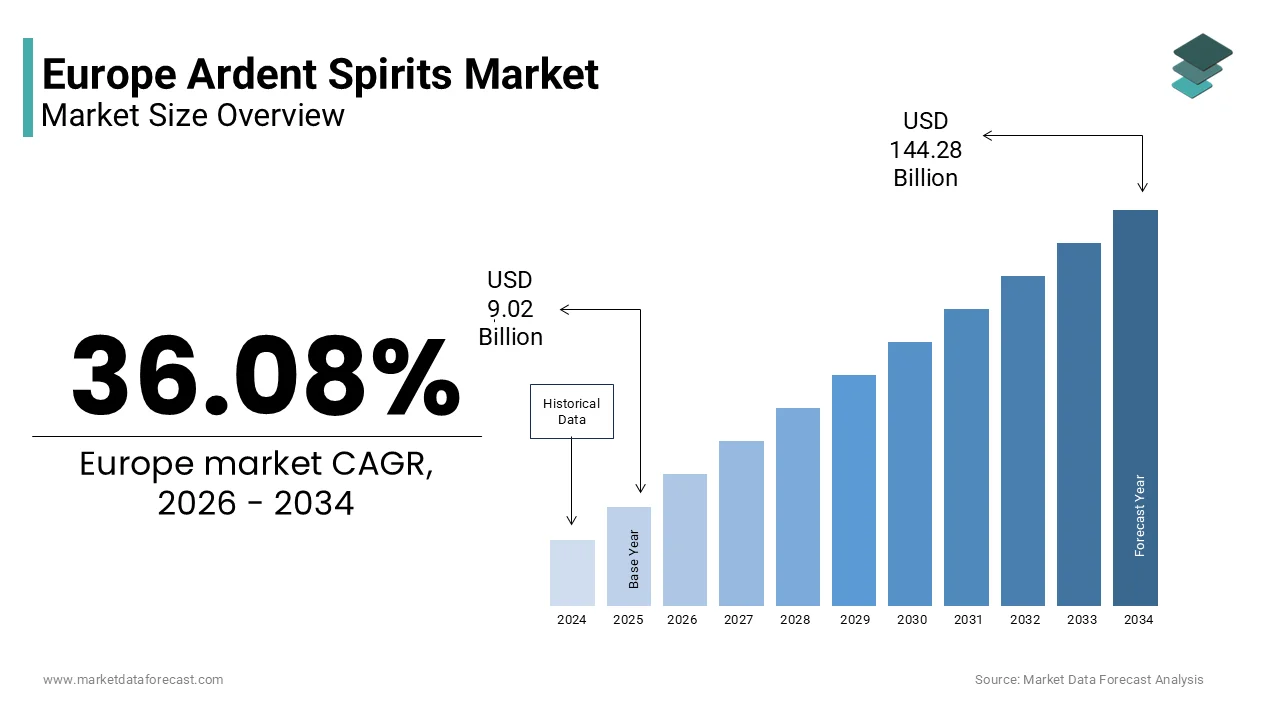
The Europe ardent spirits market operates within a complex regulatory environment governed by the European Union, which sets strict definitions for spirit drinks to ensure consumer protection and fair trade. According to Eurostat, alcohol consumption patterns in Europe remain among the highest globally, although there is a noticeable shift in preference toward premiumization rather than volume. As per the World Health Organization, while overall per capita alcohol consumption has stabilized or slightly declined in some member states, the expenditure on high-quality spirits has increased, reflecting a change in consumer behavior. The European Commission reports that the spirits sector contributes significantly to the agricultural economy by sourcing raw materials such as grains, grapes, and potatoes from local farmers. Furthermore, the industry supports millions of jobs directly and indirectly through tourism, hospitality, and retail channels. The market is currently navigating a transition driven by health consciousness, sustainability mandates, and evolving social norms regarding alcohol consumption. Despite these shifts, ardent spirits remain a staple of European social life and culinary tradition, ensuring their continued relevance in the regional beverage landscape.
MARKET DRIVERS
Premiumization and Consumer Preference for High-Quality Craft Products
The trend toward premiumization is propelling the Europe ardent spirits market expansion, as consumers increasingly prioritize quality over quantity in their purchasing decisions. Modern drinkers are more educated about production processes, aging techniques, and ingredient origins, which is leading them to seek out small-batch, craft, and single-estate spirits. As per data from IWSR Drinks Market Analysis, the value sales of super-premium and ultra-premium spirits in Western Europe have grown significantly, which is outpacing standard categories despite flat or declining volume trends. Consumers are willing to pay higher prices for products that offer unique flavor profiles, authentic storytelling, and artisanal craftsmanship. This shift is particularly evident in the whisky and gin sectors, where limited-edition releases and independent bottlings command substantial premiums. The rise of cocktail culture in urban centers further fuels demand for high-quality base spirits that can withstand complex mixing without losing character. Bars and restaurants curate extensive spirit lists featuring niche brands, which encourages experimentation and trial among patrons. Social media platforms amplify this trend by showcasing luxury consumption and educating users about tasting notes and pairing suggestions. Distilleries respond by investing in packaging design, visitor experiences, and direct-to-consumer sales channels to build brand loyalty. This focus on exclusivity and excellence allows producers to maintain profitability even as overall consumption volumes face pressure from health trends. The emotional connection consumers form with premium brands ensures sustained demand and resilience against economic fluctuations.
Strong Cultural Heritage and Protected Geographical Indications
The deep-rooted cultural heritage and robust system of protected geographical indications is further contributing to the expansion of the Europe ardent spirits market by ensuring authenticity and preserving traditional production methods. Many European spirits, such as Scotch whisky, Cognac, Armagnac, and Irish whiskey, are legally protected under EU regulations, which guarantee their origin and quality standards. As per the European Commission, there are over 50 geographical indications for spirit drinks in the European Union, which protect the intellectual property of producers and prevent imitation. These designations create a sense of trust and prestige among consumers who associate specific regions with superior quality and historical significance. Tourism plays a crucial role in reinforcing this driver as millions of visitors annually tour distilleries and vineyards in regions like Scotland, France, and Ireland. According to VisitScotland, whisky tourism alone contributes hundreds of millions of pounds to the local economy, demonstrating the symbiotic relationship between heritage and commerce. The narrative of tradition and terroir appeals to both domestic consumers and international buyers who view these spirits as cultural artifacts rather than mere commodities. Local communities take pride in their spirit-producing traditions, fostering strong regional support and advocacy. This cultural embeddedness makes it difficult for new entrants without geographical ties to compete on equal footing, thereby securing the market position of established European brands. The legal framework also facilitates export growth by providing clear differentiation in global markets.
MARKET RESTRAINTS
Stringent Public Health Policies and Alcohol Taxation
Stringent public health policies and increasing alcohol taxation is a major restraint on the Europe ardent spirits market by raising costs and discouraging consumption. Governments across Europe are implementing aggressive strategies to reduce alcohol-related harm, including higher excise duties, minimum unit pricing, and advertising restrictions. As per the World Health Organization Regional Office for Europe, several countries have introduced or planned tax increases on high-strength alcohol products to curb excessive drinking. In the United Kingdom, for instance, debates around minimum unit pricing have created uncertainty for retailers and producers, affecting sales volumes. France and Ireland have also tightened regulations on marketing and sponsorship, limiting the ability of brands to reach younger demographics. These fiscal measures increase the retail price of spirits, making them less accessible to price-sensitive consumers, particularly in lower-income segments. The cumulative effect of multiple taxes, including value-added tax and excise duty, can double the shelf price of a bottle, reducing discretionary spending on premium items. Public health campaigns highlighting the risks of alcohol consumption further dampen demand by shifting social norms away from regular drinking. The industry faces constant pressure to justify its social license to operate, leading to self-imposed restrictions on promotion. These regulatory headwinds constrain market growth and force companies to navigate a complex and often hostile political landscape. The unpredictability of policy changes makes long-term planning difficult for manufacturers and distributors.
Shifting Consumer Preferences toward Health and Wellness
The growing emphasis on health and wellness among European consumers is further hindering the growth of the Europe ardent spirits market by reducing overall alcohol intake. Increasing awareness of the link between alcohol consumption and various health issues, such as liver disease, cancer, and mental health disorders, has led many individuals to adopt moderation or abstinence. As per a survey by NielsenIQ, a rising percentage of Europeans, particularly millennials and Generation Z, are identifying as sober-curious or actively reducing their alcohol consumption. This demographic shift is supported by the availability of high-quality non-alcoholic alternatives, which mimic the taste and ritual of drinking without the intoxicating effects. The fitness and wellness industry promotes lifestyles that prioritize physical performance and mental clarity, which are often incompatible with regular heavy drinking. Social media influencers and health advocates champion Dry January and other temporary abstinence challenges, which have gained mainstream acceptance. Retailers are expanding their no- and low-alcohol sections, displacing traditional spirits on shelves. The perception of alcohol as a negative health factor is becoming more entrenched in public discourse, influencing peer groups and social gatherings. While premiumization helps offset volume declines, the overall contraction in the number of drinkers poses a fundamental challenge to market expansion. Producers struggle to appeal to health-conscious consumers who view even moderate spirit consumption as detrimental to their well-being goals.
MARKET OPPORTUNITIES
Expansion of Sustainable and Eco-Friendly Production Practices
The increasing consumer demand for sustainability is a significant opportunity for the Europe ardent spirits market to innovate and differentiate through eco-friendly production practices. Buyers are increasingly scrutinizing the environmental footprint of their purchases, including water usage, carbon emissions, and packaging waste. As per the European Environment Agency, industries that adopt circular economy principles and reduce greenhouse gas emissions gain competitive advantage and brand loyalty. Distilleries are investing in renewable energy sources, such as biomass and solar power, to operate their facilities more sustainably. Some producers are implementing water recycling systems and regenerative agriculture practices to source raw materials responsibly. Packaging innovation offers another avenue for growth, with companies transitioning to lightweight glass, recycled materials, and plastic-free closures. Brands that achieve certifications such as B Corp or Carbon Neutral can appeal to environmentally conscious consumers who are willing to pay a premium for ethical products. The narrative of sustainability resonates strongly with younger demographics who prioritize corporate responsibility in their purchasing decisions. Collaborations with environmental organizations and transparency in supply chain reporting further enhance credibility. By positioning themselves as leaders in sustainability, spirits producers can attract new customer segments and mitigate regulatory risks associated with environmental compliance. This strategic pivot aligns with broader societal goals and ensures long-term viability in a resource-constrained world.
Growth in Direct-to-Consumer and Digital Engagement Channels
The expansion of direct-to-consumer sales and digital engagement channels offers a lucrative opportunity for the Europe ardent spirits market to bypass traditional retail barriers and build deeper customer relationships. The acceleration of e-commerce adoption during recent years has normalized online alcohol purchases, allowing brands to reach consumers directly in their homes. As per Eurostat, online retail sales in the European Union have seen consistent growth, providing a robust infrastructure for spirits distribution. Distilleries are leveraging subscription models, tasting kits, and virtual masterclasses to engage customers and drive recurring revenue. These digital initiatives allow brands to collect valuable first-party data on consumer preferences, enabling personalized marketing and product development. Social media platforms serve as powerful tools for storytelling and community building, allowing producers to share behind-the-scenes content and connect with enthusiasts globally. The ability to sell limited-edition releases exclusively online creates scarcity and excitement, driving immediate sales. Digital channels also facilitate entry into new markets without the need for extensive physical distribution networks. Partnerships with online retailers and delivery apps further enhance accessibility and convenience for consumers. By embracing digital transformation, spirits companies can reduce dependency on traditional wholesalers and retailers, improving margins and control over brand presentation. This direct connection fosters loyalty and provides insights that inform strategic decision-making.
MARKET CHALLENGES
Supply Chain Disruptions and Raw Material Volatility
Supply chain disruptions and volatility in raw material prices is a significant challenge to the Europe ardent spirits market by increasing production costs and operational uncertainty. The industry relies heavily on agricultural inputs, such as barley, wheat, grapes, and potatoes, which are susceptible to weather conditions, climate change, and geopolitical tensions. As per the Food and Agriculture Organization of the United Nations, extreme weather events in Europe have impacted crop yields, leading to fluctuating availability and prices for key ingredients. Energy costs have also risen sharply, affecting the distillation process, which is energy-intensive. Logistics bottlenecks, including labor shortages in transportation and port congestion, delay the movement of goods both domestically and for export. These disruptions force manufacturers to hold higher inventory levels, tying up capital and increasing storage costs. Small and medium-sized distilleries are particularly vulnerable, as they lack the bargaining power and financial reserves of larger corporations to absorb shocks. The unpredictability of supply chains makes it difficult to maintain consistent pricing and product availability. Companies must invest in diversifying suppliers and exploring alternative sourcing strategies, which can be complex and costly. The ripple effects of global instability further exacerbate these challenges, creating a fragile operating environment. Ensuring business continuity requires significant investment in risk management and supply chain resilience, which strains resources.
Complex Regulatory Compliance and Cross-Border Trade Barriers
Navigating complex regulatory compliance and cross-border trade barriers poses a persistent challenge for the Europe ardent spirits market, particularly in the post-Brexit landscape. The divergence of regulations between the United Kingdom and the European Union has introduced new administrative burdens, customs checks, and tariffs that complicate trade flows. As per the UK Government statistics, exports of spirits from the UK to the EU have faced delays and increased costs due to additional paperwork and border controls. Within the EU itself, varying national laws regarding labeling, taxation, and advertising create a fragmented regulatory environment that hinders seamless market access. Producers must adapt their packaging and marketing strategies for each country, increasing operational complexity and costs. Changes in excise duty structures and health warning requirements further add to the compliance burden. The lack of harmonization in certain areas leads to inefficiencies and potential legal risks for non-compliance. Small exporters often struggle to understand and meet the diverse requirements of different markets, limiting their growth potential. Political uncertainties and potential future regulatory changes create an atmosphere of instability that discourages long-term investment. Companies must maintain dedicated legal and compliance teams to monitor and adapt to evolving regulations, diverting resources from innovation and marketing. This regulatory friction reduces competitiveness and slows down the speed to market for new products.
REPORT COVERAGE
| REPORT METRIC | DETAILS |
| Market Size Available | 2025 to 2034 |
| Base Year | 2025 |
| Forecast Period | 2026 to 2034 |
| CAGR | 36.08% |
| Segments Covered | By Application, Type, and Region |
| Various Analyses Covered | Global, Regional, & Country Level Analysis; Segment-Level Analysis; DROC, PESTLE Analysis; Porter’s Five Forces Analysis; Competitive Landscape; Analyst Overview of Investment Opportunities |
| Regions Covered | UK, France, Spain, Germany, Italy, Russia, Sweden, Denmark, Switzerland, Netherlands, Turkey, and the Czech Republic |
| Market Leaders Profiled | Diageo, LVMH, Brown Forman, Absolut, Bacardi Limited, Perood Ricard, The Patron Spirit Company, Beam Suntory and Mast gagermeister. |
SEGMENTAL ANALYSIS
By Application Insights
The supermarkets segment dominated the market by capturing the major share of the European market in 2025. This segment dominates because it serves as the primary destination for routine grocery shopping, where consumers frequently purchase alcohol alongside other household items. As per Eurostat, supermarkets and hypermarkets account for a significant majority of food and beverage retail sales in Western Europe, providing an unparalleled platform for spirit brands to gain visibility. The convenience of one-stop shopping appeals to busy consumers who prefer to consolidate their purchases rather than visiting specialized stores. Major retail chains such as Tesco, Carrefour, and Edeka have dedicated alcohol sections with wide assortments ranging from entry-level to premium brands, catering to diverse consumer preferences. The purchasing power of these retailers allows them to negotiate favorable terms with suppliers, resulting in lower shelf prices that attract price-sensitive shoppers. Promotional activities, including discounts, bundle offers, and loyalty program rewards, further stimulate demand within these stores. The integration of digital tools, such as online inventory checks and click-and-collect services offered by supermarkets, enhances convenience, thereby retaining customer loyalty. Additionally, the trust associated with established supermarket chains ensures product authenticity and quality, which is crucial for alcohol purchases. The sheer volume of transactions processed through supermarkets ensures that they remain the dominant channel for spirit distribution across the continent.
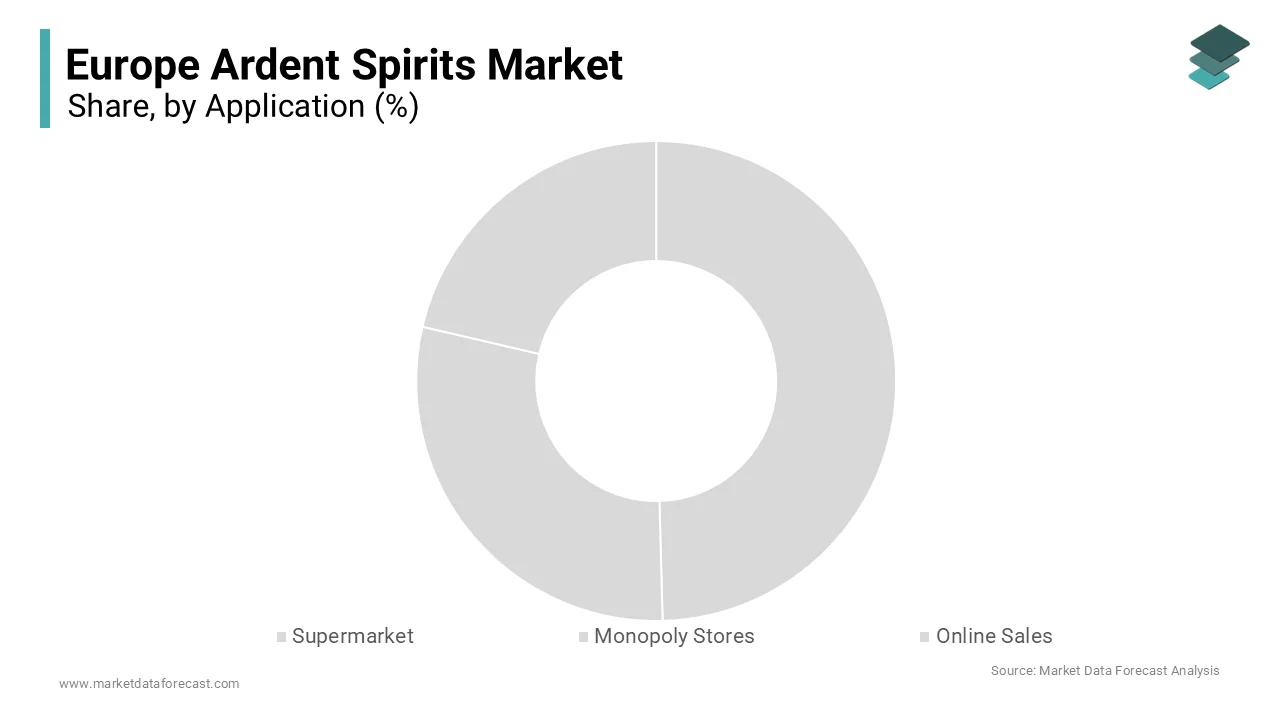
On the other end, the online sales segment is estimated to be the fastest-growing distribution channel for ardent spirits in Europe and showcase the fastest CAGR in the regional market over the forecast period owing to the digital adoption, changing consumer behaviors and as consumers increasingly prefer the convenience of home delivery and access to a wider variety of products that may not be available locally. As per eMarketer, e-commerce penetration in the European alcohol market has accelerated significantly, with double-digit growth rates observed in recent years. Online platforms allow consumers to browse extensive catalogs, read reviews, and compare prices from the comfort of their homes, facilitating informed decision-making. The rise of subscription services and curated tasting boxes has introduced new ways for consumers to discover and purchase spirits, enhancing engagement and loyalty. Direct-to-consumer models enable distilleries to bypass traditional intermediaries, offering higher margins and personalized customer experiences. The COVID-19 pandemic acted as a catalyst for this shift, normalizing online alcohol purchases and improving logistics infrastructure for age-verified deliveries. Regulatory frameworks in several European countries have adapted to facilitate online alcohol sales, ensuring compliance with age restrictions and tax requirements. Social media marketing and influencer partnerships drive traffic to online stores, converting digital engagement into sales. The ability to reach niche audiences and offer exclusive limited-edition products further fuels the growth of this channel. This digital transformation offers significant opportunities for brands to expand their reach and build direct relationships with consumers.
By Type Insights
The whisky segment dominated the market by capturing the major share of the European market in 2025. The dominance of whiskey segment in the European market is attributed to its deep cultural heritage, strong production base, and widespread consumer preference across the continent. This segment dominates because whisky is produced in several key European countries, including Scotland, Ireland, and France, creating a robust domestic supply and strong export orientation. As per the Scotch Whisky Association, exports of Scotch whisky alone reached record values in recent years, reflecting strong global and domestic demand. In Europe, whisky is perceived as a premium and sophisticated beverage suitable for both casual consumption and special occasions. The diversity of whisky styles, including single malt, blended, and grain varieties, caters to a wide range of taste preferences. The aging process and geographical indications, such as Scotch, Irish, and Cognac protected status, add value and authenticity to the product. Consumers associate whisky with tradition, quality, and craftsmanship, which supports higher price points and brand loyalty. The popularity of whisky tours and distillery visits further reinforces its cultural significance and drives direct sales. Retailers dedicate significant shelf space to whisky offerings, reflecting its high turnover and profitability. The versatility of whisky in cocktails and neat consumption ensures broad appeal across different demographics. This combination of heritage, quality, and versatility secures the leading position of whisky in the European spirits market.
However, the gin segment is a promising segment and is estimated to record the fastest CAGR in the regional market over the forecast period due to the craft gin revolution and cocktail culture. This segment is expanding rapidly as consumers seek diverse flavor profiles and botanical experiences beyond traditional juniper-dominated profiles. As per IWSR Drinks Market Analysis, gin sales in Europe have seen double-digit growth in recent years, fueled by the proliferation of independent distilleries and innovative flavor combinations. The versatility of gin in mixed drinks, particularly gin and tonic, makes it a popular choice for social gatherings and warm-weather consumption. The rise of premium tonics and garnishes has elevated the gin drinking experience, encouraging experimentation. Consumers are attracted to the artisanal nature of craft gins, which often use local botanicals and small-batch production methods. Social media plays a crucial role in promoting gin brands through visually appealing content and influencer partnerships. The relatively lower barrier to entry for gin distillation compared to whisky has led to a surge in new brands, increasing competition and innovation. This dynamic environment keeps the category fresh and engaging for consumers. The association of gin with modernity and creativity positions it as a dynamic growth engine in the European spirits market.
REGIONAL ANALYSIS
United Kingdom Market Analysis
The UK dominated the market by holding the major share of the European market in 2025 and is expected to experience steady and premium-led expansion over the next few years due to its strong heritage in whisky and gin production and high domestic consumption and a robust export industry. The global reputation of Scotch whisky that commands premium prices and loyal followings is further aiding the dominance of the UK in the European market. As per the Scotch Whisky Association, the UK exports billions of pounds worth of whisky annually, supporting local economies and jobs. The craft gin boom in the UK has also revitalized the domestic market, with hundreds of small distilleries producing innovative botanical spirits. Consumer preference for premium and artisanal products drives value growth despite flat volume trends. The vibrant pub and bar culture supports steady demand for spirits in social settings. Regulatory support for geographical indications protects the integrity of UK spirits. Tourism related to distillery visits further boosts sales and brand awareness. The UK market leads in innovation with new flavors and sustainable packaging initiatives. This combination of tradition and modernity ensures the UK remains a key player in the European spirits landscape.
France Market Analysis
France is projected to maintain a prestigious and steady trajectory over the next few years, representing a significant and prestigious segment of the Europe ardent spirits market characterized by its world-renowned brandy and cognac production. The global demand for Cognac and Armagnac that are viewed as symbols of sophistication and quality is favouring the growth of France in the European market. As per the Bureau National Interprofessionnel du Cognac, exports of Cognac have remained strong, particularly in Asian markets, driving production volumes. Domestic consumption is stable, with a preference for high-quality aged spirits. The French culinary culture integrates spirits into dining and social rituals, supporting steady demand. Government policies protect geographical indications, ensuring authenticity and preventing imitation. Innovation in packaging and marketing targets younger demographics while maintaining traditional values. The tourism industry benefits from vineyard and distillery visits, enhancing brand loyalty. France's reputation for excellence in winemaking extends to its spirit production, reinforcing its premium status. This focus on quality and heritage sustains France's influential position in the regional market.
Spain Market Analysis
Spain is anticipated to show resilient and consumption-driven growth over the next few years, holding a growing position in the Europe ardent spirits market driven by its vibrant social culture and production of brandy and rum. The popularity of branded Spanish brandy that is widely consumed in cocktails and neat is further contributing to the expansion of Spain in the European market. As per data from the Spanish Federation of Wine and Spirits, the domestic market shows resilience, with consumers preferring mid- to premium-range products. The tourism sector significantly boosts spirit consumption as visitors engage with local nightlife and culinary experiences. Production of rum in Spain has also increased, catering to both domestic and export markets. The warm climate encourages the consumption of refreshing spirit-based drinks. Regulatory frameworks support quality standards and geographical indications. Innovation in flavor profiles and packaging appeals to younger consumers. The integration of spirits into tapas culture enhances their appeal. This combination of social tradition and production capability drives steady market growth.
Germany Market Analysis
Germany is likely to sustain stable and innovation-focused advancement over the next few years, representing a mature and significant segment of the Europe ardent spirits market characterized by high consumption of vodka and gin. The popularity of gin and tonic that has become a staple in German bars and homes is further boosting the growth of Germany in the European market. As per the German Spirits Industry Association, domestic production of gin has increased significantly, with many craft distilleries entering the market. Vodka remains a popular choice due to its versatility and neutral flavor. Consumer trends favor premium and organic spirits, reflecting health consciousness. The well-developed retail sector ensures wide availability and competitive pricing. Regulatory compliance with EU standards ensures product safety and quality. The beer culture coexists with spirit consumption, particularly in urban areas. Innovation in flavored vodkas and botanical gins drives interest. This balanced approach to tradition and innovation sustains Germany's strong market position.
Italy Market Analysis
Italy is expected to witness continuous and tradition-backed development in the coming years, holding a notable position in the Europe ardent spirits market driven by its production of grappa and liqueurs. The cultural habit of consuming grappa and amaro that are deeply rooted in Italian dining customs is also driving the Italian market growth. As per data from the Italian Ministry of Agricultural, Food and Forest Policies, production of grappa has stabilized with a focus on quality and aging. The rise of cocktail culture in cities like Milan and Rome has increased demand for gin and vodka. Tourism supports the sale of local spirits as souvenirs and experiences. Consumer preference for artisanal and regional products drives niche growth. Regulatory protections for geographical indications safeguard traditional production methods. Innovation in packaging and branding appeals to international markets. The integration of spirits into gastronomy enhances their value. This cultural depth ensures Italy's continued relevance in the spirits sector.
COMPETITIVE LANDSCAPE
The competition in the Europe ardent spirits market is intense and characterized by the presence of large multinational corporations alongside a growing number of independent craft distilleries. Major players leverage their scale global distribution networks and established brand equity to dominate shelf space and on trade accounts. However niche producers are gaining traction by offering unique artisanal products that appeal to consumers seeking authenticity and local provenance. Price competition is moderate in the premium segment where brand heritage and quality perception drive purchasing decisions. Innovation in flavor profiles packaging and sustainability serves as a key differentiator. Regulatory pressures regarding health warnings and taxation create a uniform challenge that all participants must navigate. Mergers and acquisitions are common strategies for consolidating market power and accessing new categories. Digital marketing and e commerce capabilities are becoming critical competitive factors as consumers shift toward online purchasing. The market sees continuous entry of new brands particularly in the gin and whisky categories fostering a dynamic environment. Consumer loyalty is increasingly driven by ethical practices and brand transparency rather than just taste. This landscape requires agility and strategic foresight from all participants to sustain growth and relevance.
KEY MARKET PLAYERS
Key players in the Europe ardent spirits market are
- Diageo
- LVMH
- Brown Forman
- Absolut
- Bacardi Limited
- Perood Ricard
- The Patron Spirit Company
- Beam Suntory
- Mast gagermeister
Top Players in the Market
- Diageo plc stands as a dominant force in the Europe ardent spirits market with a portfolio that includes iconic brands such as Johnnie Walker Tanqueray and Smirnoff. The company leverages its extensive distribution network and marketing prowess to maintain strong brand loyalty across the continent. Diageo recently invested heavily in sustainability initiatives aiming for net zero emissions across its direct operations by 2030. The company also expanded its premium whisky offerings through strategic acquisitions and distillery expansions in Scotland. By focusing on digital engagement and direct to consumer sales channels Diageo strengthens its connection with modern consumers. These actions enhance its market position by aligning with evolving consumer values while preserving the heritage of its core brands.
- Pernod Ricard SA contributes significantly to the Europe ardent spirits market through its diverse range of premium spirits including Absolut Vodka Chivas Regal and Martell Cognac. The company emphasizes innovation and responsible drinking practices to appeal to health conscious consumers. Pernod Ricard recently launched several new product variants focusing on low alcohol and organic options to capture emerging trends. The firm has also strengthened its presence in the craft gin segment by acquiring independent distilleries. Strategic partnerships with hospitality providers ensure wide visibility and availability of its products. These efforts reinforce its reputation for quality and responsibility solidifying its leadership in the competitive European landscape.
- Beam Suntory Inc plays a pivotal role in the Europe ardent spirits market with key brands like Jim Beam Teacher’s Highland Cream and Courvoisier. The company focuses on premiumization and expanding its ultra premium portfolio to drive value growth. Beam Suntory recently enhanced its production capabilities in Europe by upgrading distillation facilities to improve efficiency and quality. The company actively promotes cocktail culture through educational programs for bartenders and consumers. Sustainability remains a core priority with investments in water conservation and renewable energy sources. These strategic moves help Beam Suntory differentiate its offerings and build resilience against market fluctuations ensuring sustained growth in the region.
Top Strategies Used by the Key Market Participants
Key players in the Europe ardent spirits market primarily focus on premiumization to drive value growth amidst stable or declining volume trends. Companies invest heavily in brand building and storytelling to create emotional connections with consumers. Sustainability initiatives including carbon reduction and eco friendly packaging are central to corporate strategies to meet regulatory and consumer expectations. Digital transformation enhances direct to consumer engagement and data driven marketing. Innovation in product formats such as ready to drink cocktails and low alcohol options addresses changing lifestyle preferences. Strategic acquisitions of craft and niche brands expand portfolios and access new demographics. Partnerships with hospitality sectors ensure prominent placement and trial opportunities. These multifaceted approaches enable participants to navigate regulatory challenges and maintain competitiveness in the dynamic European market.
MARKET SEGMENTATION
This research report on the Europe ardent spirits market is segmented and sub segmented into following categories
By Application
- Supermarket
- Monopoly Stores
- Online Sales
By Type
- Gin
- Whisky
- Brandy
- Vodka
- Rum
- Tequilla
- Baijiu
- Sake
By Country
- UK
- France
- Spain
- Germany
- Italy
- Russia
- Sweden
- Denmark
- Switzerland
- Netherlands
- Turkey
- Czech Republic
- Rest of Europe