- Product Description Description
- Table of Contents TOC
- List of Table & Figure LOT
- Get Free Sample PDF Sample PDF
Market Size, 2025
$0.53 BnMarket Estimate, 2026
$0.56 BnMarket Forecast, 2034
$0.83 BnCAGR, 2026–2034
5%Europe Artificial Flowers Market Size, Growth, Trends & Forecast (2026–2034)
The Europe artificial flowers market size was calculated to be USD 0.53 billion in 2025, is estimated to reach USD 0.56 billion in 2026, and is projected to scale up to USD 0.83 billion by 2034, registering a compound annual growth rate (CAGR) of 5.0% during the forecast period from 2026 to 2034. Propelled by rising consumer demand for low-maintenance and allergen-free home decor, post-pandemic event and hospitality sector growth, and the integration of sustainable bio-based materials under the European Green Deal, the market is transforming from utilitarian substitutes into curated lifestyle accessories.
Key Executive Metrics (At-a-Glance)
- 2025 Base Valuation: USD 0.53 Billion
- 2026 Current Valuation: USD 0.56 Billion
- 2034 Forecast Valuation: USD 0.83 Billion
- Compound Annual Growth Rate (CAGR): 5.0% (2026–2034)
- Dominant Material Segment: Polyester Segment
- Fastest-Growing Material Segment: Paper-Based Artificial Flowers (CAGR of 12.4%)
- Dominant Application Segment: Residential Segment
- Fastest-Growing Application Segment: Commercial Segment (CAGR of 9.7%)
- Dominant Distribution Channel Segment: Offline Distribution Segment
- Fastest-Growing Distribution Channel Segment: Online Sales Segment (CAGR of 14.1%)
- Dominant Regional Market: Germany (22.6% share in 2025)
- Second-Largest Regional Market: United Kingdom (18.7% share in 2025)
Core Market Drivers
- Health & Convenience: High prevalence of pollen-related allergies and urban apartment housing driving demand for durable, low-maintenance, allergen-free botanical alternatives.
- Hospitality & Event Resurgence: Post-pandemic tourism, hotel operational cost savings, and sustainable wedding trends amplifying demand for permanent, high-quality floral installations.
Primary Market Restraints & Challenges
- Aesthetic Stigma & Environmental Concerns: Persistent consumer perceptions of cheap, tacky plastic decor, alongside microplastic shedding from fossil-fuel-based polymers conflicting with circular economy goals.
- Supply Chain Dependency: Heavy overreliance on Asian production hubs creating logistical vulnerabilities, trade risks, and compliance hurdles under rigorous EU regulations.
Europe Artificial Flowers Market Classification Breakdown
| Segment Category | Largest (Dominant) Segment | Fastest-Growing Segment |
|---|---|---|
| By Material | Polyester | Paper (CAGR: 12.4%) |
| By Application | Residential | Commercial (CAGR: 9.7%) |
| By Distribution Channel | Offline | Online (CAGR: 14.1%) |
| By Region | Germany (22.6%) | United Kingdom (18.7%) / France / Netherlands |
Major Industry Players Profiled
Key enterprises and brands driving the European artificial flowers market include IKEA, Floralsilk, Sia Home Fashion, Lene Bjerre, Kaemingk, Boltze Gruppe, PTMD Collection, Edelman BV, Casa International, and Bloomingville.
Europe Artificial Flowers Market Size
The Europe artificial flowers market size was calculated to be USD 0.53 billion in 2025 and is anticipated to be worth USD 0.83 billion by 2034, growing from USD 0.56 billion in 2026 at a CAGR of 5% during the forecast period.
Artificial flowers are meticulously crafted botanical replicas made from polyester, silk, latex, and increasingly bio-based polymers designed for decorative residential, commercial, hospitality, and ceremonial use. Unlike fresh-cut flowers, these products offer enduring aesthetics, low maintenance, and allergen-free alternatives while aligning with evolving consumer values around sustainability and longevity. In a region where floral symbolism is deeply embedded in cultural rituals, seasonal celebrations, and interior design traditions, artificial blooms have transitioned from utilitarian substitutes to curated lifestyle accessories. According to multiple sources, consumer interest in home decor within Europe is growing, with a notable increase in the demand for sustainable and eco-friendly products. There is a trend towards simplicity, functionality, and the use of natural materials in home design. As per research, European authorities and consumers are focused on waste minimisation and the circular economy due to high levels of overall waste generation. There is a pronounced societal push toward adopting more reusable alternatives in many consumption areas to reduce environmental impact. Furthermore, as per the European Commission’s Circular Economy Action Plan, non-biodegradable decorative items are under scrutiny, driving innovation in recyclable and plant-derived materials. These intersecting cultural, environmental, and design dynamics position artificial flowers as both a heritage craft and a modern sustainable choice in Europe’s evolving aesthetic economy.
MARKET DRIVERS
Rising Demand for Low-Maintenance and Allergen-Free Home Décor
European consumers increasingly favour artificial flowers due to their durability, minimal upkeep, and suitability for allergy-sensitive environments, which in turn drives the growth of the Europe artificial flowers market. These are key considerations in urban and aging populations. Allergy and immunology organizations report that a very large number of Europeans suffer from pollen-related allergies, a condition that appears to be increasing in prevalence. Artificial alternatives eliminate this risk while offering year-round visual appeal without watering, pruning, or replacement. Eurostat data shows that a significant proportion of the European Union population lives in apartments, a common housing type in urban areas. Besides, research by organizations indicates that older adults often prioritize practical factors, such as ease of maintenance and accessibility, in their housing and living environment choices to support independent living as they age. Retailers have responded by expanding their artificial flower collections with dust-resistant finishes and realistic textures. This convergence of health convenience and demographic trends creates sustained demand across residential and healthcare settings.
Growth of Event and Hospitality Industries Post-Pandemic
The resurgence of weddings, corporate events, and tourism across the region has significantly amplified demand for reusable high-quality artificial floral installations that offer cost efficiency and design consistency, and it thereby further boosting the expansion of the Europe artificial flowers market. According to the European Travel Commission and UN Tourism data, international tourist arrivals in Europe (a broader region than the EU) surpassed pre-pandemic levels in 2025, continuing a strong recovery trend. This increase in visitor numbers contributes to significant activity in the hospitality and events sectors. Trends in Western European weddings show a growing interest in sustainable and cost-effective floral alternatives, leading to an increased incorporation of preserved or high-quality artificial flowers in various decorations. Luxury hotel chains use artificial arrangements in lobbies and guest rooms to maintain brand aesthetics without the logistics of weekly fresh deliveries. In the European hospitality sector, some hotels are increasingly opting for permanent botanical displays to manage operational costs and ensure consistent aesthetic appeal, moving away from the expense of fresh flower arrangements. This operational and experiential value ensures artificial flowers remain integral to Europe’s vibrant experience economy.
MARKET RESTRAINTS
Persistent Consumer Perception of Inferior Aesthetics and Tackiness
Many European consumers still associate these flowers with outdated, plastic-looking decor from previous decades, despite technological advances, which restricts the growth of the Europe artificial flowers market. This creates a stigma that hinders premium adoption. General consumer sentiment suggests that many people prefer fresh flowers for their natural appearance and freshness, while some individuals may consider artificial flowers to be less authentic or tacky compared to the real thing. This perception is particularly strong among younger demographics who prioritize natural and biodegradable products as part of broader sustainability ethics. Younger consumers tend to be less inclined to purchase or gift cut flowers compared to older demographics, often citing concerns about longevity and value. Generations X and Y are often interested in a wider range of floral products, including potted plants or arrangements that can be personalized, for gifting occasions. Retailers often relegate these items to discount sections, reinforcing the notion of low value. The artificial flowers market cannot capture discretionary spending in aesthetic-driven segments or transcend its utilitarian image until brands successfully reposition themselves as sophisticated design objects through premium materials, artisanal craftsmanship, and influencer collaborations.
Environmental Concerns Over Non-Biodegradable Materials and Microplastic Shedding
Most artificial flowers are manufactured from polyester and plastic derivatives that are not biodegradable and contribute to long-term waste, and ultimately hinder the expansion of the Europe artificial flowers market. This conflicts with Europe's circular economy and zero plastic waste ambitions. According to sources, the vast majority of artificial products, including artificial floral items, sold in the European market are made from conventional, fossil-fuel-based plastics, and a comprehensive, dedicated recycling system for these specific items is largely absent across Europe. Moreover, washing or handling these items releases microplastics into waterways. As per a study, handling artificial flowers made from synthetic textiles can lead to the release of microfibers, contributing to the broader issue of microplastic pollution in aquatic environments. The European Commission’s Single Use Plastics Directive does not yet cover decorative items,s but the upcoming Ecodesign for Sustainable Products Regulation may impose durability, recyclability, and material disclosure requirements. A limited number of artificial flower producers currently use certified bio-based or genuinely recyclable materials, as companies face challenges in the transition to more sustainable, circular plastic systems. This environmental footprint undermines the market’s sustainability narrative and risks future regulatory restrictions or consumer backlash.
MARKET OPPORTUNITIES
Integration of Bio-Based and Recyclable Materials Under Green Design Trends
The European Union’s push for sustainable materials is opening opportunities for the Europe artificial flowers market. These flowers are made from plant-derived polyesters, mycelium-based foams anmono-materialal recyclable polymers. The European bioeconomy sector is experiencing growth, with an emerging trend among various start-ups in Europe to develop and utilize innovative, bio-based materials for products such as packaging, textiles, and other consumer goods, often with the goal of industrial compostability or enhanced circularity. Some companies offer collections certified under the EU Ecolabel for low environmental impact. The French government, often with expert input from the French Agency for Ecological Transition (ADEME), is increasingly leveraging public procurement as a strategic tool to promote the circular economy and environmental objectives, encouraging the use of products with lower environmental impacts. In addition, the European Design for Sustainability Network promotes “circular floristry,” where artificial arrangements are leased, returned, and refurbished. This alignment with green public procurement and conscious consumerism transforms artificial flowers from disposable decor into responsible, long-life design objects, which opens premium B2B and B2C channels.
Expansion in Therapeutic and Institutional Settings for Mental Well-being
These flowers are gaining traction in healthcare, senior living, and educational environments as part of evidence-based design strategies to enhance psychological well-being without biological risks, and they are expected to fuel the expansion of the Europe artificial flowers market. Exposure to floral aesthetics is associated with a decrease in anxiety levels and an improvement in mood within clinical environments. Despite these observed benefits, the presence of fresh flowers is frequently restricted in medical facilities, such as hospitals, often due to infection control considerations. Many healthcare institutions prohibit live flowers in areas where patients stay overnight, creating a clear need for artificial yet realistic alternatives. Similarly, a significant majority of senior care residences incorporate permanent floral displays, which are intended to aid memory stimulation and enhance the sensory environment for the individuals living there. In schools, artificial bouquets are used in art and botany classes for year-round tactile learning without decay. These institutional applications, driven by health safety and cognitive science, create stable demand unaffected by seasonal or fashion trends.
MARKET CHALLENGES
Lack of Standardized Sustainability Certification and Greenwashing Risks
The absence of harmonized European standards for “eco-friendly” or “biodegradable” claims in decorative products allows widespread greenwashing that confuses consumers and affects credible innovators. Consequently, this impedes the growth of the Europe artificial flowers market. Many listings for artificial flowers on major e-commerce platforms utilize environmental terminology that lacks verification from independent third-party certifications. A significant portion of these product descriptions includes vague language suggesting ecological benefits without providing supporting evidence. Most digital listings for these items fail to disclose specific information regarding the material composition of the products. A pattern exists where online retailers omit instructions or data concerning the proper disposal or end-of-life processing for synthetic floral goods. A lack of compulsory labeling rules within the Ecodesign for Sustainable Products Regulation leaves consumers in the dark, which makes it difficult to tell the difference between truly bio-based items and standard, "green-dyed" polyester products. This information asymmetry depresses willingness to pay premium prices and discourages investment in sustainable R and D. The decorative floristry market remains susceptible to false claims and consumer doubt without clear EU testing rules.
Supply Chain Concentration and Geopolitical Dependency on Asian Manufacturing
Vulnerability of supply chains, due to overreliance on Asian production hubs, obstructs the expansion of the Europe artificial flowers market. A substantial majority of artificial flowers available in the European market originates from a few specific Asian nations, leading to potential risks regarding trade stability and product standards. Shipments of polyester floral goods frequently encounter logistical delays as a result of rigorous regulatory inspections and safety compliance monitoring. Heightened oversight of chemical compositions in imported floral products has resulted in the identification of prohibited substances. The detection of non-compliant materials in artificial flowers has led to product withdrawals and negative impacts on corporate prestige. European manufacturers like Deyrolle in France and Bloom & Wild’s artificial line face higher production costs due to strict REACH compliance and labor expenses limiting scale. The number of micro-enterprises within the region that produce artificial flowers through traditional artisanal methods remains limited. Current levels of handcrafted production are not high enough to satisfy existing market requirements. A gap exists between the volume of goods created by skilled artisans and the overall commercial demand for such products. This dependency on distant supply chains conflicts with Europe’s nearshoring and resilient trade objectives and exposes the market to regulatory and logistical volatility.
REPORT COVERAGE
| REPORT METRIC | DETAILS |
| Market Size Available | 2025 to 2034 |
| Base Year | 2025 |
| Forecast Period | 2026 to 2034 |
| CAGR | 5% |
| Segments Covered | By Material, Application, Distribution Channel, And Region |
| Various Analyses Covered | Global, Regional & Country Level Analysis; Segment-Level Analysis; DROC, PESTLE Analysis; Porter’s Five Forces Analysis; Competitive Landscape; Analyst Overview of Investment Opportunities |
| Regions Covered | UK, France, Spain, Germany, Italy, Russia, Sweden, Denmark, Switzerland, Netherlands, Turkey, and the Czech Republic |
| Market Leaders Profiled | IKEA, Floralsilk, Sia Home Fashion, Lene Bjerre, Kaemingk, Boltze Gruppe, PTMD Collection, Edelman BV, Casa International, Bloomingville |
SEGMENTAL ANALYSIS
By Material Insights
The polyester segment held the largest share of the Europe artificial flowers market in 2025. The supremacy of the polyester segment is attributed to its exceptional balance of realism, durability, cost efficiency,y and color retention. Unlike natural silk or paper, polyester fibers can be heat set to mimic petal curvature, hold vibrant dyes without fading, and resist moisture, which makes them ideal for both residential decor and high-traffic commercial environments. Retailers source polyester arrangements for their home collections due to consistent quality and supply chain reliability. In addition, the material’s resistance to dust and ease of cleaning, requiring only a damp cloth, aligns with European consumer preferences for low-maintenance home goods. This combination of aesthetic fidelity, functional resilience, and economic scalability ensures polyester remains the industry standard across mass market and mid-tier segments.
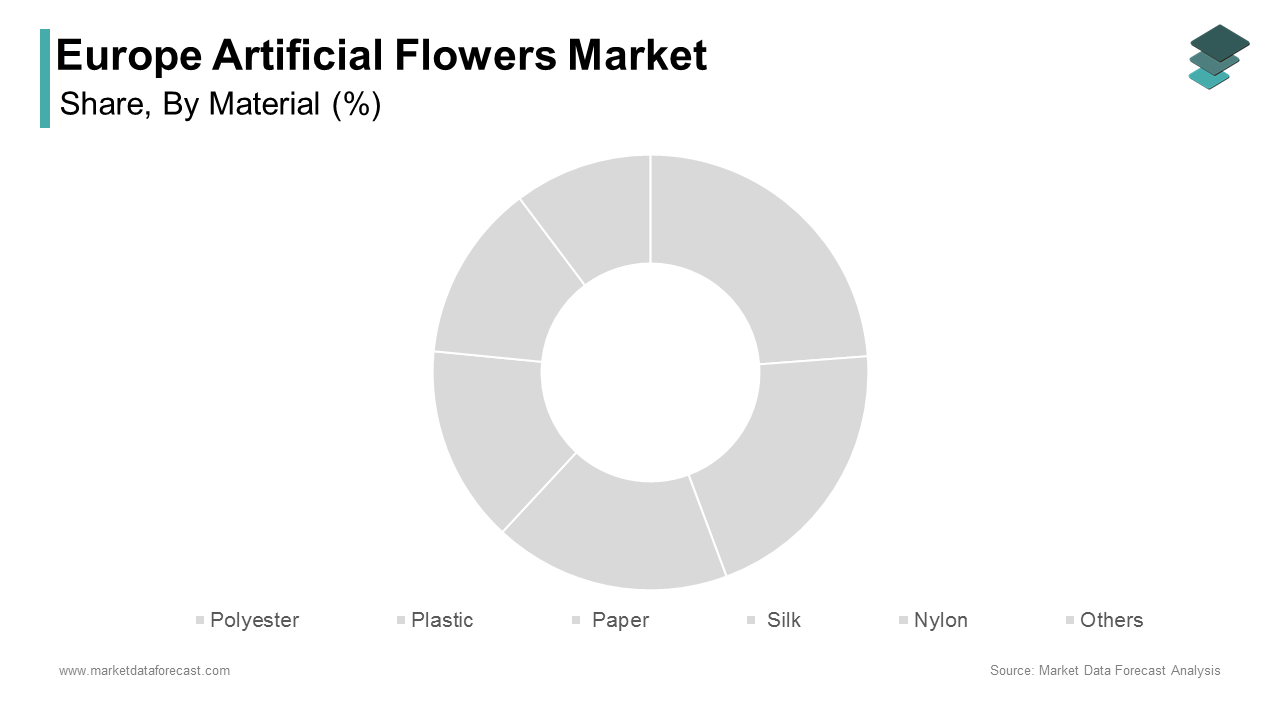
The paper-based artificial flowers segment is predicted to witness the highest CAGR of 12.4% from 2026 to 2034 due to rising demand for biodegradable, compostable, and artisanal home decor aligned with the European Green Deal and circular design principles. Paper flowers decompose naturally over several months when placed in managed composting environments, whereas synthetic alternatives do not break down. Artisan studios in Sweden, Italy, and the Netherlands now use FSC-certified paper and plant-based inks to create handcrafted bouquets for weddings and corporate gifting, sectors increasingly governed by sustainability clauses in procurement contracts. Floral products made from paper are eligible for lower tax rates at public events if they are obtained from recognized sustainable providers. Furthermore, the European Design for Sustainability Network promotes paper floristry in schools and museums as part of zero-waste education programs. This convergence of eco consciousness, cultural revival, and policy support positions the paper as the highest growth frontier in Europe’s ethical decor movement.
By Application Insights
The residential segment held the majority share of the Europe artificial flowers market in 2025. The leading position of the residential segment is credited to consistent household demand for permanent decorative elements that enhance living spaces without ongoing maintenance. A majority of European households participated in interior decoration activities. Floral arrangements emerged as one of the most frequently purchased home accessories. Consumer interest in home aesthetics reflected a consistent pattern across the region. Interior styling remained a primary focus for household engagement. The trend is particularly strong in urban apartments where natural light limitations and space constraints make live plants impractical. Furthermore, aging populations favor artificial blooms for safety and ease. Retail channels from discount stores to premium boutiques cater to this demand with seasonal collections for holidays. This deep integration into everyday domestic aesthetics ensures residential remains the market’s volume backbone.
The commercial segment is estimated to register the fastest CAGR of 9.7% over the forecast period, owing to the hospitality, retail, and event sectors’ shift toward reusable, sustainable anbrand-consistentnt floral displays that reduce operational costs and support environmental goals. Hotels across Europe, including Accor NH and Scandic, have replaced weekly fresh flower deliveries with permanent arrangements in lobbies, guest rooms, and restaurants, saving a significant amount annually per property. Similarly, luxury retail brands like Louis Vuitton and COS use custom artificial installations in window displays that last entire seasons without wilting. Event planners are increasingly providing hybrid floral packages that integrate fresh centerpieces with artificial backdrops. This shift in service offerings is intended to reduce overall costs for clients. The combination of natural and synthetic elements serves as a method to minimize material waste. Industry patterns indicate a growing preference for blended floral arrangements over exclusively fresh installations. The segment of reusable decor is well-positioned for institutional adoption among museums, galleries, and municipal venues, driven by the European Commission's increasing inclusion of such criteria in its Green Public Procurement policies.
By Distribution Channel Insights
The offline distribution segment remained the dominant segment in the Europe artificial flowers market in 2025. The dominance of the offline distribution segment is driven by the importance of tactile evaluation, aesthetic matching, and immediate purchase satisfaction, particularly for high-value or custom arrangements. Consumers often prefer to assess texture, color accuracy, and scale in person before purchasing for weddings or home staging. In France and Italy, boutique floral ateliers offer bespoke artificial bouquets with artisanal finishes that are rarely available online. Additionally, offline channels enable bundling with vases, stands, and lighting, which enhances average transaction value. Seasonal pop-ups during Christmas and Easter further drive foot traffic with curated collections that leverage sensory merchandising. This experiential and trust-based model sustains offline dominance despite the convenience of e-commerce.
The online sales segment is anticipated to witness the fastest CAGR of 14.1% from 2026 to 2034. The rapid expansion of the online segment is propelled by the rise of curated home lifestyle e-commerce platforms, enhanced visual search technology, and demand for niche or bulk arrangements not available locally. Platforms offer thousands of artisanal and mass-produced options with detailed photographs,y customer reviews, and AR preview tools that simulate floral arrangements in user-uploaded room images. Additionally, B2B buyers in hospitality and retail increasingly use digital catalogs to source bulk artificial flowers with consistent specifications across multiple locations. During off-season months, online sales ofholiday-themedd arrangements surge. This blend of personalization scale and digital innovation positions online as the high-velocity growth channel for the future.
REGIONAL ANALYSIS
Germany Artificial Flowers Market Analysis
Germany was the top performer in the Europe artificial flowers market and accounted for a 22.6% share in 2025. The prominence of the German market is attributed to its strong home goods retail sector and environmentally conscious consumers. The country’s leading role in the European Green Deal has accelerated demand for recyclable and low-impact decor, with a notable share of artificial flower buyers citing sustainability as a purchase factor. Retail giants like IKEA and Depot prioritize polyester arrangements with certified dyes and take-back programs. Additionally, Germany’s aging population fuels demand for allergen free low maintenance floral displays in senior living communities. This combination of demographic need, retail scale, and eco regulation cements Germany as the market’s volume and sustainability leader.
United Kingdom Artificial Flowers Market Analysis
The United Kingdom was the second largest player in the Europe artificial flowers market and captured a 18.7% share in 2025. The growth of the UK market is fuelled by its vibrant wedding industr robust e-commerce infrastructure, robust e-commerce infrastructure, robuse-commercece infrastructure andesign-leded retail culture. There has been a notable shift toward the use of artificial floral arrangements within the wedding industry. A significant portion of wedding ceremonies now incorporates synthetic flowers for both personal bouquets and venue styling. Couples are increasingly choosing non-natural floral alternatives as part of their event design. The pattern suggests that manufactured blooms have become a common substitute for traditional fresh flowers in modern nuptials. Online platforms offer hybrid and fully artificial collections with next-day delivery. The British Florist Association reports that event florists increasingly use artificial backdrops to reduce waste and cost. Additionally, the UK’s strong home renovation trend, fueled by the pandemic and remote work, has increased demand for permanent floral accents in home offices and living rooms. Despite Brexit, the UK aligns with European material safety standards, ensuring continued product compatibility. This blend of celebration culture, digital adoption, and domestic aesthetics sustains the UK’s dynamic market position.
France Artificial Flowers Market Analysis
France is another significant country in the Europe artificial flowers market because of its heritage in floral artistry and luxury interior design. The country is home to renowned ateliers like Deyrolle and Maison Moinard that create handcrafted silk and paper floral installations for high-end hotels, museums, and private clients. Some of the Parisian department stores dedicate premium sections to artificial arrangements as timeless design objects rather than substitutes. Additionally, the French Agency for Ecological Transition supports paper floristry through grants tbio-baseded material innovators. As per research, French brides increasingly choose preserved or artificial bouquets as heirlooms. This fusion of cultural prestige sustainabil,ity and luxury curation positions France as the market’high-valueue aesthetic leader.
Italy Artificial Flowers Market Analysis
Italy grew steadily in the Europe artificial flowers market due to deep-rooted religious customs, seasonal festivals, and strong home decoration traditions. Artificial flowers are extensively used in churches, cemeteries, and homes for feast days, including All Saints Day, Easter, and local patron saint celebrations. A notable majority of households acquire artificial decorative items each year for use during religious observances or festive periods. The country’s artisanal flower district in Rome and Florence produces hand-dyed polyester and silk blooms for both domestic and export markets. Additionally, Italy’s tourism sector drives demand in hotels and restaurants seeking low-maintenance Mediterranean-style decor. Numerous small, specialized workshops are dedicated to the craft of producing artificial floral arrangements. This cultural embeddedness and seasonal rhythm create a stable and emotionally resonant market distinct from purely aesthetic trends.
Netherlands Artificial Flowers Market Analysis
The Netherlands is likely to expand in the Europe artificial flowers market from 2026 to 2034 owing to its command in circular design and integration with the country’world-famousus horticultural identity. Dutch designers like Studio Linne and Bloemen & Co use recycled polyester and FSC paper to create artificial flowers that align with national circular economy goals. Additionally, the Netherlands’ strong floristry education system, centered at institutions, trains designers in both fresh and artificial techniques, fostering innovation in realistic textures and modular arrangements. The country’s booming e-commerce logistics hub enablespan-Europeann delivery of niche products via platforms. This unique blend of sustainability heritage and digital distribution positions the Netherlands as a scalable testbed for next-generation ethical floral design in Europe.
COMPETITION OVERVIEW
The Europe artificial flowers market features a dynamic competitive landscape spanning mass retailers, artisanal ateliers, and lifestyle brands, each navigating the tension between aesthetics, sustainability, and cost. Global home decor giants like IKEA dominate volume through standardized recyclable polyester lines while French and Italian boutiques like Deyrolle and Maison Moinard command premium segments with handcrafted silk and paper creations rooted in cultural heritage. Competition is increasingly defined not by price alone but by material transparency, environmental credentials, and narrative authenticity. The market is bifurcated between mass market polyester—driven by convenience and affordability—and emerginbio-baseded alternatives—fueled by regulatory pressure and conscious consumption. Online platforms intensify visibility yet amplify greenwashing risks without certification. Success requires balancing realism,m durability, and eco design while leveraging Europe’s deep floral traditions to differentiate in a category historically perceived as inauthentic. Trus,t sustainability and storytelling are now as critical as visual fidelity in winning consumer loyalty.
KEY MARKET PLAYERS
A few major players of the Europe artificial flowers market include
- IKEA
- Floralsilk
- Sia Home Fashion
- Lene Bjerre
- Kaemingk
- Boltze Gruppe
- PTMD Collection
- Edelman BV
- Casa International
- Bloomingville
Top Strategies Used by the Key Market Participants
Key players in the Europe artificial flowers market focus on material innovation by replacing conventional plastics with recycled polyester, FSC paper, and bio-based polymers to comply with the European Green Deal and Ecodesign for Sustainable Products Regulation. They invest in artisanal craftsmanship and cultural storytelling to elevate artificial flowers from utilitarian decor to design objects with heritage value. Companies strengthen e-commerce capabilities with augmented reality previews, detailed sustainability labelling, and seasonal subscription boxes to capture digital native consumers. Strategic partnerships with florists, event planners, and hospitality brands enable B2B expansion in the high-volume reusable decor segments. Additionally, retailers implement take-back programs and circular design principles to address end-of-life concerns and build brand trust in an increasingly eco-conscious market.
Leading Players in the Market
- IKEA Group is a leading force in the Europe artificial flowers market through its globally recognized home decor collections that emphasize affordability, sustainability, and Scandinavian design. The company offers a wide range of polyester and paper-based floral arrangements under its SÖDERHAMN and BJÖRKSTA lines, designed for everyday home use across living, dining, and seasonal settings. The company also introduced take-back bins in select European stores for end-of-life floral decor to support circularity. These initiatives reinforce IKEA’s role as a mass market enabler of sustainable home aesthetics while influencing global consumer expectations for ethical and accessible artificial floristry.
- Maisons du Monde SA is a French home furnishings retailer with a strong presence in the Europe artificial flowers market through its trend-driven and artisan-inspired collections. The company sources high-quality polyester and silk blends from ethical suppliers and emphasizes realistic textures, seasonal palettes, and decorative versatility across its boutiques and e-commerce platform. The company also partnered with French floral artisans to co-design limited edition bouquets that celebrate regional botanical heritage. These actions strengthen its position as a curator of European aesthetic identity while responding to rising demand for responsible luxury in home decor.
- Deyrolle is a historic Parisian institution renowned for its museum-quality natural and artificial botanical displays that blend scientific accuracy with artistic craftsmanship. The company supplies bespoke artificial flower installations to luxury hotels, museums, cultural institutions, and high-net-worth collectors across Europe. The company also collaborated with the French Ministry of Culture on educational exhibits featuring artificial botanical specimens for schools and public gardens. By positioning artificial flowers as cultural artifacts and conservation tools, Deyrolle elevates the category beyond decoration into heritage and pedagogy, reinforcing Europe’s legacy of botanical artistry on a global stage.
MARKET SEGMENTATION
This research report on the Europe artificial flowers market has been segmented and sub-segmented based on material, application, distribution channel, and region.
By Material
- Polyester
- Plastic
- Paper
- Silk
- Nylon
- Others
By Application
- Residential
- Commercial
By Distribution Channel
- Online
- Offline
By Region
- UK
- France
- Spain
- Germany
- Italy
- Russia
- Sweden
- Denmark
- Switzerland
- Netherlands
- Turkey
- Czech Republic
- Rest of Europe