- Product Description Description
- Table of Contents TOC
- List of Table & Figure LOT
- Get Free Sample PDF Sample PDF
Market Size, 2025
$9.89 BnMarket Estimate, 2026
$12.01 BnMarket Forecast, 2034
$56.96 BnCAGR, 2026–2034
21.47%Europe Artificial Intelligence in Cybersecurity Market Size, Growth, Trends & Forecast (2026–2034)
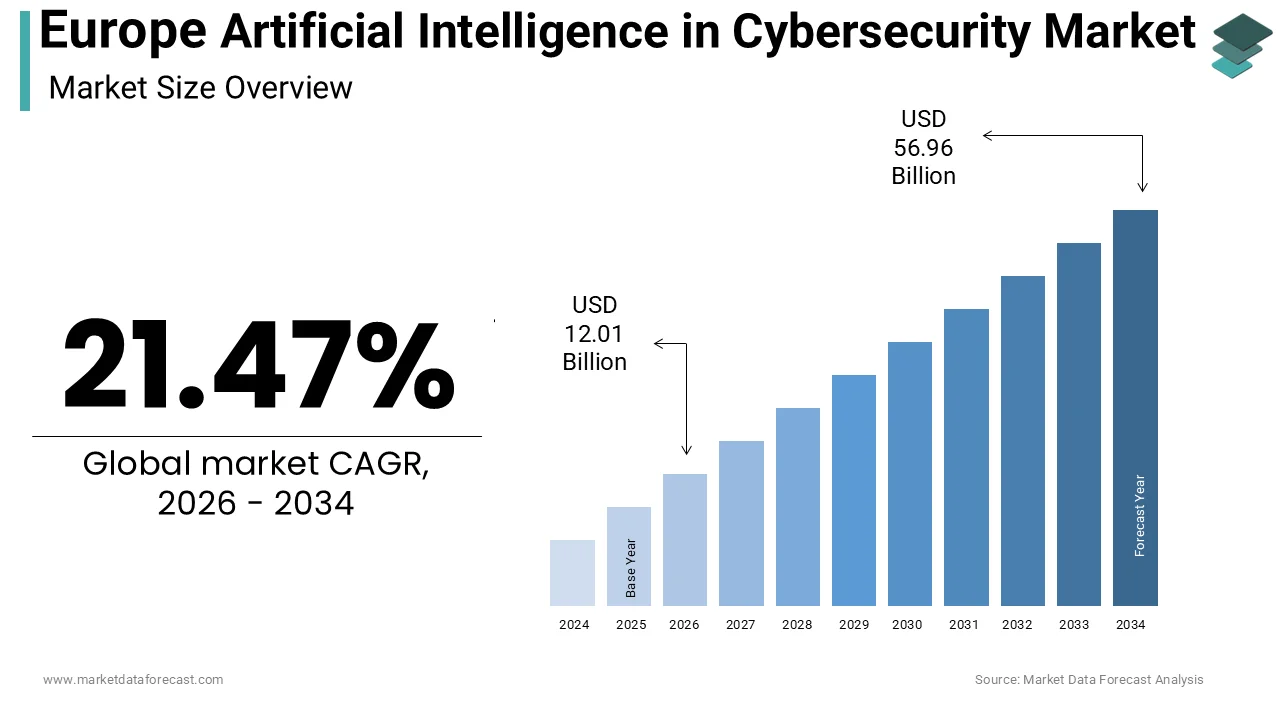
The Europe Artificial Intelligence in Cybersecurity market size was calculated to be USD 9.89 billion in 2025, is anticipated to be worth USD 12.01 billion in 2026, and is projected to reach USD 56.96 billion by 2034, growing at a compound annual growth rate (CAGR) of 21.47% during the forecast period from 2026 to 2034. Driven by escalating state-sponsored ransomware threats, acute cybersecurity professional shortages, rapid cloud migration, and tightening compliance mandates under the NIS2 Directive and EU AI Act, the regional market continues to experience phenomenal expansion.
Key Executive Metrics (At-a-Glance)
- 2025 Base Valuation: USD 9.89 Billion
- 2026 Current Valuation: USD 12.01 Billion
- 2034 Forecast Valuation: USD 56.96 Billion
- Compound Annual Growth Rate (CAGR): 21.47% (2026–2034)
- Dominant Security Type Segment: Network Security (commanding 41.7% of the European market share in 2025 due to critical infrastructure needs and DDoS defense)
- Fastest-Growing Security Type Segment: Cloud Security (projected to register the highest CAGR of 25.5% driven by multi-cloud workloads and misconfiguration management)
- Dominant Technology Segment: Machine Learning (leading with 66.7% market share in 2025 for mature threat signatures, fraud detection, and UEBA)
- Fastest-Growing Technology Segment: Deep Learning (estimated to expand at a CAGR of 30.3% to tackle polymorphic malware, zero-days, and GAN-based synthetic attacks)
- Dominant Country Market: United Kingdom (holding 23.5% of the regional market share in 2025 backed by startup ecosystems, financial hubs, and national strategies)
- Key Secondary Markets: Germany (industrial IoT & Industry 4.0 integration) and France (sovereign cybersecurity & quantum-resistant R&D)
Core Market Drivers
- Advanced Threat Sophistication: Surging ransomware variants and state-sponsored cyber attacks necessitating automated, machine-speed defense mechanisms.
- Skills Shortage Mitigation: Acute deficits in qualified cybersecurity personnel forcing organizations to deploy autonomous AI systems as operational force multipliers.
Primary Market Restraints & Challenges
- Regulatory Barriers: Strict data privacy compliance under GDPR limiting training data availability and high implementation costs for SMEs.
- Adversarial AI & Accountability: Data poisoning, evasion techniques, and a lack of standardized ethical guidelines under the EU AI Act complicating full automation.
Europe AI in Cybersecurity Market Segmentation Breakdown
| Segment Category | Leading Sub-Segment (Base/Current) | Fastest-Growing Sub-Segment |
|---|---|---|
| By Security Type | Network Security (41.7% share in 2025) | Cloud Security (25.5% CAGR) |
| By Technology | Machine Learning (66.7% share in 2025) | Deep Learning (30.3% CAGR) |
| By Region / Country | United Kingdom (23.5% share) & Germany | France & Netherlands (digital infrastructure expansion) |
Major Industry Players Profiled
Key enterprises shaping the European AI in cybersecurity market include Amazon Web Services Inc., IBM Corporation, Darktrace PLC, Fortinet Inc., BlackBerry Limited, Intel Corporation, RELX PLC, Micron Technology Inc., FireEye Inc., Acalvio Technologies Inc., Palo Alto Networks Inc., Cisco Systems Inc., Check Point Software Technologies Ltd., CyberArk Software Ltd., and Cybereason.
Europe Artificial Intelligence in Cybersecurity Market Size
The Europe Artificial Intelligence in Cybersecurity market size was calculated to be USD 9.89 billion in 2025 and is anticipated to be worth USD 56.96 billion by 2034, from USD 12.01 billion in 2026, growing at a CAGR of 21.47% during the forecast period.
Artificial intelligence in cybersecurity encompasses a sophisticated ecosystem of algorithmic tools and machine learning platforms designed to autonomously detect, analyse, and neutralize digital threats across critical infrastructure, corporate networks, and government systems. This sector leverages deep learning, natural language processing, and behavioral analytics to shift security paradigms from reactive containment to proactive prediction and automated response. According to the European Union Agency for Cybersecurity, large enterprises in the bloc experienced significant ransomware attacks in 2023, which indicates the urgent necessity for intelligent defense mechanisms that operate at machine speed. As per the European Commission, the continent faces a shortage of cybersecurity professionals, which drives the adoption of AI solutions to augment human capabilities and bridge the skills gap. Furthermore, as per Eurostat, European enterprises widely utilized cloud services in 2023, creating expansive attack surfaces that require continuous intelligent monitoring beyond human capacity. Unlike traditional signature-based antivirus software, these AI-driven systems learn from vast datasets to identify zero-day exploits and subtle anomalies indicative of advanced persistent threats. The definition extends to include regulatory compliance tools that automatically align security postures with the stringent requirements of the General Data Protection Regulation and the NIS2 Directive, ensuring that technological deployment supports legal obligations throughout the diverse digital landscape of the region.
MARKET DRIVERS
Escalating Sophistication of Ransomware and State-Sponsored Cyber Attacks
The rapidly evolving complexity of cyber threats, particularly ransomware variants and state-sponsored advanced persistent threats, is driving the growth of the European artificial intelligence in cybersecurity market. Traditional rule-based security systems fail to detect novel attack vectors that mutate in real time, necessitating adaptive defences capable of recognizing patterns invisible to human analysts. According to the European Union Agency for Cybersecurity, ransomware incidents in the European Union rose significantly in 2023, with attackers increasingly employing AI themselves to automate vulnerability scanning and evade detection. This arms race forces organizations to deploy defensive AI that can predict attack trajectories and isolate compromised systems within milliseconds before lateral movement occurs. As per the German Federal Office for Information Security, the critical infrastructure sector,s including energy and healthcare, faced a surge of targeted attacks in 2023, which is prompting massive investments in intelligent threat hunting platforms. The ability of machine learning models to analyse billions of events daily allows security teams to distinguish between benign anomalies and genuine malicious activity with high precision. Furthermore, the rise of double extortion tactics, where data is stolen before encryption, demands superior data loss prevention tools powered by AI to monitor exfiltration attempts. The existential nature of these threats, combined with the potential for catastrophic operational disruption, makes AI-driven cybersecurity an indispensable component of national and corporate security strategies throughout the continent.
Acute Shortage of Skilled Cybersecurity Professionals Drives Automation Demand
The severe deficit of qualified cybersecurity personnel across European nations creates an imperative demand for artificial intelligence solutions that can automate routine tasks and amplify the effectiveness of existing security teams, which is further propelling the regional market expansion. Organizations struggle to recruit and retain talent capable of managing complex security operations centers, leading to burnout and delayed incident response times that exacerbate breach impacts. According to the European Centre for the Development of Vocational Training, the European Union faces a significant shortfall of cybersecurity experts, a gap that is projected to widen as digital transformation accelerates. Artificial intelligence addresses this crisis by automating level one and level two security operations, such as log analysis, phishing detection, and initial triage, allowing human analysts to focus on strategic threat hunting and complex investigations. As per the International Information System Security Certification Consortium, a majority of European security leaders cite staff shortages as the primary barrier to effective defense, prompting accelerated deployment of autonomous response systems. These AI tools act as force multipliers, enabling small teams to manage vast networks and respond to thousands of alerts simultaneously without fatigue. Furthermore, the integration ofAI-drivenn training simulators helps upskill the existing workforce faster by providing realistic attack scenarios for practice. The economic reality that hiring enough humans to monitor every endpoint is impossible makes AI automation not just an option but a survival necessity for maintaining resilience against relentless cyber aggression.
MARKET RESTRAINTS
Stringent Data Privacy Regulations Under GDPR Limit Training Data Availability
The rigorous data protection standards mandated by the General Data Protection Regulation present a significant barrier to European artificial intelligence in the cybersecurity market. Machine learning algorithms require massive volumes of diverse data, including network traffic logs and user behavior patterns, to train accurately, yet GDPR imposes strict limitations on the collection, storage, and processing of personal data. According to the European Data Protection Board, organizations faced numerous formal investigations related to data processing violations in 2023, with potential fines creating a climate of caution. The requirement for data minimization and purpose limitation often conflicts with the need for comprehensive datasets to detect subtle anomalies, leading to models that may suffer from higher false positive rates or blind spots. As per the Centre for Information Policy Leadership, many European enterprises hesitate to share threat intelligence data with third-party AI vendors due to fears of non-compliance and reputational damage. Furthermore, the right to explanation mandates that automated decisions affecting individuals must be interpretable, which is challenging for complex deep learning models operating as black boxes. These regulatory complexities necessitate substantial investments in privacy-preserving technologies like federated learning and differential privacy, which increase implementation costs and time. Until clear guidelines emerge on balancing security needs with privacy rights, the regulatory friction will continue to moderate the pace of AI adoption in the cybersecurity sector.
High Implementation Costs and Complexity Deter Small and Medium-Sized Enterprises
The substantial financial investment and technical complexity required to deploy advanced artificial intelligence cybersecurity solutions are further hindering the expansion of the European artificial intelligence in cybersecurity market. Effective AI systems demand high-performance computing infrastructure, specialized software licenses, and ongoing maintenance by highly skilled personnel, resources that many smaller firms lack. According to the European Commission, small and medium-sized enterprises account for 99% of all businesses in the EU, yet many report that cost is the primary obstacle to adopting advanced cybersecurity measures. The total cost of ownership includes not only initial procurement but also continuous model retraining, integration with legacy systems, and energy consumption for data processing, which can be prohibitive for budget-constrained organizations. As per the European Small Business Alliance, only a minority of small businesses in Europe utilize AI-driven security tools, leaving them vulnerable to increasingly automated attacks that target weaker links in the supply chain. The complexity of configuring these systems to avoid disrupting normal business operations further discourages adoption, as errors can lead to costly downtime. Additionally, the scarcity of affordable managed security service providers offering AI capabilities limits access for smaller players. Without subsidized programs or simplified entry-level solutions, the digital divide in cybersecurity resilience will widen, leaving a significant portion of the European economic fabric exposed to sophisticated threats.
MARKET OPPORTUNITIES
Expansion of Zero Trust Architecture Frameworks Creates Demand for AI Verification
The widespread transition towards Zero Trust security architectures across European organizations is a lucrative opportunity for the European artificial intelligence in cybersecurity market. Zero Trust principles dictate that no user or device is trusted by default, requiring constant validation of identity and context, which generates massive data streams ideal for AI analysis. According to the European Union Agency for Cybersecurity, many large European enterprises initiated Zero Trust implementation projects in 2023, creating a pressing need for intelligent engines that can assess risk in real time. Artificial intelligence enables these frameworks by analysing behavioral biometrics, device health, and network context to make granular access decisions instantly without impeding productivity. As per the Cloud Security Alliance, organizations implementing AI-enhanced Zero Trust models reported a notable reduction in successful credential theft incidents compared to traditional perimeter defences. The opportunity lies in developing adaptive policies that evolve based on emerging threat intelligence and changing user behaviours automatically. Furthermore, the integration of AI with software-defined perimeters allows for micro-segmentation that isolates breaches before they spread. As regulatory pressure mounts under the NIS2 Directive for stricter access controls, the demand for AI-driven Zero Trust enablers will surge. Providers who can offer seamless integration with existing identity management systems will capture significant market share by enabling the practical realization of Zero Trust ideals.
Integration of Quantum-Resistant Cryptography with AI Defense Mechanisms
The impending threat of quantum computing to current encryption standards offers a strategic opportunity for European artificial intelligence in the cybersecurity market. As quantum computers advance, they pose a risk of breaking widely used cryptographic algorithms, necessitating a proactive shift to post quantum cryptography, which AI can help manage and optimize. According to the European Telecommunications Standards Institute, several European critical infrastructure operators have begun assessing their vulnerability to quantum attacks, prompting early investment in future-proof security solutions. Artificial intelligence plays a crucial role in this transition by identifying sensitive data assets that require immediate protection and optimizing the deployment of new cryptographic keys across complex networks. As per the European Commission, the flagship initiative on quantum technologies aims to secure European digital sovereignty, driving funding for research into AI-assisted cryptographic agility. The opportunity exists for vendors to offer hybrid solutions that use AI to monitor for harvest now, decrypt later attack,s where adversaries steal encrypted data today to decrypt it once quantum computers are available. Furthermore, AI can automate the testing and validation of new quantum-resistant algorithms, ensuring they function correctly without performance degradation. By positioning themselves at the forefront of this technological shift, cybersecurity firms can establish long-term contracts with governments and enterprises seeking to safeguard their digital assets against future existential threats.
MARKET CHALLENGES
Adversarial Artificial Intelligence Techniques Undermine Defensive Models
The emergence of adversarial artificial intelligence, where attackers use machine learning to poison data and evade detection, is a notable challenge to the expansion of European artificial intelligence in the cybersecurity market. Malicious actors are increasingly deploying AI to generate polymorphic malware that changes its code structure continuously or to craft inputs specifically designed to fool classification algorithms into marking threats as benign. According to the Joint Research Centre of the European Commission, studies indicate that standard machine learning models can be tricked into misclassifying adversarial samples if not specifically hardened against such attacks. This cat-and-mouse game forces defenders to constantly retrain models and develop robust verification mechanisms, increasing operational complexity and costs. As per the European Organisation for Cyber Security, the use of AI-generated deepfakes in social engineering attacks increased in 2023, bypassing traditional awareness training and exploiting human trust. The challenge is compounded by the lack of standardized benchmarks for testing AI resilience against adversarial techniques, leaving many deployments vulnerable to novel exploitation methods. Furthermore, the opacity of deep learning models makes it difficult to diagnose why a system failed to detect an adversarial attack, hindering rapid remediation. Until the industry develops universally accepted standards for adversarial robustness and explainable AI, the integrity of automated defense systems will remain a critical vulnerability.
Lack of Standardized Ethical Guidelines and Accountability Frameworks
The absence of harmonized ethical guidelines and clear accountability frameworks for artificial intelligence decision-making in cybersecurity is further challenging the growth of the European artificial intelligence in cybersecurity market. When an AI system autonomously blocks a legitimate business transaction or falsely accuses an employee of misconduct, determining liability becomes complex, especially under the strict provisions of the EU Artificial Intelligence Act. According to the European Group on Ethics in Science and New Technologies, many stakeholders express concern about the lack of transparency in how AI cybersecurity tools make critical decisions that impact individual rights and business continuity. The black box nature of many advanced algorithms makes it difficult to audit decisions or provide the explanations required by law, leading to potential legal disputes and regulatory penalties. As per the European Commission, the phased implementation of the AI Act introduces rigorous compliance requirements for high-risk systems, which many cybersecurity vendors are struggling to interpret and implement consistently. This ambiguity discourages some organizations from fully automating their security operations, fearing unintended consequences and reputational damage. Furthermore, the lack of cross-border recognition for ethical certifications complicates the deployment of pan-European security solutions. Until clear precedents are established and standardized auditing procedures are adopted, the fear of liability will continue to hinder the full realization of autonomous cybersecurity capabilities.
REPORT COVERAGE
| REPORT METRIC | DETAILS |
| Market Size Available | 2025 to 2034 |
| Base Year | 2025 |
| Forecast Period | 2026 to 2034 |
| CAGR | 21.47% |
| Segments Covered | By Security Type, Technology, And Region |
| Various Analyses Covered | Global, Regional & Country Level Analysis; Segment-Level Analysis; DROC, PESTLE Analysis; Porter’s Five Forces Analysis; Competitive Landscape; Analyst Overview of Investment Opportunities |
| Regions Covered | UK, France, Spain, Germany, Italy, Russia, Sweden, Denmark, Switzerland, Netherlands, Turkey, and the Czech Republic |
| Market Leaders Profiled | Amazon Web Services Inc., IBM Corporation, Darktrace PLC, Fortinet Inc., BlackBerry Limited, Intel Corporation, RELX PLC, Micron Technology Inc., FireEye Inc., Acalvio Technologies Inc., Palo Alto Networks Inc., Cisco Systems Inc., Check Point Software Technologies Ltd., CyberArk Software Ltd., Cybereason |
SEGMENTAL ANALYSIS
By Security Type Insights
The network security segment dominated the market by commanding for 41.7% of the European market share in 2025. The dominance of the network security segment in the European market is attributed to the critical need to protect the vast and complex data transmission pathways that connect European enterprises, government agencies, and critical infrastructure. The exponential increase in Distributed Denial of Service attacks that target network availability and require AI-driven traffic analysis to distinguish between legitimate spikes and malicious floods in real time is further contributing to the expansion of the network security segment in the regional market. According to the European Union Agency for Cybersecurity, DDoS attacks in the region rose significantly in 2023, with average attack durations extending due to their growing sophistication, necessitating automated mitigation systems that operate faster than human response times. The implementation of the NIS2 Directive that mandates stringent security measures for network and information systems across essential sectors, which is forcing organizations to upgrade legacy firewalls with intelligent intrusion detection and prevention systems, and is further aiding the expansion of the network security segment in the regional market. As per the German Federal Office for Information Security, many critical infrastructure operators in Europe deployed AI-enhanced network monitoring tools in 2023 to comply with new regulatory reporting requirements and ensure continuous service availability. The ability of these systems to learn normal traffic patterns and instantly isolate anomalies makes them indispensable for maintaining the integrity of continental digital communications. This regulatory pressure, combined with the escalating volume of network-based threats, solidifies network security as the cornerstone of the European market.
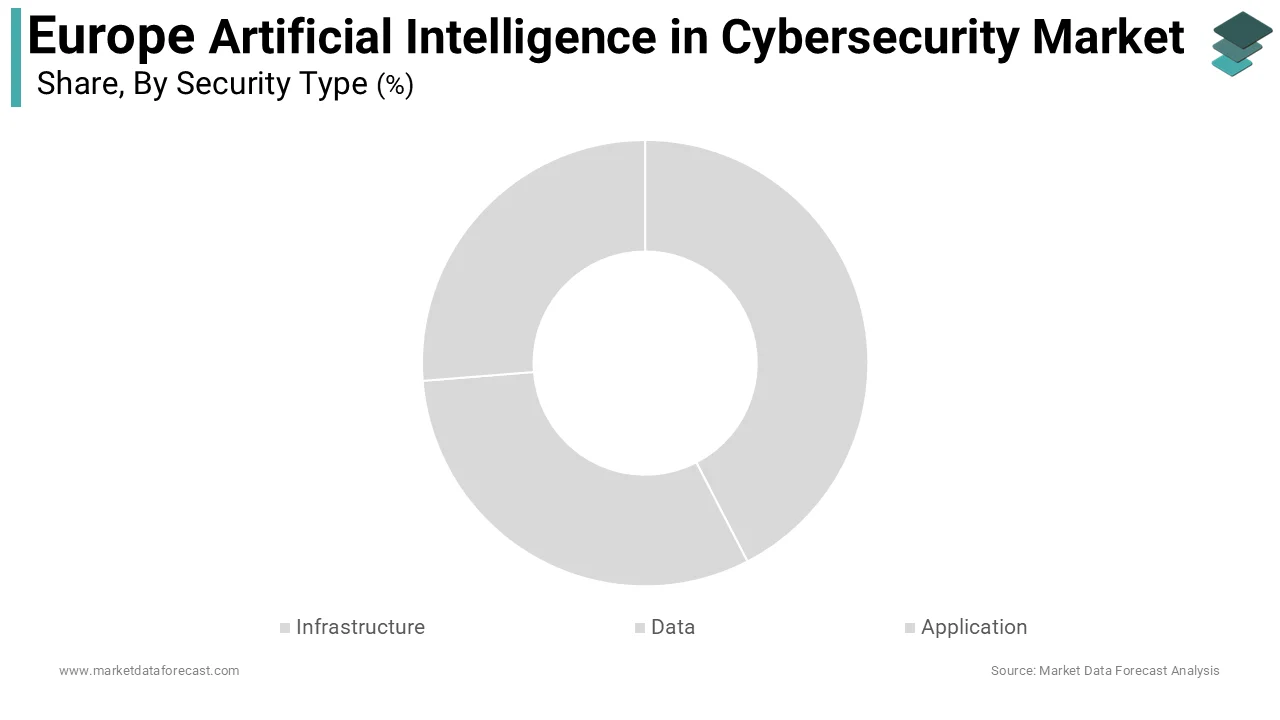
On the other hand, the cloud security segment is projected to register the highest CAGR of 25.5% in the European market over the forecast period and is making it the most rapidly expanding category within the market. This massive migration of European workloads to public and hybrid cloud environments, which has fundamentally altered the security perimeter and created new vulnerabilities requiring specialized AI protection, is primarily driving the growth of the cloud security segment in the European market. The widespread adoption of multi-cloud strategies by European enterprises, which creates fragmented visibility and complex configuration management challenges that traditional tools cannot address effectively, is further boosting the expansion of the cloud security segment in the European market. According to Eurostat, a large proportion of enterprises in the European Union utilized cloud computing services in 2023, leading to a surge in misconfiguration incidents that account for the majority of cloud breaches. Artificial intelligence solutions offer continuous posture management and automated remediation capabilities that scan vast cloud estates for deviations from security baselines instantly. The rise of serverless computing and containerization that demand dynamic security models capable of protecting ephemeral assets that exist only for minutes or seconds is also propelling the growth of the cloud security segment. As per the Cloud Security Alliance, many European organizations reported difficulties in securing containerized applications, prompting increased investment in AI-driven runtime protection platforms. These platforms use machine learning to establish behavioral baselines for microservices and detect lateral movement within cloud networks that signature-based tools miss. The convergence of rapid cloud adoption and the inadequacy of static defences positions cloud security as the leading growth engine for the continental market.
By Technology Insights
The machine learning segment led the market by capturing 66.7% of the regional market share in 2025 due to the maturity and versatility of machine learning algorithms in solving a wide array of security problems, ranging from fraud detection to malware classification, with proven reliability. The extensive use of supervised learning models for identifying known threat signatures and anomalies in user behavior, which forms the backbone of most Security Operations Center operations across the continent, is boosting the expansion of the machine learning segment in the regional market. According to the International Information System Security Certification Consortium, a majority of European security teams relied on machine learning based User and Entity Behavior Analytics to detect insider threats and compromised accounts in 2023. These models excel at processing structured log data from diverse sources to flag deviations from established norms, providing actionable alerts that reduce analyst fatigue. The integration of machine learning into existing security information and event management platforms that allow organizations to enhance their current investments without complete infrastructure overhauls is further favouring the growth of the machine learning segment in the regional market. As per the European Technology Platform for Secure Digital Society, institutions utilizing ML-enhanced SIEM solutions reported notable improvements in mean time to detect incidents compared to rule-based systems. The ability of these algorithms to continuously improve their accuracy through feedback loops makes them highly adaptable to evolving threat landscapes. Furthermore, the availability of pre-trained models from major vendors lowers the barrier to entry, enabling smaller organizations to benefit from advanced analytics. This combination of operational effectiveness, ease of integration, and continuous learning ensures that machine learning remains the dominant technological force in European cybersecurity.
However, the deep learning segment is estimated to expand at a CAGR of 30.3% over the forecast period in the European market, positioning it as the fastest-growing category within the market. The increasing complexity of cyber threats, particularly polymorphic malware and sophisticated phishing campaigns that require deeper analytical capabilities than traditional machine learning can provide, is driving the expansion of the deep learning segment in the European market. The superior ability of Convolutional Neural Networks to analyse unstructured data, such as images and code binaries, for detecting obfuscated malware that changes its appearance to evade signature detection, is further boosting the growth of the deep learning segment in the European market. According to the Joint Research Centre of the European Commission, deep learning models demonstrated strong accuracy in identifying zero-day malware variants in 2023, which is significantly outperforming conventional methods in controlled tests. The emergence of Generative Adversarial Networks that are being dual used by defenders to generate synthetic attack data for training more robust defense systems and simulating realistic threat scenarios is further contributing to the segmental expansion in the European market. As per the European Organisation for Cyber Security, the adoption of GANs for adversarial training increased in 2023 as organizations sought to harden their systems against AI-powered attacks. These technologies enable the automation of complex tasks such as natural language processing for analyzing dark web communications and predicting attacker intent. The need to counteract AI-driven offensive tools with equally advanced defensive algorithms creates a compelling demand for deep learning solutions. This technological arms race ensures that deep learning will continue to capture an increasing market share as the frontier of cyber defense innovation.
REGIONAL ANALYSIS
United Kingdom Artificial Intelligence in Cybersecurity Market Analysis
The United Kingdom maintained the leading position in the Europe artificial intelligence in cybersecurity market by holding 23.5% of the regional market share in 2025. The dominance of the UK in the European market is driven by the nation's robust ecosystem of cybersecurity startups, world-class research institutions, and proactive government strategies that foster innovation in digital defense. The UK market is characterized by high levels of adoption across the financial services and government sectors, and is driven by the National Cyber Strategy, which prioritizeAI-drivenen threat detection capabilities. According to the Department for Science, Innovation, and Technology, the UK government made significant investments in cybersecurity research and development initiatives in 2023, reinforcing its commitment to maintaining global leadership in the field. The presence of major technology hubs in London, Manchester, and Cambridge attracts substantial venture capital funding, with billions invested in UK cybersecurity companies in 2023. Furthermore, the establishment of the National Cyber Force provides strategic direction and operational capabilities that encourage private sector collaboration on advanced AI projects. The nation's strong legal framework for data protection, combined with active participation in shaping global cybersecurity standards, creates a favorable environment for solution providers. Additionally, the collaboration between academia and industry through initiatives like the Alan Turing Institute accelerates the translation cutting-edgedge research into practical security tools. This synergy of policy support, financial investment, and intellectual capital solidifies the United Kingdom's status as the premier market for artificial intelligence in cybersecurity in Europe.
Germany Artificial Intelligence in Cybersecurity Market Analysis
Germany occupied the second-largest position in the Europe artificial intelligence in cybersecurity market in 2025 due to the nation's industrial strength and rigorous approach to data sovereignty. This standing stems from the aggressive integration of AI security solutions into the manufacturing and automotive sectors as part of the Industry 4.0 initiative, which seeks to digitize production while ensuring resilience against cyber espionage. According to the Federal Ministry of the Interior and Community, German critical infrastructure operators allocated substantial funding to AI-driven cybersecurity projects in 2023, focusing on protecting supply chains and intellectual property. The market status is defined by a strong preference for on-premises and hybrid solutions that guarantee data remains within national borders, complying with strict privacy regulations. Furthermore, the German government's IT Security Act 2.0 mandates enhanced security measures for critical sectors, driving demand for automated compliance and threat monitoring tools. As per the German Federal Office for Information Security, cyber incidents in the industrial sector increased in 2023, prompting urgent upgrades to defensive capabilities. The nation's emphasis on engineering excellence drives demand for highly reliable and precise AI systems that minimize false positives. Additionally, the shortage of skilled security professionals motivates companies to adopt autonomous response systems to bridge the gap. This combination of industrial necessity, regulatory pressure, and technological precision positions Germany as a critical growth engine for the continental market.
France Artificial Intelligence in Cybersecurity Market Analysis
France is anticipated to account for a promising share of the European artificial intelligence in cybersecurity market during the forecast period, owing to the ambitious national strategies and significant public investment. This position reflects the French government's determination to establish the country as a European hub for digital sovereignty and cybersecurity innovation through comprehensive policy frameworks and funding programs. The market status is characterized by strong adoption in the defense, energy, and transportation sectors, driven by state-led initiatives to protect critical national assets from foreign interference. According to the French National Agency for the Security of Information Systems, the government committed substantial funding to cybersecurity research and startup incubation in 2023, supporting the development of indigenous AI security technologies. The establishment of dedicated cybersecurity clusters in Paris, Rennes, and Grenoble fosters collaboration between researchers and enterprises, accelerating the deployment of advanced threat intelligence platforms. Furthermore, the France 2030 investment plan prioritizes the development of quantum-resistant cryptography and AI-driven defense mechanisms, ensuring long term security resilience. As per the French Tech association, the number of cybersecurity startups in France grew significantly in 2023, attracting international investment. The focus on sovereign capabilities also drives demand for local solution providers who can guarantee data residency and adherence to national security standards. Additionally, the integration of cybersecurity into the national education curriculum prepares a future workforce capable of leveraging these technologies effectively. This strategic alignment of government policy, industrial ambition, and educational reform positions France as a pivotal market for artificial intelligence in cybersecurity growth.
Netherlands Artificial Intelligence in Cybersecurity Market Analysis
The Netherlands is expected to exhibit a healthy CAGR in the European artificial intelligence in cybersecurity market over the forecast period, owing to its advanced digital infrastructure and progressive regulatory environment. This standing reflects the nation's role as a gateway to Europe, with world-class connectivity and a highly digitized economy that facilitates rapid adoption of cloud-based AI security services. The market status is defined by strong uptake in the logistics, finance, and technology sectors, where AI optimizes threat detection and enhances resilience against sophisticated attacks. According to the Netherlands Enterprise Agency, many Dutch financial institutions utilized AI-driven fraud detection and anomaly monitoring systems in 2023, resulting in reductions in financial losses and operational disruptions. The government's National Cybersecurity Strategy provides clear guidance on risk management and encourages public-private partnerships to develop innovative security solutions. Furthermore, the presence of major data centers operated by global cloud providers ensures low latency and high availability for AI security applications serving the entire region. As per Statistics Netherlands, the country achieved one of the highest cloud adoption rates among businesses in 2023, creating a vast surface area for AI protection. This mature digital ecosystem is complemented by a strong tradition of international collaboration that drives innovation in cross-border threat intelligence sharing. Additionally, the country's open approach to testing new technologies attracts multinational corporations seeking to deploy and validate AI security solutions in a supportive environment. This convergence of infrastructure readiness, sectoral specialization, and collaborative culture positions the Netherlands as a dynamic market for artificial intelligence in cybersecurity.
Sweden Artificial Intelligence in Cybersecurity Market Analysis
Sweden is anticipated to record a steady CAGR in the European artificial intelligence in cybersecurity market during the forecast period, owing to the nation's reputation for innovation and commitment to sustainability. This position stems from the deep integration of AI security into the Swedish welfare system and green technology sectors, aiming to protect critical societal functions and achieve climate goals securely. The market status is characterized by early adoption of ethical AI frameworks and a strong emphasis on using technology for social good and resilient infrastructure protection. According to the Swedish Civil Contingencies Agency, many municipal services in Sweden were enhanced by AI-driven security tools in 2023, improving efficiency and safeguarding citizen data against breaches. The nation's robust research ecosystem, centred around universities and institutes like the Wallenberg AI Autonomous Systems and Software Program, drives cutting-edge developments in cybersecurity algorithms. Furthermore, the Swedish government's national approach to AI emphasizes transparency, fairness, and accountability, setting a benchmark for responsible deployment in security operations. As per the Swedish Investment Trade Agency, venture capital investment in Swedish cybersecurity startups reached record levels in 2023, with a focus on privacy-enhancing technologies and secure AI. The high level of digital literacy among the population and widespread broadband access facilitate the seamless adoption of AI security solutions across various demographics. Additionally, the collaboration between Nordic countries creates a larger addressable market for Swedish providers, expanding their reach beyond national borders. This blend of ethical leadership, research excellence, and societal focus positions Sweden as a unique and influential market for artificial intelligence in cybersecurity in Europe.
COMPETITION OVERVIEW
The competition in the Europe artificial intelligence in cybersecurity market is characterized by intense rivalry between established global giants and agile specialized startups vying for dominance through technological superiority and regulatory compliance. Multinational corporations leverage their extensive resources and broad product ecosystems to offer integrated suites that appeal to large enterprises seeking consolidated security management. Meanwhile, European-based firms differentiate themselves by emphasizing strict adherence to General Data Protection Regulation standards and developing sovereign AI solutions that guarantee data residency within the continent. The market witnesses rapid innovation cycles as vendors race to incorporate generative AI and autonomous response capabilities that can counteract increasingly sophisticated adversarial machine learning techniques. Price competition is moderate since buyers prioritize effectiveness, reliability, and legal compliance over cost alone, given the high stakes of cyber breaches. Strategic collaborations with government bodies and critical infrastructure operators are common as companies seek to validate their technologies in high-risk environments. Customer retention strategies focus on delivering measurable outcomes through reduced dwell times and false positive rates while providing transparent explainability for AI-driven decisions. The evolving regulatory landscape further intensifies competition as firms strive to demonstrate alignment with the EU Artificial Intelligence Act and NIS2 Directive.
KEY MARKET PLAYERS
A few major players of the Europe artificial intelligence in cybersecurity market include
- Amazon Web Services Inc
- IBM Corporation
- Darktrace PLC
- Fortinet Inc
- BlackBerry Limited
- Intel Corporation
- RELX PLC
- Micron Technology Inc
- FireEye Inc
- Acalvio Technologies Inc
- Palo Alto Networks Inc
- Cisco Systems Inc
- Check Point Software Technologies Ltd
- CyberArk Software Ltd
- Cybereason
Top Strategies Used by Key Market Participants
Key players in the Europe artificial intelligence in cybersecurity market primarily focus on strategic acquisitions of niche AI startups to rapidly integrate advanced capabilities like behavioral analytics and automated response into their existing portfolios. Companies invest heavily in establishing local research and development centers to create region-specific threat models that comply with European data privacy regulations and address local attack vectors. Product differentiation through unified platforms that consolidate network endpoint and cloud security under a single AI-driven interface allows vendors to reduce operational complexity for clients. Continuous innovation in generative AI enables providers to offer proactive threat hunting and realistic simulation tools that prepare organizations for emerging attack methodologies. Additionally, emphasis on managed services partnerships helps vendors extend their reach to smaller businesses that lack internal expertise while ensuring consistent revenue streams through subscription models.
Leading Players in the Market
- Darktrace stands as a pioneering force in the Europe artificial intelligence in cybersecurity market with its self-learning AI technology that detects and responds to cyber threats in real time. The company contributes globally by offering an autonomous response capability that mimics human intuition to neutralize attacks across cloud email and industrial environments. Recent actions include launching Darktrace HEAL, which uses AI to simulate attack scenarios and improve organizational resilience without disrupting operations. Darktrace has also expanded its presence in critical infrastructure sectors across Europe by partnering with government agencies to protect national assets. These initiatives strengthen its market position by demonstrating the practical value of autonomous AI in complex and regulated environments while adhering to strict European data sovereignty standards.
- Palo Alto Networks operates as a global leader in cybersecurity,y delivering advanced artificial intelligence-driven platforms that secure networks, clouds, and endpoints for European enterprises. The company contributes to the global market through its Cortex XDR solution, which uses machine learning to correlate data across multiple security domains for faster threat detection. Recent actions involve the acquisition of Talon Cyber Security to enhance its zero-trust architecture and integrateAI-basedd browser isolation capabilities for European customers. Palo Alto Networks has also established dedicated research centers in Europe to develop localized AI models that address regional threat landscapes and compliance requirements. These strategic moves reinforce its position by providing comprehensive integrated security suites that reduce complexity and improve defense efficacy for large-scale organizations operating within the continent.
- Sophos serves as a key player in the Europe artificial intelligence in cybersecurity market, specializing in managed detection and response services powered by deep learning algorithms. The company contributes globally by protecting smalland medium-sizedd enterprises as well as large corporations through its synchronized security approach that shares threat intelligence between endpoints and firewalls. Recent actions include the release of Sophos Central Air, which leverages AI to automate wireless network security and detect rogue access points instantly. Sophos has also invested heavily in expanding its Managed Threat Response team in Europe to provide 24/7 human expertise backed by AI insights. These efforts solidify its market position by offering accessible yet sophisticated security solutions that bridge the skills gap and ensure rapid incident containment for diverse customer bases across the region.
MARKET SEGMENTATION
This research report on the Europe artificial intelligence in cybersecurity market has been segmented and sub-segmented based on security type, technology & region.
By Security Type
- Infrastructure
- Network
- Endpoint
- Cloud
- Data
- Application
By Technology
- ML
- Deep Learning
- CNN
- GAN
- Context-Aware Computing
By Region
- UK
- France
- Spain
- Germany
- Italy
- Russia
- Sweden
- Denmark
- Switzerland
- Netherlands
- Turkey
- Czech Republic
- Rest of Europe