Europe Auto Spare Parts Market Size, Share, Trends & Growth Forecast Report, Segmented By Vehicle Type (Passenger Cars, Commercial Vehicles), Replacement Parts, Distribution Channel And Country (UK, France, Spain, Germany, Italy, Russia, Sweden, Denmark, Switzerland, Netherlands, Turkey, Czech Republic & Rest Of Europe) - Industry Analysis From (2026 To 2034)
Market Size, 2025
$106.89 BnMarket Estimate, 2026
$110.29 BnMarket Forecast, 2034
$141.68 BnCAGR, 2026–2034
3.18%Europe Auto Spare Parts Market Report Summary
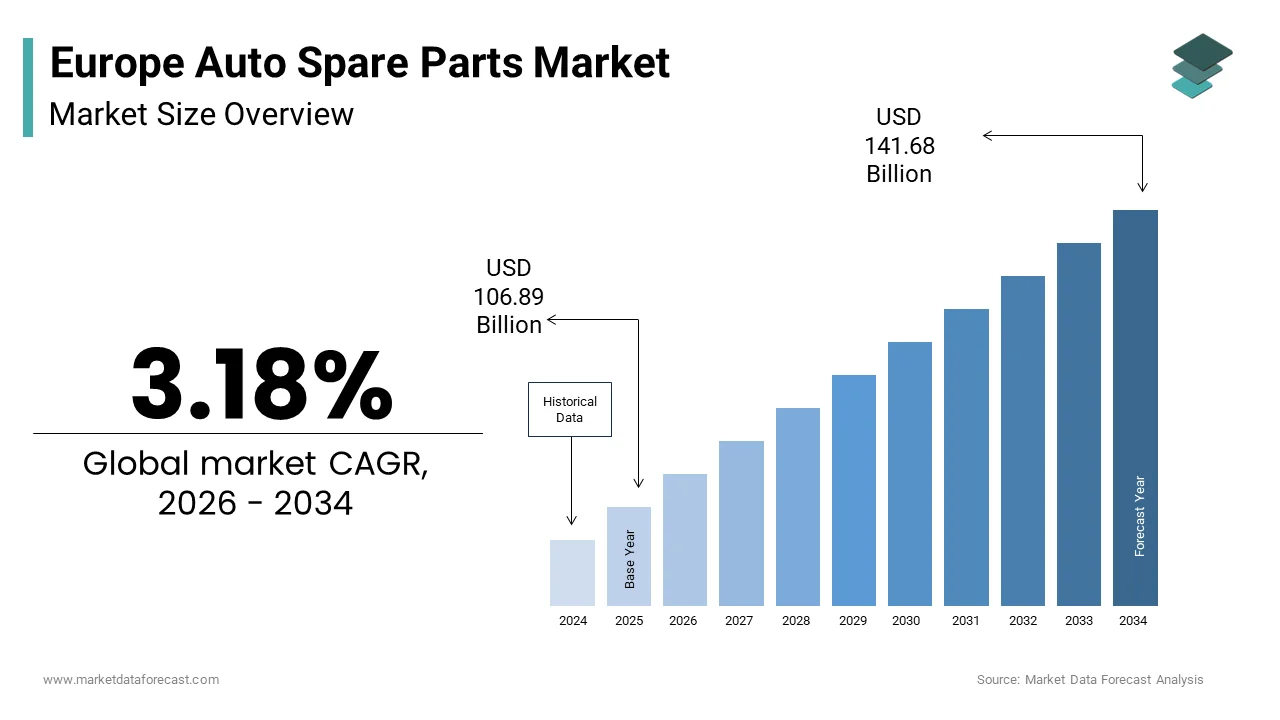
The Europe auto spare parts market size was valued at USD 106.89 billion in 2025, is estimated to reach USD 110.29 billion in 2026, and is projected to reach USD 141.68 billion by 2034, growing at a CAGR of 3.18% during the forecast period. The growth of the Europe auto spare parts market is driven by the region’s large vehicle fleet, increasing average vehicle age, and the rising need for regular maintenance and component replacement. Growing consumer preference for vehicle longevity, expansion of the automotive aftermarket industry, and the increasing adoption of advanced automotive technologies are further supporting market growth. Additionally, the expansion of e-commerce platforms for automotive components and the growing network of independent repair workshops are enhancing the availability and accessibility of spare parts across Europe.
Key Market Trends
- Rising demand for replacement auto parts due to the increasing average age of vehicles across European countries.
- Growing adoption of online automotive parts marketplaces and digital distribution platforms.
Increasing demand for high-performance and durable automotive components for improved vehicle efficiency and safety. - Expansion of independent garages and aftermarket service providers across Europe.
Rising focus on sustainability and circular economy initiatives, encouraging repair, refurbishment, and recycling of automotive components.
Segmental Insights
- Based on vehicle type, the passenger cars segment accounted for a significant share of the Europe auto spare parts market in 2025. The segment’s growth is driven by the large passenger vehicle fleet in Europe and the increasing need for regular maintenance and replacement parts.
- Based on replacement parts, the tire & wheels segment was the largest by accounting for 32.3% of the Europe auto spare parts market share in 2025. Tires and wheels require frequent replacement due to wear and tear, road conditions, and safety regulations.
- Based on distribution channel, the wholesalers & distributors segment held the largest share of 55.6% of the Europe auto spare parts market in 2025. The segment’s dominance is attributed to strong supply chain networks that connect manufacturers with repair shops, retailers, and service centers.
Regional Insights
- Germany was the largest contributor to the Europe auto spare parts market by accounting for 24.3% of the regional market share in 2025, supported by its strong automotive manufacturing industry, large vehicle fleet, and well-established aftermarket ecosystem.
- France is expected to witness steady growth due to its large vehicle parc, extensive network of independent garages, and strong government support for the right-to-repair movement.
- The United Kingdom is projected to maintain consistent market growth driven by a mature automotive culture and regulatory frameworks emphasizing vehicle safety and roadworthiness.
- Italy is experiencing growing demand for auto spare parts due to its passionate car culture, a large fleet of aging vehicles, and the strong presence of independent repair services.
- Spain is anticipated to record healthy growth as it remains a key automotive manufacturing hub and a major tourism destination, which increases vehicle usage and maintenance requirements.
Competitive Landscape
The Europe auto spare parts market is highly competitive and characterized by the presence of global automotive component manufacturers and specialized aftermarket suppliers. Companies are focusing on product innovation, expansion of distribution networks, and the development of technologically advanced automotive components to strengthen their market position. Strategic partnerships with automotive manufacturers and service providers are also helping companies expand their reach across the European aftermarket ecosystem.
Key companies operating in the Europe auto spare parts market include Robert Bosch GmbH, Continental AG, ZF Friedrichshafen AG, Valeo SA, Denso Corporation, Schaeffler AG, MAHLE GmbH, HELLA GmbH & Co. KGaA, Brembo S.p.A, SKF Group, Tenneco Inc, Faurecia SE, BorgWarner Inc, Magneti Marelli S.p.A, and Delphi Technologies PLC
Europe Auto Spare Parts Market Size
The Europe auto spare parts market size was calculated to be USD 106.89 billion in 2025 and is anticipated to be worth USD 141.68 billion by 2034, from USD 110.29 billion in 2026, growing at a CAGR of 3.18% during the forecast period.
The auto spare parts are an extensive ecosystem responsible for manufacturing, distributing, and retailing components required to maintain, repair, and upgrade motor vehicles across the continent. The intrinsically linked to the aging profile of the European vehicle parc and the increasing complexity of automotive engineering. According to the European Automobile Manufacturers Association, the average age of passenger cars in the European Union reached 12.3 years in 2023, representing a historic high that directly correlates with increased frequency of component failure and replacement needs. As per the European Commission, road transport accounts for approximately 71% of all inland freight movement, placing immense pressure on commercial vehicle fleets to minimize downtime through efficient spare parts availability. The shift toward electrification further complicates the landscape, as traditional mechanical parts face obsolescence while demand for high-voltage batteries and electronic sensors surges. This environment transforms the spare parts sector into a strategic asset for mobility continuity, where supply chain resilience determines the operational viability of the entire transport network.
MARKET DRIVERS
Aging Vehicle Parc Driving Replacement Frequency
The unprecedented aging of the vehicle fleet, which forces owners to invest heavily in repairs to extend the usable life of their assets rather than purchasing new replacements, is majorly propelling the growth of Europe auto spare parts market. High inflation and elevated interest rates have made new vehicle acquisition prohibitively expensive for many consumers and small fleet operators, leading to a deliberate strategy of maintaining older cars. According to the European Automobile Manufacturers Association, the number of vehicles older than 10 years now represents over 40% of the total passenger car fleet in the European Union, a figure that has risen steadily for a decade. Data from national registration authorities shows that the average mileage of these aging vehicles exceeds 150000 kilometers, a threshold where components such as suspension systems, braking units, and transmission parts require frequent replacement. This trend creates a structural demand for wear-and-tear parts that is largely immune to economic downturns, as safety regulations mandate that all vehicles on the road must meet strict technical inspection standards. As per the European Road Transport Safety Framework, vehicles failing periodic technical inspections due to worn parts must be repaired immediately to remain legal, compelling owners to purchase necessary spares.
Regulatory Mandates for Safety and Emissions Compliance
The stringent regulatory environment, which mandates regular safety inspections and emissions compliance, forcing vehicle owners to replace specific parts to avoid fines or deregistration, is another attribute propelling the growth of Europe auto spare parts market. The European Union enforces rigorous periodic technical inspections under Directive 2014/45/EU, which requires detailed checks on braking systems, steering mechanisms, and emission control devices, necessitating the replacement of non-compliant components. According to the European Commission, over 20% of vehicles inspected across the EU initially fail these mandatory tests, with defects in brakes and tires being the most common reasons, driving immediate demand for certified spare parts. Data from the International Motor Vehicle Inspection Committee indicates that the rejection rate for heavy-duty commercial vehicles is even higher, often exceeding 30% due to the intense usage patterns of logistics fleets. This regulatory scrutiny extends to emissions systems, where the Real Driving Emissions tests require functioning diesel particulate filters and selective catalytic reduction systems, prompting owners to replace faulty sensors and injectors to meet legal limits. Consequently, the need to maintain legal operability acts as a powerful non-discretionary demand driver by ensuring a consistent flow of revenue for manufacturers of safety-critical and emissions-related components, regardless of broader consumer sentiment.
MARKET RESTRAINTS
Proliferation of Counterfeit Components Undermining Trust
The widespread proliferation of counterfeit and substandard components, eroding consumer trust and posing severe safety risks, is hampering the growth of Europe auto spare parts market. The high margins associated with branded parts have incentivized criminal networks to produce low-quality replicas that often fail prematurely or cause catastrophic vehicle failures. According to the European Union Intellectual Property Office, the trade in counterfeit auto parts costs the European economy over 2 billion euros annually and accounts for approximately 8% of all seized counterfeit goods at EU borders. Data from customs enforcement agencies reveals that thousands of containers containing fake brake pads, airbags, and steering components are intercepted each year, yet a significant volume still enters the supply chain through unauthorized online marketplaces and unregulated workshops. This prevalence of fake goods discourages vehicle owners from seeking repairs due to fear of receiving inferior products, potentially delaying essential maintenance and reducing overall market activity. Furthermore, the difficulty in distinguishing high-quality fakes from genuine articles complicates the efforts of legitimate distributors, forcing them to invest heavily in authentication technologies and brand protection measures, which increase operational costs and squeeze profit margins in an already competitive landscape.
Supply Chain Fragmentation and Raw Material Volatility
The persistent fragmentation of the supply chain, coupled with extreme volatility in raw material prices, which disrupts production schedules and inflates costs, is also limiting the growth of Europe auto spare parts market. The industry relies heavily on a complex global network for essential inputs such as steel, aluminum, rare earth metals for electronics, and semiconductor chips, all of which have experienced significant price swings and availability issues in recent years. According to the studies, producer prices for intermediate goods in the manufacturing sector fluctuated by over 25% in 2023 alone, making cost forecasting nearly impossible for spare parts manufacturers. This instability forces distributors to hold higher inventory levels as a buffer, tying up capital and increasing storage costs, while ultimately passing higher prices onto consumers, which can dampen demand. As per analysis by logistics consultancies, the reliance on single-source suppliers for certain specialized components creates brittle supply chains where a disruption in one region can halt production lines across Europe.
MARKET OPPORTUNITIES
Expansion of E-Commerce Platforms for Direct-to-Consumer Sales
The rapid expansion of specialized e-commerce platforms that connect manufacturers and distributors directly with professional mechanics and do-it-yourself consumers is solely to create new opportunities for the growth of Europe auto spare parts market. The shift toward digital procurement allows buyers to access a vastly wider range of parts, compare prices instantly, and utilize advanced vehicle identification tools to ensure perfect fitment, overcoming the limitations of physical inventory in local stores. Data from major online marketplaces indicates that over 45% of independent garages now source at least half of their spare parts through digital channels to reduce costs and improve delivery speed. This digitalization enables smaller distributors to reach a pan-European audience without the need for extensive physical networks, democratizing access to the market. The integration of artificial intelligence for predictive part recommendations and augmented reality for installation guidance is further enhancing the online buying experience by reducing return rates and increasing customer confidence. Furthermore, the rise of same-day delivery services in urban centers addresses the urgent need for parts in professional repair scenarios, making online channels increasingly viable for time-sensitive jobs.
Growth of the Independent Aftermarket Due to Right to Repair
The strengthening of the "Right to Repair" legislation across the European Union by leveling the playing field between authorized dealer networks and the independent aftermarket. This factor is attributed to leveraging the growth of Europe auto spare parts market. New regulations mandate that vehicle manufacturers provide independent repairers and parts distributors with equal access to technical information, diagnostic tools, and original spare parts, breaking the monopoly previously held by official service centers. According to the European Commission, these measures are designed to foster competition and reduce repair costs for consumers, potentially expanding the addressable market for independent spare parts suppliers by billions of euros annually. The legal experts in automotive regulation, the requirement for standardized data formats, and fair pricing for information access remove significant barriers to entry by allowing innovative startups and established independents to flourish.
MARKET CHALLENGES
Complexity of Integrating Advanced Electronics in Legacy Fleets
The escalating complexity of integrating advanced electronic systems and software updates into the existing legacy fleet of vehicles is one of the challenges for the growth of Europe auto spare parts market. Modern automobiles are increasingly becoming software-defined machines, where mechanical failures are often intertwined with electronic glitches, requiring specialized diagnostic equipment and proprietary software access that many independent repair shops lack. According to the European Association of Automotive Suppliers, the amount of software code in a new premium vehicle now exceeds 100 million lines, dwarfing the complexity of previous generations and making troubleshooting exponentially more difficult. Data from technical training institutes reveals that over 50% of independent mechanics feel inadequately trained to handle high-voltage systems and complex sensor networks found in modern hybrids and electric vehicles. The availability of physical spare parts is rendered useless without the corresponding technical expertise and digital tools to install and calibrate them correctly. As per the European Commission's assessment of the aftermarket sector, the lack of standardization in diagnostic interfaces and the restriction of certain software functions to authorized dealers hinder the ability of the broader market to service newer vehicles effectively.
Environmental Regulations on Disposal and Recycling of Parts
The increasingly stringent environmental regulations governing the disposal, recycling, and remanufacturing of end-of-life vehicle components are another challenging factor for the growth of Europe auto spare parts market. The European Green Deal and the Circular Economy Action Plan impose strict targets for material recovery and waste reduction, compelling parts manufacturers and distributors to adopt costly reverse logistics systems and eco-friendly production methods. According to the European Environment Agency, the automotive sector generates millions of tonnes of waste annually, and new rules require that waste be recycled or reused, placing a heavy administrative and financial burden on market participants. Data from industry compliance bodies indicates that the cost of adhering to these new environmental standards can increase operational expenses for small and medium-sized enterprises involved in parts distribution and remanufacturing. Furthermore, restrictions on the use of certain hazardous substances in new and replacement parts force manufacturers to reformulate products, often at a higher cost and with longer development cycles. As per the European Commission's End-of-Life Vehicle Directive revisions, producers are increasingly held responsible for the entire lifecycle of their products, including the collection and treatment of used parts, which requires significant investment in infrastructure.
REPORT COVERAGE
| REPORT METRIC | DETAILS |
| Market Size Available | 2025 to 2034 |
| Base Year | 2025 |
| Forecast Period | 2026 to 2034 |
| CAGR | 3.18% |
| Segments Covered | By Vehicle Type, Replacement Parts, Distribution Channel, And Region |
| Various Analyses Covered | Global, Regional & Country Level Analysis; Segment-Level Analysis; DROC, PESTLE Analysis; Porter’s Five Forces Analysis; Competitive Landscape; Analyst Overview of Investment Opportunities |
| Regions Covered | UK, France, Spain, Germany, Italy, Russia, Sweden, Denmark, Switzerland, Netherlands, Turkey, and the Czech Republic |
| Market Leaders Profiled | Robert Bosch GmbH, Continental AG, ZF Friedrichshafen AG, Valeo SA, Denso Corporation, Schaeffler AG, MAHLE GmbH, HELLA GmbH & Co. KGaA, Brembo S.p.A., SKF Group, Tenneco Inc., Faurecia SE, BorgWarner Inc., Magneti Marelli S.p.A., Delphi Technologies PLC |
SEGMENTAL ANALYSIS
By Vehicle Type Insights
The passenger cars segment accounted for a significant share of the Europe auto spare parts market in 2025, owing to the sheer volume of passenger vehicles in circulation compared to commercial fleets, creating a massive installed base that continuously generates demand for maintenance and repair components. The high density of private vehicle ownership across the continent, where personal mobility remains the preferred mode of transport for the majority of the population. According to the European Automobile Manufacturers Association, there are over 290 million passenger cars currently registered in the European Union, a figure that dwarfs the commercial vehicle fleet by a ratio of more than six to one. The aging profile of these vehicles, as economic pressures have led consumers to retain their cars for longer periods, thereby increasing the frequency of part replacements. Furthermore, the diversity of the passenger car parc, ranging from compact city cars to large SUVs, necessitates a vast and varied inventory of spare parts, ensuring constant activity across all distribution channels.
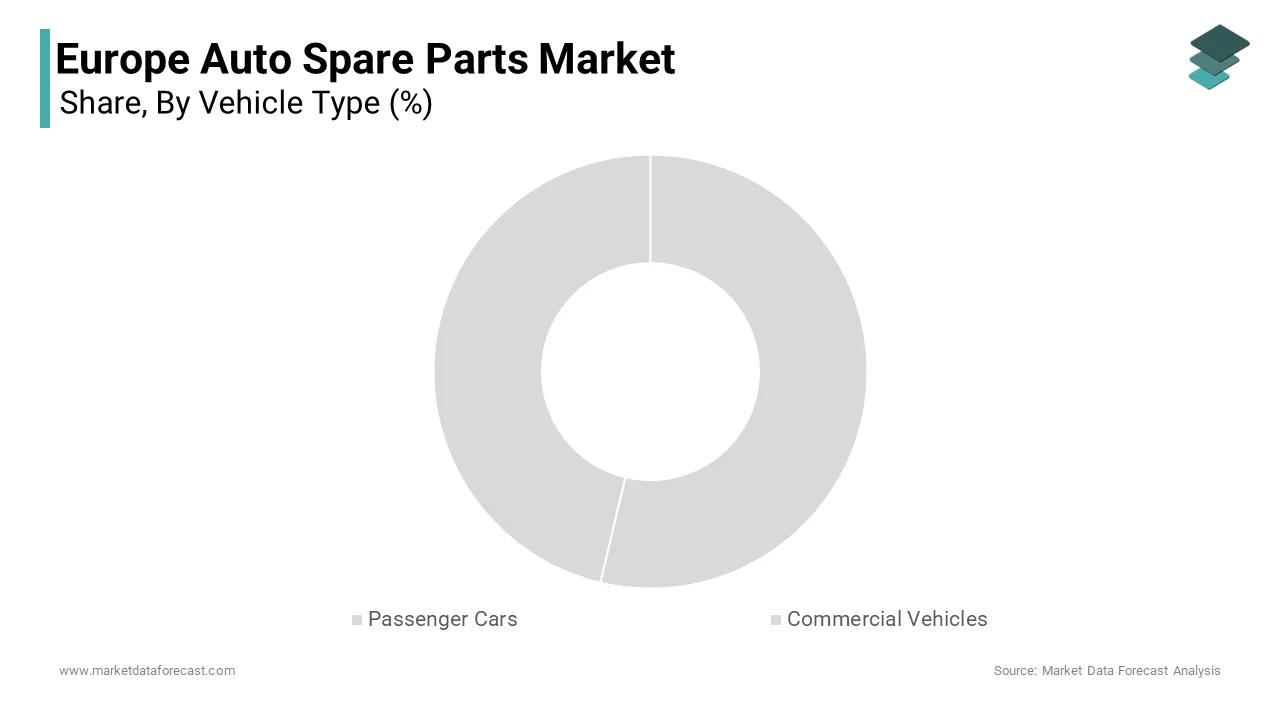
The commercial vehicles segment is projected to register the fastest CAGR of 6.5% during the forecast period. The growth of the segment is driven by the e-commerce sector and the corresponding surge in last-mile delivery operations, which places unprecedented stress on light and heavy-duty delivery fleets. The intensification of logistics activities required to meet consumer expectations for same-day and next-day delivery leads to higher vehicle utilization rates and accelerated wear on critical components. The stringent regulatory environment governing commercial transport, where safety inspections are more frequent and rigorous than for passenger cars, mandates the regular replacement of safety-critical parts. Data from the International Road Transport Union shows that commercial vehicles undergo mandatory technical inspections every six to twelve months, depending on their weight class, by creating a recurring and non-discretionary demand for certified spare parts. Additionally, the transition toward electrification in the commercial sector is driving demand for specialized components such as high-voltage batteries and electric drivetrains, which command higher value per unit.
By Replacement Parts Insights
The Tire & Wheels segment was the largest by accounting for 32.3% of the Europe auto spare parts market share in 2025, owing to the absolute necessity of tires for vehicle operation and their status as high-frequency consumables that require regular replacement due to wear, seasonal changes, and legal mandates. The regulatory requirement across many European nations for the use of winter tires during specific months effectively doubles the tire consumption rate for millions of vehicle owners in northern and central regions. According to the European Tyre and Rubber Manufacturers Association, over 200 million replacement tires are sold annually in Europe, with a significant portion driven by seasonal swapping mandates in countries like Germany, Sweden, and Austria. Furthermore, the rise in fuel prices has increased awareness of rolling resistance, leading many drivers to upgrade to premium eco-friendly tires that offer better fuel efficiency, thereby increasing the average transaction value.
The battery segment is anticipated to grow at the fastest CAGR of 11.2% in the coming years. The growth of the segment is propelled by the dual dynamics of the expanding electric vehicle fleet requiring high-voltage traction batteries and the increasing complexity of start-stop systems in internal combustion engines demanding advanced auxiliary batteries. The aggressive adoption of electric mobility across Europe, supported by government incentives and tightening emission standards, is rapidly increasing the number of EVs on the road that will eventually require battery servicing or replacement. According to the European Automobile Manufacturers Association, sales of fully electric cars in Europe surpassed 2 million units in 2023, creating a burgeoning future market for high-value traction battery modules and management systems.
By Distribution Channel Insights
The wholesalers & distributors segment accounted in holding 55.6% of the Europe auto spare parts market share in 2025. The fragmented nature of the independent repair shop network, which relies heavily on intermediaries to aggregate supply from multiple manufacturers and deliver diverse inventories efficiently. According to the European Federation of Associations of Motor Vehicle Repairers, independent workshops perform over 70% of all vehicle maintenance in Europe, and these small businesses depend on local wholesalers for just-in-time delivery to minimize their own inventory holding costs. The value-added services provided by distributors, such as technical support, warranty handling, and consolidated billing, simplify the procurement process for mechanics. A single wholesaler can stock up to 50000 different part numbers by offering a breadth of availability that no single retailer or direct manufacturer channel can match locally. Furthermore, the ability of distributors to manage reverse logistics and handle core returns for remanufactured parts creates an essential link in the circular economy of auto components.
The retailers segment is projected to grow at the fastest CAGR of 7.8% during the forecast period, owing to the rising trend of do-it-yourself maintenance among cost-conscious consumers and the increasing sophistication of e-commerce platforms that make part identification and purchasing easier than ever before. The digital transformation of the automotive aftermarket, where online retailers offer unparalleled convenience, transparent pricing, and extensive product catalogs that attract a growing base of tech-savvy vehicle owners. The emergence of omnichannel strategies, where customers can research and purchase parts online and pick them up at physical locations or have them delivered directly to their homes or chosen garages within hours. Additionally, the economic pressure on households has encouraged more car owners to attempt simple repairs themselves, such as changing wiper blades, filters, and bulbs, driving volume through retail channels.
REGIONAL ANALYSIS
Germany Auto Spare Parts Market Analysis
Germany was the largest contributor to the Europe auto spare parts market by holding 24.3% of the market share in 2025. The growth of the market in this country is driven by its position as the automotive heartland of the continent, hosting the headquarters of major global manufacturers and a dense network of highly skilled independent workshops. The exceptionally high standard of vehicle maintenance is enforced by rigorous periodic technical inspections, which compel owners to replace worn components promptly to remain compliant with strict safety regulations. According to the German Federal Motor Transport Authority, over 40 million passenger cars are registered in Germany, with an average age of 12.5 years, creating a massive and mature demand base for replacement parts. The strong culture of DIY car maintenance is supported by a well-developed retail infrastructure and accessible technical information, which drives significant volume through retail channels. Furthermore, Germany's central location makes it a pivotal logistics hub for the distribution of spare parts to neighboring countries.
France Auto Spare Parts Market Analysis
France's auto spare parts market growth is likely to have a steady pace in the coming years, with the large vehicle parc, a robust network of independent garages, and strong government support for the right to repair movement. According to the French Ministry of Ecological Transition, there are over 38 million light vehicles in circulation, with a significant portion exceeding ten years of age, ensuring sustained demand for maintenance services. The presence of major automotive retail chains and cooperative groups has consolidated much of the distribution sector by offering competitive pricing and efficient logistics to local repair shops. Additionally, France's commitment to circular economy principles is fostering growth in the remanufactured parts sector, providing cost-effective alternatives for consumers.
United Kingdom Auto Spare Parts Market Analysis
The United Kingdom auto spare parts market growth is likely to grow with the influence of a mature automotive culture and a distinct regulatory framework that emphasizes vehicle safety and roadworthiness. The high prevalence of older vehicles kept on the road due to economic constraints, alongside a rapidly growing electric vehicle segment that is beginning to reshape parts demand. According to the Driver and Vehicle Standards Agency, millions of vehicles fail their MOT tests annually due to issues with brakes, tires, and lights, generating immediate and compulsory demand for replacement parts. The strong presence of online retail platforms and fast-fit centers has revolutionized the way consumers access spare parts by offering speed and convenience that traditional channels struggle to match. Furthermore, the post-Brexit trade environment has prompted distributors to build larger domestic stockpiles by altering inventory management strategies.
Italy Auto Spare Parts Market Analysis
Italy's auto spare parts market growth is fueled by a passionate car culture, a vast fleet of aging vehicles, and a dominant independent repair sector. The geographical and climatic diversity of the country, which necessitates specific maintenance routines, such as frequent brake replacements due to hilly terrain and seasonal tire changes in northern regions. According to the Italian National Institute of Statistics, the average age of the Italian car fleet exceeds 11 years, with millions of vehicles relying on regular mechanical interventions to remain operational. The prevalence of small family-owned workshops that form the backbone of the service network by relying on local wholesalers for a steady supply of affordable and reliable parts. Data from the Italian Confederation of Craftsmanship and Small and Medium Enterprises shows that independent garages handle the vast majority of vehicle repairs, fostering a decentralized but robust distribution ecosystem. Additionally, the popularity of compact and city cars in Italy creates specific demand patterns for smaller, high-turnover components.
Spain Auto Spare Parts Market Analysis
Spain's auto spare parts market growth is anticipated to grow with a key automotive manufacturing hub and a major tourism destination that influences vehicle usage patterns. The large fleet of vehicles used for rental and ride-hailing services accumulates high mileage quickly and requires rigorous maintenance schedules to ensure safety and reliability. According to the Spanish Association of Automobile Manufacturers, the vehicle parc in Spain includes a significant proportion of cars used for commercial purposes, which drives demand for durable and cost-effective spare parts. Data from the Spanish Directorate General for Traffic indicates that mandatory technical inspections are strictly enforced, with high rejection rates prompting immediate repairs. Furthermore, the warm climate in many regions affects the longevity of certain components like batteries and cooling systems by creating specific seasonal demand peaks.
COMPETITION OVERVIEW
The competition within the Europe auto spare parts market is intense and characterized by the presence of large multinational original equipment manufacturers alongside numerous independent producers and distributors. Major global entities leverage their brand reputation and extensive product portfolios to secure loyalty from professional workshops and retail chains, while smaller firms often compete through niche specialization or aggressive pricing strategies. Regulatory complexity regarding right-to-repair laws and environmental standards across different European nations adds layers of challenge requiring participants to maintain strict compliance and adapt quickly. Strategic acquisitions are common tactics employed to consolidate market positions and gain access to new technologies or geographic regions. Furthermore, there is a growing emphasis on sustainability, which has prompted providers to expand their remanufactured part offerings and reduce carbon footprints. This shift towards green practices creates new battlegrounds where environmental credentials become as crucial as product quality.
KEY MARKET PLAYERS
A few major players of the Europe auto spare parts market include
- Robert Bosch GmbH
- Continental AG
- ZF Friedrichshafen AG
- Valeo SA
- Denso Corporation
- Schaeffler AG
- MAHLE GmbH
- HELLA GmbH & Co. KGaA
- Brembo S.p.A
- SKF Group
- Tenneco Inc
- Faurecia SE
- BorgWarner Inc
- Magneti Marelli S.p.A
- Delphi Technologies PLC
Top Strategies Used by the Key Market Participants
Key players in this sector primarily focus on expanding their digital ecosystems to enhance customer experience and streamline supply chain operations through online platforms. Companies frequently invest in remanufacturing capabilities to offer cost-effective and sustainable alternatives to new parts while adhering to circular economy goals. Another major strategy involves forming strategic partnerships with independent repair shops and retail chains to broaden distribution reach and ensure product availability. Market participants also prioritize developing specialized training programs to upskill technicians on handling advanced vehicle technologies and complex electronic systems. Additionally, organizations leverage data analytics to optimize inventory management and predict maintenance needs more accurately.
Leading Players in the Europe Auto Spare Parts Market
- Robert Bosch GmbH stands as a preeminent global supplier of automotive technology and services with a deeply entrenched presence across Europe. The company contributes significantly to the worldwide aftermarket by providing a vast portfolio of spare parts ranging from braking systems to ignition components for diverse vehicle types. Their involvement extends to establishing robust distribution networks that ensure timely delivery to independent workshops and retail chains throughout the continent. Recently, Bosch has focused on digitalizing its supply chain through advanced data analytics to predict demand patterns more accurately. They also launched innovative e-commerce platforms tailored for professional mechanics to streamline ordering processes.
- Continental AG operates as a leading technology company specializing in brake systems, powertrain components, and chassis solutions with a strong footprint in the European spare parts sector. The company plays a vital role in the global market by offering high-quality replacement parts that meet rigorous safety and performance standards for passenger and commercial vehicles. Their extensive network supports customers with comprehensive technical information and training programs to ensure correct installation and usage. Recent actions include significant investments in remanufacturing facilities to promote circular economy principles and reduce environmental impact. They also expanded their digital catalogues to include augmented reality features that assist technicians in identifying parts quickly. These efforts demonstrate their commitment to sustainability and innovation, ensuring they remain at the forefront of industry developments in the competitive aftermarket environment.
- ZF Friedrichshafen AG is a global technology supplier known for its expertise in driveline and chassis technology as well as active and passive safety systems with substantial operations in Europe. The company contributes to the international market by delivering durable and efficient spare parts that extend the lifecycle of vehicles across various segments. Their involvement spans original equipment manufacturing and the independent aftermarket, where they provide certified replacements for critical systems. To strengthen its market position, ZF recently enhanced its logistics capabilities by implementing automated warehousing solutions to accelerate order fulfillment. They also introduced new service packages for fleet operators that include predictive maintenance tools powered by artificial intelligence.
MARKET SEGMENTATION
This research report on the Europe auto spare parts market has been segmented and sub-segmented based on vehicle type, replacement parts, distribution channel & region.
By Vehicle Type
- Passenger Cars
- Commercial Vehicles
By Replacement Parts
- Tire & Wheels
- Battery
- Brake Pads
- Body Parts
- Lighting Component
- Others
By Distribution Channel
- Retailers
- Wholesalers & Distributors
By Region
- UK
- France
- Spain
- Germany
- Italy
- Russia
- Sweden
- Denmark
- Switzerland
- Netherlands
- Turkey
- Czech Republic
- Rest of Europe
Frequently Asked Questions
1. What factors are driving the growth of the Europe Auto Spare Parts Market?
Growth is driven by the increasing number of vehicles on the road, aging vehicle fleets, rising demand for vehicle maintenance, and expansion of the automotive aftermarket industry.
2. What types of products are included in the auto spare parts market?
The market includes engine components, brake systems, filters, batteries, suspension systems, lighting components, tires, and electronic parts used in vehicles.
3. What is the difference between OEM and aftermarket auto spare parts?
OEM (Original Equipment Manufacturer) parts are produced by the original vehicle manufacturer, while aftermarket parts are produced by third-party companies for replacement or upgrades.
4. How does the aging vehicle fleet influence the market?
Older vehicles require frequent repairs and replacement parts, which increases the demand for spare parts across Europe.
5. What role does e-commerce play in the auto spare parts market?
Online platforms have made it easier for consumers and repair shops to purchase spare parts, improving product accessibility and boosting market growth.
6. What are the key distribution channels in the Europe Auto Spare Parts Market?
Distribution channels include authorized dealerships, independent repair shops, wholesalers, retailers, and online platforms.
7. How is the growth of electric vehicles affecting the spare parts market?
Electric vehicles require different components compared to traditional vehicles, leading to new opportunities in batteries, electronic systems, and powertrain components.
8. What challenges does the Europe Auto Spare Parts Market face?
Challenges include counterfeit spare parts, fluctuating raw material prices, strict environmental regulations, and supply chain disruptions.
9. What are the emerging trends in the Europe Auto Spare Parts Market?
Key trends include the growth of online auto parts sales, increasing demand for high-performance components, and rising adoption of advanced vehicle technologies.
10. What is the future outlook for the Europe Auto Spare Parts Market?
The market is expected to grow steadily due to increasing vehicle ownership, technological advancements in vehicles, and the continued need for maintenance and replacement parts.
Related Reports
Access the study in MULTIPLE FORMATS
Purchase options starting from
$ 2000
Didn’t find what you’re looking for?
TALK TO OUR ANALYST TEAM
Need something within your budget?
NO WORRIES! WE GOT YOU COVERED!
Call us on: +1 888 702 9696 (U.S Toll Free)
Write to us: sales@marketdataforecast.com