Europe Automotive Telematics Market Size, Share, Trends & Growth Forecast Report, Segmented By Service (Infotainment And Navigation, Fleet Management, Safety And Security, Others), Sales Channel Type, End User, And Country (UK, France, Spain, Germany, Italy, Russia, Sweden, Denmark, Switzerland, Netherlands, Turkey, Czech Republic & Rest Of Europe) - Industry Analysis From (2026 To 2034)
Market Size, 2025
$19.60 BnMarket Estimate, 2026
$22.49 BnMarket Forecast, 2034
$67.47 BnCAGR, 2026–2034
14.72%Europe Automotive Telematics Market Report Summary
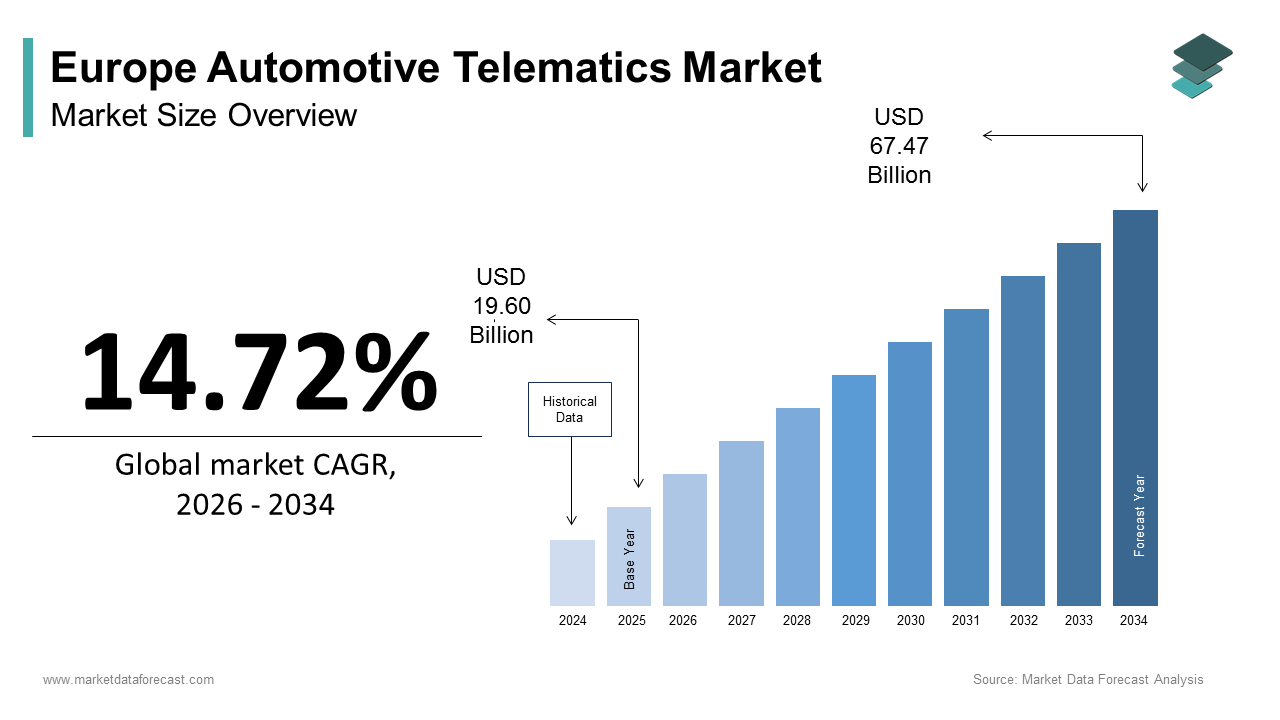
The Europe automotive telematics market was valued at USD 19.60 billion in 2025 and is projected to reach USD 67.47 billion by 2034, growing from USD 22.49 billion in 2026 at a CAGR of 14.72% during the forecast period. Market growth is driven by rapid fleet digitalization, increasing demand for connected vehicle services, and widespread adoption of data-driven mobility solutions across Europe. Regulatory emphasis on road safety, emissions monitoring, and insurance telematics, along with the integration of AI, IoT, and cloud platforms, is accelerating telematics deployment. The rising need for real-time vehicle diagnostics, route optimization, and predictive maintenance continues to strengthen market expansion.
Key Market Trends
- Strong adoption of fleet management solutions to improve operational efficiency and compliance
- Increasing penetration of OEM-fitted telematics driven by connected vehicle strategies
- Growing use of insurance telematics and usage-based insurance models
- Integration of telematics with EV management, ADAS, and smart mobility platforms
- Rising focus on data security, ethical data use, and regulatory compliance
Segmental Insights
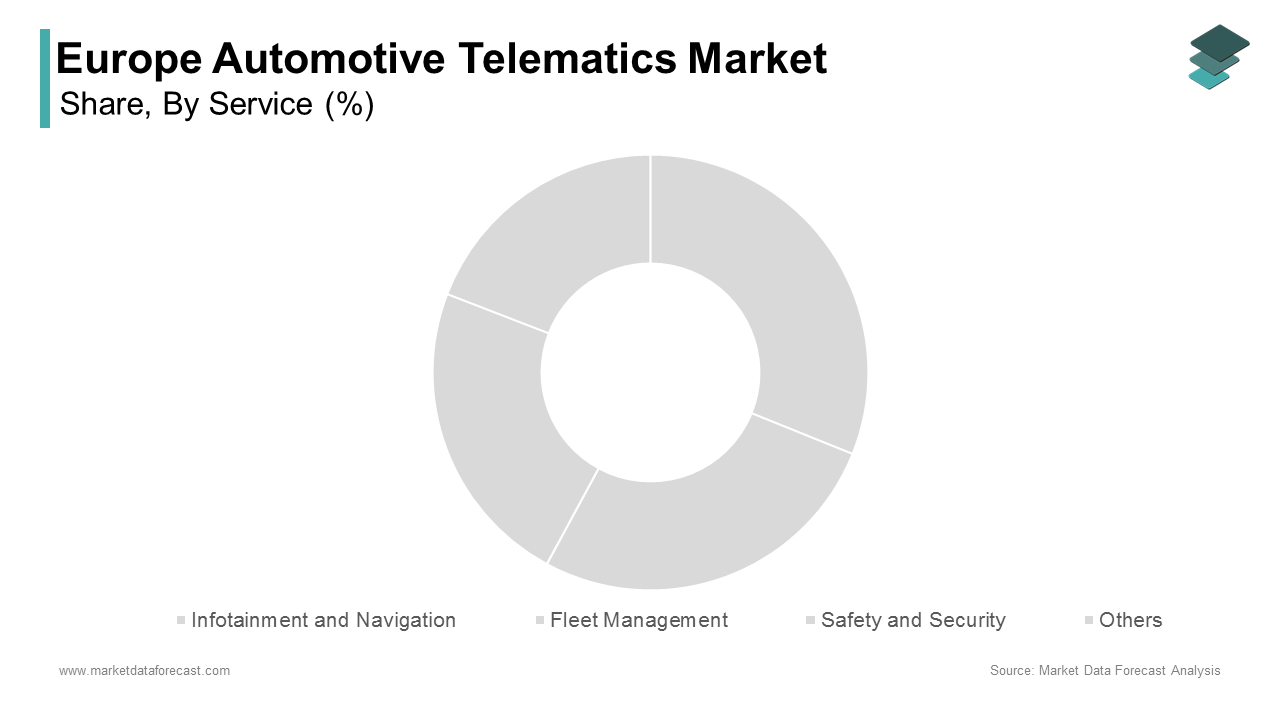
Based on service, the fleet management segment dominated the Europe automotive telematics market in 2025 by accounting for 37.4% of the regional market share, driven by demand for real-time tracking, fuel optimization, and driver behavior analytics.
Based on sales channel type, the OEM-fitted telematics segment led the market in 2025 by holding 70.4% of the total market share, supported by increasing factory-installed connectivity and software-defined vehicle architecture.s
Based on end user, the fleet operators segment captured the largest share in 2025 by holding 55.7% of the regional market share, reflecting large-scale adoption across logistics, leasing, and corporate mobility flee.ts
Regional Insights
- Germany led the Europe automotive telematics market in 2025 by accounting for 21.2% of the total market share, supported by a strong automotive manufacturing base and advanced connected vehicle adoption
- United Kingdom is distinguished by a mature insurance telematics ecosystem and an agile regulatory environment following Brexit.
- France is driven by state-led digital mobility initiatives and strong adoption across public transport and government fleets.
- Italy demonstrates early and widespread adoption of insurance telematics alongside accelerating fleet digitization.
- Sweden has emerged as a leader in ethical data use, smart mobility integration, and sustainable transport solutions.
Competitive Landscape
The Europe automotive telematics market is highly competitive and technology-driven, with players focusing on platform scalability, advanced analytics, and seamless OEM integration. Companies are strengthening partnerships with automakers, insurers, and fleet operators while expanding capabilities in EV telematics, autonomous readiness, and mobility data services.
Prominent players in the Europe automotive telematics market include Bosch, Continental AG, Harman International, TomTom, Verizon Connect, Geotab, Octo Telematics, Trimble, Valeo, ZF Friedrichshafen AG, Airbiquity, HERE Technologies, Telefónica, Vodafone Automotive, and BMW Group.
Europe Automotive Telematics Market Size
The Europe Automotive Telematics market size was calculated to be USD 19.60 billion in 2025 and is anticipated to be worth USD 67.47 billion by 2034, growing from USD 22.49 billion in 2026 at a CAGR of 14.72% during the forecast period.
Automotive telematics refers to integrated systems that combine telecommunications, vehicle diagnostics, and data analytics to enable real-time monitoring, navigation, safety, and fleet management functionalities. These systems leverage embedded connectivity modules, GPS, and onboard sensors to transmit vehicle data to cloud platforms for processing and action. The European automotive telematics ecosystem is uniquely shaped by stringent regulatory mandates, advanced digital infrastructure, and a high penetration of connected vehicles. According to the European Commission, over 90% of new passenger cars sold in the European Union in 2024 are equipped with embedded cellular connectivity, largely driven by the mandatory eCall emergency response system introduced under EU Regulation 2015/758. As per the European Environment Agency, telematics data is increasingly used by national transport authorities to model traffic congestion and emissions in urban zones. Furthermore, the European Data Act, effective from 2024, establishes clear rules on access to in-vehicle generated data, balancing innovation with consumer rights. This regulatory and technological confluence positions Europe as a sophisticated and compliance-driven market where telematics serves not only commercial and safety purposes but also public policy objectives in mobility decarbonization and road safety.
MARKET DRIVERS
Mandatory eCall and Advanced Emergency Response Regulations
The legal requirement for all new type-approved vehicles in the European Union to feature the eCall emergency telematics system has been a key driver of the European automotive telematics market. Enforced since March 2018 under EU Regulation 2015/758, eCall automatically dials the Europe-wide emergency number 112 in the event of a serious crash, transmitting critical data including vehicle location, time, and direction of travel to the nearest emergency center. According to the European Commission’s 2024 review, millions of vehicles across the EU are now equipped with eCall, and the system has improved emergency response times, particularly in rural areas. The regulation not only mandated hardware integration but also spurred the development of supporting cellular infrastructure and backend data platforms. Moreover, the upcoming Advanced eCall initiative, endorsed by the European Council in 2023, plans to expand data transmission to include vehicle type, number of occupants, and potential hazardous materials, further deepening telematics integration.
Growth of Commercial Fleet Digitization and Logistics Optimization
The accelerating digitization of commercial vehicle fleets in Europe is a powerful demand catalyst for automotive telematics, which is driven by operational efficiency mandates and sustainability targets. According to Eurostat, EU road freight transport in 2024 totaled about 1,867 billion tonne kilometers of goods, with telematics now considered essential for route optimization, fuel management, and regulatory compliance. The European Commission’s Mobility Package requires all commercial vehicles over 3.5 tons to comply with digital tachograph rules and driving time regulations, functions seamlessly supported by modern telematics systems. As per the International Road Transport Union, a large majority of European logistics companies with fleets exceeding 50 vehicles deployed integrated telematics platforms in 2024 to monitor driver behavior, reduce idling, and lower CO2 emissions. National initiatives reinforce this trend, for example, Germany’s Federal Office for Goods Transport mandates real-time vehicle tracking for cross-border hauliers under the “Digital Road Freight” program.
MARKET RESTRAINTS
Stringent Data Privacy and Ownership Regulations
Europe’s robust data protection framework under the General Data Protection Regulation imposes significant constraints on the collection, processing, and commercialization of automotive telematics data, which is hampering the growth of the European automotive telematics market. Unlike other regions where vehicle data is freely monetized by manufacturers, the GDPR requires explicit informed consent for any secondary use of personal data, including location, driving patterns, and vehicle health metrics. According to the European Data Protection Board, vehicle data that can identify a driver or infer behavioral patterns is classified as personal data, subject to strict purpose limitation and data minimization principles. The European Data Act entered into force in January 2024, but its provisions on vehicle data access will only apply fully from September 2025, granting vehicle owners and authorized third parties direct access to in-vehicle generated data through standardized interfaces. This reduces manufacturers’ control over data flows and limits their ability to offer exclusive telematics services.
Fragmented Connectivity Infrastructure and Cross-Border Interoperability
Despite high overall connectivity, Europe’s automotive telematics market faces operational inefficiencies due to fragmented mobile network coverage and inconsistent cross-border data roaming policies, which further impede the automotive telematics market in Europe. While 5G deployment is advancing in urban centers, rural and alpine regions in countries like Romania, Greece, and parts of the Balkans still suffer from limited 4G continuity, leading to data transmission gaps for moving vehicles. According to the European Electronic Communications Observatory, cross-border mobile data handover between EU member states can result in higher latency and occasional service interruptions due to differing network configurations and spectrum allocations. Moreover, the lack of a unified telematics data exchange standard across national emergency services means that while eCall functions technically, response protocols and data interpretation vary significantly between countries. A 2024 study by the European Transport Safety Council found that emergency centers in Southern Europe often lack systems to process advanced eCall payloads, diminishing the system’s full potential.
MARKET OPPORTUNITIES
Integration with Urban Mobility and Smart City Ecosystems
Automotive telematics is increasingly positioned as a critical data layer in Europe’s smart city infrastructure, which is enabling dynamic traffic management, low-emission zone compliance, and integrated multimodal transport, and is a promising opportunity in the European automotive telematics market. Cities like Amsterdam, Copenhagen, and Helsinki are leveraging anonymized vehicle telematics feeds to optimize traffic light sequencing, reduce congestion, and forecast air quality in real time. According to the European Innovation Partnership on Smart Cities, more than one hundred European municipalities now operate urban data platforms that ingest vehicle telematics to inform mobility policies. The EU’s C‑ITS Platform promotes cooperative intelligent transport systems where vehicles communicate with roadside units to receive warnings about congestion, accidents, or roadworks, a functionality dependent on embedded telematics. Furthermore, Germany’s “Digital Test Fields for Automated Driving” initiative uses telematics data from thousands of connected vehicles to validate autonomous driving algorithms in real-world urban environments. As cities implement congestion charging and zero-emission zones, telematics enables automatic verification of vehicle eligibility.
Expansion into Usage-Based Insurance and Pay-As-You-Drive Models
The European automotive telematics market is witnessing accelerated adoption through the growth of usage-based insurance (UBI) and pay-as-you-drive (PAYD) programs that align premiums with actual driving behavior, which is another potential opportunity in the regional market. Unlike traditional insurance based on static risk profiles, UBI leverages telematics to monitor metrics such as speed, acceleration, braking, and time of day, enabling personalized pricing. According to the European Insurance and Occupational Pensions Authority, millions of European drivers were enrolled in UBI schemes by the end of 2024, with Italy and the UK leading adoption due to favorable regulatory sandboxes. In Italy, insurers like UnipolSai offer discounts for safe drivers validated through OBD II or embedded telematics. The UK’s Financial Conduct Authority has endorsed UBI as a tool for fairer pricing, particularly for young drivers. Moreover, the European Commission’s Sustainable and Smart Mobility Strategy encourages risk-appropriate insurance models that incentivize eco-driving and accident prevention.
MARKET CHALLENGES
Cybersecurity Vulnerabilities in Connected Vehicle Platforms
The increasing connectivity of European vehicles introduces significant cybersecurity risks that challenge the reliability and public acceptance of automotive telematics systems, which is a key challenge to the growth of the European automotive telematics market. As vehicles transmit and receive data over cellular and Wi‑Fi networks, they become potential targets for remote attacks, including location tracking, unauthorized control of functions, or data exfiltration. According to the European Union Agency for Cybersecurity (ENISA), the number of reported automotive cyber incidents in Europe rose sharply between 2021 and 2024, with telematics control units among the most frequently exploited entry points. The agency’s 2023 threat landscape report identified vulnerabilities in over-the-air update mechanisms and third-party app integrations that could compromise vehicle integrity. In response, the EU’s UN Regulation No. 155 requires manufacturers to implement certified cybersecurity management systems, including real-time intrusion detection in telematics modules. However, legacy vehicles and aftermarket devices often lack these protections, creating a fragmented security posture. A 2024 penetration test by Germany’s TÜV found that a significant share of telematics‑enabled fleet vehicles in operation had unpatched firmware vulnerabilities.
Lack of Standardized Data Formats and Interoperability Protocols
The Europe automotive telematics market struggles with a lack of harmonized data standards, impeding interoperability between vehicle manufacturers, third-party service providers, and public authorities. While the European Data Act mandates access to in-vehicle data, it does not prescribe a universal data format or communication protocol, resulting in proprietary implementations that vary by OEM. According to the European Association of Automotive Suppliers, more than a dozen distinct telematics data schemas are currently in use across major European car brands, complicating integration for insurance firms, fleet operators, and repair networks. This fragmentation inflates development costs and limits innovation, as third parties must build custom connectors for each manufacturer. The absence of a common diagnostic language also hinders independent workshops; a 2024 study by the European Consumer Organisation found that most independent garages face delays in accessing real-time vehicle data due to incompatible telematics interfaces. Although initiatives like the WAVE standard and the Car Data Platform by ACEA aim to create interoperability, adoption remains voluntary and incomplete.
REPORT COVERAGE
| REPORT METRIC | DETAILS |
| Market Size Available | 2025 to 2034 |
| Base Year | 2025 |
| Forecast Period | 2026 to 2034 |
| CAGR | 14.72% |
| Segments Covered | By Service, Sales Channel Type, End User, And Region |
| Various Analyses Covered | Global, Regional & Country Level Analysis; Segment-Level Analysis; DROC, PESTLE Analysis; Porter’s Five Forces Analysis; Competitive Landscape; Analyst Overview of Investment Opportunities |
| Regions Covered | UK, France, Spain, Germany, Italy, Russia, Sweden, Denmark, Switzerland, Netherlands, Turkey, and the Czech Republic |
| Market Leaders Profiled | Bosch, Continental AG, Harman International, TomTom, Verizon Connect, Geotab, Octo Telematics, Trimble, Valeo, ZF Friedrichshafen AG, Airbiquity, HERE Technologies, Telefónica, Vodafone Automotive, BMW Group |
SEGMENTAL ANALYSIS
By Service Insights
The fleet management segment led the market by commanding for 37.4% of the European market share in 2025. The growth of the fleet management segment in the European market is driven by regulatory mandates, operational efficiency demands, and the continent’s dense commercial logistics network. The European Union’s Mobility Package enforces digital tachograph rules, driving hour limits, and rest period compliance, which is requiring real time vehicle monitoring. According to the International Road Transport Union, millions of commercial vehicles in the EU now operate with telematics systems that track location, speed, engine diagnostics, and driver behavior. National authorities reinforce this trend; Germany’s Federal Office for Goods Transport mandates telematics for heavy vehicles engaged in cross-border haulage. Additionally, the European Green Deal’s Fit for 55 initiative pressures logistics firms to reduce emissions, and telematics enables fuel consumption optimization and eco-driving coaching. A 2024 study by the European Environment Agency found that fleet operators using advanced telematics achieved measurable CO2 reductions through route and idling management.
The safety and security service segment is the fastest growing in the Europe automotive telematics market and is estimated to grow at a CAGR of 15.5% over the forecast period, owing to the mandatory eCall system, the rise of advanced driver assistance systems, and growing consumer demand for vehicle protection. Since its enforcement in 2018, eCall has become active in millions of vehicles across the EU, according to the European Commission, automatically alerting emergency services during crashes. The upcoming Advanced eCall initiative will further enhance data transmission to include vehicle type, number of occupants, and crash severity. According to the European Insurance Bureau, vehicles equipped with telematics-based anti-theft systems experience lower theft rates, which is incentivizing adoption among premium car buyers.
By Sales Channel Type Insights
The OEM‑fitted telematics segment held 70.4% of the European market share in 2025. The leading position of OEM-fitted segment in the European market is attributed to the deep integration of connectivity into new vehicle design and regulatory requirements. The EU’s eCall mandate necessitates embedded hardware in all new passenger cars and light commercial vehicles. According to the European Automobile Manufacturers Association, over 90% of new cars sold in the EU in 2024 came with factory-installed telematics modules supporting services ranging from emergency calling to over-the-air software updates. Automakers like Stellantis, Volkswagen, and Mercedes‑Benz bundle telematics into subscription packages that generate recurring revenue while ensuring data sovereignty and system reliability.
The aftermarket segment is a promising segment and is estimated to record a CAGR of 13.3% over the forecast period, owing to the rising need to retrofit telematics functionality into the vast existing vehicle fleet, most of which predate eCall and embedded connectivity. Commercial fleet operators with aging vehicles are primary adopters; according to the European Transport Safety Council, many logistics companies with fleets older than five years installed aftermarket telematics in 2024 to comply with digital tachograph and eco driving mandates.
By End‑User Insights
The fleet operators segment led the market by holding 55.7% of the regional market share in 2025. The leading position of the fleet operators segment in the European market is attributed to the legal obligations, operational imperatives, and scale economies. Europe’s road freight sector relies on telematics for regulatory compliance with EU driving time rules, digital tachographs, and cross-border transport documentation. Major logistics firms like DHL and PostNL have deployed telematics across tens of thousands of vehicles to optimize delivery routes, reduce fuel consumption, and monitor driver fatigue. As per a 2024 analysis by the International Road Transport Union, fleet operators using telematics achieved significant operational cost reductions through reduced idling and preventive maintenance.
The private consumers segment is expected to exhibit the fastest CAGR of 12.4% in the European automotive telematics market during the forecast period, owing to the rising safety awareness, demand for connected car experiences, and the proliferation of value-added services bundled with new vehicles. According to the European Consumer Organisation, a majority of European car buyers in 2024 considered embedded connectivity, including navigation, remote diagnostics, and emergency assistance, as a decisive purchase factor. In the UK, millions of private drivers use telematics for personalized premiums, according to the Association of British Insurers.
REGIONAL ANALYSIS
Germany Automotive Telematics Market Analysis
Germany had 21.2% of the European automotive telematics market share in 2025 and held the leading position in the regional market. Germany serves as the continent’s industrial and regulatory epicenter for connected mobility. Home to Volkswagen, BMW, and Mercedes‑Benz, the country leads in OEM-integrated telematics innovation and deployment. According to the German Federal Motor Transport Authority, the vast majority of new passenger vehicles registered in 2024 featured embedded connectivity, largely driven by eCall compliance and manufacturer subscription services. Germany’s dense autobahn network and high commercial vehicle traffic, with millions of trucks registered as per the Federal Office for Goods Transport, create strong demand for fleet telematics. National initiatives such as the “Digital Test Fields for Automated Driving” program use telematics data from thousands of vehicles to validate autonomous systems in real-world conditions. Strict data protection laws under the Federal Data Protection Act have also pushed OEMs to develop on‑vehicle data processing architectures aligned with GDPR.
UK Automotive Telematics Market Analysis
The UK is distinguished by its mature insurance telematics sector and agile regulatory approach post‑Brexit. The UK pioneered usage‑based insurance, with millions of policies active in 2024 according to the Association of British Insurers, making it Europe’s largest UBI market. Companies like Admiral and Direct Line use telematics to offer personalized premiums, particularly for young drivers. The UK Department for Transport has reported that telematics programs contribute to reduced accident rates. Despite leaving the EU, the UK retained the eCall mandate and expanded it through the “Connected and Automated Mobility Roadmap.” London’s Ultra Low Emission Zone relies on telematics for automatic vehicle identification, while national police services collaborate with automakers to track stolen vehicles in real time.
France Automotive Telematics Market Analysis
France’s market is driven by state‑led digital mobility initiatives and strong public sector adoption. The government’s “France Mobilités” plan allocates billions of euros to intelligent transport systems, including nationwide telematics integration for public fleets. According to France’s Ministry of Ecological Transition, a majority of municipal and state vehicles are now equipped with telematics for route optimization and emissions monitoring. France enforces strict road safety mandates under its “Vision Zero 2050” strategy, requiring eCall and advanced driver monitoring. Automakers like Renault and Stellantis use national telematics data hubs to develop AI‑driven driver behavior models compliant with CNIL data protection rules. Low-emission zones in Paris, Lyon, and Grenoble rely on telematics‑based vehicle classification for access control.
Italy Automotive Telematics Market Analysis
Italy is characterized by early and widespread adoption of insurance telematics and growing fleet digitization. Italy pioneered UBI in Europe, with millions of policies in force by 2024 according to IVASS, the national insurance regulator. Insurers like UnipolSai and Generali use OBD II and embedded telematics to reward safe driving with discounts. Italy’s fragmented road network and high urban congestion drive demand for real‑time navigation and traffic avoidance services. According to Italy’s National Agency for New Technologies, hundreds of thousands of commercial vehicles now use telematics for compliance with tachograph rules and anti‑evasion measures. Italy’s National Recovery and Resilience Plan also funds telematics retrofits for last‑mile delivery vans in historic city centers.
Sweden Automotive Telematics Market Analysis
Sweden has emerged as a leader in ethical data use and sustainable mobility integration. The country’s advanced digital infrastructure and high EV adoption create ideal conditions for next‑generation telematics. Volvo and Polestar embed telematics not only for safety but also for carbon footprint tracking. The Swedish Transport Agency mandates telematics for commercial vehicles in northern regions to improve emergency response in remote areas. Sweden’s Data Protection Authority requires explicit opt‑in for secondary use of vehicle data, fostering consumer trust. The “Fossil Free Sweden” initiative integrates telematics data into national transport models to predict and manage EV charging demand.
COMPETITION OVERVIEW
The Europe automotive telematics market features a multi-layered competitive dynamic defined by collaboration, regulatory alignment, and technological specialization. At the top-tier global automakers and Tier 1 suppliers like Bosch dominate through embedded OEM solutions that offer seamless integration and regulatory compliance. In parallel, specialized telematics providers such as Geotab Webfleet and Octo Telematics lead in fleet and aftermarket segments with open platforms tailored to commercial needs. Competition is not primarily price-driven but centers on data governance, security, reliability, and value-added services. The European Data Act has intensified focus on interoperability, prompting vendors to develop standardized APIs while protecting core differentiators. Public sector procurement and insurance partnerships create additional entry points for agile players. Unlike other regions, Europe’s competition is also shaped by national policies on data sovereignty and road safety, which vary subtly across countries. As a result, successful players combine global scale with local regulatory fluency and ethical data practices. The market rewards those who treat telematics not as a hardware add-on but as a trusted service layer in Europe’s evolving mobility ecosystem.
KEY MARKET PLAYERS
A few major players of the Europe automotive telematics market include
- Bosch
- Continental AG
- Harman International
- TomTom
- Verizon Connect
- Geotab
- Octo Telematics
- Trimble
- Valeo
- ZF Friedrichshafen AG
- Airbiquity
- HERE Technologies
- Telefónica
- Vodafone Automotive
- BMW Group
Top Strategies Used by the Key Market Participants
Key players in the Europe automotive telematics market employ four primary strategies to navigate the region’s complex landscape. First, they ensure strict compliance with EU regulations, including eCall UN R155 cybersecurity mandates and the European Data Act by embedding legal requirements into product architecture from inception. Second, they invest in sovereign data infrastructure by establishing EU-based cloud centers and local data processing to meet GDPR and data residency expectations. Third, they adopt open platform approaches that enable interoperability with third-party services such as insurers, repair networks, and public authorities while maintaining security. Fourth, they expand beyond basic connectivity into value-added services like EV battery analytics, usage-based insurance integration, and carbon footprint tracking to enhance customer retention and recurring revenue. These strategies collectively address Europe’s unique balance of innovation, consumer rights, and public policy priorities.
Leading Players in the Europe Automotive Telematics Market
- Bosch Mobility Solutions is a leading global supplier of automotive telematics hardware and software with deep integration across European vehicle manufacturers. The company provides embedded telematics control units, eCall modules, and cloud-based fleet management platforms that comply with EU safety and data regulations. Bosch’s systems are featured in vehicles from Volkswagen, Stellantis, and Renault, offering services ranging from predictive maintenance to emergency response. In 2024, Bosch launched its “Connected Horizon” platform, which uses real-time telematics data to optimize energy consumption in electric vehicles through adaptive route planning. The company also enhanced its cybersecurity architecture to meet UN Regulation No 155 requirements. Through its engineering excellence, regulatory alignment, and ecosystem partnerships, Bosch strengthens Europe’s position as a benchmark for safe, secure, and sustainable connected mobility worldwide.
- Geotab Inc is a global leader in IoT and telematics solutions with a strong footprint in the European commercial vehicle sector. The company specializes in aftermarket and OEM integrated telematics devices that deliver real-time vehicle diagnostics, driver behavior analytics, and EV sustainability insights. Geotab’s open platform approach enables integration with over 200 third-party applications serving logistics, public sector, and utility fleets across the UK, Germany, and the Nordics. In 202,3 Geotab expanded its European data center capacity in Amsterdam and Frankfurt to ensure full compliance with GDPR and the EU Data Act. The company also launched MyGeotab E, V a dedicated suite for electric fleet monitoring that tracks battery health, charging patterns, and carbon savings. By prioritizing data sovereignty, interoperability, and sustainability, Geotab has become a trusted partner for European organizations modernizing their mobility operations in alignment with green and digital transitions.
- Volkswagen Group is not only a major automaker but also a significant force in shaping the Europe automotive telematics market through its in-house digital mobility services. The company embeds proprietary telematics systems across its brands, including Volkswagen, Audi, and Porsche, enabling features such as remote vehicle control, emergency calling, predictive maintenance, and over-the-air software updates. Volkswagen’s Car Net and ID series connectivity platforms are designed to comply with stringent EU data protection and cybersecurity standards while offering personalized driver experiences. In 2024, the group launched its “Volkswagen Data Marketplace,” allowing authorized third parties like insurers and repair shops to access anonymized vehicle data in line with the European Data Act. This initiative positions Volkswagen as a data steward, fostering an open yet secure mobility ecosystem. Through vertical integration, regulatory foresight, and consumer-centric innovation, the group influences telematics development far beyond its manufacturing footprint.
MARKET SEGMENTATION
This research report on the Europe automotive telematics market has been segmented and sub-segmented based on service, sales channel type, end user, and region.
By Service
- Infotainment and Navigation
- Fleet Management
- Safety and Security
- Others
By Sales Channel
- OEM-Fitted
- Aftermarket
By End User
- Private Consumers
- Fleet Operators
- Others
By Region
- UK
- France
- Spain
- Germany
- Italy
- Russia
- Sweden
- Denmark
- Switzerland
- Netherlands
- Turkey
- Czech Republic
- Rest of Europe
Frequently Asked Questions
1. What is driving the growth of the Europe automotive telematics market?
Key drivers include rising demand for connected vehicles, stringent EU safety and emission regulations, growth of fleet management solutions, and increasing adoption of electric vehicles.
2. What are the major applications of automotive telematics in Europe?
Major applications include fleet management, navigation and infotainment, vehicle safety and security, insurance telematics, and remote diagnostics.
3. What role does regulation play in this market?
EU mandates such as eCall systems, emission monitoring, and road safety regulations significantly boost telematics adoption across Europe.
4. What is the impact of electric vehicles on telematics demand?
Electric vehicles increase demand for telematics solutions related to battery monitoring, charging optimization, range prediction, and predictive maintenance
5. How is fleet management influencing market growth?
The growing logistics, transportation, and ride-hailing sectors rely heavily on telematics for real-time tracking, cost optimization, and driver performance monitoring.
6. What technologies are commonly used in automotive telematics?
GPS, cellular communication (4G/5G), IoT sensors, cloud computing, AI, and big data analytics are widely used technologies.
7. What are the key challenges faced by the market?
Challenges include data privacy concerns, cybersecurity risks, high installation costs, and integration issues with legacy vehicle systems.
8. How does insurance telematics contribute to market expansion?
Usage-based insurance (UBI) models leverage telematics to assess driving behavior, reduce risk, and offer personalized premiums.
9. What are the emerging trends in the Europe automotive telematics market?
Key trends include AI-based analytics, over-the-air (OTA) updates, integration with smart city infrastructure, and autonomous vehicle support.
10. What is the future outlook of the Europe automotive telematics market?
The market is expected to witness strong growth driven by digital transformation in mobility, increasing connected vehicle penetration, and advancements in autonomous and electric vehicle technologies.
Related Reports
Access the study in MULTIPLE FORMATS
Purchase options starting from
$ 2000
Didn’t find what you’re looking for?
TALK TO OUR ANALYST TEAM
Need something within your budget?
NO WORRIES! WE GOT YOU COVERED!
Call us on: +1 888 702 9696 (U.S Toll Free)
Write to us: sales@marketdataforecast.com