- Product Description Description
- Table of Contents TOC
- List of Table & Figure LOT
- Get Free Sample PDF Sample PDF
Market Size, 2025
$6.12 BnMarket Estimate, 2026
$6.24 BnMarket Forecast, 2034
$7.31CAGR, 2026–2034
2%Europe Base Oil Market Summary
The Europe base oil market stood at USD 6.12 billion in 2025, is projected to reach USD 6.24 billion in 2026, and is estimated to grow to USD 7.31 billion by 2034, expanding at a CAGR of 2% from 2026 to 2034. Market growth is shaped by the transition toward high-purity Group II and Group III hydroprocessed oils, the expansion of industrial machinery maintenance requirements, and evolving regulatory frameworks under REACH, Euro emission standards, and circular economy mandates across the region.
Key Insights
- Regulatory & Performance Drivers: The market is driven by stringent engine emission standards, OEM lubricant specifications, and fuel-efficiency requirements, which accelerate the shift from conventional Group I oils to low-SAPS, thermally stable Group II / Group III and synthetic base oils. Parallel industrial policies promoting resource efficiency, extended equipment life, and circularity further reinforce demand for premium base-oil formulations across transportation and manufacturing sectors.
- Market Segmentation: In 2024, the mineral oil segment retained the largest market share owing to its cost-effectiveness and compatibility with legacy machinery, particularly across Eastern and Southern Europe, while bio-based oils are expected to experience the fastest growth under Green Public Procurement rules, biodegradability mandates, and sustainability reporting requirements. By viscosity grade, medium-viscosity oils (ISO VG 46–68) dominated usage in hydraulic, gearbox, and compressor systems, whereas low-viscosity oils are expanding rapidly in line with fuel-efficient and hybrid powertrain designs.
Key Growth Drivers:
Growth is supported by:
- Euro 7 emission standards & OEM low-SAPS lubricant compatibility needs
- Rising focus on industrial uptime, predictive maintenance, and extended drain intervals
- Transition toward Group III & synthetic performance oils
- Investments in re-refining and circular lubricant recovery infrastructure
- Emerging demand from EV driveline oils, dielectric coolants, and thermal management fluids
These shifts structurally reposition base oils as critical enablers of engine compliance, energy efficiency, and equipment reliability across Europe.
Challenges:
The market faces headwinds from:
- Regulatory classification of high-aromatic Group I oils as carcinogenic under REACH
- Declining regional refining capacity and feedstock variability
- Heavy reliance on imported Group III and synthetic base stocks
- Traceability gaps in used-oil collection across member states
- Longer supply lead times and higher formulation costs for high-VI oils
These constraints elevate supply-chain risk and compliance burden, particularly for price-sensitive downstream blenders.
Major Market Players
Key companies operating in the Europe base oil market include: ExxonMobil, Shell, Chevron, TotalEnergies, SABIC, Nynas AB, Lukoil, Petrobras, Indian Oil Corporation, Hindustan Petroleum, and Others.
Europe Base Oil Market Size
The Europe base oil market stood at USD 6.12 billion in 2025, is projected to reach USD 6.24 billion in 2026, and is estimated to grow to USD 7.31 billion by 2034, expanding at a CAGR of 2% from 2026 to 2034.
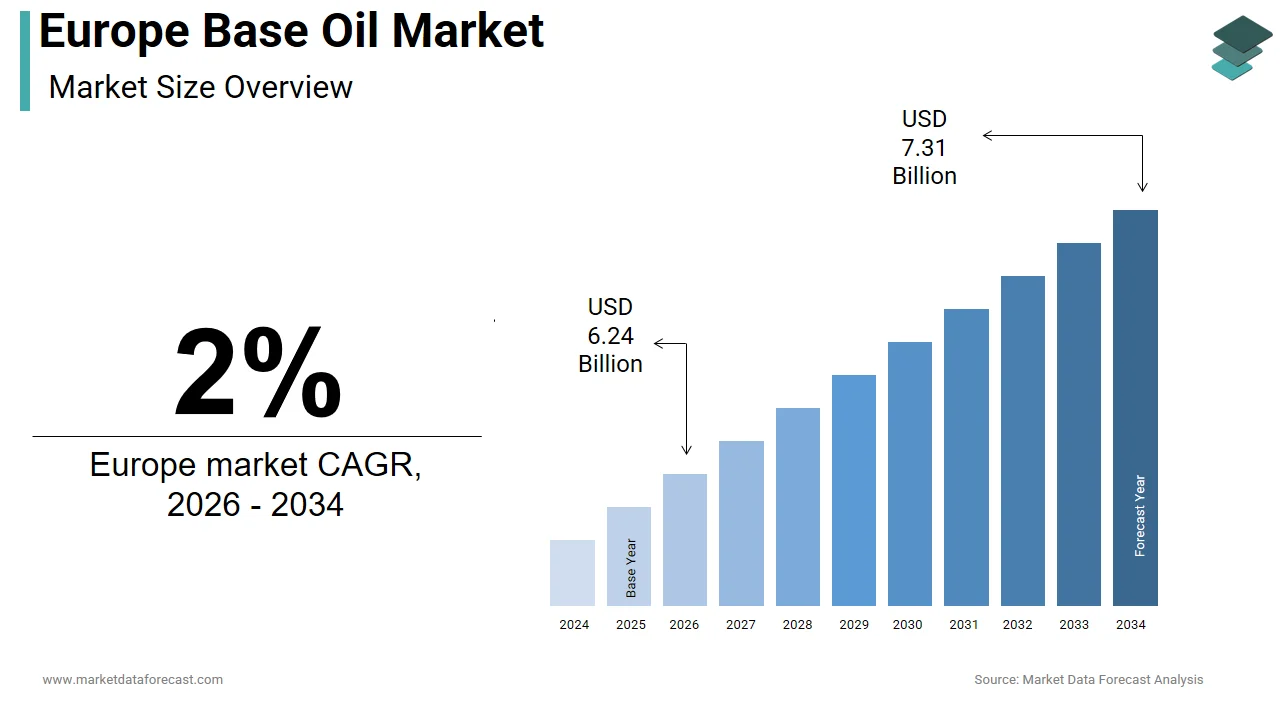
Base oils serve as the foundational component of lubricants used across transportation, industrial machinery, and metalworking operations throughout Europe. These refined petroleum or synthetic fluids provide critical functions, including friction reduction, thermal stability, and corrosion protection. Lubricant consumption in the European Union is substantial, driven by extensive vehicle usage and consistent industrial maintenance requirements across member states. The sector is significantly integrated into circular economy initiatives, with a large number of facilities registered for managing and handling used lubricants in accordance with the Waste Framework Directive. A few key member nations, including Germany, France, Italy, and Poland, account for a large majority of the overall lubricant demand, primarily due to their significant manufacturing activity and widespread road freight networks. Notably, the European Chemicals Agency classifies certain mineral base oils as substances of very great concern under REACH, prompting accelerated adoption of Group II and Group III hydroprocessed oils. This regulatory evolution, coupled with stringent emission standards from the European Automobile Manufacturers Association, is reshaping base oil specifications toward higher purity and performance consistency across the continent.
MARKET DRIVERS
Stringent Emission and Fuel Efficiency Regulations Driving High Performance Lubricant Demand
European Union vehicle emission standards, particularly Euro 7 standards, mandate reduced particulate and nitrogen oxide outputs which directly influence lubricant formulation requirements, and thereby drive the growth of the Europe base oil market. According to the European Automobile Manufacturers Association, modern internal combustion engines require low SAPS base oils low in sulfur, ash, and phosphorus to protect exhaust after treatment systems such as diesel particulate filters and selective catalytic reduction units. A large majority of new heavy-duty trucks in the EU are equipped with advanced exhaust after-treatment technologies, driving the need for engine oils formulated with high-quality synthetic or Group III base oils to maintain system functionality and compliance. The current EU fleet-wide average CO2 emission target for new passenger cars is 93.6 grams of CO2 per kilometer (g CO2/km) for the period 2025-2029. Research by major lubricant developers, including Shell, has consistently demonstrated that transitioning to high-quality synthetic and Group III base oils in engine formulations significantly reduces internal engine friction, leading to noticeable improvements in fuel economy and overall energy efficiency. The substantial number of internal combustion engine vehicles currently operating across European roads ensures a continuing and significant structural demand for advanced, high-performance base oils for the foreseeable future, even as the market share of electric vehicles grows.
Expansion of Industrial Maintenance and Machinery Uptime Requirements
The region’s capital-intensive manufacturing sector relies on high-performance lubricants to ensure machinery longevity and operational continuity, which fuels the expansion of the Europe base oil market. Industrial sectors across the European Union are increasingly adopting advanced maintenance strategies as the availability of large-scale operational data grows. Unplanned downtime represents a significant and rising financial burden for German manufacturers, reinforcing the critical need for reliable components and maintenance practices. This has accelerated the shift from conventional mineral base oils to hydrocracked Group II and Group III variants, which offer superior thermal stability and oxidation resistance. Manufacturers are seeing performance improvements, such as extended service intervals, by upgrading from less refined lubricants to higher-quality base oils in critical industrial applications. Additionally, Regulatory bodies and industry standards are increasingly emphasizing strict performance verification and hygiene requirements for lubricants used in applications with potential incidental food contact. The EU's emphasis on resource efficiency through its Green Deal reinforces the demand for premium base oils across industrial end uses, as the policy encourages extended equipment life.
MARKET RESTRAINTS
Regulatory Classification of Certain Mineral Base Oils as Carcinogenic Substances
The European Chemicals Agency has classified high aromatic content Group I base oils as substances of very great concern due to their polycyclic aromatic hydrocarbon content, which exhibits carcinogenic and mutagenic properties. This restricts the growth of the Europe base oil market. The European lubricant market is undergoing a significant transition, moving away from Group I base oils towards higher-performing Group II and Group III alternatives. Driven by evolving regulatory pressures and stricter original equipment manufacturer (OEM) performance standards, many European refiners have reduced or completely shut down their Group I production capacity over the last decade. Formulators are increasingly compelled to reformulate products due to stricter national occupational exposure limit (OEL) values for mineral oil hydrocarbons (MOH), encouraging the use of cleaner, more highly refined base stocks. The decline in new passenger car registrations and a general shift in market dynamics indicate a decrease in the overall procurement and use of Group I base oils within the European automotive service sector. This regulatory pressure not only restricts supply options but also increases compliance costs as companies must implement closed handling systems and health monitoring protocols, thereby constraining market flexibility for cost-sensitive segments.
Volatility in Crude Oil Feedstock Quality and Refinery Yield Constraints
Base oil production in the region remains heavily dependent on vacuum gas oil derived from crude distillation, yet the declining availability of light sweet crude and increasing reliance on heavier sour grades have compromised yield and quality consistency. Consequently, this hinders the expansion of the Europe base oil market. Refineries in Europe have been observed processing crude oil with an increasing average sulfur content. This shift in the quality of the crude feedstock being processed has led to a noticeable reduction in the yield of suitable lube distillates. Furthermore, refinery conversions toward petrochemical integration have diverted vacuum gas oil streams away from lube units. A facility in Western Europe adjusted its production strategy, leading to the reallocation of base material supply to prioritize the creation of other petroleum-based chemicals, resulting in reduced output from its lubricating oil unit. An analysis of the regional industry shows a general trend of consolidation within Western Europe, with the overall number of dedicated lubricating oil processing facilities experiencing a marked decrease over a period of time. This structural decline in refining capacity, coupled with inconsistent feedstock quality, undermines the stable supply of conventional base oils and elevates dependence on imported Group III or synthetic alternatives.
MARKET OPPORTUNITIES
Rising Adoption of Re-refined Base Oils Under Circular Economy Mandates
The European Union’s Circular Economy Action Plan has caused investment in used lubricant re-refining technologies that produce Group I equivalent base oils with significantly lower carbon footprints, which creates new opportunities for the growth of the Europe base oil market. There is an observable, substantial amount of material gathered each year within the area under consideration. The infrastructure designed to process this material has seen a significant increase in capacity over a defined period. New facilities capable of producing a specific quantity of processed material have been approved in various regions. The processed material meets specific quality guidelines, ensuring its usability. A newly commissioned processing unit utilizes an advanced method and achieves a high level of purity, comparable to raw materials. Updated criteria now acknowledge the use of processed materials in certain products, allowing for procurement preferences. Hence, this segment offers a credible pathway to decarbonize base oil supply while conserving finite crude resources.
Growth in Electric Vehicle Thermal Management and Auxiliary Lubricant Applications
The decline in demand for engine oil due to electric vehicles is offset by the need for new base oil uses in areas like thermal management systems, reduction gears, and battery cooling circuits, and thereby offers fresh prospects for the Europe base oil market expansion. Electric vehicles require a specialized volume of dielectric coolant or gear oil per unit, emphasizing the need for synthetic and high-purity mineral base oils to ensure proper electrical insulation and thermal stability. The production volume of electric vehicles within the region has grown significantly, now accounting for a notable percentage of total light-duty vehicle output. A major automotive manufacturing facility has alone produced over five hundred thousand electric vehicles, each requiring specialized transmission fluids utilizing specific types of base stocks. Industry standards have been established by a standardization committee, which released specifications for oxidation stability and dielectric strength requirements tailored for electric vehicle lubricants. Companies in the lubricant sector have responded to these demands by launching new, electric vehicle-specific base oil blends that offer enhanced thermal conductivity compared to conventional formulations. This emerging demand offsets declines in internal combustion segments and creates a high-value niche for advanced base oils aligned with Europe’s electromobility transition.
MARKET CHALLENGES
Persistent Shortfall in Domestic Group III Base Oil Production Capacity
The region lacks sufficient hydrocracking and gas-to-liquid infrastructure to meet escalating demand for high viscosity index Group III base oils, which degrades the growth of the Europe base oil market. This is driven by low SAPS and fuel economy requirements. There is a significant reliance on imports to meet the demand for this base oil in the European market. Domestic production capabilities within Europe are observed to be substantially lower than the volume of materials being imported. The essential nature of high-performance lubricants for key industrial applications points to a potential vulnerability in supply chains. The reduction of a specific production facility has contributed to a greater supply deficit within the region. Only a couple of remaining facilities in the region maintain some operational capacity for producing this particular base oil. A noticeable pattern has emerged in the supply chain, where lead times for this material have demonstrably lengthened compared to other related materials. This supply gap increases formulation costs and exposes European lubricant blenders to global arbitrage risks, which affects strategic autonomy in a critical industrial input.
Inconsistent Collection and Traceability of Used Lubricants Across Member States
The efficiency of used lubricant collection varies drastically across countries, which impedes the scalability of re-refining and circular supply chains, and constrains the expansion of the Europe base oil market. This is despite EU-wide directives. Significant variations are observed in the quantity of used oil collected across different areas. A considerable amount of used oil collected in some southern locations is not verified as reaching sanctioned treatment centers. Moreover, the absence of a harmonized digital tracking system prevents real-time monitoring of oil flows. Many entities involved in collecting used oil continue to utilize conventional, paper-based tracking methods. This fragmentation limits feedstock availability for re-refiners and compromises the environmental integrity of circular claims. Europe needs robust collection enforcement and digital tracking to unlock re-refined base oils for sustainability and supply security.
REPORT COVERAGE
| REPORT METRIC | DETAILS |
| Market Size Available | 2025 to 2034 |
| Base Year | 2025 |
| Forecast Period | 2026 to 2034 |
| Segments Covered | By Type, End-use, Application, Viscosity Grade, and Country. |
| Various Analyses Covered | Global, Regional, and Country-Level Analysis, Segment-Level Analysis, Drivers, Restraints, Opportunities, Challenges; PESTLE Analysis; Porter’s Five Forces Analysis, Competitive Landscape, Analyst Overview of Investment Opportunities |
| Countries Covered | UK, France, Spain, Germany, Italy, Russia, Sweden, Denmark, Switzerland, Netherlands, Turkey, Czech Republic, and the Rest of Europe. |
| Market Leaders Profiled | ExxonMobil, Shell, Chevron, TotalEnergies, SABIC, Nynas AB, Lukoil, Petrobras, Indian Oil Corporation, Hindustan Petroleum, and Others. |
SEGMENTAL ANALYSIS
By Type Insights
The mineral oil segment maintained the leading share of the Europe base oil market in 2025. The leading position of the mineral oil segment is because of established infrastructure, cost efficiency, and suitability for a wide array of industrial and automotive applications despite regulatory pressures. The continued operation of legacy machinery across Eastern and Southern Europe sustains demand for conventional Group I and Group II oils, which offer adequate performance at lower cost. Many smaller industrial operations in Europe continue to use mineral oil-based lubricants in various systems like gearboxes, compressors, and hydraulic setups. The compatibility of these lubricants with existing equipment configurations contributes to their ongoing use. Within the manufacturing sector, most industrial maintenance contracts still call for mineral-based oils in applications deemed less critical. Additionally, the re-refining ecosystem in Europe is primarily calibrated for mineral oil streams. This circular loop extends the lifecycle of mineral oils while reducing reliance on virgin crude. Industries with high equipment density but constrained margins, such as construction textiles and food processing, favor mineral base oils due to their economic advantage. The majority of construction firms continue to rely on mineral oil-based fluids for their mobile equipment fleets to maintain lower overhead costs. Regional manufacturing and artisan workshops often find that utilizing traditional lubricants allows for significant budgetary savings. Operational data suggests that choosing mineral oil over synthetic alternatives does not necessarily lead to immediate or frequent equipment failure. The preference for mineral-based products remains a common strategy for smaller enterprises seeking to balance maintenance requirements with financial constraints. Furthermore, standardization bodies like DIN and AFNOR maintain legacy specifications that permit Group I oils in non-extreme conditions, enabling continued procurement. As per sources, rapid synthetic conversion would impose disproportionate costs on micro enterprises. This economic reality ensures mineral oil remains entrenched despite performance limitations.

The bio-based base oils segment is expected to exhibit a noteworthy CAGR of 11.4% from 2025 to 2033 due to the EU’s Green Public Procurement criteria, which now mandate renewable content in lubricants for municipal and state-owned fleets. Regulatory bodies have implemented mandates requiring heavy machinery used in natural resource management to utilize lubricants with high concentrations of plant-based components. Economic incentives, such as tax relief for biodegradable products, have been linked to a notable rise in the regional consumption of sustainable hydraulic fluids. The establishment of standardized ecological criteria has allowed a broad range of manufacturers to align their products with environmental certifications. Base oils derived from repurposed organic waste materials have gained formal recognition and technical validation from major vehicle manufacturers for use in transport fleets. Bio-based oils are gaining structural traction and moving beyond niche uses as the EU works toward its 2030 goal of reduced fossil lubricant consumption. Legislation governing operations in ecologically vulnerable zones has created a regulatory pull for bio-based base oils, which exhibit rapid biodegradability and low aquatic toxicity. Environmental regulations in various mountainous regions and marine environments increasingly necessitate the use of highly biodegradable lubricants for machinery. International standards help define specific categories for hydraulic fluids to ensure they meet required decomposition rates within set timeframes. National environmental policies are evolving to mandate bio-based alternatives for specialized maritime and coastal equipment to protect aquatic ecosystems. Legal classifications of traditional mineral oils as hazardous substances have prompted a shift toward vegetable or synthetic ester alternatives in sensitive water protection zones. Synthetic esters derived from natural oils demonstrate significantly higher biodegradation levels in standardized testing compared to conventional mineral-based products. Municipalities and industrial operators are adopting sustainable lubricant options for maintenance and forestry equipment to comply with stricter water safety standards. These legal imperatives, combined with corporate sustainability reporting under the EU Corporate Sustainability Reporting Directive, are converting environmental compliance into commercial demand for renewable base oils.
By Viscosity Grade Insights
The medium viscosity base oils segment dominated the Europe base oil market and accounted for a 52.5% share in 2024. These oils, typically in the ISO VG 46 to VG 68 range, serve as the backbone of industrial hydraulics gear systems and compressor applications where balanced fluidity and film strength are essential. Energy efficiency mandates for industrial equipment, such as fans, pumps, and compressors, influence the preferred lubricant characteristics. A large percentage of newly installed industrial gearboxes now specify lubricants within a specific medium viscosity range. Furthermore, the prevalence of hydraulic systems in manufacturing relies significantly on medium viscosity oils for performance and longevity across varying temperatures. The widespread adoption of DIN 51517 and ISO 12925 standards further institutionalizes this viscosity class across metalworking and power generation sectors. Europe’s temperate climate with winter lows near minus fifteen degrees Celsius and summer highs above thirty-five degrees Celsius necessitates lubricants that perform reliably across a broad thermal range. Medium viscosity base oils meet this requirement without requiring seasonal changeouts. Moderate viscosity formulations balance fluid flow during initial equipment startup with the maintenance of a protective barrier during standard operation. The use of mid-range viscosity oils can lead to a measurable decrease in energy requirements for industrial machinery, with lower internal friction within hydraulic systems being a primary driver for improved mechanical efficiency when using lighter oil grades. Selecting specific oil weights allows for consistent performance across varying thermal environments, supporting both component lubrication and system pressure. Additionally, equipment OEMs design machinery with medium viscosity as the default specification, reducing inventory complexity for maintenance teams. This operational pragmatism ensures sustained dominance despite the rise of multigrade synthetics.
The low viscosity base oils segment is estimated to register the fastest CAGR of 9.2% during the forecast period, owing to the automotive industry’s shift toward fuel-efficient engine and transmission designs that demand lower internal friction. The implementation of emissions reduction goals has correlated with a notable change in the types of engine oils being utilized. Moreover, there has been an increase in the adoption of engine oils characterized by low viscosity, specifically 0W-16 and 0W-20 grades. The formulation of these low-viscosity lubricants frequently incorporates specific types of base stocks, including Group III and synthetic varieties. A majority of new gasoline passenger vehicles in major European automotive markets were being filled with these low-viscosity lubricants at the point of manufacture. Furthermore, the rise of hybrid powertrains, which operate at lower temperatures and shorter oil drain intervals, necessitates base oils with excellent low-temperature fluidity and oxidation control. These performance benefits align directly with Europe’s decarbonization objectives, making low viscosity oils a strategic growth vector. European vehicle manufacturers have institutionalized low viscosity requirements through proprietary oil specifications that link lubricant performance to warranty validity. There is an observable shift towards specifications that require lower kinematic viscosity in transmission fluids at a standard temperature point for certain electric vehicle platforms. A pattern is emerging where certain manufacturer approvals for engine oils are mandating formulations that feature reduced levels of sulfated ash, phosphorus, and sulfur (low SAPS) while also capping high-temperature, high-shear viscosity limits. The majority of recent approvals issued by a prominent industry association for new light-duty engine oils are consistently falling into energy-conserving categories, which necessitate the use of lower viscosity base oils. These OEM-driven standards create a locked-in demand channel that blenders must serve to retain automotive contracts. The move towards low-viscosity gear oils is further solidified by the requirements of battery electric vehicles, as their reduction units demand these specific lubricants even with the progression of electrification.
By End Use Insights
The automotive segment was the prominent segment in the Europe base oil market and captured a 39.7% share in 2024. The prominence of the automotive segment is attributed to the continent’s dense vehicle parc of over two hundred forty million units and extensive service infrastructure. Despite electric vehicle adoption, internal combustion engines remain prevalent, with millions of light-duty vehicles requiring engine and transmission oil changes annually, as per research. Germany alone performs millions of oil changes per year across passenger, commercial, and two-wheeler segments. Additionally, the EU’s periodic vehicle inspection regime mandates lubricant condition checks in many member states, reinforcing maintenance frequency. The aftermarket channel, comprising independent workshops and retail chains, accounts for a portion of automotive base oil consumption, ensuring consistent offtake regardless of OEM production cycles. Europe’s vehicle fleet is aging. Older vehicles typically require more frequent oil changes and higher viscosity grades, increasing base oil consumption per unit. Vehicles that have been in operation for an extended period typically require more lubricant replenishment compared to newer models. This increased consumption appears to be connected to the normal aging processes of internal engine components, such as seals and other moving parts. Regions with older vehicle fleets tend to have a higher frequency of oil changes per person across the population. A significant number of automotive maintenance facilities across a specific economic bloc utilize conventional base oils for their repair and upkeep services, often as a measure to manage costs effectively. This vast decentralized network creates resilient demand that is less sensitive to new vehicle sales volatility and more tied to vehicle kilometers traveled, which remains stable at approximately five point two trillion annually across the EU.
The industrial end-use segment is anticipated to witness the fastest CAGR of 7.8% from 2025 to 2033. The rapid expansion of the industrial end-use segment is propelled by the EU’s Green Deal investment in advanced manufacturing digitalization and critical infrastructure resilience. Financial resources have been dedicated to enhancing industrial facilities through the integration of advanced manufacturing tools. The integration of automated systems into manufacturing has resulted in more intricate requirements for industrial lubricants. There is an observable market trend showing a preference for certain synthetic base oils over conventional alternatives. Machinery engineered for precise functions mandates the use of high-purity lubricants for peak performance. A developing trend in lubricant management favors high-performance lubricants capable of supporting longer operational cycles before requiring replacement. Furthermore, the expansion of renewable energy has created new demand for wind turbine gearboxes. This convergence of industrial policy and energy transition is transforming industrial lubrication into a high-growth domain. The adoption of Industry 4 point 0 technologies has shifted industrial lubrication from time-based to condition-based strategies, increasing demand for high-performance base oils that support extended service life. These systems require base oils with stable molecular structures that do not degrade prematurely. The compelling economic incentive to invest in premium base oils is driven by predictive maintenance's role in reducing unplanned downtime. This data-driven approach is redefining industrial lubrication as a performance enabler rather than a consumable cost.
COUNTRY-LEVEL ANALYSIS
Germany Base Oil Market Analysis
Germany was the top performer in the European base oil market by holding a 26.6% share in 2024. The demand for base oil in Germany is primarily driven by its world-class automotive, manufacturing, and industrial machinery sectors, along with its advanced refining infrastructure. Multiple facilities are actively involved in the dedicated production of base oils within the nation. The total output from these specific production facilities is substantial, reaching hundreds of thousands of metric tons annually. A significant volume of industrial lubricants is consumed annually by manufacturing plants across the nation. There is a discernible preference within the manufacturing sector for specific, higher-quality categories of base oils. Furthermore, Germany’s stringent environmental regulations under the Federal Immission Control Act have accelerated the phase-out of Group I oils in favor of hydroprocessed alternatives. The Federal Ministry for Economic Affairs also subsidized re-refining capacity expansion, which enables circular supply chains that align with national sustainability goals.
France Base Oil Market Analysis
France followed closely in the European base oil landscape and occupied a 15.8% share in 2024. The country benefits from TotalEnergies’ integrated refining and lubricant operations, including the Gonfreville lube plant, which supplies high viscosity index base oils across Western Europe. The automotive manufacturing industry in the country creates a steady need for different types of operational oils. Municipal vehicle fleets have shown a clear move towards using particular lubricants developed for reduced emissions. This change supports the operational mandates put in place in large cities to enhance air quality. Additionally, France’s aerospace industry, centered in Toulouse and Bordeaux, consumes specialized synthetic base oils for turbine and actuator systems. National policies linking lubricant choice to CO2 performance further embed base oil demand in decarbonization pathways.
Italy Base Oil Market Analysis
Italy is another key player in the European base oil market. The demand in the country is heavily influenced by its dense network of small and medium enterprises in textiles, metalworking, and food processing, all of which rely on cost-effective mineral-based oils for machinery maintenance. The number of active industrial facilities suggests a considerable ongoing need for industrial lubricants, predominantly specific common viscosity grades. In the agricultural and forestry sectors, the implementation of fiscal incentives has coincided with a noticeable increase in the adoption and sale of bio-based lubricants. The large number of automotive service centers points to a significant and consistent demand for engine oils within the automotive aftermarket across the country. Eni’s Sannazzaro refinery remains a critical supplier producing both conventional and hydrocracked base oils to meet diverse end-user needs. This blend of industrial fragmentation and policy-driven innovation defines Italy’s base oil dynamics.
United Kingdom Base Oil Market Analysis
The United Kingdom witnessed a consistent growth in the Europe base oil market. Despite Brexit, the UK maintains strong demand from its offshore energy, maritime, and advanced manufacturing sectors. A significant volume of high-performance base oils is used for equipment involved in the extraction of oil and gas from a major regional sea area. Domestic vehicle production requires ongoing supplies of initial fill and maintenance lubricants. Investment in facilities for alternative energy processes, such as hydrogen production and carbon capture, has prompted demand for specialized lubricants like compressor oils. BP’s Grangemouth refinery continues to supply base oils to both domestic and export markets, while UK re-refiners like Circular Oil process significant metric tons of used lubricant. Regulatory alignment with EU standards ensures product compatibility across European supply chains.
Netherlands Base Oil Market Analysis
The Netherlands is anticipated to expand in the Europe base oil market during the forecast period due to the Port of Rotterdam, which serves as Europe’s primary entry point for imported base oils and lubricant additives. A large European refinery is currently engaged in the production and continent-wide distribution of various base oils, including Group I, Group II, and synthetic types. The expansion of used oil collection and re-refining capacity is being supported by a funding allocation from the national government. There is a clear initiative in place to significantly increase the rate at which used oil is collected. The Netherlands is also a hub for sustainable aviation fuel development, with Neste’s Rotterdam facility producing renewable base oils from waste fats for aerospace applications. This combination of logistics leadership, regulatory ambition, and green innovation secures the Netherlands’ role as a key base oil node in Europe.
COMPETITIVE LANDSCAPE
Competition in the Europe base oil market is characterized by a dual structure where large integrated refiners coexist with niche specialty producers and re-refiners. Major players leverage scale and refining integration to dominate the high-volume Group I and Group II segments while competing fiercely in the premium Group III and synthetic space through performance and sustainability credentials. Regulatory pressure under REACH and evolving OEM specifications continuously raise technical barriers favoring incumbents with R and D capabilities. At the same time, policy-driven circular economy targets have enabled agile re-refiners and bio-based innovators to gain footholds, particularly in industrial and municipal applications. Geopolitical disruptions to crude supply and the EU’s carbon border adjustment mechanism further complicate cost structures, pushing firms toward localized and low-carbon solutions. This dynamic environment rewards both operational excellence in traditional refining and strategic agility in renewable innovation, creating a multifaceted competitive landscape across viscosity grades and end-use sectors.
KEY MARKET PLAYERS
The leading companies operating in the Europe base oil market include:
- ExxonMobil Corporation
- Shell plc
- Chevron Corporation
- TotalEnergies SE
- SABIC
- Nynas AB
- Lukoil
- Petrobras
- Indian Oil Corporation Limited
- Hindustan Petroleum Corporation Limited
TOP PLAYERS IN THE MARKET
- Shell plc operates one of the most advanced base oil production networks in Europe, with major facilities in Hamburg, Germany, and Rotterdam, the Netherlands. The company supplies Group I, Group II, and Group III base oils to global markets, serving automotive, industrial, and marine sectors. Shell’s global technology centers in the UK and Germany drive innovation in low viscosity and synthetic formulations aligned with emission regulations. This product supports OEM decarbonization goals and reinforces Shell’s leadership in premium lubricant solutions across Europe and beyond.
- TotalEnergies SE is a key integrated producer of base oils in Europe with its Gonfreville lube refinery in France serving as a strategic hub for high-quality Group II and Group III output. The company supplies base oils to its global lubricants brand TotalEnergies Lubricants, which operates in over one hundred fifty countries. TotalEnergies emphasizes circularity by incorporating re-refined content into industrial lubricants under its Rubia line.
- Nynas AB is a specialized European producer renowned for its naphthenic base oils used in demanding industrial applications, including transformers, metalworking, and rubber processing. Headquartered in Sweden, the company exports to over sixty countries and maintains a strong technological edge in high solvency, low pour point formulations. Nynas has intensified its focus on sustainability through its bio-based NYTRO and NYTEX ranges derived from renewable feedstocks. This positions the company as a critical enabler of Europe’s energy infrastructure decarbonization.
TOP STRATEGIES USED BY THE KEY MARKET PARTICIPANTS
Key players in the Europe base oil market prioritize technological advancement by investing in hydrocracking and gas-to-liquid processes to produce high-purity Group III and synthetic base oils. They align product development with EU environmental regulations, including REACH and the Green Deal, to ensure compliance and market access. Companies actively expand refining capabilities to support circular economy mandates and reduce reliance on virgin crude. Strategic partnerships with original equipment manufacturers enable co-development of application-specific lubricants that enhance equipment efficiency. Additionally, they diversify feedstock sources by incorporating bio-based and waste-derived inputs to meet sustainability targets and mitigate fossil fuel dependency.
MARKET SEGMENTATION
This research report on the Europe base oil market has been segmented and sub-segmented into the following categories.
By Type
- Mineral Oil
- Synthetic Oil
- Bio-based Oil
By End-use
- Automotive
- Industrial
- Aerospace
- Marine
- Railway
By Application
- Automotive Lubricants
- Industrial Lubricants
- Marine Lubricants
- Other Lubricants
By Viscosity Grade
- Low Viscosity
- Medium Viscosity
- High Viscosity
By Country
- United Kingdom
- France
- Spain
- Germany
- Italy
- Russia
- Sweden
- Denmark
- Switzerland
- Netherlands
- Rest of Europe