Europe Battery Recycling Market Size, Share, Trends & Growth Forecast Report, Segmented By Battery Type (Lead-Acid Batteries, Lithium-Ion Batteries, Nickel-Cadmium Batteries, Others), Source, Recycling Method, And Country (UK, France, Spain, Germany, Italy, Russia, Sweden, Denmark, Switzerland, Netherlands, Turkey, Czech Republic & Rest Of Europe) - Industry Analysis From (2025 To 2033)
Europe Battery Recycling Market Size
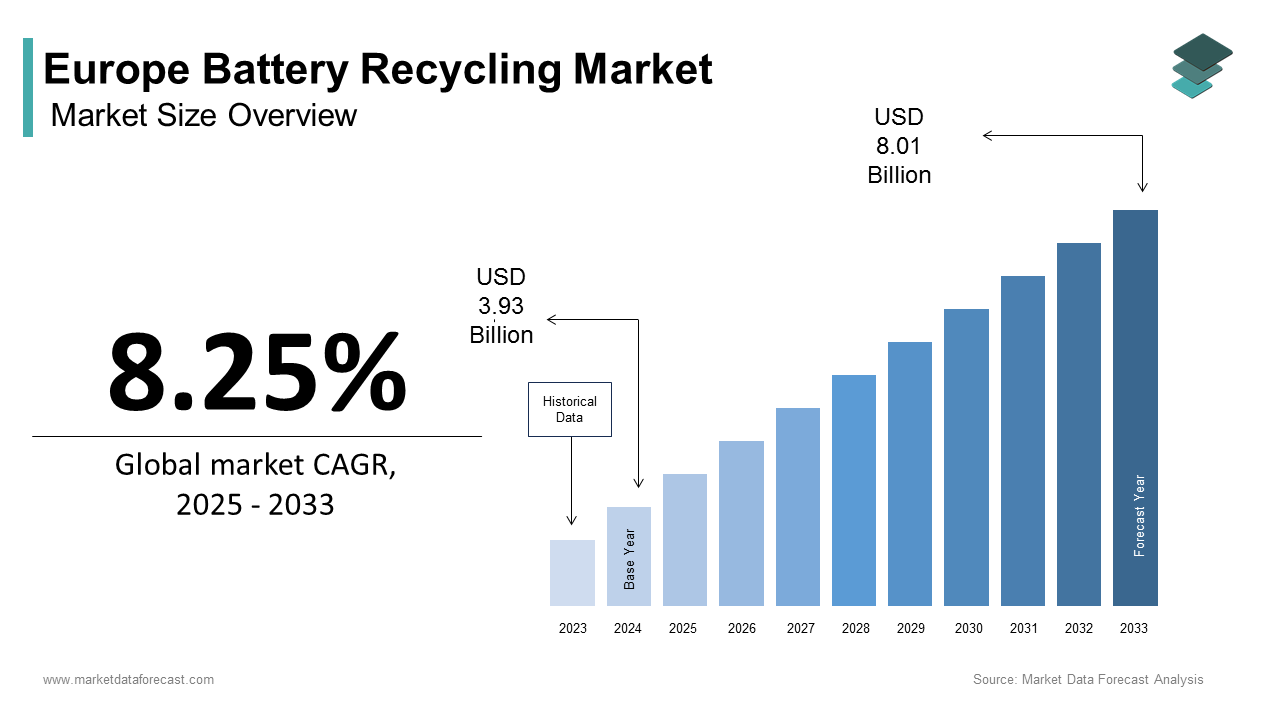
The Europe battery recycling market size was calculated to be USD 3.93 billion in 2024 and is anticipated to be worth USD 8.01 billion by 2033, from USD 4.25 billion in 2025, growing at a CAGR of 8.25% during the forecast period.
Battery recycling refers to the systematic recovery of critical raw materials, such as lithium, cobalt, nickel, manganese and graphite, from spent portable industrial and traction batteries through hydrometallurgical, pyrometallurgical or direct recycling processes. This activity has transitioned from a peripheral waste management function to a strategic industrial priority under the European Union’s circular economy and critical raw materials security frameworks. According to Eurostat data from 2022, approximately 111,000 metric tons of used portable batteries were formally collected for recycling in the EU, representing 46% of average annual sales. Moreover, due to regulations, batteries in the EU generally cannot be sent to landfills. The challenge lies in scaling up formal collection and recycling infrastructure to manage the projected significant increase in end-of-life lithium-ion batteries from electric vehicles and consumer electronics in the coming years. Meanwhile, the European Commission’s 2023 Critical Raw Materials Act identifies lithium, cobalt and nickel as strategic materials with supply risks, noting that the EU imports over 97 percent of its lithium and 90 percent of its cobalt. Against this backdrop, battery recycling is no longer merely an environmental obligation but a cornerstone of industrial policy aimed at reducing import dependency and enabling domestic battery value chains under the European Battery Alliance.
MARKET DRIVERS
Mandatory Recycling Targets Under the EU Battery Regulation
The legally binding collection and material recovery targets established by the revised EU Battery Regulation drive the growth of the Europe battery recycling market. The new legislation mandates a significant increase in the collection of portable batteries for recycling in the coming years. The regulation requires high minimum recovery efficiencies for valuable materials, such as cobalt, nickel, and copper, from electric vehicle lithium-ion batteries. It also introduces a battery passport system, which necessitates the digital tracking of material composition and carbon footprint. These changes aim to boost the processing of end-of-life batteries annually. Member states are obligated to establish accessible collection networks, including at retail points and municipal waste sites. Non-compliance triggers financial penalties and market access restrictions, compelling producers to partner with certified recyclers. This regulatory architecture transforms battery recycling from a voluntary activity into a compulsory industrial process integrated into the product life cycle mandate across all 27 member states.
Rising Deployment of Electric Vehicles and Associated Battery Waste Streams
The rapid adoption of electric mobility is generating a predictable and growing stream of high-value end-of-life traction batteries that fuels the expansion of the Europe battery market. According to data from the European Automobile Manufacturers' Association (ACEA), over 1.5 million battery electric vehicles were registered in the EU in 2023, representing a 14.6% market share of total new car sales. An average EV battery pack weighs approximately 400 to 545 kg (900 to 1,200 lbs) and typically contains around 8 kg of lithium, 29 kg of nickel, and varying amounts of cobalt and other minerals. Based on an average 8 to 10 year vehicle lifespan, the first significant wave of EV battery retirements is expected to occur between approximately 2028 and 2032. The volume of end-of-life batteries is projected to increase substantially in the years after this initial wave. Automakers have already signed long-term offtake agreements with recyclers to reclaim materials for new cell production. This forward integration creates a closed-loop incentive where recycling is not just waste management but a supply chain necessity. The scale and chemical consistency of EV batteries make them far more attractive for recyclers than heterogeneous consumer battery waste, thereby accelerating investment in dedicated hydrometallurgical facilities across Germany, France and Sweden.
MARKET RESTRAINTS
Complex and Cost-Intensive Logistics for Battery Collection and Transportation
Lithium-ion batteries are classified as hazardous under the European Agreement concerning the International Carriage of Dangerous Goods by Road (ADR), which requires stringent packaging, labelling, and transport conditions and thereby hinders the growth of the Europe battery recycling market. These regulations drastically increase logistics costs, with specialized transport services costing more than standard freight. Moreover, the lack of standardized collection points means recyclers must coordinate pickups from thousands of dispersed sources, including auto dismantlers, electronics retailers and municipal depots. In rural regions, collection density falls below economic thresholds, making regular routes unviable. The result is prolonged storage at intermediate sites, which increases fire risk and regulatory scrutiny. The implementation of a harmonized pan-European reverse logistics framework is essential to overcome the logistical barriers that currently suppress collection rates and inflate operational costs across the recycling value chain.
Technological Immaturity in Lithium and Graphite Recovery Efficiency
The recovery of lithium and graphite remains technically challenging and economically marginal under current process standards, which inhibits the expansion of the Europe battery recycling market. Graphite recovery is even less developed, with most facilities discarding anode material as inert waste despite it comprising a portion of cell mass. The European Commission’s 2023 Battery Regulation mandates 50 percent lithium recovery by 2027, yet few plants possess the necessary solvent extraction or electrochemical refining capabilities. This technological gap forces recyclers to focus on high-value cobalt and nickel while treating lithium as a byproduct, reducing overall process economics. Europe will struggle to meet its statutory material recovery targets, particularly for lithium, unless public or private investment in next-generation direct recycling or selective recovery technologies increases.
MARKET OPPORTUNITIES
Integration of Recycled Content Mandates in New Battery Production
Integration of recycled content mandates in new battery production provides fresh opportunities for the growth of the Europe battery recycling market. The EU Battery Regulation’s requirement that new electric vehicle batteries placed on the market from 2031 must contain minimum levels of recycled content, 16 percent for cobalt, 6 percent for lithium, a nd 6 percent for nickel, rising further by 2036. This policy creates a guaranteed demand signal for high-purity recycled materials, directly linking recyclers to battery cell manufacturers. Companies have already committed to using recycled nickel in their cells by 2030, while Umicore supplies cathode precursors with a portion of recycled content to major automakers. The regulation also stipulates that recycled materials must be traceable via the digital battery passport, ensuring quality and origin verification. This closed-loop framework transforms recyclers from waste processors into strategic raw material suppliers. This policy-driven circularity not only reduces primary mining dependence but also enhances the economic viability of advanced recycling facilities across the bloc.
Emergence of Urban Mining Hubs in Industrial and Automotive Clusters
The region is witnessing the strategic development of integrated battery recycling and remanufacturing parks adjacent to existing automotive and chemical industrial zones, creating synergistic “urban mining” ecosystems. This creates new opportunities for the expansion of the Europe battery recycling market. In Germany, the Chemnitz and Salzgitter regions host coordinated clusters where Volkswagen’s battery gigafactory, Northvolt’s recycling pilot and BASF’s cathode production co-locate to minimize transport and enable material exchange. The European Investment Bank has allocated funds to support such industrial symbiosis projects under its Innovation Fund. These hubs benefit from shared infrastructure, including hydrogen-based energy grids, solvent recovery systems and digital traceability platforms compliant with battery passport requirements. The co-location of collection, dismantling, recycling, and reintegration within these hubs leads to dramatic improvements in both process economics and regulatory compliance. This arrangement also allows them to serve as testbeds for advanced direct recycling technologies.
MARKET CHALLENGES
Cross-Border Regulatory Fragmentation in Waste Classification and Permitting
The inconsistent national interpretation of EU waste and chemicals legislation leads to divergent permitting requirements and cross-border movement barriers, which constrain the growth of the European battery recycling market. Although the EU Battery Directive establishes harmonized principles, the transposition into national law varies significantly. According to the European Environment Agency end of end-of-life batteries are classified as hazardous waste in Germany and France, but as non-hazardous in certain circumstances in Italy and Spain, creating legal uncertainty for recyclers operating across jurisdictions. The permitting process for recycling facilities also differs widely. Furthermore, the shipment of used batteries between member states requires prior notification under the Waste Shipment Regulation, but national authorities often impose additional documentation or inspection demands, causing delays. This regulatory patchwork increases compliance costs, European scale and fragments investment in large centralized recycling capacity, undermining the efficiency of the internal market for secondary raw materials.
Shortage of Skilled Workforce for Advanced Battery Recycling Operations
A serious human capital gap also hampers the expansion of the Europe battery recycling market. This is because the shift from mechanical shredding to chemical refining demands highly specialized expertise in electrochemistry, hydrometallurgy, and process automation that is currently scarce across the continent. However, vocational training programs remain underdeveloped. Existing chemical engineers often lack exposure to lithium recovery circuits, while waste management personnel are untrained in handling high-energy battery chemistries. The European Commission’s Skills Agenda identifies battery recycling as a priority sector for upskilling, yet implementation lags. Pilot programs train fewer professionals annually than the projected demand. This talent shortfall delays plant commissioning, increases operational errors and elevates safety risks, particularly in thermal runaway management. Europe's ambitious recycling targets may be technically achievable but practically unstaffed without coordinated investment in education and cross-sectoral reskilling.
REPORT COVERAGE
| REPORT METRIC | DETAILS |
| Market Size Available | 2024 to 2033 |
| Base Year | 2024 |
| Forecast Period | 2025 to 2033 |
| CAGR | 8.25% |
| Segments Covered | By Battery Type, Source, Recycling Method and Region |
| Various Analyses Covered | Global, Regional & Country Level Analysis; Segment-Level Analysis; DROC, PESTLE Analysis; Porter’s Five Forces Analysis; Competitive Landscape; Analyst Overview of Investment Opportunities |
| Regions Covered | UK, France, Spain, Germany, Italy, Russia, Sweden, Denmark, Switzerland, Netherlands, Turkey, and the Czech Republic |
| Market Leaders Profiled | Umicore, Accurec Recycling GmbH, Euro Dieuze Industrie (EDI), Bebat, Redux Recycling GmbH, Recupyl, Glencore International AG, Fortum Battery Recycling, SNAM S.A.S, Stena Recycling, Li-Cycle, ECOBAT And Battery Recycling Holland |
SEGMENTAL ANALYSIS
By Battery Type Insights
The lead-acid batteries segment held the leading share of 68.3% of the Europe battery recycling market in 2024. The supremacy of the lead-acid batteries segment is propelled by decades of mature collection infrastructure and near-complete recyclability. This dominance stems from their entrenched use in automotive starting, lighting and ignition systems and uninterrupted regulatory support. Europe has achieved significant collection and recycling rates for automotive lead-acid batteries due to well-integrated take-back systems at garages, scrapyards and retailers. This efficiency is unmatched by newer chemistries whose collection networks remain fragmented. The simplicity of lead reclamation, using pyrometallurgical smelting in dedicated furnaces, enables small and medium enterprises to participate profitably. The EU's lead recycling infrastructure is deeply embedded in national waste management frameworks, ensuring a consistent flow of feedstock regardless of economic cycles, a stability made possible by the presence of several certified recyclers. Moreover, lead retains strong market value due to its reuse in new battery production, with most of Europe’s lead consumption derived from recycled sources. The closed loop model allows for to supply of refined lead directly back to battery manufacturers such as Exide and Clarios under long-term contracts. Besides, lead-acid batteries contain minimal regulated substances beyond lead and sulfuric acid, both of which are efficiently neutralized and recovered. This economic and technical simplicity ensures that, despite declining use in electric mobility, lead-acid recycling remains the backbone of Europe’s battery recovery ecosystem both in volume and operational reliability.
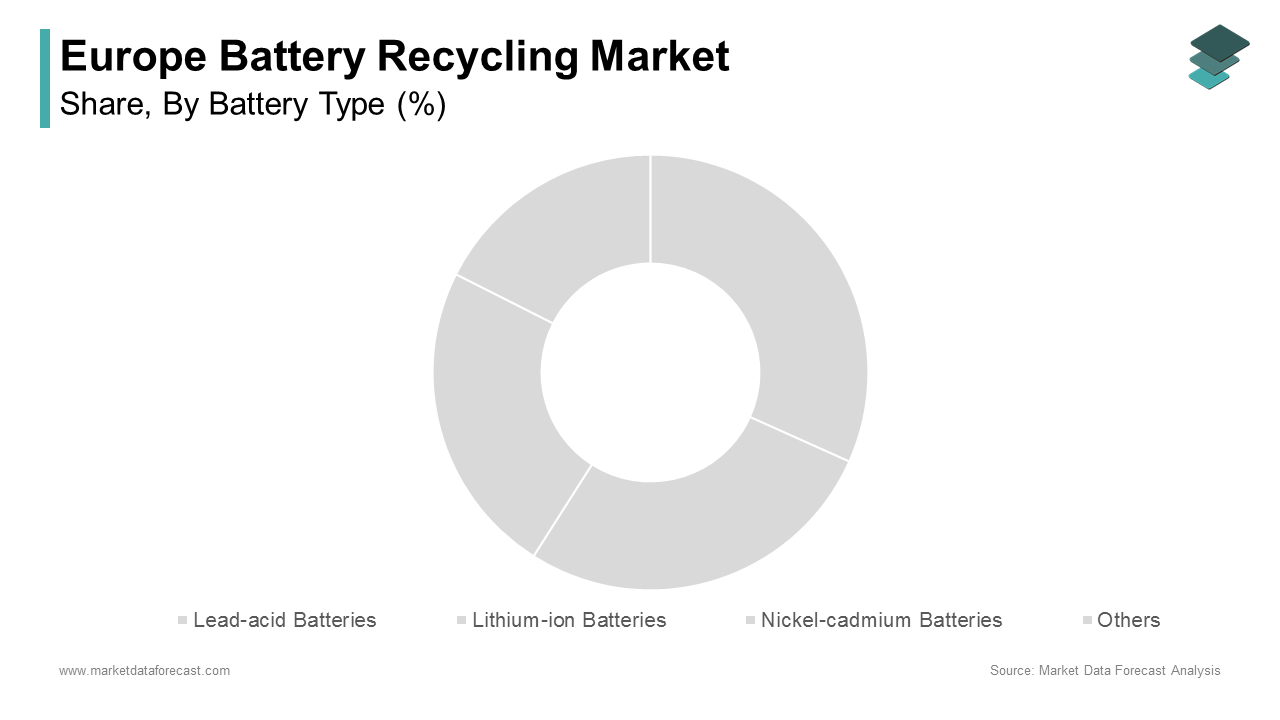
The lithium-ion batteries segment is likely to experience the fastest CAGR of 34.7% from 2025 to 2033 due to factors such as electric vehicle adoption and stringent regulatory mandates. The first major wave of retired lithium-ion traction batteries from early electric vehicles is now entering the waste stream. According to sources, a large number of battery electric vehicles sold between 2014 and 2018 are approaching their 8-to-10-year service life. Each pack contains recoverable cobalt and lithium. Automakers have signed binding agreements with recyclers to reclaim these materials for new cell production. This predictable high-value waste stream is attracting over 2 billion euros in private investment for hydrometallurgical plants across Germany, France, and Sweden. The EU Battery Regulation, enacted in 2023, sets escalating targets for lithium cobalt and nickel recovery and mandates minimum recycled content in new batteries from 2031. These dual requirements create both supply and demand pressure. Companies design batteries for disassembly to facilitate recycling compliance. The battery passport system further ensures traceability, enabling recyclers to certify output purity. This regulatory scaffolding transforms lithium-ion recycling from a cost center into a strategic raw material sourcing channel, accelerating facility construction and technology adoption across the continent.
By Source Insights
The transportation OEMs segment was the largest segment of the Europe battery recycling market by capturing a 52.6% share in 2024. The dominance of the transportation OEMs segment is propelled by the massive scale of traction battery deployment in electric vehicles and commercial fleets. Under the EU Battery Regulation, manufacturers of electric vehicles are legally responsible for financing and organizing the collection and recycling of end-of-life batteries. The structured approach ensures high-quality feedstock with known chemistry and minimal contamination, enabling efficient material recovery. The regulatory certainty also allows recyclers to invest in chemistry-specific processing lines, knowing future supply is guaranteed. In addition, European automakers view battery recycling not as waste disposal but as a critical input for securing raw materials amid supply chain vulnerabilities. The vertical integration reduces reliance on imported critical minerals and lowers the carbon footprint.
The consumer electronics segment is on the rise and is expected to be the fastest-growing segment in the market by witnessing a CAGR of 22.4% from 2025 and 203,3, owing to short device lifespans and new regulatory triggers. Europeans discard millions of metric tons of e-waste annually, with batteries comprising a growing share due to the ubiquity of smartphones, laptops and wearables. The infrastructure expansion will unlock vast dormant volumes currently stored in households or discarded improperly. The EU’s 2023 Ecodesign for Sustainable Products Regulation requires that from 2027 all smartphones and laptops sold in Europe must have user-replaceable batteries. Manufacturers are already redesigning products to comply. These design shifts, combined with municipal waste collection upgrades under the Circular Economy Action Plan, will transform consumer electronics from a fragmented waste stream into a high-volume, consistent feedstock source for recyclers.
By Recycling Method Insights
The pyrometallurgy segment led the Europe battery recycling market by occupying a substantial share in 2024. The prominence of the pyrometallurgy segment is attributed to its robustness, scalability, and integration with existing non-ferrous smelting infrastructure. Major European recyclers operate pyrometallurgical furnaces co-located with copper and nickel smelters, allowing synergistic energy and material flows. The integration reduces capital expenditure and leverages decades of metallurgical expertise. The high temperature process effectively destroys organic electrolytes and separators while concentrating cobalt, nickel and copper into an alloy that is easily refined. This operational flexibility makes it the default choice for handling heterogeneous battery waste streams from consumer electronics and industrial sources. Pyrometallurgical facilities benefit from well-understood permitting pathways under the EU Industrial Emissions Directive. Their air pollution control systems, using bag filters, scrubbers and dioxin abatement, are certified and monitored by national authorities, ensuring compliance with Best Available Techniques reference documents. In contrast, newer methods face regulatory uncertainty. The European Chemicals Agency recognizes pyrometallurgy as a proven end-of-waste technology enabling recovered metals to be sold as virgin equivalents. This regulatory clarity accelerates project approvals and investor confidence.
The hydrometallurgy segment is expected to exhibit a noteworthy CAGR of 38.1% over the forecast period due to superior lithium recovery and alignment with circular economy goals. Hydrometallurgical processes use aqueous chemistry, leaching, precipitation and solvent extraction to selectively recover lithium, cobalt, nickel and manganese at high purities. This output meets battery grade specifications, allowing direct reuse in cathode synthesis without energy-intensive refining. In contrast, pyrometallurgy loses most of the lithium to slag streams. Companies are building modular hydrometallurgical plants in Germany and Finland, designed to process black mass from pre-treated batteries. Hydrometallurgy operates at ambient to moderate temperatures, typically below 100 degrees Celsius, drastically reducing energy consumption compared to pyrometallurgical smelting. This advantage aligns with the EU’s Carbon Border Adjustment Mechanism and corporate net zero commitments. Additionally, the modular nature of hydrometallurgical plants allows deployment near urban collection hubs, reducing transport emissions. Hence, this environmental edge will accelerate adoption across new and retrofit recycling facilities.
REGIONAL ANALYSIS
Germany Battery Recycling Market Analysis
Germany outperformed other countries in the Europe battery recycling market by capturing a 26.4% share in 2024. The supremacy of Germany in the regional market is driven by its dual role as Europe’s largest automotive producer and a leader in industrial recycling infrastructure. The country hosts many certified lithium-ion battery recyclers. Germany’s KrWG Circular Economy Act mandates producer-funded collection, achieving notable portable battery recovery. With seven gigafactories under construction and the 2035 EU ICE ban accelerating EV adoption, Germany’s recycling demand is structurally anchored. Its robust chemical industry and strict waste permitting further attract international recyclers seeking EU entry points, making Germany the undisputed core of Europe’s battery circular economy.
France Battery Recycling Market Analysis
France was the next-prominent country in the Europe battery recycling market and accounted for a 17.8% share in 2024. The growth of the French market is because to aggressive state-led industrial policy and major automotive electrification initiatives. The country is home to the “Battery Valley” in Hauts de France, integrating Renault’s EV assembly, Verkor’s gigafactory and TES’s recycling plant into a closed-loop ecosystem. The French government allocates funds to battery value chain development. Companies are pioneering hydrometallurgical lithium recovery from black mass, achieving extraction efficiency. France has strategically positioned itself as Europe's alternative to German dominance by leveraging a nuclear-powered grid for low-carbon processing and fostering strong collaboration among state agencies, industry, and research institutes.
Sweden Battery Recycling Market Analysis
Sweden is another key player in the Europe battery recycling market due to its pioneering role in sustainable battery value chains and abundant renewable energy. The country hosts Northvolt’s flagship Revolt recycling facility in Västerås, which processes black mass from its Skellefteå gigafactory to recover nickel, manganese and lithium for direct cathode reuse. The government provides grants for circular battery projects. Sweden also leads in regulatory innovation, requiring all battery producers to join a national producer responsibility organization with mandatory annual recovery reporting. Sweden’s combination of green energy, strict environmental standards, and industrial foresight has made it a high-value niche leader in Europe’s battery recycling landscape.
Belgium Battery Recycling Market Analysis
Belgium expanded gradually in the Europe battery recycling market owing to its historic role as Europe’s non-ferrous metals hub and home to Umicore’s world-class Hoboken recycling complex. The Port of Antwerp serves as a key entry point for end-of-life batteries from across Europe, facilitating centralized processing. The country’s dense network of scrapyards and electronics retailers ensures high collection density even in urban areas. With deep expertise in precious metals refining and a strategic location in the heart of the EU, Belgium remains an indispensable node in the continental recycling infrastructure despite its small size.
Netherlands Battery Recycling Market Analysis
The Netherlands is likely to grow in the Europe battery recycling market between 2025 and 2033 due to its advanced logistics infrastructure and progressive circular economy policies. The Port of Rotterdam handles a share of Europe’s battery waste imports, serving as a consolidation hub for recyclers like TES and Fortum. The government allocated funds to fostering collaboration between TU Delft, TNO and industry for next-generation recycling. Companies like Li Cycle operate demonstration hydrometallurgical plants in Rotterdam, processing black mass from pre-treated batteries. The Netherlands attracts international recyclers looking for a gateway to the European market, making it a dynamic and growing player in the recycling ecosystem, thanks to English as a business lingua franca, strong IP protection, and access to EU research funds.
COMPETITION OVERVIEW
The Europe battery recycling market features a dynamic mix of established smelters, specialized recyclers and vertically integrated battery manufacturers competing on technology compliance and integration depth. Traditional players like Umicore leverage decades of metallurgical expertise and pyrometallurgical scale, while newcomers such as Northvolt and Li Cycle emphasize low-carbon hydrometallurgical processes tailored to lithium recovery. Competition is less about price and more about purity, traceability and alignment with OEM sustainability targets. The EU Battery Regulation acts as a great equalizer, mandating minimum recovery rates and recycled content, which forces all participants to upgrade capabilities. Fragmented collection infrastructure creates opportunities for companies that build strong reverse logistics through retail or municipal partnerships. Meanwhile, talent shortages and permitting delays constrain rapid scaling, allowing first movers with regulatory approvals to secure long-term advantages. As gigafactories come online, the race is shifting toward securing feedstock access and closing loops with automakers, making strategic positioning more critical than pure processing capacity.
KEY MARKET PLAYERS
A few major players of the Europe battery recycling market include
- Umicore
- Accurec Recycling GmbH
- Euro Dieuze Industrie (EDI)
- Bebat
- Redux Recycling GmbH
- Recupyl
- Glencore International AG
- Fortum Battery Recycling
- SNAM S.A.S
- Stena Recycling
- Li-Cycle
- ECOBAT
- Battery Recycling Holland
Top Strategies Used by the Key Market Participants
Key players in the Europe battery recycling market prioritize vertical integration by co-locating recycling facilities with battery manufacturing or automotive assembly to enable material loops and reduce transport emissions. They invest heavily in hydrometallurgical and direct recycling technologies to meet EU mandates for lithium recovery and recycled content. Companies establish long-term offtake agreements with automakers to secure feedstock and guarantee demand for recovered materials. Digital traceability systems aligned with the EU battery passport are deployed to ensure compliance and transparency. Strategic partnerships with municipalities, retailers and logistics providers strengthen collection networks while public-private collaborations with research institutions accelerate next-generation process innovation. These strategies collectively address regulatory, technical and commercial complexities unique to the European circular battery economy.
Leading Players in the Europe Battery Recycling Market
Umicore
Umicore is a Belgian materials technology and recycling group with a world-leading position in battery recycling through its Hoboken facility in Antwerp. The company processes end-of-life lithium-ion and nickel-metal-hydride batteries using proprietary pyrometallurgical technology to recover cobalt, nickel and copper at high purity for direct reuse in cathode production. Umicore supplies recycled cathode materials to major global battery cell manufacturers and automotive OEMs, including Audi and BMW. The company also integrated blockchain traceability into its output streams to support the EU battery passport initiative, reinforcing its role as a sustainable and compliant raw material supplier for the global electric mobility transition.
Northvolt
Northvolt is a Swedish battery manufacturer that has vertically integrated recycling into its core business model through its Revolt program. Operating one of Europe’s most advanced hydrometallurgical recycling plants in Västerås, Northvolt recovers lithium, nickel, manganese and cobalt from both manufacturing scrap and end-of-life batteries to produce new battery materials with a lower carbon footprint. The company supplies recycled content to its own gigafactories and partners like Volvo and Scania. These actions position Northvolt as a pioneer in closed-loop battery production aligned with the EU circular economy and climate objectives.
TES (formerly TES AMBA)
TES is a France-headquartered global leader in sustainable technology lifecycle services with a strong focus on lithium-ion battery recycling in Europe. The company operates advanced hydrometallurgical facilities in France and the Netherlands capable of processing black mass to recover battery-grade lithium, cobalt and nickel. TES serves major automotive OEMs, including Stellantis and Renault, through long-term offtake agreements and provides certified chain of custody documentation for compliance with EU regulations. The company also launched a digital battery passport interface to track recovered material flows from collection to refined output, supporting transparency and regulatory adherence across the European value chain.
MARKET SEGMENTATION
This research report on the Europe battery recycling market has been segmented and sub-segmented based on battery type, source, recycling method and region.
By Battery Type
- Lead-acid Batteries
- Lithium-ion Batteries
- Nickel-cadmium Batteries
- Others
By Source
- Manufacturing Scrap
- Transportation OEMs
- Consumer Electronics
- Others
By Recycling Method
- Pyrometallurgy
- Hydrometallurgy
- Direct Recycling
- Others
By Region
- UK
- France
- Spain
- Germany
- Italy
- Russia
- Sweden
- Denmark
- Switzerland
- Netherlands
- Turkey
- Czech Republic
- Rest of Europe
Frequently Asked Questions
1. What is driving the growth of the Europe battery recycling market?
Strict EU regulations, rising EV adoption, sustainability targets, and increased battery waste volumes are major growth drivers.
2. Which battery type is most commonly recycled in Europe?
Lead-acid batteries hold the highest recycling rate, followed by the emerging growth in lithium-ion battery recycling.
3. How does EV adoption impact the battery recycling market?
The surge in electric vehicles generates high volumes of end-of-life Li-ion batteries, increasing demand for recycling technologies.
4. What EU regulations support battery recycling?
The EU Battery Regulation, Circular Economy Action Plan, and Waste Framework Directive mandate collection targets and recycling efficiency standards.
5. Who are the key market players in Europe battery recycling?
Umicore, Accurec, Fortum, Glencore, Redux Recycling, Recupyl, ECOBAT, and Stena Recycling are major companies.
6. What materials are recovered in battery recycling?
Lithium, cobalt, nickel, manganese, lead, graphite, and aluminum are typically recovered from spent batteries.
7. What technologies are used in battery recycling?
Hydrometallurgical, pyrometallurgical, and mechanical processing are the main recycling methods.
8. What opportunities exist in the Europe battery recycling market?
Second-life batteries, advanced recycling technologies, and investments in local supply chains offer major opportunities.
9. Which end-use industries rely on recycled battery materials?
Automotive, electronics, energy storage systems, and industrial manufacturing sectors.
10. What is the future outlook of the market?
Rapid growth is expected due to EV penetration, stricter regulations, and the push toward a circular battery economy by 2030 and beyond.
Related Reports
Access the study in MULTIPLE FORMATS
Purchase options starting from
$ 2000
Didn’t find what you’re looking for?
TALK TO OUR ANALYST TEAM
Need something within your budget?
NO WORRIES! WE GOT YOU COVERED!
Call us on: +1 888 702 9696 (U.S Toll Free)
Write to us: sales@marketdataforecast.com