- Product Description Description
- Table of Contents TOC
- List of Table & Figure LOT
- Get Free Sample PDF Sample PDF
Market Size, 2025
$3.08 BnMarket Estimate, 2026
$3.35 BnMarket Forecast, 2034
$6.55 BnCAGR, 2026–2034
8.75%Executive Summary: Europe Cocoa Beans Market
- Market Scope: European market analysis covering cocoa products, end-use applications, and country-level trade/consumption hubs.
- Market Valuation: Valued at USD 3.08 billion (2025), estimated at USD 3.35 billion (2026), and projected to reach USD 6.55 billion by 2034, growing at a CAGR of 8.75% (2026–2034).
- Primary Growth Drivers: High regional processing capacity (EU importing ~1.4 million metric tons of cocoa beans in 2025 and producing >1.2 million metric tons of cocoa products annually), strong domestic confectionery demand (Germany's chocolate consumption at 8.7 kg per capita in 2025), and extreme commodity dynamics (cocoa prices exceeding USD 10,000 per metric ton in 2025).
Key Market Segment Metrics (2026–2034)
| Category | Leading Segment (2025 Position) | Fastest-Growing Segment |
|---|---|---|
| By Product | Cocoa Liquor (41.4% market share) | Cocoa Powder (7.04% CAGR) |
| By Application | Confectionery (73.4% market share) | Functional Foods and Beverages (9.08% CAGR) |
| By Country / Hub | Germany (25.2% share; Belgium exports at €4.9B; Netherlands as major import gateway) | — |
Major Market Players & Market Structure
Market Structure: Highly competitive landscape centered on strict supply-chain traceability, sustainable sourcing frameworks, regenerative agriculture practices, specialty fine-flavor cocoa, and advanced processing efficiency.
Key Companies: Fuji Oil Co., Ltd., Valrhona, The Hershey Company, Mars Group Holdings Corp, Cargill, Barry Callebaut AG, and Nestlé S.A.
Europe Cocoa Beans Market Size
The Europe cocoa beans market size was valued at USD 3.08 billion in 2025 and is projected to reach USD 6.55 billion by 2034 from USD 3.35 billion in 2026, growing at a CAGR of 8.75%.
Cocoa beans are raw and semi processed cocoa beans used primarily in chocolate manufacturing, food ingredients and cosmetic applications across European Union member states. Europe is not a producer of cocoa but serves as the world’s largest processor, which is transforming a significant share of global cocoa output into liquor, butter and powder. This central role stems from a dense concentration of historic and industrial chocolate makers in countries like Germany, Belgium and the Netherlands, which together host more than sixty major grinding facilities. According to the European Commission, the EU imported approximately 1.4 million metric tons of cocoa beans in 2025 with the Netherlands acting as the primary entry point through the Port of Amsterdam, which is the world’s largest cocoa port. In 2025, Germany led chocolate consumption in Europe with an average of 8.7 kilograms per capita, followed by other countries such as Estonia and Denmark. These structural dependencies position Europe as the global nexus of cocoa value addition, where regulatory, sustainability and quality standards increasingly shape upstream supply chains in West Africa and Latin America.
MARKET DRIVERS
The Stringent Deforestation and Supply Chain Due Diligence Regulations of Europe Reshape Sourcing Practices
The enforcement of the EU Deforestation Regulation that is effective from December 2025 mandates that all cocoa imported into the European Union must be verified as deforestation free after December 2020 with geolocation traceability required for each consignment, which is driving the cocoa beans market growth in Europe. As per the European Commission, this regulation affects the majority of current cocoa imports, as most originate from Côte d’Ivoire and Ghana regions where agricultural expansion has historically contributed to forest loss. Chocolate manufacturers and processors must now implement satellite monitoring, farm mapping and third-party verification systems to comply, which is fundamentally altering procurement strategies. Barry Callebaut, which is the world’s largest cocoa processor headquartered in Belgium reported in early 2026 that it had mapped over 220,000 farms supplying its European operations using GPS and blockchain ledgers to meet these requirements. For instance, a significant share of licensed cocoa importers had invested in digital traceability platforms by mid-2025. These compliance imperatives are driving unprecedented investment in origin transparency, which is elevating the value of certified, traceable beans and reshaping long term supplier relationships.
Persistent Consumer Preference for Premium and Artisanal Chocolate Sustains Demand for Fine Flavor Cocoa
European consumers continue to demonstrate strong willingness to pay for high quality, ethically sourced and origin specific chocolate, which is fuelling demand for fine flavor cocoa beans and contributing to the regional market expansion. As per the European Cocoa Association, fine flavor varieties accounted for around one fifth of cocoa bean imports into Belgium and Switzerland in 2025, which is an up from a smaller share in 2020. This shift is amplified by the rise of bean to bar chocolatiers; France has seen strong growth in artisanal chocolate makers in recent years. Supermarkets have followed suit with UK retailer Waitrose reporting that sales of single origin chocolate bars grew significantly year on year in 2025. These products require specific post-harvest fermentation and drying protocols to develop nuanced flavor profiles, which is creating stable demand for specialty beans despite global price volatility. This cultural and gastronomic appreciation for terroir driven chocolate ensures a resilient niche that buffers the broader market against commodity swings.
MARKET RESTRAINTS
Volatility in Global Cocoa Prices and Currency Fluctuations Disrupts Procurement Stability
Extreme price instability in the international cocoa market severely impacts European processors who operate on thin margins and fixed long-term contracts with confectionery brands, which is one of the key factors inhibiting the cocoa beans market growth in Europe. In 2025, cocoa prices on the ICE Futures exchange surged to record highs above 10,000 US dollars per metric ton, which is the highest in over four decades and is driven by supply shortages in West Africa and speculative trading. According to the International Cocoa Organization, this represented a sharp increase compared to early 2023. Simultaneously, the depreciation of the British pound and euro against the US dollar further inflated import costs for European buyers. For instance, many German confectionery manufacturers experienced margin compression in 2025 due to the inability to immediately pass on raw material cost increases to retailers. This financial pressure forces smaller processors to reduce inventories or exit the market, consolidating the sector and reducing competition. Until pricing mechanisms become more transparent and hedging tools more accessible, European cocoa users will remain vulnerable to external macroeconomic shocks.
Limited Domestic Processing Capacity in Source Countries Threatens EU’s Value Addition Dominance
While Europe dominates cocoa grinding, producing over 1.2 million metric tons of cocoa products annually, producing nations are increasingly asserting control over downstream processing to capture more value. Côte d’Ivoire’s cocoa grinding capacity has expanded significantly in recent years, supported by government incentives and foreign investment. Similarly, Ghana aims to process half of its cocoa domestically by 2026, up from about a quarter in 2022 according to its Cocoa Board. This shift reduces the volume of raw beans available for European import and increases competition for high quality fermentation output. For instance, if current trends continue, EU grinders could face notable shortfalls in raw bean supply by 2028. Furthermore, local processing in origin countries often bypasses European quality and sustainability standards, which is creating market fragmentation. This strategic realignment challenges Europe’s historical role as the global cocoa processing hub and pressures its industry to secure exclusive supply agreements or invest upstream to maintain feedstock access.
MARKET OPPORTUNITIES
Expansion of Regenerative Agriculture Partnerships Opens New Supply Channels
European chocolate manufacturers are increasingly investing in regenerative cocoa farming initiatives that restore soil health, enhance biodiversity and improve farmer livelihoods, which is a notable opportunity for the European cocoa beans market. As per the European Cocoa Association, a growing share of major EU-based chocolate companies had active regenerative agriculture pilots in 2025, which is covering extensive hectares across West Africa and Latin America. Nestlé’s “Cocoa Plan” in Côte d’Ivoire, for instance, reported yield improvements and higher carbon sequestration on participating farms after several years of agroforestry integration. Similarly, Tony’s Chocolonely partners with cooperatives in Ghana to implement shade grown cocoa systems that mimic natural forest ecosystems. These models not only secure long term bean supply but also qualify for green financing under the European Investment Bank’s sustainable agri-food facility. By embedding environmental and social resilience into sourcing, European firms are transforming cocoa from a commodity into a platform for systemic sustainability, which is creating differentiated and future proof supply chains.
Growth of Plant Based and Functional Food Trends Drives Innovation in Cocoa Ingredients
Beyond traditional chocolate, cocoa beans are gaining traction in Europe’s expanding plant based and functional food sectors due to their rich antioxidant profile, natural flavor depth and clean label appeal, which is another potential opportunity for the European cocoa beans market. As per the European Food Safety Authority, cocoa flavanols are officially recognized for contributing to normal blood flow, which is enabling health claims on fortified products and this has spurred product innovation. In 2025, Germany recorded strong growth in new food launches featuring cocoa powder as a functional ingredient, including protein bars, dairy alternatives and nootropic beverages. Similarly, as per the UK’s Food Standards Agency, cocoa derived ingredients appeared in a notable share of new plant-based dessert launches in 2025. These applications require consistent, high purity cocoa powders with standardized flavanol content, which is creating premium opportunities for specialized processors. As European consumers seek indulgence without compromise, cocoa’s versatility is unlocking value beyond confectionery into health oriented, everyday nutrition.
MARKET CHALLENGES
Inadequate Farmer Income and Labor Practices Undermine Sustainable Sourcing Commitments
Despite decades of certification and sustainability programs, cocoa farmers in West Africa continue to earn far below a living income, jeopardizing the long-term viability of ethical sourcing pledges, which is a key challenge to the regional market growth. According to a 2025 study by the Living Income Community of Practice, the average daily income of a cocoa farming household in Côte d’Ivoire was less than half the estimated living income benchmark. This economic distress perpetuates child labor and deforestation, which is directly conflicting with the EU’s Corporate Sustainability Due Diligence Directive. The European Commission acknowledged in its 2025 Cocoa Sector Review that only a small share of certified farms demonstrated measurable income improvement over five years. Major European buyers such as Mondelez and Ferrero have responded with direct cash transfer programs and productivity packages but systemic change remains elusive. Until pricing structures reflect true cost of sustainable production, Europe’s sustainability commitments will struggle to translate into on the ground impact.
Fragmented Certification Standards Confuse Consumers and Dilute Market Impact
The European cocoa market is inundated with overlapping sustainability certifications is creating confusion among consumers and inefficiency among producers. As per the European Consumer Organisation, a majority of surveyed EU shoppers in 2025 could not distinguish between the environmental or social criteria of major cocoa labels. This lack of clarity reduces willingness to pay premiums and enables greenwashing. Simultaneously, farmers face duplication of audits and paperwork. A cooperative in Ghana may undergo multiple assessments annually for different buyer programs, which is diverting resources from actual farm improvement. The European Commission’s 2025 Sustainability Labeling Study concluded that label proliferation has diminished consumer trust and diluted the market signal for genuine sustainability. In response, industry coalitions like the European Cocoa Initiative are pushing for harmonized metrics under the EU deforestation regulation, but progress remains slow. Until a unified, enforceable standard emerges, the impact of ethical consumption will remain fragmented and suboptimal.
REPORT COVERAGE
| REPORT METRIC | DETAILS |
| Market Size Available | 2025 to 2034 |
| Base Year | 2025 |
| Forecast Period | 2026 to 2034 |
| CAGR | 8.75% |
| Segments Covered | By Product, Application, and Region |
| Various Analyses Covered | Global, Regional, & Country Level Analysis; Segment-Level Analysis; DROC, PESTLE Analysis; Porter’s Five Forces Analysis; Competitive Landscape; Analyst Overview of Investment Opportunities |
| Regions Covered | UK, France, Spain, Germany, Italy, Russia, Sweden, Denmark, Switzerland, Netherlands, Turkey, and the Czech Republic |
| Market Leaders Profiled | Fuji Oil Co Ltd, Valrhona, The Hershey Company, Mars Group Holdings Corp, Cargill, Barry Callebaut AG, and Nestlé SA |
SEGMENTAL ANALYSIS
By Product Insights
The cocoa liquor segment held 41.4% of the European cocoa beans market share in 2025. The dominance of cocoa liquor segment in the European cocoa beans market is driven by its foundational role in chocolate manufacturing. Cocoa liquor is the primary ingredient in dark, milk and compound chocolate and cannot be substituted without compromising texture and flavor authenticity and Europe’s status as the world’s leading chocolate producer. According to the European Cocoa Association, the EU processes substantial volumes of cocoa beans into liquor annually with Germany, Belgium and Italy among the largest contributors to output. Major manufacturers like Barry Callebaut, Mondelez and Ferrero operate large-scale conching facilities that require consistent, high viscosity liquor with standardized fat content. The regulatory preference for real chocolate in premium segments is further boosting the dominance of cocoa liquor segment in the European market. The EU Cocoa and Chocolate Products Directive mandates that products labeled as “chocolate” must contain a minimum of 35% total cocoa solids, the majority of which derive from liquor. As per the German Federal Ministry of Food and Agriculture, the vast majority of dark chocolate sold in Germany in 2025 complied with these standards, which is rejecting cheaper compound alternatives. This legal and cultural commitment to authentic chocolate formulation ensures sustained, high-volume demand for cocoa liquor across both industrial and artisanal production channels.
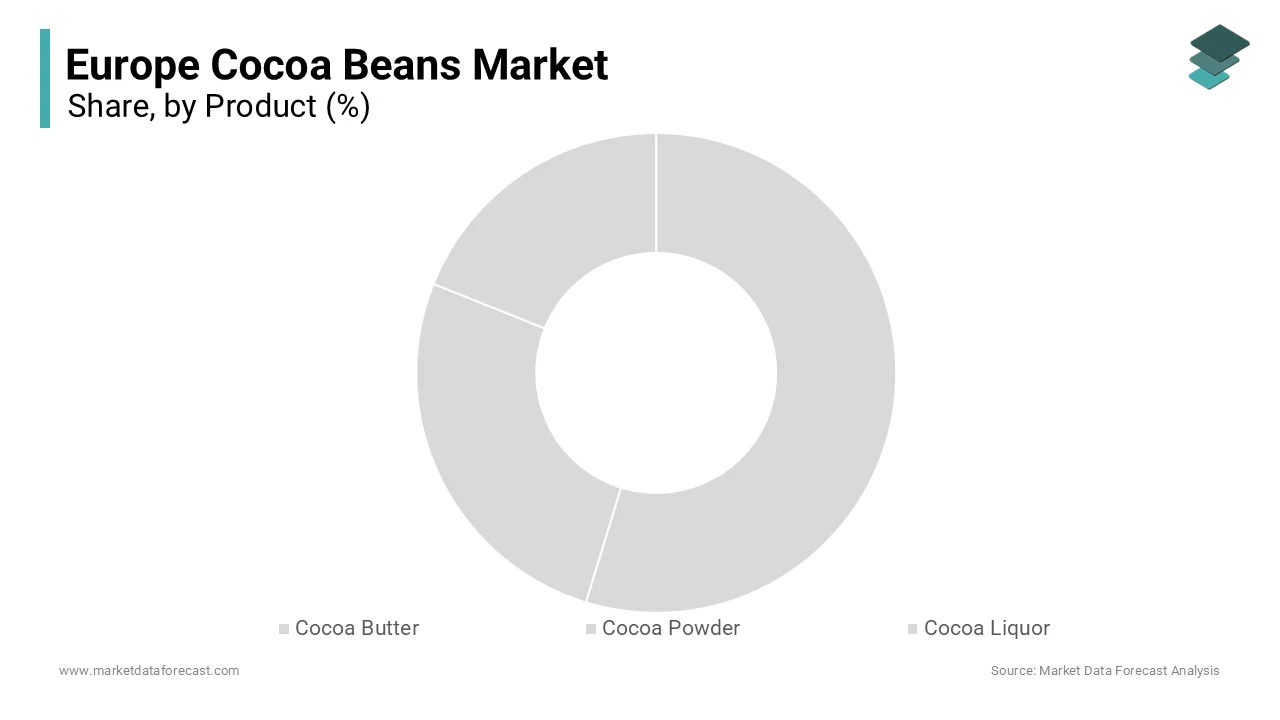
The cocoa powder segment is a promising segment and is expected to record a CAGR of 7.04% over the forecast period owing to its expanding use beyond traditional hot beverages into functional foods, plant-based nutrition and clean label formulations. According to the European Food Safety Authority, cocoa flavanols are officially recognized for supporting cardiovascular health, which is a claim permitted on packaging. This regulatory endorsement has spurred innovation. In 2025, Germany recorded strong growth in new plant-based protein products incorporating natural cocoa powder for flavor and antioxidant content. The rise of health-conscious indulgence among European consumers is also contributing to the expansion of cocoa powder segment in the European market. As per the European Consumer Organisation, a majority of surveyed adults in 2025 expressed willingness to choose products with “functional benefits” even in treat categories. This trend has transformed cocoa powder into a versatile ingredient in no added sugar protein bars, dairy free ice creams and mood enhancing beverages. Additionally, the shift toward natural colorants has increased demand for alkalized and natural cocoa powders as alternatives to synthetic dyes in baked goods. These cross category applications are propelling cocoa powder beyond its traditional niche into mainstream functional food development.
By Application Insights
The confectionery segment led the Europe cocoa beans market by accounting for 73.4% of the European market share in 2025. The growth of the confectionery segment in the European market is attributed to Europe’s deeply embedded chocolate culture, high per capita consumption and dense concentration of industrial and artisanal chocolatiers. According to Eurostat, average chocolate consumption across the EU remains high with Switzerland among the leaders. The confectionery sector relies almost exclusively on cocoa liquor and butter for authentic texture and melt characteristics, as mandated by EU labeling laws that restrict the use of non-cocoa fats in products labeled as chocolate. The seasonal and gifting economy that amplifies demand during holidays is also propelling the confectionery segment in this regional market. Major retailers expand assortments during these periods, requiring massive, predictable cocoa inputs. Furthermore, premiumization trends have increased cocoa content per unit, partially offsetting volume stagnation in mass market segments. This cultural, regulatory and commercial ecosystem ensures confectionery remains the undisputed core application for cocoa beans in Europe.
The functional foods and beverages segment is the fastest growing application segment and is anticipated to record a CAGR of 9.08% over the forecast period owing to the integration of cocoa into health oriented product categories that leverage its natural bioactive compounds. According to the European Food Safety Authority, cocoa powder is rich in flavanols, which are officially recognized for supporting cardiovascular health, which is a claim permitted on packaging in the EU. This regulatory endorsement has spurred innovation; in 2025, Germany saw increased launches of plant-based protein products incorporating natural cocoa powder for flavor and antioxidant content. The rise of health-conscious indulgence among European consumers is further driving the growth of the functional food and beverages segment in the European market. For instance, many adults in 2025 expressed willingness to choose products with “functional benefits” even in treat categories. This trend has transformed cocoa powder into a versatile ingredient in no added sugar protein bars, dairy free ice creams and mood enhancing beverages. Additionally, the shift toward natural colorants has increased demand for alkalized and natural cocoa powders as alternatives to synthetic dyes in baked goods. These cross category applications are propelling cocoa powder beyond its traditional niche into mainstream functional food development.
REGIONAL ANALYSIS
Germany Market Analysis
Germany occupied the major share of 25.2% of the Europe cocoa beans market in 2025 owing to its dual role as Europe’s biggest chocolate producer and most populous consumer market. Germany hosts numerous major chocolate manufacturers, including Stollwerck, Ritter Sport and key facilities for global players like Mondelez and Nestlé. Germany processed hundreds of thousands of metric tons of cocoa beans in 2025, primarily into liquor and butter for confectionery. Strict adherence to the EU Cocoa Directive ensures that the vast majority of domestically sold chocolate uses real cocoa ingredients, which is sustaining high raw material demand. Additionally, Germany’s engineering prowess supports advanced grinding and conching technology and attracting cocoa processors seeking efficiency and quality. With robust retail channels, strong export orientation and a culture that values both mass and premium chocolate, Germany remains the industrial and commercial epicenter of Europe’s cocoa economy.
Netherlands Market Analysis
The Netherlands is predicted to command a promising share of the European cocoa beans market in 2025 due to its strategic position as the global gateway for cocoa imports. The Port of Amsterdam handles large volumes of cocoa beans annually and is widely regarded as one of the leading cocoa ports globally. This logistical dominance is complemented by a dense cluster of processors, including Olam, Cargill and Barry Callebaut, which operate large grinding facilities in the Amsterdam harbor area. The Dutch government’s active support for sustainable supply chains has also made the country a hub for certified and traceable cocoa flows. Furthermore, the Netherlands serves as a re-export center, which is distributing processed cocoa products across Northern and Central Europe. This unique combination of infrastructure, policy and trade centrality solidifies the Netherlands as Europe’s indispensable cocoa logistics and processing nexus.
Belgium Market Analysis
Belgium is expected to register a healthy CAGR in the European cocoa beans market over the forecast period owing to its world renowned artisanal and industrial chocolate heritage. Belgium is home to thousands of chocolatiers and iconic brands such as Neuhaus, Godiva and Lotus Bakeries. According to Belgium’s Federal Public Service Economy, chocolate exports were valued at roughly 4.9 billion euros in 2025 with cocoa liquor forming the core input. Belgian chocolate is protected under EU geographical indications, mandating high cocoa content and traditional production methods that drive consistent bean demand. Tourism further amplifies consumption; Brussels attracts millions of visitors annually who purchase premium pralines. The government’s support for cocoa sustainability ensures long term supply integrity. Belgium’s fusion of craft excellence, brand prestige and export scale makes it a high value cocoa destination.
Switzerland Market Analysis
Switzerland is projected to hold a notable share of the Europe cocoa beans market over the forecast period. Despite its small population, due to its unparalleled per capita chocolate consumption and premium manufacturing base. According to the Swiss Federal Customs Administration, Switzerland imports substantial volumes of cocoa beans, primarily for its famed milk chocolate, which requires high fat cocoa butter blended with Alpine milk. Swiss chocolate enjoys protected status under bilateral EU agreements, ensuring strict quality standards that mandate minimum cocoa content. Per capita consumption is among the highest in Europe as per the Swiss Federal Statistical Office. Companies like Lindt and Nestlé invest heavily in sustainable sourcing with a large share of their cocoa traceable to farm level. Switzerland’s emphasis on luxury, consistency and innovation makes it a trusted hub for high end cocoa processing and global brand reputation.
France Market Analysis
France is estimated to hold a considerable share of the European market over the forecast period owing to a renaissance in artisanal chocolate and strong regulatory support for origin transparency. France hosts hundreds of beans to bar chocolatiers with Paris home to many specialty makers. French consumers increasingly favor single origin and direct trade cocoa, pushing demand for fine flavor beans from Ecuador and Madagascar. The government’s “Cocoa and Deforestation” roadmap, launched in 2023, allocates funding to support traceable supply chains, benefiting processors like Cémoi and Michel Cluizel. Additionally, France’s culinary tradition integrates cocoa into gourmet desserts and patisserie, sustaining steady industrial demand. With rising consumer literacy, policy alignment with the EU Deforestation Regulation and a culture that celebrates terroir in chocolate, France has emerged as a dynamic and values driven cocoa market.
COMPETITIVE LANDSCAPE
KEY MARKET PLAYERS
Some of the notable key players in the Europe cocoa beans market are
- Fuji Oil Co., Ltd.
- Valrhona
- The Hershey Company
- Mars Group Holdings Corp
- Cargill
- Barry Callebaut AG
- Nestlé S.A.
TOP STRATEGIES USED BY THE KEY MARKET PLAYERS
Key players in the Europe cocoa beans market prioritize full supply chain traceability by deploying satellite imagery farm mapping and blockchain ledgers to comply with the EU Deforestation Regulation. They invest in regenerative agriculture programs that improve farmer livelihoods while enhancing carbon sequestration and biodiversity in cocoa growing regions. Strategic partnerships with European retailers and chocolate makers enable co development of carbon neutral and living income verified cocoa products. Companies expand their fine flavor and specialty cocoa offerings to capture premium segments driven by artisanal and bean to bar demand. Continuous modernization of grinding and processing facilities in the Netherlands Belgium and Germany ensures operational efficiency and quality consistency in a volatile raw material environment.
COMPETITION OVERVIEW
The Europe cocoa beans market is characterized by intense competition among a few dominant multinational processors and a growing number of specialty suppliers catering to premium and ethical segments. The market is highly consolidated at the industrial level with scale, traceability infrastructure and sustainability credentials serving as primary competitive differentiators. Regulatory pressures—particularly the EU Deforestation Regulation and Corporate Sustainability Due Diligence Directive—have raised barriers to entry, favoring incumbents with established origin networks and digital monitoring capabilities. At the same time, the rise of fine flavor cocoa and bean to bar chocolate has created space for agile, mission driven players who emphasize terroir, direct trade and farmer partnerships. Price volatility and thin processing margins intensify cost discipline, while consumer demand for transparency pushes all participants toward greater accountability. The competitive landscape thus balances industrial efficiency with ethical authenticity with leadership increasingly defined by the ability to deliver both compliance and conscience in a single supply chain.
TOP PLAYERS IN THE MARKET
- Barry Callebaut is the world’s largest cocoa processor and chocolate manufacturer with deep integration across the Europe cocoa beans market through its extensive network of grinding plants in Belgium, Germany and the Netherlands. The company supplies both industrial and artisanal customers with cocoa liquor, butter and powder, while leading sustainability efforts through its Cocoa Horizons Foundation. In 2025 Barry Callebaut implemented farm level GPS mapping across 220,000 cocoa farms in West Africa to comply with the EU Deforestation Regulation, enabling full traceability for its European clients. It also launched a new line of regenerative cocoa products sourced from agroforestry systems, aligning with the EU Farm to Fork Strategy and strengthening its position as a sustainability pioneer in the European market.
- Cargill plays a pivotal role in the Europe cocoa beans market through its global origination network and advanced processing facilities in the Netherlands and Germany. The company provides a full spectrum of cocoa ingredients to confectionery, food and beverage manufacturers across the continent. In 2025 Cargill expanded its digital traceability platform to cover 100% of its European cocoa supply chain, integrating satellite monitoring and blockchain verification to meet new EU due diligence requirements. It also partnered with German retailers to launch carbon insetting programs that link cocoa purchases to verified reforestation projects in Côte d’Ivoire, enhancing brand credibility and securing long term supply in a tightening regulatory environment.
- Olam Food Ingredients maintains a strong presence in the Europe cocoa beans market through its sustainable sourcing initiatives and state of the art processing operations centered at the Port of Amsterdam. The company supplies premium cocoa ingredients to both multinational brands and specialty chocolatiers, emphasizing farmer income improvement and deforestation free supply chains. In 2025 Olam achieved full mass balance certification under the EU Deforestation Regulation for its European cocoa flows and launched a new fine flavor cocoa line from Ecuador featuring blockchain verified fermentation data. It also collaborated with Swiss and French chocolate makers to develop carbon neutral cocoa products, reinforcing its leadership in ethical and traceable cocoa solutions for discerning European buyers.
MARKET SEGMENTATION
This research report on the Europe cocoa beans market has been segmented and sub-segmented based on categories.
By Product
- Cocoa Butter
- Cocoa Powder
- Cocoa Liquor
By Application
- Confectionery
- Functional Foods & Beverages
- Pharmaceuticals
- Cosmetics
By Distribution Channel
- Online
- Offline
- Hypermarkets & Supermarkets
- Convenience Stores
- Specialty Stores
- Others
By Country
- UK
- France
- Spain
- Germany
- Italy
- Russia
- Sweden
- Denmark
- Switzerland
- Netherlands
- Turkey
- Czech Republic
- Rest of Europe