Europe Cold Storage Market Research Report Segmented By Construction Type (Production Stores, Bulk Storage, And Ports),Temperature (Frozen And Chilled), Application (Dairy Products, Processed Foods, Meat And Seafood, Fruits And Vegetables, And Pharmaceuticals), Warehouse Type (Private, Semi-Private And Public), And Country (UK, France, Spain, Germany, Italy, Russia, Sweden, Denmark, Switzerland, Netherlands, Turkey, Czech Republic And Rest Of Europe) – Size, Share, Trends, Growth, Forecast (2026 To 2034)
Market Size, 2025
$75.83 BnMarket Estimate, 2026
$81.73 BnMarket Forecast, 2034
$148.83 BnCAGR, 2026–2034
7.78%Europe Cold Storage Market Report Summary
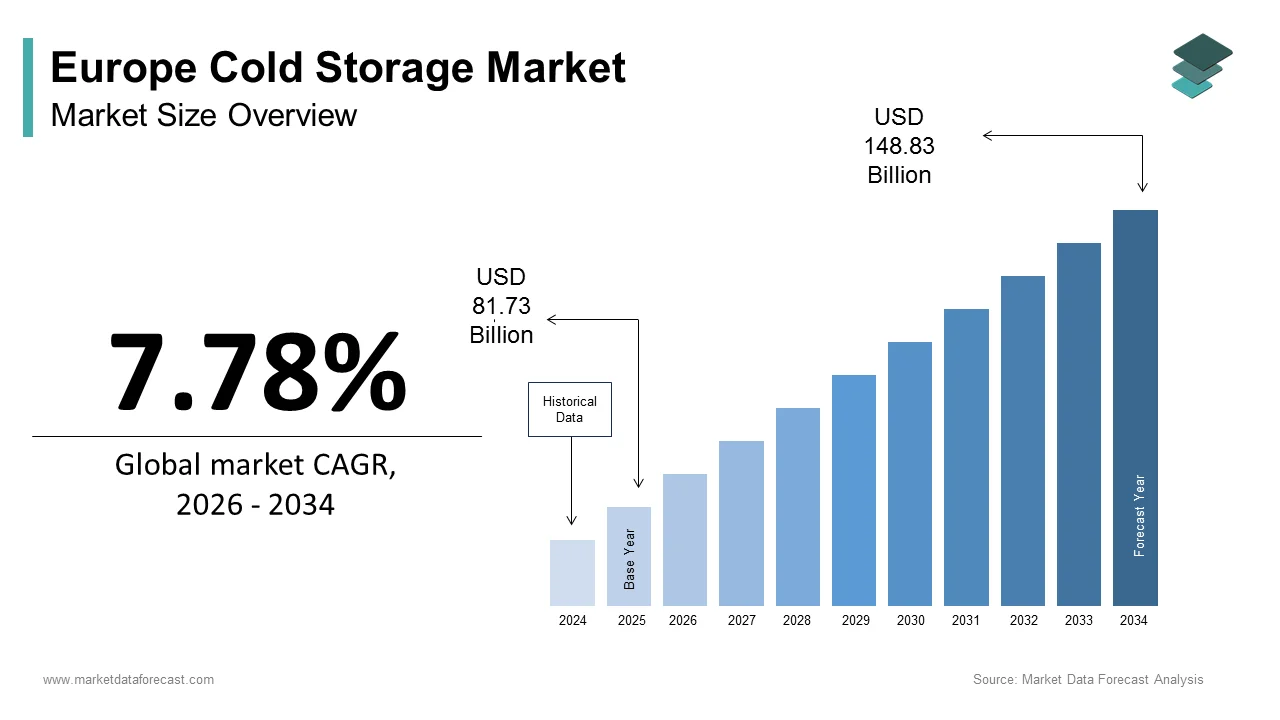
The Europe cold storage market was valued at USD 75.83 billion in 2025 and is projected to reach USD 148.83 billion by 2034, growing from USD 81.73 billion in 2026 at a CAGR of 7.78% during the forecast period. Market growth is driven by increasing demand for temperature-controlled logistics, rising consumption of frozen and processed foods, expanding pharmaceutical cold chain requirements, and the rapid growth of e-commerce grocery distribution. Investments in energy-efficient refrigeration systems, warehouse automation, and cold chain infrastructure are further supporting market expansion.
Key Market Trends
- Rising demand for temperature-controlled logistics across the food and pharmaceutical industries.
- Increasing investment in automated and energy-efficient cold storage facilities.
- Growing consumption of frozen foods and ready-to-eat meals.
- Expansion of pharmaceutical and vaccine cold chain logistics.
- Rising adoption of smart warehouse management systems and IoT-enabled monitoring technologies.
Segmental Insights
- Based on Construction Type, the bulk storage facilities segment dominated the Europe cold storage market in 2025 by accounting for 60.8% of the market share. The segment's growth is driven by its high storage capacity, cost efficiency, and ability to support large-scale food and pharmaceutical distribution.
- Based on Temperature, the frozen storage segment held the largest market share in 2025 due to the increasing need to preserve meat, seafood, dairy products, frozen foods, and processed food products for extended periods while maintaining product quality and safety.
- Based on Application, the meat and seafood segment dominated the Europe cold storage market in 2025, supported by growing consumption, stringent food safety regulations, and increasing international trade in perishable food products.
- Based on Warehouse Type, the private cold warehouses segment accounted for the largest market share in 2025, owing to increasing investments by food manufacturers, retailers, and logistics providers in dedicated cold storage infrastructure to improve supply chain efficiency.
Regional Insights
- Germany dominated the Europe cold storage market in 2025 by accounting for 24.8% of the regional market share. The country's leadership is supported by its advanced logistics infrastructure, strong food processing industry, and growing pharmaceutical cold chain demand.
- The Netherlands held a significant share of the Europe cold storage market due to its strategic position as Europe's primary gateway for perishable imports, supported by world-class port infrastructure and advanced logistics capabilities.
- The United Kingdom remains a key market, driven by its sophisticated retail sector, expanding e-commerce grocery market, and increasing investment in cold chain infrastructure following post-Brexit supply chain restructuring.
- France is expected to witness steady market growth, supported by its extensive agricultural production, well-developed food processing industry, and centralized food distribution network.
- Italy is anticipated to experience notable growth during the forecast period due to increasing exports of perishable food products, expanding cold chain logistics, and ongoing modernization of domestic warehousing infrastructure.
Competitive Landscape
The Europe cold storage market is highly competitive, with companies focusing on warehouse automation, energy-efficient refrigeration technologies, digital inventory management, and expansion of temperature-controlled logistics networks. Market participants are investing in capacity expansion, strategic acquisitions, and sustainable cold storage solutions to strengthen their market positions.
Key players operating in the Europe cold storage market include Burris Logistics, Americold Logistics LLC, Gulf Drug LLC, AGRO Merchants Group, Henningsen Cold Storage Co., Kloosterboer, Lineage Logistics Holding LLC, Nordic Logistics, and Oxford Logistics Group
Europe Cold Storage Market Size
The size of the European cold storage market was expected to be worth USD 75.83 billion in 2025 and is anticipated to be worth USD 148.83 billion by 2034, from USD 81.73 billion in 2026, growing at a CAGR of 7.78% during the forecast period.
Cold storage is a specialized facility or container designed to store perishable and temperature-sensitive products at controlled low temperatures to extend their shelf life and maintain quality. This infrastructure is not merely logistical but a critical public health and economic asset, ensuring food safety, reducing waste, and enabling modern supply chains. Its current expansion is shaped by systemic pressures beyond commerce. According to EU food waste estimates, a substantial amount of food is wasted annually, with the primary sources being households and manufacturing rather than solely distribution and retail. Simultaneously, the European Medicines Agency indicates a continuing rise in the approval of innovative medicines, including specialized biologics and gene therapies, which significantly increases the demand for strict cold chain logistics. These dual imperatives, sustainability through waste reduction and healthcare integrity through temperature-sensitive logistics, define the essential role and strategic urgency of cold storage infrastructure across the continent.
MARKET DRIVERS
EU Policy Mandates to Reduce Food Loss and Enhance Supply Chain Resilience
European Union policy frameworks are acting as a powerful structural driver for the Europe cold storage market expansion. The EU Farm to Fork Strategy commits to significantly lowering per capita food waste at the retail and consumer stages within this decade. Achieving this goal necessitates robust cold chain infrastructure to prevent spoilage between farm and fork. The European Commission promotes better cold chain logistics as part of a broader strategy to reduce food loss and waste throughout the food supply chain. This policy imperative has translated into concrete funding. The Common Agricultural Policy facilitates investments in rural infrastructure, including post-harvest handling, to improve sustainability. Furthermore, the lessons from recent supply chain disruptions have prompted national governments to classify cold storage as critical infrastructure, accelerating permitting and incentivizing private investment to build a more resilient and distributed network capable of absorbing future shocks.
Rapid Growth of Temperature-Sensitive Pharmaceutical and Biotech Logistics
The life sciences sector is emerging as a high-value growth enabler for the Europe cold storage market. Europe is a global hub for pharmaceutical innovation, with Germany, Switzerland, and the UK hosting major research and manufacturing clusters. The nature of modern medicine is increasingly temperature-sensitive. According to European Medicines Agency data for 2024, a significant portion of newly approved human medicines consists of biological treatments, vaccines, and advanced therapies, which frequently require specialized cold-chain storage. The rollout of personalized medicine and cell and gene therapies, which often have shelf lives measured in hours, demands a network of GMP-compliant, real-time monitored cold storage hubs near urban treatment centers. This shift transforms cold storage from a bulk commodity service into a precision logistics function, commanding premium rates and driving investment in highly specialized, secure, and digitally integrated facilities that meet stringent regulatory standards for data integrity and temperature control.
MARKET RESTRAINTS
Stringent Environmental Regulations on Refrigerants and Energy Consumption
The very technology that enables cold storage is under intense regulatory scrutiny due to its environmental impact, which in turn restricts the expansion of the Europe cold storage market. Traditional refrigerants with high global warming potential, such as R404A, are seeing significantly restricted availability due to the EU F-Gas Regulation, which dictates a steep, quota-based reduction of HFCs on the market to achieve long-term climate targets. Moving to natural refrigerants like ammonia or CO2 requires significant upfront capital investment for new, specialized equipment and safety, though these investments often result in lower long-term operating costs and better energy efficiency. Compounding this, the EU’s Energy Efficiency Directive imposes strict energy performance standards on industrial buildings. Cold storage facilities are among the most energy-intensive, and failing to meet these benchmarks can result in operational restrictions or fines. These dual pressures force operators to choose between costly upgrades and reduced capacity, directly constraining market growth despite strong underlying demand.
High Capital Expenditure and Long Payback Periods
Developing a modern cold storage facility requires substantial upfront investment, which creates a significant barrier to entry and growth of the Europe cold storage market. The construction of highly automated, single-temperature European cold chain facilities requires significant capital expenditure, with costs heavily influenced by, and often higher in, regions with limited available space near major ports, according to various sources. When multi-temperature zones or ultra-cold capabilities are added, costs escalate further. Automated cold storage projects frequently require extended periods to recover initial investment costs, with high capital costs and elevated borrowing rates creating a challenging investment environment, resulting in a preference for pre-leased or build-to-suit projects over speculative developments. Public funding, while available, is often fragmented across national and regional programs with complex application processes. This capital intensity means that market growth is largely confined to well-established players with strong balance sheets, limiting the agility of the sector to respond quickly to surging demand in emerging areas like e-grocery or biopharma logistics.
MARKET OPPORTUNITIES
Integration of Renewable Energy and Sustainable Cold Chain Solutions
The convergence of climate policy and technological innovation is opening a major opportunity in green cold storage. This is expected to contribute to the expansion of the Europe cold storage market. Companies that integrate on-site renewable energy, such as solar photovoltaic arrays or geothermal cooling, with high-efficiency refrigeration systems can significantly reduce both operating costs and carbon footprint. Research in the Netherlands indicates that solar-powered cold storage can maintain required temperatures while reducing reliance on the power grid. The European Union's Innovation Fund has committed substantial funding for industrial decarbonization, which includes eligibility for cold chain infrastructure improvements. This creates a compelling financial case for new builds or retrofits that combine natural refrigerants, thermal energy storage, and smart grid integration. Cold storage operators can turn environmental compliance into a competitive advantage by partnering with tenants on sustainability, thus attracting green financing.
Expansion of Urban Micro-Fulfillment Centers for E-Grocery and Pharma
The rise of e-commerce is driving demand for small-scale, strategically located cold storage nodes within city limits, which provides fresh prospects for the growth of the Europe cold storage market. The proportion of grocery sales conducted through digital channels across Western European markets has expanded significantly since the beginning of the decade. This sustained shift in consumer behavior has intensified the requirement for specialized temperature-controlled logistics and infrastructure to manage the final stage of delivery. Unlike traditional large warehouses on urban fringes, these micro-fulfillment centers, often repurposed retail spaces or basements, require compact, modular refrigeration units and real-time inventory tracking. Similarly, the growth of home healthcare and direct-to-patient drug delivery necessitates urban cold lockers and pharmacy-integrated chillers for short-term storage. This shift toward decentralized, agile cold storage networks offers higher margins and faster turnover than bulk warehousing. Companies that can master the logistics of dense urban environments, navigate zoning regulations, and deploy scalable modular technology are positioned to capture this high-growth, high-value segment of the market.
MARKET CHALLENGES
Shortage of Skilled Technicians for Advanced Refrigeration Systems
The transition to sustainable refrigerants and digital monitoring systems has created a critical skills gap in the European cold storage market. Natural refrigerants like ammonia require specialized handling certifications, and modern facilities rely on technicians who can manage both mechanical systems and IoT-based control platforms. Due to the regulatory transition towards greener refrigerants and rising demand in the cold chain, the European HVACR sector is experiencing a significant, growing, and documented shortage of qualified personnel. This shortage leads to longer repair times, increased risk of temperature excursions, and higher insurance premiums. Training programs are struggling to keep pace with technological change, and the aging workforce in this specialized field exacerbates the problem. A lack of skilled labor cripples high-tech cold storage, jeopardizing product integrity across the supply chain.
Fragmented Regulatory Landscape Across Member States
Inconsistent application of cold storage regulations across EU member states makes compliance complex, despite the existence of overarching EU frameworks, whiclimitts the expansion of the Europe cold storage market. Building codes for insulation thickness, fire safety requirements for refrigerant types, and hygiene standards for food-grade facilities differ from country to country. For example, Germany mandates double-walled ammonia piping in all new installations, while France allows single-walled systems with enhanced monitoring. Similarly, energy performance certification processes are managed at the national level, leading to inconsistent evaluation criteria. This fragmentation forces multinational operators to maintain multiple design standards and compliance teams, increasing costs and delaying project timelines. The establishment of a unified European cold chain remains impeded by bureaucratic and technical obstacles, restricting growth and innovation until improved harmonization is achieved.
REPORT COVERAGE
| REPORT METRIC | DETAILS |
| Market Size Available | 2025 to 2034 |
| Base Year | 2025 |
| Forecast Period | 2026 to 2034 |
| CAGR | 7.78% |
| Segments Covered | By Construction Type, Temperature, Application, Warehouse Type, And Region |
| Various Analyses Covered | Global, Regional & Country Level Analysis; Segment-Level Analysis; DROC, PESTLE Analysis; Porter’s Five Forces Analysis; Competitive Landscape; Analyst Overview of Investment Opportunities |
| Regions Covered | UK, France, Spain, Germany, Italy, Russia, Sweden, Denmark, Switzerland, Netherlands, Turkey, and the Czech Republic |
| Market Leaders Profiled | Burris Logistics, AmeriCold Logistics LLC, Gulf Drug LLC, AGRO Merchants Group, Henningsen Cold Storage Co, Kloosterboer, Lineage Logistics Holding, LLC, Nordic Logistics, and Oxford Logistics Group |
SEGMENTAL ANALYSIS
By Construction Type Insights
The bulk storage facilities segment dominated the Europe Cold Storage Market and accounted for a 60.8% share in 2025. The dominance of the segment is attributed to its foundational role in the continent’s food supply chain, serving as central hubs for long-term preservation of agricultural output and imported goods. According to Eurostat, the EU produces a high volume of raw milk, with a large portion delivered to dairies for processing, alongside a substantial annual harvest of cereals, both of which often require temperature-controlled or specialized storage before processing or distribution. Bulk warehouses, often located near major ports or agricultural regions, provide the economies of scale necessary to handle these vast volumes efficiently. Their large footprint and standardized temperature zones make them ideal for storing commodities like frozen meat, dairy blocks, and seasonal produce. National strategic reserves, such as France’s emergency food stockpiles managed by the Ministry of Agriculture, further anchor demand for high-capacity, reliable bulk storage infrastructure across the region.
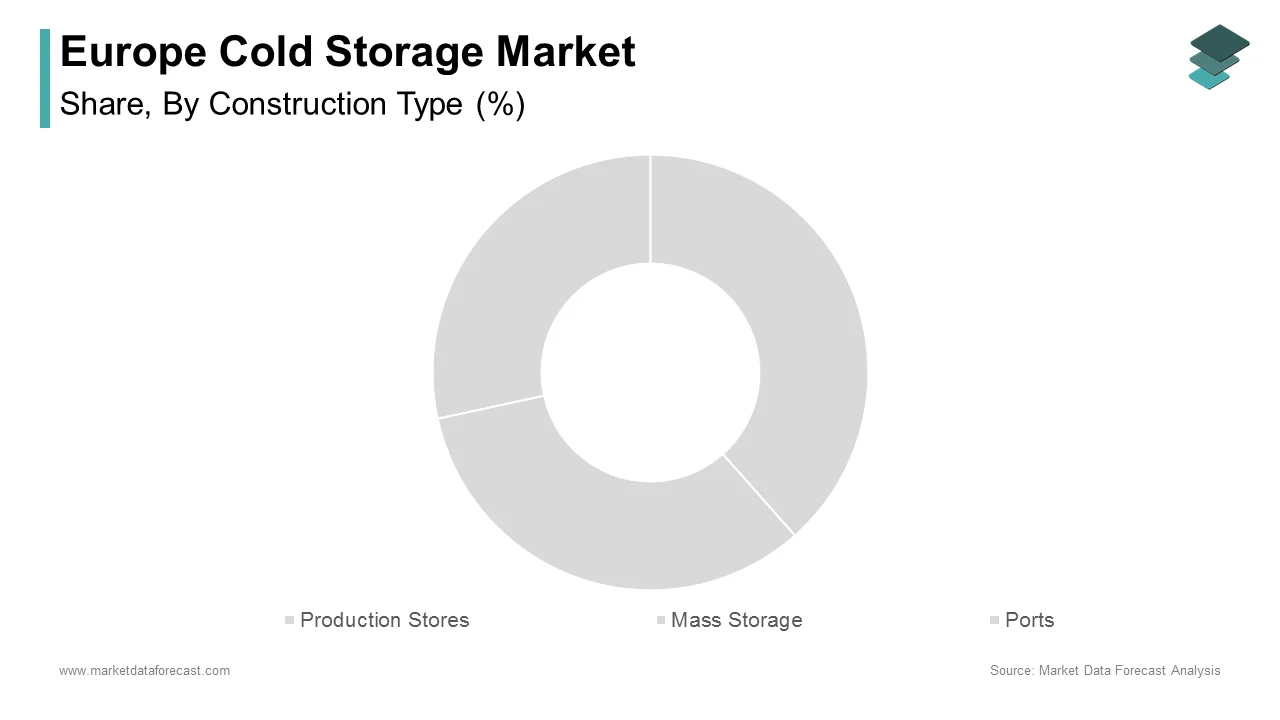
The production stores segment is on the rise and is expected to be the fastest-growing segment in the market by witnessing a CAGR of 8.9% from 2026 to 2034. The driver for this growth is the rise of highly automated, continuous production lines that require immediate cold holding of finished goods before dispatch. These facilities are integrated directly into food processing and pharmaceutical manufacturing plants, enabling just-in-time inventory management and seamless workflow integration. In the food sector, ready-meal manufacturers in Germany and the Netherlands operate production stores that maintain products at precise temperatures for less than 24 hours before shipment, minimizing quality degradation. In pharma, biologics producers in Switzerland and Ireland rely on adjacent cold rooms to store vaccines and cell therapies under GMP conditions immediately after batch completion. This model reduces handling, enhances traceability, and ensures compliance with stringent hygiene standards, making production-integrated cold storage indispensable for modern, high-throughput manufacturing.
By Temperature Insights
The frozen storage segment led the Europe cold storage market in 2025 because of the extensive need to preserve meat, seafood, and frozen convenience foods over extended periods. The European Union functions as a major producer and consumer in the global frozen food market, with industry data indicating significant market value and high consumer demand for products like ready meals. Reports show consistent growth in this sector, driven by convenience and sustainability trends across major European economies. Deep-freeze facilities operating at minus 18 degrees Celsius or lower are essential for maintaining the safety and quality of these products throughout complex supply chains. Furthermore, strategic stockpiling initiatives, such as the EU’s emergency reserves of frozen meat and fish, rely on vast frozen warehouses to ensure food security. The logistical advantage of frozen storage, which allows for longer shelf life and more flexible distribution scheduling compared to chilled alternatives, cements its dominance in both food and certain pharmaceutical applications like vaccine distribution.
The chilled storage segment is expected to exhibit a noteworthy CAGR of 9.3% during the forecast period due to the booming demand for fresh and short-shelf-life products, including dairy, ready-to-eat meals, fresh produce, and biopharmaceuticals. The European Union’s push for healthier dietary patterns has aligned with a rising consumer preference for convenient, fresh food options, resulting in a notable upward trend in the purchase of ready-to-eat salads and fresh convenience meals across the internal market. Simultaneously, the pharmaceutical sector’s shift toward biologics, which typically require storage between 2 and 8 degrees Celsius, has created premium demand for GxP-compliant chilled environments. Urban e-grocery fulfillment centers, which must maintain precise temperature control for perishables during rapid last-mile delivery, are another key driver. This convergence of fresh food trends, advanced medicine logistics, and e-commerce is propelling chilled storage into the forefront of cold chain innovation.
By Application Insights
The meat and seafood segment was the largest segment in the Europe cold storage market in 2025. The supremacy of the segment is credited to Europe’s high per capita consumption and complex import-export dynamics. The European Union maintains its position as a major global producer of animal protein, with meat production largely driven by pork and poultry, while functioning as a net importer of specific meat products to meet domestic demand, according to the European Commission and Eurostat. Much of this volume requires deep-frozen storage for preservation during transit and buffer stocking. Countries like Spain and the Netherlands serve as key entry points for seafood imports from Asia and South America, necessitating massive port-adjacent cold storage capacity. Additionally, national food safety regulations mandate strict temperature control throughout the meat supply chain to prevent pathogen growth. This combination of trade volume, regulatory stringency, and consumer demand ensures that meat and seafood remain the single largest driver of cold storage utilization across the continent.
The pharmaceuticals segment is predicted to witness the highest CAGR of 12.1% between 2026 and 2034. The swift expansion of the segment is fuelled by the exponential rise in temperature-sensitive biologics, vaccines, and advanced therapy medicinal products. A significant and growing portion of newly authorized medicines in the European Union are biological products, necessitating specialized, refrigerated storage to maintain stability. The rollout of personalized medicine and cell and gene therapies, often with shelf lives of less than 72 hours, demands a network of ultra-reliable, real-time monitored cold storage hubs near urban treatment centers. Major biopharma clusters in Germany, Switzerland, and Belgium are investing heavily in GMP-compliant cold chain infrastructure. This high-value, high-compliance segment commands premium storage rates and is reshaping cold storage design toward smaller, more secure, and digitally integrated facilities that prioritize data integrity and temperature stability above all else.
By Warehouse Type Insights
The private cold warehouses segment held the majority share of the Europe cold storage market in 2025 as major food processors, retailers, and pharmaceutical companies invest in dedicated facilities to ensure full control over their supply chains. Retail giants like Carrefour and Tesco operate vast private cold networks to manage their private-label fresh and frozen product lines, while meat processors such as Danish Crown and seafood exporters like Lerøy rely on proprietary storage for quality assurance and logistics efficiency. This vertical integration allows companies to enforce strict hygiene protocols, optimize inventory turnover, and protect sensitive products like branded pharmaceuticals from cross-contamination. Research indicates that a significant portion of cold storage capacity in Western Europe is managed through a mix of in-house operations by food producers and specialized third-party providers. This trend is driven by the need for supply chain control and the adoption of outsourced, flexible, and sustainable logistics solutions.
The public cold storage facilities segment is estimated to register the fastest CAGR of 10.2% over the forecast period. These third-party logistics (3PL) providers offer scalable, flexible solutions that are particularly attractive to small and medium-sized enterprises, e-grocers, and emerging biotech firms that cannot justify the capital expenditure of private warehouses. The rise of online grocery shopping has created immense demand for shared cold space in urban fulfillment centers. Public operators like Lineage Logistics and NewCold are responding by deploying automated, multi-temperature facilities with real-time inventory tracking and API integrations for seamless e-commerce order management. This asset-light model enables clients to access state-of-the-art cold chain capabilities without long-term capital commitment, driving rapid adoption across dynamic and fragmented sectors.
REGIONAL ANALYSIS
Germany Cold Storage Market Analysis
Germany outperformed other countries in the Europe cold storage market and accounted for a 24.8% share in 2025. The dominance of the segment is driven by its position as the EU’s industrial and logistical powerhouse, home to major food processors, automotive suppliers with cold chain needs for parts, and a dense network of pharmaceutical manufacturers. The country’s central location in Europe makes it a critical transit hub, with a notable share of EU road freight passing through its territory. Germany’s stringent food safety laws and early adoption of automation have driven investment in high-tech, energy-efficient cold warehouses. The government’s “National Logistics Strategy” further supports cold chain expansion through funding for sustainable refrigeration and digital logistics platforms, solidifying Germany’s role as the continent’s cold storage backbone.
Netherlands Cold Storage Market Analysis
The Netherlands followed closely in the Europe cold storage market due to its unparalleled role as Europe’s gateway for perishable imports. The Port of Rotterdam and Amsterdam Schiphol Airport handle a significant portion of all non-EU fruit and seafood entering the bloc. This massive throughput necessitates vast, highly specialized cold storage clusters in the Randstad region, equipped with phytosanitary inspection zones and customs clearance facilities. The Netherlands is also a leader in horticulture, exporting billions of dollars ' worth of fresh vegetables annually, much of which is stored in climate-controlled facilities before export. The government’s “Greenport” initiative actively promotes innovation in sustainable cold chain technology, including geothermal cooling and hydrogen-powered refrigerated transport, making the country a testbed for next-generation cold storage solutions that serve the entire European market.
United Kingdom Cold Storage Market Analysis
The United Kingdom is also a key player in the Europe cold storage market because of its sophisticated retail sector and post-Brexit supply chain restructuring. The UK’s grocery market is one of the most advanced in Europe, with notable online penetration. This has spurred massive investment in urban micro-fulfillment centers with integrated cold rooms to support rapid grocery delivery. Simultaneously, Brexit has compelled food importers to establish larger buffer stocks within the UK to mitigate border delays, increasing demand for bulk cold storage near key ports like Felixstowe and Dover. The country’s strong life sciences sector, centered around Cambridge and Oxford, also drives demand for GMP-compliant pharmaceutical cold storage. This dual engine of e-grocery innovation and strategic stockpiling sustains the UK’s significant and evolving cold storage market.
France Cold Storage Market Analysis
France expanded steadily in the Europe cold storage market owing to its vast agricultural output and centralized food distribution model. As the EU’s largest agricultural producer, France generates enormous volumes of dairy, meat, and wine that require temperature-controlled storage before domestic sale or export. The country’s “Grandes Surfaces” retail model relies on regional distribution centers with extensive cold storage capacity to supply nationwide supermarket chains. Furthermore, France maintains one of Europe’s largest strategic food reserves, managed by the Ministry of Agriculture, which includes millions of tonnes of frozen meat and dairy held in government-contracted cold warehouses. Recent investments in renewable-powered cold storage in rural areas, supported by the France 2030 plan, are modernizing this infrastructure. This blend of agricultural scale, retail concentration, and state-led food security ensures France’s enduring importance in the regional cold chain.
Italy Cold Storage Market Analysis
Italy is anticipated to grow in the Europe cold storage market from 2026 to 2034 due to a unique combination of perishable exports and fragmented domestic logistics. The country is a leading exporter of fresh produce, cheese, and seafood, with billions in perishable food exports in 2024. Much of this flows through specialized cold facilities in port cities like Genoa and Naples. Domestically, Italy’s logistics landscape is characterized by thousands of small food producers who rely on public cold storage operators for consolidation and distribution. The government’s National Recovery Plan has allocated funds to modernize agri-food logistics, including cold chain infrastructure, to reduce post-harvest losses in southern regions. This focus on upgrading export capacity while supporting smallholders creates a dynamic and high-growth environment for cold storage investment across the peninsula.
COMPETITION OVERVIEW
The Europe Cold Storage Market features intense competition between global logistics giants, specialized European operators, and national players. Lineage Logistics, NewCold, and AGRO Merchants lead through scale, technological sophistication, and strategic location near ports or urban centers. Competition is increasingly defined by capabilities in automation, energy efficiency, and digital integration rather than price alone. Smaller regional firms often compete by offering niche services such as bonded warehousing or pharma-grade compliance, but struggle to match the capital intensity of larger rivals. The market is highly fragmented in Southern and Eastern Europe, creating acquisition opportunities for well-funded players. Regulatory pressures from the EU Green Deal and F-Gas Regulation are raising operational barriers, favoring companies with strong sustainability roadmaps. Success requires balancing massive capital investment with agile service models to meet the diverse needs of food retail, pharmaceuticals, and e-commerce sectors across a complex regulatory landscape.
KEY MARKET PLAYERS
A few major players of the Europe cold storage market include
- Burris Logistics
- AmeriCold Logistics LLC
- Gulf Drug LLC
- AGRO Merchants Group
- Henningsen Cold Storage Co
- Kloosterboer
- Lineage Logistics Holding
- LLC
- Nordic Logistics
- Oxford Logistics Group
Top Strategies Used by the Key Market Participants
Key players in the Europe Cold Storage Market are heavily investing in automation and robotics to address labor shortages and improve operational efficiency. They are integrating renewable energy sources such as solar power and geothermal cooling to comply with stringent EU environmental regulations and reduce long-term operating costs. Companies are expanding their networks of urban micro-fulfillment centers to support the rapid growth of e-grocery and last-mile delivery. Strategic acquisitions of regional operators are being used to accelerate geographic coverage and gain access to port-adjacent assets. Furthermore, they are developing specialized GxP-compliant facilities to capture high-margin opportunities in the pharmaceutical and biologics cold chain segments.
Leading Players in the Market
- Lineage Logistics is a global leader in temperature-controlled logistics with a formidable presence across Europe through its extensive network of automated cold storage facilities. The company serves major food retailers, processors, and pharmaceutical clients by offering scalable, technology-driven warehousing solutions that emphasize real-time inventory visibility and energy efficiency. To strengthen its European footprint, Lineage has aggressively expanded through strategic acquisitions of regional players and greenfield developments in key logistics corridors like the Netherlands and Poland. It recently deployed its proprietary warehouse execution system across its EU sites, enabling seamless integration with e-grocery platforms and just-in-time supply chains. These initiatives position Lineage as a critical enabler of resilient, digitized cold chain infrastructure aligned with Europe’s sustainability and food security objectives.
- NewCold is a rapidly growing international cold storage provider known for its fully automated, high-density warehouses that maximize space utilization and minimize energy consumption. In Europe, the company operates state-of-the-art facilities in Germany, the UK, and Spain, catering to large food manufacturers and retail distributors seeking operational efficiency. NewCold has reinforced its market position by investing in renewable energy integration, including on-site solar generation and advanced heat recovery systems that align with EU decarbonization mandates. Its automated retrieval technology reduces labor dependency while ensuring precise temperature control, a critical advantage amid Europe’s skilled labor shortages. NewCold addresses two of the continent’s most pressing cold chain challenges by combining automation with sustainability. In doing so, they secure long-term partnerships with leading FMCG brands.
- AGRO Merchants Group is a prominent global cold chain solutions provider with deep roots in European port logistics and food distribution. The company specializes in integrated services spanning cold storage, blast freezing, and customs-bonded warehousing, particularly at strategic gateways like Rotterdam and Barcelona. AGRO has strengthened its European role by enhancing its pharmaceutical-grade cold storage capabilities to meet the rising demand for biologics logistics. It recently upgraded its temperature monitoring systems to comply with EU GDP guidelines, enabling end-to-end traceability for sensitive healthcare products. Through its focus on port-centric logistics and dual expertise in food and pharma, AGRO bridges international trade flows with continental distribution needs, making it an indispensable partner in Europe’s complex perishable supply chain ecosystem.
MARKET SEGMENTATION
This research report on the Europe cold storage market has been segmented and sub-segmented based on construction type, temperature, application, warehouse type, & region.
By Construction Type
- Production Stores
- Mass Storage
- Ports
By Temperature
- Frozen
- Refrigerated
By Application
- Dairy Products
- Processed Foods
- Meat and Seafood
- Fruits and Vegetables
- Pharmaceuticals
By Warehouse Type
- Private
- Semi-Private
- Public
By Region
- UK
- France
- Spain
- Germany
- Italy
- Russia
- Sweden
- Denmark
- Switzerland
- Netherlands
- Turkey
- Czech Republic
Frequently Asked Questions
1. What is driving the growth of the Europe cold storage market?
Market growth is mainly driven by increasing demand for frozen and processed foods, rising preference for perishable goods, and expansion of organized retail infrastructure across Europe.
3. Which applications contribute significantly to market demand?
Major applications include dairy products, processed foods, meat and seafood, fruits and vegetables, and pharmaceutical products.
4. How does urbanization influence the Europe cold storage market?
Urban lifestyles increase demand for packaged and ready-to-eat food products, thereby boosting the need for refrigerated storage facilities.
5. What trends are shaping the Europe cold storage market?
Key trends include increasing adoption of automation technologies, solar-powered refrigeration systems, and advancements in temperature monitoring solutions.
6. What challenges are faced by the Europe cold storage market?
Lack of sufficient infrastructure and unstable power supply may restrain market growth in certain regions.
7. Which distribution channels dominate the market?
Industrial and logistics distribution channels dominate due to large-scale usage in food processing and pharmaceutical industries.
8. What is the future outlook of the Europe cold storage market?
The market is expected to witness steady growth due to rising investments in logistics infrastructure and increasing demand for cold chain storage facilities.
9. How does e-commerce influence the market?
The growth of online grocery shopping is increasing the need for efficient cold storage facilities to maintain product freshness.
10. What is the future outlook of the Europe cold storage market?
The market is expected to witness steady growth due to rising investments in logistics infrastructure and increasing demand for cold chain storage facilities.
Related Reports
Access the study in MULTIPLE FORMATS
Purchase options starting from
$ 2000
Didn’t find what you’re looking for?
TALK TO OUR ANALYST TEAM
Need something within your budget?
NO WORRIES! WE GOT YOU COVERED!
Call us on: +1 888 702 9696 (U.S Toll Free)
Write to us: sales@marketdataforecast.com