- Product Description Description
- Table of Contents TOC
- List of Table & Figure LOT
- Get Free Sample PDF Sample PDF
Market Size, 2025
$1.34 BnMarket Estimate, 2026
$1.40 BnMarket Forecast, 2034
$1.97 BnCAGR, 2026–2034
4.39%Europe Cooling Towers Market Report Summary
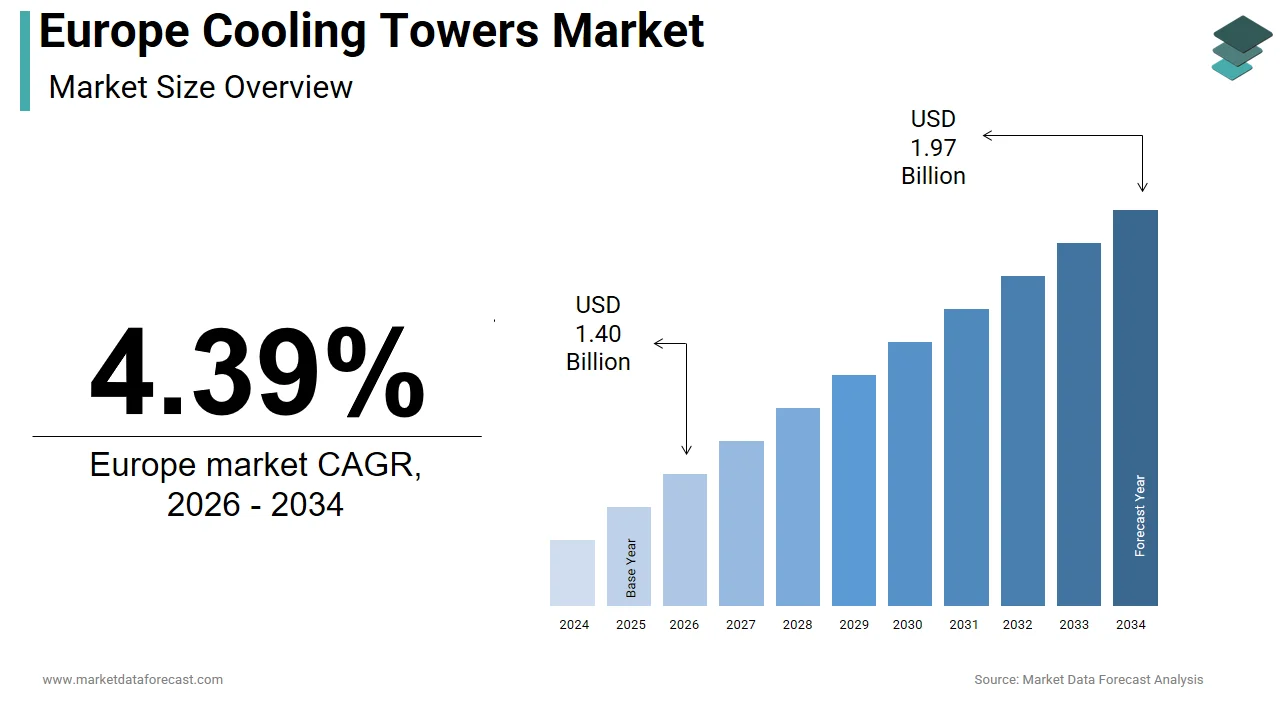
The Europe cooling towers market was valued at USD 1.34 billion in 2025, is expected to reach USD 1.40 billion in 2026, and is projected to grow to USD 1.97 billion by 2034, expanding at a CAGR of 4.39% from 2026 to 2034. Market growth is driven by expanding data center capacity, industrial electrification, and stringent environmental regulations governing thermal discharge and water usage. Cooling towers remain indispensable thermal-management assets across chemicals, power generation, data centers, and district energy systems, while evolving sustainability mandates are reshaping system design toward hybrid and closed-loop configurations.
Key Market Trends
- Rising data center electricity consumption increasing demand for high-efficiency heat rejection
- Industrial process electrification creating concentrated thermal loads
- Shift from traditional wet towers toward hybrid and dry systems in water-stressed regions
- Integration of heat recovery and circular thermal networks
- Growing adoption of digital monitoring and predictive maintenance to manage compliance and reliability
Segmental Insights
-
Based on type:
-
Wet cooling towers dominated the market with 55.8% share in 2024, due to superior thermal efficiency and lower upfront costs in Northern and Central Europe.
-
Hybrid cooling towers are the fastest-growing segment, registering a CAGR of 11.4%, driven by water-conservation mandates and climate resilience needs in Southern Europe.
-
-
Based on application:
-
Chemicals & petrochemicals led the market with 36.5% share, supported by continuous, high-load thermal requirements and regulatory mandates such as the Seveso III Directive.
-
Integration of carbon capture, electrified heat processes, and hydrogen production is further increasing cooling demand in industrial clusters.
-
Regional Insights
The European cooling towers market demonstrates regionally differentiated demand, shaped by industrial density, water availability, and regulatory intensity.
- Germany dominated the market with 25.1% share, driven by dense chemical clusters, mandatory energy audits, and industrial decarbonization policies.
- France remains a key market due to its nuclear-heavy power mix, with increasing transition toward hybrid systems amid river-temperature restrictions.
- The United Kingdom is witnessing steady growth from nuclear new builds, industrial retrofit programs, and stricter Legionella compliance enforcement.
Competitive Landscape
The Europe cooling towers market is moderately consolidated, characterized by global thermal-engineering leaders and specialized regional manufacturers. Competition increasingly extends beyond equipment supply to integrated solutions encompassing water efficiency, digital intelligence, heat recovery, and regulatory compliance. Tightening EU and national regulations on water withdrawal, Legionella control, and carbon intensity favor players with strong compliance capabilities, lifecycle service offerings, and hybrid-system expertise. Collaboration with industrial clusters and district energy operators is becoming a key differentiator, as cooling towers evolve from standalone assets into nodes of circular energy systems.
Key players operating in the market include SPX Corporation, Baltimore Aircoil Company, EVAPCO, Kelvion Holding, Hamon & Cie, MITA Cooling Technologies, JAEGGI Hybridtechnologie, and others.
Europe Cooling Towers Market Size
The Europe cooling towers market size was USD 1.34 billion in 2025, is anticipated to be USD 1.40 billion in 2026, and is projected to reach USD 1.97 billion by 2034, registering a CAGR of 4.39% from 2026 to 2034.
Cooling towers are engineered heat rejection systems that dissipate waste thermal energy from industrial processes, power generation, and HVAC applications through evaporative or convective cooling. These systems serve as critical thermal management infrastructure in refineries, chemical plants, data centers, and district heating networks across the continent. According to the Joint Research Centre, data centres in the EU-27 consumed 45–65 TWh of electricity in 2022, which amounts to 1.8–2.6 % of total EU electricity use and directly amplifies demand for high-efficiency cooling infrastructure. Simultaneously, as per the European Environment Agency, large industrial facilities in Western Europe often operate beyond their original thermal design capacity due to process intensification. Regulatory frameworks such as the EU Industrial Emissions Directive impose strict limits on thermal discharge and water usage, which is accelerating the replacement of outdated wet cooling towers with closed-circuit and hybrid dry systems. Additionally, the EU’s Energy Efficiency Directive mandates that all new industrial installations undergo best available techniques assessments, where advanced cooling towers often feature as compliance solutions. This confluence of thermal demand, regulatory stringency, and sustainability imperatives defines the evolving role of cooling towers as enablers of both operational continuity and environmental stewardship in Europe.
MARKET DRIVERS
Expansion of Data Centers and Digital Infrastructure Across Europe
The rapid proliferation of cloud computing, artificial intelligence, and 5G networks is driving unprecedented thermal management requirements across European data centers, which is primarily driving the growth of the European cooling towers market. According to the European Data Centre Association, European data-centre power demand is expected to grow at an average annual rate of 15 % through 2030. Modern high-density server racks generate heat fluxes exceeding thirty kilowatts per square meter, necessitating robust and scalable cooling solutions. Cooling towers remain the backbone of indirect evaporative and chilled water systems in hyperscale facilities, particularly in climate zones with favorable wet bulb temperatures such as Northern and Central Europe. Ireland hosts major cloud regions for Microsoft and Google, and cooling water demand from data centers in Ireland has increased in recent years, as per the Environmental Protection Agency of Ireland. Although some operators explore adiabatic or liquid immersion cooling, many large facilities still rely on high-efficiency counterflow towers integrated with heat recovery systems to meet sustainability targets. The European Commission’s Digital Decade Policy Programme further incentivizes energy-efficient infrastructure through green data center certifications that reward water and energy-optimized cooling designs. This digital expansion ensures sustained demand for advanced cooling towers that balance performance with resource efficiency and drive the cooling towers market growth in Europe.
Industrial Modernization and Electrification of Process Heat
The industrial sector of Europe is undergoing a dual transition toward both digital automation and low-carbon operations, which is intensifying thermal load complexity and driving cooling infrastructure upgrades. According to the International Energy Agency, industrial electricity consumption in the EU remained roughly flat in 2024, following declines of around 6% in both 2022 and 2023. Electric arc furnaces, heat pumps, and induction systems generate concentrated thermal outputs that legacy cooling systems cannot manage efficiently. In Germany, the Industrial Heat Electrification Roadmap published by the Federal Ministry for Economic Affairs and Climate Action mandates that 50% of process heat must be electrified by 2030, requiring new thermal-management architectures. Existing facilities are being retrofitted with high-capacity fiberglass reinforced polymer cooling towers that resist corrosion from chemical by-products while offering lower lifecycle costs. Moreover, the EU’s Carbon Border Adjustment Mechanism incentivises energy efficiency as a means to reduce embedded emissions, making advanced cooling a strategic investment. As per a study by VDMA, German chemical plants replaced older cooling towers to comply with updated Best Available Techniques reference documents. This industrial transformation creates a steady pipeline of replacement and green-field demand for modern cooling towers.
MARKET RESTRAINTS
Stringent Water Usage Regulations and Environmental Permitting Constraints
Water scarcity and ecological protection policies across Europe are imposing significant operational and design limitations on evaporative cooling towers, which are hampering the regional market growth. According to the European Environment Agency, up to 70% of the population in southern Europe may experience seasonal water scarcity stress during summer, which has prompted authorities to restrict or deny water withdrawal permits for once-through and open recirculating systems. In Spain, the National Hydrological Plan requires industrial facilities in stressed basins to reduce freshwater consumption, directly discouraging traditional wet cooling towers. Similarly, France’s Water Framework Directive implementation mandates zero liquid discharge for new industrial projects in sensitive watersheds as per the French Ministry of Ecological Transition. These constraints require costly transitions to dry or hybrid cooling systems, which have higher capital expenditure and lower thermal efficiency in warm climates. Moreover, the discharge of blowdown water containing biocides and scale inhibitors is increasingly regulated with the EU Biocidal Products Regulation requiring rigorous environmental risk assessments. According to a 2024 audit by the European Chemicals Agency, industrial cooling tower operators in Italy faced non-compliance with discharge limits, leading to operational suspensions. These regulatory hurdles increase project timelines and discourage investment in conventional cooling infrastructure and further hindering the regional market expansion.
High Capital and Maintenance Costs of Advanced Cooling Systems
The shift toward environmentally compliant cooling technologies entails substantial financial burdens that deter adoption, particularly among small and medium industrial enterprises, which further hinders the cooling towers market growth in Europe. Closed-circuit and hybrid cooling towers cost forty to seventy percent more than traditional open wet towers, according to the European Federation of Heating, Ventilation, and Air Conditioning Associations. Additionally, these systems require sophisticated water treatment chemical monitoring and corrosion control protocols that increase operational complexity. As per a survey by the German Chamber of Industry and Commerce, many SMEs in the metal-processing sector delayed cooling system upgrades due to upfront costs exceeding significant thresholds. Maintenance expenses are also elevated with dry cooling systems requiring regular cleaning of finned heat exchangers to prevent fouling, which reduces efficiency if neglected, as per industry technical data. In Eastern Europe, where access to green financing is limited, many facilities continue operating obsolete towers despite efficiency losses. The EU’s Innovation Fund provides grants for industrial decarbonisation but covers only a portion of eligible costs, leaving a significant funding gap. This economic barrier slows the market’s transition to sustainable cooling despite regulatory and environmental imperatives.
MARKET OPPORTUNITIES
Integration of Heat Recovery and Circular Thermal Systems
The growing emphasis on industrial symbiosis and energy cascading presents a significant opportunity for the European cooling towers market. According to the Urban Agenda recommendation paper, industrial waste heat recovery could meet 25% of the EU’s current heating demand if fully harnessed. Modern cooling towers equipped with heat exchangers can transfer low-grade thermal energy to district heating networks, agricultural greenhouses, or absorption chillers for cooling. For instance, district heating in Copenhagen integrates recovered heat from industrial cooling circuits in Denmark. Companies like Arla Foods and Novo Nordisk have implemented closed-loop cooling systems that capture waste heat for on-site space heating and pasteurization, reducing natural gas consumption. The EU’s Horizon Europe program has allocated funding since 2023 to projects developing smart thermal grids that interconnect industrial facilities with municipal energy systems. These initiatives transform cooling towers from mere heat rejection devices into nodes in integrated energy ecosystems, enhancing their strategic value beyond traditional cooling functions.
Adoption of Smart Monitoring and Predictive Maintenance Technologies
Digitalization is unlocking new performance and efficiency frontiers in cooling tower operations through real-time monitoring and data-driven optimization, which is another significant opportunity for the European market. Leading industrial operators are deploying IoT-enabled sensors that continuously track water chemistry, fill condition, fan performance, and drift emissions. According to research by the Fraunhofer institutes, digital-twin solutions are increasingly being integrated into industrial equipment and facility-management systems to enable predictive maintenance, which uses machine-learning algorithms to forecast scaling, corrosion, or biological fouling and enables pre-emptive intervention that extends equipment life and reduces water and chemical consumption. In the Netherlands, a pilot by Royal HaskoningDHV demonstrated optimisation of cooling system operation using data-driven analytics in a petrochemical plant. The European Clean Hydrogen Partnership also supports projects linking cooling system data with overall plant energy management to identify thermal inefficiencies. As Industry 4.0 standards mature, these intelligent cooling systems will become standard in high-compliance environments, transforming operational reliability and resource stewardship.
MARKET CHALLENGES
Legionella Risk and Public Health Compliance Burden
Cooling towers remain a primary vector for Legionnaires' disease outbreaks in Europe due to the potential for aerosolized water contaminated with Legionella pneumophila, which is a major challenge to the regional market. According to the European Centre for Disease Prevention and Control, evaporative cooling systems such as cooling towers and HVAC circuits remain identified sources of Legionnaires’ disease outbreaks, which is prompting rigorous national regulations requiring continuous biocide dosing, water-temperature control, and quarterly microbial testing. In the United Kingdom, the Health and Safety Executive’s Approved Code of Practice L8 mandates comprehensive risk assessments and maintenance logs, with non-compliance carrying unlimited fines and potential criminal liability. These requirements impose significant administrative and chemical costs, with operators spending substantial sums annually per tower on compliance under industry association guidance. Moreover, public perception risks are high with local authorities increasingly denying permits for new wet towers near residential areas. This health and safety imperative forces operators to either invest heavily in water treatment or switch to dry systems, which sacrifice efficiency for safety and creating a persistent operational dilemma.
Climate Change-Induced Temperature Extremes and Cooling Efficiency Loss
Rising ambient temperatures across Europe are degrading the thermodynamic performance of evaporative cooling towers, particularly during summer heatwaves, which is further challenging the growth of the European cooling towers market. According to the Copernicus European State of the Climate report, summer wet-bulb extremes in Southern Europe have increased since 2000, reducing the evaporative cooling potential of wet systems. During the 2023 heatwave, industrial facilities in France and Italy reported operational impacts, including cooling systems approaching or exceeding design limits that forced production throttling or temporary shutdowns. Cooling towers sized for historical climate norms are now underperforming just as thermal loads increase due to industrial electrification. The European Environment Agency and recent sector studies warn that many industrial cooling systems in the Mediterranean region will need capacity upgrades or hybridization by mid-century to maintain reliability. However, redesigning or replacing towers involves extensive permitting and capital outlays that many operators cannot absorb rapidly. This climate performance gap creates a systemic vulnerability in Europe’s industrial resilience, where thermal infrastructure is increasingly mismatched to environmental realities, threatening both productivity and regulatory compliance.
REPORT COVERAGE
| REPORT METRIC | DETAILS |
| Market Size Available | 2025 to 2034 |
| Base Year | 2025 |
| Forecast Period | 2026 to 2034 |
| Segments Covered | By Type, Application, and County. |
| Various Analyses Covered | Global, Regional, and Country-Level Analysis, Segment-Level Analysis, Drivers, Restraints, Opportunities, Challenges; PESTLE Analysis; Porter’s Five Forces Analysis, Competitive Landscape, Analyst Overview of Investment Opportunities |
| Countries Covered | UK, France, Spain, Germany, Italy, Russia, Sweden, Denmark, Switzerland, Netherlands, Turkey, Czech Republic, and the Rest of Europe. |
| Market Leaders Profiled | Krones AG, SPX Corporation, Babcock & Wilcox Enterprises, Inc., EWK, Kelvion Holding GmbH, Hamon & Cie (International) S.A., MITA Cooling Technologies Srl, JACIR – GOHL, ILMED Impianti SRL, JAEGGI Hybridtechnologie AG, EVAPCO, Inc., Artec Cooling Towers Pvt. Ltd., Torraval Cooling, DELTA Cooling Towers Inc., Marley Cooling, Baltimore Aircoil Company, Inc., Composite Custom Cooling Solutions, Tower Tech, American Cooling Tower, National Cooling Towers, and Others. |
SEGMENTAL ANALYSIS
By Type Insights
The wet cooling towers segment captured 55.8% of the European cooling towers market share in 2024 due to their superior thermal efficiency and lower initial cost in regions with abundant water resources and moderate climates. Wet cooling towers remain the preferred solution for high-heat-load applications because evaporative cooling achieves approach temperatures within a few degrees of the wet-bulb temperature, which significantly outperforms dry systems and typically operates much further above ambient dry-bulb conditions. According to sources, many large thermal power plants and chemical refiners in Northern and Central Europe rely on wet towers due to their ability to handle continuous megawatt-scale thermal rejection. In Germany, at the major chemical cluster at Ludwigshafen, BASF employs numerous wet cooling towers at its site as per its sustainability disclosures. The consistent thermal performance of wet systems under steady-state conditions makes them indispensable in processes where temperature excursions risk product quality or safety. Even with rising water costs, the energy savings from wet cooling often outweigh operational expenses in high-load scenarios, which ensures continued adoption in core industrial zones and contributes to the dominance of the wet cooling segment in the European market.
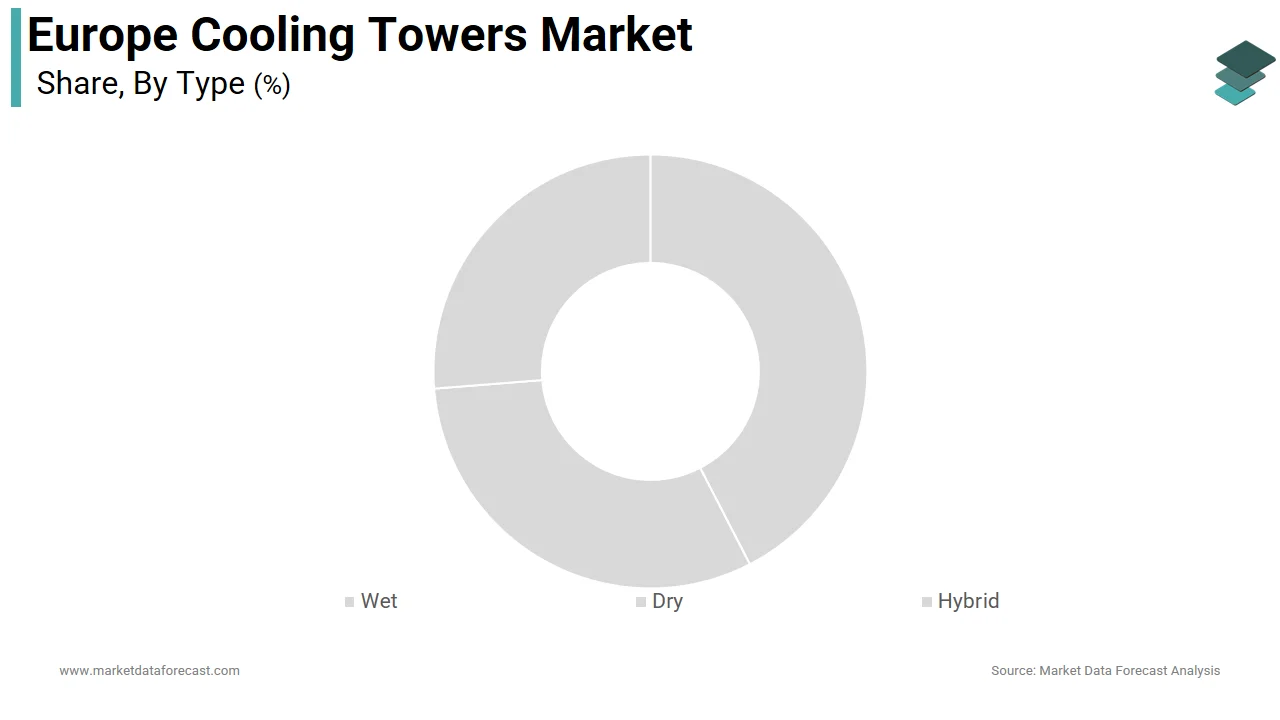
The hybrid cooling towers segment is the fastest growing type in the Europe cooling towers market and is predicted to register a CAGR of 11.4% over the forecast period. The growing need to balance water conservation with thermal reliability under tightening environmental regulations is majorly propelling the growth of the hybrid segment in the European market. Hybrid systems combine dry sensible cooling with intermittent evaporative assist and are gaining traction in regions facing water scarcity or stringent discharge limits. According to sources, an increasing number of industrial permits in Southern Europe now mandate either dry or hybrid cooling solutions for new facilities. In Spain, authorities in water-stressed basins are requiring industrial projects to demonstrate significant reductions in freshwater withdrawal, with hybrid towers often used because they can operate in dry mode during peak water-stress periods and activate evaporation only when necessary. Similarly, Italy’s recovery and resilience financing mechanisms increasingly favour cooling systems with appreciable water savings compared to conventional wet towers. These policy levers are making hybrid systems the de facto standard for new installations in Mediterranean climates, where water availability is increasingly volatile due to climate change, which is favouring the expansion of the hybrid cooling segment in the European market.
By Application Insights
The chemicals and petrochemicals segment led the Europe cooling towers market in 2024 with a 36.5% of the regional market share. The dominance of the segment is attributed to the continuous high heat rejection needs across refining, polymerization, and distillation processes. Chemical manufacturing involves exothermic reactions, distillation columns, and compressor intercooling that generate constant and substantial thermal loads requiring reliable year-round heat rejection. Large chemical sites in Europe dissipate substantial volumes of waste heat continuously, which requires multiple large-scale cooling towers. At the Ludwigshafen complex operated by BASF, the volume of cooling water required is reported at approximately 1,905 million m³ for cooling processes in 2024. The consistent thermal loads mean that, unlike cyclical applications such as HVAC, these processes cannot be interrupted for maintenance or efficiency loss without compromising safety and product integrity. The EU’s Seveso III Directive mandates strict control of hazardous installations, which further entrenches the need for robust wet or hybrid cooling solutions. Moreover, the integration of carbon-capture units in refineries adds new thermal loads that existing cooling infrastructure must absorb. This operational imperative ensures that chemicals remain one of the largest demand drivers for industrial cooling towers across Europe.
COUNTRY LEVEL ANALYSIS
Germany Cooling Towers Market Analysis
Germany dominated the cooling towers market in Europe in 2024 by holding 25.1% of the regional market share. The dominance of Germany in the European market is driven by its dense concentration of chemical, automotive, and steel industries that rely on continuous thermal management. The Rhine‑Ruhr metropolitan region alone hosts large industrial cooling installations. According to the Gesetz über Energiedienstleistungen und andere Energieeffizienzmaßnahmen (EDL‑G), all large companies must conduct an energy audit at least every four years. Furthermore, the industrial carbon-management and decarbonisation strategy requires heat-recovery integration, which is spurring adoption of closed-circuit systems in new plants. Audits and policy reform are driving legacy asset modernisation and industrial decarbonisation, which is ensuring Germany remains a key market leader in this space.
United Kingdom Cooling Towers Market Analysis
The United Kingdom is a promising regional segment for cooling towers in Europe. The ongoing nuclear new build program and industrial decarbonization initiatives in the UK are propelling the UK market growth. The Hinkley Point C nuclear plant, currently under construction, will deploy significant hybrid cooling infrastructure to meet the Environment Agency water-use limits. The UK’s Climate Change Committee mandates that all new industrial clusters achieve net zero by 2040, which is driving investment in efficient thermal systems. The Teesside and Humberside industrial zones are retrofitting legacy towers with smart monitoring and drift-control to comply with the Health and Safety Executive’s updated Legionella guidelines. The UK’s Industrial Energy Transformation Fund (IETF) Phase 3 has a budget of up to £185 million for industry energy-efficiency and deployable technologies, which is intended to include cooling-system upgrades. According to these policy-driven modernisation initiatives combined with energy-security imperatives, strong demand for cooling infrastructure upgrades remains despite economic headwinds.
France Cooling Towers Market Analysis
France commanded a prominent share of the Europe cooling towers market in 2025. The unique energy mix of France creates massive and steady thermal loads requiring large cooling infrastructure. The 19 operational nuclear plants operate hundreds of wet towers, though many are undergoing conversion to hybrid or dry systems due to river water temperature limits imposed during heatwaves. According to RTE, during a summer heatwave, nuclear reactors reduced output because cooling‐water discharge exceeded thermal thresholds. The Autorité de sûreté nucléaire has increased its push for alternative cooling, which is accelerating this transition. Simultaneously, the Grand Paris industrial zone is modernising chemical and pharmaceutical facilities with closed‐circuit towers to comply with Seine‐basin water restrictions. France thus exemplifies the tension between thermal necessity and environmental limits shaping its cooling‐tower evolution.
Netherlands Cooling Towers Market Analysis
The Netherlands is predicted to witness a prominent CAGR in the European cooling towers market during the forecast period. Its significance arises from the Port of Rotterdam, which is the largest industrial cluster in Europe that integrates petrochemical refineries, hydrogen production, and data centers into a shared thermal ecosystem. The Porthos CO2 transport project has spurred new cooling demands for carbon capture units, which generate additional low-grade heat. The Dutch government’s Climate Agreement mandates that all industrial clusters develop heat reuse plans by 202,5 with cooling towers serving as exchange nodes. In 2024, the Rotterdam Heat Roundabout began transferring waste heat from Shell’s refinery to district heating networks using hybrid cooling infrastructure. Additionally, strict national water regulations prohibit once-through cooling, forcing all new installations to use recirculating or hybrid systems. This systemic integration of cooling with circular energy and stringent water policy makes the Netherlands a model for future industrial thermal management.
Sweden Cooling Towers Market Analysis
Sweden is projected to grow at a healthy CAGR in the Europe cooling towers market during the forecast period. Sweden stands out for its nearly fossil-free electricity grid and aggressive industrial electrification, which paradoxically increases thermal loads from electric arc furnaces and electrolyzers. SSAB’s HYBRIT project for fossil-free steel uses electric reduction that generates intense localized heat, requiring new cooling solutions. Sweden’s Environmental Code mandates that all industrial cooling must minimize freshwater use and ecological impact, leading to widespread adoption of dry and hybrid towers even in colder climates. The Swedish Energy Agency reported that eighty-five percent of new industrial cooling projects in 2024 used closed-circuit or air-cooled systems. Furthermore, district heating networks in cities like Stockholm recover waste heat from data centers and factories using absorption chillers linked to cooling towers. This forward-looking integration of electrification, circularity, and environmental stewardship positions Sweden as an innovation leader despite its modest market size.
COMPETITIVE LANDSCAPE
The Europe cooling towers market features a competitive landscape shaped by global engineering leaders, regional specialists, and emerging technology providers. Competition is increasingly defined not by hardware alone but by integrated solutions that combine thermal performance, water stewardship, digital intelligence, and regulatory compliance. Large multinational firms leverage scale engineering expertise and service networks to dominate industrial and power sectors, while agile regional players capture niche applications in food processing or urban HVAC through customized compact designs. The tightening of EU and national regulations on water use, Legionella control, and carbon intensity has raised barriers to entry, favoring established players with compliance capabilities. Simultaneously, the push for circular energy systems creates opportunities for collaboration over pure competition as cooling infrastructure becomes part of broader industrial symbiosis and district heating initiatives. This dynamic fosters a market where technical excellence must be matched by environmental responsibility and digital sophistication.
KEY MARKET PLAYERS
Some of the companies that are playing a dominating role in the Europe cooling towers market include
- Krones AG
- SPX Corporation
- Babcock & Wilcox Enterprises, Inc.
- EWK
- Kelvion Holding GmbH
- Hamon & Cie (International) S.A.
- MITA Cooling Technologies Srl
- JACIR – GOHL
- ILMED Impianti SRL
- JAEGGI Hybridtechnologie AG
- EVAPCO, Inc.
- Artec Cooling Towers Pvt. Ltd.
- Torraval Cooling
- DELTA Cooling Towers Inc.
- Marley Cooling
- Baltimore Aircoil Company, Inc.
- Composite Custom Cooling Solutions
- Tower Tech
- American Cooling Tower
- National Cooling Towers
TOP PLAYERS IN THE MARKET
- SPX Cooling Technologies is a global leader in thermal management solutions with a strong presence across Europe through manufacturing facilities in Germany and the Netherlands. The company contributes significantly to the global market by offering a comprehensive portfolio of wet, dry, and hybrid cooling towers tailored for power generation, industrial, and HVAC applications. In Europe, SPX supports major chemical clusters and data center operators with high-efficiency Marley-branded systems. To strengthen its position, the company recently launched its EcoFlow hybrid cooling platform in 2024, featuring intelligent controls that optimize water and energy use based on real-time ambient conditions. It also expanded its predictive maintenance service network across Southern Europe to address tightening Legionella compliance requirements and enhance customer uptime.
- Baltimore Aircoil Company is a Belgium-headquartered multinational renowned for its closed-circuit and evaporative cooling systems deployed across European pharmaceutical, food processing, and energy sectors. The company plays a vital role globally by pioneering ammonia and CO2 refrigerant-compatible cooling solutions that align with low-GWP mandates. In Europe, BAC leverages its deep expertise in hygienic and corrosion-resistant designs to serve stringent industries. In 2024, the company introduced its AquaStream smart monitoring system, which integrates water chemistry sensors and AI-driven analytics to reduce chemical consumption and ensure regulatory compliance. It also partnered with Danish district heating operators to develop waste heat recovery configurations that integrate cooling towers into circular thermal grids, reinforcing its sustainability leadership.
- EVAPCO Europe is a subsidiary of the US-based thermal management innovator with key operations in Italy, Spain, and the UK. The company is recognized globally for its energy-efficient and compact cooling tower designs serving data centers, cold food chains, and renewable energy facilities. In the European market, EVAPCO emphasizes modular and low-drift solutions that meet urban installation constraints and public health standards. In 2024, the company rolled out its iTEC digital control platform across its EuroStream product line, enabling remote diagnostics and performance optimization. It also established a dedicated R&D center in Barcelona focused on dry and hybrid cooling technologies for water-stressed regions, further aligning its portfolio with EU environmental directives and climate resilience goals.
TOP STRATEGIES USED BY THE KEY MARKET PARTICIPANTS
Key players in the Europe cooling towers market prioritize the development of hybrid and water-efficient cooling systems to comply with tightening environmental regulations on water withdrawal and thermal discharge. They invest in digitalization through IoT-enabled monitoring and predictive maintenance platforms to enhance operational reliability and reduce Legionella risks. Strategic partnerships with industrial clusters and district energy networks enable integration of waste heat recovery, turning cooling towers into energy exchange assets. Companies also expand localized service and spare parts networks to support aging infrastructure and ensure compliance with national health and safety codes. Furthermore, they align product innovation with EU decarbonization policies by designing systems compatible with low-GWP refrigerants and renewable energy integration.
MARKET SEGMENTATION
This research report on the Europe cooling towers market has been segmented and sub-segmented into the following categories.
By Type
- Wet
- Dry
- Hybrid
By Application
- Chemicals & Petrochemicals
- Pharmaceutical
- Power Generation
- HVAC
- Food & Beverages
- Others
By Country
- United Kingdom
- France
- Spain
- Germany
- Italy
- Russia
- Sweden
- Denmark
- Switzerland
- Netherlands
- Rest of Europe