- Product Description Description
- Table of Contents TOC
- List of Table & Figure LOT
- Get Free Sample PDF Sample PDF
Market Size, 2025
$5.00 BnMarket Estimate, 2026
$6.06 BnMarket Forecast, 2034
$27.89 BnCAGR, 2026–2034
21.03%Executive Summary: Europe Customer Journey Analytics Market
- Market Scope: Comprehensive analysis of the European customer journey analytics (CJA) sector, covering component segments, organization sizes, applications, end-user verticals, country-level frameworks, and the competitive industry landscape.
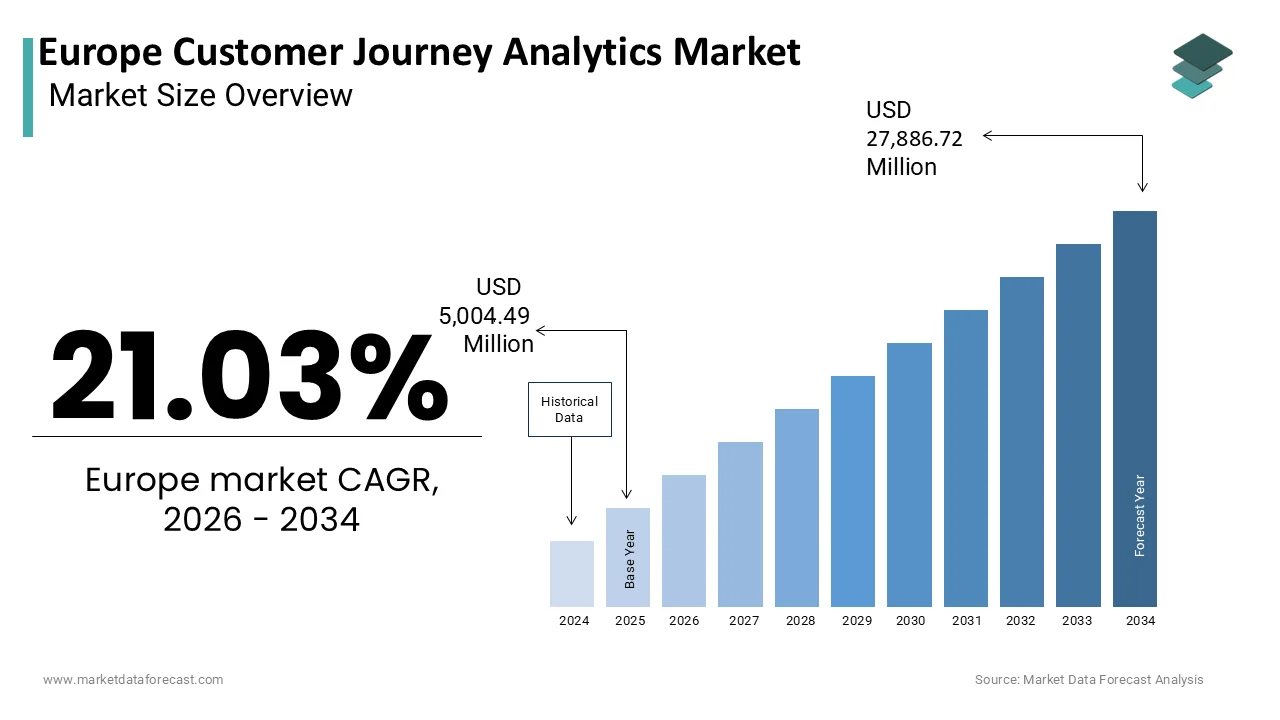
- Market Valuation: Valued at USD 5,004.49 million in 2025, estimated to reach USD 6,056.94 million in 2026, and projected to expand to USD 27,886.72 million by 2034, growing at a rapid CAGR of 21.03% from 2026 to 2034.
- Primary Growth Drivers: Increasing adoption of omnichannel retail and financial services strategies alongside escalating demand for hyper-personalized customer experiences.
Key Market Segment Metrics
| Category | Leading Segment (Base Position) | Fastest-Growing / High-Growth Segment |
|---|---|---|
| By Component | Software (held the majority 65.8% share in 2025 due to central data aggregation engines, visualization, and AI automation) | Services (predicted highest CAGR of 14.5% driven by complex implementations and specialized data integration expertise) |
| By Organization Size | Large Enterprises (dominated in 2025 anchored by substantial budgets, complex multi-channel data, and dedicated IT resources) | Small & Medium Enterprises / SMEs (fastest CAGR of 16.2% fueled by affordable cloud-based SaaS and easy deployment) |
| By Region / Country | Europe (mature regional market with high digital penetration, strict GDPR compliance, and advanced omnichannel adoption) | UK, France, Germany & Netherlands (high-growth hubs driving AI analytics, financial tech, and e-commerce personalization) |
Major Market Players & Industry Landscape
Market Structure: Highly competitive landscape featuring global enterprise software giants, customer experience platform leaders, and specialized analytics vendors balancing deep insights with GDPR compliance.
Key Companies: Adobe Inc., Salesforce, Inc., SAP SE, Oracle Corporation, IBM Corporation, Microsoft Corporation, Google LLC, NICE Ltd., Verint Systems Inc., Teradata Corporation, Medallia Inc., and Cisco Systems, Inc.
 Download Free Sample Report
Europe Customer Journey Analytics Market Size
The Europe Customer Journey Analytics Market was valued at USD 5,004.49 million in 2025, is estimated to reach USD 6,056.94 million in 2026, and is projected to reach USD 27,886.72 million by 2034, growing at a CAGR of 21.03% from 2026 to 2034.
Customer Journey Analytics (CJA) is the process of tracking, connecting, and analyzing customer interactions across every channel and touchpoint, both online and offline, to understand their complete experience and how it impacts business goals. These platforms integrate data from digital channels such as websites mobile applications social media and physical stores to create a unified view of the customer experience. By leveraging advanced technologies like artificial intelligence and machine learning businesses can identify friction points predict future behaviors and personalize interactions in real time. This holistic approach is essential for organizations aiming to enhance customer retention and drive revenue growth in an increasingly competitive landscape. According to Eurostat, approximately 95 percent of individuals in the European Union aged 16 to 74 used the internet in 2025, indicating a highly digitized consumer base that generates vast amounts of behavioral data. As per the European Commission, the ICT sector accounts for approximately 5 percent of the European Union's gross domestic product, with digital transformation efforts aiming to significantly increase this share through regional economic activity. The proliferation of omnichannel retail strategies has further complicated the customer path necessitating robust analytical tools to decipher complex journey maps. Regulatory frameworks such as the General Data Protection Regulation impose strict guidelines on data collection and processing requiring analytics providers to embed privacy by design into their architectures. Consequently the market is evolving towards solutions that balance deep insights with stringent compliance standards. The ability to translate raw data into actionable intelligence allows enterprises to deliver seamless experiences that meet the high expectations of modern European consumers. This technological evolution supports strategic decision making and fosters long term customer loyalty.
MARKET DRIVERS
Increasing adoption of omnichannel strategies by retail and financial services sectors
The widespread adoption of omnichannel strategies by leading retail and financial services institutions serves as a primary factor for the growth of the Europe customer journey analytics market. Consumers today expect a seamless experience whether they are interacting with a brand online via mobile devices or in physical branches and stores. According to McKinsey & Company, the integration of online and offline channels has become a standard expectation for shoppers, with over 70 percent of consumers using multiple channels during their purchasing process. This complexity creates significant challenges for businesses attempting to maintain consistency and personalization across all touchpoints. As per the European Banking Authority financial institutions are increasingly deploying digital platforms to enhance customer engagement resulting in a fragmented data landscape that requires unified analytics solutions. Customer journey analytics platforms enable these organizations to stitch together disparate data sources providing a single source of truth about customer behavior. By understanding how customers move between channels companies can optimize marketing spend improve service delivery and reduce churn. The ability to attribute sales to specific journey paths allows for more accurate return on investment calculations. Furthermore the competitive intensity in the European retail and banking sectors drives continuous innovation in customer experience management. Companies that fail to provide a cohesive omnichannel experience risk losing market share to more agile competitors. Therefore, the strategic imperative to unify customer interactions fuels the demand for advanced analytics capabilities. This driver ensures sustained investment in technologies that can handle the volume velocity and variety of omnichannel data.
Demand for hyper personalization to enhance customer retention and loyalty
The escalating demand for hyper personalized customer experiences is a significant driver propelling the expansion of the Europe customer journey analytics market. Modern consumers expect brands to anticipate their needs and offer tailored recommendations based on their past behaviors and preferences. According to a study by Accenture, a majority of consumers are more likely to remain loyal to brands that provide personalized interactions and relevant content, while the European Consumer Organisation emphasizes that such personalization must respect strict privacy boundaries. Generic marketing messages are increasingly ineffective leading to lower engagement rates and higher acquisition costs. As per the Interactive Advertising Bureau Europe programmatic advertising and personalized content delivery rely heavily on detailed user profiles derived from journey analytics. These platforms utilize machine learning algorithms to analyze historical data and predict future actions enabling real time personalization at scale. For instance e commerce platforms can dynamically adjust product displays based on a users browsing history while telecommunications providers can offer customized plans to prevent churn. The ability to deliver the right message at the right time through the preferred channel significantly enhances customer satisfaction. In a market characterized by high consumer choice and low switching costs personalization becomes a key differentiator. European regulations also encourage transparency and consent which when managed correctly through analytics platforms can build trust. Companies leveraging journey analytics to drive personalization report higher conversion rates and increased customer lifetime value. This direct correlation between personalized experiences and business outcomes motivates organizations to invest heavily in analytical tools. The continuous refinement of personalization engines ensures that this driver remains potent throughout the forecast period.
MARKET RESTRAINTS
Stringent data privacy regulations and compliance complexities
The rigorous data privacy regulatory environment in the region negatively impacts the growth of the Europe customer journey analytics market. The General Data Protection Regulation imposes strict requirements on how personal data is collected stored processed and shared creating significant compliance burdens for analytics providers and their clients. According to the GDPR, fines for the most serious infringements can reach up to 20 million euros or 4 percent of the total worldwide annual turnover of the preceding financial year, whichever is higher. This regulatory landscape necessitates that analytics platforms incorporate robust privacy enhancing technologies such as data anonymization and pseudonymization which can increase development costs and complexity. As per the International Association of Privacy Professionals many organizations struggle to interpret and implement GDPR requirements consistently across different member states due to varying national interpretations. The requirement for explicit consent before tracking user activities limits the amount of data available for analysis potentially reducing the accuracy and completeness of journey maps. Additionally the right to be forgotten mandates that companies delete user data upon request which complicates historical analysis and model training. The need for continuous monitoring and auditing of data practices diverts resources from innovation and expansion. Smaller vendors may find it challenging to meet these stringent standards leading to market consolidation. The uncertainty surrounding emerging regulations such as the ePrivacy Directive further hesitates investment decisions. Organizations must balance the desire for deep insights with the obligation to protect user privacy often resulting in conservative data usage policies. This tension between insight generation and compliance adherence slows down the adoption of advanced analytics features.
High implementation costs and integration challenges with legacy systems
The substantial financial investment required for implementing CJA solutions and the technical difficulties associated with integrating them into existing IT infrastructure are also major restraints to the European customer journey analytics market. Many European enterprises operate on legacy systems that were not designed to handle the real time data processing and complex integrations required by modern analytics platforms. According to the European Commission small and medium sized enterprises which constitute a large portion of the European business landscape often lack the financial resources and technical expertise to undertake such digital transformations. The cost of licensing software hiring specialized data scientists and maintaining the infrastructure can be prohibitive for organizations with limited budgets. As per Gartner integration issues are among the top reasons for failure in big data and analytics projects with many companies struggling to connect siloed data sources effectively. Data quality issues further exacerbate these challenges as inconsistent or incomplete data leads to inaccurate insights and poor decision making. The time required to clean normalize and unify data from various channels delays the realization of value from analytics investments. Additionally the shortage of skilled professionals capable of managing and interpreting complex analytics outputs adds to the operational burden. Organizations often face resistance from internal stakeholders who are accustomed to traditional methods of analysis. The total cost of ownership including training support and ongoing maintenance can exceed initial estimates leading to budget overruns. These financial and technical barriers discourage some potential adopters particularly in price sensitive segments. Until solutions become more affordable and easier to deploy the market growth may be constrained by these implementation hurdles.
MARKET OPPORTUNITIES
Integration of artificial intelligence and predictive analytics capabilities
The integration of artificial intelligence and predictive analytics into customer journey platforms offers a significant opportunity for expansion and value creation in the Europe customer journey analytics market. AI driven solutions can process vast amounts of unstructured data from social media emails and call centers to uncover hidden patterns and trends that traditional methods might miss. According to the European Commission's Digital Decade 2030 targets, the adoption of AI in business is expected to accelerate, with at least 75% of EU enterprises expected to take up AI or big data by 2030. These technologies enable businesses to anticipate customer needs and proactively address issues before they escalate thereby improving satisfaction and loyalty. As per McKinsey & Company, companies that leverage AI for personalization can see a 40 percent increase in revenue from those activities and a 10 to 20 percent reduction in marketing and sales costs. Predictive models can identify customers at risk of churning allowing companies to intervene with targeted retention offers. Furthermore AI powered chatbots and virtual assistants can provide instant support guiding customers through their journeys more efficiently. The ability to simulate different journey scenarios helps organizations optimize their strategies and allocate resources more effectively. Machine learning algorithms continuously improve their accuracy over time ensuring that insights remain relevant and actionable. The growing availability of cloud based AI services lowers the barrier to entry for smaller firms enabling them to access advanced capabilities without significant upfront investment. European governments are also promoting AI research and development through initiatives like the Digital Europe Programme fostering an conducive environment for innovation. Companies that successfully embed AI into their analytics workflows will gain a competitive edge by delivering superior customer experiences. This technological advancement opens new avenues for service differentiation and revenue growth.
Expansion into emerging verticals such as healthcare and public sector
The expansion of CJA into emerging verticals such as healthcare and the public sector provides substantial growth possibilities for participants in the Europe customer journey analytics market. Traditionally focused on retail and banking these industries are increasingly recognizing the value of understanding citizen and patient journeys to improve service delivery and outcomes. According to European Commission reports on the Cross-border Healthcare Directive, cross-border patient mobility is rising, creating a need for better digital coordination through platforms like MyHealth@EU to improve patient experience. Analytics platforms can help healthcare providers track patient interactions from appointment scheduling to post treatment follow up identifying bottlenecks and areas for improvement. As per the European Institute of Public Administration digital transformation in the public sector is a priority with governments aiming to provide more efficient and user centric services. Citizen journey analytics can streamline processes such as license applications tax filings and benefit claims reducing administrative burdens and enhancing satisfaction. The European Union eGovernment Action Plan encourages the use of data driven approaches to modernize public services creating a favorable regulatory environment. Healthcare organizations can use analytics to personalize patient care plans and improve adherence to treatment protocols leading to better health outcomes. The public sector focus on transparency and accountability aligns well with the visibility provided by journey analytics. As these sectors mature in their digital capabilities the demand for specialized analytics solutions will grow. Vendors that tailor their offerings to meet the unique regulatory and operational requirements of healthcare and government entities can capture new market segments. This diversification reduces dependence on traditional industries and drives long term sustainability.
MARKET CHALLENGES
Data silos and fragmentation across organizational departments
The persistence of data silos and fragmentation across various organizational departments poses a significant challenge to the effective implementation in the Europe customer journey analytics market. Many enterprises store customer data in isolated systems managed by different teams such as marketing sales and customer service leading to inconsistent and incomplete views of the customer. According to Harvard Business Review Analytic Services, data silos are cited as the number one problem for companies struggling to improve customer experience, with nearly half (44%) of executives reporting that a lack of collaboration and siloed efforts are the top impediments to successful customer engagement. This fragmentation hinders the ability of analytics platforms to create accurate and comprehensive journey maps as critical touchpoints may be missing or duplicated. As per the European Interoperability Framework (EIF), interoperability issues across technical, semantic, organizational, and legal layers further complicate data integration efforts across different software applications and sectors. Without a centralized data strategy organizations struggle to reconcile conflicting information resulting in flawed insights and misguided strategic decisions. The cultural resistance to sharing data across departments exacerbates the problem as teams may prioritize their own metrics over organizational goals. Overcoming these silos requires significant change management efforts and investment in data governance frameworks which many companies find challenging to execute. The lack of standardized data formats and definitions across systems adds another layer of complexity to integration projects. Consequently, analytics initiatives often fail to deliver the expected return on investment due to poor data quality and accessibility. Addressing this challenge requires a holistic approach that combines technology process and people changes. Organizations must first break down their internal barriers. Until then, the full potential of customer journey analytics will remain unrealized.
Shortage of skilled professionals for data interpretation and management
The acute shortage of skilled professionals capable of interpreting complex data and managing advanced analytics platforms further inhibits the expansion of the Europe customer journey analytics market. While technology provides the tools human expertise is essential for deriving meaningful insights and translating them into actionable business strategies. According to the European Centre for the Development of Vocational Training there is a growing skills gap in digital competencies with a particular scarcity of data scientists analysts and engineers. As per the Digital Economy and Society Index only 56 percent of Europeans possess basic digital skills limiting the pool of talent available to organizations. The complexity of customer journey analytics requires a multidisciplinary skill set including statistical analysis programming and domain knowledge which is rare to find in a single individual. Companies often struggle to recruit and retain qualified personnel leading to project delays and suboptimal utilization of analytics tools. The competition for talent is intense with tech giants and financial institutions offering lucrative packages that smaller firms cannot match. This disparity creates an uneven playing field where only large organizations can fully leverage advanced analytics. Furthermore the rapid pace of technological change requires continuous upskilling and reskilling of the workforce which demands significant time and financial resources. Without adequate human capital organizations risk misinterpreting data or failing to act on insights effectively. This talent deficit constrains the scalability of analytics initiatives and limits innovation. Addressing this challenge requires collaborative efforts between industry academia and government to enhance digital education and training programs.
REPORT COVERAGE
| REPORT METRIC | DETAILS |
| Market Size Available | 2025 to 2034 |
| Base Year | 2025 |
| Forecast Period | 2026 to 2034 |
| Segments Covered | By Component, Organization Size, Application, End User, and Region. |
| Various Analyses Covered | Global, Regional and Country-Level Analysis, Segment-Level Analysis, Drivers, Restraints, Opportunities, Challenges; PESTLE Analysis; Porter’s Five Forces Analysis, Competitive Landscape, Analyst Overview of Investment Opportunities |
| Countries Covered | UK, France, Spain, Germany, Italy, Russia, Sweden, Denmark, Switzerland, Netherlands, Turkey, Czech Republic, Rest of Europe |
| Market Leaders Profiled | Adobe Inc., Salesforce, Inc., SAP SE, Oracle Corporation, IBM Corporation, Microsoft Corporation, Google LLC, NICE Ltd., Verint Systems Inc., Teradata Corporation, Medallia Inc., Cisco Systems, Inc. |
SEGMENTAL ANALYSIS
By Component Insights
The software segment held the majority share of 65.8% of the Europe customer journey analytics market in 2025. This supremacy of the segment is credited to the fundamental need for robust technological platforms that can aggregate process and visualize vast amounts of customer data from disparate sources. The software serves as the core engine enabling organizations to derive actionable insights and automate decision making processes. One of the major drivers of the software segment is the critical requirement for a centralized technological infrastructure capable of aggregating data from multiple touchpoints. Modern customer journeys span websites mobile applications social media platforms and physical stores generating massive volumes of structured and unstructured data. According to a study, the amount of data generated globally is expected to reach 175 zettabytes by 2025, with a significant portion originating from European digital interactions. Without specialized software solutions organizations struggle to unify this fragmented data into a coherent view of the customer. As per research, companies that implement unified customer data platforms report up to a 30 percent improvement in marketing efficiency, though Gartner warns that actual feature utilization remains as low as 33% in some organizations. The software provides the necessary architecture to clean normalize and integrate data ensuring accuracy and consistency. It enables real time processing which is essential for delivering personalized experiences at scale. The complexity of modern IT environments necessitates sophisticated software that can interface with legacy systems and cloud based applications seamlessly. This technological backbone allows businesses to track customer interactions across channels and identify patterns that inform strategic decisions. The continuous evolution of software capabilities including support for big data and advanced analytics further cements its central role. Organizations recognize that without robust software foundations their analytics initiatives are likely to fail. Consequently investment in software licenses and subscriptions remains the largest component of spending in this market. The inclusion of advanced analytical capabilities and automation features within customer journey analytics software significantly drives its market domination. Modern software solutions are equipped with artificial intelligence and machine learning algorithms that enable predictive analytics and automated decision making. These features allow businesses to anticipate customer needs and proactively address issues before they impact satisfaction. The ability to automate routine tasks such as segmentation and campaign triggering reduces manual effort and minimizes human error. Software platforms offer visualization tools that make complex data accessible to non technical users facilitating broader adoption across the organization. The integration of natural language processing enables sentiment analysis of customer feedback providing deeper insights into emotional drivers. These advanced capabilities transform raw data into strategic assets enabling companies to optimize every stage of the customer journey. The competitive advantage gained through superior analytics motivates organizations to prioritize software investments. Furthermore the scalability of cloud based software allows businesses to expand their analytics capabilities as they grow. This combination of intelligence automation and usability ensures that software remains the leading component in the market.
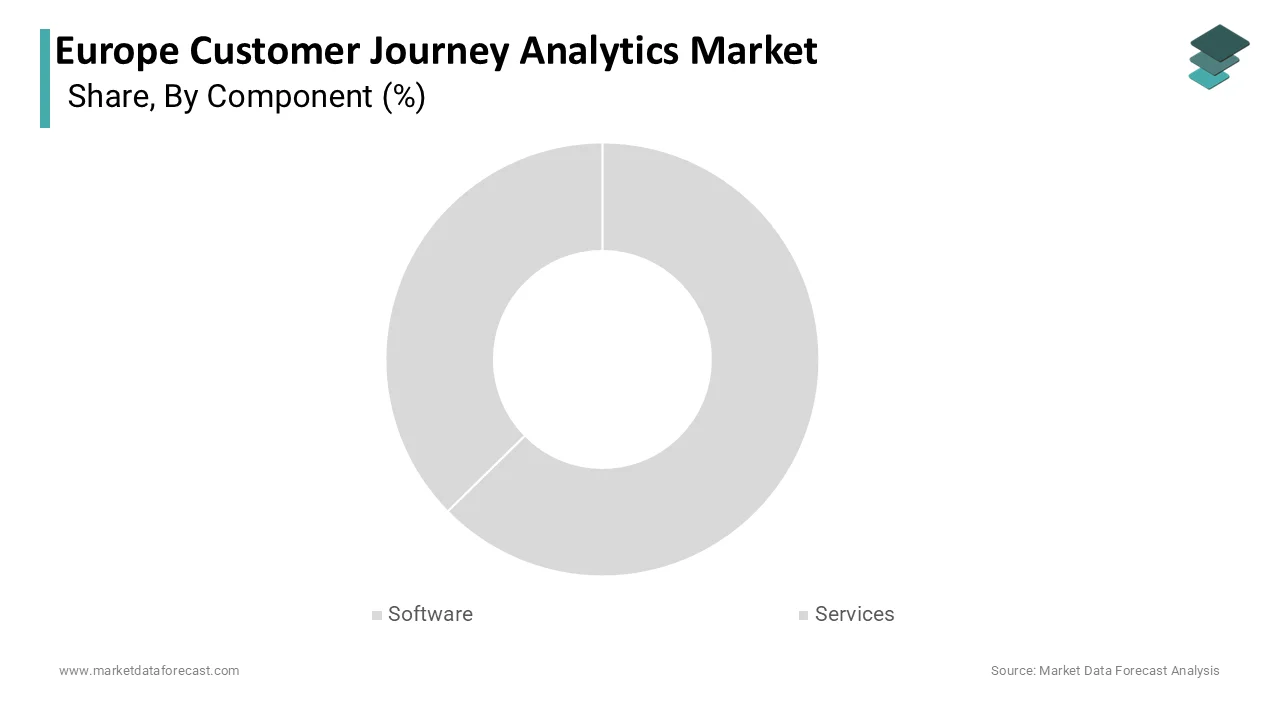
The services segment is predicted to witness the highest CAGR of 14.5% between 2026 and 2034 due to the increasing complexity of analytics implementations and the need for specialized expertise to maximize return on investment. Moreover, the growing need for specialized expertise in the implementation and integration of customer journey analytics solutions is a primary driver for the rapid growth of the services segment. Deploying these complex platforms requires significant technical knowledge and strategic planning to ensure they align with business objectives. According to the European Institute of Innovation and Technology (EIT), many organizations lack the internal skills required to configure and optimize analytics software effectively, leading to the creation of EU-wide upskilling initiatives like SkillSync. This skills gap necessitates the engagement of external consultants and system integrators who possess the necessary expertise. As per Deloitte, professional services firms report a surge in demand for data strategy and implementation services as companies seek to avoid common pitfalls, such as fragmented data landscapes and regulatory complexities. Service providers offer valuable guidance on data governance architecture design and change management ensuring successful adoption. They help organizations navigate the complexities of integrating new analytics tools with existing legacy systems which is often a major challenge. The customization of software to meet specific industry requirements also requires specialized service interventions. Furthermore training programs provided by service partners empower internal teams to utilize the software effectively. The ongoing support and maintenance services ensure that the analytics platform continues to perform optimally as business needs evolve. The strategic value of expert advice in maximizing the utility of analytics investments drives organizations to allocate substantial budgets to services. This reliance on external expertise ensures that the services segment grows at a faster pace than the software segment. The increasing emphasis on strategic consulting for data driven transformation is accelerating the growth of the services segment in the Europe customer journey analytics market. Organizations are recognizing that technology alone is insufficient to achieve desired outcomes and require holistic strategies to leverage analytics effectively. Service providers help businesses define clear key performance indicators and develop roadmaps for integrating customer insights into decision making processes. These services include workshops assessments and coaching sessions that foster a data driven culture within the organization. Consultants assist in identifying high value use cases for customer journey analytics ensuring that efforts are focused on areas with the greatest potential impact. They also help organizations establish best practices for data privacy and compliance which is critical in the European regulatory environment. The ability to translate technical insights into business value is a key differentiator offered by service providers. As the market matures the demand for strategic guidance on optimizing customer experiences through analytics continues to rise. This shift from purely technical implementation to strategic partnership drives the sustained growth of the services segment. Companies view these services as essential for navigating the complexities of digital transformation and maintaining competitive advantage.
By Organization Size Insights
The large enterprises segment dominated the Europe customer journey analytics market and accounted for a substantial share in 2025. This dominance of the segment is driven by the substantial financial resources extensive customer bases and complex operational structures of large organizations which necessitate advanced analytics solutions. The substantial financial resources available to large enterprises enable them to make significant investments in customer journey analytics technologies and infrastructure. These organizations have the capital to acquire premium software licenses hire specialized talent and engage top tier consulting firms. The financial strength allows them to adopt comprehensive analytics platforms that offer advanced features such as real time processing and predictive modeling. Moreover, the ability to absorb the initial costs of implementation and ongoing maintenance makes large enterprises the primary adopters of sophisticated analytics solutions. They can also afford to experiment with emerging technologies such as artificial intelligence and machine learning gaining a competitive edge. The scale of their operations means that even small improvements in customer experience can yield significant financial benefits justifying the investment. Furthermore large enterprises often have dedicated IT departments that can manage complex analytics projects effectively. This resource advantage ensures that they remain the dominant users of customer journey analytics tools. Their early adoption also sets industry standards influencing the broader market. The continuous allocation of budgets for digital transformation initiatives sustains their leadership in the market. The complex operational structures and high customer volumes characteristic of large enterprises drive their dominant position in the customer journey analytics market. These organizations typically operate across multiple regions channels and business units generating vast amounts of customer data that require sophisticated management. Customer journey analytics platforms provide the necessary scalability and processing power to handle this volume of data efficiently. The complexity of their supply chains and service delivery models necessitates a holistic view of the customer journey to identify bottlenecks and inefficiencies. Analytics tools enable these organizations to segment customers precisely and tailor interactions to specific needs enhancing satisfaction and loyalty. The ability to monitor performance across different business units allows for centralized oversight and strategic alignment. Large enterprises also face greater regulatory scrutiny requiring robust compliance mechanisms that analytics platforms can provide. The sheer scale of their operations means that insights derived from analytics have a magnified impact on overall performance. Consequently large enterprises are compelled to adopt advanced analytics solutions to maintain operational efficiency and competitive advantage. This structural necessity ensures their continued dominance in the market. The integration of analytics into core business processes further solidifies their reliance on these technologies.
The small and medium sized enterprises segment is estimated to register the fastest CAGR of 16.2% over the forecast period owing to the increasing availability of affordable cloud based solutions and the growing recognition of the importance of customer experience among smaller businesses. Also, the increasing availability of affordable cloud based customer journey analytics solutions is a primary driver for the rapid growth of the small and medium sized enterprises segment. Software as a Service models have lowered the barrier to entry by eliminating the need for significant upfront capital expenditure on hardware and software licenses. The shift allows smaller businesses to access enterprise grade analytics capabilities at a fraction of the cost. Also, the ease of deployment and minimal maintenance requirements of cloud based solutions further appeal to SMEs that often lack dedicated IT staff. These platforms offer user friendly interfaces and pre built templates that simplify the analytics process. The ability to start small and expand features as the business grows reduces the risk associated with technology adoption. Furthermore cloud providers often include regular updates and security patches ensuring that SMEs always have access to the latest features. This democratization of technology empowers smaller businesses to compete with larger rivals by leveraging data driven insights. The growing ecosystem of third party integrations also enhances the value proposition of these solutions. As more SMEs recognize the benefits of affordable analytics the demand for these services continues to surge. The growing recognition of the importance of customer experience among small and medium sized enterprises is accelerating the adoption of customer journey analytics. In an increasingly competitive market SMEs are realizing that superior customer service is a key differentiator that can drive loyalty and growth. Analytics tools provide SMEs with the insights needed to understand customer preferences and pain points enabling them to deliver personalized experiences. SMEs are using analytics to identify high value customers and tailor marketing efforts to maximize return on investment. The ability to respond quickly to customer feedback and resolve issues proactively enhances brand reputation. Social media monitoring and sentiment analysis features allow SMEs to track brand perception and engage with customers in real time. The availability of success stories and case studies demonstrating the value of analytics further encourages adoption. Industry associations and government initiatives are also promoting digital literacy and the use of data driven tools among SMEs. This cultural shift towards customer centricity drives the demand for analytics solutions that are easy to use and provide immediate value. As SMEs continue to prioritize customer experience the growth of this segment is expected to remain robust.
By Application Insights
The customer behavioural analysis segment led the Europe customer journey analytics market and captured a 25.5% share in 2025. This leading position of the segment is attributed to the critical need for organizations to understand underlying customer motivations and predict future actions to optimize engagement strategies. A key driver for the dominance of customer behavioural analysis is the ability to gain deep insights into customer motivations and preferences which are essential for effective marketing and service delivery. By analyzing browsing patterns purchase history and interaction data businesses can understand what drives customer decisions. Behavioral analysis allows companies to segment customers based on actual actions rather than demographics leading to more accurate targeting. This segment enables organizations to identify micro moments when customers are most likely to engage or convert. The ability to track cross channel behavior provides a holistic view of the customer journey revealing hidden connections between different touchpoints. For instance understanding how a social media interaction influences a subsequent website visit helps optimize marketing spend. Behavioral analysis also helps in detecting anomalies or unusual patterns that may indicate fraud or dissatisfaction. The granularity of insights provided by this application supports strategic decision making across various departments including marketing sales and product development. The continuous refinement of behavioral models through machine learning ensures that insights remain relevant and actionable. This depth of understanding is crucial for creating meaningful connections with customers. Consequently organizations prioritize investments in behavioral analysis tools to enhance their competitive advantage. The capability to predict future actions and assess churn risk is a significant factor driving the leading position of the customer behavioural analysis segment. Predictive analytics uses historical behavioral data to forecast future customer behaviors such as likelihood to purchase or churn. Behavioral analysis models identify early warning signs of dissatisfaction such as reduced engagement or negative sentiment. The proactive approach is more effective and cost efficient than reactive retention strategies. The ability to predict upsell and cross sell opportunities also drives revenue growth by targeting customers with relevant offers at the right time. Behavioral scoring helps prioritize leads for sales teams improving efficiency and conversion rates. The integration of predictive insights into customer relationship management systems enables seamless execution of retention and growth strategies. The accuracy of these predictions improves over time as more data is collected and models are refined. Organizations rely on these forecasts to allocate resources effectively and optimize marketing campaigns. The strategic value of anticipating customer needs ensures that behavioral analysis remains a top priority. This forward looking capability distinguishes it from other descriptive analytics applications.
The customer segmentation and targeting segment is anticipated to witness the fastest CAGR of 15.8% from 2026 to 2034. This rapid growth of the segment is fuelled by the increasing demand for hyper personalized marketing and the need to optimize marketing spend in a crowded digital landscape. The escalating demand for hyper personalized marketing campaigns is a primary catalyst for the rapid growth of the customer segmentation and targeting segment. Consumers expect brands to deliver relevant content and offers tailored to their individual preferences and contexts. Advanced segmentation techniques allow marketers to create micro segments based on detailed behavioral and contextual data. Customer journey analytics platforms enable dynamic segmentation where customers are grouped in real time based on their current interactions. This agility allows for timely and relevant messaging that resonates with customers. The ability to target specific segments with customized offers improves conversion rates and return on ad spend. Segmentation also helps in identifying high value customers for exclusive promotions enhancing loyalty. The integration of artificial intelligence automates the segmentation process making it scalable and efficient. Marketers can test different messages across segments to determine the most effective approaches. The shift from mass marketing to one to one communication drives the adoption of advanced segmentation tools. As competition intensifies the ability to stand out through personalization becomes a critical success factor. This trend ensures sustained growth for the segmentation and targeting application. The need to optimize marketing spend and allocate resources efficiently is accelerating the adoption of customer segmentation and targeting solutions. In an environment of rising customer acquisition costs businesses must ensure that every euro spent on marketing delivers maximum value. Customer journey analytics helps identify which segments are most responsive to specific channels and messages. By focusing efforts on high potential segments companies can improve their return on investment. Segmentation also helps in allocating budgets across different channels based on performance metrics. The ability to measure the impact of targeted campaigns provides accountability and informs future strategies. Dynamic targeting allows for real time adjustments to campaigns based on performance data. This flexibility ensures that marketing resources are used effectively throughout the campaign lifecycle. The transparency provided by analytics platforms builds confidence in marketing investments. Organizations are increasingly adopting attribution models that link segmentation efforts to revenue outcomes. This focus on efficiency and effectiveness drives the rapid growth of the segmentation and targeting segment. Businesses are striving for greater accountability. Consequently, the demand for precise targeting tools will continue to rise.
By End User Insights
The BFSI (Banking Financial Services and Insurance) segment was the largest segment in the Europe customer journey analytics market and occupied a 22.5% share in 2025. This prominence of the segment is supported by the highly competitive nature of the sector the critical importance of customer trust and the extensive regulatory requirements that necessitate rigorous monitoring and personalization. The intense competition within the European BFSI sector drives the dominant adoption of customer journey analytics as institutions strive to retain customers and differentiate their services. With numerous traditional banks fintech startups and digital neobanks vying for market share providing a superior customer experience is paramount. Analytics platforms enable banks to identify at risk customers and implement targeted retention strategies. The ability to personalize financial products and advice based on individual customer profiles enhances engagement. BFSI organizations use analytics to streamline onboarding processes reducing friction and abandonment rates. The insights gained help in designing intuitive digital interfaces that meet customer expectations. The high lifetime value of banking customers makes retention a strategic priority. Analytics also support cross selling and upselling efforts by identifying relevant product opportunities. The competitive pressure to innovate and deliver seamless experiences ensures that BFSI remains the largest end user segment. The continuous evolution of customer expectations demands ongoing investment in analytics capabilities. This dynamic environment sustains the leading position of the BFSI sector in the market. The stringent regulatory compliance and fraud detection requirements in the BFSI sector significantly contribute to its dominant position in the customer journey analytics market. Financial institutions must adhere to strict regulations such as Anti Money Laundering and Know Your Customer directives which require comprehensive monitoring of customer transactions and behaviors. Customer journey analytics platforms provide the visibility needed to track interactions and identify anomalies that may indicate fraud. The ability to map customer journeys helps in understanding normal behavior patterns making deviations easier to spot. Compliance reporting is also streamlined through automated data collection and analysis features. The reputational risk associated with security breaches and non compliance motivates institutions to invest heavily in analytics. The integration of regulatory checks into the customer journey ensures a secure and trustworthy experience. The growing sophistication of financial crimes necessitates continuous improvement in detection capabilities. Analytics provide the real time insights required to respond to threats promptly. This regulatory imperative ensures that BFSI organizations remain major consumers of customer journey analytics solutions. The dual benefit of compliance and security reinforces the segment's leadership.
The Retail & E-commerce segment is likely to experience the fastest CAGR of 17.5% during the forecast period. This quick surge of the segment is propelled by the shift to omnichannel retailing the need for personalization and the intense competition in the online marketplace. The rapid shift to omnichannel retailing and the demand for seamless customer experiences are primary drivers for the fast growth of the Retail & E-commerce segment. Consumers expect to move effortlessly between online and offline channels during their shopping journey. Customer journey analytics enables retailers to track interactions across websites mobile apps social media and physical stores. Analytics platforms help retailers unify data from these diverse touchpoints providing a single view of the customer. This visibility allows for consistent messaging and inventory management across channels. Retailers can optimize store layouts and online interfaces based on journey insights. The ability to offer services like buy online pick up in store requires precise coordination supported by analytics. The competitive landscape forces retailers to adopt these technologies to meet customer expectations. The growth of mobile commerce further increases the complexity of journeys requiring advanced tracking. Retailers use analytics to reduce friction in the checkout process and improve conversion rates. This focus on seamless integration drives the rapid adoption of journey analytics in the retail sector. The intense competition in the European retail and e-commerce landscape and the critical need for personalization are accelerating the adoption of customer journey analytics. With low barriers to entry in e-commerce retailers must differentiate themselves through superior customer experiences. Personalization is a key differentiator that drives loyalty and repeat purchases. Customer journey analytics provides the data needed to create personalized product recommendations and marketing messages. Retailers use these insights to tailor promotions and discounts to individual preferences. The ability to predict future purchases allows for proactive engagement. Analytics also help in optimizing pricing strategies based on customer sensitivity. The fast paced nature of retail requires real time decision making which analytics platforms support. Retailers can adjust campaigns instantly based on performance data. The focus on customer centricity drives investment in tools that enhance understanding of shopper behavior. The need to maximize return on marketing spend in a crowded market further fuels adoption. As retailers strive to build lasting relationships with customers the demand for journey analytics continues to surge. This strategic imperative ensures sustained high growth for the segment.
COUNTRY LEVEL ANALYSIS
Germany Customer Journey Analytics Market Analysis
Germany was the top performer in the Europe customer journey analytics market and accounted for a 20.6% share in 2025. This dominance of the German market is driven by its robust industrial base strong automotive and manufacturing sectors and a high level of digital maturity among enterprises. The German economy is characterized by a strong emphasis on quality and efficiency which extends to customer experience management. According to the Federal Ministry for Economic Affairs and Climate Action (BMWK), the digital transformation of German industries, codified in the Digital Strategy 2025, is a national priority driving significant investment in advanced analytics and AI. The automotive sector in particular is a major adopter of customer journey analytics to enhance dealer networks and after sales services. As per sources, Germany maintains one of Europe's highest internet penetration rates (over 93%), ensuring a vast and mature data ecosystem for customer journey analytics, even as total user growth stabilizes. German companies are known for their rigorous approach to data privacy and compliance with GDPR which influences the selection of analytics vendors. The presence of leading software providers and technology hubs in cities like Berlin and Munich fosters innovation in the sector. The manufacturing industry uses analytics to understand B2B customer journeys and optimize supply chain interactions. The strong vocational training system ensures a skilled workforce capable of utilizing complex analytics platforms. The focus on Industry 4.0 integrates customer data with production processes creating new opportunities for personalization. The stable economic environment encourages long term investments in technology. The collaborative ecosystem between startups and established corporations accelerates the adoption of innovative solutions. These factors collectively sustain Germany’s position as the largest market for customer journey analytics in Europe. The continuous push for digital excellence ensures steady market growth.
United Kingdom Customer Journey Analytics Market Analysis
The United Kingdom followed closely behind in the Europe customer journey analytics market and captured a 18.2% share in 2025. This expansion of the UK market is attributed to its advanced financial services sector vibrant retail industry and early adoption of digital technologies. The UK has a highly developed digital economy with a strong culture of innovation and entrepreneurship. According to the Office for National Statistics the UK has one of the highest rates of e-commerce penetration in Europe driving demand for sophisticated analytics. The financial services sector in London is a global hub that extensively uses customer journey analytics for retention and personalization. As per the Department for Science, Innovation and Technology (DSIT), the UK Digital Strategy actively supports the adoption of data-driven technologies like AI to maintain the UK's position as a global leader in the digital economy. The retail sector is highly competitive with major players investing heavily in omnichannel strategies. The presence of numerous tech startups and venture capital firms fosters a dynamic ecosystem for analytics innovation. UK companies are quick to adopt cloud based solutions and AI driven tools. The regulatory framework although influenced by Brexit remains aligned with high data protection standards. The strong focus on customer centricity in British business culture drives the uptake of analytics. The availability of skilled data professionals supports the implementation of complex projects. The media and entertainment industry also contributes to market growth through audience analytics. The strategic importance of data in maintaining competitive advantage ensures sustained demand. These elements maintain the UK’s strong position in the European market. The continuous evolution of digital services keeps the market vibrant and growing.
France Customer Journey Analytics Market Analysis
France maintains a noteworthy presence in the Europe customer journey analytics market due to its strong luxury retail sector telecommunications industry and government initiatives promoting digital transformation. The French economy features a prominent luxury goods sector that relies heavily on personalized customer experiences to maintain brand loyalty. According to the French Ministry of Economy and Finance the digital transition of French businesses is supported by various funding programs and incentives. Luxury brands use customer journey analytics to manage high net worth client relationships across global markets. As per INSEE the digitalization of French SMEs is accelerating expanding the user base for analytics solutions. The telecommunications sector is another major adopter using analytics to reduce churn and improve service quality. The government’s France 2030 plan includes significant investments in digital technologies fostering innovation. The presence of major international tech companies in Paris creates a hub for analytics expertise. French consumers are increasingly digital savvy expecting seamless interactions from brands. The regulatory environment emphasizes data sovereignty influencing vendor selection. The tourism and hospitality industry also utilizes analytics to enhance visitor experiences. The strong academic institutions produce a steady stream of data scientists and analysts. The cultural appreciation for quality and service drives the adoption of customer centric tools. These factors support the continued growth of the market in France. The strategic focus on digital sovereignty ensures local development of solutions.
Netherlands Customer Journey Analytics Market Analysis
The Netherlands held a promising share of the Europe customer journey analytics market owing to its advanced digital infrastructure high English proficiency and status as a logistics and trade hub. The Netherlands is a leader in digital adoption in Europe with a highly connected population and business community. According to Statistics Netherlands, the country maintains one of the highest internet penetration rates in the world (99%), providing a robust foundation for high digital engagement and data-driven activities. The logistics and transport sector uses customer journey analytics to optimize B2B interactions and supply chain visibility. As per the Netherlands Enterprise Agency the government actively promotes digital innovation through partnerships and grants. The retail and e-commerce sectors are well developed with many international companies headquartered in the country. The high level of digital literacy among consumers drives demand for personalized experiences. The presence of major tech hubs in Amsterdam attracts talent and investment in analytics. Dutch companies are early adopters of cloud technologies and agile methodologies. The open business culture encourages collaboration and knowledge sharing. The financial sector is also a significant user of analytics for customer insights. The strong regulatory framework ensures high standards of data protection. The focus on sustainability and efficiency aligns with the benefits of analytics. These characteristics position the Netherlands as a key market in Europe. The continuous investment in digital infrastructure supports market expansion.
Italy Customer Journey Analytics Market Analysis
Italy is predicted to grow significantly in the Europe customer journey analytics market from 2026 to 2034 due to its growing digital transformation efforts strong tourism sector and increasing adoption of e-commerce. The Italian economy is undergoing a significant digital transformation supported by national recovery plans. According to the Italian National Institute of Statistics (ISTAT), the use of digital technologies by Italian businesses has increased, with the percentage of SMEs reaching at least a basic level of digital intensity hitting 70.2% in 2024. The tourism and hospitality sector is a major adopter of customer journey analytics to enhance visitor experiences and manage bookings. As per the Italian Department for Digital Transformation, government initiatives under the National Recovery and Resilience Plan (NRRP) are accelerating the digitization of public services, with over 80% of essential services expected online by 2026. The retail sector is shifting towards omnichannel models driving demand for analytics. The fashion and design industries use analytics to understand global customer preferences. The fragmentation of the Italian business landscape with many SMEs presents both a challenge and an opportunity for cloud based analytics providers. The increasing internet usage among older demographics expands the data pool. The cultural emphasis on personal relationships in business aligns with the goals of customer journey analytics. The regulatory environment is evolving to support digital innovation. The growth of fintech and insurtech sectors adds to the demand. These dynamics contribute to the steady growth of the market in Italy. The focus on modernizing traditional industries ensures long term potential.
COMPETITIVE LANDSCAPE
The competition in the Europe customer journey analytics market is characterized by the presence of established global technology giants alongside innovative specialized vendors and emerging startups. Large enterprises leverage their comprehensive suites and extensive resources to offer end to end solutions that integrate seamlessly with existing enterprise systems. These players compete on the breadth of their offerings brand reputation and ability to serve large multinational corporations with complex needs. Specialized vendors differentiate themselves through deep functional expertise superior user experiences and agile development cycles that allow for rapid innovation. The market sees intense rivalry in areas such as artificial intelligence capabilities real time data processing and ease of integration. Price competition is moderate as customers prioritize value and return on investment over initial cost. Strategic partnerships and ecosystems play a vital role as no single vendor can meet all customer requirements independently. The threat of new entrants remains present due to the lowering barriers to entry provided by cloud technologies. However high switching costs and data migration challenges create stickiness for existing customers. Regulatory compliance serves as both a barrier and a differentiator with vendors who demonstrate robust privacy features gaining an edge. The market is consolidating as larger players acquire smaller innovators to enhance their portfolios. This dynamic environment drives continuous improvement and benefits customers through enhanced features and services.
KEY MARKET PLAYERS
Some of the companies that are playing a dominating role in the global Europe Customer Journey Analytics Market include
- Adobe Inc.
- Salesforce, Inc.
- SAP SE
- Oracle Corporation
- IBM Corporation
- Microsoft Corporation
- Google LLC (Alphabet Inc.)
- NICE Ltd.
- Verint Systems Inc.
- Teradata Corporation
- Medallia Inc.
- Cisco Systems, Inc
TOP LEADING PLAYERS IN THE MARKET
- Adobe stands as a global leader in digital experience solutions with a significant footprint in the Europe customer journey analytics market. The company offers Adobe Experience Platform which unifies customer data from various sources to create comprehensive real time profiles. Adobe contributes to the global market by providing robust tools for personalization and attribution that help brands deliver consistent experiences across channels. Recent actions to strengthen its position include the integration of advanced artificial intelligence capabilities through Adobe Sensei to automate insights and predictive modeling. The company has also enhanced its privacy compliance features to align with strict European regulations such as GDPR. Adobe actively collaborates with enterprise clients to co innovate solutions that address specific industry challenges. Their continuous investment in cloud infrastructure ensures scalability and reliability for large scale deployments. By focusing on open ecosystems and interoperability Adobe enables seamless integration with third party applications. This approach fosters a flexible environment for businesses to customize their analytics stacks. The company’s commitment to ethical data use builds trust among European consumers and regulators. These strategic initiatives solidify Adobe’s role as a pivotal enabler of digital transformation in the region.
- Salesforce is a dominant player in the Europe customer journey analytics market leveraging its extensive Customer 360 platform to provide holistic views of customer interactions. The company integrates sales service marketing and commerce data to enable seamless journey orchestration. Salesforce contributes to the global market by democratizing access to advanced analytics through user friendly interfaces and low code development tools. Recent actions to strengthen its market position include the acquisition of specialized data analytics firms to enhance its AI driven insights capabilities. The introduction of Einstein AI allows users to predict customer behavior and recommend next best actions in real time. Salesforce has also expanded its industry specific clouds tailored for European sectors such as financial services and healthcare. The company prioritizes data sovereignty by establishing local data centers in key European countries to comply with regulatory requirements. Strategic partnerships with consulting firms help accelerate implementation and adoption among enterprise clients. Salesforce continuously updates its platform with new features based on customer feedback and emerging trends. Their focus on sustainability and social responsibility resonates with European values enhancing brand loyalty. These efforts ensure that Salesforce remains a preferred choice for organizations seeking to optimize customer journeys.
- SAP holds a prominent position in the Europe customer journey analytics market by leveraging its deep expertise in enterprise resource planning and customer experience management. The company offers SAP Customer Data Cloud and SAP Analytics Cloud which provide integrated solutions for data management and visualization. SAP contributes to the global market by connecting operational data with experiential data to drive actionable insights. Recent actions to strengthen its market position include the enhancement of its intelligent suite with machine learning algorithms for predictive analytics. The company has focused on improving the interoperability of its solutions with other enterprise systems to break down data silos. SAP has also invested heavily in user experience improvements making its analytics tools more accessible to business users. The expansion of its partner ecosystem in Europe facilitates localized support and customized implementations. SAP emphasizes trust and transparency in data handling which is critical for compliance with European privacy laws. The company regularly releases updates that incorporate the latest technological advancements such as natural language processing. By aligning its product roadmap with the strategic goals of European enterprises SAP ensures long term relevance. Their comprehensive approach to customer journey management supports complex organizational structures effectively.
TOP STRATEGIES USED BY THE KEY MARKET PARTICIPANTS
Key players in the Europe customer journey analytics market primarily focus on integrating artificial intelligence and machine learning to enhance predictive capabilities and automate insight generation. Companies are increasingly adopting cloud native architectures to ensure scalability flexibility and easier deployment for clients across diverse regions. Strategic acquisitions of niche technology firms allow vendors to expand their feature sets and address specific industry needs effectively. Partnerships with consulting and system integration firms are crucial for driving adoption and ensuring successful implementation of complex analytics solutions. Emphasis on data privacy and compliance with regulations like GDPR is a central strategy to build trust and mitigate legal risks in the European market. Vendors are also developing industry specific solutions to cater to the unique requirements of sectors such as banking retail and telecommunications. Continuous innovation in user interface design aims to make advanced analytics accessible to non technical users thereby broadening the customer base. These strategies collectively enable companies to maintain competitive advantages and drive sustainable growth in a dynamic landscape.
MARKET SEGMENTATION
This research report on the europe customer journey analytics market is segmented and sub-segmented into the following categories
By Component
- Software
- Services
By Organization Size
- Large Enterprises
- Small and Medium-Sized Enterprises (SMEs)
By Application
- Customer Behavioural Analysis
- Customer Segmentation and Targeting
By End User
- BFSI (Banking, Financial Services, and Insurance)
- Retail & E-commerce
By Country
- Germany
- United Kingdom
- France
- Italy
- Netherlands
- Rest of Europe