- Product Description Description
- Table of Contents TOC
- List of Table & Figure LOT
- Get Free Sample PDF Sample PDF
Market Size, 2025
$356 MnMarket Estimate, 2026
$388 MnMarket Forecast, 2034
$773 MnCAGR, 2026–2034
9%Europe Dehumidifier Market Summary
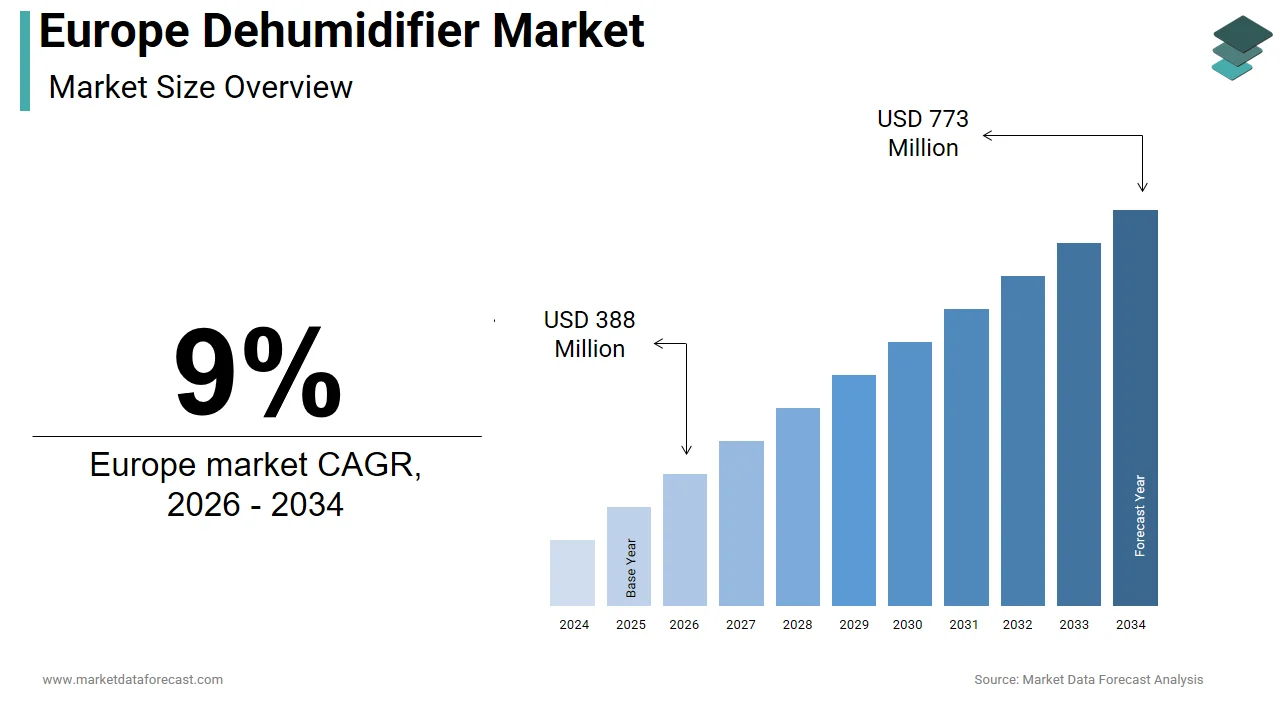
The Europe dehumidifier market was valued at USD 356 million in 2025 and is projected to reach USD 773 million by 2034, growing at a CAGR of 9% from 2026 to 2034. Market growth is driven by rising concerns over indoor air quality, increasing prevalence of dampness and mold in residential buildings, accelerating urbanization, and the growing impact of climate change induced humidity extremes across the region. Dehumidifiers are increasingly adopted across residential, commercial, and industrial settings to mitigate moisture-related health risks, material degradation, and regulatory non-compliance.
Dehumidifiers are electrical appliances designed to remove excess moisture from indoor air, thereby improving comfort, preventing mold growth, and protecting building structures and sensitive materials. In Europe, aging housing stock, compact urban living spaces, and energy-efficient airtight buildings have structurally increased the need for active humidity control, positioning dehumidifiers as essential indoor climate management solutions.
Key Market Trends & Insights
- Germany dominated the European dehumidifier market in 2025, supported by strong consumer awareness, strict building standards, and industrial demand.
- Residential applications account for the largest share, driven by urban housing density and rising health awareness.
- Refrigerant-type dehumidifiers remain the most widely adopted due to cost efficiency and suitability for European climates.
- Industrial dehumidification is the fastest-growing application segment, supported by pharmaceutical, food processing, and data center expansion.
- Climate volatility and flooding events are increasing year-round demand beyond seasonal usage.
- Energy efficiency regulations are reshaping product design and accelerating innovation in low-energy models.
Market Size & Forecast
- 2025 Market Size: USD 356 Million
- 2026 Market Size: USD 388 Million
- 2034 Projected Market Size: USD 773 Million
- CAGR (2026 to 2034): 9%
- Largest Country Market (2025: Germany
- Fastest-Growing Application: Industrial
Key Report Takeaways
- By product type, refrigerant dehumidifiers dominated the market in 2025 due to affordability, ease of maintenance, and energy efficiency in moderate climates.
- By End-user, the residential segment held the largest share in 2025, supported by indoor air quality awareness and compact urban living.
- The industrial segment is forecast to register the highest CAGR (8.1%), led by stringent humidity control requirements in pharmaceuticals, food processing, and data centers.
- By country, Germany accounted for 22.1% market share in 2024, followed by the United Kingdom and France, while Southern and Nordic Europe offer steady growth potential.
Europe Dehumidifier Market Size
The size of the Europe dehumidifier market was worth USD 356 million in 2025. The regional market is anticipated to grow at a CAGR of 9% from 2026 to 2034 and be worth USD 773 million by 2034 from USD 388 million in 2026.
A dehumidifier is an electrical appliance that removes excess moisture (water vapor) from the air, lowering humidity levels for health, comfort, and material preservation across residential, commercial (pools, warehouses), and industrial (pharma, electronics) sectors, using technologies like refrigeration or absorption to prevent mold, dust mites, and product degradation, with market growth driven by rising health awareness, climate change, and industrial process needs. These systems play a pivotal role in enhancing indoor air quality, mitigating mold proliferation, and preserving structural integrity in settings vulnerable to persistent humidity. As per research, the prevalence of households in the EU experiencing indoor dampness or visible mold is a notable concern, with recent data indicating a growing trend in this issue. Besides, building age is a significant risk factor for dampness and mold, with older properties generally showing a higher susceptibility to humidity-related degradation due to the absence of modern insulation and ventilation standards. These structural and environmental realities establish a foundational impetus for dehumidification demand independent of direct market size metrics.
MARKET DRIVERS
Escalating Prevalence of Respiratory Conditions Linked to Indoor Humidity
The growing burden of respiratory ailments in the region directly amplifies demand for controlled indoor humidity environments, which fuels the growth of the Europe dehumidifier market. Many people in the European Union have chronic respiratory diseases, including conditions like asthma and allergic rhinitis. These respiratory conditions are often made worse by dampness and mold spores found indoors. Exposure to damp indoor environments is associated with an increased risk of children developing asthma. A notable proportion of children in France experience physician-diagnosed asthma. Indoor humidity has been identified as a contributing environmental factor in many of these French cases. Households experiencing persistent dampness appear more likely to have residents with chronic bronchitis or recurrent respiratory infections. Such epidemiological evidence has spurred public health advisories across Nordic and Western European nations recommending humidity control as a non-pharmaceutical intervention. Consequently, consumers and public institutions increasingly integrate dehumidifiers into preventive health strategies, particularly in basements, schools, and elderly care facilities, where air quality directly impacts vulnerable populations. This medically substantiated linkage between indoor moisture and respiratory morbidity continues to drive steady demand across both consumer and institutional segments.
MARKET RESTRAINTS
Stringent Energy Performance Regulations Constraining Product Design
European Union energy efficiency directives impose significant technical and economic constraints on dehumidifier manufacturers, which restrict the expansion of the Europe dehumidifier market. This is due to mandatory compliance with evolving eco-design and energy labeling frameworks. Regulations require that electric dehumidifiers sold in the European Union meet minimum seasonal energy efficiency ratios. Devices unable to achieve a high energy rating are not permitted for market entry. This regulatory threshold has rendered numerous legacy models obsolete, particularly compact units relying on conventional compressor technology, which typically operate at energy efficiency ratios below the mandated benchmark. As per various studies, a significant portion of dehumidifiers previously available in European retail channels would not meet current efficiency standards without substantial redesign. Consequently, manufacturers face increased research and development expenditures to integrate variable speed compressors, advanced heat exchangers, and low global warming potential refrigerants. These modifications elevate production costs, which in turn restricts affordability for price-sensitive consumers, particularly in Southern and Eastern European markets. Moreover, small and medium enterprises lacking in-house engineering capabilities struggle to navigate complex certification processes, thereby limiting competitive diversity. Thus, while these regulations advance sustainability objectives, they simultaneously throttle product accessibility and innovation velocity across the dehumidifier value chain.
MARKET OPPORTUNITIES
Intensifying Urbanization and Densification of Residential Spaces
The region’s advancing urban transformation creates new opportunities for the growth of the Europe dehumidifier market. This provides fertile ground for dehumidifier adoption by concentrating populations in compact living environments where natural ventilation is inherently limited. A majority of the European Union population lives in urban areas, and the average dwelling size in several major cities measures less than sixty square meters per household, according to research. In such confined residential units, particularly in high-rise apartments or renovated historic buildings, moisture generated from cooking, bathing, and respiration accumulates rapidly without adequate airflow. Indoor relative humidity in urban dwellings often exceeds sixty-five percent during the winter months. Furthermore, renovation projects in cities such as Stockholm and Vienna often convert basements and attics into habitable rooms without commensurate upgrades to mechanical ventilation. This spatial compression effect is especially pronounced in rental markets where tenants lack the authority to modify building envelopes. Consequently, demand for portable and quiet dehumidifiers has surged in metropolitan regions. This urban-driven necessity transcends seasonal weather patterns, establishing dehumidifiers as essential household appliances in Europe’s evolving residential landscape.
Climate Change-Induced Hydrological Extremes
Accelerating climate volatility across the region is generating unprecedented patterns of indoor moisture accumulation, which in turn offers fresh prospects for the growth of the Europe dehumidifier market. This thereby expands the operational necessity and geographic relevance of dehumidification systems. The occurrence of significant precipitation events in Central and Western Europe has seen an increase. The summer of 2024 experienced substantial rainfall across regions, including Germany, Belgium, and the Netherlands. These deluges saturate building materials and elevate groundwater levels, leading to prolonged indoor dampness even in structurally sound properties. A large number of residential buildings across Europe were impacted by water intrusion resulting from flood events in 2023. Beyond acute flooding, chronic humidity stress is intensifying due to rising dew points. As per research, average summer moisture levels, indicated by dew point temperatures, have risen in Southern Europe. In coastal cities where sea level rise exacerbates capillary moisture rise in masonry structures, the prevalence of salt-induced efflorescence and plaster degradation has escalated. These environmental shifts render traditional passive ventilation inadequate, particularly in energy-efficient airtight buildings constructed under modern thermal regulations. Consequently, both public infrastructure managers and private homeowners are compelled to deploy active dehumidification not as a luxury but as a resilience measure against climate-driven indoor environmental degradation.
MARKET CHALLENGES
High Upfront Investment Relative to Perceived Urgency
Consumer perceptions of non-essentiality, coupled with comparatively high acquisition costs, challenge the expansion of the Europe dehumidifier market. This is despite documented health and structural benefits. The current perception classifies dehumidifiers as optional appliances rather than necessities such as refrigerators or water heaters. This viewpoint is reinforced by average retail prices for mid-tier units. The cost of these appliances may exceed the monthly utility budget of many low- and middle-income households. Therefore, disposable income allocated for non-core home appliances remains minimal in certain regions. Moreover, unlike heating or cooling systems, dehumidification lacks widespread integration into national building codes or subsidy programs. Consequently, purchase decisions are often deferred until visible mold or property damage occurs, creating a reactive rather than preventive demand pattern. This economic and psychological barrier particularly impedes penetration in Southern and Eastern Europe, where the climate is perceived as naturally drier despite localized microclimates in basements, coastal areas, and densely built urban centers exhibiting persistent dampness. Market momentum will remain stunted as long as dehumidifiers are seen as optional comfort items instead of vital health equipment, causing the urgency of need to conflict with their perceived cost.
Fragmented Distribution Channels and After-Sales Service Gaps
Operational friction due to a highly fragmented retail and service ecosystem that impedes consistent consumer access and post-purchase support, and negatively impacts the growth of the Europe dehumidifier market. Unlike standardized white goods, dehumidifiers are often categorized as specialty appliances, resulting in inconsistent availability across mainstream electronics and home improvement retailers. As per sources, many major retail chains within the EU do not maintain dedicated inventory for dehumidification equipment, and coverage is particularly inconsistent in rural and peri-urban regions of Eastern Europe. This distribution gap is compounded by a limited technical support infrastructure. A significant number of authorized service centers in Southern Europe do not stock necessary replacement parts for dehumidifiers or employ technicians with specialized training for relevant repairs. As a result of these inventory and training issues, the time required for dehumidifier repairs is considerably longer than that for typical conventional appliances. Such delays discourage repeat purchases and amplify perceptions of unreliability. Furthermore, e-commerce platforms, although expanding, offer minimal guidance on unit sizing, capacity matching, and installation best practices, leading to mismatched purchases and performance dissatisfaction. Consumer complaints related to dehumidifier performance often stem from customers selecting incorrect models or experiencing inadequate post-sale support. Consumer uptake and market expansion face limitations until distribution channels match those of established appliance sectors and service standards become consistent across regions.
REPORT COVERAGE
| REPORT METRIC | DETAILS |
| Market Size Available | 2025 to 2034 |
| Base Year | 2025 |
| Forecast Period | 2026 to 2034 |
| Segments Covered | By Product Type, Technology, End User, and Country. |
| Various Analyses Covered | Global, Regional, and Country-Level Analysis, Segment-Level Analysis, Drivers, Restraints, Opportunities, Challenges; PESTLE Analysis; Porter’s Five Forces Analysis, Competitive Landscape, Analyst Overview of Investment Opportunities |
| Countries Covered | UK, France, Spain, Germany, Italy, Russia, Sweden, Denmark, Switzerland, Netherlands, Turkey, Czech Republic, and the Rest of Europe. |
| Market Leaders Profiled | Electrolux AB, Berlin Brands Group, Desiccant Technologies Group, Haier Smart Home Co., Ltd., Munters Group AB, General Filters, Inc., Meaco (U.K.) Limited, DeLonghi Group, Honeywell International Inc., Whirlpool Corporation, Motors And Armatures Inc.(Mars), LG Electronics, and Others. |
SEGMENTAL ANALYSIS
By Technology Insights
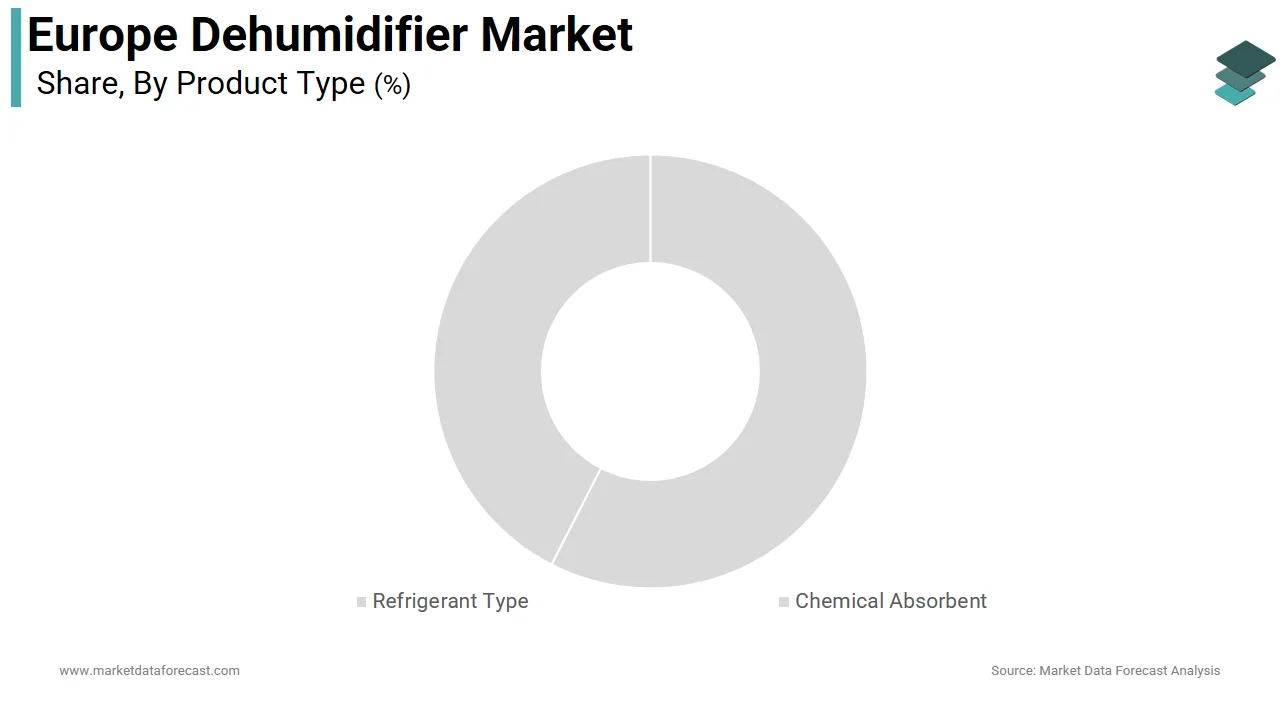
The refrigerant segment dominated the Europe dehumidifier market in 2025 because of its cost-effectiveness, energy efficiency, and suitability for moderate ambient temperatures typical across most European climates. Their operational simplicity and lower maintenance requirements make them highly preferred in residential and light commercial applications. An additional driver of this segment is the widespread adoption of variable speed compressors that significantly improve seasonal energy performance. Consumer familiarity and readily available spare parts further reinforce market preference. Retailers across Germany, France, and the Netherlands consistently rank refrigerant models among top top-selling small climate appliances. These technical and commercial advantages sustain the segment’s dominance across temperate European regions where extremely low temperature operation is rarely required.
By End User Insights
The residential application segment held the largest share of the Europe dehumidifier market in 2025. The supremacy of the residential application segment is attributed to rising awareness of indoor air quality health implications and increasing urban housing density with limited natural ventilation. Small living spaces in cities such as Paris, Berlin, and Amsterdam exacerbate moisture accumulation from routine domestic activities, leading to persistent dampness. National health agencies have reinforced public messaging linking indoor humidity to respiratory conditions. Moreover, energy-efficient models now qualify for green appliance incentives in Italy and Spain under national recovery plans, further stimulating uptake. This convergence of health consciousness, urban living patterns, and policy support solidifies residential dominance across Western and Southern Europe.
The industrial application segment is predicted to witness the highest CAGR of 8.1% over the forecast period, owing to stringent regulatory standards and infrastructure modernization across sensitive manufacturing sectors. In pharmaceuticals, the European Medicines Agency requires relative humidity control in production and storage areas to ensure drug stability and sterility. According to sources, a notable share of new EU-based drug manufacturing facilities inaugurated integrate industrial desiccant dehumidification systems. Similarly, the food processing industry faces tightening moisture control mandates under the EU’s Food Hygiene Regulation. Apart from these, data center expansion driven by cloud computing demand has intensified cooling and dehumidification needs. These regulatory, technical, and digital economy forces collectively propel industrial dehumidification beyond cyclical consumer trends.
COUNTRY-LEVEL ANALYSIS
Germany Dehumidifier Market Analysis
Germany led the Europe dehumidifier market and accounted for a 22.1% share in 2024. The leading position of the German market is driven by advanced building standards, high consumer awareness, and a robust industrial base requiring precise climate control. The country’s Energiewende energy transition policy has intensified demand for energy-efficient home appliances, including dehumidifiers compliant with the EU Energy Label Class A standard. Industrial demand remains strong, particularly in Bavaria and Baden-Württemberg, where automotive and pharmaceutical clusters enforce strict ISO 14644 cleanroom standards necessitating continuous humidity management. Furthermore, nationwide flood recovery initiatives following the 2021 Rhine basin inundation have institutionalized post-disaster moisture remediation protocols involving commercial-grade dehumidifiers across public infrastructure projects.
United Kingdom Dehumidifier Market Analysis
The United Kingdom was the next prominent country in the Europe dehumidifier market and captured a share of 16.5% in 2024. The growth of the UK market is credited to sustained demand from both the aging housing stock and the expanding healthcare infrastructure. Many homes across the United Kingdom were constructed without modern standards for adequate damp proofing or mechanical ventilation. This characteristic makes those structures potentially more vulnerable to moisture-related issues. The frequency and intensity of rainfall events have been increasing in certain regions. These changing environmental patterns can exacerbate existing structural vulnerabilities related to dampness. The National Health Service has responded by upgrading humidity control in over two hundred hospital pharmacies to meet revised Medicines and Healthcare products Regulatory Agency storage guidelines. These interlinked housing climate and health policy drivers sustain the UK’s prominent market role.
France Dehumidifier Market Analysis
France grew steadily in the Europe dehumidifier market because of public health initiatives, urban densification, and post-renovation humidity challenges in historic districts. A national strategy for indoor air quality has been introduced, identifying humidity control as a key intervention in addressing respiratory health issues. In one major city, the office responsible for heritage conservation now requires the installation of dehumidification systems during all basement renovation projects. The average size of living spaces in major cities has decreased, leading to more intensive moisture accumulation in modern residential units. Also, there has been a notable increase in the purchase of dehumidification appliances, particularly in coastal areas impacted by significant marine humidity. Government subsidy programs for green renovations have expanded their eligibility criteria to include dehumidification systems, thereby encouraging greater household adoption across different economic backgrounds.
Italy Dehumidifier Market Analysis
Italy is another key player in the European dehumidifier market, with growth due to climate vulnerability, southern regional demand, and tourism-related facility maintenance. As per sources, a portion of households in regions such as Campania and Sicily experience seasonal basement flooding during autumn storms, a trend exacerbated by inadequate urban drainage. Coastal hotels and museums face continuous challenges from salt-laden air, which induces efflorescence and microbial growth on frescoes and textiles. Besides, the National Health Institute reported a correlation between indoor dampness and respiratory hospitalizations, with southern regions showing a forty-two percent higher incidence than the EU average. These environmental heritage and health dynamics uniquely position Italy as a resilient and growing market.
Sweden Dehumidifier Market Analysis
Sweden is anticipated to grow in the Europe dehumidifier market from 2025 to 2033 owing to stringent building codes, cold climate requirements, and demand in sustainable industrial climate solutions. A trend in building construction involves the regular use of specific air management systems. Highly sealed building environments require intentional ventilation to manage indoor conditions. Such ventilation systems often include technology that captures heat from outgoing air. The careful management of humidity levels is part of this construction approach. This practice helps in avoiding issues related to internal moisture buildup, which can be a concern in cooler climates. A significant portion of new residential buildings in urban areas of the country incorporates active systems for controlling moisture indoors. Industrial demand is equally robust, with companies requiring precision dehumidification in production environments. Government policy in Sweden encourages the use of refrigerants that have less impact on the global climate. This is part of an ongoing national effort to achieve net-zero emissions. The market for smart dehumidifiers has seen an increase in consumer interest. This trend is particularly evident in apartments, as individuals focus on preventative measures such as addressing concerns about mold. This policy-driven technical ecosystem solidifies Sweden’s advanced and stable market position.
COMPETITIVE LANDSCAPE
Competition in the Europe dehumidifier market is characterized by a blend of multinational appliance manufacturers and specialized climate control solution providers vying for dominance across residential and industrial segments. Established brands leverage their brand recognition, distribution reach and R and D capabilities to introduce technologically advanced and regulation-compliant products. At the same time, niche players differentiate through application-specific engineering, particularly in sectors requiring stringent humidity control, such as pharmaceuticals and archival storage. The competitive landscape is further shaped by increasing consumer awareness of indoor air quality and evolving building standards that mandate active moisture management. Companies are compelled to balance cost efficiency with performance reliability while navigating fragmented retail channels and uneven service infrastructure across regions. This dynamic fosters continuous innovation in energy consumption, noise reduction, and digital connectivity as primary battlegrounds for market influence without reliance on price-based competition.
KEY MARKET PLAYERS
The leading companies operating in the Europe dehumidifier market include:
- Electrolux AB
- Berlin Brands Group
- Desiccant Technologies Group
- Haier Smart Home Co., Ltd.
- Munters Group AB
- General Filters, Inc.
- .Meaco (U.K.) Limited
- De’Longhi Group
- Honeywell International Inc.
- Whirlpool Corporation
- Motors And Armatures Inc. (Mars)
- LG Electronics
TOP PLAYERS IN THE MARKET
- DeLonghi Group, headquartered in Italy, maintains a prominent presence in the Europe dehumidifier market through its focus on compact energy-efficient residential units tailored for urban households. The company leverages its extensive distribution network across Western and Southern Europe to ensure broad product accessibility. In recent developments, DeLonghi enhanced its product line by integrating smart humidity sensors and mobile connectivity features, enabling real-time indoor air quality monitoring. This innovation aligns with growing consumer demand for intelligent home climate solutions. Additionally, the company intensified its collaboration with European retail chains to offer bundled promotions with air purifiers, thereby strengthening cross-category appeal and reinforcing brand loyalty without expanding into industrial segments.
- Electrolux AB, a Swedish multinational, contributes significantly to the Europe dehumidifier market by emphasizing sustainability and quiet operation in its appliance portfolio. The company designs dehumidifiers that comply with the European Union’s stringent ecodesign regulations while prioritizing low noise emissions suitable for bedrooms and offices. Electrolux recently upgraded its manufacturing facilities in Poland to incorporate circular economy principles, including recyclable component sourcing and modular assembly for easier repairs. Furthermore, the company launched a digital platform offering personalized humidity management advice based on local weather data and dwelling characteristics. These initiatives reflect Electrolux’s strategy to position dehumidification as an integral element of holistic indoor environmental health rather than a standalone function.
- Munters Group AB, based in Sweden, specializes in industrial and commercial dehumidification solutions serving sectors such as pharmaceuticals, food processing, and data centers across Europe. The company distinguishes itself through advanced desiccant and condensation-based technologies engineered for high moisture load environments. Munters recently expanded its service footprint by establishing technical support hubs in Spain and the Netherlands to accelerate response times for maintenance and system optimization. This digital integration enhances operational reliability and supports Munters’ commitment to delivering precision climate control tailored to mission-critical European industrial applications.
TOP STRATEGIES USED BY THE KEY MARKET PARTICIPANTS
Key participants in the Europe dehumidifier market employ product innovation through smart features such as humidity sensing and mobile app integration to align with consumer preferences for connected home devices. They prioritize compliance with European energy efficiency and ecodesign regulations by adopting advanced compressors and eco-friendly refrigerants. Companies are expanding after-sales service networks to improve customer retention and reduce repair delays. Strategic retail partnerships enable bundled offerings with complementary appliances like air purifiers to increase average transaction value. Additionally, firms invest in digital engagement platforms offering personalized indoor climate advice to build brand authority and consumer trust across diverse European geographies.
MARKET SEGMENTATION
This research report on the Europe dehumidifier market has been segmented and sub-segmented into the following categories.
By Product Type
- Portable
- Fixed
By Technology
- Refrigerant
- Desiccant
- Others
By End User
- Residential
- Commercial
- Industrial
By Country
- United Kingdom
- France
- Spain
- Germany
- Italy
- Russia
- Sweden
- Denmark
- Switzerland
- Netherlands
- Rest of Europe