- Product Description Description
- Table of Contents TOC
- List of Table & Figure LOT
- Get Free Sample PDF Sample PDF
Market Size, 2025
$990.40 MnMarket Estimate, 2026
$1,084.49 MnMarket Forecast, 2034
$2,241 MnCAGR, 2026–2034
9.5%Europe Digital Audio Workstation Market Size
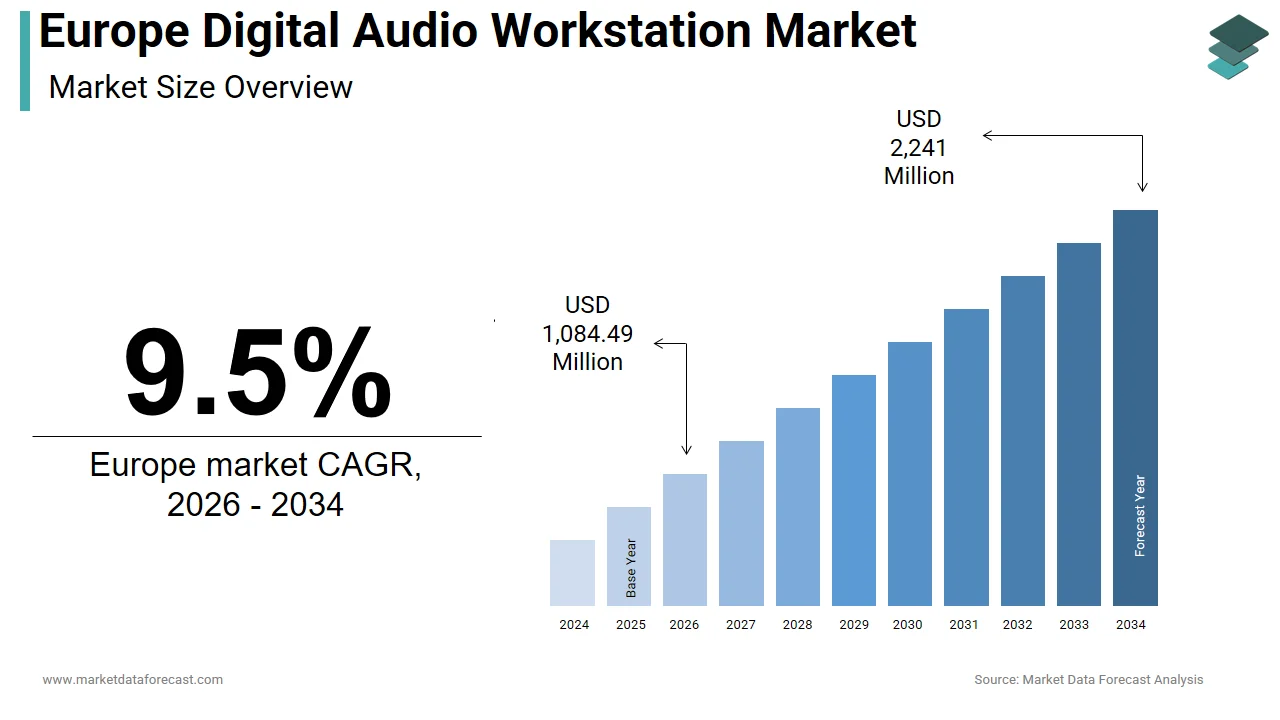
The Europe digital audio workstation market was valued at USD 990.40 million in 2025, is estimated to reach USD 1,084.49 million in 2026, and is projected to reach USD 2,241 million by 2034, growing at a CAGR of 9.5% from 2026 to 2034.
A digital audio workstation (DAW) refers to integrated software and hardware systems that enable recording, editing, mixing, and mastering of audio content. In Europe, the DAW market covers professional studio solutions, educational tools, and creator-focused platforms used across music production, podcasting, film scoring, and live sound design. The region’s robust creative economy supported large number of cultural and creative enterprises and forms the foundation of sustained DAW adoption. Europe hosts a dense ecosystem of independent artists. The European Composer and Songwriter Alliance (ECSA) represents approximately 30,000 music creators across its 28 member countries. The proliferation of remote collaboration tools and cloud-based project sharing has further accelerated DAW usage among home studios and educational institutions. As per research, Europe contributed a portion of global recorded music revenues in 2023, emphasizing the continent’s centrality in audio content creation. In contrast to commodity hardware, the DAW market's growth is driven by advancements in software, user experience, and a strong ecosystem, which allows it to quickly adapt to changes in creative workflows and digital skills. This dynamic landscape positions the Europe DAW market at the intersection of technological advancement and cultural output.
MARKET DRIVERS
Rise of Independent Music Creation and Home Studios
The surge in independent music production across Europe has become a primary driver for the digital audio workstation market. Also, creators are increasingly bypassing traditional studios in favour of affordable and powerful home setups. The cost of entry has dramatically declined with professional-grade software offering full functionality under 100 euros, while free tiers from companies attract novice users. The European Union’s Creative Europe program supported music projects, many of which utilized DAWs for remote collaboration across borders. As per the International Federation of the Phonographic Industry, independent artists accounted for a portion of all European music streams. This democratization of music production ensures continuous demand for intuitive, scalable, and interoperable DAW platforms.
Integration of Artificial Intelligence in Music Production Workflows
The incorporation of artificial intelligence into digital audio workstations is reshaping creative processes and driving software upgrades across regions, which also fuels the expansion of the Europe digital audio workstation market. AI-powered features such as stem separation, intelligent tempo detection, lyric suggestion, and automated mastering are now standard in leading DAWs like Ableton Live, Logic Pr,o and FL Studio. Companies are responding with targeted innovations that enable precise pitch and timing correction without manual slicing. Academic institutions have partnered with DAW developers to refine machine learning models trained on European musical traditions. This technological prowess reinforces demand for next-generation DAWs that blend creative control with intelligent automation.
MARKET RESTRAINTS
Persistent Software Piracy and Unauthorized Distribution
Software piracy remains a barrier to revenue realization and innovation investment, which impedes the growth of the Europe digital audio workstation market. Despite strong intellectual property frameworks, unauthorized use of premium DAWs such as Pro Tools, Cubase, and Logic Pro is widespread among hobbyists and emerging artists. According to the European Union Intellectual Property Office, a portion of DAW software used in Southern and Eastern Europe in 2023 was unlicensed, representing a substantial loss in potential sales. This affects developers’ ability to fund research and development, particularly for smaller European firms like Reason Studios and Bitwig. The problem is exacerbated by online forums and peer-to-peer networks that distribute cracked installers with pre-activated licenses, often bundled with malware. Subscription models have lowered upfront costs; however, piracy persists because of regional income disparities. This economic asymmetry sustains a shadow market that distorts pricing and discourages localized product development.
Fragmented Educational Access and Digital Literacy Gaps
Uneven access to music technology education across European regions constrains the expansion of the Europe digital audio workstation market. While countries like Sweden, Finland, and the Netherlands integrate DAW training into secondary school curricula, others, particularly in the Balkans and parts of Southern Europe, lack standardized programs. Moreover, the gap limits early exposure and skill development, especially among students from non-urban or low-income backgrounds. Consequently, talent pipelines remain narrow and innovation clusters concentrate in Western Europe. Stagnation in emerging creator communities and a lack of diversity in audio software design will result without dedicated investment in inclusive digital arts education.
MARKET OPPORTUNITIES
Expansion of Cloud-Based Collaborative DAW Platforms
The evolution of cloud native enables real-time collaboration across regions’ geographically dispersed creative communities, which provides new opportunities for the growth of the Europe digital audio workstation market. Platforms such as Soundtrap by Spotify and BandLab enable multiple users to edit, mix, and produce tracks simultaneously from different locations with version control and latency-optimized streaming. According to sources, a large number of collaborative music projects were initiated on cloud DAWs in the EU in 2023. This growth is fueled by cross-border artistic initiatives. Cloud infrastructure also reduces hardware dependency, allowing creators in regions with limited computing resources to access professional tools via web browsers. These developments position cloud DAWs as essential infrastructure for Europe’s next generation of distributed and inclusive music creation.
Growing Demand for Immersive and Spatial Audio Production
The rise of immersive audio formats such as Dolby Atmos and MPEG-H is offering fresh prospects for the expansion of the Europe digital audio workstation market. European film, television, and gaming industries are rapidly adopting these standards. According to research, a portion of original series produced by European streamers in 2023 included spatial audio tracks. This shift requires DAWs with advanced panning engines, binaural rendering, and metadata authoring tools, prompting developers to release specialized modules. Steinberg’s Nuendo and Avid’s Pro Tools offer certified Atmos workflows used in post-production houses across London, Berlin, and Prague. Apart from these, the gaming sector, which generated significant revenue in Europe in 2023, as per sources, increasingly integrates spatial audio for virtual reality and metaverse experiences. These converging media trends establish spatial audio as a critical growth vector for next-generation DAW capabilities in Europe.
MARKET CHALLENGES
Rapid Obsolescence Due to Accelerated Software Update Cycles
The breakneck pace of feature updates and operating system dependencies renders DAWs vulnerable to functional obsolescence, which strains user budgets and institutional procurement cycles, and thereby inhibits the growth of the Europe digital audio workstation market. Leading DAW developers now release major version updates annually with compatibility often limited to the latest two generations of macOS and Windows. According to research, Many music and arts education programs struggle with the significant costs of maintaining up-to-date hardware and software licenses for digital audio workstations (DAWs) and other music production equipment. The transition to Apple Silicon prompted developers to update their applications to run natively on the new architecture to maximize performance. During such transitions, users face performance degradation or complete incompatibility. Unlike hardware musical instruments, software lacks longevity, creating a cycle of recurring expenditure that disproportionately affects independent creators in lower-income EU member states. This volatility affects long-term workflow stability and discourages deep mastery of any single platform.
Data Privacy and Cloud Storage Compliance Under GDPR
Stringent data protection regulations under the General Data Protection Regulation pose operational and design problems for the Europe digital audio workstation market. Audio projects often contain personally identifiable information, such as vocal recordings metadata with location tags or collaborator emails, triggering GDPR compliance requirements. Under the General Data Protection Regulation (GDPR), a Digital Audio Workstation (DAW) storing user data on servers outside the European Economic Area must ensure adequate data protection safeguards are in place. Compliance costs are particularly burdensome for small developers who lack the legal resources to navigate cross-border data flow rules. These regulatory layers increase development complexity and delay feature rollouts, limiting the agility of DAW providers in one of the world’s most innovation-sensitive creative markets.
REPORT COVERAGE
| REPORT METRIC | DETAILS |
| Market Size Available | 2025 to 2034 |
| Base Year | 2025 |
| Forecast Period | 2026 to 2034 |
| Segments Covered | By Type, End Use, Component, Deployment Mode, Operating System, and Country. |
| Various Analyses Covered | Global, Regional and Country-Level Analysis, Segment-Level Analysis, Drivers, Restraints, Opportunities, Challenges; PESTLE Analysis; Porter’s Five Forces Analysis, Competitive Landscape, Analyst Overview of Investment Opportunities |
| Countries Covered | UK, France, Spain, Germany, Italy, Russia, Sweden, Denmark, Switzerland, Netherlands, Turkey, Czech Republic, and the Rest of Europe. |
| Market Leaders Profiled | Steinberg (Germany), Ableton AG (Germany), Apple Inc., Native Instruments (Germany), MAGIX (Germany), Image Line Software (Belgium), Bitwig (Germany), and Renoise (Germany). |
SEGMENTAL ANALYSIS
By Component Insights
The software segment was the leading segment and occupied a significant share of the Europe digital audio workstation market in 2025. Users primarily purchase or subscribe to DAW applications such as Ableton Live, Logic Pr,o Cubase, and FL Studio, which provide the interface engine and processing architecture for recording, editing, and mixing. The shift toward subscription models has stabilized revenue streams, with companies reporting a portion of new users opting for annual plans. Software also serves as the gateway to plug-in ecosystems, with the EU hosting many independent audio plug-in developers. Educational licensing further entrenches software adoption with universities negotiating site-wide agreements that expose thousands of students to specific platforms. Software, not peripheral services, is the most valuable and indispensable part of the DAW value chain because it dictates the creative workflow and user experience.
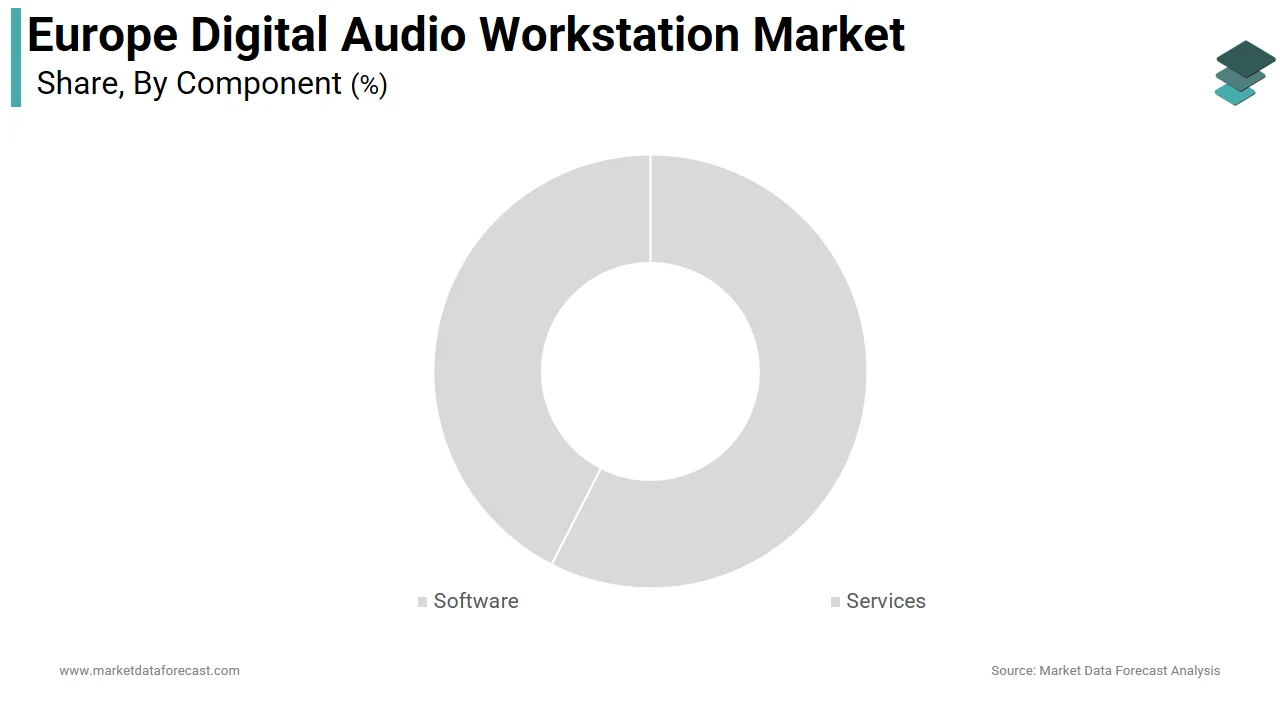
The services segment is anticipated to witness the fastest CAGR of 13.6% from 025 to 2033. The swift growth of the services segment is led by rising demand for cloud storage, technical support training, and collaborative project management features bundled with DAW subscriptions. Companies offer integrated learning portals with video tutorials, certification paths, and community forums that enhance user retention. The European Commission’s program has funded border mentorship initiatives connecting emerging producers with seasoned engineers via DAW-linked consultation services. Apart from these, post-production houses increasingly outsource mixing and mastering to specialized service providers who operate within the client’s preferred DAW environment, ensuring workflow continuity. This shift from product to platform emphasizes the strategic importance of services in deepening user engagement.
By Operating System Insights
The Mac OS segment dominated the Europe digital audio workstation market and captured a 58.3% share in 2024. Its reputation for audio stability, low latency performance, and deep integration with leading professional software is largely attributed to the growth of the Mac OS segment in the regional market. Apple’s Core Audio framework provides deterministic timing and efficient driver management, which are critical for real-time processing in high track count sessions. Music technology education also supports this preference with institutions standardizing on Mac labs for advanced courses. Apple’s transition to M-series silicon has further enhanced performance with native DAWs reporting faster rendering times. The aesthetic and ergonomic design of Mac hardware also appeals to freelance creators who value compact all-in-one setups. This ecosystem lock-in spans hardware, software, and pedagogy, sustaining Mac OS as the dominant platform for serious audio work across Europe.
On the other hand, the windows segment is likely to experience the fastest CAGR of 10.1% from 2025 to 2033. The expansion of the windows segment is fueled by cost accessibility and broad hardware compatibility, particularly among independent creators and educational institutions in Central and Eastern Europe. DAW developers have significantly improved Windows support with ASIO driver optimization and native ARM64 builds, enabling stable performance on diverse hardware. Steinberg Cubase and Image Line FL Studio are natively Windows first platforms and dominate usage in certain countries. Besides, Windows Subsystem for Linux allows developers to test open source audio tools without dual booting, expanding its appeal among technical users. These factors position Windows as the platform of inclusion and scalability in Europe’s evolving DAW landscape.
By Type Insights
The mixing segment held the largest share of 42.5% of the Europe digital audio workstation market in 2024. The growth of the mixing segment is driven by the increasing complexity of audio productions and the demand for broadcast-ready sound quality across music, film, and gaming. Professional mixing requires advanced DAW capabilities, including high track counts, precise automation, spectral editing, and surround sound panning, all of which are central to premium software offerings. Music production has also evolved with the commercial track containing individual stems, which requires sophisticated bus routing and dynamic processing. The rise of remote collaboration further amplifies demand for cloud-enabled mixing environments where engineers refine sessions initiated by artists in different countries. Educational institutions across Europe have responded by expanding mixed curricula. This convergence of technical standards, creative expectations, and pedagogical focus strengthens mixing as the core functional pillar of the DAW ecosystem.
The editing segment is predicted to witness the highest CAGR of 9.4% from 2025 to 2033. The rapid expansion of the editing segment is fuelled by the proliferation of spoken word content, including podcasts, audiobooks, and voice-over work, which require precise waveform manipulation, noise reduction, and timing correction. According to research, a significant number of active podcasts originated from Europe, with a portion produced using DAW-based editing workflows. Platforms have introduced AI-powered tools such as automatic silence trimming, spectral repair, and voice leveling that drastically reduce post-production time. Besides, the gaming industry’s demand for adaptive dialogue systems requires frame-accurate audio editing to synchronize with real-time gameplay. Educational institutions are also integrating editing literacy into journalism and media studies. These cross-sectoral content demands position editing as the most dynamically expanding DAW function.
By End Use Insights
The commercial segment accounted for a substantial share of the Europe digital audio workstation market in 2024. Factors such as professional studios, post-production houses, broadcasters, and music labels that require enterprise-grade reliability and feature depth have significantly contributed to the prominence of the commercial segment. Commercial users prioritize low-latency performance, multi-user collaboration, and integration with hardware control surfaces, all of which justify premium licensing costs. Music publishing remains robust, with Europe generating a substantial amount in recorded music revenue in 2023, as per studies, which necessitates high-fidelity mixing and mastering environments. Some broadcasters have mandated DAW-based workflows for all original programming to ensure compliance with EBU R128 loudness standards. Furthermore, commercial entities benefit from volume licensing, educational discounts, and technical support contracts that enhance operational continuity. The concentration of creative industries in urban hubs further consolidates commercial DAW adoption through studio networks and equipment rental ecosystems that standardize on specific platforms.
The non-commercial segment is estimated to register the fastest CAGR of 11.2% during the forecast period, owing to the democratization of music and audio creation among students, independent artists, and hobbyists. Free and low-cost DAWs such as Cakewalk by BandLab, GarageBand, and LMMS have removed financial barriers, enabling widespread experimentation. Social media platforms like TikTok and Instagram have further incentivized audio creation with short-form video driving demand for quick editing and sound design. The European Commission has funded many school-based music technology labs. Grassroots initiatives integrate DAWs into secondary education, fostering early skill development. This cultural shift toward participatory audio creation ensures sustained expansion of the non-commercial user base.
COUNTRY LEVEL ANALYSIS
United Kingdom Digital Audio Workstation Market Analysis
The United Kingdom was the top performer in the Europe digital audio workstation market and accounted for 24.1% share of the regional market in 2024. world world-leading music industry, broadcast sector, and higher education infrastructure have mainly fuelled the growth of the United Kingdom. London alone hosts numerous professional recording studios and post-production facilities, as per sources, which serve global artists and streaming platforms. The increasing demand for immersive audio from streaming services and the music industry has accelerated the adoption of Dolby Atmos-enabled Digital Audio Workstations (DAWs) and spatial audio mixing practices across the broadcast supply chain. Universities offer specialized degrees in music technology. The UK’s independent artist community is also highly active, with self-releasing musicians using DAWs for end-to-end production. Government initiatives have allocated funds to regional music hubs equipped with professional DAW suites. This blend of commercial excellence, educational depth, and grassroots creativity ensures the UK’s continued dominance in Europe’s audio software ecosystem.
Germany Digital Audio Workstation Market Analysis
Germany was the second largest region in the Europe digital audio workstation market by capturing 19.6% share in 2024. The growth of Germany is driven by its strong engineering culture, electronic music heritage, and robust vocational education system. The country is home to globally influential DAW developers, including Steinberg, whose Cubase and Nuendo platforms are industry standards in film and music production. Furthermore, Germany’s manufacturing sector leverages DAWs for sound design in automotive and industrial product development, with companies like BMW and Siemens using spatial audio tools for user experience testing. This unique fusion of creative industry academic rigor and industrial application cements Germany’s central role in the European DAW landscape.
France Digital Audio Workstation Market Analysis
France is steadily moving ahead in the Europe digital audio workstation market due to state-backed cultural policies, a vibrant film industry, and a growing electronic music scene. The country’s cinema sector, which produced feature films, also uses DAWs for post-production, with studios in Paris and Lyon equipped with Dolby Atmos-certified mixing environments. Educational access is expanding. French developers like Arturia contribute to the ecosystem with software instruments tightly integrated into major DAWs. Festivals such as Nuits Sonores and Sónar Paris foster live DAW performance culture, driving demand for real-time processing capabilities. This coordinated support across public policy, creative output, and technological innovation sustains France’s position as a key DAW market.
Sweden Digital Audio Workstation Market Analysis
Sweden expanded moderately in the Europe digital audio workstation market owing to its outsized influence in global music production and tech innovation. The country is renowned for its pop music export machine, with producers like Max Martin shaping international hits using DAWs such as Logic Pro and Pro Tools. Sweden’s education system mandates digital music creation in upper secondary schools, with a portion of municipalities providing DAW access, as per sources. Stockholm hosts a thriving startup scene with companies offering cloud-based DAW integrations that enhance collaboration and sample licensing. High broadband penetration and digital literacy further enable seamless adoption of cloud native DAW features. Sweden’s blend of cultural impact, technological readiness, and policy support makes it a disproportionately influential player in the European market.
Netherlands Digital Audio Workstation Market Analysis
The Netherlands is likely to grow in the Europe digital audio workstation market and is fueled by its advanced digital infrastructure, electronic music festivals, and strong higher education programs. Amsterdam and Rotterdam serve as hubs for audio technology, with institutions offering specialized DAW-based curricula to students annually. The country’s electronic dance music culture, centered around events, drives demand for live performance-oriented DAWs with professional DJs and producers active in the scene, according to research. Dutch broadcasters like NPO have adopted object-based audio workflows requiring DAWs with spatial mixing capabilities. This ecosystem of education innovation and global connectivity ensures the Netherlands remains a dynamic force in Europe’s DAW market.
COMPETITIVE LANDSCAPE
The Europe digital audio workstation market features intense competition among established global developers and agile regional innovators vying for mindshare in a highly specialized creative software domain. Differentiation hinges on workflow intuitiveness, audio engine stability, ecosystem integration, and cultural relevance rather than price alone. Incumbents like Apple and Steinberg leverage decades of industry trust and technical standards while challengers such as Ableton and Bitwig attract users through novel paradigms like non-linear composition and modular routing. The absence of significant hardware dependencies lowers entry barriers but raises the stakes for user experience and community engagement. Open source alternatives like Ardour maintain niche appeal, particularly in Linux-oriented academic circles, but lack the commercial support scale. Regulatory alignment with GDPR and EU digital education policies further shapes product design, especially for cloud features. As audio creation permeates gaming, film education, and social media, the battle for seamless cross-platform interoperability and AI-augmented creativity defines the next competitive frontier.
KEY MARKET PLAYERS
Some of the companies that are playing a dominating role in the Europe digital audio workstation market include
- Steinberg (Germany)
- Ableton AG (Germany)
- Apple Inc
- Native Instruments (Germany)
- MAGIX (Germany)
- Inage Line Software (Belgium)
- Bitwig (Germany)
- Renoise (Germany)
TOP PLAYERS IN THE MARKET
- Ableton AG is a Berlin-based developer renowned for its innovative Live software, which redefined real-time music creation and performance workflows. The company plays a pivotal role in the global DAW market by bridging studio production and live electronic performance with a unique session view interface. Ableton has strengthened its position through continuous investment in machine learning features such as audio to MIDI conversion and tempo detection. In recent years, the company launched Ableton Cloud, enabling real-time project collaboration and automatic backup directly within the software. It also expanded its educational outreach by partnering with European conservatories to integrate Live into curricula. These initiatives reinforce Ableton’s influence among both professional producers and emerging creators across Europe and worldwide.
- Apple Inc. dominates the professional music creation space through its Logic Pro digital audio workstation designed exclusively for macOS. The company contributes significantly to the global DAW ecosystem by tightly integrating hardware and software to deliver low-latency high fidelity audio performance. The firm also expanded its royalty-free sound library with region-specific instruments, including Celtic and Balkan ensembles, to appeal to local creators. Regular free updates and deep compatibility with MainStage for live performance sustain strong loyalty among composers, producers, and educators across the continent.
- Steinberg Media Technologies GmbH, headquartered in Hamburg, is a foundational force in the digital audio workstation industry with its Cubase and Nuendo platforms serving music and post-production professionals globally. The company pioneered MIDI and VST technologies that became universal standards across the audio software landscape. It also introduced a subscription tier for Cubase, lowering entry barriers for students and independent artists. Collaborations with German and French film schools ensure early adoption while its ASIO driver remains the benchmark for Windows audio performance, supporting Steinberg’s technical prowess.
TOP STRATEGIES USED BY THE KEY MARKET PARTICIPANTS
Key players in the Europe digital audio workstation market are prioritizing cloud integration to enable real-time collaboration and automatic project backup across geographies. Companies are embedding artificial intelligence for intelligent editing, mastering, and sound design to enhance creative efficiency. Strategic educational partnerships with conservatories and media schools secure early user adoption and brand loyalty. Firms are also expanding royalty-free sound libraries with culturally diverse instruments to resonate with regional creators. Apart from these, developers are optimizing software for next-generation processors and operating systems to deliver superior performance and energy efficiency, aligning with Europe’s digital sustainability goals.
MARKET SEGMENTATION
This research report on the Europe digital audio workstation market has been segmented and sub-segmented into the following categories.
By Component
- Software
- Services
By Operating System
- Mac OS
- Windows
- Linux
By Deployment Mode
- Cloud
- Local
By Type
- Recording
- Editing
- Mixing
By End Use
- Non-Commercial
- Commercial
By Country
- United Kingdom
- France
- Spain
- Germany
- Italy
- Russia
- Sweden
- Denmark
- Switzerland
- Netherlands
- Rest of Europe