- Product Description Description
- Table of Contents TOC
- List of Table & Figure LOT
- Get Free Sample PDF Sample PDF
Market Size, 2025
$5.93 BnMarket Estimate, 2026
$6.36 BnMarket Forecast, 2034
$11.24 BnCAGR, 2026–2034
7.37%Executive Summary: Europe Electronic Warfare Market
- Market Scope: Comprehensive analysis of the European Electronic Warfare (EW) industry, tracking electronic support (ES), electronic protection (EP), and electronic attack (EA) systems across air, naval, ground, and unmanned platforms (forecast period: 2026-2034).
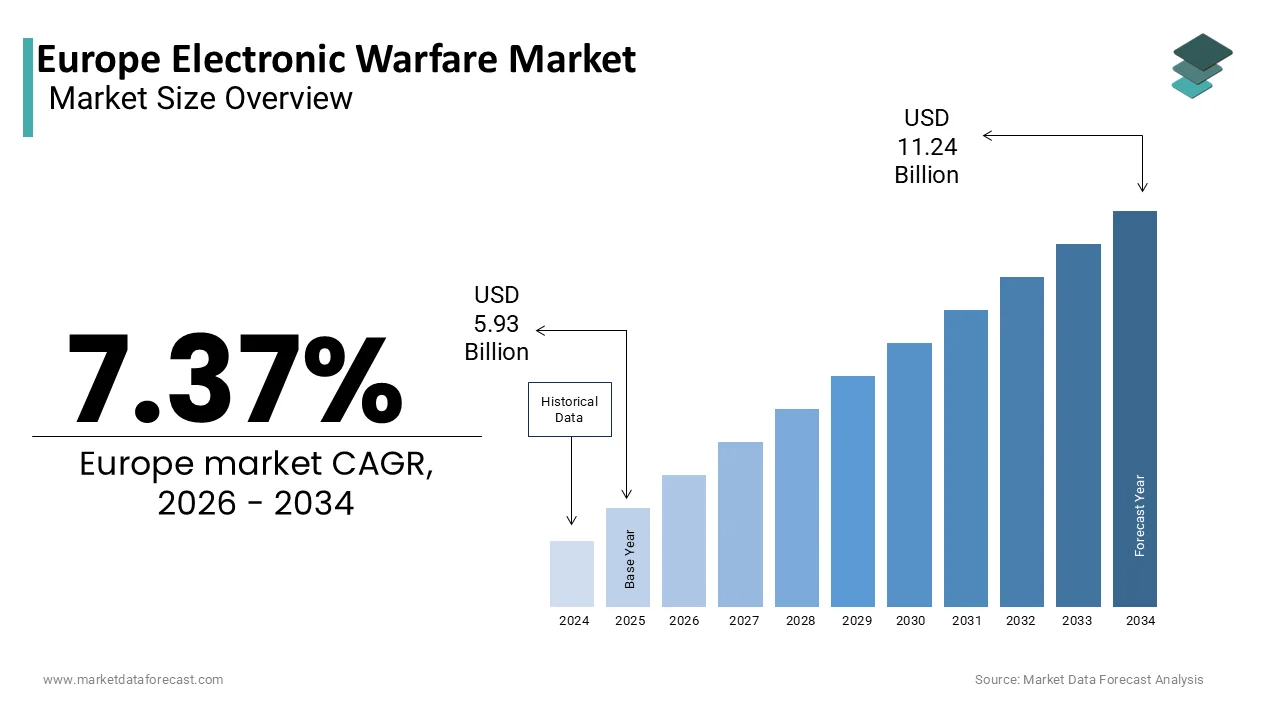
- Market Valuation: Valued at USD 5.93 billion in 2025, estimated to reach USD 6.36 billion in 2026, and projected to expand to USD 11.24 billion by 2034, growing at a robust CAGR of 7.37% from 2026 to 2034.
- Primary Growth Drivers: Escalating electromagnetic threats and GPS jamming from state and non-state actors, combined with mandated NATO interoperability and EU defense initiatives (e.g., EDF, PESCO).
Key Market Segment Metrics
| Category | Leading Segment (Base Position) | Fastest-Growing / High-Growth Segment |
|---|---|---|
| By End User | Air Segment (captured 48.6% share in 2025 anchored by fighter jet protection, self-defense suites, and air dominance missions) | Naval Segment (projected fastest 9.6% CAGR driven by maritime tension in the Baltic, Black Sea, and North Atlantic against anti-ship missiles) |
| By Platform | Aircraft (largest with 45.2% share in 2025 due to strategic asset value and vulnerability in contested airspace) | Vehicle Platforms (projected fastest 10.2% CAGR fueled by mobile ground-based brigade jammers and counter-drone systems) |
| By Technology | Anti-Jam Electronic Protection (dominated with 36.6% share in 2025 safeguarding communications and GPS navigation) | Directed Energy Weapons (projected fastest 14.8% CAGR propelled by laser and HPM solutions to counter drone swarms) |
| By Country / Region | Germany (top performer capturing 21.4% share in 2025 anchored by the Zeitenwende special defense fund and robust local prime contractors) | United Kingdom, France, & Italy (high-growth hubs leveraging sovereign EW R&D, signals intelligence, and naval upgrades) |
Major Market Players & Industry Landscape
Market Structure: Highly consolidated defense-industrial ecosystem dominated by European aerospace primes and specialized electronics firms partnering on NATO-compliant, AI-driven cognitive EW architectures.
Key Companies & Leaders: Airbus Defence and Space, BAE Systems plc, Thales Group, Leonardo S.p.A., Saab AB, HENSOLDT AG, Rheinmetall AG, Indra Sistemas S.A., Elettronica S.p.A., and Kongsberg Defence & Aerospace AS.
 Download Free Sample Report
Europe Electronic Warfare Market Size
The Europe electronic warfare market was valued at USD 5.93 billion in 2025, is estimated to reach USD 6.36 billion in 2026, and is projected to reach USD 11.24 billion by 2034, growing at a CAGR of 7.37% from 2026 to 2034.
Electronic Warfare (EW) is the strategic use of the electromagnetic spectrum (EMS), including radio waves, radar, infrared, and visible light, to sense, protect, and communicate while denying an adversary those same advantages. These capabilities, spanning electronic support (ES), electronic protection (EP), and electronic attack (EA), are integrated into naval vessels, fighter aircraft, ground vehicles, and unmanned platforms to ensure spectrum dominance in contested environments. The Europe electronic warfare market operates within a strategic framework defined by NATO interoperability mandates, national sovereignty imperatives, and emerging hybrid threats from state and non-state actors. According to multiple studies, a vast majority of European Union member states have significantly increased their annual defence expenditures, driving record levels of investment into new equipment and advanced military capabilities. According to research, NATO allies have committed to a substantial new spending benchmark that broadens the definition of defence investment to include critical infrastructure protection, network security, and advanced technological innovation. Furthermore, the European Union is directing over a billion euros annually into collaborative research and development to pioneer next-generation technologies such as artificial intelligence and advanced sensor systems for modern battlefield environments. This convergence of alliance coordination, technological autonomy, and threat evolution positions electronic warfare as a critical enabler of Europe’s defense resilience in an increasingly congested and contested electromagnetic spectrum.
MARKET DRIVERS
Escalating Electromagnetic Threats from State and Non-State Actors
European defense forces face intensifying EW threats from both peer competitors and asymmetric adversaries, which propels the growth of the European electronic warfare market. This drives urgent investment in countermeasures. According to various sources, state-sponsored electronic interference originating from conflict zones has become a daily occurrence across Northern and Eastern Europe, causing widespread navigation disruptions for commercial aircraft and maritime vessels. Similarly, the rapid evolution of unmanned aerial threats has prompted military authorities to develop and test advanced radio-frequency weapons capable of neutralizing large groups of drones simultaneously at a minimal cost. In response, German defense authorities have committed over a billion euros to modernize their primary fighter jet fleet with cutting-edge sensors and electronic combat systems to ensure air superiority and the ability to neutralize ground-based threats. France’s Defence Procurement Agency accelerated deployment of the SPECTRA electronic protection system across Rafale fleets to counter advanced radar-guided missiles. These developments reflect a strategic shift: EW is no longer a niche capability but a frontline necessity for force survivability in multi-domain operations where electromagnetic denial can precede kinetic engagement.
Mandated Interoperability Under NATO and EU Defense Initiatives
The push for seamless electronic warfare coordination among allied forces has fuelled the expansion of the European electronic warfare market. This has become a structural driver for standardized, network-centric EW systems across the region. NATO’s Federated Mission Networking and the EU’s Permanent Structured Cooperation require member states to adopt common signal intelligence protocols, emitter libraries, and data link standards such as Link 22 and JREAP. According to multiple studies, Recent defense acquisition cycles across Europe are characterized by a strict adherence to common technical protocols to ensure that electronic sensing and support data can be seamlessly exchanged between allied military platforms. Major European aerospace and defense contractors are collaborating on multinational initiatives funded by the Union to develop intelligent jamming systems capable of autonomously adapting to complex electromagnetic environments. Additionally, joint operations like the EU’s enhanced Forward Presence in the Baltics demand real-time EW data fusion between French, German, and Spanish platforms. European legislative and defense oversight bodies are increasingly mandating that all new cooperative electronic combat programs include built-in technical compatibility to allow for integrated operations among different national forces. This institutional alignment ensures sustained investment in open architecture, software-defined EW systems that can evolve with alliance requirements.
MARKET RESTRAINTS
Prolonged Certification and Security Clearance Cycles for Classified Systems
The deployment of EW systems in the region is significantly delayed by rigorous national security certification processes and complex export control regimes, which impede the growth of the European electronic warfare market. Unlike conventional defense equipment, EW platforms handle sensitive signal intelligence and cryptographic algorithms, requiring exhaustive validation under national secrecy laws and Wassenaar Arrangement controls. According to studies, modernizing naval electronic combat systems involves prolonged technical integration phases, further extended by the rigorous security certifications required to protect sensitive military communications and data processing architectures. The refinement of digital threat libraries during live maritime trials remains a critical technical challenge that can impact the delivery schedules of advanced naval electronic warfare modernization programs. Similarly, Sweden’s Gripen E program experienced setbacks when its Arexis EW system failed to synchronize with new datalink encryption protocols. These delays stem from fragmented national testing regimes, as each country maintains its own defense standards body, leading to redundant validations. Defense technology providers operating across European borders face significant administrative hurdles due to varying national security standards, prompting legislative efforts to harmonize certification procedures and improve industrial competitiveness. Such timelines inflate program costs and hinder rapid technology insertion, especially for software updates.
Budgetary Competition with Other High-Priority Defense Domains
EW systems face intense internal competition for funding, and therefore inhibit the expansion of the European electronic warfare market. This is the case despite rising defense expenditures. They must compete against more visible or politically salient capabilities such as fighter jets, missile defense, and troop modernization. Record-breaking increases in European military spending have been primarily directed toward urgent kinetic capabilities and large-scale equipment modernization, while specialized electronic combat systems represent a smaller portion of the overall procurement landscape. To counter evolving regional threats, Poland is significantly increasing its investment in integrated air defense sensors and electronic combat technologies alongside its major acquisitions of advanced aircraft and long-range artillery. Similarly, Spanish defense planners are managing simultaneous modernization efforts across naval and land domains, seeking to balance the delivery of advanced undersea capabilities with the urgent need for modernized armored units. Even in technologically advanced nations like France, the 2025 Military Programming Law allocated just a portion of the air force modernization envelope to EW, with the majority going to airframes and weapons. Legislative oversight bodies in Europe are increasingly emphasizing that mastery of the electromagnetic spectrum is essential for the effectiveness of all other military assets, advocating for more consistent and prioritized investment in electronic combat technologies. This perception constrains long-term R&D investment and limits vendor innovation cycles.
MARKET OPPORTUNITIES
Integration of Artificial Intelligence for Cognitive Electronic Warfare
The incorporation of artificial intelligence into EW systems offers key growth areas to enhance threat recognition, adaptive jamming, and decision speed in dynamic electromagnetic environments, which is predicted to drive the expansion of the European electronic warfare market. European defense agencies are actively funding AI modules that autonomously classify unknown emitters, predict adversary tactics, and optimize jamming waveforms in real time. Major European defense contractors are leading collaborative research initiatives funded by the Union to integrate artificial intelligence into electronic combat systems, aiming to enhance the speed and accuracy of signal processing in complex electromagnetic environments. British defense strategies are increasingly focused on leveraging artificial intelligence to automate complex data analysis, to provide military personnel with more intuitive decision-making tools and faster response times against modern digital threats. Similarly, German defense authorities are integrating advanced deep-learning software into their combat aircraft to enable the real-time identification and classification of complex radar threats in contested environments. These systems do not replace human judgment but augment it, critical in multi-domain battlespaces where spectrum complexity exceeds manual processing capacity. AI ethics frameworks are maturing under the EU’s Defence AI Guidelines. Consequently, trusted cognitive EW will become a standard differentiator in next-generation systems.
Expansion into Unmanned and Distributed Electronic Warfare Architectures
EW capabilities are increasingly being adapted for unmanned platforms and distributed sensor networks to enable stand-in and stand-off jamming without risking manned assets, which is anticipated to accelerate the growth of the European electronic warfare market. This shift responds to the need for persistent electronic surveillance and deception in denied areas. European defense authorities are accelerating the development of unmanned systems equipped with specialized electronic warfare capabilities, prioritizing the creation of compact and energy-efficient sensors to enhance the resilience of autonomous platforms in contested environments. Modern naval defense strategies are increasingly utilizing unmanned surface and underwater platforms equipped with advanced passive sensors to extend situational awareness and detect threats without compromising the position of the primary fleet. Similarly, Germany’s Future Combat Air System program includes loyal wingman drones equipped with Saab’s Arexis EW suite for escort jamming. Collaborative European defense funding is increasingly directed toward autonomous drone swarms capable of coordinated movement and signal processing, aiming to provide a distributed electronic combat capability that can overcome traditional air defense systems. The shift in great power competition toward denied air and sea domains has made unmanned EW an operational mandate, driving market opportunities outside of traditional, manned platforms.
MARKET CHALLENGES
Cyber Vulnerability of Networked Electronic Warfare Systems
The increasing connectivity of electronic warfare platforms exposes them to sophisticated cyber threats, which negatively impacts the expansion of the European electronic warfare market. These threats can compromise signal intelligence, spoof emitter databases, or disable jamming coordination. Modern EW systems rely on IP-based networks and open system architectures to enable interoperability, but this also expands the attack surface. Strategic sectors such as defense and telecommunications remain primary targets for sophisticated cyberespionage, with European authorities tracking thousands of vulnerabilities and hundreds of significant infrastructure incidents annually. High-intensity international cyber exercises are increasingly testing the resilience of military command and battle management systems against sophisticated simulated attacks to improve real-time defensive coordination among allied nations. The challenge is compounded by software supply chain risks; many EW vendors use third-party libraries with unpatched vulnerabilities. Security assessments of critical technology sectors in Germany continue to highlight the risks posed by aging software architectures, driving new federal initiatives to modernize cryptographic standards and enhance overall digital resilience. Hardening these systems requires continuous penetration testing, zero-trust architectures, and sovereign software development, capabilities still maturing across the European defense industrial base. Cyber resilience must become intrinsic rather than additive. Until then, EW reliability in contested environments remains at risk.
Shortage of Skilled Personnel for EW Operation and Signal Analysis
A critical deficit of personnel trained in advanced EW and signals intelligence threatens operational readiness across the regional armed forces, which further challenges the growth of the European electronic warfare market. Modern EW platforms require operators who understand not only tactical doctrine but also spectrum management, machine learning outputs, and real-time waveform analysis, skills increasingly scarce amid demographic decline and competition from civilian tech sectors. Rapid expansion and modernization of the European defense sector are creating a significant structural labor shortage, with industry leaders warning that the demand for technical and digital specialists far exceeds the current supply of qualified professionals. High-tech air combat units are experiencing persistent pressure on their personnel pipelines as they transition to more advanced digital and electronic warfare-integrated aircraft standards. Similarly, extensive mid-life modernization of naval combat systems requires intensive crew training and system integration periods to ensure that legacy platforms can effectively operate new digital sensor and defense technologies. Vocational military academies struggle to keep curricula aligned with rapid EW evolution, and software updates often outpace training cycles. European defense authorities are increasingly prioritizing the development of shared virtual environments and simulation facilities to bridge the training gap in complex electromagnetic combat operations. The efficacy of advanced EW systems is fundamentally constrained by human capital shortages. Failure to invest rapidly in simulation, international, and personnel development will result in operational underperformance.
REPORT COVERAGE
| REPORT METRIC | DETAILS |
| Market Size Available | 2025 to 2034 |
| Base Year | 2025 |
| Forecast Period | 2026 to 2034 |
| Segments Covered | By End User, Platform, Technology, and Region. |
| Various Analyses Covered | Global, Regional, and Country-Level Analysis, Segment-Level Analysis, Drivers, Restraints, Opportunities, Challenges; PESTLE Analysis; Porter’s Five Forces Analysis, Competitive Landscape, Analyst Overview of Investment Opportunities |
| Countries Covered | UK, France, Spain, Germany, Italy, Russia, Sweden, Denmark, Switzerland, Netherlands, Turkey, Czech Republic, Rest of Europe |
| Market Leaders Profiled | Airbus Defence and Space, BAE Systems plc, Thales Group, Leonardo S.p.A., Saab AB, HENSOLDT AG, Rheinmetall AG, Cobham Limited, Elbit Systems Ltd., Raytheon Technologies Corporation, Northrop Grumman Corporation, L3Harris Technologies, Inc., General Dynamics Corporation, Lockheed Martin Corporation, Boeing, Indra Sistemas S.A., QinetiQ Group plc, Ultra Electronics Holdings plc, Elettronica S.p.A., Kongsberg Defence & Aerospace AS |
SEGMENTAL ANALYSIS
By End User Insights
The air segment led the European electronic warfare market and captured a 48.6% share in 2025. The supremacy of the segment is attributed to the critical need to protect high-value fighter aircraft and airborne platforms from advanced radar-guided and infrared threats. Modern combat aircraft like the Eurofighter Typhoon, Dassault Rafale, and Saab Gripen rely on integrated electronic warfare suites for survivability in contested airspace. European Defence Agency initiatives are advancing next-generation self-protection and electronic attack systems to improve the survivability of member states' combat aircraft in contested environments. The French Defence Procurement Agency (DGA) is upgrading the Rafale fleet to the F4 standard, which features an enhanced SPECTRA electronic warfare suite designed for improved autonomous threat detection and increased data connectivity. Similarly, Germany approved funding for the Eurofighter EK project, which integrates new artificial intelligence-driven jamming algorithms and hardware into the aircraft's Electronic Warfare suite for specialized suppression of enemy air defenses. The UK Ministry of Defence, through the Global Combat Air Programme, is investing in the Tempest fighter's next-generation sensor and avionics suite, which features significant, high-level integration of AI-driven cognitive electronic warfare capabilities. Air dominance remains central to NATO strategy, even as peer adversaries deploy low-frequency radars and networked air defenses. Therefore, investment in airborne EW continues to outpace other domains due to platform vulnerability and mission criticality.
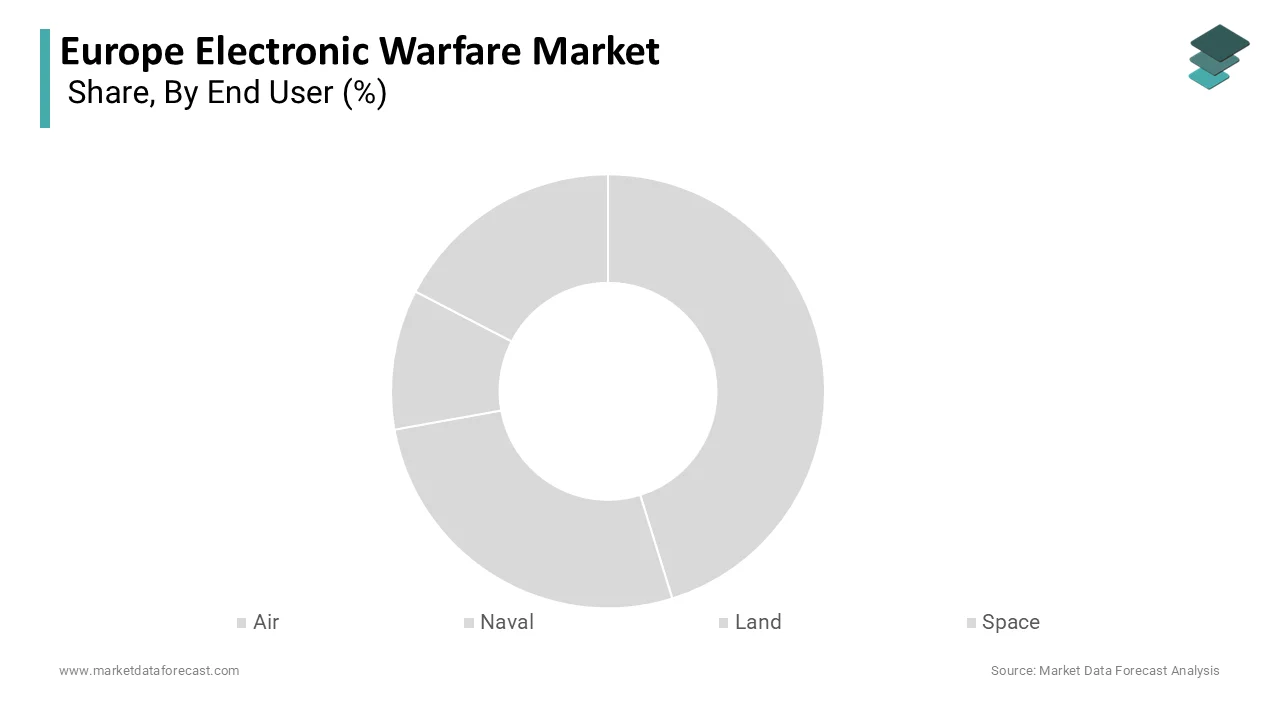
The naval end-user segment is expected to exhibit a noteworthy CAGR of 9.6% from 2026 to 2034 due to heightened maritime tensions in the Baltic, Black Sea, and North Atlantic, where surface vessels face sophisticated anti-ship missile threats and electronic surveillance. Regional maritime authorities have observed a notable rise in foreign naval presence near European waters, which has accelerated the modernization of electronic warfare capabilities across the continent. Germany is equipping its newest class of frigates with advanced digital electronic support systems to enhance their ability to detect and locate radar emitters without revealing their own position. Similarly, France is upgrading its existing frigate fleet with modernized electronic warfare technology specifically designed to improve defenses against incoming anti-ship missiles. The Royal Netherlands Navy is modernizing its primary surface combatants to improve electronic coordination and data sharing with allied forces through updated communication standards. European defense initiatives are increasingly funding collaborative projects aimed at developing unmanned maritime platforms capable of conducting coordinated electronic interference operations. As naval task forces operate in GPS-denied environments and face drone swarms, the demand for integrated, multi-static EW architectures is growing rapidly. This trend makes it the most dynamic frontier in European electronic warfare.
By Platform Insights
The aircraft segment was the largest segment in the European electronic warfare market and held a 45.2% share in 2025. The prominence of the segment is credited to the high cost, strategic value, and vulnerability of manned and unmanned aerial systems in modern conflict. Fighter jets, transport aircraft, and intelligence gathering platforms require comprehensive electronic protection against radar tracking, missile guidance, and communications jamming. European defense authorities are overseeing a widespread effort to upgrade the electronic warfare capabilities of their diverse military aviation fleets through both individual national initiatives and cross-border partnerships. France’s Rafale F4 standard includes the SPECTRA system, which integrates radar warning, laser warning, and active jamming in a single architecture, reducing pilot workload while enhancing survivability. Germany’s Eurofighter EK variant, dedicated to electronic attack, will carry external jamming pods to suppress enemy air defenses. The UK’s Tempest program embeds cognitive EW as a core design pillar, using machine learning to adapt to unknown threats. Unlike ground vehicles, aircraft cannot rely on terrain masking, making onboard EW their primary defense. This operational imperative ensures sustained, high-value investment in airborne electronic warfare systems across European air forces.
The vehicle platform segment is predicted to witness the highest CAGR of 10.2% over the forecast period, owing to the proliferation of mobile ground-based electronic warfare systems for brigade-level protection and tactical deception. Armored fighting vehicles, command posts, and specialized EW trucks now deploy compact, high-power jamming systems to shield convoys and forward operating bases from drone surveillance and guided munitions. European nations are increasingly launching collaborative efforts to enhance the electronic protection of ground forces, with major powers modernizing their infantry fighting vehicles to include advanced jamming and soft-kill defensive systems. Poland is utilizing domestically produced heavy trucks as platforms for mobile air defense and counter-unmanned systems to protect ground troops from various aerial threats. Sweden’s BAE Systems Hägglunds developed an EW variant of the CV90 with integrated signal intelligence and GPS spoofing capabilities. European Union funding is currently prioritizing the development of modular electronic warfare systems for land vehicles to allow military units to adjust their equipment based on specific mission requirements. As hybrid warfare blurs front lines, mobile EW vehicles become essential force multipliers, driving unprecedented growth in this segment.
By Technology Insights
The anti-jam electronic protection systems segment dominated the European electronic warfare market and occupied a share of 36.6% share in 2025 because of the urgent need to safeguard military communications, navigation, and datalinks from deliberate interference. GPS spoofing, radio frequency jamming, and data link disruption have become standard tactics in modern conflicts, threatening everything from precision munitions to drone operations. European space and aviation agencies have documented a substantial and accelerating rise in satellite navigation disruptions along eastern borders, impacting both commercial transport and defense operations. In response, the UK Ministry of Defence deployed the MIDS JTRS terminal with anti-jam waveforms across Typhoon fleets. Germany is integrating modernized digital communication suites into its armored vehicle fleet to maintain reliable networking and command capabilities during high-intensity electronic combat. France’s CONTACT program equips all frontline units with software-defined radios featuring frequency hopping and spread spectrum techniques resistant to jamming. These systems are no longer optional; they are foundational to command integrity in multi-domain operations. As adversaries refine electronic denial tactics, demand for resilient, adaptive protection technologies continues to anchor this segment as the market’s core pillar.
The directed energy weapons segment is estimated to register the fastest CAGR of 14.8% between 2026 and 2034. The swift expansion of the segment is propelled by the urgent need to counter low-cost drone swarms and loitering munitions that overwhelm traditional kinetic defenses. High-power microwave and laser systems offer deep magazines, low cost per shot, and precision engagement without collateral damage. European defense consortia are receiving multinational funding to scale up the power of portable laser systems for deployment on various military platforms. Naval and land procurement agencies are validating new microwave-based technologies that can simultaneously neutralize groups of small aerial threats over a wide area. Similarly, the United Kingdom is fast-tracking the transition of its sovereign laser weapon from a laboratory demonstrator to a primary defensive system for its front-line naval fleet. These systems complement traditional EW by providing hard kill options in the electromagnetic spectrum. Drone threats are evolving from a simple nuisance to a strategic risk. Consequently, directed energy is transitioning from experimental to essential, creating a high-growth frontier in electronic warfare.
COUNTRY LEVEL ANALYSIS
Germany Electronic Warfare Market Analysis
Germany dominated the Europe electronic warfare market and captured a 21.4% share in 2025. The leading position of the German market is driven by an unprecedented acceleration in procurement following the historic policy shift known as the Zeitenwende, which has unlocked a substantial special fund for defense modernization. This financial injection has prioritized the acquisition of advanced signal intelligence and jamming systems to protect armored brigades and air assets from emerging drone threats. Domestic industry leaders like Hensoldt and Rohde & Schwarz are operating at full capacity to delivernext-generationn radar warning receivers and cyber electronic warfare suites to the Bundeswehr and allied forces. The strategic location of Germany makes it the primary logistics and coordination hub for NATO electronic defense initiatives, fostering deep collaboration with neighboring nations on joint development programs. Furthermore,e the integration of artificial intelligence into spectrum management systems is becoming a standard requirement in new contracts, ts driving innovation across the supply chain. This convergence of massive fiscal commitment, ent industrial prowess,wess and strategic necessity ensures Germany remains the dominant force shaping the trajectory of the European electronic warfare landscape.
United Kingdom Electronic Warfare Market Analysis
The United Kingdom was the second largest country in the European electronic warfare market and held a share of roughly 15.8% in 2025. The growth of the Uk market is propelled byworld-classclass expertise in signals intelligence and cognitive electronic warfare. The country shows a strong emphasis on sovereign capabilities and the development of cutting-edge technologies that allow for real-time adaptation to dynamic threat environments. British defense contractors such as BAE Systems and Leonardo UK are at the forefront of creating integrated self-protection suites for the Royal Air Force and Royal Navy that combine radar jamming with cyber effects. The government has committed to increasing defense spending, which includes significant allocations for modernizing electronic attack platforms and unmanned systems. Recent studies emphasize that the UK has launched several classified programs focused on directed energy weapons and advanced decoy systems to counter hypersonic threats. The presence of top-tier research institutions facilitates a steady pipeline of innovation in quantum sensing and secure communications, which are critical for future battlefield dominance. Geopolitical tensions have further accelerated the deployment of electronic warfare pods on fighter jets and frigates,s ensuring readiness for high-intensity conflicts. This blend of historical expertise, aggressive investment,t and technological foresight solidifies the UK as a critical innovator and key revenue generator in the regional market.
France Electronic Warfare Market Analysis
France occupies a significant share of the European electronic warfare market due to its unwavering commitment to strategic autonomy. The market status reveals a comprehensive national strategy that prioritizes indigenous development of all critical electronic warfare components to avoid reliance on foreign supply chains. French aerospace and defense giant Thal, es along with MBDA, are delivering state of the art jamming pods and electronic support measures that equip the Rafale fighter jet and FREMM frigates,ates setting high standards for performance. The French Ministry of Armed Forces has significantly increased its budget for electromagnetic operations,tions recognizing spectrum dominance as a decisive factor in modern warfare. France also plays a leading role in European Defense Fund projects aimed at harmonizing electronic warfare standards across the continent while maintaining its own proprietary technologies. The ongoing modernization of its nuclear deterrent includes advanced electronic protection systems ensuring survivability against sophisticated tracking networks. This focus on complete sovereignty, equity combined with active participation in European collaborative programs,rograms creates a resilient and dynamic market environment that drives continuous innovation in high-value contracts.
Italy Electronic Warfare Market Analysis
Italy is rapidly growing in the European electronic warfare market owing to strategic investments in naval and air domain awareness. The market sees a strong focus on protecting maritime interests in the Mediterranean Sea, which has spurred demand for advanced shipborne electronic warfare systems and coastal surveillance radars. Leonardo SpA serves as the national champion,n providing sophisticated jamming and deception technologies to the Italian Navy and Air Force while also exporting these solutions to allied nations. The Italian government has confirmed plans to reach the NATO target of spending 2 percent of gross domestic product on defense,se which will inject billions into the modernization of legacy electronic warfare fleets. Recent contracts include the acquisition of new electronic attack aircraft and the upgrade of existing helicopters with the latest generation self-protection suites. The geographic position of Italy makes it a crucial node for monitoring migration routes and countering asymmetric threats, leading to increased procurement of portable and vehicle-mounted jamming systems. Collaboration with other European partners on joint training exercises has highlighted the need for interoperable electronic warfare tools, driving further investment in compatible technologies. This strategic alignment of naval priorities increased budgetary allocation and industrial excellence positions Italy as a key growth engine for the European market.
Russia Electronic Warfare Market Analysis
Russia continues to be a noteworthy player in the European market. It is a mature andbattle-testedd electronic warfare industrial base that functions outside the Western market economy. The Russian military has deeply integrated electronic warfare into its combined arms doctrine, utilizing a vast array ofvehicle-mountedd jammers, long-range strategic interference platforms, and anti-drone systems to disrupt adversary communications and navigation. Continuous combat usage in Eastern Europe has served as a real-world laboratory, accelerating the iterative development of new countermeasures and electronic attack tactics. State-owned enterprises prioritize mass production of proven designs to equip large formations along the western border regions, ensuring a constant presence of electromagnetic pressure. The Russian approach emphasizes overwhelming saturation of the electromagnetic spectrum to blind enemy sensors and degrade command and control networks effectively. Despite international sanctions limiting access to certain microelectronics,s the domestic industry has adapted by increasing local production and sourcing components from alternative suppliers to maintain output levels. This intense focus on electronic dominance ensures that Russia remains a critical and influential factor in any analysis of European electronic warfare capabilities ,regardless of its exclusion from Western trade statistics.
KEY MARKET PLAYERS
Some of the companies that are playing a dominating role in the global Europe Electronic Warfare Market include
- Airbus Defence and Space
- BAE Systems plc
- Thales Group
- Leonardo S.p.A.
- Saab AB
- HENSOLDT AG
- Rheinmetall AG
- Cobham Limited (Part of Advent International)
- Elbit Systems Ltd.
- Raytheon Technologies Corporation
- Northrop Grumman Corporation
- L3Harris Technologies, Inc.
- General Dynamics Corporation
- Lockheed Martin Corporation
- Boeing (Electronic Systems Divisions)
- Indra Sistemas S.A.
- QinetiQ Group plc
- Ultra Electronics Holdings plc
- Elettronica S.p.A.
- Kongsberg Defence & Aerospace AS
TOP LEADING PLAYERS IN THE MARKET
- Thales Group is a French multinational technology leader with a pivotal role in the global electronic warfare market, particularly through its advanced airborne, naval, and ground-based EW systems. In Europe, Thales supplies the SPECTRA suite for the Rafale fighter, the VIGILE family for naval vessels, and the ECLIPSE system for armored vehicles. The company emphasizes cognitive electronic warfare, cyber resilience, and AI-driven signal recognition to future-proof its platforms. It also established a sovereign cybersecurity lab in Paris dedicated to hardening EW code against advanced persistent threats, reinforcing its position as a trusted partner for European defense autonomy and interoperability within NATO frameworks.
- Leonardo is an Italian aerospace and defense giant that plays a critical role in Europe’s electronic warfare landscape through its integrated EW suites for aircraft, helicopters, and naval platforms. The company’s BriteCloud expendable active decoy and SEER electronic support measures are deployed across NATO forces. Leonardo contributes globally by pioneering digital radio frequency memory technology and software-defined EW architectures. The company also co-leads the EU-funded COGNITIVE EW consortium, developing AI-powered signal intelligence tools. These initiatives position Leonardo at the forefront of next-generation electronic protection and attack capabilities for European and allied forces.
- Saab AB, headquartered in Sweden, is a key architect of sovereign European electronic warfare capabilities through its Arexis EW family deployed on Gripen fighters, naval vessels, and ground vehicles. The company integrates EW as a core element of its combat systems, ensuring full control over algorithms and source code. Saab prioritizes passive detection, low probability of intercept waveforms, and distributed sensor fusion to counter advanced threats. Additionally, Saab partnered with Finland’s Defence Forces to develop a mobile ground-based EW system for Arctic operations. These actions reinforce Saab’s leadership in agile, networked electronic warfare tailored to Northern European defense needs.
TOP STRATEGIES USED BY THE KEY MARKET PARTICIPANTS
Key players in the European electronic warfare market pursue open architecture frameworks to enable plug-and-play integration of new sensors and jammers. They invest heavily in artificial intelligence for autonomous threat recognition and adaptive jamming waveform generation. Companies establish sovereign cybersecurity laboratories to harden software against advanced persistent threats and comply with EU defense cyber regulations. Strategic partnerships with unmanned system developers ensure native EW support for drone swarms and loyal wingman platforms. Participation in European Defence Fund consortia secures co-financing for next-generation capabilities like cognitive EW and high-power microwave weapons. Emphasis on NATO STANAG compliance ensures interoperability across allied fleets. Training simulators and digital twins are deployed to enhance operator proficiency and reduce human error. These strategies collectively reinforce technological leadership and long-term program relevance in a rapidly evolving threat environment.
COMPETITIVE LANDSCAPE
The European electronic warfare market is characterized by a concentrated yet dynamic competitive landscape dominated by national champions with deep ties to sovereign defense programs. Thales, Leonardo, and Saab lead due to their integration within national weapon systems and control over proprietary signal processing algorithms. Competition is not price-driven but centers on technological sovereignty, cyber resilience, interoperability, and lifecycle support. New entrants face high barriers, including decades-long qualification cycles, classified algorithm development, and stringent security clearances. However, the shift toward open systems creates opportunities for specialized software firms in AI, signal intelligence, and directed energy. National preferences remain strong. France favors Thales, Italy backs Leonardo, and Sweden supports Saabbut EU collaborative programs like COGNITIVE EW are fostering cross-border standardization. The market rewards vendors who balance national control with alliance compatibility and who can evolve software faster than hardware obsolescence. As electromagnetic spectrum dominance becomes central to multi-domain warfare, EW providers must act as both integrators and innovators to maintain strategic relevance.
MARKET SEGMENTATION
This research report on tEuropeanope electronic warfare market is segmented and sub-segmented into the following categories.
By End User
- Air
- Naval
- Land
- Space
By Platform
- Aircraft
- Naval Vessels
- Ground Vehicles
- Unmanned Systems
By Technology
- Electronic Support (ES)
- Electronic Attack (EA)
- Electronic Protection (EP)
- Anti-Jam Electronic Protection Systems
- Directed Energy Weapons
By Country
- Germany
- United Kingdom
- France
- Italy
- Spain
- Sweden
- Netherlands
- Rest of Europe