- Product Description Description
- Table of Contents TOC
- List of Table & Figure LOT
- Get Free Sample PDF Sample PDF
Market Size, 2025
$17.85 BnMarket Estimate, 2026
$20.27 BnMarket Forecast, 2034
$56.06 BnCAGR, 2026–2034
13.56%Executive Summary: Europe Energy Management Systems Market
- Market Scope: Comprehensive regional analysis of the European energy management systems (EMS) market covering solution types, deployment modes, components, end-user segments, country-level insights, and regulatory frameworks like the EU Energy Efficiency Directive and Fit for 55 package.
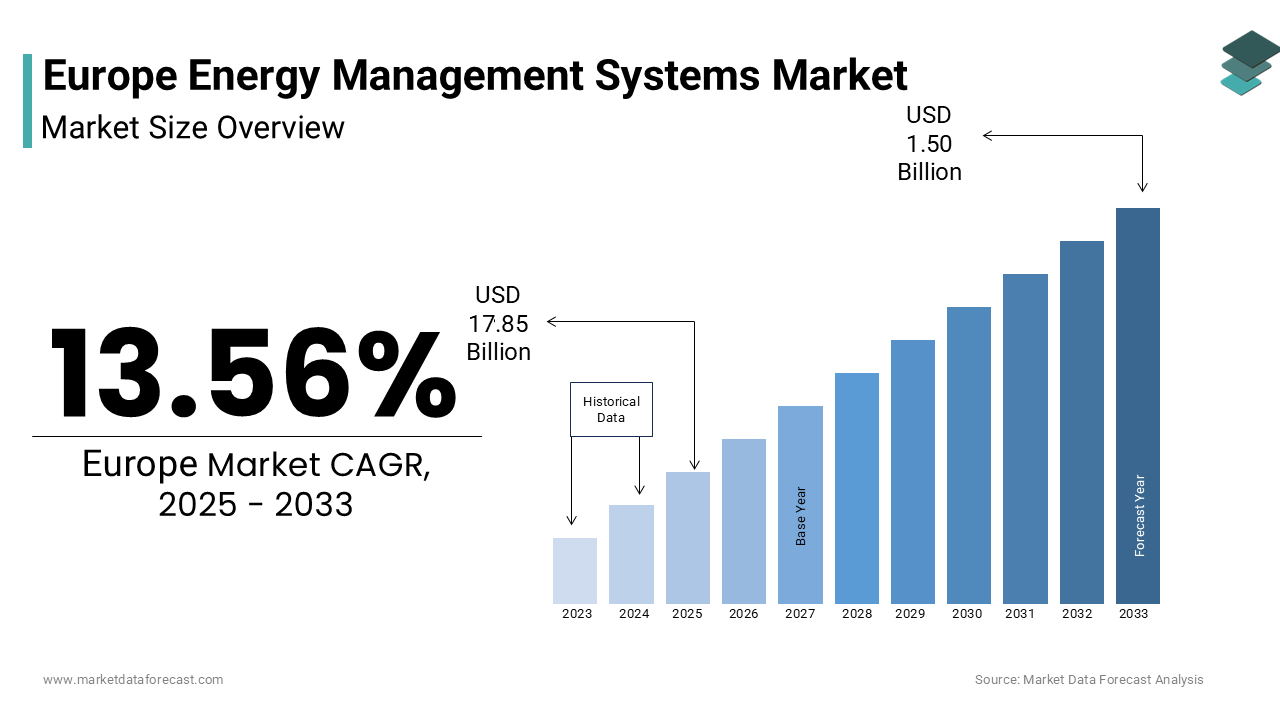
- Market Valuation: Valued at USD 17.85 billion (2025), estimated at USD 20.27 billion (2026), and projected to reach USD 56.06 billion by 2034, registering a strong CAGR of 13.56% (2026–2034).
- Primary Growth Drivers: Mandatory energy audits and performance certifications for large enterprises and public buildings; rapid integration of distributed renewable energy sources requiring dynamic load balancing.
Key Market Segment Metrics (2026–2034)
| Category | Leading Segment (2025 Position) | Fastest-Growing Segment / Country |
|---|---|---|
| By Solution Type | Building Energy Management Systems / BEMS (dominated due to stringent building performance directives and high commercial energy intensity) | Home Energy Management Systems / HEMS (witnessing a fastest CAGR of 21.4% driven by household electrification subsidies and heat pump/solar integration) |
| By Deployment Mode | On-Premises (accounted for 59.3% market share in 2025 due to industrial demands for complete data control, legacy infrastructure compatibility, and cybersecurity compliance) | Cloud-Based (anticipated to grow at a fastest CAGR of 23.6% driven by multi-site commercial property managers seeking centralized dashboard tracking and subscription models) |
| By End-User | Commercial and Retail (held 54.3% market share in 2025 driven by tertiary decrees, mandatory energy reporting, and CSRD compliance) | Residential End-User (projected to grow at a 22.1% CAGR fueled by prosumer expansion, EV charging coordination, and government grants) |
| By Country | Germany (top performer accounting for 24.3% market share in 2025 backed by strict regulatory frameworks like the Energy Services Act and large industrial base) | France & Italy (experiencing robust growth driven by tertiary decrees, high electricity tariffs, and generous fiscal incentives like Superbonus schemes) |
Major Market Players & Market Structure
Market Structure: Highly competitive landscape featuring global industrial automation leaders, building control specialists, and agile software innovators specializing in AI predictive optimization, cybersecurity resilience (NIS2), and cloud analytics.
Key Companies: Schneider Electric SE, Siemens AG, ABB Ltd., Honeywell International Inc., Eaton Corporation plc, Johnson Controls International plc, General Electric Company, IBM Corporation, Emerson Electric Co., Rockwell Automation, Inc., SAP SE, Cisco Systems, Inc., Hitachi Energy Ltd., Toshiba Corporation, and Landis+Gyr AG.
Europe Energy Management Systems Market Size
The Europe energy management systems market size was valued at USD 17.85 billion in 2025 and is anticipated to reach USD 20.27 billion in 2026 from USD 56.06 billion by 2034, growing at a CAGR of 13.56% during the forecast period from 2026 to 2034.
Energy management systems are integrated hardware and software platforms that monitor control and optimize energy consumption across buildings industrial facilities and grid infrastructure. These systems enable real time visibility into energy flows predictive load forecasting and automated demand response aligning operational efficiency with decarbonization mandates. The European landscape is uniquely shaped by binding regulatory frameworks, such as the Energy Efficiency Directive and the Fit for 55 package which require large enterprises and public buildings to conduct regular energy audits and implement continuous monitoring. In 2024, non-residential buildings in the EU were subject to mandatory energy performance certifications reflecting a vast addressable base for EMS deployment. Concurrently, the European Environment Agency reported that industrial facilities consuming more megawatt hours annually must install certified energy monitoring systems under Article 8 of the amended Energy Efficiency Directive.
MARKET DRIVERS
Mandatory Energy Audits for Large Enterprises Trigger Systemic EMS Adoption
The European Union’s requirement for large enterprises to conduct energy audits every four years for structured energy management system deployment, across industrial and commercial sectors is majorly fuelling the growth of Europe energy management systems market. As per the European Commission’s, implementation review of the Energy Efficiency Directive many companies in the EU qualified as “large enterprises” in 2024 and were legally obligated to implement certified monitoring measures following their audits. These audits often reveal 15 to 25% potential energy savings through operational optimization which can only be realized through continuous EMS oversight. For instance after its 2023 audit the German chemical giant BASF installed an enterprise wide EMS across 12 sites integrating over 50000 sensors to track steam electricity and compressed air usage in real time. Similarly France’s energy regulator CRE mandates that all industrial sites above 500 kilowatts must submit monthly energy performance reports starting in 2025 a requirement enforceable only through automated EMS data collection. This regulatory enforcement transforms EMS from a discretionary efficiency tool into a legal necessity.
Integration of Renewable Energy Sources Demands Dynamic Load Balancing Capabilities
The rapid expansion of distributed renewable generation has intensified the need for advanced energy management systems capable of dynamic load balancing and grid interaction, which is leveraging the growth of Europe energy management systems market. In 2024, renewable sources of EU electricity production with solar photovoltaic capacity alone growing by 56 gigawatts since 2022, as per some studies. This intermittency creates voltage fluctuations and reverse power flows that destabilize local distribution networks unless managed through intelligent EMS. Industrial consumers with on-site solar or wind are now required under the EU Grid Code to provide 15 minute ahead generation forecasts and curtailment readiness. Companies like Volvo in Sweden and FCA in Italy have deployed AI driven EMS that automatically shift loads, such as paint curing or battery charging to periods of high solar availability reducing grid import in their 2024 sustainability disclosures.
MARKET RESTRAINTS
High Initial Investment and Integration Complexity Deter SME Uptake
The upfront capital expenditure and technical complexity of energy management systems remain significant barriers for small and medium enterprises, which is hampering the growth of Europe energy management systems market. A basic EMS deployment for a medium sized factory typically costs, including sensors gateways software licenses and engineering integration. Unlike large corporations, SMEs lack dedicated energy managers or IT teams to oversee implementation with insufficient internal expertise. Integration with legacy machinery is particularly challenging as older equipment often lacks standardized communication protocols like Modbus or BACnet requiring custom retrofitting. In Italy, SMEs in the manufacturing sector have adopted full EMS despite high energy costs due to these barriers.
Fragmented Building Automation Standards Hinder Interoperability
The legacy of fragmented communication protocols and building automation standards is another attribute limiting the growth of Europe energy management systems market. While modern EMS rely on open standards, such as KNX BACnet and M Bus a significant portion of existing infrastructure operates on proprietary or obsolete protocols. According to the European Committee for Electrotechnical Standardization, commercial buildings constructed before 2010 use non-standard HVAC or lighting controls that cannot natively interface with contemporary EMS platforms. This forces costly gateway installations or complete subsystem replacements. In Germany, building owners reported an average integration delay of 14 weeks due to protocol incompatibilities. The situation is exacerbated in multi-tenant buildings, where different floors use disparate systems. Although, the EU’s Level(s) framework promotes interoperability compliance remains voluntary.
MARKET OPPORTUNITIES
Expansion of AI Driven Predictive Energy Optimization Unlocks New Value Streams
The incorporation of artificial intelligence into energy management systems is creating advanced predictive capabilities that move beyond reactive monitoring to anticipatory optimization. This factor is eventually setting up new opportunities for the growth of Europe energy management systems market. European providers, such as Siemens and Schneider Electric now offer AI powered EMS that forecast energy demand weather impacts and tariff fluctuations 24 to 72 hours in advance using machine learning trained on historical and external data. Similarly, the Port of Antwerp uses a predictive EMS to coordinate shore power for vessels minimizing diesel generator use and cutting port emissions by 18000 tons annually.
Emergence of Energy as a Service Models Lowers Adoption Barriers
The rise of Energy as a Service business models from a capital expense into an operational subscription thereby accelerating adoption particularly among public institutions and SMEs. The emergence of energy as a service models is also escalating the growth of Europe energy management systems market. Under this model providers like ENGIE and Veolia, finance install manage and guarantee savings from EMS installations charging clients a fixed monthly fee or age of verified energy reduction. Similarly, French hospitals adopted EaaS EMS through a national framework agreement launched by the Ministry of Health in 2023. According to the European Federation of Energy Traders, this model is driven by public sector demand. EaaS transfers performance risk to the vendor aligns incentives through outcome-based pricing and bundles maintenance ensuring system longevity.
MARKET CHALLENGES
Cybersecurity Vulnerabilities in Connected EMS Pose Operational and Compliance Risks
The increasing connectivity of energy management systems to corporate networks and cloud platforms introduces significant cybersecurity exposure that threatens both operational continuity and regulatory compliance. The cybersecurity vulnerabilities in connected EMS pose operational and compliance risks is primarily to create a challenge for the growth of Europe energy management systems market. A 2024 survey by the European Union Agency for Cybersecurity found that industrial EMS in Europe had at least one unpatched vulnerability related to outdated firmware or weak authentication protocols. The NIS2 Directive, which became applicable in October 2024 classifies EMS in infrastructure as essential services requiring stringent security measures including regular penetration testing and incident reporting. However, some of EMS vendors currently provide certified security updates. Many legacy systems lack encryption or secure boot capabilities making them non-compliant by design.
Lack of Skilled Workforce for EMS Design and Maintenance Constrains Market Growth
The shortage of professionals qualified to design commission and maintain advanced energy management systems, which directly limits deployment speed and system effectiveness. The lack of skilled workforce for EMS design and maintenance constrains is also to inhibit the growth of Europe energy management systems market. Many certified energy managers and building automation specialists across the EU in 2024 with Germany, France, and Italy. Vocational training programs remain underdeveloped with few of technical schools offering dedicated EMS curricula, as reported by Cedefop. In Poland, many building owners delayed EMS upgrades in 2024 due to inability to find local integrators. The EU Skills Agenda has prioritized energy digitalization training yet implementation lags.
REPORT COVERAGE
| REPORT METRIC | DETAILS |
| Market Size Available | 2025 to 2034 |
| Base Year | 2025 |
| Forecast Period | 2026 to 2034 |
| Segments Analysed | By Solution Type, Component, Deployment Mode, End-User and Region |
| Various Analyses Covered | Global, Regional & Country Level Analysis, Segment-Level Analysis, Drivers, Restraints, Opportunities, Challenges; PESTLE Analysis; Porter's Five Forces Analysis, Competitive Landscape, Analyst Overview of Investment Opportunities |
| Regions Analysed | United Kingdom, France, Spain, Germany, Italy, Russia, Sweden, Denmark, Switzerland, the Netherlands, Turkey, and the Czech Republic. |
| Market Leaders Profiled | Schneider Electric SE, Siemens AG, ABB Ltd., Honeywell International Inc., Eaton Corporation plc, Johnson Controls International plc, General Electric Company, IBM Corporation, Emerson Electric Co., Rockwell Automation, Inc., SAP SE, Cisco Systems, Inc., Hitachi Energy Ltd., Toshiba Corporation, and Landis+Gyr AG. |
SEGMENTAL ANALYSIS
By Solution Type Insights
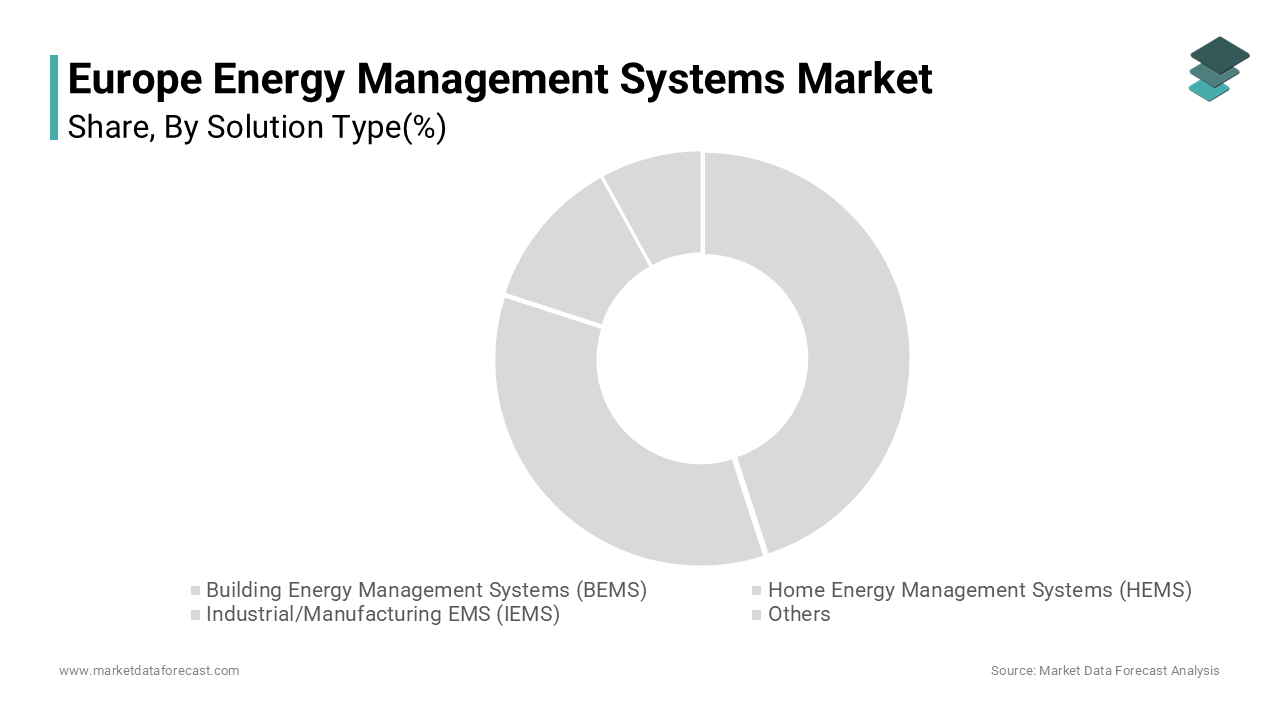
The building energy management systems segment was the largest by holding a dominant share of the Europe energy management systems market in 2025. The growth of the segment is driven by stringent regulatory mandates and the high energy intensity of commercial and public infrastructure.
The European Energy Performance of Buildings Directive requires all public buildings over 250 square meters to display energy performance certificates and implement continuous monitoring systems. In France, the Decree on Energy Management in Tertiary Buildings obliges office complexes to reduce energy use with BEMS, as the primary compliance mechanism. These legal frameworks transform BEMS from optional upgrades into operational necessities for building owners and facility managers across the continent. BEMS delivers rapid payback in hospitals data centers and manufacturing sites where HVAC and lighting of total energy use. A 2024 case study by the European Hospital Association showed that hospitals in the Netherlands and Sweden reduced annual electricity consumption by BEMS integration through optimized chiller sequencing and occupancy based lighting. The average simple payback period for BEMS in such high consumption environments is 2.4 years as calculated by the Fraunhofer Institute for Building Physics. This compelling economics incentivizes private sector investment beyond regulatory compliance in logistics centers and retail malls facing rising energy tariffs.
The home energy management systems segment is likely to witness a fastest CAGR of 21.4% throughout the forecast period. Governments across Europe are subsidizing HEMS to support the electrification of heating and transport in households. In 2024, Italy’s Superbonus 100% scheme covered 100% of HEMS costs when bundled with heat pumps or solar PV installations leading to over 280000 HEMS deployments as reported by the Italian Ministry of Ecological Transition. Similarly, the UK’s Boiler Upgrade Scheme provides 7500 pounds toward smart thermal stores and HEMS for heat pump retrofits with over 45000 applications approved in 2024. These systems enable dynamic coordination between rooftop solar battery storage EV charging and heat pumps maximizing self consumption and minimizing grid dependence.
By Deployment Mode Insights
The on-premises deployment segment was the largest by accounting for 59.3% of the Europe energy management systems market share in 2025. Industries, such as chemicals pharmaceuticals and utilities favor on premises EMS to maintain full control over sensitive operational data and ensure uninterrupted function during internet outages. The members operate on premises EMS due to concerns over intellectual property leakage and process security. Similarly, all financial data centers use locally hosted building management systems to comply with the Critical Entities Resilience Directive. In Germany, the Federal Office for Information Security requires on premises architecture for any EMS interfacing with industrial control systems classified under KRITIS. Many manufacturing and utility sites operate on decades old supervisory control and data acquisition systems that lack secure cloud connectivity. Retrofitting these environments with cloud-based EMS would require costly protocol gateways and cybersecurity hardening. According to the European Association of Electrical Contractors, industrial facilities built before 2010 rely on proprietary fieldbus networks such as Profibus or Modbus RTU incompatible with standard cloud APIs. On premises EMS platforms like Siemens Desigo or Schneider Electric EcoStruxure offer native drivers for these legacy protocols enabling seamless data aggregation without system replacement.
The cloud based segment is anticipated to grow at a fastest CAGR of 23.6% throughout the forecast period. Commercial property managers and retail chains increasingly adopt cloud EMS to monitor dozens or hundreds of locations from a single dashboard without upfront server investment. Companies like IKEA, and Carrefour, use cloud EMS from Siemens and Johnson Controls to track real time energy use across 300 plus stores by enabling centralized procurement and anomaly detection. Subscription pricing also converts capital expenditure into predictable operational expense aligning with modern corporate finance models. Cloud platforms enable automatic participation in dynamic electricity pricing and grid flexibility schemes through direct utility APIs. In the Netherlands, all major energy suppliers offer time of use tariffs that require cloud connected EMS to shift loads intelligently. Similarly, the UK’s National Grid ESO integrates with over 40 cloud EMS vendors for its Demand Flexibility Service by allowing commercial buildings to earn revenue by reducing consumption during system stress events.
By End User Insights
The commercial and retail sector held 54.3% of the Europe energy management systems market share in 2025. The EU’s Energy Efficiency Directive Article 9 mandates that all member states enforce progressive energy consumption cuts in tertiary buildings. France’s Tertiary Decree requires office and retail spaces to reduce final energy use by 2050 relative to 2010 with interim targets enforced through annual BEMS data submission. Non-compliance incurs fines up to 7500 euros per violation as outlined by the French Energy Regulatory Commission. In 2024, over 38,000 commercial buildings in France alone submitted BEMS derived energy reports. Similarly, Spain’s Royal Decree 36/2023 obliges retail chains with more than 20 stores to implement centralized EMS for national reporting. These legal obligations create a structural demand base independent of energy price volatility. Large retailers and corporate occupiers are deploying EMS to meet science based climate targets and satisfy investor ESG criteria. Similarly, the European Securities and Markets Authority now requires listed companies to disclose building level energy data under the Corporate Sustainability Reporting Directive. EMS provides auditable granular data essential for compliance.
The residential end user segment is projected to grow at a CAGR of 22.1% throughout the forecast period with the policy incentives and the rise of prosumer households. Governments are directly funding HEMS as part of broader home decarbonization initiatives. In 2024, Germany’s Federal Office of Economics and Export Control, approved 185000 grants for HEMS integrated with heat pumps or solar storage under the BEG EM program. These subsidies lower consumer barriers and bundle HEMS into holistic renovation packages. The proliferation of home EV chargers and residential batteries is turning households into active energy nodes requiring intelligent coordination. In Sweden, new single-family homes in 2024 included both solar PV and EV charging, as per the Swedish Energy Agency necessitating HEMS for load balancing. Companies like Tibber and Octopus Energy offer HEMS enabled tariffs that automatically charge EVs when grid carbon intensity is lowest or electricity prices dip below 5 euro cents per kilowatt hour.
REGIONAL ANALYSIS
Germany Energy Management Systems Market Analysis
Germany was the top performer in the European energy management systems market by accounting for 24.3% of share in 2025. Germany’s EMS market growth is driven by the Energy Services Act and the Building Energy Act, which mandate continuous monitoring for all non-residential buildings above defined consumption thresholds. Over 45,000 industrial and commercial facilities are legally required to operate certified EMS, as per the Federal Office of Economics and Export Control. The country also hosts Europe’s largest industrial base with firms like BASF Siemens and BMW deploying enterprise-wide EMS across hundreds of sites. Additionally, Germany’s Energiewende policy drives integration of distributed renewables requiring advanced load management in both commercial and residential sectors.
France Energy Management Systems Market Analysis
France was positioned second by holding 18.3% of the Europe energy management systems market share in 2024. France’s EMS adoption is uniquely propelled by the Tertiary Decree which imposes binding energy reduction targets on all non-residential buildings over 1000 square meters with non-compliance resulting in financial penalties. In 2024, many buildings submitted mandatory annual energy reports derived from BEMS data. The French government also launched the “Tertiary Energy Performance Platform” enabling centralized monitoring of compliance across regions. The French Alternative Energies and Atomic Energy Commission provides technical assistance to municipalities for EMS integration in social housing.
The United Kingdom Energy Management Systems Market Analysis
The United Kingdom energy management systems market growth is likely to be driven by its advanced commercial real estate sector and grid flexibility initiatives. The UK’s strength lies in its sophisticated demand side response mechanisms and corporate net zero commitments. The National Grid ESO’s Demand Flexibility Service enrolled over 2.1 million residential and commercial participants in 2024 all requiring cloud connected EMS for real time load adjustment. The UK’s non domestic Minimum Energy Efficiency Standards require commercial landlords to achieve at least an EPC rating of B by 2030 triggering widespread EMS retrofits. Additionally, the Smart Systems and Flexibility Plan mandates that all new smart meters support HEMS integration enabling household energy optimization.
Italy Energy Management Systems Market Analysis
Italy energy management systems market growth is likely to grow with the generous fiscal incentives and high residential electrification. The Superbonus 110% scheme, which covers full costs of HEMS when combined with heat pumps solar PV or building insulation is accelerating the growth of Europe energy management systems market. The scheme also applies to condominiums driving multi-unit BEMS adoption in urban centers like Milan and Rome. On the commercial side, the National Recovery and Resilience Plan allocated 2.3 billion euros to modernize public administration buildings with advanced EMS under the “Italy Digitale” pillar. Italy’s high electricity prices averaging 0.32 euros per kilowatt hour in 2024 further incentivize private investment.
COMPETITIVE LANDSCAPE
Competition in the Europe energy management systems market is characterized by a dynamic interplay between global industrial automation leaders regional building controls specialists and emerging software innovators. Incumbents such as Schneider Electric Siemens and Johnson Controls dominate through vertically integrated hardware software and service ecosystems that ensure reliability in mission critical environments. They leverage deep domain expertise regulatory familiarity and long standing relationships with utilities and large enterprises. At the same time agile players like Gridspion and Energyworx gain traction by offering cloud native AI powered platforms focused exclusively on demand response and carbon optimization. The market is further segmented by sector with industrial EMS requiring high cybersecurity and legacy integration while commercial BEMS prioritize ESG reporting and user interfaces. Public procurement rules increasingly mandate interoperability GAIA X alignment and GDPR compliant data handling raising entry barriers. Differentiation now hinges on the ability to translate EU policy into actionable software features while delivering verifiable energy and carbon savings.
KEY MARKET PLAYERS
Some of the companies that are playing a dominating role in the Europe Energy Management Systems Market include
- Schneider Electric SE
- Siemens AG
- ABB Ltd.
- Honeywell International Inc.
- Eaton Corporation plc
- Johnson Controls International plc
- General Electric Company
- IBM Corporation
- Emerson Electric Co.
- Rockwell Automation, Inc.
- SAP S
- Cisco Systems, Inc.
- Hitachi Energy Ltd.
- Toshiba Corporation
- Landis+Gyr AG
Top Players in the Market
Schneider Electric
Schneider Electric is a global leader in energy management and automation with a comprehensive portfolio of energy management systems spanning building industrial and grid applications. In Europe the company plays a pivotal role in enabling the energy transition through its EcoStruxure platform which integrates IoT connected devices cloud analytics and AI driven optimization. Schneider Electric contributes significantly to global standards development and interoperability frameworks including collaboration with GAIA X and the EU’s Level(s) initiative. The company launched its EcoStruxure Energy Advisor with built in EU Taxonomy and CSRD compliance reporting tailored for European commercial real estate. It also expanded its microgrid control solutions for industrial parks in Germany and Spain supporting onsite renewable integration. These actions reinforce Schneider Electric’s position as a trusted partner for regulatory aligned and scalable energy intelligence.
Siemens
Siemens delivers advanced energy management systems through its Desigo and Spectrum Power platforms serving commercial industrial and utility customers across Europe. The company is instrumental in shaping smart infrastructure through its integration of building automation grid control and digital twin technologies. Globally Siemens contributes to energy efficiency standards and participates in over 30 EU funded smart city and industrial decarbonization projects. In 2024 Siemens introduced its AI powered Desigo CC 5.0 platform featuring automated fault detection and carbon intensity forecasting aligned with EN 17333 energy performance standards. The company also partnered with the Port of Rotterdam to deploy a district scale EMS coordinating electricity steam and cooling across 20 industrial tenants. These initiatives demonstrate Siemens’ commitment to integrated and future ready energy orchestration.
Johnson Controls
Johnson Controls is a key provider of building energy management systems in Europe with its Metasys and OpenBlue platforms enabling intelligent control of HVAC lighting and security systems. The company supports global sustainability efforts by embedding science based target tracking and ESG reporting directly into its EMS software. In Europe, Johnson Controls actively collaborates with public institutions and retail chains to meet tertiary sector energy mandates. In 2024 the company enhanced its OpenBlue Enterprise Manager with real time demand response capabilities certified by the European Network of Transmission System Operators for Electricity. It also launched a carbon aware EMS module for hospitals in the UK and France that shifts non critical loads to low grid carbon periods. These innovations position Johnson Controls as a strategic enabler of compliant and resilient building operations.
Top Strategies Used by the Key Market Participants
Key players in the Europe energy management systems market prioritize regulatory alignment by embedding EU directives such as the Energy Efficiency Directive CSRD and Taxonomy into their software for automated compliance reporting. They develop AI driven predictive optimization engines that forecast energy demand carbon intensity and tariff fluctuations to enable proactive load management. Companies offer cloud based and hybrid deployment models to cater to both data sensitive industrial users and scalable commercial portfolios. Strategic partnerships with utilities grid operators and renewable developers facilitate integration into demand response and virtual power plant programs. Vendors provide bundled financing through energy as a service models to lower adoption barriers for public and small enterprise customers. They also ensure interoperability with legacy building systems through open protocols like BACnet KNX and M Bus. Continuous investment in cybersecurity certifications under NIS2 and ENISA guidelines builds trust in critical infrastructure applications. These strategies collectively address Europe’s unique blend of policy rigor operational complexity and decarbonization urgency.
MARKET SEGMENTATION
This research report on the europe energy management systems market has been segmented and sub–segmented into the following categories.
By Solution Type
- Building Energy Management Systems (BEMS)
- Home Energy Management Systems (HEMS)
- Industrial/Manufacturing EMS (IEMS)
- Others
By Component
- Hardware
- Software
- Services
By Deployment Mode
- On-premise
- Cloud-based
By End-User
- Commercial and Retail
- Residential
- Industrial Facilities
- Healthcare
- Others
By Country
- UK
- France
- Spain
- Germany
- Italy
- Russia
- Sweden
- Denmark
- Switzerland
- Netherlands
- Turkey
- Czech Republic
- Rest of Europe