- Product Description Description
- Table of Contents TOC
- List of Table & Figure LOT
- Get Free Sample PDF Sample PDF
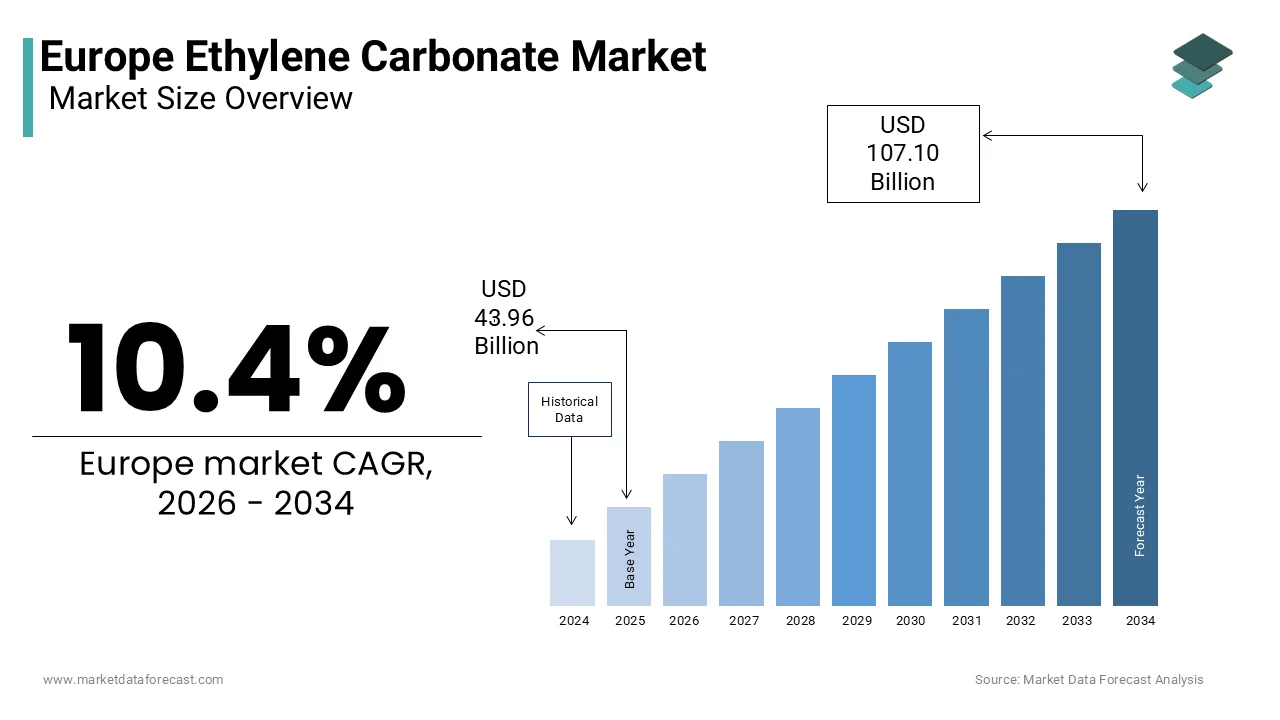
Market Size, 2025
$43.96 MnMarket Estimate, 2026
$48.53 MnMarket Forecast, 2034
$107.10 MnCAGR, 2026–2034
10.4%Executive Summary: Europe Ethylene Carbonate Market
- Market Scope: Comprehensive European ethylene carbonate industry analysis covering product grades (battery grade, electronic grade, industrial grade), application segments (lithium battery electrolytes, semiconductors), regional leadership frameworks, strategic corporate developments, and competitive landscapes.
- Market Valuation: Valued at USD 43.96 million (2025), estimated at USD 48.53 million (2026), and projected to reach USD 107.10 million by 2034, registering a robust CAGR of 10.4% (2026–2034).
- Primary Growth Drivers: EU Net-Zero Industry Act lithium-ion battery scaling, EU Chips Act semiconductor high-purity solvent demand, EU Battery Regulation carbon thresholds, and bio-based feedstock integration. Restraints include energy-intensive production costs under the EU ETS and ethylene oxide feedstock volatility.
Key Market Segment Metrics (2026–2034)
| Category | Leading Segment / Region (Position) | Fastest-Growing Segment |
|---|---|---|
| By Grade & Application | Battery grade ethylene carbonate (leading share in 2025 via high dielectric solvent role >99.95% purity) & Lithium battery electrolyte application | Electronic grade (fastest CAGR of 12.4% over forecast period) & Semiconductor segment (10.4% CAGR) |
| By End-Use Industry | Automotive end-use (dominated market in 2025 anchored by regional gigafactory demand) | Electronics sector (estimated to grow at a CAGR of 12.3% driven by advanced semiconductor fabrication) |
| By Region / Country | Germany (led regionally with a 27.5% share in 2024 via integrated production lines) | Sweden (projected to showcase prominent growth driven by low-carbon hydroelectric-powered battery manufacturing) |
Major Market Players & Market Structure
Market Structure: Highly strategic European chemical and electrolyte supply chain ecosystem characterized by vertical integration from ethylene oxide, high-purity distillation units for solid-state battery cooperation, and sub-ppm impurity electronic-grade manufacturing.
Key Companies: BASF SE, Huntsman Corporation, Mitsubishi Chemical Corporation, Shandong Haike Chemical Group Co., Ltd., HELM AG, Lixing Chemical Co., Ltd., Solvay SA, and Merck KGaA.
Europe Ethylene Carbonate Market Size
The europe ethylene carbonate market was valued at USD 43.96 million in 2025, is estimated to reach USD 48.53 million in 2026, and is projected to reach USD 107.10 million by 2034, growing at a CAGR of 10.4% from 2026 to 2034.
Ethylene carbonate is a high-polarity aprotic solvent primarily used as a critical electrolyte component in lithium-ion batteries and as a chemical intermediate in polycarbonate and pharmaceutical synthesis. In Europe, its industrial relevance has intensified due to the continent’s strategic pivot toward electrification and advanced materials. Ethylene carbonate’s high dielectric constant and ability to dissolve lithium salts make it indispensable in formulating stable electrolytes for electric vehicles and energy storage batteries. According to the European Chemicals Agency, ethylene carbonate has 30 REACH registration dossiers, which reflects its embedded role in industrial chemistry. According to ecoinvent-based emission factors compiled in Climatiq, ethylene carbonate production emits approximately 2.1 kg CO2e per kg of output, which places it under scrutiny within the EU’s Industrial Emissions Directive. As per the European Battery Alliance, electrolyte formulation accounts for a notable share of total lithium-ion cell material costs, with ethylene carbonate constituting a significant fraction of typical solvent blends. According to the European Commission’s Net-Zero Industry Act, Europe is targeting at least 550 GWh of annual battery manufacturing capacity by 2030, and as this expansion continues, the demand for high-purity ethylene carbonate is transitioning from a niche chemical supply to a strategic industrial input underpinning the region’s clean energy transition.
MARKET DRIVERS
Surge in Lithium-Ion Battery Production Drives Electrolyte Demand
The rapid expansion of lithium-ion battery manufacturing across Europe is the foremost driver of ethylene carbonate consumption as it serves as a foundational solvent in conventional carbonate-based electrolytes. According to the European Battery Alliance, around 30 gigafactories are now operational or under construction in Europe, with a combined annual capacity projected at about 413 GWh by 2027. Each gigawatt-hour of battery capacity requires approximately 900 to 1,100 tonnes of electrolyte solvents, and ethylene carbonate typically comprises 20% to 30% of these blends, as verified by the Fraunhofer Institute for Systems and Innovation Research. For context, Northvolt’s Skellefteå facility in Sweden alone consumes an estimated 8,500 tonnes of ethylene carbonate annually at full output. Additionally, the Net‑Zero Industry Act mandates that 40% of strategic net-zero technology deployment must be manufactured domestically in the EU by 2030. According to Transport & Environment, around 1.8 million battery electric vehicles were produced in Europe in 2024, which is greatly increasing demand for high-purity electrolytes compliant with UNECE Regulation 100 safety standards. This confluence of industrial policy, manufacturing scale, and technical necessity has elevated ethylene carbonate from a bulk chemical to a mission-critical battery enabler.
Regulatory Support for Electrolyte Localization Strengthens Supply Chain Security
The policy framework of Europe actively incentivizes the onshoring of battery material, including ethylene carbonate, to reduce reliance on Asian imports and enhance supply chain resilience, which is also contributing to the growth of the European ethylene carbonate market. According to the Critical Raw Materials Act (CRMA) of the European Commission, the EU set benchmarks for 2030 of at least 10% of its annual consumption of strategic raw materials being extracted domestically, 40% processed within the EU, and 25% recycled. The requirement that the EU Battery Regulation mandates carbon footprint declarations for all traction batteries sold in Europe was compelling manufacturers to switch to low-emission solvents.
MARKET RESTRAINTS
High Production Energy Intensity Increases Compliance and Cost Burdens
Ethylene carbonate synthesis via the reaction of ethylene oxide and carbon dioxide is inherently energy-intensive and subject to Europe’s stringent climate regulations, which constrain scalability and raise operating costs, which is hampering the regional market growth. According to the European Environment Agency, the chemical and petrochemical industry accounted for 22% of the total final energy consumption in industry in the EU in 2020. The process typically requires high-pressure reactors operating at elevated temperatures and pressurized CO₂ streams, which is resulting in significant specific energy consumption. According to the European Environment Agency, under the EU Emissions Trading System, the annual average carbon price reached €83/t in 2023, which is significantly inflating production expenses. Moreover, the Industrial Emissions Directive mandates Best Available Techniques for solvent manufacturers, including high solvent recovery rates and nitrogen oxide abatement, which necessitate costly secondary treatment units. A typical ethylene carbonate plant in North Rhine-Westphalia must invest in emission control infrastructure to maintain permitting. These regulatory overheads disproportionately affect small and mid-sized producers, limiting new entrants and favoring integrated chemical giants with existing decarbonization infrastructure. Consequently, the market remains concentrated, and supply elasticity is constrained despite rising demand.
Feedstock Dependency on Ethylene Oxide Creates Volatility Exposure
The ethylene carbonate production of Europe is tightly coupled to the availability and pricing of ethylene oxide, a petrochemical derivative whose supply is vulnerable to crude oil fluctuations and cracker outages, which further hinders the growth of the European market. According to the International Energy Agency, the chemical sector in Europe continues to face high input costs due to energy price volatility, which is significantly influencing ethylene oxide production economics. Ethylene oxide constitutes a major portion of ethylene carbonate’s raw material cost, with recent price fluctuations driven by feedstock scarcity. According to the European Chemical Industry Council, more than 60% of EU ethylene oxide capacity is integrated within steam crackers that also produce ethylene for plastics, which is creating production shifts toward higher-margin derivatives during margin stress. Unplanned maintenance activities at major crackers such as INEOS’ facility in Köln have periodically reduced regional ethylene oxide supply, which is triggering allocation cuts for downstream carbonate producers, as reported by industry monitors. Additionally, the EU’s Carbon Border Adjustment Mechanism indirectly affects ethylene oxide imports from non-EU regions by imposing embedded carbon costs, which further tighten supply. This feedstock linkage renders ethylene carbonate pricing highly reactive to energy markets and petrochemical dynamics, which is undermining cost predictability for battery manufacturers and deterring long-term offtake agreements.
MARKET OPPORTUNITIES
Integration of Bio-Based Feedstocks Opens Sustainable Production Pathways
The development of bio-based ethylene carbonate from renewable ethylene oxide is a lucrative opportunity aligned with Europe’s Green Deal and circular economy objectives. According to the Joint Research Centre, bio-based chemical routes such as those using bioethanol-derived ethylene oxide can significantly reduce lifecycle carbon emissions compared to fossil-based processes. Companies like Solvay and BASF have pioneered routes using bioethanol-derived ethylene oxide, which is reducing the carbon footprint of ethylene carbonate compared to fossil-based equivalents. According to the European Bioplastics Association, bio-based ethylene oxide capacity in Europe is projected to reach 220,000 tonnes annually by 2026, which is enabling scalable production of green electrolytes. This matters because the EU Battery Regulation requires the disclosure of carbon intensity and will impose maximum thresholds starting in 2027, which favors low-carbon solvents. Northvolt has already signed off-take agreements for bio-based ethylene carbonate to achieve its 2030 goal of fossil-free batteries. Furthermore, the Horizon Europe program allocated €280 million in 2023 to support circular chemistry projects, including CO₂ utilization for carbonate synthesis. These initiatives position ethylene carbonate not as a legacy petrochemical but as a platform for decarbonized electrochemical innovation.
Expansion of Solid-State Battery R&D Creates Niche High-Purity Demand
Although solid-state batteries aim to reduce liquid electrolyte reliance, their development and hybrid variants still require ultra-high-purity ethylene carbonate for interfacial stabilization and wetting layers, which is another major opportunity in the European market. According to the European Commission, the European Union has significantly increased funding for next-generation battery technologies under the Horizon Europe and Innovation Fund programs since 2022, which is supporting multiple solid-state battery consortia across member states. These projects often use ethylene carbonate as a minor but critical additive to enhance lithium-ion conductivity at electrode interfaces. According to the Fraunhofer Institute for Material and Beam Technology, purity requirements for such applications exceed 99.99%, with water content below 10 parts per million, which is far stricter than standard battery grade. This creates a premium segment for specialty chemical producers capable of multi-stage distillation and molecular sieve drying. Companies like Merck KGaA have launched electronic-grade ethylene carbonate lines in Darmstadt, targeting this emerging demand. As Europe advances its solid-state pilot lines, including upcoming facilities such as Solvay’s SolidPower site in Germany, ethylene carbonate remains relevant not as a bulk component but as a high-value performance enabler in next-generation architectures.
MARKET CHALLENGES
Limited Domestic Production Capacity Constricts Supply Autonomy
The ethylene carbonate manufacturing base of Europe remains insufficient to meet the surging demand from its expanding battery sector, creating a structural supply gap that undermines strategic autonomy, which is primarily challenging the growth of the European market. According to the European Chemical Industry Council, Europe currently has limited domestic production capacity for battery-grade ethylene carbonate, concentrated mainly in Germany, Belgium, and the Netherlands. As per the European Battery Alliance, the region’s growing gigafactory network is expected to drive a sharp rise in electrolyte solvent demand by 2025, which is creating a capacity gap between local supply and consumption. As a result, battery makers continue to rely heavily on imports of ethylene carbonate from major producers in South Korea and Japan, as reflected in Eurostat’s trade data. This dependency runs counter to the European Commission’s target of achieving 80% domestic electrolyte material coverage by 2027 and exposes the supply chain to geopolitical and logistical risks. According to the European Environment Agency, environmental permitting for new chemical plants in Western Europe often takes more than two years, which is further slowing capacity additions. Until new facilities come online, Europe’s battery ambitions will remain partially tethered to external solvent suppliers.
Stringent Purity and Safety Standards Increase Qualification Timelines
The qualification of ethylene carbonate for battery applications involves rigorous analytical validation and safety testing that significantly extends time to market and raises entry barriers for new producers is further challenging the growth of the European market. Battery-grade ethylene carbonate must comply with IEC 62620 standards requiring impurity profiles below 50 parts per million for metals like iron and copper, which catalyze electrolyte decomposition. According to the European Directorate for the Quality of Medicines, certification for high-purity chemicals such as ethylene carbonate involves multiple steps, including Karl Fischer titration, trace metal analysis, and thermal stability screening, and typically requires several months to complete per batch. Additionally, the Classification, Labelling and Packaging Regulation categorizes ethylene carbonate as harmful if swallowed and an eye irritant, which is necessitating specialized handling protocols under REACH. According to the European Agency for Safety and Health at Work, 22% of chemical incidents in 2023 involved solvent mismanagement during transfer or storage, which is prompting stricter workplace controls. These technical and regulatory hurdles delay supplier onboarding and discourage diversification as battery manufacturers prefer long-standing partners with proven compliance records,s, even at premium pricing.
REPORT COVERAGE
| REPORT METRIC | DETAILS |
| Market Size Available | 2025 to 2034 |
| Base Year | 2025 |
| Forecast Period | 2026 to 2034 |
| Segments Covered | By Grade, Application, End Use, and Region. |
| Various Analyses Covered | Global, Regional, and Country-Level Analysis, Segment-Level Analysis, Drivers, Restraints, Opportunities, Challenges; PESTLE Analysis; Porter’s Five Forces Analysis, Competitive Landscape, Analyst Overview of Investment Opportunities |
| Countries Covered | UK, France, Spain, Germany, Italy, Russia, Sweden, Denmark, Switzerland, Netherlands, Turkey, Czech Republic, Rest of Europe |
| Market Leaders Profiled | BASF SE, Huntsman Corporation, Mitsubishi Chemical Corporation, New Japan Chemical Co., Ltd., TOAGOSEI Co., Ltd., Zhongke Hongye Chemical Co., Ltd., Shandong Shida Shenghua Chemical Group Co., Ltd., Asahi Kasei Corporation, Oriental Union Chemical Corporation (OUCC), Liaoning Oxiranchem, Inc., FPC USA Corporation, TOKYO Chemical Industry Co., Ltd. (TCI), Merck KGaA, Kowa Company, Ltd., Empower Materials, Inc., Panax Etec Co., Ltd., Otto Chemie Pvt. Ltd., Shandong Haike Chemical Group Co., Ltd., HELM AG, Lixing Chemical Co., Ltd. |
SEGMENTAL ANALYSIS
By Grade Insights
The battery grade ethylene carbonate segment accounted for the leading share of the European market in 2025 due to its indispensable role as a high dielectric solvent in lithium-ion battery electrolytes. This grade requires purity levels exceeding 99.95 with strict limits on water content below 20 parts per million and trace metals such as iron and copper below 5 parts per million to prevent electrolyte decomposition and ensure cell longevity. According to the European Automobile Manufacturers Association, more than 2.3 million battery electric vehicles were assembled in the EU in 2024, each requiring between 5 kg and 8 kg of battery-grade ethylene carbonate per pack. Furthermore, the European Battery Regulation mandates that all traction batteries sold from 2027 must disclose carbon footprint data, which favors locally produced high-purity solvents. According to the European Commission, 28 gigafactories are expected to be operational by 2026, collectively demanding over 85,000 tonnes of battery-grade ethylene carbonate annually. According to the European Energy Exchange, Europe added around 12 GWh of new energy storage system capacity in 2024, which is amplifying demand alongside renewable integration. These converging industrial and regulatory forces anchor battery-grade ethylene carbonate as the market’s structural core and contribute to the domination of the battery-grade ethylene carbonate segment in the European market.
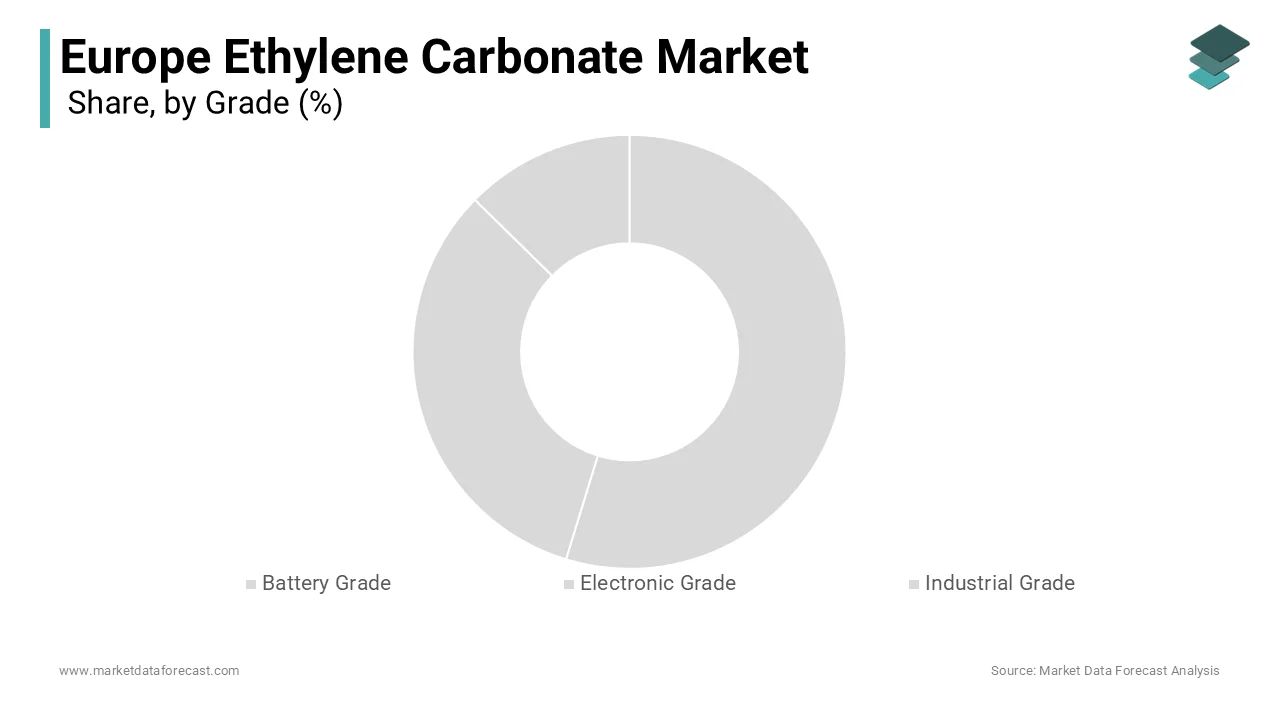
The electronic grade ethylene carbonate segment is anticipated to grow at the fastest CAGR of 12.4$ over the forecast period, owing to its use in advanced semiconductor cleaning formulations and solid-state battery interfacial layers. According to the European Semiconductor Industry Association, the EU Chips Act has spurred multiple semiconductor fabrication projects across Europe, which is driving demand for high-purity specialty chemicals. This ultra-high-purity variant requires impurity thresholds below 1 part per million for metallic contaminants and must be free of ionic residues that could compromise wafer integrity. According to the Fraunhofer Institute for Microelectronics, ethylene carbonate-based formulations are increasingly used in post-etch cleaning due to their low surface tension and compatibility with high-k dielectrics. Additionally, electronic-grade ethylene carbonate serves as a wetting agent in quasi-solid-state batteries developed under the European Innovation Council’s Battery 2030+ initiative, which allocated €340 million in 2025 for interface engineering. Companies like Merck KGaA have launched sub-0.1-part-per-million purity lines in Darmstadt to serve this niche. As Europe advances its semiconductor sovereignty and next-generation battery programs, this segment is positioned for sustained high growth.
By Application Insights
The lithium battery electrolyte segment captured the major share of the European ethylene carbonate market in 2024, as it serves as the primary solvent in conventional carbonate-based electrolyte blends. Ethylene carbonate’s high dielectric constant enables efficient dissociation of lithium salts such as LiPF6, while its solid electrolyte interphase-forming capability enhances anode stability. This application’s primacy is directly tied to Europe’s electric mobility transition. According to the International Energy Agency, global demand for EV batteries reached more than 750 GWh in 2023, which is highlighting the scale-up of battery manufacturing worldwide. According to industry market analysis, EV batteries typically require about 8–12 kg of electrolyte per 100 kWh (roughly 0.08–0.12 kg per kWh), and ethylene carbonate constitutes roughly 15–30% of the solvent mixture in many lithium-ion formulations, according to technical suppliers and literature. According to the European Commission, the EU’s Fit for 55 package sets progressively tighter fleet CO₂ targets (including interim reductions for 2025–2029 and steeper cuts to 2030 and a 0 g CO₂/km fleet-wide objective for 2035), which is accelerating automaker electrification plans. According to industry production trackers, Volkswagen has announced plans to scale EV production capacity in Europe to several million vehicles annually in the mid-2020s, which is driving large industrial-scale demand for battery material,,s including electrolyte solvents. This industrial-scale demand boosts the lithium battery electrolyte segment as the uncontested core application for ethylene carbonate in the region.
The semiconductor segment is expected to exhibit the fastest CAGR of 10.4% over the forecast period in the European ethylene carbonate market during the forecast period due to its adoption in precision cleaning and photoresist stripping formulations for advanced node fabrication. According to the European Commission, the EU Chips Act mobilizes €43 billion in public and private investment to strengthen Europe’s semiconductor ecosystem and supply chain resilience. According to the European Semiconductor Industry Association, semiconductor material consumption in Europe increased significantly in 2024, with specialty solvents like ethylene carbonate seeing growing adoption due to their compatibility with extreme ultraviolet lithography tools. The CEA-Leti research institute in France has reported that ethylene carbonate-based strippers can deliver high photoresist removal efficiency without damaging copper interconnects, whioutperformsing traditional NMP alternatives that are now restricted under REACH. Additionally, STMicroelectronics has integrated ethylene carbonate into its 300-millimeter wafer cleaning protocols at its Crolles facility, which is helping to reduce defect density and improve surface integrity. With Europe targeting 20% of global semiconductor production by 2030, the semiconductor segment, but high-value application is set for accelerated expansion.
By End Use Insights
The automotive segment captured the largest share of the ethylene carbonate market in Europe in 2025 due to its role in lithium-ion batteries for electric and hybrid vehicles. According to the European Environment Agency, the transport sector accounted for about 22% of total EU greenhouse gas emissions in 2023, which is making vehicle electrification a key policy focus. The European Commission’s Alternative Fuels Infrastructure Regulation requires member states to deploy around 1 million public charging points by 2025, which is further incentivizing electric vehicle adoption. According to the German Association of the Automotive Industry, Germany produced more than 800,000 battery electric cars in 2024, each containing roughly 60–70 kilowatt-hours of battery capacity, and such vehicles require several kilograms of electrolyte solvents, including ethylene carbonate per unit. Major OEMs such as Stellantis and BMW have signed long-term electrolyte solvent offtake agreements with European chemical producers to secure supply. As internal combustion engine phase-out mandates take effect across EU member states, the automotive industry’s chemical demand is shifting decisively toward electrochemical materials. This policy-driven industrial transformation ensures the automotive sector remains the primary consumption channel for ethylene carbonate across the region and propels the growth of the automotive segment in the European market.
The electronics segment is estimated to grow at a CAGR of 12.3% over the forecast period in the European ethylene carbonate market over the forecast period owing to the increasing demand from consumer devices, industrial sensors, and data center energy storage systems. Beyond semiconductors, ethylene carbonate is increasingly used in the electrolytes of small-format lithium polymer batteries powering laptops, wearables, and medical electronics. According to Eurostat, the EU imported €478 billion worth of high-tech products in 2024, with many incorporating rechargeable lithium batteries. According to ICIS, hyperscale data centres in Europe consumed about 96 TWh of electricity in 2024, which requires on-site lithium-ion backup systems that use ethylene carbonate-based electrolytes for thermal stability. The EU’s Ecodesign for Sustainable Products Regulation now mandates longer battery life spans and reparability, driving demand for high-purity solvents that reduce degradation. Companies like Saft and ACC (the Saft–TotalEnergies–Stellantis joint venture) have expanded small-cell production in France and Germany with ethylene carbonate as a core component. As Europe digitizes its economy and prioritizes energy resiliency, this segment is experiencing compound growth far exceeding traditional industrial applications.
COUNTRY LEVEL ANALYSIS
Germany Ethylene Carbonate Market Analysis
Germany led the market by holding 27.5% of the regional market share in 2024. The dual role of Germany as Europe’s top automotive producer and a hub for advanced chemical manufacturing is primarily driving the domination of Germany in the European market. According to the German Chemical Industry Association, Germany’s chemical sector invested heavily in battery materials infrastructure in 2024, which reflects the country’s push toward domestic energy storage value chains. Germany hosts major ethylene carbonate consumers, including BMW, Volkswagen, and Northvolt’s planned gigafactory in Heide, which is expected to require substantial volumes of battery-grade solvent annually. Germany is also home to leading producers such as BASF in Ludwigshafen, which operates one of Europe’s few integrated ethylene oxide to ethylene carbonate production lines. The Federal Ministry for Economic Affairs and Climate Action has designated electrolyte solvents as critical under its Raw Materials Strategy, which is accelerating permitting for new production units. With strong R&D collaboration between industry and institutions like the Karlsruhe Institute of Technology, Germany maintains end-to-end control over ethylene carbonate quality from synthesis to application, which is ensuring the continued leadership of Germany in the European ethylene carbonate market during the forecast period.
France Ethylene Carbonate Market Analysis
France commanded a substantial share of the European ethylene carbonate market in 2024. The growth of the French market is driven by its state-led battery and semiconductor sovereignty initiatives. According to the French Ministry of Economy, France has committed more than €3 billion in state aid under the France 2030 plan to support the localization of battery and electrolyte material production, including pilot projects such as Solvay’s bio-based ethylene carbonate initiative in Lyon. France is home to major gigafactories, including Verkor and ACC, with a combined capacity expected to exceed 60 gigawatt-hours by 2027, which will require substantial volumes of ethylene carbonate. Additionally, through the European Chips Act, France’s semiconductor expansion includes STMicroelectronics’ 300-millimeter wafer fab in Crolles, which is utilizing ethylene carbonate in advanced cleaning processes. The French Environment Agency mandates strict carbon accounting for industrial chemicals, which aligns with EU Battery Regulation requirements and favors domestic low-emission production. This fusion of industrial policy, green chemistry, and strategic autonomy is driving the ethylene carbonate market in France.
Netherlands Ethylene Carbonate Market Analysis
The Netherlands is predicted to account for a considerable share of the European ethylene carbonate market during the forecast period, owing to its integrated petrochemical cluster in the Port of Rotterdam and advanced materials ecosystem. According to the Netherlands Enterprise Agency, the Netherlands hosts several producers of high-purity and battery-grade chemical solvents that support regional supply chains for European gigafactories, including Northvolt’s facility in Sweden and Tesla’s Berlin plant. Shell’s Pernis refinery and LyondellBasell’s chemical complex provide ethylene oxide feedstock, which is enabling localized ethylene carbonate synthesis. According to the Dutch government, the National Growth Fund allocated €1.1 billion in 2023 to support battery material innovation, including CO₂-based carbonate production projects at the Brightlands Chemelot Campus. Additionally, ASML’s semiconductor supply chain indirectly drives demand for electronic-grade ethylene carbonate used in wafer cleaning by Dutch and Belgian subcontractors. With world-class logistics, stringent environmental standards, and cluster synergies, the Netherlands functions as Europe’s ethylene carbonate logistics and innovation nexus.
Sweden Ethylene Carbonate Market Analysis
Sweden is projected to showcase a prominent CAGR in the European ethylene carbonate market over the forecast period due to its leadership in green battery manufacturing powered by hydroelectricity. According to the Swedish Energy Agency, more than 96% of Sweden’s electricity generation comes from low-carbon sources such as hydropower and nuclear energy, which enables chemical production with one of the smallest carbon footprints in Europe. Northvolt’s Ett and Fem gigafactories in Skellefteå and Gothenburg are among Europe’s largest consumers of battery-grade ethylene carbonate, with annual demand projected to reach several thousand tonnes at full capacity. According to the Royal Institute of Technology (KTH), the use of low-carbon electricity significantly reduces the lifecycle emissions of ethylene carbonate compared to the EU average. Northvolt’s partnership with chemical producer Perstorp includes developing a bio-based ethylene carbonate supply chain using tall oil derivatives sourced from Swedish forestry. The Swedish Chemicals Agency enforces some of Europe’s strictest solvent handling and purity regulations, which ensure high quality and safety standards. This combination of clean energy, circular feedstocks, and industrial integration positions Sweden as a premium ethylene carbonate market.
Italy Ethylene Carbonate Market Analysis
Italy is estimated to witness a healthy CAGR in the European ethylene carbonate market during the forecast period, owing to its growing electric vehicle component sector and chemical processing heritage. According to ISTAT, Italy’s chemical industry comprises more than 2,000 enterprises, with Eni’s Versalis subsidiary operating ethylene oxide infrastructure in Porto Marghera, which is enabling potential ethylene carbonate integration. According to the Italian government, the National Recovery and Resilience Plan allocated €620 million in 2023 to strengthen domestic battery material supply chains, including investments in solvent purification technologies. Italy hosts battery module assembly plants for Stellantis and Leclanché that require regional electrolyte sourcing. Additionally, the country’s electronics manufacturing base in Emilia-Romagna consumes ethylene carbonate for small-cell batteries used in industrial automation and medical devices. The Ministry of Ecological Transition has introduced tax incentives for low-emission chemical production, which aligns with EU sustainability goals. While not a primary producer, Italy’s strategic consumption base and policy support secure its role in the regional market.
COMPETITIVE LANDSCAPE
Competition in the European ethylene carbonate market is characterized by a concentrated landscape of integrated chemical majors and specialty producers competing on purity, consistency, sustainability credentials, and regulatory compliance rather than price. The market is highly technical with barriers to entry, including capital-intensive purification infrastructure, stringent REACH and Battery Regulationrequirementst,,, and lengthy customer qualification processes that can exceed nine months. Global players like BASF and Solvay dominate due to their feedstock integration and scale, while niche firms like Merck KGaA capture high-value segments through ultra-high purity offerings. Competition is further shaped by Europe’s policy environment, where low-carbon production methods and circular feedstocks confer significant commercial advantages. New entrants face challenges in securing ethylene oxide allocation and permitting for high-pressure synthesis units. As a result, rivalry centers on innovation in green chemistry digital batctraceabilityli, ty, and strategic alignment with Europe’s industrial sovereignty agenda,nda rather than traditional volume-based competition.
KEY MARKET PLAYERS
Some of the companies that are playing a dominating role in the global europe ethylene carbonate market include
- BASF SE
- Huntsman Corporation
- Mitsubishi Chemical Corporation
- New Japan Chemical Co., Ltd.
- TOAGOSEI Co., Ltd.
- Zhongke Hongye Chemical Co., Ltd.
- Shandong Shida Shenghua Chemical Group Co., Ltd.
- Asahi Kasei Corporation
- Oriental Union Chemical Corporation (OUCC)
- Liaoning Oxiranchem, Inc.
- FPC USA Corporation
- TOKYO Chemical Industry Co., Ltd. (TCI)
- Merck KGaA
- Kowa Company, Ltd.
- Empower Materials, Inc.
- Panax Etec Co., Ltd.
- Otto Chemie Pvt. Ltd.
- Shandong Haike Chemical Group Co., Ltd.
- HELM AG
- Lixing Chemical Co., Ltd.
TOP LEADING PLAYERS IN THE MARKET
- BASF SE is a German multinational and a leading producer of ethylene carbonate in Europe with integrated operations spanning ethylene oxide feedstock to high-purity battery-grade output. The company supplies ethylene carbonate to major European battery and automotive manufacturers under long-term offtake agreements. BASF has strengthened its position by commissioning a dedicated battery materials unit at its Ludwigshafen Verbund site capable of producing ultra-low-moisture ethylene carbonate compliant with IEC 62620 standards. In 2024, the company partnered with Northvolt to develop a low-carbon solvent supply chain leveraging renewable energy and carbon capture technologies. Through its global chemical network, BASF also exports European-manufactured ethylene carbonate to Asia and North America, supporting its worldwide battery materials strategy while reinforcing Europe’s supply resilience.
- Solvay SA is a Belgium-based advanced materials and specialty chemicals company with a strategic focus on sustainable ethylene carbonate production for the European battery ecosystem. The company operates high-purity distillation units in Rheinberg, Germany, and Rosignano, Italy, producing both battery and electronic grades. Solvay has recently pioneered a bio-based ethylene carbonate route using ethylene oxide derived from bioethanol, which reduces lifecycle emissions by over 60 percent, as validated by the Joint Research Centre. In 2024, Solvay launched its ECOSOLV portfolio targeting electrolyte formulators under the EU Battery Regulation’s carbon footprint requirements. Its close collaboration with European semiconductor equipment makers and solid-state battery developers further diversifies its end-use exposure beyond traditional automotive applications.
- Merck KGaA is a German science and technology company that plays a specialized role in the European ethylene carbonate market through its Electronics business unit, which produces electronic-grade ethylene carbonate for semiconductor and advanced battery applications. Operating from its Darmstadt facility, Merck supplies ultra-high purity ethylene carbonate with impurity levels below 0.1 parts per million to European chipmakers and solid-state battery innovators. In 2024, the company expanded its purification capacity using molecular sieve and sub-ambient distillation technologies to meet demand from new EU fabrication plants. Merck’s deep integration into the semiconductor supply chain and its focus on performance-critical grades position it as a key enabler of Europe’s technological sovereignty in both microelectronics and next-generation energy storage.
TOP STRATEGIES USED BY THE KEY MARKET PARTICIPANTS
Key players in the European ethylene carbonate market pursue vertical integration by securing ethylene oxide feedstock through in-house crackers or long-term partnerships to ensure supply stability and cost control. They invest in advanced purification infrastructure such as multi-stage distillation and molecular sieve drying to meet stringent battery and semiconductor purity standards. Companies actively develop bio-based and CO2-derived production routes to align with EU sustainability mandates and secure premium contracts under the Battery Regulation. Strategic collaborations with battery cell manufacturers and semiconductor foundries enable co-development of application-specific grades and faster qualification cycles. Additionally, firms leverage Europe’s green energy advantage by locating production in regions with low-carbon electricity to reduce reported product carbon footprints and gain competitive differentiation in regulated markets.
MARKET SEGMENTATION
This research report on the europe ethylene carbonate market is segmented and sub-segmented into the following categories.
By Grade
- Battery Grade
- Electronic Grade
- Industrial Grade
- Others
By Application
- Lithium Battery Electrolyte
- Semiconductor
- Plasticizers and Lubricants
- Others
By End Use
- Automotive
- Electronics
- Industrial
- Others
By Country
- Germany
- France
- Netherlands
- Sweden
- Italy
- Rest of Europe