- Product Description Description
- Table of Contents TOC
- List of Table & Figure LOT
- Get Free Sample PDF Sample PDF
Executive Summary: Europe Feed Palatability Enhancers & Modifiers Market
- Market Scope: Overview of the European feed palatability enhancers and modifiers market covering varied additive types, livestock categories, and major country-level markets (UK, France, Spain, Germany, Italy, etc.).
- Market Valuation: Valued at USD 893.5 million in 2025, estimated at USD 1,918.25 million in 2026, and projected to reach USD 1,142.59 million by 2034, growing at a steady CAGR of 2.77% over the forecast period from 2026 to 2034.
- Primary Growth Drivers: Integration of alternative protein sources requiring flavor masking (such as insect meal and single-cell proteins), expansion of precision livestock farming, and rising companion animal humanization trends.
Key Market Segment Metrics (2026–2034)
| Category | Leading Segment (Base Position) | Fastest-Growing / High-Growth Segment |
|---|---|---|
| By Type | Flavors (accounted for 56.5% of the European market share in 2025 due to multifunctional roles in masking off-tastes and stimulating intake) | Sweeteners (anticipated to grow at a promising CAGR of 10.4% driven by species-specific sweet receptor biology and potency) |
| By Animal Type | Swine (held 32.6% of the European market share in 2025 backed by high biological sensitivity to taste and intensive production systems) | Aquaculture (emerges as the fastest-growing animal segment at a CAGR of 12.4% propelled by fish farming expansion and marine ingredient substitution) |
| By Country / Region | United Kingdom & France (lead regional market adoption backed by specialized pet food manufacturing, natural flavor R&D hubs, and advanced feed production) | Spain & Germany (high-volume intensive swine/poultry sectors alongside ecological modernization initiatives) |
Major Market Players & Industry Landscape
Market Structure: Competitive market structure comprising established multinational feed additive suppliers, flavor houses, and specialty ingredient corporations navigating strict EFSA regulatory frameworks.
Key Companies: Associated British Foods PLC, Kerry Group PLC, Diana Group, Eli Lilly and Company, E.I. du Pont de Nemours and Company, Ensign-Bickford Industries Inc., Kemin Europa, Ferrer, Kent Feeds Inc., and Tanke International Group.
 Download Free Sample Report
Europe Feed Palatability Enhancers And Modifiers Market Size
The Europe feed palatability enhancers & modifiers market size was valued at USD 893.5 million in 2025 and is anticipated to reach a valuation of USD 1918.25 million in 2026 and USD 1,142.59 million by 2034, growing at a CAGR of 2.77% from 2026 to 2034.
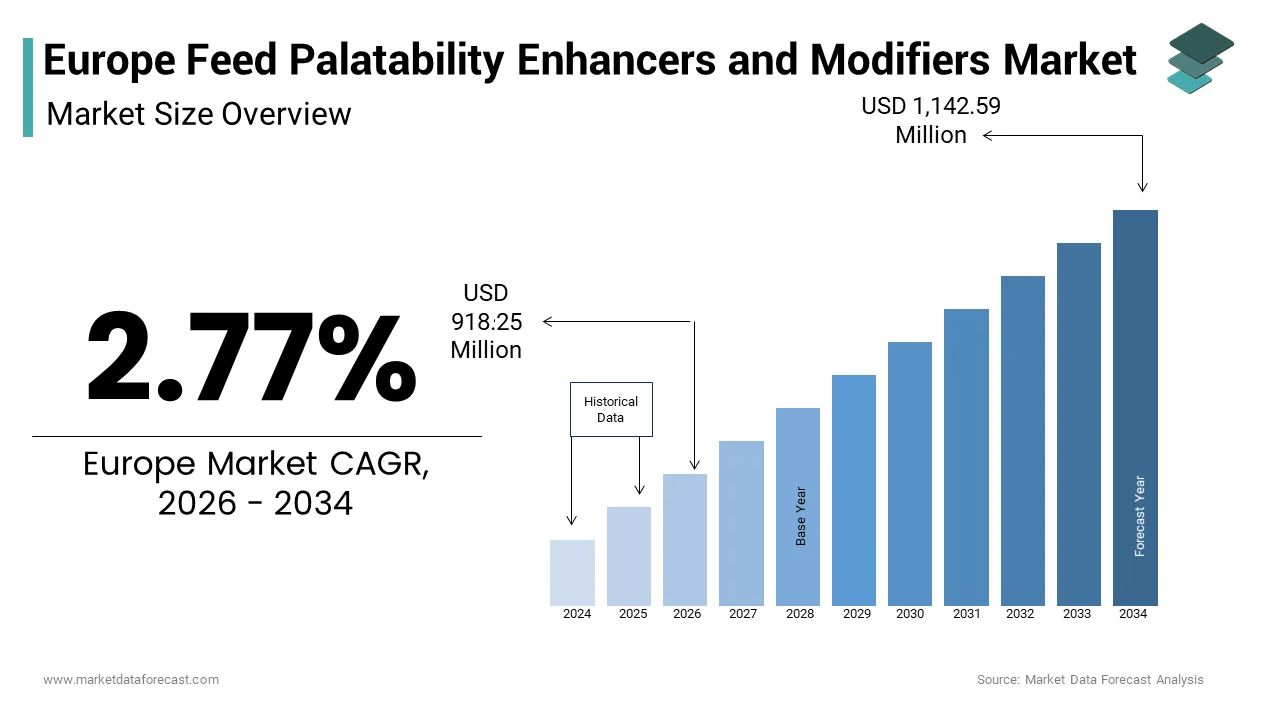
According to Eurostat, the European Union produced 149 million tonnes of compound feed in 2023, creating substantial baseline demand for intake optimization technologies ensuring efficient nutrient delivery. As per the European Food Safety Authority, over 350 feed flavoring substances have been evaluated under Regulation EC 1831/2003, establishing rigorous safety and efficacy standards distinguishing this region from less regulated markets. Furthermore, according to FEFAC data, feed conversion ratios in European pig production improved by 8% between 2018 and 2023 partly attributable to enhanced palatability supporting consistent intake during critical growth phases. This market operates at the intersection of animal nutrition science and sensory biology, where precise flavor modulation enables formulators to incorporate sustainable but less palatable ingredients without compromising performance. Unlike human food flavors, these additives must account for species specific taste receptor variations and physiological responses, requiring specialized research infrastructure and regulatory compliance frameworks unique to European animal production systems.
MARKET DRIVERS
Integration of Alternative Protein Sources Requiring Flavor Masking
The widespread incorporation of insect meal, single cell proteins and plant based alternatives into European feed formulations drives the European feed palatability enhancers and modifiers market forward. According to the European Commission’s Farm to Fork Strategy, the EU aims to reduce dependency on imported soy by 20% by 2030, accelerating adoption of locally sourced alternative proteins that often possess bitter or metallic taste profiles deterring voluntary consumption. As per Protix, black soldier fly larvae meal inclusion above 5% in piglet diets reduced feed intake by 12% without flavor enhancement, necessitating palatability solutions to maintain growth performance. The European Food Safety Authority approved 14 new insect derived feed materials in 2023, each requiring species specific palatability validation before commercial scale integration. According to Ynsect, their industrial facility in France produces 10000 tonnes of mealworm protein annually primarily for aquafeed where fish sensitivity to novel protein sources demands sophisticated masking technologies. Unlike conventional soybean meal with established acceptance, alternative proteins introduce variable sensory characteristics depending on substrate and processing methods, creating ongoing need for customized flavor systems rather than standardized solutions. This driver operates through formulation necessity as sustainability mandates compel ingredient diversification regardless of inherent palatability, making flavor modifiers essential enablers of circular economy objectives embedded in European agricultural policy.
Precision Livestock Farming and Individualized Nutrition Requirements
Advanced monitoring technologies enabling real time intake tracking create demand for palatability enhancers calibrated to individual animal preferences and physiological states, which is further boosting the European feed palatability enhancers and modifiers market expansion. According to Wageningen University research, automated feeding stations deployed across 35% of Dutch dairy farms in 2023 detected 18% variation in individual cow flavor preferences, prompting development of modular flavor systems adjustable at point of dispensing. As per DeLaval, their precision feeding platform integrated palatability feedback loops in 2023 allowing dynamic adjustment of flavor intensity based on residual feed measurements, improving group average intake consistency by 9% across 200 test herds. The European Innovation Partnership for Agricultural Productivity funded 28 projects between 2021 and 2023 specifically targeting sensor driven flavor optimization, reflecting policy recognition that one size fits all approaches waste nutrients and compromise welfare. PigCHAMP ProEuropa trials demonstrated that sows receiving flavor matched transition feeds during lactation consumed 14% more energy versus control groups, directly translating to improved litter weaning weights. This technological convergence transforms palatability from static formulation parameter to dynamic management variable responsive to biological feedback. As automation penetrates deeper into European livestock operations, demand shifts toward intelligent flavor systems integrated with farm management software rather than standalone additives, creating value added service layers beyond commodity ingredient supply.
MARKET RESTRAINTS
Stringent Regulatory Approval Timelines Under EFSA Framework
Extended evaluation periods for novel feed flavoring substances under European Food Safety Authority protocols constrain innovation velocity and limit product portfolio diversity compared to less regulated regions, which is a significant impediment to the European feed palatability enhancers and modifiers market. According to EFSA’s annual activity report, median approval timeline for new feed additive applications reached 42 months in 2023, representing a 15 month increase from 2019 due to expanded data requirements on environmental fate and non-target species safety. As per the European Commission’s Register of Feed Additives, only 68 authorized flavoring substances are listed for aquaculture versus 215 for terrestrial livestock, reflecting disproportionate regulatory burden for aquatic species where taste biology remains poorly characterized. Kemin Industries reported delaying launch of three novel umami enhancers in Europe by an average of 28 months awaiting EFSA opinion while identical products received U.S. FDA GRAS status within 8 months, creating competitive disadvantage in global export markets. Small and medium enterprises face particular barriers as comprehensive toxicology dossiers cost between 350000 and 800000 euros per substance, exceeding R&D budgets for niche flavor innovations. Unlike pharmaceutical approvals where exclusivity periods protect investment, feed additive authorizations are non-proprietary meaning first movers bear full compliance costs while followers free ride on established safety precedents. This structural disincentive reduces applicant pool and slows introduction of next generation palatability solutions despite clear technical feasibility and market need.
Raw Material Price Volatility for Natural Flavoring Compounds
Dependence on botanical extracts and fermentation derived ingredients exposes manufacturers to supply instability and cost unpredictability undermining formulation consistency and margin stability, which is further hampering the European market expansion. According to the International Trade Centre, vanilla extract prices fluctuated between 180 and 420 US dollars per kilogram during 2022 to 2023 due to cyclone damage in Madagascar and speculative inventory hoarding, forcing reformulation cycles for premium pet food palatants. As per the European Spice Association, aniseed oil availability declined 35% in 2023 following drought in Turkish growing regions, triggering allocation rationing among feed flavor compounders serving multiple industries simultaneously. IFF’s 2023 sustainability report revealed that 22% of natural flavoring raw materials sourced from outside the EU experienced delivery delays exceeding 60 days due to geopolitical disruptions and logistics bottlenecks, necessitating costly safety stock accumulation. Unlike synthetic alternatives with stable petrochemical feedstocks, natural compounds face agricultural yield variability compounded by climate change impacts on traditional growing zones. Organic certification premiums further amplify volatility as certified botanical supplies represent less than 8% of global production according to FiBL statistics. Manufacturers face binary choice between absorbing margin erosion during price spikes or reformulating with inferior synthetics risking customer rejection in clean label sensitive segments. This constraint limits ability to offer fixed price contracts and complicates long term supply planning essential for industrial feed manufacturing continuity.
MARKET OPPORTUNITIES
Aquaculture Expansion and Species Specific Flavor Optimization
Rapid growth of European aquaculture production creates specialized demand for palatability solutions tailored to diverse fish and crustacean sensory biologies currently underserved by terrestrial focused product portfolios, which is a prominent opportunity for the European market. According to EAS Aquaculture Europe, regional salmonid production reached 1.3 million tonnes in 2023 with trout and char species expanding 12% annually as diversification strategies reduce disease concentration risks. As per Skretting’s R&D division, Atlantic salmon and rainbow trout exhibit fundamentally different amino acid receptor sensitivities, requiring distinct umami enhancer blends to achieve equivalent feed intake stimulation at the same inclusion rates. The European Maritime Fisheries and Aquaculture Fund allocated 45 million euros in 2023 specifically for feed innovation projects targeting emerging species like pikeperch and ballan wrasse where commercial palatants remain unavailable. Biomar’s collaboration with Norwegian University of Science and Technology identified three novel betaine derivatives improving shrimp feed acceptance by 22% in 2023 trials, demonstrating untapped potential in crustacean nutrition. Unlike poultry and swine where decades of research established flavor baselines, aquaculture represents a frontier market with species specific opportunities commanding premium pricing due to limited competition. As the EU Blue Economy strategy targets a 25% aquaculture production increase by 2030, early movers developing validated aquatic palatability platforms secure first mover advantages in high growth segments insulated from saturated terrestrial markets.
Companion Animal Humanization and Premiumization Trends
Escalating consumer willingness to pay for gourmet pet food formats creates opportunity for the European feed palatability enhancers and modifiers market. According to Euromonitor International, European premium pet food sales grew 9% in 2023 reaching 8.2 billion euros with fresh refrigerated and freeze dried formats expanding fastest at a 28% annual rate. As per Mars Petcare’s European innovation center, wet food formats incorporating culinary inspired flavor profiles achieved 35% higher repeat purchase rates versus traditional kibble in 2023 consumer panels across Germany, France, and the UK. According to the European Pet Food Industry Federation, grain free and raw inspired products now represent 22% of cat food volume, requiring advanced masking technologies to overcome inherent bitterness of high meat inclusion without artificial enhancers rejected by clean label conscious owners. Nestlé Purina invested 65 million euros in 2023 expanding Waltham Centre’s feline sensory research capabilities including electrophysiological taste receptor mapping enabling rational design rather than empirical screening of palatants. This trend elevates companion animal palatability from functional necessity to experiential differentiator where emotional connection drives purchasing decisions. Suppliers offering chef collaborative flavor development and consumer tested sensory validation capture value beyond technical specifications, positioning as partners in brand storytelling rather than commodity ingredient vendors.
MARKET CHALLENGES
Species Specific Sensory Biology Knowledge Gaps
Incomplete understanding of taste receptor mechanisms across economically important European livestock species impedes rational design of targeted palatability solutions forcing reliance on costly empirical screening, which is a major challenge for the European feed palatability enhancers and modifiers market. According to INRAE research published in 2023, only 38% of known porcine bitter taste receptors have been functionally characterized versus 85% for humans, limiting ability to predictively screen masking compounds for novel feed ingredients. As per the Roslin Institute at the University of Edinburgh, chicken and turkey exhibit divergent sweet receptor sensitivities despite phylogenetic proximity, explaining why sucrose based palatants effective in broilers fail in turkey poults requiring separate optimization programs. FEDIAF’s nutritional guidelines acknowledge that canine and feline umami perception differs substantially yet most commercial cat food palatants derive from dog preference studies due to historical research bias toward canines. This knowledge deficit means formulators cannot leverage computational modeling or in vitro assays to preselect candidates, instead conducting thousands of animal feeding trials costing 15000 to 25000 euros each according to contract research organization pricing. For minor species like rabbits, goats, and game birds, virtually no peer reviewed palatability literature exists forcing extrapolation from ruminant data with unpredictable results. Until comparative sensory biology receives sustained public research funding comparable to human nutrition science, product development will remain inefficient and species coverage incomplete despite clear market demand for specialized solutions.
Cross Contamination Risks in Multi Species Production Facilities
Shared manufacturing infrastructure for ruminant and monogastric feed additives creates regulatory and operational complexities limiting production flexibility and increasing compliance costs. According to European Commission Directive 2002/32/EC, carryover limits for certain flavoring substances between species categories require cleaning validation protocols adding 4 to 6 hours downtime per changeover in facilities producing both cattle and poultry palatants. As per Cargill’s European feed additives division, dedicated line investments averaged 2.8 million euros per facility in 2023 to avoid cross contamination risks, yet only 35% of small and medium producers could justify such capital expenditure given fragmented demand across numerous species specific SKUs. The French Agency for Food Environmental and Occupational Health Safety documented 12 non-compliance notifications in 2023 related to unauthorized transfer of ruminant derived flavor carriers into poultry feeds, triggering batch recalls averaging 180000 euros per incident. Unlike pharmaceutical manufacturing with single product dedication, feed additive facilities must balance economic utilization against regulatory segregation requirements creating inherent tension. Contract manufacturers face particular challenges serving multiple clients with incompatible species restrictions, requiring complex scheduling algorithms and extensive documentation trails. This constraint favors vertically integrated multinationals with sufficient scale to dedicate lines while marginalizing smaller innovators unable to absorb compliance overhead, reducing competitive diversity and slowing niche product introductions despite technical feasibility.
REPORT COVERAGE
| REPORT METRIC | DETAILS |
| Market Size Available | 2024 to 2033 |
| Base Year | 2024 |
| Forecast Period | 2025 to 2033 |
| CAGR | 2.77% |
| Segments Covered | By Type, Livestock, And By Country |
| Various Analyses Covered | Global, Regional & Country Level Analysis; Segment-Level Analysis, DROC, PESTLE Analysis, Porter’s Five Forces Analysis, Competitive Landscape, Analyst Overview of Investment Opportunities |
| Regions Covered | UK, France, Spain, Germany, Italy, Russia, Sweden, Denmark, Switzerland, Netherlands, Turkey, Czech Republic & Rest of Europe |
| Market Leaders Profiled | British Foods PLC, Kerry Group PLC, Diana Group, Eli Lilly and Company, E. I. Dupont, Ensign-Bickford Industries Inc., Kemin Europa, Ferrer, Kent Feeds Inc., Tanke International Group. |
SEGMENTAL ANALYSIS
By Type Insights
The flavors segment dominated the market by accounting for 56.5% of the European market share in 2025. The dominance of flavors segment in the European market can be credited to their multifunctional role in both masking undesirable tastes from alternative ingredients and providing positive sensory cues that stimulate voluntary intake across diverse species. According to the European Food Safety Authority, over 220 flavoring substances are currently authorized under Regulation EC 1831/2003 for use in animal nutrition, representing the largest category of approved palatability additives compared to only 35 sweeteners and 48 aroma enhancers. As per DSM Firmenich’s 2023 technical documentation, compound flavor systems incorporating multiple taste modalities achieve 25% higher intake stimulation versus single note compounds in piglet transition feeds, driving formulator preference for complex blends over simple additives. The European Commission’s Farm to Fork Strategy mandates a 20% reduction in soy imports by 2030, accelerating incorporation of insect meal and single cell proteins requiring sophisticated flavor masking solutions that only multi component flavor systems can provide effectively. Unlike sweeteners limited to sweetness perception or aroma enhancers restricted to olfactory stimulation, flavors engage gustatory trigeminal and retronasal pathways simultaneously creating comprehensive sensory experiences that address multiple palatability barriers concurrently. This functional breadth ensures sustained dominance as formulation complexity increases with sustainability driven ingredient diversification across European livestock and aquaculture sectors.
However, the sweeteners segment is anticipated to grow at a promising CAGR of 10.4% over the forecast period in the global market owing to the expanding recognition of species specific sweet taste receptor biology enabling targeted applications previously overlooked when sucrose was assumed universally effective. According to Wageningen University’s 2023 comparative taste physiology study, pigs possess functional T1R2/T1R3 sweet receptors responsive to artificial high intensity sweeteners like neotame and advantame at concentrations 10000 times lower than sucrose, creating economic incentives for potent alternatives in cost sensitive swine rations. As per the European Food Safety Authority, steviol glycosides were re-evaluated in 2023 confirming safety and efficacy for poultry applications, triggering a 35% increase in usage among French and Spanish integrators seeking natural label compliant sweetening options. Novus International reported sales of encapsulated sodium saccharin products grew 42% year over year in 2023 as controlled release technology improved stability during pelleting processes that previously degraded conventional sweeteners at temperatures exceeding 80 degrees Celsius. Unlike flavors requiring complex custom blending, sweeteners offer standardized dosing and predictable cost per unit sweetness enabling precise formulation optimization. As precision feeding technologies enable individualized ration adjustment, demand grows for modular sweetener components that can be titrated independently rather than locked into fixed flavor premixes, supporting dynamic nutrition strategies gaining traction across European intensive livestock operations.
By Animal Type Insights
The swine segment held 32.6% of the European market share in 2025. The growth of the swine segment in the European market is attributed to the biological sensitivity of pigs to taste variation combined with intensive production systems where small intake fluctuations significantly impact profitability and welfare outcomes. According to INRAE’s 2023 swine nutrition meta-analysis, piglets exhibit 40% greater taste receptor density than adult sows making early life stages particularly dependent on palatability optimization during weaning transitions when feed refusal causes irreversible gut health deterioration. As per the European Pig Producers Association, average weaning age decreased to 24 days in 2023 under EU welfare directives, extending the critical period requiring highly palatable creep feeds to prevent post weaning growth checks costing producers an estimated 4.50 euros per affected piglet. Danish Crown’s integrated production system reported that farms using standardized flavor protocols achieved 9% lower mortality and 12% faster time to slaughter versus non-participating herds in a 2023 benchmarking study covering 180 facilities. Unlike ruminants with rumen buffering capacity or poultry with rapid gut transit, pigs possess monogastric digestive physiology similar to humans making them exceptionally responsive to flavor modulation but also vulnerable to intake suppression from unpalatable ingredients. This biological vulnerability combined with economic sensitivity to performance variation ensures sustained high expenditure on palatability solutions regardless of commodity price cycles affecting other segments.
On the other hand, the aquaculture segment emerges as the fastest growing animal type segment and is predicted to register a CAGR of 12.4% over the forecast period owing to the rapid expansion of European fish farming combined with increasing formulation complexity as marine ingredient substitution accelerates under sustainability pressures. According to EAS Aquaculture Europe, regional salmonid production reached 1.3 million tonnes in 2023 while emerging species like pikeperch and ballan wrasse expanded 28% annually, each requiring species specific palatability validation absent in terrestrial livestock with decades of established baselines. As per Skretting’s 2023 R&D report, replacing 30% of fishmeal with plant proteins reduced Atlantic salmon feed intake by 15% without flavor enhancement, necessitating customized umami and amino acid blends to maintain growth performance amid circular economy ingredient transitions. The European Maritime Fisheries and Aquaculture Fund allocated 45 million euros in 2023 specifically for feed innovation projects targeting palatability challenges in novel species and sustainable formulations, signaling public policy support for sector development. Unlike swine and poultry where palatability solutions are mature commodities, aquaculture represents a frontier market with limited competition and premium pricing tolerance due to high value per kilogram of farmed fish. As the EU Blue Economy strategy targets a 25% production increase by 2030 while reducing marine ingredient dependency, demand for specialized aquatic palatability solutions grows structurally through both volume expansion and formulation intensification dynamics unique to this segment.
COUNTRY LEVEL ANALYSIS
UK Feed Palatability Enhancer Market Analysis
The UK led the market in 2025 by holding 16.4% of the regional market share and is set to accelerate through custom post Brexit regulatory frameworks and expanding artisanal pet food manufacturing over the next few years. According to the UK Pet Food Manufacturers Association, premium pet food sales reached 2.8 billion pounds in 2023 with fresh and raw formats expanding 32% annually driving demand for culinary inspired palatability systems matching human grade sensory expectations. As per the UK’s Department for Environment Food and Rural Affairs, an independent feed additive authorization pathway was established in 2023 separate from EFSA, creating a dual registration burden for multinational suppliers but also an opportunity for domestic innovators to gain first mover advantage in a newly autonomous regulatory environment. AB Agri’s 2023 sustainability report documented that British pig producers using locally sourced rapeseed meal required 22% higher flavor inclusion rates versus imported soy diets to maintain intake parity, stimulating a domestic flavor compounding sector serving import substitution needs. Scotland’s aquaculture industry consumed 18% of national palatability additive volume despite representing only 4% of total UK feed tonnage, reflecting intensive salmon farming’s disproportionate reliance on specialized aquatic palatants. Post Brexit trade friction increased ingredient costs by 15% according to AHDB estimates, incentivizing local manufacturing and reducing dependence on continental European suppliers. The UK’s distinctive position lies in balancing world leading pet food innovation with agricultural self sufficiency priorities creating bifurcated demand patterns unlike more homogeneous continental markets.
France Feed Palatability Enhancer Market Analysis
France market expansion is projected to remain robust as domestic manufacturers pioneer natural extraction breakthroughs and sustainable protein valorization over the next few years. France is a regional hub for flavor manufacturing and home to major ingredient suppliers leveraging deep expertise in natural extraction technologies. According to FranceAgriMer, the country produced 21.5 million tonnes of compound feed in 2023 with the poultry sector accounting for 42% of volume creating substantial baseline demand for broiler specific palatability solutions. As per Symrise and Mane, headquartered in the Grasse region, over 3500 people are employed in feed flavor R&D and production facilities, controlling 35% of the European natural flavoring compound supply through vertically integrated botanical sourcing networks spanning Provence lavender fields to Madagascar vanilla plantations. The French Ministry of Agriculture’s Protein Plan allocated 85 million euros in 2023 for legume and insect protein valorization projects, each requiring palatability validation before commercial scale integration into mainstream rations. Cooperl Arc Atlantique’s integrated pig production system implemented an AI driven flavor optimization platform in 2023 adjusting palatant dosing in real time based on residual feed sensor data across 120 farms, improving group intake consistency by 11%. France’s leadership stems from historical perfume industry expertise transferred to animal nutrition creating technological moats difficult for new entrants to replicate. However, stringent national environmental regulations on volatile organic compound emissions from flavor manufacturing impose compliance costs 20% above EU averages, constraining capacity expansion despite strong demand fundamentals.
Spain Feed Palatability Enhancer Market Analysis
Spain represents a notable share of the European feed palatability enhancers market and is distinguished by intensive pig and poultry production systems operating at scale requiring cost efficient bulk palatability solutions. According to INTERPORC, Spain exported 2.8 million tonnes of pork in 2023 maintaining its position as the EU’s largest producer with a 62 million head inventory generating consistent high volume demand for swine transition feed additives. As per the Spanish Confederation of Compound Feed Manufacturers, member companies consumed 28% of European swine palatability additives in 2023 reflecting concentration of intensive production in Catalonia and Aragon regions where economies of scale favor standardized rather than customized flavor systems. Mercadona’s private label pet food line achieved a 22% market share in 2023 through aggressive pricing enabled by simplified palatability formulations avoiding premium multi modal systems used by branded competitors, demonstrating value segment importance often overlooked in innovation focused analyses. Spain’s Ministry of Agriculture funded 12 Mediterranean crop residue valorization projects in 2023 exploring olive pomace and citrus pulp as feed ingredients requiring specialized masking technologies due to high polyphenol content causing astringency. Unlike Northern European markets emphasizing welfare and sustainability premiums, Spanish demand prioritizes cost per unit performance metrics driving preference for high potency synthetic sweeteners and concentrated flavors over expensive natural alternatives. This volume oriented positioning creates stable baseline demand resilient to economic downturns but limits premium segment penetration compared to affluent Northern markets.
Germany Feed Palatability Enhancer Market Analysis
Germany is forecast to steady around ecological modernization targets and pioneering research in alternative microbial proteins over the next few years. According to the Bundesarbeitsgemeinschaft Ökologische Tierhaltung, certified organic livestock farms consumed 12% of national palatability additives in 2023 despite representing only 8% of total feed volume, reflecting higher inclusion rates needed to mask variable quality of regionally sourced organic ingredients lacking standardization of conventional supply chains. As per BASF and Evonik, major feed additive R&D centers in Ludwigshafen and Hanau employ 800 scientists specializing in amino acid based umami enhancers and encapsulation technologies enabling heat stable delivery through pelleting processes exceeding 85 degrees Celsius. Germany’s Federal Ministry of Food and Agriculture launched the Alternative Protein Sources initiative in 2023 allocating 40 million euros for insect and microbial protein palatability research, recognizing domestic production cannot succeed without solving sensory acceptance barriers. Deutsche Tiernahrung Cremer’s 2023 sustainability report documented that farms using regionally adapted flavor protocols achieved a 14% lower carbon footprint versus imported additive users due to reduced transport emissions and local ingredient synergy. Germany’s distinctive position lies in balancing industrial scale efficiency with ecological modernization imperatives creating a dual track market where premium organic and cost efficient conventional segments coexist with limited crossover. Regulatory leadership in chemical safety and environmental standards sets benchmarks adopted across the EU amplifying German influence beyond direct market share metrics.
Italy Feed Palatability Enhancer Market Analysis
Italy is anticipated to thrive on regional biodiversity initiatives and high value specialty livestock nutrition segments over the next few years with a unique focus on specialty livestock breeds and Mediterranean diet derived ingredient traditions influencing palatability preferences. According to ASSALZOO, Italian compound feed production reached 14.8 million tonnes in 2023 with rabbit and horse nutrition representing 8% of volume versus less than 2% in Northern Europe, creating demand for species specific palatants underserved by pan European suppliers focused on major commodities. As per the Italian Ministry of Agricultural Food and Forestry Policies, 15 traditional livestock breeds were designated as protected genetic resources in 2023, each requiring tailored feeding protocols respecting breed specific sensory preferences developed over centuries of local adaptation. Veronesi Group’s AIA division invested 18 million euros in 2023 expanding a Modena facility dedicated to Mediterranean herb extracts including oregano, rosemary, and sage as natural palatability enhancers aligned with clean label trends and regional culinary heritage. Italy’s National Recovery and Resilience Plan allocated 120 million euros for circular economy feed projects utilizing tomato processing residues and grape marc, each possessing distinct polyphenol profiles requiring specialized masking approaches different from Northern European crop residues. Unlike standardized industrial markets, Italian demand reflects biodiversity and cultural specificity creating opportunities for artisanal flavor houses leveraging local botanical knowledge inaccessible to multinational competitors relying on global ingredient portfolios. This terroir driven differentiation insulates domestic suppliers from commoditization pressures affecting the broader European market.
COMPETITIVE LANDSCAPE
Competition in the Europe feed palatability enhancers and modifiers market exhibits pronounced stratification between multinational ingredient giants controlling integrated supply chains and specialized regional players competing through niche expertise and local botanical knowledge. Large players leverage scale advantages in R&D investment regulatory dossier preparation and global raw material sourcing securing long term contracts with multinational feed manufacturers requiring consistent quality and comprehensive species coverage. Specialized firms differentiate through deep understanding of regional crop residues traditional livestock breeds and indigenous plant extracts inaccessible to standardized global portfolios. Geographic fragmentation persists as national regulatory interpretations organic certification requirements and species composition variations create localized strongholds for domestic suppliers despite pan European brand recognition of multinational leaders. Competition intensifies around scientific validation and mechanistic understanding as buyers demand evidence based efficacy claims rather than empirical performance data alone. Price competition remains secondary to functional reliability concerns given high cost of feed refusal incidents meaning winners compete on assured performance rather than lowest unit cost. Consolidation accelerates as mid sized operators face capital constraints preventing necessary upgrades to meet evolving safety sustainability and digitalization standards forcing acquisition by better capitalized entities seeking technological or geographic complementarities. Success requires balancing operational scale with biological specificity since neither pure commoditization nor artisanal positioning alone captures full market opportunity across diverse European species applications and buyer personas.
KEY MARKET PLAYERS
Some of the major companies dominating the market, by their products and services, include
- Associated British Foods PLC
- Kerry Group PLC
- Diana Group
- DSM Firmenich AG
- Kemin Industries Inc
- Symrise AG
- Eli Lilly and Company
- E. I. Dupont
- Ensign-Bickford Industries Inc.
- Kemin Europa
- Ferrer
- Kent Feeds Inc.
- Tanke International Group.
Top Players In The Market
- DSM Firmenich AG maintains significant influence in European feed palatability through extensive natural flavoring portfolios derived from proprietary fermentation and botanical extraction technologies. The company recently expanded its Grasse France facility in 2023 increasing umami enhancer production capacity by 35 percent to meet growing aquaculture demand for marine ingredient masking solutions. DSM Firmenich partnered with Wageningen University on species specific taste receptor mapping projects enabling rational design of swine and poultry palatants rather than empirical screening approaches. Their encapsulation technology platform ensures heat stability during pelleting processes exceeding 85 degrees Celsius addressing critical application barriers. These investments strengthen technical differentiation in premium segments where functional reliability determines supplier selection over price considerations alone across diverse European livestock and companion animal nutrition markets.
- Kemin Industries Inc contributes substantially to European feed palatability innovation through specialized bitter masking compounds and multi modal flavor systems targeting alternative protein acceptance challenges. The company launched next generation insect meal masking solution in early 2024 validated across six European pig production trials demonstrating 18 percent intake improvement versus previous formulations. Kemin invested 22 million euros in Herentals Belgium R&D center expansion completed in 2023 enhancing sensory biology research capabilities including electrophysiological taste receptor assays for rapid candidate screening. Their collaboration with INRAE produced peer reviewed publications establishing scientific credibility for proprietary umami enhancers in regulatory dossiers accelerating EFSA approval timelines. These actions address critical knowledge gaps in novel ingredient palatability while building evidence based positioning distinguishing products from empirical competitors lacking mechanistic validation required by increasingly sophisticated European formulators and regulators.
- Symrise AG leverages deep expertise in natural aroma chemicals and botanical extracts serving European feed palatability market through vertically integrated supply chains spanning Provence lavender fields to global vanilla sourcing networks. The company commissioned new sustainable extraction facility in Holzminden Germany in March 2024 reducing solvent usage by 40 percent while improving yield consistency for organic certified feed flavorings. Symrise partnered with French insect protein producer Ynsect developing co branded palatability solutions specifically optimized for mealworm protein inclusion in aquafeed and pet food applications. Their digital flavor design platform integrates machine learning algorithms trained on 50000 sensory data points enabling predictive formulation reducing animal trial requirements by 60 percent. These initiatives strengthen sustainability credentials increasingly demanded by European retailers while accelerating innovation velocity through computational approaches complementing traditional sensory science methodologies in complex multi species palatability optimization challenges.
Major Strategies Used By Key Market Participants
Key players prioritize vertical integration through dedicated botanical sourcing and extraction facilities securing natural raw material supply amid climate induced volatility and certification complexity. Companies increasingly invest in species specific sensory biology research partnerships with academic institutions enabling rational palatant design rather than costly empirical screening across diverse European livestock and aquatic species. Strategic capacity expansions focus on encapsulation and heat stable delivery technologies addressing pelleting process compatibility challenges that previously limited application scope in industrial feed manufacturing. Digital flavor design platforms incorporating machine learning and receptor binding models accelerate development timelines while reducing animal testing requirements aligned with evolving ethical expectations. Sustainability certifications and carbon footprint documentation become competitive differentiators as retailers and integrators demand verified environmental credentials beyond baseline regulatory compliance. Collaborative innovation projects with alternative protein producers create bundled solutions addressing simultaneous ingredient and palatability challenges in circular economy formulations. Geographic diversification through local manufacturing hubs reduces logistics vulnerabilities and currency exposure while enabling faster response to regional regulatory variations across fragmented European markets. These strategies collectively transform palatability additives from commoditized ingredients into value added technical solutions carrying measurable performance and sustainability attributes justifying sustainable premiums in increasingly sophisticated B2B procurement environments.
MARKET SEGMENTATION
This research report on the European feed playability enhancers market is segmented and sub-segmented into the following categories.
By Type
- Sweeteners
- Restaurants
- Flavors
By Livestock
- Swine
- Cattle
- Poultry
- Pet foods
- Aquaculture
- Others
By Country
- UK
- France
- Spain
- Germany
- Italy
- Russia
- Sweden
- Denmark
- Switzerland
- Netherlands
- Turkey
- Czech Republic