- Product Description Description
- Table of Contents TOC
- List of Table & Figure LOT
- Get Free Sample PDF Sample PDF
Market Size, 2025
$79.43 BnMarket Estimate, 2026
$84.38 BnMarket Forecast, 2034
$136.84 BnCAGR, 2026–2034
6.23%Executive Summary: Europe Fertilizer Market
- Market Scope: Comprehensive regional European fertilizer market analysis covering product categories, physical forms, application sectors, country-level leadership frameworks, and sustainable agricultural transition metrics.
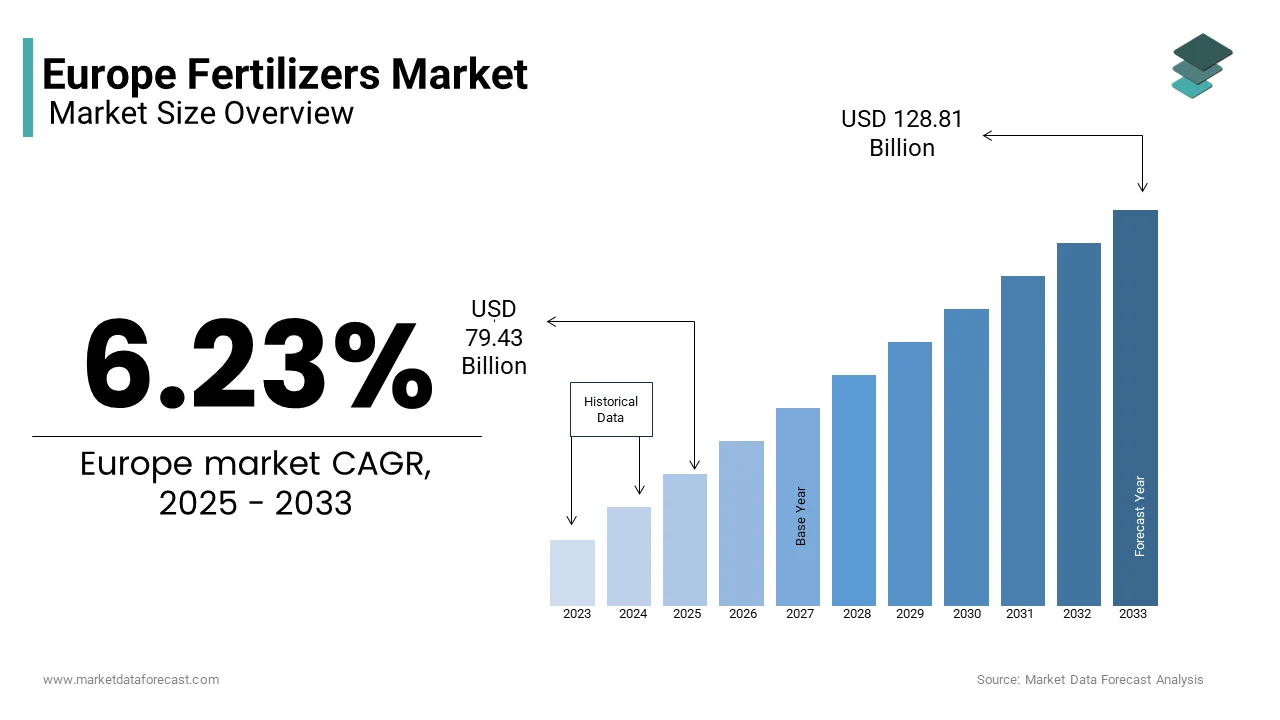
- Market Valuation: Valued at USD 79.43 billion (2025), estimated at USD 84.38 billion (2026), and projected to reach USD 136.84 billion by 2034, registering a robust CAGR of 6.23% (2026–2034).
- Primary Growth Drivers: Increasing demand for high-value crops (fruits, vegetables, and industrial crops) and stringent environmental regulations promoting organic farming and precision agriculture technologies.
Key Market Segment Metrics (2026–2034)
| Category | Leading Segment (2025 Position) | Fastest-Growing Segment |
|---|---|---|
| By Product Type | Nitrogen-Based Fertilizers (accounted for 60.4% share in 2025) | Organic Plant-Based Fertilizers (expected to exhibit a CAGR of 9.1%) |
| By Form | Dry Fertilizers (dominated, holding 70.7% of European market share in 2025) | Liquid Fertilizers (projected to expand at a CAGR of 6.2% over the forecast period) |
| By Application | Agriculture (ruled the application segment holding 81.8% share in 2025) | Horticulture (anticipated to record a CAGR of 7.3% in Mediterranean countries) |
| By Country Leadership | France (largest contributing country occupying 22.7% of regional market share in 2025) | Spain (progressing at a 6.2% CAGR, leading regional organic farming expansion) |
Major Market Players & Market Structure
Market Structure: Fragmented European agricultural input landscape featuring major global chemical enterprises and specialized regional players competing on NPK formulations, bio-based solutions, precision farming technology, and sustainability compliance.
Key Companies: CF Industries Holdings Inc., Eurochem Group, ICL Group Ltd, OCI NV, Yara International ASA, and BASF.
Europe Fertilizer Market Size
The European fertilizers market size was valued at USD 79.43 billion in 2025 and is anticipated to reach USD 84.38 billion in 2026 from USD 136.84 billion by 2034, growing at a CAGR of 6.23% during the forecast period from 2026 to 2034.
Fertilizers, including nitrogenous, phosphatic, potassic, and specialty variants, are indispensable for enhancing soil fertility and crop yields, particularly in regions with intensive agricultural activities. According to the European Fertilizer Manufacturers Association (EFMA), the fertilizer industry contributes over EUR 25 billion annually to the European economy and supports millions of jobs directly and indirectly. In 2022, nitrogen-based fertilizers accounted for approximately 60% of total fertilizer consumption in Europe due to their widespread use in cereals and industrial crops like wheat and maize.
TheEuropeane fertilizer market has faced significant challenges in recent years, including supply chain disruptions and escalating prices due to geopolitical tensions, particularly the Russia-Ukraine conflict, which impacted natural gas supplies. The International Fertilizer Association reports that fertilizer prices surged by nearly 150% between 2021 and 2022, forcing farmers to explore alternative solutions such as precision agriculture and biofertilizers. Meanwhile, stringent environmental regulations imposed by the European Union, aimed at reducing greenhouse gas emissions and nitrate pollution, have further shaped the market landscape. Eurostat highlights that organic farming in Europe grew by 7% annually from 2019 to 2022, reflecting a shift toward sustainable agricultural practices.
MARKET DRIVERS
Increasing Demand for High-Value Crops
One of the major drivers of the European fertilizer market is the rising demand for high-value crops, such as fruits, vegetables, and industrial crops like rapeseed and sunflower. According to the reports of the European Commission, the production of these crops has grown by approximately 5% annually over the past five years, driven by consumer preferences for healthier diets and biofuel production. High-value crops require precise nutrient management, increasing the demand for specialty fertilizers, including water-soluble and slow-release variants. According to Eurostat, the use of precision agriculture technologies in Europe has risen by 12% since 2020, enabling farmers to optimize fertilizer application and reduce waste. Furthermore, as per the International Fertilizer Association, nitrogenous fertilizers account for nearly 60% of total fertilizer usage in Europe, which indicates their critical role in boosting yields. This trend is further amplified by the growing export demand for European agricultural products, which reinforces the need for efficient fertilization practices.
Stringent Environmental Regulations Promoting Sustainable Solutions
The implementation of stringent environmental regulations aimed at reducing greenhouse gas emissions and nitrate pollution that have spurred innovation in sustainable fertilizer solutions is further boosting the expansion of theEuropeane fertilizer market. According to the European Environment Agency, nitrate pollution from excessive fertilizer use affects over 13% of groundwater resources in Europe, which is prompting stricter enforcement of the Nitrates Directive. As a result, there has been a surge in demand for eco-friendly alternatives, such as biofertilizers and organic fertilizers. Additionally, according to the European Investment Bank, investments in circular economy initiatives, including nutrient recovery from wastewater, exceeded EUR 2 billion in 2022. These regulatory frameworks not only promote sustainable farming practices but also encourage the adoption of innovative fertilizers, driving market expansion while aligning with Europe’s Green Deal objectives.
MARKET RESTRAINTS
Volatility in Raw Material Prices and Supply Chain Disruptions
One of the major restraints affecting the European fertilizer market is the volatility in raw material prices, particularly natural gas, which is a critical feedstock for nitrogen-based fertilizers. As per the European Commission, natural gas prices surged by over 400% between 2021 and 2022 due to geopolitical tensions, notably the Russia-Ukraine conflict, which disrupted supply chains. This price instability has significantly increased production costs, with nitrogen fertilizer prices rising by approximately 150% during the same period, as reported by the International Fertilizer Association. Such cost escalations have forced many small-scale farmers to reduce fertilizer usage, impacting crop yields. Additionally, according to Eurostat, the reliance of Europe on imported phosphates and potash further exacerbates supply vulnerabilities, which makes the market susceptible to global trade disruptions. These challenges hinder the affordability and accessibility of fertilizers, constraining market growth.
Stringent Environmental Regulations Limiting Conventional Fertilizer Use
The stringent environmental regulations imposed by the European Union that are aimed at curbing nitrate pollution and greenhouse gas emissions from conventional fertilizers are inhibiting the growth of the European fertilizer market. According to the reports of the European Environment Agency, more than 13% of groundwater resources in Europe are affected by nitrate contamination, which is prompting stricter enforcement of the Nitrates Directive. While these measures are essential for environmental sustainability, they impose operational challenges for farmers and manufacturers. For instance, as per the statements of the European Commission, certain regions in Europe have introduced mandatory reductions in fertilizer application rates, which is leading to a decline in demand for traditional nitrogenous fertilizers. Furthermore, according to the European Investment Bank, compliance with these regulations requires significant investments in alternative solutions, such as biofertilizers, which currently account for less than 5% of the market. These regulatory pressures limit the growth potential of conventional fertilizers in the short term.
MARKET OPPORTUNITIES
Growing Adoption of Precision Agriculture Technologies
One of the major opportunities in the European fertilizer market lies in the growing adoption of precision agriculture technologies, which optimize fertilizer application and enhance sustainability. According to the reports of the European Commission, precision farming practices have expanded by 12% annually since 2020 due to the advancements in GPS-guided equipment and soil sensors. These technologies enable farmers to apply fertilizers more efficiently by reducing waste and environmental impact while improving crop yields. According to Eurostat, more than 30% of European farms have adopted precision agriculture tools, particularly in high-value crop production such as fruits and vegetables. Additionally, as per the International Fertilizer Association, slow-release and controlled-release fertilizers that align with precision farming goals are projected to grow at a brisk pace over the forecast period. This shift not only supports Europe’s Green Deal objectives but also opens new revenue streams for innovative fertilizer manufacturers catering to tech-savvy farmers.
Rising Demand for Biofertilizers and Organic Farming
The rising demand for biofertilizers and organic farming due to the stringent environmental regulations and consumer preferences for sustainable agriculture are opening new avenues for the market participants in the European fertilizer market. According to the European Biostimulants Industry Council, the biofertilizer market is expected to grow at a notable CAGR in the coming years due to the policies promoting circular economy practices. In addition, as per the reports of the European Environment Agency, organic farming has grown by 7% annually from 2019 to 2022, with over 14.6 million hectares of farmland now under organic management. Furthermore, according to the European Investment Bank, investments in sustainable agricultural practices exceeded EUR 3 billion in 2022 to support the development of eco-friendly fertilizers. As governments incentivize organic farming and reduce reliance on chemical fertilizers, biofertilizers present a lucrative opportunity for manufacturers to tap into this expanding segment while addressing environmental concerns.
MARKET CHALLENGES
High Dependency on Fertilizer Imports
One of the major challenges facing the European fertilizer market is its high dependency on imports for critical raw materials such as phosphates and potash, which are not abundantly available within the region. According to the reports of the European Commission, over 70% of phosphatic fertilizers and 90% of potassic fertilizers consumed in Europe are imported, primarily from Morocco, Russia, and Canada. This reliance on external suppliers makes the market vulnerable to geopolitical tensions and trade disruptions, as mentioned by the International Fertilizer Association. For instance, the Russia-Ukraine conflict led to a 30% reduction in fertilizer imports from these regions in 2022. Additionally, according to Eurostat, import costs surged by nearly 50% during the same period, which is further straining farmers and manufacturers. This dependency not only threatens supply chain stability but also increases price volatility, posing significant challenges to market sustainability.
Balancing Agricultural Productivity with Environmental Sustainability
The difficulty in balancing agricultural productivity with environmental sustainability due to the stringent regulations imposed by the European Union is further challenging the growth of theEuropeane fertilizer market. According to the European Environment Agency, nitrate pollution from excessive fertilizer use affects approximately 13% of groundwater resources in Europe and is prompting stricter enforcement of the Nitrates Directive. While these measures aim to protect ecosystems, they often limit fertilizer application rates, reducing crop yields and impacting farmer incomes. As per the European Commission, certain regions have mandated a 20% reduction in nitrogen fertilizer usage by 2030, which is creating operational hurdles for conventional farming practices. Furthermore, according to the European Investment Bank, transitioning to sustainable alternatives like biofertilizers requires significant investments, which many small-scale farmers cannot afford. This regulatory push creates a delicate trade-off between productivity and compliance, challenging market growth.
REPORT COVERAGE
| REPORT METRIC | DETAILS |
| Market Size Available | 2025 to 2034 |
| Base Year | 2025 |
| Forecast Period | 2026 to 2034 |
| CAGR | 6.23% |
| Segments Covered | By Form, Product, Application, and Country |
| Various Analyses Covered | Global, Regional & Country Level Analysis; Segment-Level Analysis; DROC, PESTLE Analysis; Porter’s Five Forces Analysis; Competitive Landscape; Analyst Overview on Investment Opportunities |
| Regions Covered | UK, France, Spain, Germany, Italy, Russia, Sweden, Denmark, Switzerland, Netherlands, Turkey, Czech Republic, & Rest of Europe |
| Market Leaders Profiled | CF Industries Holdings, Inc., Eurochem Group, ICL Group Ltd, OCI NV, Yara International ASA |
SEGMENTAL ANALYSIS
By Form Insights
The dry fertilizers segment dominated the European market by holding 70.7% of the European market share in 2025. The domination of the ry fertilizers segment is majorly driven by their cost-effectiveness and widespread use in staple crops like wheat and maize that cover over 50% of Europe’s arable land. Dry variants, such as urea and ammonium nitrate, are favored for their ease of storage and transportation, making them ideal for large-scale farming. The International Fertilizer Association highlights that nitrogen-based dry fertilizers remain the most affordable option, ensuring high demand. Their compatibility with precision agriculture technologies further enhances efficiency, solidifying their importance in maintaining agricultural productivity across Europe.
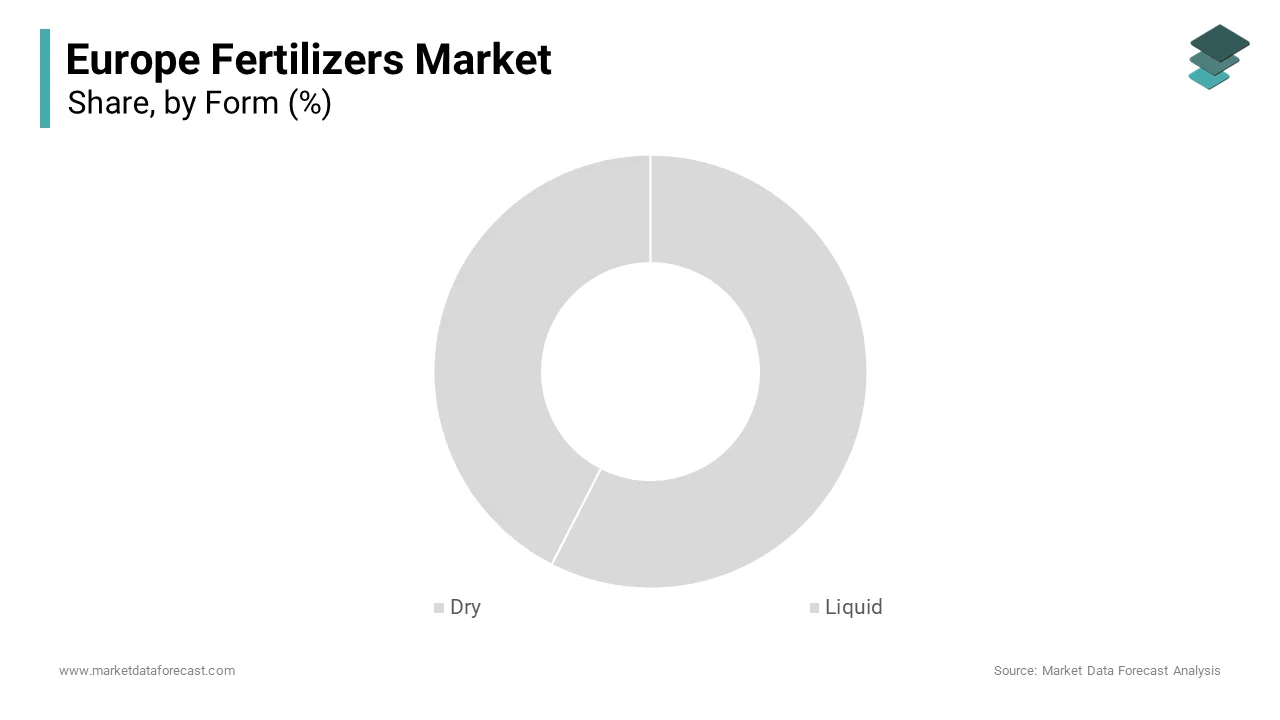
The liquid fertilizers segment is projected to expand at a CAGR of 6.2% over the forecast period due to factors such as increasing adoption in high-value crops like fruits and vegetables, particularly in fertigation systems that optimize water and nutrient use. According to the European Commission, liquid fertilizers reduce waste by enabling precise nutrient delivery to align with sustainability goals. Their compatibility with biofertilizers also supports organic farming expansion, which grew by 7% annually from 2019 to 2022, per Eurostat. As Europe prioritizes sustainable agriculture, liquid fertilizers play a pivotal role in enhancing crop quality while minimizing environmental impact, which is making them a key driver of innovation in the fertilizer market.
By Product Insights
The nitrogen-based segment dominated the European fertilizer market by accounting for 60.4% of the European market share in 2025. Among these, urea and ammonium nitrate are the most widely used, particularly in staple crops like wheat, barley, and maize. As per the International Fertilizer Association, nitrogen fertilizers are favored for their cost-effectiveness and ability to significantly boost crop yields. For instance, Urea is the most affordable nitrogen source, while ammonium nitrate is preferred for its high efficiency in cooler climates prevalent in Northern Europe. Their widespread adoption is further supported by advancements in slow-release technologies, ensuring sustained nutrient delivery. As a cornerstone of agricultural productivity, nitrogen-based fertilizers remain indispensable for meeting the food security needs of Europe.
The organic plant-based fertilizers segment is expected to exhibit a CAGR of 9.1% over the forecast period, owing to the rising demand for sustainable agricultural practices and the expansion of organic farming. Plant-based fertilizers that are derived from sources like compost, seaweed, and leguminous plants are gaining popularity due to their eco-friendly nature and ability to improve soil health. As per the European Environment Agency, these fertilizers align with the EU’s Green Deal objectives and reduce reliance on chemical inputs while mitigating nitrate pollution. Additionally, their compatibility with precision agriculture and biofertilizers makes them ideal for high-value crops like fruits and vegetables. As Europe prioritizes sustainability, plant-based fertilizers are poised to play a pivotal role in transforming the agricultural landscape.
By Application Insights
The agriculture segment ruled the European fertilizer market by application, holding 81.8% of the European market share in 2025. The growth of the agriculture segment in the European market is primarily driven by the extensive use of fertilizers in staple crops such as wheat, barley, and maize. Nitrogen-based fertilizers like urea and ammonium nitrate are particularly critical for enhancing yields in large-scale farming operations. According to the International Fertilizer Association, agricultural productivity in Europe relies heavily on fertilizers to meet the food demands of a growing population. Additionally, advancements in precision agriculture technologies have further optimized fertilizer application, ensuring efficient nutrient delivery while minimizing environmental impact. As the backbone of Europe’s food security, the agriculture segment remains pivotal to the fertilizer market.
The horticulture segment is anticipated to record a promising CAGR of 7.3% over the forecast period. Factors such as the increasing demand for high-value crops, such as fruits, vegetables, and ornamental plants, particularly in Mediterranean countries like Spain and Italy, are fuelling the growth of the horticulture segment in the European market. According to the European Commission, horticulture benefits significantly from liquid fertilizers and biofertilizers that enable precise nutrient delivery and improve crop quality. Additionally, the expansion of organic farming has further boosted demand for sustainable fertilizers in this segment. The focus of Horticulture on premium produce aligns with consumer preferences for healthier and environmentally friendly products, making it a key driver of innovation and growth in the European fertilizer market.
REGIONAL ANALYSIS
France Market Analysis
France was the largest contributor to the European fertilizer market and occupied 22.7% of the regional market share in 2025. The domination of France in the European fertilizer market is mainly attributed to the position of France as the largest agricultural producer in Europe, with over 50% of its land dedicated to farming. The robust demand of France for nitrogenous and phosphate fertilizers and the focus of France on high-value crops like wheat, rapeseed, and wine grapes are further fuelling the growth of the French fertilizer market. According to the International Fertilizer Association, France has also been at the forefront of adopting precision agriculture technologies by optimizing fertilizer use while reducing environmental impact. Additionally, the investment in the French government in sustainable farming practices, including biofertilizers, aligns with the Green Deal objectiveand is further contributing to the expansion of the French fertilizer market.
Germany Market Analysis
Germany is one of the top performers in the European fertilizer market. The advanced agricultural sector of Germany that extensively adopts precision farming technologies to enable efficient fertilizer application is driving the German fertilizer market growth. According to the reports of Eurostat, Germany leads Europe in organic farming, with over 10% of its agricultural land dedicated to organic practices, which is increasing demand for eco-friendly fertilizers. As per the European Biostimulants Industry Council, the strong R&D ecosystem of Germany fosters innovation in slow-release and biofertilizers to align with sustainability goals. FurthermoreGermany'she emphasis on reducing nitrate pollution through stricter regulations has accelerated the adoption of advanced fertilizer solutions, ensuring steady growth in this segment.
Spain Market Analysis
Spain is a prominent regional segment for fertilizers in the European market and is estimated to progress at a CAGR of 6.2% over the forecast period. The thriving horticulture sector of Spain, particularly in regions like Andalusia, where high-value crops such as fruits, vegetables, and olives are cultivated, is boosting the Spanish market growth. According to Eurostat, Spain accounts for over 30% of Europe’s organic farming area, which is driving demand for organic and biofertilizers. As per the International Fertilizer Association, liquid fertilizers are widely used in fertigation systems to optimize water and nutrient use in arid regions. Additionally, the strategic focus of Spain on sustainable agriculture, which is supported by EU subsidies, has encouraged the adoption of innovative fertilizers. These factors, combined with favorable climatic conditions, position Spain as a key player in the European fertilizer market.
Italy Market Analysis
Italy accounted for a considerable share of the European fertilizer market in 2024. The rising demand for fertilizers in horticulture, particularly for fruits, vegetables, and ornamental plants, is majorly favouring the Italian fertilizer market expansion. For instance, Italian farmers invested €1.8 billion in fertilizers in 2022, with specialty formulations accounting for 40% of total usage, as outlined in their market analysis. The Mediterranean climate and fertile soil make Italy ideal for high-value crops, amplifying fertilizer consumption. According to Eurostat, Italy leads Europe in tomato production, requiring precise nutrient management to ensure quality and yield. Additionally, government incentives for organic farming have accelerated the adoption of bio-based fertilizers, creating new opportunities for innovation. A report by Deloitte underscores that Italy’s focus on premium produce positions it as a leader in advanced nutrient solutions.
Netherlands Market Analysis
The Netherlands is a noteworthy regional segment in the European fertilizer market. The advanced greenhouse farming industwhichthat relies on specialty fertilizers to optimize yield and ty, is majorly driving the Netherlands fertilizer market growth. For instance, Dutch farmers spend €1.2 billion annually on fertilizers, with a strong preference for bio-based and controlled-release formulations, as outlined in their sustainability audit. The country’s focus on high-value crops like flowers, tomatoes, and peppers has amplified demand for precision nutrient delivery systems. According to Eurostat, the Netherlands accounts for 20% of Europe’s greenhouse farming output, underscoring its importance in the fertilizers market. Additionally, collaborations between tech firms and agricultural cooperatives have fostered innovation, driving growth in eco-friendly solutions. These factors position the Netherlands as a leader in sustainable and efficient fertilizer usage.
COMPETITIVE LANDSCAPE
The European fertilizers market is highly competitive, characterized by the presence of global giants and regional innovators. Yara International, BASF, and ICL Group dominate the landscape, leveraging their expertise in nitrogen, phosphorus, and potassium (NPK) formulations. According to a study by Gartner, the market is fragmented, with numerous players targeting niche segments such as bio-based fertilizers and precision farming solutions. Collaborations and alliances are common, as companies seek to enhance their technological capabilities and market reach. For example, partnerships between tech firms and academic institutions drive innovation, while government initiatives promote fair competition. The competitive dynamics are further intensified by the rapid pace of technological advancements, requiring companies to continuously innovate to maintain their edge.
KEY MARKET PLAYERS
A few of the market players in thEuropeanpe fertilizers market include
- CF Industries Holdings, Inc
- Eurochem Group
- ICL Group Ltd
- OCI NV
- Yara International ASA.
Top Players In The Market
The European fertilizers market is led by Yara International, BASF, and ICL Group. Yara International dominates the global market. BASF excels in specialty fertilizers, achieving a 25% market share in high-value crops, as stated in their performance metrics. ICL Group plays a pivotal role in bio-based solutions, with a 30% share in eco-friendly fertilizers, as highlighted in their financial disclosures. These players collectively drive innovation and shape the future of the fertilizers market globally.
Top Strategies Used By Key Players
Key players in the European fertilizers market employ strategies such as product innovation, strategic partnerships, and sustainability initiatives to strengthen their positions. For instance, Yara International launched a line of low-carbon fertilizers in 2022, designed to reduce greenhouse gas emissions by 20%, as outlined in their sustainability roadmap. BASF partnered with agricultural cooperatives to develop customized nutrient solutions, enhancing their appeal among farmers. ICL Group focused on expanding its bio-based fertilizer portfolio, investing €500 million in R&D to meet growing demand for eco-friendly alternatives, as stated in their innovation strategy. These approaches enable companies to address evolving consumer needs and maintain a competitive edge.
RECENT MARKET NEWS
- In March 2023, Yara International launched a line of low-carbon fertilizers, designed to reduce greenhouse gas emissions by 20%.
- In June 2023, BASF partnered with German agricultural cooperatives to develop customized nutrient solutions, achieving a 15% increase in sales.
- In January 2024, ICL Group acquired a startup specializing in bio-based fertilizers, aiming to expand its eco-friendly product portfolio.
- In September 2023, K+S Group collaborated with Swiss precision farming startups to integrate IoT-enabled nutrient delivery systems.
- In November 2023, CF Industries invested €300 million in expanding its specialty fertilizer production capacity, focusing on horticultural crops.
MARKET SEGMENTATION
This research report on the European fertilizers market is segmented and sub-segmented into the following categories.
By Form
- Dry
- Liquid
By Product
- Organic
- Plant based
- Animal based
- Mineral based
- Inorganic
- Nitrogen
- Urea
- Anhydrous ammonia
- CAN
- UAN Solution
- Ammonium sulfate
- Phosphorus
- Diammonium phosphate
- Monoammonium phosphate
- Triple superphosphate
- Ordinary superphosphate
- Ammonium polyphosphate
- Others
- Potassium
- Potassium chloride
- Potassium sulfate
- Potassium nitrate
- Nitrogen
By Application
- Agriculture
- Horticulture
- Gardening
- Others
By Country
- UK
- Russia
- Germany
- Italy
- France
- Spain
- Sweden
- Denmark
- Poland
- Switzerland
- Netherlands
- Rest of Europe