Europe Fiber Optics Market Size, Share, Trends & Growth Forecast Report, Segmented By Type (Multi-mode, Single mode, Plastic Optical Fiber (POF)), Application, And Country (UK, France, Spain, Germany, Italy, Russia, Sweden, Denmark, Switzerland, Netherlands, Turkey, Czech Republic & Rest Of Europe) - Industry Analysis From (2026 To 2034)
Market Size, 2025
$2.22 BnMarket Estimate, 2026
$2.31 BnMarket Forecast, 2034
$3.15 BnCAGR, 2026–2034
3.97%Europe Fiber Optics Market Report Summary
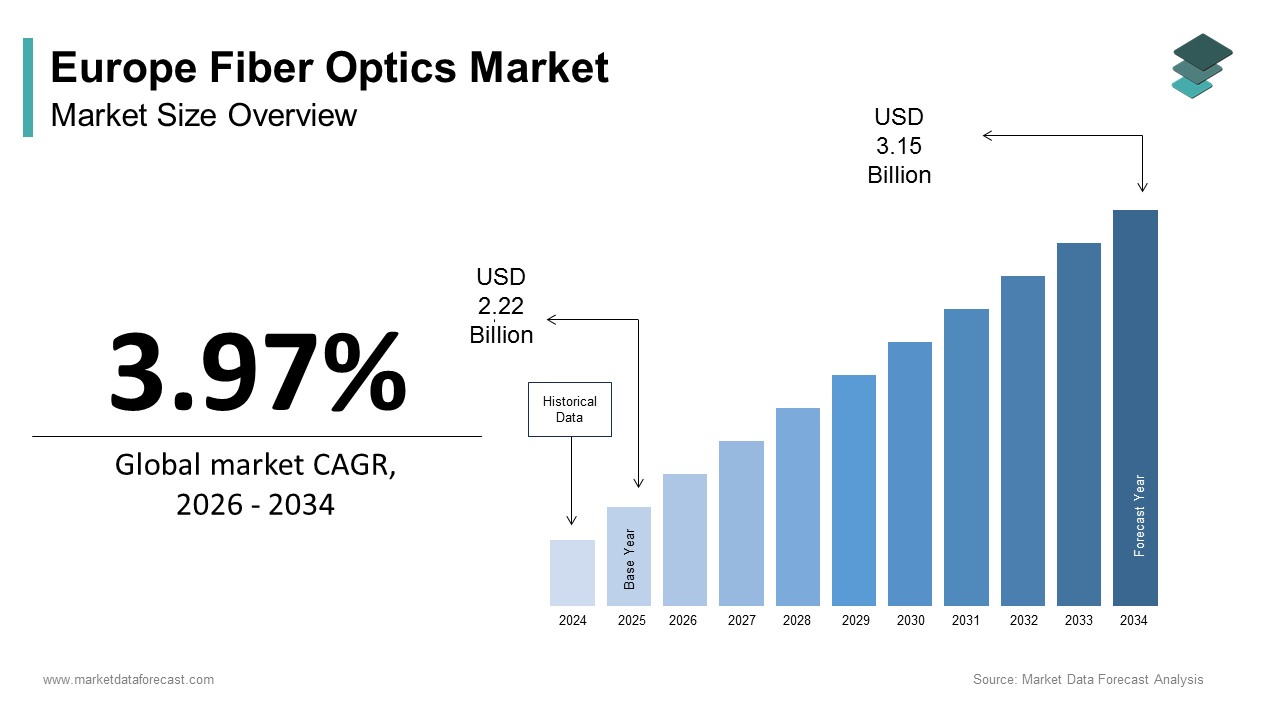
The Europe fiber optics market was valued at USD 2.22 billion in 2025 and is projected to reach USD 3.15 billion by 2034, growing from USD 2.31 billion in 2026 at a CAGR of 3.97% during the forecast period. Market growth is driven by expanding broadband infrastructure, increasing deployment of 5G networks, and rising demand for high-capacity data transmission across telecom and data center applications. Government-backed digital connectivity programs, fiber-to-the-home rollouts, and growing investments in hyperscale data centers are further strengthening the adoption of fiber optic technologies across Europe.
Key Market Trends
- Increasing deployment of single-mode fiber to support long-distance and high-bandwidth communication
- Strong demand from telecom operators driven by 5G rollout and network densification
- Expansion of hyperscale data centers is increasing demand for high-performance fiber infrastructure.
- Growing focus on open-access fiber networks and rural broadband connectivity
- Rising emphasis on sustainable and energy-efficient fiber deployment practices
Segmental Insights
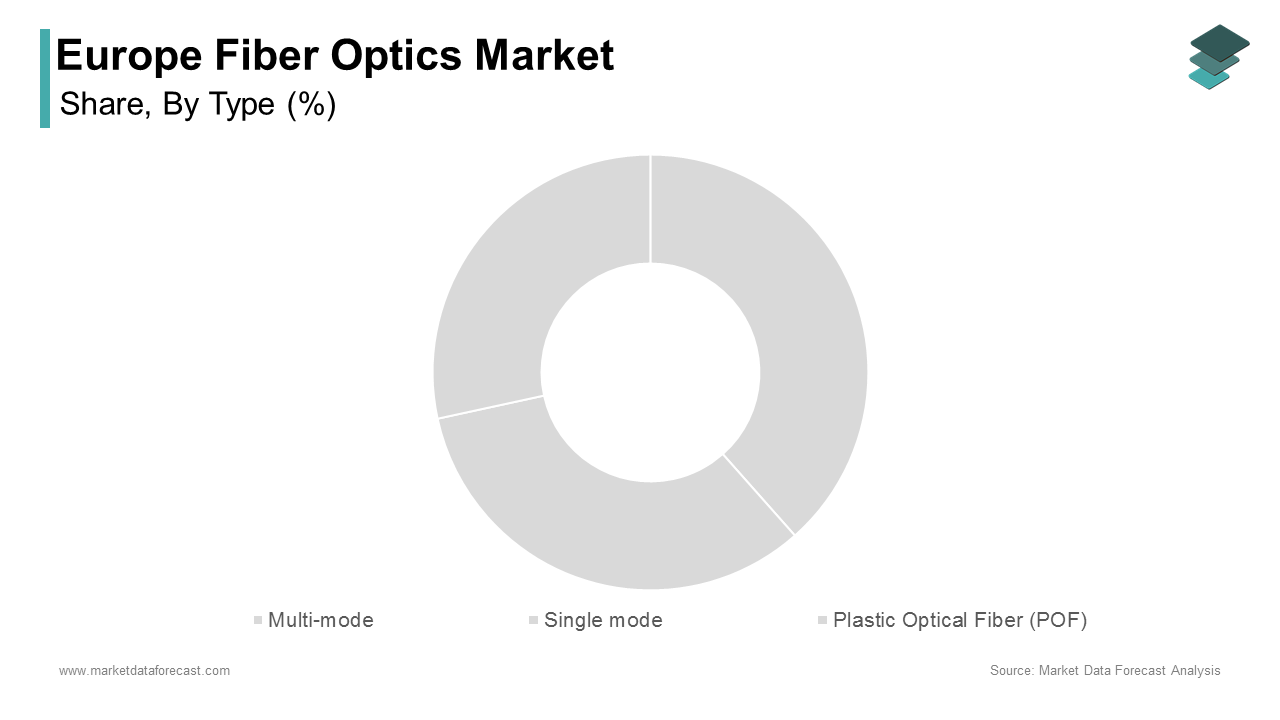
Based on type, the single-mode fiber segment held the majority share of the Europe fiber optics market in 2025, supported by its superior performance in long-distance and high-speed data transmission
Based on application, the telecom segment dominated the market in 2025 by accounting for 64.7% of the total market share, driven by broadband expansion, mobile backhaul requirements, and fiber-to-the-premises initiatives.
Regional Insights
- Germany led the Europe fiber optics market in 2025 by holding 25.6% of the total market share, supported by large-scale broadband expansion and industrial digitalization.n
- France ranked second by capturing 20.1% of the market share in 2025, driven by national fiber rollout programs and strong telecom investments.
- United Kingdom remains a key market due to its concentration of hyperscale data centers and transatlantic subsea cable landings. The
- Netherlands is experiencing steady growth, supported by its open-access fiber model, renewable energy integration, and dense data center clustering.
- Sweden is expected to expand notably from 2026 to 2034, driven by leadership in sustainable fiber deployment and the universal rural access initiative.s
Competitive Landscape
The Europe fiber optics market is moderately competitive, with leading manufacturers focusing on capacity expansion, advanced fiber technologies, and long-term supply agreements with telecom operators and data center providers. Companies are investing in low-loss fibers, higher fiber counts, and sustainable manufacturing processes to strengthen their market positioning.
Prominent players in the Europe fiber optics market include Corning Incorporated, Prysmian Group, Nexans, OFS Fitel LLC, LEONI AG, Huber+Suhner AG, Furukawa Electric Europe Ltd, Sumitomo Electric Industries Europe Ltd, CommScope Holding Company, AFL Europe Ltd, Fujikura Europe Ltd, and Draka Communications.
Europe Fiber Optics Market Size
The Europe fiber optics market size was calculated to be USD 2.22 billion in 2025 and is anticipated to be worth USD 3.15 billion by 2034, growing from USD 2.31 billion in 2026 at a CAGR of 3.97% during the forecast period.
Fiber optics is a technology that uses flexible, hair-thin strands of pure glass (silica) or plastic to transmit data as pulses of light. Unlike copper-based systems, fiber optics utilizes glass or plastic strands to transmit data as light pulses, offering superior speed, immunity to electromagnetic interference, and energy efficiency over long distances. Fixed broadband infrastructure across the continent is experiencing a significant transition, with a vast majority of subscriptions now utilizing fiber-to-the-home or fiber-to-the-building technologies to deliver high-speed, gigabit connectivity. The rising energy needs of data centers are being addressed through the adoption of fiber-based interconnects, which provide superior spectral efficiency and reduce power consumption per transmitted bit. Regional policy initiatives are accelerating this shift by targeting widespread access to high-capacity networks, effectively reclassifying advanced fiber infrastructure from a premium service to an essential utility for digital independence. This transition is characterized by a rapid decline in legacy copper network reliance, as both urban and rural areas are increasingly served by fiber, aligning with long-term digital goals.
MARKET DRIVERS
EU Mandates for Gigabit Connectivity Under the Digital Decade Policy Programme
The European Union’s binding commitment to universal gigabit access by 2030 has institutionalized fiber optics as the backbone of continental digital infrastructure, which drives the growth of the Europe fiber optics market. National broadband strategies across many European nations are shifting focus toward fiber-to-the-premises deployments. Substantial public funding is being directed toward these infrastructure projects to accelerate connectivity goals. Specific national initiatives are driving significant increases in household fiber coverage. Regulatory bodies are confirming the progress of these high-speed internet rollouts. Strategies aimed at speeding up infrastructure development, such as streamlined permitting, are enabling faster fiber deployment. Key industry players are accelerating their deployment rates compared to previous years. These investments are not optional. The Digital Decade targets tying national progress to EU funding eligibility, creating sustained demand irrespective of short-term economic cycles. Fiber is the essential, future-proof replacement for overburdened legacy copper, enabling mass deployment of 8K video, cloud gaming, and telemedicine.
Rapid Expansion of Hyperscale Data Centers Requiring High-Density Optical Interconnects
The proliferation of cloud computing, artificial intelligence, and edge analytics has triggered an unprecedented demand for fiber optic interconnects within and between data centers across the region, and is propelling the expansion of the Europe fiber optics market. Hyperscale data center development has accelerated in specific European regions, driven by a strategic preference for colder climates and access to renewable power sources. The deployment of these facilities necessitates a massive, high-density fiber infrastructure to support complex, high-speed networking requirements. Internal network structures within large-scale data centers rely heavily on advanced fiber connectivity solutions to facilitate high-bandwidth, low-latency traffic, such as that required for artificial intelligence workloads. High-density, multi-fiber connector systems and single-mode cabling are frequently employed to meet the bandwidth needs of modern data center architectures. Moreover, the EU’s Data Act encourages data sharing across sectors, increasing traffic between colocation sites and necessitating wavelength division multiplexing upgrades. Rising power density and limited space make fiber optics essential for providing the necessary bandwidth density in Europe’s digital infrastructure.
MARKET RESTRAINTS
High Civil Works Costs and Permitting Delays in Urban and Historic Areas
The physical deployment of fiber networks faces significant friction, despite strong policy support, due to expensive and time-consuming civil engineering requirements, particularly in dense or heritage-protected urban zones, which restrict the growth of the Europe fiber optics market. Underground fiber installation in many European urban environments exhibits significantly higher expenses compared to similar projects in North America. The primary cost drivers for elevated urban deployment expenses in Europe are associated with labor rates, complex underground utility congestion, and strict, extensive archaeological protection requirements. In specific European historic city centers, regulatory requirements for preliminary, non-invasive ground scanning, such as radar surveys, create substantial delays in project timelines. Stringent urban restoration requirements in European cities, particularly the mandate for hand-laid, traditional surface reinstatement, drastically increase the expenses associated with post-excavation pavement repairs. These barriers disproportionately affect smaller operators lacking scale to absorb delays, deterring competition and slowing last-mile penetration even where demand is high. Fiber deployment will continue to be expensive and uneven until unified duct sharing and micro-trenching standards are adopted.
Shortage of Skilled Fiber Splicing and Installation Technicians Across Member States
A serious deficit of certified professionals capable of performing precision fusion splicing termination and OTDR testing hinders the expansion of the Europe fiber optics market. These tasks are essential for network reliability. The demand for new fiber technicians across the European Union significantly outpaced the number of qualified personnel entering the workforce. Accelerated network expansion goals have widened the gap between the required and available labor force in the telecommunications sector. Rural infrastructure projects in specific regions are experiencing delays, often linked to challenges in staffing crews with required certification levels. Demographic shifts are creating a long-term decline in the availability of skilled labor for construction and technical roles. Robotic splicing tools are available, but high costs and the need for human supervision hinder widespread implementation. The ambitious gigabit agenda risks failure at its most critical point, the human workforce installing the fiber, unless we urgently invest in mobile vocational academies and cross-border credential recognition.
MARKET OPPORTUNITIES
Integration of Fiber Sensing in Critical Infrastructure Monitoring
Beyond data transmission, fiber optics is emerging as a distributed sensor for real-time structural health monitoring of pipelines, railways, bridges, and power grids, which provides new opportunities for the Europe fiber optics market. This creates a high-value industrial application. European nations are adopting advanced fiber-optic sensing to monitor the structural integrity and security of rail networks. These systems utilize light scattering to detect physical shifts, environmental hazards, and unauthorized activities. Energy operators are increasingly deploying fiber-optic cables along pipelines to identify minor irregularities before significant failures. Regional policies are driving a shift toward continuous monitoring to enhance the stability of essential services. This pattern reflects a transition to proactive, high-sensitivity monitoring to improve response times for infrastructure anomalies. Unlike discrete sensors, fiber provides continuous coverage over tens of kilometers with no power required in the field. This convergence of security regulation and photonics innovation opens a durable B2B revenue stream insulated from telecom cycle volatility.
Deployment of Fiber to the Antenna in 5G and Open RAN Networks
The rollout of 5G and Open Radio Access Network architectures is driving demand for fiber optic fronthaul connecting centralized baseband units to remote radio heads, especially in dense urban and industrial settings, which is anticipated to boost the expansion of the Europe fiber optics market. Industry standards indicate that, in urban environments, dense 5G small cell deployment often requires dedicated single-mode fiber connectivity to meet strict, low-latency requirements for fronthaul and backhaul protocols. Recent, large-scale urban deployments of 5G small cells frequently utilize fiber-optic backhaul to ensure the necessary performance levels for high-density, high-bandwidth applications. Industrial, manufacturing, and port environments are increasingly moving toward prioritizing fiber-optic connections over wireless alternatives to guarantee deterministic performance for critical IoT applications. Governmental and industrial entities are adopting policies that prioritize fiber infrastructure, specifically for manufacturing zones, to ensure stable and reliable 5G operations. The shift to Open RAN further accelerates this trend by decoupling hardware and software and increasing reliance on standardized optical interfaces. The increasing demand for high-speed, low-latency 5G services is driving the adoption of dense optical fiber infrastructure at antenna sites, transforming mobile base stations into interconnected nodes of the wider fiber network.
MARKET CHALLENGES
Geopolitical Dependencies in Specialty Glass and Rare Earth Materials
The region’s fiber optics supply chain remains vulnerable to external concentration in critical raw materials, particularly ultra-pure silica preforms and rare earth dopants like erbium used in optical amplifiers, which challenges the growth of the European fiber optics market. The supply of components for European optical fiber networks is heavily reliant on a small group of non-EU nations, as there is currently limited large-scale domestic production capacity. Concerns regarding the procurement of specialized, high-performance fibers for defense applications have risen following export restrictions on key raw materials by a major global supplier. Simulations indicate that a prolonged disruption in the import of raw preform materials could notably delay the expansion of high-speed digital infrastructure. Restoring Europe's photonics capability is a priority for industry groups, yet true scaling requires billions in CAPEX and a multi-year effort to refine production processes. Europe’s digital sovereignty remains partially dependent on stability in Asia and North America until it achieves breakthroughs in material science, vertical integration, or strategic stockpiling.
Fragmented Technical Standards and Interoperability Gaps Across National Operators
Fiber optic deployment suffers from inconsistent technical specifications and testing protocols across member states, despite EU harmonization efforts, which affects economies of scale, multi-country project execution, and the expansion of the Europe fiber optics market. Variations in how national operators interpret and implement international optical fiber classification standards can create interoperability challenges for cross-border infrastructure projects. Diverse requirements for bend-insensitive fiber across different regions can necessitate that suppliers manage a broader range of products, affecting inventory management. A lack of uniform standards for passive components, such as splitters and connectors, can result in instances where custom solutions are required for rural fiber installations. Differences in connector interface requirements can sometimes cause compatibility issues during the deployment of fiber infrastructure. The EU’s Radio Equipment Directive (RED) creates a regulatory gap by covering only active devices and ignoring passive infrastructure. This oversight leaves a significant portion of network components unregulated. Policy ambitions for a unified European digital infrastructure will not be realized until end-to-end interoperability is guaranteed through mandatory conformity checks.
REPORT COVERAGE
| REPORT METRIC | DETAILS |
| Market Size Available | 2025 to 2034 |
| Base Year | 2025 |
| Forecast Period | 2026 to 2034 |
| CAGR | 3.97% |
| Segments Covered | By Type, Application, And Region |
| Various Analyses Covered | Global, Regional & Country Level Analysis; Segment-Level Analysis; DROC, PESTLE Analysis; Porter’s Five Forces Analysis; Competitive Landscape; Analyst Overview of Investment Opportunities |
| Regions Covered | UK, France, Spain, Germany, Italy, Russia, Sweden, Denmark, Switzerland, Netherlands, Turkey, and the Czech Republic |
| Market Leaders Profiled | Corning Incorporated, Prysmian Group, Nexans, OFS Fitel LLC, LEONI AG, Huber+Suhner AG, Furukawa Electric Europe Ltd., Sumitomo Electric Industries Europe Ltd., CommScope Holding Company, AFL Europe Ltd., Fujikura Europe Ltd., Draka Communications |
SEGMENTAL ANALYSIS
By Type Insights
The single-mode fiber segment held the majority share of the Europe fiber optics market in 2025. The supremacy of the single-mode fiber segment is driven by its unmatched capacity for long distance high bandwidth transmission essential for national broadband backbones, data center interconnects, and 5G infrastructure. The small core diameter of single-mode fiber restricts light propagation to a single path, which minimizes modal dispersion and enables long-distance signal transmission without the need for repeaters. Single-mode fiber is commonly employed in infrastructure projects requiring significant, long-distance, or high-capacity connectivity. Recent broadband deployment initiatives often prioritize the installation of single-mode cabling to ensure infrastructure readiness for future high-speed data demands. Network operators are actively deploying significant lengths of single-mode fiber to link rural exchanges and urban areas as part of broader connectivity strategies. Similarly, hyperscale operators like Amazon Web Services mandate single-mode for all intra-campus links in their Dublin and Stockholm data centers to support 800G Ethernet upgrades. Hence, single mode aligns with Europe’s strategic vision of seamless, scalable digital infrastructure, making it the unequivocal standard for public and private network investment.
The Plastic Optical Fiber (POF) segment is expected to exhibit a noteworthy CAGR of 14.6% from 2026 to 2034 due to demand for low-cost, easy install connectivity in automotive, industrial automation, and smart building applications. Unlike glass fiber,s POF uses polymer cores that are millimeters wide, enabling simple cut and connectorization with basic tools—ideal for environments where vibration resistance and rapid deployment outweigh bandwidth needs. The adoption of plastic optical fiber for data transmission in passenger vehicle systems is increasing, driven by its resilience to electromagnetic interference from electric motors. In industrial environments, plastic optical fiber is becoming a preferred choice for machine-to-machine communication, offering a solution to signal degradation issues caused by metal dust in factories. The utilization of plastic optical fiber is increasing in specialized industrial settings because it reduces safety risks by eliminating electrical currents in environments with high spark potential. Plastic Optical Fiber (POF) is carving out a robust niche in IoT, automotive, and home networking by prioritizing ease of use over raw speed.
By Application Insights
The telecom segment was the largest in the Europe fiber optics market by accounting for a 64.7% share in 2025. The leading position of the telecom segment is attributed to continent-wide fiber to the home rollouts, 5G backhaul requirements, and national commitments to gigabit connectivity under the EU Digital Decade targets. A significant majority of fixed broadband subscriptions across the European Union are delivered via fiber infrastructure, indicating a transition away from legacy copper networks. National initiatives and infrastructure projects are accelerating the deployment of fiber technology, increasing access to services and streamlining permitting processes for network expansion. Beyond residential access, telecom operators rely on dense wavelength division multiplexing over single-mode fiber to handle surging mobile data. Fiber is the essential, non-negotiable foundation for Europe's digital public utilities, driven by the complete transition of voice and video to IP networks.
The medical application segment is predicted to witness the highest CAGR of 18.3% during the forecast period, owing to the integration of fiber optics into minimally invasive diagnostics, surgical robotics, and biomedical sensing. Unlike traditional imaging, fiber enables real-time high-resolution visualization inside the human body through endoscopes, catheters, and laparoscopic tools. The utilization of fiber-based imaging systems for minimally invasive procedures in regional hospitals has experienced a notable upward trend. Medical device manufacturers are increasingly transitioning to coherent fiber bundle technology to facilitate high-definition imaging through smaller diameter channels. This technological advancement in imaging systems is enhancing capabilities for earlier diagnostic detection in specialized areas such as gastroenterology and bronchoscopy. Additionally, fiber Bragg grating sensors are now embedded in surgical robots like those from Medtronic to provide haptic feedback during neurosurgery, measuring force with micron-level precision. The EU Medical Device Regulation’s emphasis on traceability and performance validation further accelerates adoption as fiber components offer sterilizable, durable, and EMI-immune alternatives to electronic probes. Fiber optics is shifting from a passive supporting tool to a proactive clinical enabler in the era of digitized, personalized healthcare.
REGIONAL ANALYSIS
Germany Fiber Optics Market Analysis
Germany dominated the Europe fiber optics market by holding a 25.6% share in 2025. The prominence of the German market is attributed to its dual role as Europe’s manufacturing powerhouse and digital infrastructure pioneer. National initiatives are driving a transition toward widespread, high-capacity fiber-optic infrastructure, with significant deployment underway from both national and regional providers. The development focuses on expanding fiber-to-the-premises to replace legacy connections, with specific efforts aimed at increasing coverage in industrial and rural communities. Beyond telecom, Germany’s automotive and machinery sectors drive demand for specialty fibers; Bosch and Siemens integrate plastic optical fiber into factory automation and vehicle networks for EMI-resistant communication. The Fraunhofer Institute further advances R and D in fiber sensing for structural health monitoring of bridges and pipelines. Germany leads Europe in integrated photonics deployment, driven by a strategic combination of public-private cooperation, extensive fiber technician training, and Industry 4.0 integration.
France Fiber Optics Market Analysis
France was the second largest player in the Europe fiber optics market by capturing a 20.1% share in 2025. The growth of the French market is propelled by its centralized state-led fiber expansion under the France Très Haut Débit plan. The majority of households now have access to high-speed fiber infrastructure, driven by coordinated efforts from major internet service providers. Public funding initiatives are actively subsidizing the extension of fiber networks to reach underserved areas, ensuring broader coverage. Fiber infrastructure is increasingly being used for purposes beyond internet access, such as enhancing energy grid technology and monitoring capabilities. Energy providers are integrating optical cable deployment with power infrastructure to facilitate real-time grid management and improve service reliability. The military also invests heavily. The French Defense Procurement Agency commissioned a secure fiber backbone linking air bases and naval ports using quantum key distribution trials. France is accelerating its critical fiber infrastructure by pairing top-down national strategies with cross-sectoral integration.
United Kingdom Fiber Optics Market Analysis
The UK is another key player in the European fiber optics market due to its concentration of hyperscale data centers and transatlantic subsea cable landings. Fixed broadband infrastructure in the region has experienced a significant shift toward fiber-based connections. Major network infrastructure providers are actively engaged in competition to expand fiber coverage to millions of residential and commercial locations. Key urban centers across the UK and Ireland serve as central hubs for massive data center facilities operated by major cloud service providers. The expansion of these hyperscale facilities necessitates a high volume of fiber installations for both internal connectivity and external networking. The geographical positioning of the UK serves as a primary landing point for critical international subsea cable systems. A substantial portion of transatlantic data traffic between Europe and North America flows through these specific, concentrated coastal landing points. Post Brexit, the government prioritized digital sovereignty, launching the Project Gigabit initiative with significant funding. The UK serves as the central nervous system for European data, driven by superior connectivity and cloud infrastructure density.
Netherlands Fiber Optics Market Analysis
The Netherlands is growing steadily in the Europe fiber optics market owing to its open-access fiber model, renewable energy integration, and data center clustering. Household fiber connectivity is widespread, with independent operators enhancing market competition by providing wholesale access to various service providers. The regional climate and renewable energy resources are drawing large-scale data center operators to invest in infrastructure that supports AI workloads with low latency. Fiber optic technology is being utilized for industrial safety, specifically for monitoring pipelines through distributed sensing capabilities. Governmental initiatives are actively directing funding toward combining sustainable energy infrastructure with advanced digital connectivity. The Netherlands demonstrates that small nations can lead in optical connectivity by blending a strategic geographical position with sustainable practices and open market policies.
Sweden Fiber Optics Market Analysis
Sweden is anticipated to expand in the Europe fiber optics market from 2026 to 2034 due to its leadership in sustainable fiber deployment and universal rural access. High-speed internet infrastructure is widely available across Swedish households, with specialized deployment techniques facilitating connectivity in less populated areas. The nation's energy mix, primarily derived from renewable and nuclear sources, provides a favorable environment for data center operations. Large-scale data storage facilities in the region are leveraging the cold climate for cooling efficiency, resulting in low power usage effectiveness. Research institutions are actively developing environmentally conscious materials for fiber optic installation. Moreover, Sweden’s defense forces deploy secure fiber networks across the Baltic for surveillance and command resilience. Sweden’s commitment to digital inclusion, equity, and sustainability demonstrates that universal high-speed internet is achievable even in sparse regions, providing a replicable Nordic model for Europe.
COMPETITION OVERVIEW
Competition in the Europe fiber optics market is defined by a blend of technological excellence, regulatory alignment, and strategic localization rather than price alone. The landscape features a mix of European industrial champions like Nexans and Prysmian alongside global innovators such as Corning, each competing on product performance, installation efficiency, and environmental credentials. Regulatory pressures, including the EU Digital Decade targets Green Public Procurement criteria, and the Critical Entities Resilience Directive, raise entry barriers favoring incumbents with certified product portfolios and civil works integration capabilities. Labor shortages in fiber splicing and permitting bottlenecks in historic cities further intensify demand for pre-terminated solutions and micro trenching expertise. As national broadband plans converge with data center expansion and industrial digitization, the competitive edge lies in offering future-proof, scalable, and sustainable optical infrastructure. This environment rewards deep domain knowledge, cross-sectoral application development, and commitment to Europe’s vision of digital sovereignty.
KEY MARKET PLAYERS
A few major players of the Europe fiber optics market include
- Corning Incorporated
- Prysmian Group
- Nexans
- OFS Fitel LLC
- LEONI AG
- Huber+Suhner AG
- Furukawa Electric Europe Ltd
- Sumitomo Electric Industries Europe Ltd
- CommScope Holding Company
- AFL Europe Ltd
- Fujikura Europe Ltd
- Draka Communications
Top Strategies Used by the Key Market Participants
Key players in the Europe fiber optics market invest in localized manufacturing and perform production to reduce supply chain dependencies and ensure compliance with EU raw material regulations. They develop bend-insensitive and ultra-low-loss single-mode fibers tailored to dense urban deployments and data center interconnects. Companies expand optical fiber sensing capabilities for critical infrastructure monitoring in alignment with EU resilience directives. Strategic partnerships with national telecom operators and hyperscalers secure long-term off-take agreements for gigabit rollout programs. Additionally, firms prioritize sustainability through bio-based cable sheathing, recyclable packaging, and energy-efficient production processes to meet Europe’s green public procurement criteria.
Leading Players in the Market
- Nexans is a cornerstone of the Europe fiber optics market with deep expertise in designing and manufacturing high-performance optical cables for telecom, energy, and industrial applications. The company supplies single-mode and specialty fibers to national broadband projects across France, Germany, and the Nordics, leveraging its integrated production facilities in Lyon and Hanover. In recent years, Nexans has accelerated its focus on sustainable cable solutions, introducing bio-sourced sheathing materials and low smoke zero halogen designs compliant with EU green building standards. It also expanded its submarine cable capabilities to support offshore wind farm connectivity in the North Sea. Globally, Nexans exports its Europe-validated fire safety and environmental protocols to emerging markets, establishing itself as a benchmark for responsible fiber infrastructure deployment aligned with circular economy principles.
- Prysmian Group maintains a strong presence in the Europe fiber optics market through its end-to-end portfolio spanning terrestrial submarine and data center interconnect solutions. The company plays a pivotal role in major EU digital initiatives, supplying millions of kilometers of bend-insensitive single-mode fiber for national gigabit rollouts in Italy, Spain, and the UK. Prysmian has invested heavily in its Alverca, Portugal, facility to produce pre-terminated trunk cables for hyperscale data centers, reducing installation time by up to forty percent. It also pioneered optical fiber sensing systems for pipeline and railway monitoring, now deployed across Eastern Europe. Prysmian strengthens Europe’s digital sovereignty and exports its technical standards to global projects by combining manufacturing scale with application-specific innovation.
- Corning Incorporated is a key enabler of the Europe fiber optics market through its advanced glass science and optical fiber innovations that underpin high-speed networks across the continent. The company supplies ultra-low-loss single-mode fiber and bend-optimized cables to telecom operators and data center builders in Germany, France, and Ireland, supporting 5G densification and cloud expansion. Corning recently enhanced its European footprint by expanding its fiber preform production capacity in Hainault, Belgium, to meet rising demand for OS2 grade cable under the Digital Decade targets. It also collaborates with European research institutes on next-generation multicore fibers for space division multiplexing. Corning maintains the superior performance and reliability of Europe’s optical network through continuous material advancements and localized sourcing.
MARKET SEGMENTATION
This research report on the Europe fiber optics market has been segmented and sub-segmented based on type, application, and region.
By Type
- Multi-mode
- Single mode
- Plastic Optical Fiber (POF)
By Application
- Telecom
- Oil & Gas
- Military & Aerospace
- BFSI
- Medical
- Railway
- Other Application
By Region
- UK
- France
- Spain
- Germany
- Italy
- Russia
- Sweden
- Denmark
- Switzerland
- Netherlands
- Turkey
- Czech Republic
- Rest of Europe
Frequently Asked Questions
1. What are the key factors driving the Europe fiber optics market?
Major drivers include rising demand for high-speed internet, expansion of 5G networks, growth of data centers, increasing fiber-to-the-home (FTTH) deployments, and digital transformation across industries.
2. How does 5G deployment impact the Europe fiber optics market?
5G networks require dense fiber infrastructure for backhaul and fronthaul connectivity, significantly boosting demand for fiber optic cables and associated equipment across Europe.
3. What are the major applications of fiber optics in Europe?
Key applications include telecommunications, broadband networks, data centers, industrial automation, smart cities, healthcare imaging, defense systems, and energy and utility networks.
4. What types of fiber optic cables are widely used in Europe?
Single-mode fiber cables are widely used for long-distance and high-bandwidth applications, while multi-mode fiber cables are commonly used in data centers and short-distance communication networks.
5. What role do data centers play in market growth?
The rapid expansion of hyperscale and colocation data centers across Europe is a major growth factor, as fiber optics are essential for high-speed, low-latency data transmission.
6. What challenges does the Europe fiber optics market face?
Key challenges include high installation and infrastructure costs, complex regulatory frameworks, skilled labor shortages, and competition from wireless technologies in certain applications.
7. What is the impact of FTTH and FTTB deployments in Europe?
Growing investments in fiber-to-the-home (FTTH) and fiber-to-the-building (FTTB) projects are significantly increasing fiber optic cable demand in residential and commercial sectors.
8. How is sustainability influencing the fiber optics market in Europe?
Manufacturers are focusing on eco-friendly materials, energy-efficient production processes, and recyclable cable designs to align with Europe’s strong sustainability regulations.
9. What technological trends are shaping the Europe fiber optics market?
Key trends include higher fiber counts, bend-insensitive fibers, hollow-core fiber development, and advanced cable designs for high-density networks.
10. How competitive is the Europe fiber optics market?
The market is highly competitive, with the presence of global manufacturers and regional players focusing on product innovation, strategic partnerships, and network expansion.
11. What industries beyond telecom are adopting fiber optics in Europe?
Industries such as healthcare, oil and gas, transportation, aerospace, defense, and manufacturing are increasingly adopting fiber optics for precision, speed, and reliability.
12. What is the future outlook for the Europe fiber optics market?
The market is expected to grow steadily, supported by 5G expansion, increasing data consumption, smart city projects, and continuous investments in digital infrastructure across Europe.
Related Reports
Access the study in MULTIPLE FORMATS
Purchase options starting from
$ 2000
Didn’t find what you’re looking for?
TALK TO OUR ANALYST TEAM
Need something within your budget?
NO WORRIES! WE GOT YOU COVERED!
Call us on: +1 888 702 9696 (U.S Toll Free)
Write to us: sales@marketdataforecast.com