Europe Flame Retardants Market Size, Share, Trends & Growth Forecast Report By Chemistry, By End User, and By Country (Germany, France, Italy, United Kingdom, Sweden, Rest of Europe) – Industry Analysis and Forecast, 2025 to 2033
Europe Flame Retardants Market Size
The europe flame retardants market was valued at USD 1.52 billion in 2024, is expected to reach USD 1.60 billion in 2025, and is projected to grow at a 5.2% CAGR from 2025 to 2033 is projected to reach USD 2.36 billion by 2033.
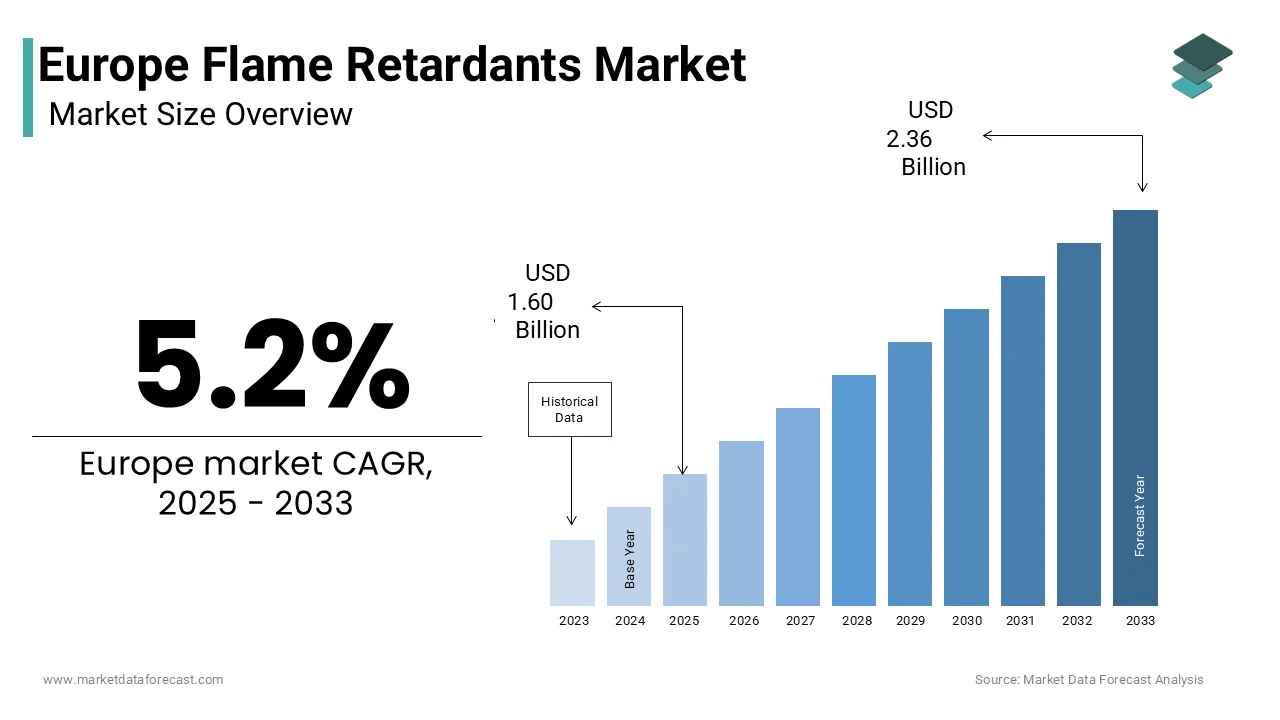
Flame retardants are specialized chemical additives incorporated into polymers, textiles, and construction materials to inhibit ignition, delay flame spread, and reduce heat release during fire events. In Europe, their use is critically shaped by stringent fire safety mandates across sectors such as electronics, building, ng and construction, transportation, and furniture. According to th,e European Commission, fire incidents in the EU result in over 5,000 fatalities and 150,000 injuries annually, with residential buildings accounting for the majority of fire-related deaths. This hum, a toll underpins robust regulatory frameworks like the Construction Products Regulation and the Low Voltage Directive, which require certified, fire performance for materials used in walls, cables, and electronic housings. Concurrently, the European Green Deal exerts dual pressure is forcing a rapid shift from legacy brominated compounds toward halogen-free and bio-based alternatives. As per the European Chemicals Agency, over 180 flame retardant substances are currently under regulatory scrutiny under REACH AC, with 42 restricted or phased out since 2010. The interplay between life safety imperatives and chemical sustainability defines the unique trajectory of the European flame retardants market, where performance, compliance, and eco compatibility must coexist.
MARKET DRIVERS
Stringent Fire Safety Regulations Across Construction and Electronics Are Fuelling Demand
European fire safety legislation serves as the foremost driver for flame retardant adoption, with binding requirements embedded in sector-specific directives that mandate minimum fire resistance thresholds, which is primarily driving the regional market growth. The Construction Products Regulation requires all building materials placed on the EU market to carry CE marking with declared fire performance ratings under Euroclass A to F classifications. As per the European Committee for Standardization, most thermal insulation foams used in residential construction now incorporate flame retardants to achieve at least Euroclass E. Similarly, the Low Voltage Directive compels all electrical and electronic equipment operating between 50 and 1,000 volts to meet IEC 60695 flammability standards, which directly influences the formulation of connector housings and printed circuit boards. In 2024, the European Union adopted updated fire safety guidelines for high-rise buildings following the Grenfell Tower tragedy, requiring exterior cladding systems to achieve Euroclass B or higher, which is a change that significantly increased flame-retardant use in polyisocyanurate insulation across Germany, France, and the Netherlands. These legally enforceable standards create non-discretionary demand, ensuring consistent consumption irrespective of raw material cost fluctuations.
Electrification of Transport and Expansion of EV Infrastructure Is Accelerating Specialty Additive Use
The rapid electrification of road transport in Europe is generating new high-performance requirements for flame retardants in battery systems, connectors, and charging components, which is further propelling the flame retardants market expansion in Europe. Electric vehicles contain significantly more polymer content than internal combustion engine vehicles, much of it in high voltage battery enclosures and cable harnesses, where fire propagation must be contained for passenger safety. As per the European Automobile Manufacturers Association, EV registrations reached 2.9 million units in 2024, which represents 27% of total new car sales and drives demand for phosphorus and nitrogen-based flame retardants that offer halogen-free flame suppression without corroding sensitive electronics. Moreover, the Alternative Fuels Infrastructure Regulation mandates the installation of 1 million public EV charging points across the EU by 2025. Each fast charger contains substantial amounts of flame-retarded engineering plastics in its housing and connectors. In 2024, Germany’s Federal Motor Transport Authority issued new crash and fire safety protocols requiring EV battery modules to withstand direct flame exposure, which is a benchmark met only through intumescent or ceramic-forming flame retardant systems. This convergence of vehicle innovation and infrastructure buildout is transforming mobility into a high-growth vector for advanced flame inhibition chemistry.
MARKET RESTRAINTS
Regulatory Restrictions on Halogenated Compounds Are Limiting Formulation Options
The European Union’s progressive restriction of brominated and chlorinated flame retardants under REACH and the Stockholm Convention severely constrains available chemistries for formulators, which is a notable restraint for the European market. Substances such as decabromodiphenyl ether and hexabromocyclododecane have been banned since 2019, and in 2023, the European Chemicals Agency added tetrabromobisphenol A to the Candidate List for authorization due to its persistence and endocrine-disrupting properties. As per the European Environment Agency, a majority of legacy brominated flame retardants used in electronics and insulation before 2015 are now either restricted or under a sunset clause. This regulatory attrition forces manufacturers to reformulate with alternatives that often lack equivalent efficacy. For example, aluminum trihydroxide requires high loadings by weight to match the performance of brominated systems, which compromises mechanical properties and processability. In the construction sector, this has delayed the rollout of thinner high R-value insulation panels, while in electronics, it has increased the thickness of plastic enclosures to maintain UL94 V0 ratings. The compliance burden is particularly acute for small and medium enterprises that lack in-house toxicology expertise, which is leading to product discontinuations and supply chain fragmentation across the European market.
Volatility in Raw Material Supply and Pricing Undermines Cost Predictability
The persistent cost instability due to its dependence on petrochemical and mineral feedstocks, subject to global trade and environmental policy shifts, is further impeding the European flame retardants market growth. Key precursors such as bisphenol A, red phosphor, and antimony trioxide are exposed to supply chain disruptions. In 2024, Chinese export curbs on antimony caused European prices to surge significantly within six months. Similarly, the EU’s Carbon Border Adjustment,t Mechanism no,w imposes embedded carbon tariffs on imported phosphorus-based intermediates from high-emission regions, adding notable increases to landed costs. Bio-based alternatives like lignin or phytate derivatives remain commercially marginal due to inconsistent purity and scalability; global production of bio-derived flame retardants totaled under 15,000 tonnes in 2024, which is insufficient to offset conventional shortages. This volatility complicates long-term pricing agreements with automotive and electronics OEMs who demand fixed cost structures. Consequently, formulators are forced to absorb margin pressure or pass costs to end users, which is slowing adoption of next-generation systems and reinforcing reliance on regulated but stable legacy chemistries despite compliance risks.
MARKET OPPORTUNITIES
Rise of Circular Economy Mandates Is Creating Demand for Recyclable Flame Retardant Systems
The European Union’s Circular Economy Action Plan is catalysing innovation in flame retardants that are compatible with polymer recycling streams without compromising fire safety or material quality, which is a promising opportunity for the regional market. As per the European Commission, all plastic packaging placed on the EU market must be reusable or recyclable by 2,030, yet conventional brominated systems contaminate mechanical recycling loops and generate toxic dioxins during reprocessing. This has spurred demand for reactive and polymeric flame retardants that bind chemically to the polymer backbone and survive multiple recycling cycles. In 2024, Covestro launched a halogen-free polycarbonate grade incorporating a phosphinate-based additive that maintains a UL94 V0 rating after multiple extrusion cycles, certified under the RecyClass protocol. Similarly, according to the European Plastics Converters association, more than two-thirds of its members now specify recyclable flame-retarded compounds for electronic housings, up from about one-third in 2021. Legislative momentum is accelerating this shift. France’s Anti-Waste Law prohibits the use of non-recyclable flame retardants in consumer electronics as of January 2025. These policy and market signals are transforming recyclability from a niche attribute into a core performance criterion, opening a high-value corridor for next-generation additive technologies.
Growth in Renewable Energy Infrastructure Is Unlocking New Application Frontiers
The expansion of wind and solar power installations across Europe is generating novel demand for flame retardants in composite materials and electrical components exposed to high voltage and thermal stress. Offshore wind turbine nacelles and transformer housings require glass fiber reinforced epoxy resins with UL94 V0 compliance to prevent arc flash propagation, which is a single 15 megawatt turbine that contains substantial amounts of flame-retarded composites according to WindEurope data. Similarly, utility-scale battery energy storage systems use flame-retarded polypropylene and polyamide in battery modules and busbars to meet IEC 62619 safety standards. In 2024, the German Federal Network Agency mandated that all new grid-scale storage facilities undergo rigorous fire propagation testing, effectively requiring intumescent or ceramic-forming additives. These applications demand additives that are not only halogen-free but also stable under UV exposure, thermal cycling, and salt spray corrosion, as these conditions degrade many conventional systems. This convergence of energy transition and fire safety is positioning the renewables sector as a strategic growth vector for high durability flame inhibition solutions.
MARKET CHALLENGES
Technical Trade-Offs Between Fire Performance and Mechanical Properties Remain Unresolved
The inherent compromise between fire resistance and the mechanical or aesthetic properties of the base polymer is a major challenge to the European flTrade-Offsants market. Achieving stringent ratings such as UL94 V0 or Glow Wire Ignition Temperature above 750 degrees Celsius often requires high additive loadings that reduce impact strength, which increases brittleness, or cause plate out during injection molding. For instance, aluminum trihydroxide at high loading levels in polyolefins can significantly decrease tensile strength and elongation at break, which is compromising mechanical performance. In electric vehicle battery housings, this requires thicker walls or secondary reinforcement, which adds weight and cost. Similarly, in thin-wall electronics enclosures, excessive flame-retardant content causes warpage and surface defects unacceptable to OEMs. While nano additives like layered double hydroxides show promiseaddsispersion stability and cost remain barriers to commercialization. For instance, a substantial share of flame-retarded compound rejections in 2024 were due to failed mechanical validation and not fire tests. This performance paradox slows adoption of safer chemistries and perpetuates reliance on legacy systems that offer a better balance, albeit with regulatory risk.
Lack of Harmonized Fire Testing Protocols Across EU Member States Hinders Innovation
The absence of fully harmonized fire safety testing methodologies across European countries creates technical and commercial uncertainty that impedes the rollout of next-generation flame retardants, which further challenges the market expansion in Europe. While Euroclass provides a common construction framework, sector-specific standards vary significantly. For example, Germany’s DIN 4102 and France’s M1 classification for interior materials yield different outcomes for identical formulations. In transportation, rail applications follow EN 45545 while automotive uses FMVSS 302—both referenced in EU type approval but interpreted differently by national authorities. For instance, a significant share of flame-retarded products requires duplicate testing to meet divergent national requirements, which increases time to market and adds notable certification costs. This fragmentation discourages SMEs from investing in novel chemistries and favours incumbents with established test data libraries. Moreover, emerging applications like solid-state batteries lack standardized fire protocols altogether, which leaves manufacturers to rely on proprietary or generic tests that do not reflect real-world failure modes. Until testing frameworks are fully aligned under a single EU fire safety governance body, innovation will remain constrleavesiance complexity rather than technical merit.
REPORT COVERAGE
| REPORT METRIC | DETAILS |
| Market Size Available | 2024 to 2033 |
| Base Year | 2024 |
| Forecast Period | 2025 to 2033 |
| Segments Covered | By Chemistry, End User, and Region. |
| Various Analyses Covered | Global, Regional, and Country-Level Analysis, Segment-Level Analysis, Drivers, Restraints, Opportunities, Challenges; PESTLE Analysis; Porter’s Five Forces Analysis, Competitive Landscape, Analyst Overview of Investment Opportunities |
| Countries Covered | UK, France, Spain, Germany, Italy, Russia, Sweden, Denmark, Switzerland, Netherlands, Turkey, Czech Republic, Rest of Europe |
| Market Leaders Profiled | Clariant AG, Lanxess AG, Albemarle Corporation, ICL Group Ltd., BASF SE, Nabaltec AG, Huber Engineered Materials (J.M. Huber Corporation), DuPont de Nemours, Inc., Italmatch Chemicals S.p.A., Akzo Nobel N.V., Adeka Corporation, DIC Corporation, Kraton Corporation, PolyOne Corporation (Avient Corporation), Chemtura Corporation (LANXESS subsidiary), Dow Inc., RTP Company, Sinochem International Corporation, Budenheim KG, Sigma-Aldrich (Merck KGaA). |
SEGMENTAL ANALYSIS
By Chemistry Insights
The aluminum trihydroxide segment commanded 31.3% of the regional market share in 2024. The dominance of the aluminum trihydroxide segment in the European flame retardants market is driven by its non-halogenated composition, thermal stability, and dual functionality as a suppressant and filler. ATH decomposes endothermically at approximately 180 degrees Celsius, which releases water vapor that dilutes flammable gases and cools the combustion zone and making it ideal for use in construction, insulation, and wire and cable jacketing. For instance, a majority of mineral wool and extruded polystyrene insulation produced in the EU incorporates ATH to meet Euroclass E fire ratings without toxic emissions. The dominance of the ATH segment in this regional market is further driven by REACH compliance; unlike brominated alternatives, ATH is not classified as a substance of very great concern, allowing unrestricted use across consumer applications. Additionally, ATH is cost-effective, derived as a byproduct of bauxite refining, with European producers like Alteo and Nabaltec ensuring a stable supply. In the greatable sector, CENELEC standards HD 603 and HD 604 mandate low smoke zero halogen formulations for public infrastructure, a requirement ATH meets when used at 50% to 65% loading in polyolefins. This regulatory safety and economic advantage boost ATH as the backbone of Europe’s halogen-free flame retardant strategy.
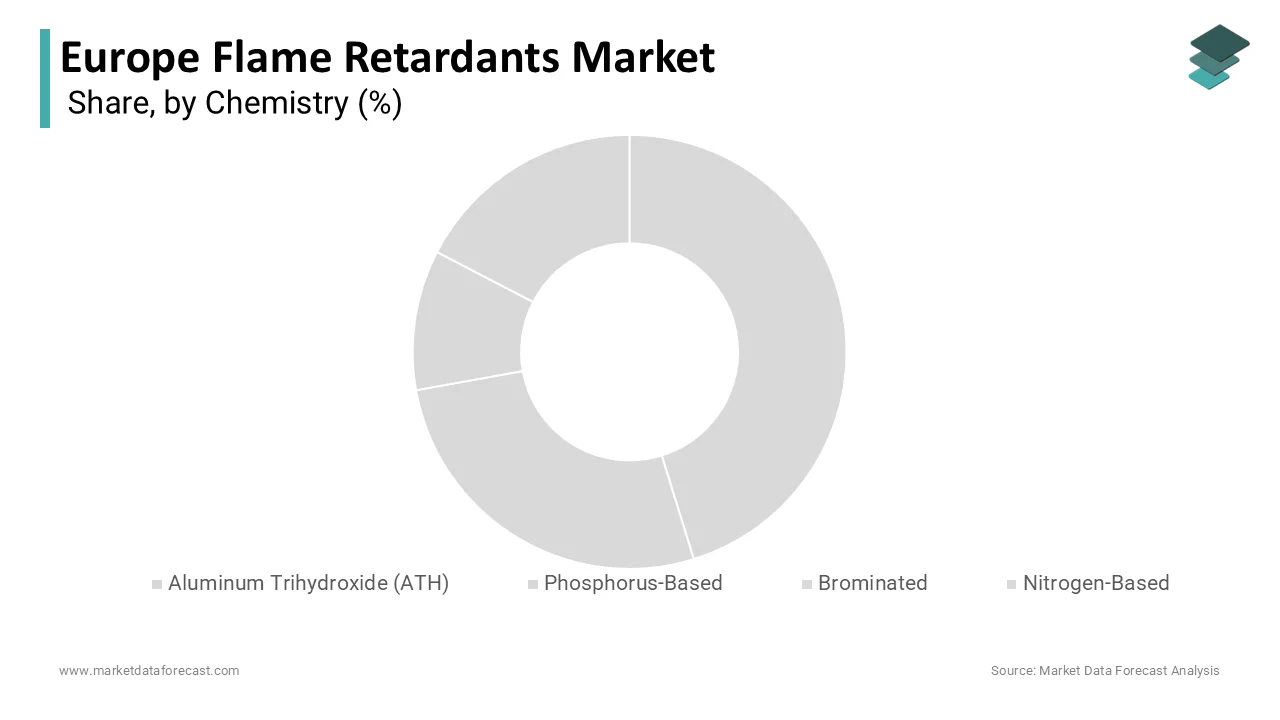
The phosphorous segment is the fastest-growing chemistry segment in Europe and is estimated to expand at a CAGR of 8.44% over the forecast period, owing titsir versatility in both reactive and additive applications and strong alignment with circular economy goals. Unlike mineral fillers, phosphorous compounds like ammonium polyphosphate and DOPO derivatives function effectively at low loadings (10% to 20%), preserving mechanical properties in engineering plastics used in electronics and electric vehicles. Phosphorous systems enable polycarbonate and polyamide blends to retain UL94 V0 rating after multiple recycling cycles, which is a critical requirement under France’s Anti-Waste Law and the EU Ecodesign Directive. In 2024, Germany’s Federal Institute for Materials Research certified a new intumescent polyamide formulation containing cyclic phosphonate for EV battery enclosures, which passed thermal runaway propagation tests. Moreover, bio-based phosphorous flame retardants derived from phytic acid and lignin are gaining traction with industry reports noting a sharp increase in pilot-scale production of such systems in 2024. This convergence of performance, recyclability, and regulatory acceptance positions phosphorous chemistry as the innovation frontier of Europe’s flame retardant transition.
By End User Insights
The construction segment accounted for 37.7% of the European flame retardants market share in 2024, owing to the mandatory fire safety standards for insulation,n cladd, and interior materials in residential and commercial buildings. The Construction Products Regulation requires all materials to carry CE marking with Euroclass fire performance certification, which is driving consistent demand for flame retarded expanded polystyrene, polyisocyanurate, and phenolic foams. According to Eurostat, the EU completed a large number of new residential dwellings in 2024, each requiring substantial insulated envelope areas, which supports significant annual demand for flame-retarded insulation. High-rise building regulations further intensify usage. Following the 2017 Grenfell tragedy, several,,l EU countries strengthened requirements for external insulation systems, which is reducing the use of non-flame-retarded foams in multi-story projects. Additionally, renovation activity under the EU’s Renovation Wave initiative sustains retrofit demand. ATH and melamine cyanurate dominate this segment due to their low smoke and halogen-free profiles, aligning with Green Public Procurement criteria that prioritize non-toxic materials in public housing. This regulatory and demographic momentum ensures construction remains the bedrock of flame-retardant consumption.
The electrical and electronics segment is predicted to register the fastest CAGR of 9.12% over the forecast period in the European flame retardants market, owing to miniaturization, rising powder density, and stringent fire safety mandates for consumer and industrial devices. Modern electronics pack more circuitry into smaller housings, which is increasing heat buildup and short circuit risks that necessitate UV0-rated materials. Across the EU, consumer electronics volumes are substantial, with laptops, power adapters, and smart home appliances commonly requiring flame-retarded polycarbonate, ABS, or polyamide resins. The shift toward halogen-free formulations is well advanced; IEC 62321 provides test methods for screening brominated flame reta,,rdants and supports RoHS compliance, while EU Ecolabel criteria encourage reduced use of hazardous substances rather than mandating specific chemistries. In 2024, leading OEM initiatives and supply-chain programs accelerated the adoption of phosphorus-based systems, including phosphinate and phosphonate technologies recognized for safer profiles and recyclability objectives. Moreover, data centres require flame-retarded cable trays and server housings to help limit fire propagation in denser racks, with EU discussions indicating their growing electricity demand. This combination of volume growth, regulatory stringency, and material innovation fuels the segment’s accelerated trajectory.
COUNTRY LEVEL ANALYSIS
Germany Flame Retardants Market Analysis
Germany dominated the flame retardants market in Europe by holding 22.8% of the regional market share in 2024. Germany is serving as the continent’s primary hub for automotive electronics and chemical manufacturing. Germany’s strict interpretation of fire safety standards sets de facto benchmarks across the EU. Germany completed a large number of new residential units in 2024, each requiring halogen-free insulation compliant with B1 fire class. Simultaneously, Germany leads Europe in electric vehicle production with over one million units assembled in 2024, which is driving demand for high-performance phosphorous and nitrogen-based flame retardants in battery and connector systems. Domestic chemical giants like Clariant and Lanxess anchor a robust supply chain for advanced additives, while the Fraunhofer Institute provides independent fire testing infrastructure. Germany’s early adoption of the Chemicals Strategy for Sustainability further accelerates the phase out of substances of concern, reinforcing its role as both a high-demand market and an innovation driver for next-generation flame inhibition technologies.
France Flame Retardants Market Analysis
France held a substantial share of the European flame retardants market in 2024 owing to its aggressive regulatory action on chemical safety and circularity. France’s Anti-Waste Law for a Circular Economy, enacted in 20,20, strengthens restrictions on non-recyclable or toxic flame retardants in consumer electronics and textiles from 2025. According to France’s Ministry of Ecological Transition, a majority of flame-retarded plastic formulations sold in 2024 were halogen-free, a compliance rate unmatched in Southern Europe. The construction sector also drives demand with a significant number of new homes built in 2024. Per INSEE data, insulation used in public housing must meet stringent fire classes and carry an Environmental and Health Declaration. France’s nuclear and rail industries further require specialized flame retarded composites resistant to radiation and arc flash. Domestic producer Imerys and international players like Solvay have established formulation centers near Lyon to serve these high-compliance sectors. This policy-led market structure ensures France remains a critical testing ground for sustainable flame retardant adoption across the EU.
Italy Flame Retardants Market Analysis
Italy is projected to hold a prominent share of the European flame retardants market during the forecast period, owing to its dense network of small and medium enterprises in furniture, textiles, and electrical equipment. Italy is a leading producer of upholstered furniture, necessitating compliance with UNI 9175 flammability standards for domestic upholstery. Simultaneously, Italy’s textile cluster in Prato processes large volumes of fabrics yearly, which requires durable flame-retardant finishes for curtains, protective workwear, and theater drapery. The electronics sector centered in Emilia Romagna produces millions of power supplies and connectors for global OEMs, which must meet IEC 62368-1 standards. Recent regulatory shifts are accelerating halogen-free transitions. Italy has tightened rules on halogenated flame-retarded cables in public infrastructure projects. Local chemical formulators like Italmatch Chemicals are responding with phosphorous-based masterbatches tailored for recycled polyesters. This blend of traditional manufacturing and evolving compliance creates sustained and diversified flame-retardant demand.
United Kingdom Flame Retardants Market Analysis
The United Kingdom is a prominent market for flame retardants in Europe. The Grenfell fire safety reforms and strong electronics manufacturing are driving the flame retardants market growth in the UK. The Building Safety Act 2022 mandates that all external wall systems on buildings over 11 meters achieve Euroclass A2 s1 d0 fire performance, effectively eliminating combustible insulation. According to the UK Department for Levelling Up Housing and Communities, extensive cladding remediation progressed in 2024, which requires substantial volumes of non-combustible mineral or ATH-filled insulation. In electronics, the UK remains a key design and assembly hub for defense and medical devices, which demand the highest fire safety ratings under BS EN 60601 and DEF STAN 02 717. Companies like Johnson Matthey and Synthomer supply specialty phosphonate and intumescent systems for these critical applications. Despite Brexit, UK ire standards remain aligned with EU norms, ensuring continued compatibility. This uncompromising approach to life safety sustains premium demand for high-performance flame retardants across both construction and advanced manufacturing sectors.
Sweden Flame Retardants Market Analysis
Sweden is estimated to showcase a healthy CAGR in the European flame retardants market over the forecast period due to its leadership in green public procurement and circular material policies. Sweden mandates that all state-funded construction projects use only non-toxic flame retardants certified under the Nordic Swan Ecolabel, a standard that excludes brominated and antimony-based systems. According to Statistics Sweden, a majority of insulation used in public housing in 2024 contained ATH or melamine derivatives. Sweden’s electric vehicle and battery ecosystem, centered around Northvolt and Volvo Cars, also drives demand for recyclable flame retarded polymers; Northvolt’s Skellefteå gigafactory requires all battery module plastics to pass UL94 V0 and be mechanically recyclable per its 2024 supplier code. The Swedish Chemicals Agency actively screens flame retardants under its national substitution program, identifying safer alternatives ahead of EU REACH actions. Domestic research institutions like RISE provide testing platforms for bio-based flame retardants derived from forest residuals. This holistic integration of fire safety, sustainability, and industrial policy positions Sweden as a forward-looking market shaping Europe’s long-term flame-retardant trajectory.
COMPETITIVE LANDSCAPE
The European flame retardants market features intense competition among multinational chemical companies and specialized formulators vying for leadership in a highly regulated and rapidly evolving landscape. Differentiation is driven not by price but by regulatory compliance, performance consistency, nd alignment with circular economy principles. Global players like Albemar, le Clari, and LANXESS dominate through vertically integrated R&D technical service networks and early engagement with EU regulatory bodies. Meanwhile, niche European producers focus on bio-based or mineral systems tailored for regional construction or textile standards. The market is characterized by high entry barriers, including stringent REACH authorization requirements, extensive fire testing protocols, and the need for application-specific validation. Collaboration is common as suppliers work closely with polymer compounders, OEMs, and recyclers to codevelop solutions that satisfy both fire safety and sustainability mandates. This dynamic fosters continuous innovation but limits disruptive entrants, resulting in a stable yet progressive competitive structure shaped by policy and material science advancement.
KEY MARKET PLAYERS
Some of the companies that are playing a dominating role in the global Europe Flame Retardants Market include
- Clariant AG
- Lanxess AG
- Albemarle Corporation
- ICL Group Ltd.
- BASF SE
- Nabaltec AG
- Huber Engineered Materials (J.M. Huber Corporation)
- DuPont de Nemours, Inc.
- Italmatch Chemicals S.p.A.
- Akzo Nobel N.V.
- Adeka Corporation
- DIC Corporation
- Kraton Corporation
- PolyOne Corporation (Avient Corporation)
- Chemtura Corporation (LANXESS subsidiary)
- Dow Inc.
- RTP Company
- Sinochem International Corporation
- Budenheim KG
- Sigma-Aldrich (Merck KGaA)
TOP LEADING PLAYERS IN THE MARKET
- Albemarle is a pivotal participant in the European flame retardants market through its portfolio of brominated and organophosphorus solutions tailored for electronics construction and transportation. The company supplies high-purity polybrominated diphenyl ethers alternatives, such as Saytex NX, T, that meet EU REACH and RoHS compliance while maintaining fire performance in engineering plastics. In 20,4, Albemarle expanded its technical service center in Amsterdam to support halogen-free formulation development for electric vehicle battery enclosures and charging infrastructure. The company also partnered with leading European polymer recyclers to validate the recyclability of its phosphinate-based additives under mechanical recycling protocols. These initiatives reinforce Albemarle’s global leadership in sustainable flame inhibition and deepen its integration with Europe’s circular economy and electrification agendas.
- Clariant plays a central role in advancing halogen-free flame retardancy across Europe with its Exolit AP and OP series of ammonium polyphosphate and phosphonate-based additives. These products are widely specified in wire and cable insulation, electronic housings, and construction foams due to their low smoke toxicity and recyclability. In early 2,5, Clariant launched bio-based flame retardant derived from renewable feedstocks for polyamide applications in automotive connectors, meeting both UL94 V0 and ISO 14021 recyclability claims. The company also enhanced its GreenScreen assessment protocols to provide full chemical hazard transparency to OEMs. By aligning its innovation roadmap with the EU Chemicals Strategy for Sustainability and Ecodesign Directive requirements, Clariant strengthens its position as a solutions provider for safe and circular flame retarded materials globally.
- LANXESS is a key European manufacturer of reactive and additive flame retardants serving the automotive electronics and construction sectors. Its Bromplus and Levagard lines include both brominated and halogen-free solutions engineered for high-temperature polymers like PBT and PC ABS. In late 2024, LANXESS introduced a new redphosphorus-free polyphosphonate masterbatch that enables electric vehicle battery trays to achieve Glow Wire Ignition Temperature above 850 degrees Celsius without compromising mechanical strength. The company also expanded its regulatory affairs team in Cologne to accelerate REACH authorization dossiers for next-generation chemistries. Through deep collaboration with German automotive OEMs and adherence to VDA 278 emission standards, LANXESS ensures its flame retardants meet the dual demands of fire safety and indoor air quality in premium mobility applications worldwide.
TOP STRATEGIES USED BY THE KEY MARKET PARTICIPANTS
Key players in the European flame retardants market prioritize regulatory compliance by proactively reformulating products to align with REACH, RoHS, and the EU Chemicals Strategy for Sustainability. They invest heavily in developing halogen-free and bio-based alternatives that maintain fire performance while enabling polymer recyclability. Strategic partnerships with polymer producers, electronics OEMs, and recyclers facilitate engineered solutions that meet sector-specific safety and circularity targets. Companies also enhance technical service capabilities, offering formulation ssupportlifecycle assessment, and fire testing validation to strengthen customer integration. Additionally, they leverage digital tools to provide chemical transparency through GreenScreen or similar hazard assessment platforms, building trust in an increasingly scrutinized regulatory environment.
MARKET SEGMENTATION
This research report on the europe flame retardants market is segmented and sub-segmented into the following categories.
By Chemistry
- Aluminum Trihydroxide (ATH)
- Phosphorus-Based
- Brominated
- Nitrogen-Based
- Others
By End User
- Construction
- Electrical & Electronics
- Automotive
- Textiles
- Furniture & Furnishings
- Others
By Country
- Germany
- France
- Italy
- United Kingdom
- Sweden
- Rest of Europe
Frequently Asked Questions
1. Which industries are driving growth in the Europe Flame Retardants Market?
Key growth drivers include the electrical & electronics industry, building & construction, automotive, and transportation sectors in Europe.
2. What types of flame retardants dominate the Europe Flame Retardants Market?
Halogen-free flame retardants, including phosphorus-based and mineral hydroxides, hold a larger market share compared to halogenated types in Europe.
3. How do regulations impact the Europe Flame Retardants Market growth?
Strict fire safety and chemical regulations in Europe promote the adoption of flame retardants that meet environmental and safety standards.
4. What geographic segments are included in the Europe Flame Retardants Market?
The market includes Germany, France, the UK, Italy, Russia, and other European countries, with varying demand across regions.
5. Why is the electrical & electronics sector important for the Europe Flame Retardants Market?
The complexity and miniaturization of electronic devices increase the need for flame retardants to prevent fire hazards, boosting market demand.
6. What role does sustainability play in the Europe Flame Retardants Market?
Growing demand for environmentally friendly and non-halogenated flame retardants encourages innovation and safer chemical alternatives.
7. Who are some leading players in the Europe Flame Retardants Market?
Key companies include BASF SE, Lanxess AG, Albemarle Corporation, ICL Group Ltd, and Clariant AG among others.
8. How is the Europe Flame Retardants Market segmented by application?
Applications include building and construction, automotive and transportation, electrical and electronics, and textiles.
9. How does the construction industry influence the Europe Flame Retardants Market?
Rising construction investments and demand for fire-safe materials create substantial opportunities for flame retardant applications.
10. What are the main challenges faced by the Europe Flame Retardants Market?
Environmental and health concerns related to some chemical flame retardants and high compliance costs pose challenges for market growth.
Related Reports
Access the study in MULTIPLE FORMATS
Purchase options starting from
$ 2000
Didn’t find what you’re looking for?
TALK TO OUR ANALYST TEAM
Need something within your budget?
NO WORRIES! WE GOT YOU COVERED!
Call us on: +1 888 702 9696 (U.S Toll Free)
Write to us: sales@marketdataforecast.com