- Product Description Description
- Table of Contents TOC
- List of Table & Figure LOT
- Get Free Sample PDF Sample PDF
Market Size, 2025
$6.33 BnMarket Estimate, 2026
$6.68 BnMarket Forecast, 2034
$10.29 BnCAGR, 2026–2034
5.55%Europe Flavors Market Size, Growth, Trends & Forecast (2026–2034)
The Europe flavors market size was calculated at USD 6.33 billion in 2025, is estimated to reach USD 6.68 billion in 2026, and is anticipated to be worth USD 10.29 billion by the end of 2034, registering a compound annual growth rate (CAGR) of 5.55% during the forecast period from 2026 to 2034. Driven by surging consumer demand for clean-label natural ingredients, the expansion of plant-based alternative protein categories, and ongoing bio-based innovations in precision fermentation, the European flavors market stands as a primary global benchmark for food safety compliance and sensory excellence.
Key Executive Metrics (At-a-Glance)
- 2025 Base Valuation: USD 6.33 Billion
- 2026 Current Valuation: USD 6.68 Billion
- 2034 Forecast Valuation: USD 10.29 Billion
- Compound Annual Growth Rate (CAGR): 5.55% (2026–2034)
- Largest Nature Segment: Natural Flavors
- Largest Form Segment: Liquid and Gel Flavors
- Fastest-Growing Form Segment: Powder Flavors (9.12% CAGR)
- Largest Application Segment: Food (55.8% share in 2025)
- Fastest-Growing Application Segment: Beverages (8.8% CAGR)
- Largest Regional Market: Germany (21.1% share in 2025)
Core Market Drivers
- Clean Label & Natural Preference: Widespread consumer rejection of synthetic additives, prompting formulators to prioritize botanical and fermentation-derived solutions compliant with EU Regulation EC 1334/2008.
- Plant-Based Protein Growth: Rising consumption of meat and dairy alternatives creating strong demand for sophisticated umami-rich and masking flavor systems.
Primary Market Restraints & Challenges
- Rigorous EU Regulations: Complex EFSA safety dossiers, re-evaluation programs, and stringent criteria for natural labeling that increase compliance costs.
- Raw Material Supply Volatility: Climate-induced weather shocks and geopolitical conflicts disrupting the global supply chains of critical botanical raw materials like vanilla and citrus.
Europe Flavors Market Segmentation Breakdown
| Segment Category | Dominant / Leading Segment | Fastest-Growing / High-Potential Segment |
|---|---|---|
| By Nature | Natural Flavors | Fermentation-Derived Bioengineered Profiles |
| By Form | Liquid and Gel Flavors | Powder Flavors (9.12% CAGR) |
| By Application | Food (55.8% share in 2025) | Beverages (8.8% CAGR) |
| By Region | Germany (21.1% share in 2025) | Spain, Italy, United Kingdom |
Major Industry Players Profiled
Key enterprises shaping the European flavors market include Givaudan SA, DSM Firmenich, Symrise AG, International Flavors & Fragrances (IFF), Kerry Group, Robertet, Takasago International, Mane, BASF, Sensient Technologies, Corbion, Cargill, and Tate & Lyle.
Europe Flavors Market Size
The Europe flavors market size was calculated at USD 6.33 billion in 2025 and is anticipated to reach USD 10.29 billion by 2034, from USD 6.68 billion in 2026, growing at a CAGR of 5.55% during the forecast period.
Flavors are used to impart or enhance taste in food, beverages, confectionery, dairy, and functional nutrition products. These formulations range from single molecule isolates like vanillin and limonene to complex compounded profiles mimicking fruit spice or savory notes and are strictly regulated under the European Union’s flavoring legislation, including Regulation EC 1334 2008 and the Union List of approved substances. According to CBI, European imports of essential oils amounted to 68,094 tonnes in 2022 and were valued at over €1,844 million. As per the European Food Safety Authority, around 2,100 flavouring substances are authorised for use in the EU under the Union list. Moreover, the Farm to Fork Strategy by the European Commission has intensified scrutiny on synthetic additives, prompting formulators to prioritise fermentation-derived and enzymatically modified natural flavours. This regulatory and cultural environment positions Europe not only as a major consumer but also as a global benchmark for flavour innovation, sustainability, and compliance.
MARKET DRIVERS
Rising Consumer Demand for Clean Label and Natural Ingredients
European consumers are increasingly rejecting artificial additives and demanding transparency in flavor sourcing, and this has accelerated the shift toward natural and fermentation-derived flavor solutions, which are majorly driving the flavors market growth in Europe. European consumers are increasingly rejecting artificial additives and demanding transparency in flavour sourcing. The clean-label trends show that around 61% of European consumers believe natural and botanical flavour ingredients are more environmentally sustainable. Retailers and brands are responding by emphasising simpler ingredient lists and traceability. According to CBI, the value of European imports of selected natural food additives (including orange oils) increased by 21% between 2019 and 2023. Meanwhile, under European Food Safety Authority and European Commission regulation, the authorised flavouring substances list is continuously updated, and the EU “Union list” remains the only legal basis for flavouring substances. Together, these regulatory and consumer-driven forces compel flavour developers to invest in fermentation-derived and enzymatically modified solutions, botanical extraction biotechnology, and supply chain traceability to meet both compliance and authenticity expectations.
Expansion of Plant-Based and Alternative Protein Product Categories
The rapid growth of plant-based meat, dairy, and ready-to-eat meals across Europe has created unprecedented demand for savory umami and masking flavors to improve sensory acceptability, which is further boosting the regional market expansion. For example, sales of plant-based foods in Europe grew by 21% over two years to reach €5.8 billion, according to Good Food Institute. Europe consumer insights show that a substantial minority of Europeans reported eating plant-based dairy and meat products at least once a week in 2023. This behavioural shift is reinforced by product development as ingredient systems and supplier partnerships are increasingly focusing on masking off-notes and replicating “meaty” character in plant-based formats. These forces compel flavour technology developers to invest in botanical extraction, fermentation-derived systems, enzyme-modified lipids, and enhanced traceability to meet both sensory and regulatory expectations for authenticity in the Europe Flavors Market.
MARKET RESTRAINTS
Stringent and Evolving EU Regulatory Framework for Flavoring Substances
The Europe flavors market operates under one of the world’s most rigorous regulatory regimes, which, while ensuring safety, imposes significant compliance burdens and limits ingredient flexibility, which is one of the significant restraints to the regional market growth. According to the European Commission's Directorate General for Health and Food Safety, numerous flavoring substances originally permitted under national rules have been withdrawn from the Union List due to insufficient toxicological data or genotoxicity concerns. The European Food Safety Authority's re-evaluation program mandates that all flavoring substances undergo full safety dossiers, including metabolic fate intake assessment and threshold of toxicological concern analysis, which is a process that requires substantial financial investment per substance. EFSA periodically issues scientific opinions requesting additional data on specific flavoring substances used in various applications, which can significantly delay new product launches. Furthermore, Regulation EC 1334/2008 establishes strict requirements for the use of the term "natural" in flavoring labeling, which is forcing reformulation toward more expensive natural extracts that comply with the regulatory definition. These regulatory dynamics create uncertainty for product developers and disproportionately impact small and medium-sized flavor houses lacking resources for dossier preparation and advocacy.
Supply Chain Volatility for Natural Raw Materials
The persistent vulnerability due to climate-related disruptions and geopolitical instability is affecting the global supply of key botanical raw materials and hindering the growth of the Europe flavors market. Extreme weather events have significantly impacted global vanilla production, with Madagascar, which is the source of approximately 80% of the world's supply, experiencing cyclones and prolonged drought in recent years. This has caused vanilla prices to surge substantially in global markets. Similarly, citrus production in Spain and other European regions has faced challenges due to weather-related issues, including excessive rainfall during fruit setting, drought conditions, and irrigation restrictions. In Eastern Europe, the conflict in Ukraine disrupted agricultural exports, including sunflower and coriander seed, which are critical ingredients for savory and confectionery flavors, with European imports from Ukraine declining considerably. These shocks force flavor manufacturers to reformulate or absorb cost increases and threatening product consistency and margins. While biotechnology offers alternatives such as fermentation-derived vanillin, adoption of bio-based substitutes remains limited due to consumer skepticism and regulatory delays in novel food approvals.
MARKET OPPORTUNITIES
Innovation in Fermentation-Derived and Bioengineered Flavors
Europe is witnessing a surge in sustainable flavor innovation through precision fermentation and enzymatic bioconversion, offering consistent natural profiles without agricultural dependency, which is a potential opportunity for the European flavors market. According to the European Commission's Horizon Europe program, millions of euros have been allocated to develop microbial platforms for producing key flavor molecules such as nootkatone, raspberry ketone, and ethyl maltol through precision fermentation technologies. Fermentation-based ingredient development has gained significant research funding, with projects focused on creating natural flavor compounds using engineered microorganisms. The adoption of bioengineered natural flavors in new regulatory submissions has been increasing as the technology matures and demonstrates safety profiles acceptable to European authorities. According to sources, enzymatic modification of whey peptides can yield savory, brothy notes that enable significant sodium reduction in soups and other applications without compromising flavor quality. These technologies align with the Farm to Fork Strategy's goal of reducing environmental impact while meeting clean label demands, which is making bio-based flavors a strategic growth frontier for European flavor houses.
Growth of Functional and Fortified Food and Beverage Segments
The integration of health-enhancing ingredients into everyday foods has elevated the role of flavors in masking bitterness and off notes from vitamins, minerals, and botanical actives, which is another notable opportunity for the regional market. Consumer demand for functional foods and beverages with added health benefits, such as immunity support and cognitive health, has grown significantly, which is driving demand for fortified products across the European Union. The European Commission's Novel Foods Catalogue has seen numerous new vitamin and plant extract authorizations in recent years, many of which require sophisticated flavor masking techniques for ingredients such as magnesium citrate or ashwagandha. Functional beverage launches increasingly utilize citrus, mint, and berry flavor systems to counteract the astringency and off-notes associated with polyphenols and adaptogens. The flavor market has developed extensive new flavor profiles specifically for protein-enriched snacks targeting demographics such as women and seniors, which feature appealing notes like salted caramel and spiced apple. As functionalization becomes mainstream, flavor expertise is no longer about enhancement but essential sensory viability.
MARKET CHALLENGES
Consumer Mistrust of “Natural” Labeling and Greenwashing Concerns
Despite strong demand for natural flavors, European consumers are increasingly skeptical of marketing claims lacking verifiable proof that undermines brand credibility and complicates product positioning, which is majorly challenging the flavors market growth in Europe. Consumer concerns about the authenticity of "natural flavor" labels have grown, with many respondents expressing skepticism about vague or misleading labeling practices. Food labeling enforcement activities have identified significant non-compliance with Regulation EC 1169/2011 in online marketplaces, particularly regarding insufficient origin disclosure and undefined sourcing claims. In France, the Directorate General for Competition, Consumer Affairs, and Fraud Control actively enforces regulations against misleading food labeling practices, including cases where brands imply fruit content through flavor alone without actual juice. This scrutiny extends to sustainability claims, with research showing that a minority of "eco-friendly flavor" claims provide third-party certifications such as ISO 14040 for life cycle assessment. Without standardized definitions and transparent chain of custody documentation from farm to flavor, even legitimate natural products risk consumer rejection, which is forcing the industry toward blockchain traceability and on-pack QR code disclosures to rebuild trust.
Technical Limitations in Replicating Complex Savory and Regional Tastes
The Europe flavors market struggles to authentically reproduce intricate regional and umami-rich profiles using only approved natural substances, especially in clean-label formats. According to the European Federation of Food Science and Technology, many traditional European tastes, such as aged Parmesan, fermented black garlic, or Iberian ham, rely on Maillard reaction products and pyrazines that require complex multi-step natural processes to replicate. Regulatory restrictions on certain flavoring molecules can impact the ability to enhance specific flavor notes in applications such as plant-based meats. Artisanal food producers have expressed concerns that commercial natural flavors are inadequate substitutes for heritage fermentation techniques and traditional production methods that have been refined over generations. Moreover, the absence of approved natural sources for certain sulfur compounds limits realistic replication of allium and cruciferous notes critical in vegan cheese and meat analogs. While enzymatic and fermentation methods show promise, they often lack the depth of time-aged products. This sensory gap hinders the mainstream adoption of alternative foods and pressures flavor developers to innovate within narrow regulatory and technical boundaries, which is balancing authenticity, compliance, and consumer expectation in an increasingly discerning market.
REPORT COVERAGE
| REPORT METRIC | DETAILS |
| Market Size Available | 2025 to 2034 |
| Base Year | 2025 |
| Forecast Period | 2026 to 2034 |
| CAGR | 5.55% |
| Segments Covered | By Nature, Form, Application, and Region |
| Various Analyses Covered | Global, Regional & Country Level Analysis; Segment-Level Analysis; DROC, PESTLE Analysis; Porter’s Five Forces Analysis; Competitive Landscape; Analyst Overview of Investment Opportunities |
| Regions Covered | UK, France, Spain, Germany, Italy, Russia, Sweden, Denmark, Switzerland, Netherlands, Turkey, and the Czech Republic |
| Market Leaders Profiled | Givaudan, Firmenich, Symrise, International Flavors & Fragrances (IFF), Kerry Group, Robertet, Takasago International, Mane, BASF, Sensient Technologies, Corbion, Cargill, Tate & Lyle |
SEGMENTAL ANALYSIS
By Nature Insights
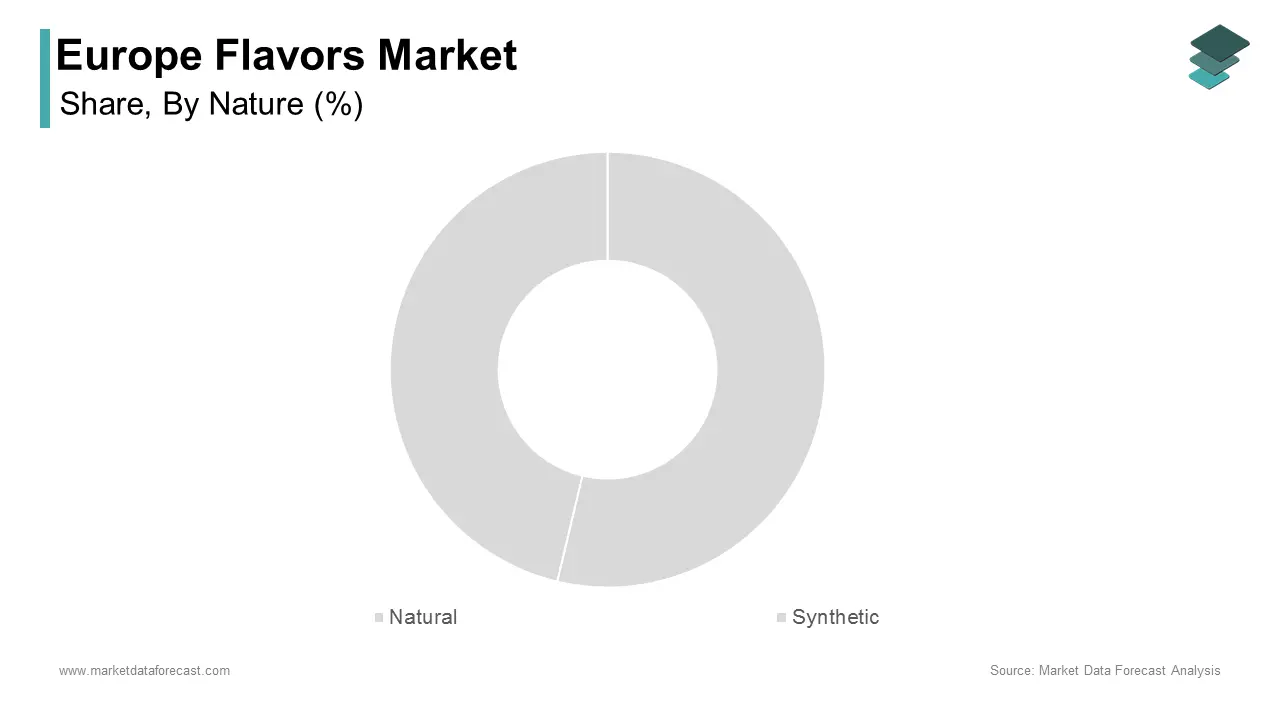
The natural flavors segment commanded the dominant share of the European flavors market in 2025. The dominance of the natural flavors segment in the European market is attributed to the stringent consumer preference for clean-label products and progressive regulatory alignment with natural sourcing. A significant majority of EU consumers actively avoid artificial ingredients, with natural flavors perceived as safer and more authentic. This trend is reinforced by retailer policies, particularly in Germany, where private label food launches increasingly feature "no artificial flavors" claims to meet consumer demand. The European flavor industry has adapted to this shift, with natural flavor substance approvals under the Union List showing growth in recent years. The citrus essential oil market has experienced notable expansion, with increased contracting between flavor houses and citrus growers for cold-pressed essential oils used in beverage formulations, particularly in France, where the clean label movement has gained strong traction. Additionally, the European Food Safety Authority's re-evaluation program has led to the removal of certain synthetic substances due to insufficient safety data, which is further narrowing the acceptable palette for manufacturers. These regulatory and behavioural forces have made natural flavors not just a preference but a commercial necessity across food and beverage categories in Europe, which is majorly contributing to the dominance of the natural flavors segment in the European market.
By Form Insights
The liquid and gel flavors segment occupied the major share of the European flavors market in 2025. The growth of the liquid and gel flavors segment is driven by their superior solubility, ease of dosing, and compatibility with beverage, dairy, and sauce applications. These formats allow for precise flavor delivery and rapid integration into high-speed production lines without requiring additional processing steps. For instance, over 90% of soft drink and functional beverage manufacturers in the EU use liquid flavor systems to ensure batch consistency and stability across carbonated and still products. In the dairy sector, a majority of yogurt and flavored milk producers rely on liquid emulsions to disperse citrus and fruit notes evenly without separation. According to reports, liquid flavor usage in ready meals has been steadily increasing as manufacturers shift toward clean-label broth and herb profiles that require oil‑soluble delivery systems. Additionally, liquid formats enable cold processing, preserving heat‑sensitive top notes such as mint and citrus, which are critical in premium beverage and confectionery segments. This functional versatility across high‑volume categories is primarily driving the dominance of the liquid and gel segment in this regional market.
The powder flavors segment is estimated to grow at the fastest CAGR of 9.12% over the forecast period in the European market. The expansion of dry mix applications, including plant-based protein powders, instant soups, and functional snacks, is fuelling the growth of the powder flavors segment in the European market. In 2023, over 400 new powdered plant‑based nutrition products were launched in the EU, requiring stable free‑flowing flavor systems that withstand long shelf life and resist moisture uptake. A majority of new high‑protein snack bars introduced in 2023 used encapsulated powder flavors to mask beany off notes from pea and soy isolates while maintaining texture integrity. In the Netherlands, flavor houses developed dozens of new powdered savory profiles in 2023 for instant soup mixes targeting sodium reduction through umami enhancement. Advances in spray drying and microencapsulation have improved flavor retention with technologies like starch lipid matrices providing strong protection against oxidation. As convenience and functional nutrition converge, powder flavors offer critical stability and dosing precision for next‑generation dry food formats, which is likely to contribute to the expansion of the segment in this regional market.
By Application Insights
The food segment captured the leading share of 55.8% of the regional market in 2025. The dominance of the food segment in the European market is driven by its broad application across dairy confectionery, bakery, meat alternative, and ready-to-eat meals. Flavor complexity in solid and semi-solid matrices demands advanced systems to balance top note impact with thermal stability during processing. In the EU, thousands of flavored dairy products are commercially available, with yogurt and dessert segments consuming large volumes of fruit and vanilla flavors annually. A significant share of new artisanal bread and pastry launches in 2023 featured natural spice and citrus notes to differentiate in premium categories. In plant‑based foods, most meat analogs require savory umami and fat flavor systems to replicate sensory authenticity. Many alternative protein startups collaborate with flavor suppliers during product development. This deep integration across diverse and high‑volume food categories supports the leading position of the food segment by application in the European flavors market.
The beverages segment represents the fastest growing application segment in the Europe flavors market and is predicted to witness a CAGR of 8.8% over the forecast period, owing to the innovation in functional hydration alcohol free alternatives and personalized nutrition drinks. In 2023, hundreds of new functional beverage SKUs were launched in the EU featuring adaptogens, vitamins, and botanicals that require sophisticated flavor masking and enhancement. Alcohol‑free beer volumes grew significantly in 2023, with flavor houses developing malt and hop profiles that compensate for lost fermentation complexity. In the United Kingdom, many new plant‑based milk alternatives use citrus and vanilla liquid flavors to mask beany notes and improve mouthfeel. Furthermore, the rise of personalized hydration, such as electrolyte tablets and effervescent powders, demands stable flavor systems that activate upon dissolution. Beverage flavor innovation cycles have shortened to under six months from concept to shelf due to agile consumer trends. This dynamic and high‑velocity segment drives continuous flavor formulation breakthroughs across Europe.
REGIONAL ANALYSIS
Germany Flavors Market Analysis
Germany led the flavors market in Europe in 2025 by holding 21.1% of the regional market share. The dominance of the robust food processing industry, strong clean label movement, and leadership in plant-based innovation. Germany hosts over 6,000 food and beverage manufacturers, including global leaders like Dr. Oetker, Ritter Sport, and Rügenwalder Mühl,e that drive consistent demand for natural and masking flavors. A large majority of new food launches in 2023 carried “no artificial flavors” claims, with natural vanilla, citrus, and spice profiles dominating bakery and dairy categories. Many alternative protein companies collaborate directly with flavor houses during product development to optimize sensory appeal. The Technical University of Munich operates a dedicated flavor research center working with industry on fermentation‑derived and enzymatic flavor systems. With stringent consumer standards, advanced manufacturing, and a culture of nutritional transparency, Germany sets the benchmark for flavor quality and innovation across the continent.
France Flavors Market Analysis
France held a substantial share of the Europe flavors market in 2025 due to its world-renowned culinary heritage, premium beverage sector, and strong agricultural base for flavor raw materials. France is Europe’s largest producer of wine, cognac, and fruit concentrates, providing abundant local feedstock for natural flavor extraction. Citrus and berry contracts with flavor houses increased significantly in 2023 to support beverage and dairy innovation. Thousands of flavored yogurt and dessert products use natural vanilla and fruit flavors compliant with the “Produit en France” origin labeling scheme. Additionally, France leads in premium confectionery, with a large share of new chocolate launches in 2023 featuring natural spice and floral notes such as lavender and pink pepper. With a deep cultural emphasis on taste, authenticity, and terroir, France remains a crucible for high‑end natural flavour development and application.
United Kingdom Flavors Market Analysis
The United Kingdom holds the third position in the Europe flavors market. The dynamic functional beverage scene, rapid adoption of plant-based foods, and strong regulatory alignment with EFSA standards are contributing to the UK flavors market growth. In 2023, hundreds of new functional beverage products were launched in the UK, requiring advanced flavor masking for vitamins and botanicals. Alcohol‑free beer volumes grew significantly in 2023, with flavor houses replicating hoppy and malty profiles without fermentation. In plant‑based foods, most meat analogs use umami and fat flavor systems to enhance realism. Many new dairy alternatives use natural vanilla and citrus to improve palatability. Despite post‑Brexit adjustments, the UK’s agile innovation ecosystem and consumer openness to new formats sustain its influence on flavor trends across Northern Europe.
Italy Flavors Market Analysis
Italy is predicted to account for a notable share of the Europe flavors market during the forecast period due to factors such as its artisanal food culture, strong dairy and coffee sectors, and growing demand for clean label ingredients. In 2023, thousands of new food products launched in Italy featured natural flavors with citrus, almond, and Mediterranean herb profiles dominating bakery and confectionery. Flavored mozzarella, ricotta, and gelato segments consumed large volumes of natural fruit and vanilla flavors. In coffee, a majority of new ready‑to‑drink and instant launches used natural roasted and nutty notes to enhance authenticity without artificial additives. Additionally, regional authenticity drives flavor selection, with consumers rejecting generic profiles in favor of terroir‑linked notes like Sicilian lemon or Amalfi bergamot. This cultural reverence for taste heritage ensures Italy remains a key market for premium natural flavor applications.
Spain Flavors Market Analysis
Spain is estimated to register a prominent CAGR in the Europe flavors market over the forecast period, owing to its leadership in citrus production, olive oil-based food, and Mediterranean beverage innovation. According to the Spanish Ministry of Agriculture, the country produced over 3 million metric tons of oranges and lemons in 2023, which provides abundant raw material for cold‑pressed essential oils used in beverages and dairy. A large share of new juice and nectar launches in 2023 used natural citrus flavors to enhance brightness and authenticity. In olive oil‑based products, flavor houses developed dozens of new herb and garlic profiles in 2023 for ready‑to‑eat sauces and marinades compliant with clean label standards. Additionally, Spain is a hub for alcohol‑free sangria and vermouth innovation, with new non‑alcoholic variants launched in 2023 relying on natural red fruit and spice flavors. With strong agricultural roots and a focus on fresh Mediterranean tastes, Spain drives demand for vibrant natural flavor profiles across Southern Europe.
COMPETITION OVERVIEW
The Europe flavors market features a competitive landscape dominated by global specialty ingredient companies with deep technical expertise and extensive regulatory knowledge. Incumbents like Givaudan, DSM Firmenich, and Symrise leverage integrated R and D networks, sensory analytics, and sustainable sourcing to maintain an advantage over regional players. Competition is increasingly centered on the ability to deliver clean-label natural profiles that mask off notes in plant-based and functional foods while ensuring supply chain resilience. Regulatory complexity under EFSA and the Union List creates high barriers to entry, favoring established firms with dossier preparation capabilities. Differentiation arises through proprietary fermentation platforms, regional taste expertise, and speed to market in high-growth categories like alcohol free beverages and protein snacks. While private label pressure exists in commoditized segments, premiumization and personalization drive innovation in high-value applications. The market is thus evolving toward a dual dynamic where scale ensures compliance and agility enables sensory differentiation.
KEY MARKET PLAYERS
A few major players of the Europe flavors market include
- Givaudan
- Firmenich
- Symrise
- International Flavors & Fragrances (IFF)
- Kerry Group
- Robertet
- Takasago International
- Mane
- BASF
- Sensient Technologies
- Corbion
- Cargill
- Tate & Lyle
Top Strategies Used by the Key Market Participants
Leading players in the Europe flavors market prioritize the development of natural and fermentation-derived flavor solutions to align with clean-label consumer demands and EU regulatory trends. They invest heavily in sensory science and artificial intelligence to predict flavor acceptance and optimize masking for functional ingredients. Strategic partnerships with farmers and raw material suppliers ensure traceable and sustainable sourcing of botanicals like citrus, vanilla, and spices. Companies are also co-creating region-specific flavor profiles with food brands through consumer insight platforms to enhance product differentiation. Finally, they actively participate in EU-funded research initiatives under Horizon Europe to advance bioengineered flavors and reduce reliance on climate-vulnerable agricultural supply chains.
Leading Players in the Market
Givaudan SA
Givaudan SA is a global leader in flavor innovation with deep integration across Europe’s food and beverage industry. Headquartered in Switzerland, the company supplies natural and bioengineered flavor solutions to major dairy confectionery and plant-based food manufacturers across the continent. Givaudan operates six R and D centers in Europe, including facilities in France, Germany, and the Netherlands, focused on clean-label masking and fermentation-derived taste technologies. In 2025, the company launched its TasteScape platform in partnership with European food brands to co-create region-specific flavor profiles using sensory data and consumer insights. It also expanded its natural vanilla and citrus oil extraction capabilities in Spain to address supply chain volatility. Through its emphasis on sustainability, traceability, and sensory science, Givaudan strengthens its role as a strategic innovation partner in both European and global flavor markets.
Firmenich International SA
Firmenich International SA is a prominent European flavor house known for its expertise in natural extraction, biotechnology, and sensory analytics. Following its merger with DSM to form DSM Firmenich, the company leverages integrated capabilities in taste and nutrition to serve food and beverage clients across the EU. Firmenich operates major innovation centers in Geneva, France, and the UK, developing clean-label solutions for plant-based dairy and functional beverages. In 2023, it introduced its AI-powered Taste AI platform, validated across 12 European consumer panels to predict flavor acceptance and optimize masking for bitter actives. The company also partnered with citrus growers in Sicily and Valencia to secure traceable cold-pressed essential oils. By combining sensory science with sustainable sourcing, DSM Firmenich reinforces its leadership in high-value flavor creation, aligned with European regulatory and consumer expectations.
Symrise AG
Symrise AG is a key German-based flavor innovator with a strong footprint in Europe’s dairy confectionery and beverage sectors. The company supplies natural and nature-identical flavors to over 3,000 food manufacturers across the continent and operates R and D hubs in Holzminden, France, and Denmark. Symrise emphasizes circular economy principles, sourcing 85 percent of its natural raw materials through certified sustainable programs such as its Vanilla Program in Madagascar. In 2025, Symrise launched its SymFerm platform, offering fermentation-derived natural flavors including vanillin and nootkatone, approved for organic use in the EU. It also collaborated with plant-based meat startups in the Netherlands to develop umami and fat flavor systems that replicate sensory authenticity. Through vertical integration, sustainable sourcing, and clean label innovation, Symrise maintains a distinctive position in Europe’s evolving flavor landscape.
MARKET SEGMENTATION
This research report on the Europe flavors market has been segmented and sub-segmented based on nature, form, and application region.
By Nature
- Natural
- Synthetic
By Form
- Powder
- Liquid/Gel
By Application
- Food
- Beverages
By Region
- UK
- France
- Spain
- Germany
- Italy
- Russia
- Sweden
- Denmark
- Switzerland
- Netherlands
- Turkey
- Czech Republic
- Rest of Europe