- Product Description Description
- Table of Contents TOC
- List of Table & Figure LOT
- Get Free Sample PDF Sample PDF
Market Size, 2025
$4.75 BnMarket Estimate, 2026
$5.03 BnMarket Forecast, 2034
$7.90 BnCAGR, 2026–2034
5.81%Europe Food Colorants Market Summary
The European food Colorants market was valued at USD 4.75 billion in 2025, is expected to reach USD 5.03 billion in 2026, and is projected to grow to USD 7.90 billion by 2034, registering a CAGR of 5.81% from 2026 to 2034. Market growth is fueled by rising demand for clean-label and naturally sourced ingredients, increasing consumption of packaged and processed foods, and the expansion of the regional food & beverage manufacturing sector.
Key Market Trends
-
Strong shift toward natural food Colorants, driven by clean-label preferences and consumer demand for chemical-free ingredients, increasing the popularity of red food Colorants, especially from beet, paprika, and carmine sources, is due to their wide applicability.
-
Expansion of processed and convenience foods, accelerating the adoption of food-grade colours across bakery, beverages, snacks, and dairy.
-
Growing use of functional and botanical pigments, such as spirulina and turmeric, for both colouring and nutritional benefits.
-
Rapid innovation in microencapsulation and formulation technologies is improving colour stability, heat resistance, and solubility.
Segmental Insights
-
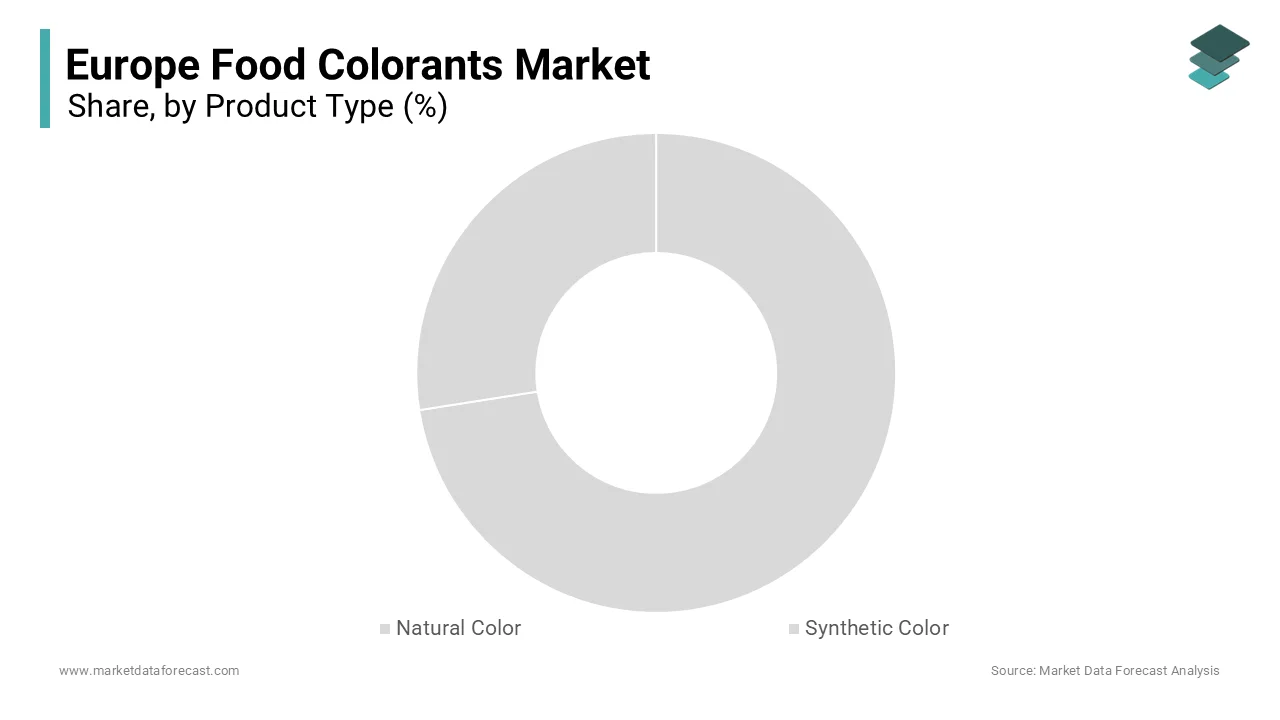
Based on product type, natural Colorants led with 68.6% share in 2025, driven by clean-label demand and rising health awareness.
-
Based on colour, red Colorants dominated with a 32% share in 2025 due to strong use in drinks, dairy, confectionery, and meat alternatives.
-
Based on application, food & beverages held 89.5% share in 2025, supported by high usage across bakery, snacks, dairy, and beverages.
Regional Insights
-
Europe saw strong growth as food processors widely adopted natural colors to meet rising clean-label consumer demand.
-
Germany led with a 24.5% share, driven by strong food manufacturing, clean-label launches, and a preference for natural ingredients.
-
These markets grew steadily, supported by packaged food innovation and rising demand for natural, safe colour additives.
-
These regions showed faster adoption of plant-based colours due to supportive regulations and high clean-label awareness.
Competitive Landscape
The European food Colorants market is moderately consolidated, with leading companies focusing on expanding natural ingredient portfolios, improving pigment extraction technologies, and strengthening partnerships with food manufacturers. Innovation in natural and hybrid colour formulations, sustainability initiatives, and clean-label product development are key strategic priorities among players.
Prominent companies operating in the European food Colorants market include: Royal DSM, BASF SE, Chr. Hansen A/S, Sensient Technologies, and Dohler Group SE
Europe Food Colorants Market Size
The Europe food colorants market size was valued at USD 4.75 billion in 2025 and is projected to reach USD 7.90 billion by 2034 from USD 5.03 billion in 2026, growing at a CAGR of 5.81%.
Food colorants are natural and synthetic additives used to enhance or restore the visual appeal of food and beverage products without altering their taste or nutritional profile. These substances are subject to stringent pre-market authorisation under the European Food Safety Authority framework. The market operates within a unique regulatory ecosystem where consumer perception heavily influences ingredient selection far beyond technical functionality. According to the European Commission, a significant share of prepackaged food products sold in EU supermarkets contain at least one form of colourant to meet aesthetic expectations shaped by decades standardised product appearance. As per sources, a majority of European shoppers associate vibrant and consistent colouring with freshness and quality, even in products where colour naturally varies,s, such as fruit yoghurts or sauces. Furthermore, as per the European Parliament, thousands of food products were reformulated between 2020 and 2025 to replace synthetic dyes following consumer pressure and retailer clean-label commitments. This interplay of regulation, consumer psychology, and product standardisation defines the European food colorants market as a domain where chemistry intersects with cultural expectation and legislative oversight.
MARKET DRIVERS
Consumer Demand for Clean Label and Natural Ingredients
The escalating incidence of consumer demand for clean-label and natural ingredients across Europe is one of the key factors propelling the growth of the European food colorants market. According to the 2026 Eurobarometer on Food Safety, food additives are among the top three consumer concerns, with 70% of Europeans actively checking food labels. Retailers such as Carrefour and Tesco have implemented private-label policies banning synthetic colours across their own-brand products, as confirmed in sustainability disclosures. Nestlé has committed to removing artificial colours from its confectionery portfolio in Europe, while Danone’s Activia brand says natural formulations in its dairy range. This clean-label imperative is not merely marketing but a compliance necessity as brands align with consumer ethics and impending EU restrictions on azo dyes.
Expansion of Processed and Ready-to-Eat Food Consumption
The growth of the European food colorants market is driven by the rising consumption of processed ready-to-eat foods across the continent. According to Eurostat’s Household Budget Survey, food and nonalcoholic beverages account for 13–15% of household expenditure in major EU economies, with convenience and prepared foods showing steady growth. The European ready-to-eat food market was valued at USD 91.5 billion in 2026, with strong growth projected through 2030. These categories rely heavily on colour stabilisation to counteract fading discolouration during storage and cooking. Plant-based meat alternatives also require complex colour systems to mimic animal products convincingly.
MARKET RESTRAINTS
Stringent EU Regulatory Bans on Specific Synthetic colorants
One of the primary restraints facing the European food colorants market is the stringent EU regulatory bans on specific synthetic colorants. The European Commission requires that seven azo dyes, including Tartrazine and Sunset Yellow, carry warning labels stating “mahurton activity and attention in children”. EFSA concluded in 2021 that titanium dioxide (E171) could no longer be considered safe, which is leading to its ban in food products effective February 2022. Approval timelines for new colour sources average 18–24 months, delaying innovation and increasing R&D costs.
Supply Chain Volatility of Natural Colourant Raw Materials
The supply chain disruptions and raw material shortages are hampering the European food colorants market growth. Annatto seed prices have surged due to crop failures in Latin America, the primary supplier. Climate variability has impacted beetroot and carrot yields in France and Poland, while paprika oleoresin supplies have been disrupted by export restrictions. Unlike synthetics, natural extracts vary in pigment concentration, requiring constant recalibration. Industry reports confirm that variability in natural colour potency has led to batch failures and reformulation delays for European dairy producers.
MARKET OPPORTUNITIES
Innovation in Microencapsulation Stabilisation Technologies
The growing adoption of microencapsulation and stabilisation technologies is a significant opportunity for the European food colorants market. According to the European Patent Office, multiple patents related to natural colourant stabilisation were filed in 2025, including anthocyanin-based and stable natural blue formulations. Microencapsulation of anthocyanins and spirulina extracts has improved heat and light stability by up to 80%, enabling broader use in UHT milk, baked goods, and confectionery. Companies such as GNT and Chr Hansen have commercialised proprietary platforms like Exberry’s “Shield” series, protecting pigments during processing.
Growth of Plant-Based and Alternative Protein Segments
The development of plant-based and alternative protein segments offers another promising avenue for the European food colorants market expansion. According to the Good Food Institute,, plant-based food sales across six major European countries reached €5.7 billion in 2025, growing by 5.5% in value and 3.5% in volume. Colour authenticity is cited as a top purchase driver, with 68% of consumers highlighting its importance. Plant-based burgers require a colour shift from red to brown during cooking, achieved through beet juice blends or fermentation-derived heme. Plant-based seafood uses algae extracts to replicate salmon’s pink hue, while dairy alternatives rely on carotenoids for creamy yellows.
MARKET CHALLENGES
Technical Limitations in Achieving Stable Blue and Green Hues
The absence of harmonised EU approvals for certain natural blue and green colorants is primarily challenging the European food colorants market. EFSA confirms that spirulina extract is the only permitted natural blue, restricted to specific categories such as confectionery and chewing gum. True green requires blending blue and yellow, but without a stable blue base, formulators rely on chlorophyllin, which often degrades to olive or brown. Beverages also struggle, with synthetic Brilliant Blue FCF still widely used because spirulina imparts an undesirable aftertaste at effective concentrations. Fermentation-derived alternatives such as phycocyanin remain unapproved under current EU Novel Food regulations.
Consumer Misperception and Inconsistent Clean Label Definitions
The growing instability due to consumer misperceptions of food additives is also challenging the expansion of the European food colorants market. According to the 2026 Eurobarometer, food additives remain one of the top three consumer concerns, with widespread confusion about Enumbers. Many consumers mistakenly believe that Enumbers exclusively denote synthetic additives, unaware that natural colours such as riboflavin (E101) and lutein (E161b) also carry E codes. Retailer definitions of clean label vary widely, with Aldi banning all Enumbers while Lidl permits natural Ecoded colours, creating formulation chaos for suppliers. A mid-sized European sauce manufacturer reported spending 30% of its R&D budget maintaining parallel product lines for different retailers.
REPORT COVERAGE
| REPORT METRIC | DETAILS |
| Market Size Available | 2025 to 2034 |
| Base Year | 2025 |
| Forecast Period | 2026 to 2034 |
| CAGR | 5.81% |
| Segments Covered | By Product TypeColouror, Application, and Region |
| Various Analyses Covered | Global, Regional, & Country Level Analysis; Segment-Level Analysis; DROC, PESTLE Analysis; Porter’s Five Forces Analysis; Competitive Landscape; Analyst Overview of Investment Opportunities |
| Regions Covered | UK, France, Spain, Germany, Italy, Russia, Sweden, Denmark, Switzerland, Netherlands, Turkey, and the Czech Republic |
| Market Leaders Profiled | Royal DSM, BASF SE, Chr. Hansen A/S, Sensient Technologies, and Dohler Group SE. |
SEGMENTAL ANALYSIS
By Product Type Insights
The natural colorants segment dominated the European food colorants market by holding 68.6% of the market share in 2025. The dominance of the natural colorants segment in this European market is attributed to regulatory orientation and consumer rejection of synthetic dyes in favour of plant, microbial, mineral-derived alternatives perceived as safer and more transparent. As per the European Commission, seven azo dyes now require mandatory warning labels, and titanium dioxide (E171) was banned entirely in 2022 due to nanoparticle concerns.
According to the European Food and Drink Association, in 2025, over 500 food brands across Germany and France voluntarily removed all synthetic colours ahead of anticipated stricter rules. Retailer policies amplify this shift, with Carrefour and REWE requiring naturally colorants in all private label products. As per Eurobarometer, 71% of Europeans believe natural colorants are healthier even when science confirms equivalent safety. In the next few years, natural colorants are expected to consolidate their dominance as regulation, consumer trust, and retailer policies continue to align.
BColourror Insights
The red colour segment led the European food colorants market and accounted for 32% of the market share in 202,4, owing to its broad culinary and psychological association with ripeness, sweetness, and indulgence across confectionery, dairy, beverages, and savoury applications. As per the European Dairy Association, in 2025, 92% of strawberry-flavoured yoghurts and 88% of fruit drinks in the EU used natural reds to meet clean-label demands. According to the European Alternative Proteins Association, 76% plant-based burger formulations rely on red colour systems. In the next few years, red colorants are expected to retain leadership due to their indispensable role in both traditional and plant-based foods.
The purpcolour segment is anticipated to grow at a promising CAGR of 9.4% through 2030 in the European market. The urbanisation, time poverty, and the normalisation of single-person households are supporting the growth of the purple colour segment in this European market. As per YouGov, 64% of European consumers associate purple foods with high antioxidant content, and 58% are willing to pay a premium for them. According to Mintel, purple smoothie bowls accounted for 22% of new beverage launches in the UK in 2025. As per EFSA, purple sweet potato extract was confirmed safe in 2023, facilitating rapid adoption. Over the next few years, purple colorants are expected to surge as “superfood” positioning and technical viability drive premium product launches.
By Application Insights
The food and beverages segment held the leading position in the European food colorants market in 2025 and occupied 89.5% of the regional market share. The dominance of the food and beverages segment in this European market is driven by the fundamental role of visual appeal in consumer food selection across processed categories. As per the European Bakery Federation, 95% of industrially produced muffins and croissants use colorants to ensure uniform golden crusts regardless of flour or egg batch differences. According to the European Dairy Association, 92% of fruit nectars and flavoured waters in Europe contain added hues to signify flavour or even when fruit content is minimal. As per EDEKA, a 2025 audit found that 17% of supplier deliveries were rejected for minor colour deviations. In the coming years, food and beverages will remain the backbone of demand, with colorants indispensable for consistency and branding.
The dietary supplements segment is anticipated to exhibit a CAGR of 10.2% through 2030 in the European market. The urbanisation, time poverty, and the normalisation of single-person households are favouring the growth of the dietary supplements segment in this European market. As per the European Health Ingredients Observatory, in 2025, 78% of new supplement launches in Germany and the Netherlands featured coloured capsules or gummies with hues aligned to their health claims. According to Bayer and Nestlé, microencapsulated anthocyanins are now used to achfade-resistantstred-purpleplcolours es in gummy vitamins. In the next few years, dietary supplements are expected to be the fastest-growing application, driven by health consciousness and chromatic differentiation.
REGIONAL ANALYSIS
Germany Market Analysis
Germany dominated the market in Europe in 2025 by holding 24.5% of the regional market share. The dominating position of Germany in the European market is driven by its stringent regulatory enforcement and leadership in natural ingredient innovation. According to the German Food Federation, the country hosts over 120 food additive manufacturers, including global players like Symrise and BASF, which collectively invest around €180 million annually in colourant R&D. As per the Federal Institute for Risk Assessment (BfR), Germany maintains one of Europe’s most rigorous approval processes, with dozens of natural colour sources evaluated in 2025. According to Statista, German consumers show strong vigilance, with over 80% checking for “without artificial colours” claims. As per the German Organic Food Association, 68% of organic certified processed foods use beetroot or turmeric-based colours. Municipal clean-label procurement policies in Berlin and Hamburg further reinforce natural-only additives in school meals. Germany is expected to sustain its leadership through regulatory rigour and innovation in the coming years.
France Market Analysis
France represents a promising regional segment in the European food colorants market. According to the French Ministry of Agriculture, over 700 food brands reformulated between 2022 and 2025 to eliminate synthetic dyes ahead of anticipated bans. As per INSEE consumer surveys, 76% of French consumers prefer products colored with fruit or vegetable extracts. Carrefour banned synthetic colours across all 3,000 own-brand SKUs in 2023, reinforcing retail-driven clean label adoption. According to FranceAgriMer, French beetroot and carrot crops supply a significant share of EU demand for red and orange extracts. France is likely to remain a bellwether for clean label evolution in Europe over the next few years.
The United Kingdom plays a key role in Europe’s food colorants market. According to the British Retail Consortium, major supermarkets mandated the removal of synthetic colours from private label products, affecting over 8,000 SKUs. As per the UK Office for National Statistics, households increasingly avoid dyes such as E129 and E102. According to the UPlant-Based Foods Alliance, 72% of plant-based meat launches in 2025 used natural reds to mimic beef. Post-Brexit autonomy has allowed faster adoption of novel natural sources such as spirulina blue. The UK is expected to remain a critical testing ground for next-generation colourant applications.
Italy Market Analysis
Italy continues to exert influence in Europe’s food colorants market. According to ISTAT, 84% of Italian consumers associate vibrant reds in tomato sauces and sausages with quality. As per Assitol’s 2025 census, over 200 Italian ingredient firms specialise in fruit and vegetable concentrates used as colorants. According to Italian Organic Association data, 61% of organic pasta sauces use paprika or beetroot red. Italy also supports EU bans on titanium dioxide and restricts azo dyes in children’s foods. Italy is expected to expand its role in natural colourant sourcing and application in the coming years.
Netherlands Market Analysis
The Netherlands is positioned as Europe’s logistics and innovation hub for food colorants. According to the Port of Rotterdam Authority, the port handled a significant share of EU imports in 2025. As per DSM technical bulletins, its MaxiBrite platform achieved 90% light stability in dairy applications. Statistics Netherlands reports that 73% of Dutch shoppers prefer natural colours. The Dutch Green Deal for Food supports algae-based pigment projects, reducing reliance on importsBusiness.gov.nl. The Netherlands is expected to strengthen its role as Europe’s colourant innovation nexus in the next few years.
COMPETITIVE LANDSCAPE
KEY MARKET PLAYERS
Some of the notable key players in the European food colorants market are
- Royal DSM
- BASF SE
- Chr. Hansen A/S
- Sensient Technologies
- Dohler Group SE
TOP STRATEGIES USED BY THE KEY MARKET PLAYERS
Leading players in the Efood ccolcolorants market intensifying investments in natural colour or innovation through biotechnology and microencapsulation to overcome stability and hue limitations. They are establishing vertical integration with raw material growers to secure supply and ensure traceability amid climate volatility. Companies are developing digital tools for real-time colour matching and formulation support to accelerate client product development cycles. Strategic collaborations with retailers and food brands are being leveraged to co-create clean label standards aligned with EFSA guidelines. Additionally, firms are expanding production capacity in Europe to reduce import dependency and comply with stricter novel food and sustainability regulations.
COMPETITION OVERVIEW
Competition in the European food colorants market is defined by a race toward technical superiority in natural systems rather than price or volume. Global ingredient giants like GNT, Chr Hansen and DDW dominate through proprietary extraction methmethods fermentationatforms and application expertise that solve real formulation challenges in dairy beverages and plant-based foods. Unlike other regions, Europe’s stringent EFSA regulations and retailer-driven clean label mandates create high barriers to entry, favouring established players with regulatory track records. Smaller suppliers focus on niche hues or regional crops but struggle with scalability. The competitive edge lies in delivering colours that are not only natural but also stable, functional, and traceable. Innovation in blue and green shades microencapsulation and digital formulation tools has become the new battleground as companies strive to replace synthetics without compromising performance. This environment fosters collaboration with food manufacturers and continuous R and D investment, making the market both dynamic and highly specialised.
TOP PLAYERS IN THE MARKET
- GNT Group is a Netherlands-based leader in natural food colorants, renowned for its Exberry brand, which uses fruit and vegetable concentrates to deliver clean label hues. The company supplies over 80 countries globally and is recognised for pioneering water-soluble colour systems that perform in challenging applications like dairy and beverages. In 2025, GNT expanded its production capacity in Germany with a new 30 million euro facility dedicated to purple and blue shades derived from purple sweet potato and spirulina. It also launched a digital colour-matching tool, enabling food manufacturers to preview natural hues in real-time formulations. These initiatives reinforce GNT’s position as an innovation driver committed to sustainability, transparency, and technical excellence in natural colouring
- Chr Hansen is a Danish biotechnology company with a strong legacy in natural ingredient solutions, including food colorants derived from microbial fermentation and plant extracts. Globally, it serves major dairy confectionery and plant-based food producers with stable anthocyanin and carotenoid systems. In 2025, Chr Hansen introduced a next-generation red colourant fronon-GMOMO yeast engineered for heat and light stability in baked goods and meat alternatives. The company also deepened its partnership with European retailers to co-develop clean label guidelines that align with EFSA standards. By combining biotech innovation with regulatory foresight, Chr Hansen strengthens its role as a trusted partner in the transition toward fully natural colouring across Europe.
- DDW TheColourr House is a global natural colourant specialist with significant European operations headquartered in Germany. The company specialises in custom colour solutions using black carrot turmeric and spirulina, with a focus on consistent performance in acidic and thermal processing environments. In 2025, DDW launched its “ColorClean” certification program, verifying the absence of synthetic residues and allergens in its extracts. It also invested in traceability blockchain technology to provide farm-to-factory visibility for key raw materials like beetroot and paprika. These actions enhance brand credibility and meet the growing demand from European food manufacturers for auditable, sustainable, and compliant natural colour systems that support both clean label and corporate ESG goals.
MARKET SEGMENTATION
This research report on the European food colorants market has been segmented and sub-segmented based on categories.
By Product Type
- Natural Color
- Anthocyanins
- Carotenoids
- Curcumin
- Carmine
- Spirulina
- Other Types
- Synthetic Color
- Azo Dyes (e.g., Tartrazine, Sunset Yellow, etc.)
- Brilliant Blue FCF
- Others
By Color
- Blue
- Green
- Red
- Yellow
- Purple
- Orange
- Pink
- Others
By Application
- Food and Beverages
- Bakery and Confectionery
- Dairy Products
- Snacks and Cereals
- Beverages
- Others
- Personal Care and Cosmetics
- Pharmaceuticals
- Dietary Supplements
- Other Applications
By Country
- UK
- France
- Spain
- Germany
- Italy
- Russia
- Sweden
- Denmark
- Switzerland
- Netherlands
- Turkey
- Czech Republic
- Rest of Europe