- Product Description Description
- Table of Contents TOC
- List of Table & Figure LOT
- Get Free Sample PDF Sample PDF
Market Size, 2025
$8.81 BnMarket Estimate, 2026
$9.42 BnMarket Forecast, 2034
$16.20 BnCAGR, 2026–2034
7.01%Europe Frozen Fish Market Report Summary
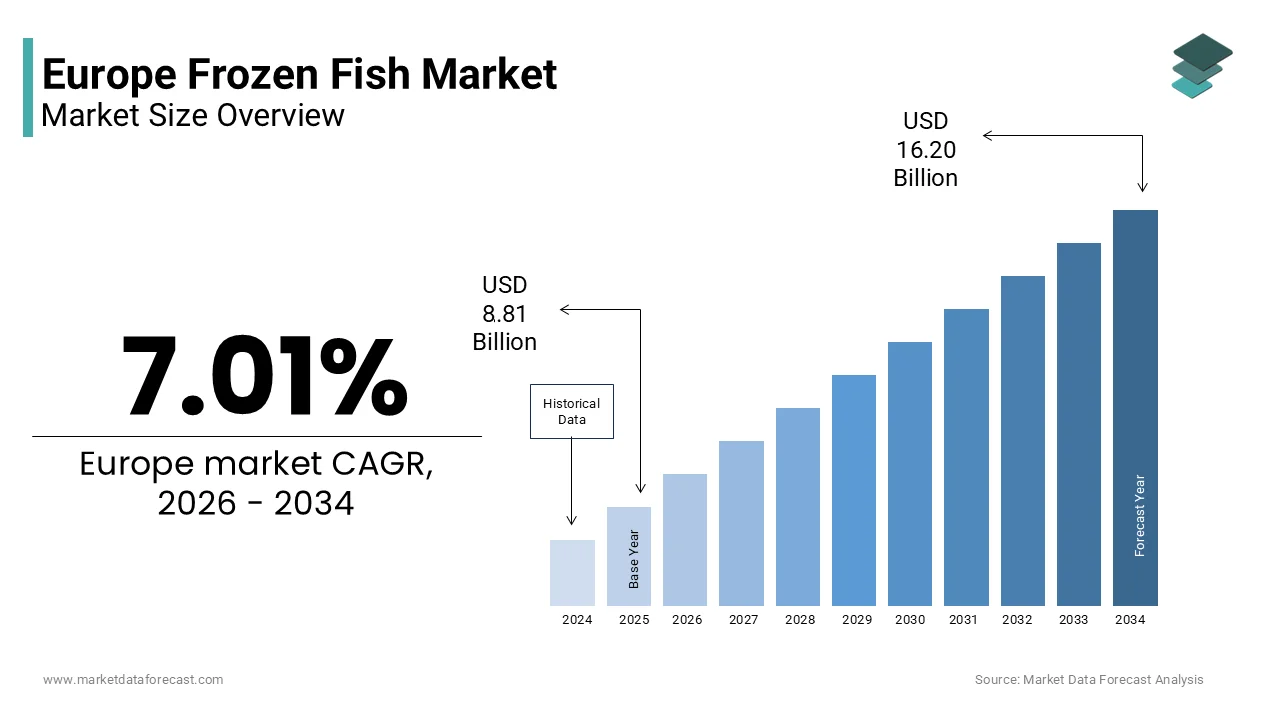
The Europe frozen fish market was valued at USD 8.81 billion in 2025, is estimated to reach USD 9.42 billion in 2026, and is projected to reach USD 16.20 billion by 2034, growing at a CAGR of 7.01% during the forecast period from 2026 to 2034. The growth of the Europe frozen fish market is driven by increasing consumer preference for convenient and long shelf life seafood products, rising demand for protein rich diets, and expanding retail distribution networks. The growing popularity of ready to cook and processed seafood, along with advancements in freezing technologies that preserve freshness and nutritional value, are further supporting market expansion. Additionally, the rising consumption of breaded and value added fish products is contributing to sustained market growth across Europe.
Key Market Trends
- Increasing demand for frozen seafood driven by convenience, extended shelf life, and reduced food waste among consumers.
- Rising popularity of ready to cook and breaded fish products due to changing lifestyles and quick meal preferences.
- Strong growth of supermarkets and hypermarkets as key distribution channels offering wide product availability and one stop shopping convenience.
- Growing consumer focus on high protein and healthy diets supporting increased seafood consumption.
- Advancements in cold chain logistics and freezing technologies ensuring product quality and safety.
Segmental Insights
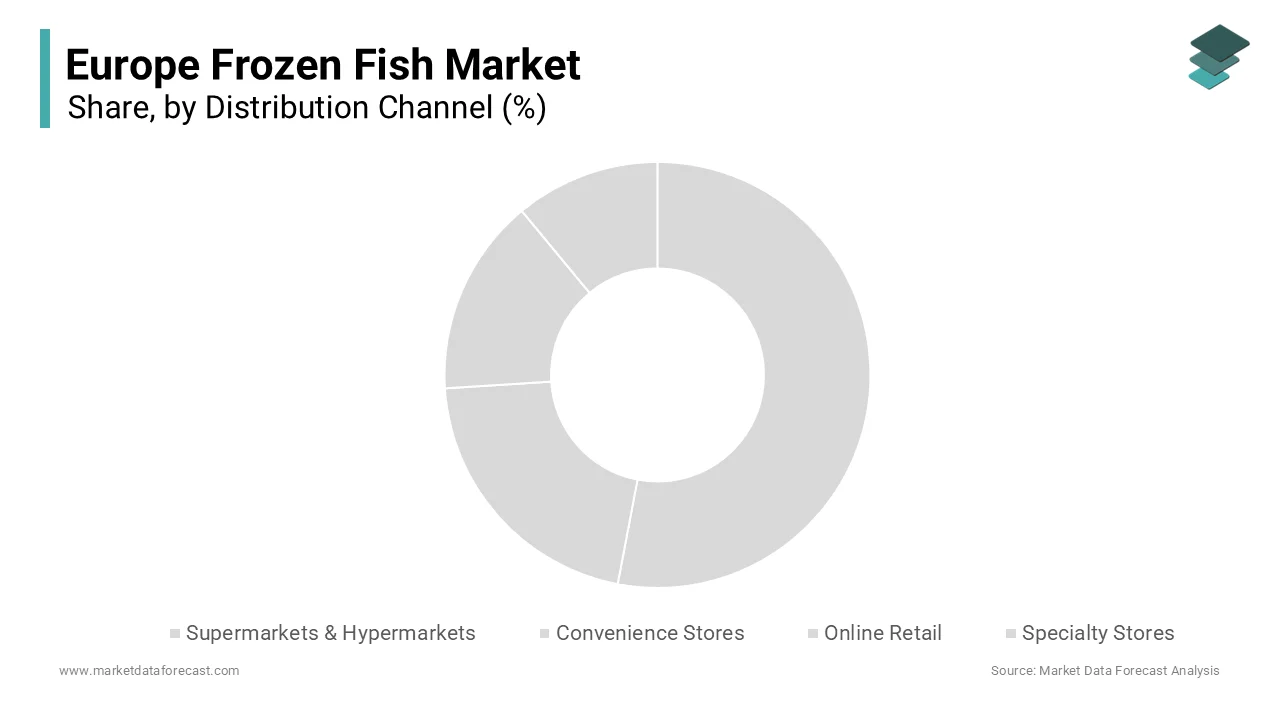
- Based on distribution channel, the supermarkets and hypermarkets segment held a significant share of the Europe frozen fish market in 2025. The dominance of this segment is attributed to one stop shopping convenience, wide product assortment, and strong presence of organized retail chains across Europe.
Regional Insights
- The Europe frozen fish market is witnessing steady growth across key countries driven by increasing seafood consumption and expanding retail infrastructure.
- Germany was the largest contributor, accounting for 32.2% of the Europe frozen fish market share in 2025, driven by high consumption of processed and breaded fish products, strong demand for convenient seafood options, and a well established discount retail sector.
Competitive Landscape
The Europe frozen fish market is competitive with several global and regional players focusing on product innovation, sustainable sourcing, and expansion of distribution networks. Companies are investing in value added seafood products, improving cold chain capabilities, and strengthening partnerships with retail chains to enhance market presence. Prominent players in the Europe frozen fish market include Dongwon Enterprises Co. Ltd., Mowi ASA, Zoneco Group Co., Ltd., F.C.F. Fishery Co., Ltd., Nippon Suisan Kaisha, Ltd., Chicken of the Sea International under Thai Union Group PLC, Nueva Pescanova S.L under Abanca Corporación Bancaria S.A., Tassal Group Limited, High Liner Foods, and SalMar ASA under Kvera AS.
Europe Frozen Fish Market Size
The Europe frozen fish market size was valued at USD 8.81 billion in 2025 and is projected to reach USD 16.20 billion by 2034 from USD 9.42 billion in 2026, growing at a CAGR of 7.01%.
The frozen fish is rapid freezing techniques to maintain nutritional integrity and extend shelf life. As per data from the European Environment Agency, over 60% of fish stocks in the Northeast Atlantic are now harvested at sustainable levels, providing a stable raw material base for freezing operations. The European Commission notes that household freezers are present in nearly 95% of homes across the European Union, creating a robust infrastructure for long-term storage by end consumers. Furthermore, the Food and Agriculture Organization of the United Nations indicates that freezing reduces food waste by extending the usability of perishable catches by up to 12 months compared to fresh alternatives. National statistics from Norway reveal that approximately 80% of its salmon production is exported, with a significant portion destined for freezing to facilitate global logistics. Meanwhile, the European Food Safety Authority emphasizes that proper freezing protocols eliminate parasites in certain species by making them safe for raw consumption like sushi.
MARKET DRIVERS
Expansion of Retail Cold Chain Infrastructure and Penetration
The continuous enhancement of cold chain logistics and the ubiquitous presence of freezer units in retail outlets serve is majorly fuelling the growth of the Europe frozen fish market. Modern supply chains ensure that fish products maintain optimal temperatures from the point of capture to the supermarket shelf, preserving quality and safety standards that consumers demand. As per the European Cold Storage and Logistics Association, the capacity of temperature-controlled warehousing in Europe has increased by 15% over the last five years, enabling larger volumes of frozen seafood to be stored and distributed efficiently. This infrastructural growth allows retailers to stock a wider variety of species, including exotic imports from Asia and South America, without fear of spoilage. Data from Eurostat shows that the density of superstores and hypermarkets equipped with extensive frozen food aisles has risen by 8% in Eastern Europe, opening new markets for frozen protein. The reliability of these cold chains reduces shrinkage and waste for retailers, making frozen fish a more profitable category than fresh fish which has a shorter shelf life. Furthermore, the integration of real-time temperature monitoring systems ensures compliance with strict European food safety regulations, building consumer trust. The ability to transport goods over long distances without degradation facilitates trade between Northern production hubs and Southern consumption centers, driving overall market volume.
Rising Consumer Preference for Convenience and Ready-to-Cook Formats
The shifting lifestyle dynamics are busier schedules and smaller household sizes, such as breaded fillets, ready meals, and pre-marinated portions is additionally bolstering the growth of Europe frozen fish market. Consumers increasingly seek meal solutions that minimize preparation time while retaining nutritional value, a need that frozen formats address effectively. As per the recent survey, 45% of European shoppers purchase frozen fish specifically for its convenience features, such as single-serve packaging and included seasoning sauces. The perception of frozen food has evolved from a budget option to a premium choice, with gourmet frozen lines featuring wild-caught species gaining traction in major markets like France and Germany. Retailers support this shift by dedicating more shelf space to innovative frozen ranges that offer restaurant-quality meals at home. The consistency of portion sizes in frozen products also aids in dietary management and cost control for households. This behavioral shift towards convenience ensures sustained demand for processed frozen fish varieties.
MARKET RESTRAINTS
Volatility in Raw Material Supply Due to Climate Change
The instability of wild fish stocks caused by changing ocean temperatures and shifting migration patterns is restraining the growth of Europe frozen fish market. Climate change alters the abundance and location of key commercial species, leading to unpredictable catch volumes that disrupt the steady supply required for industrial freezing operations. These reductions limit the availability of raw materials for processors, leading to production bottlenecks and increased competition for remaining resources. Data from the European Commission shows that quota cuts for cod and haddock have directly impacted the output of frozen fillet plants in countries like Iceland and the United Kingdom. The unpredictability of catches makes long-term planning difficult for manufacturers who rely on consistent volumes to operate freezing lines efficiently. Furthermore, the shift of species toward northern waters increases fuel costs for fishing fleets, raising the overall cost of goods sold. This supply volatility forces producers to either raise prices, potentially dampening demand, or switch to alternative species that may not have established market acceptance. The ecological uncertainty thus poses a fundamental risk to the stability and scalability of the frozen fish sector.
Negative Consumer Perception Regarding Quality and Freshness
The negative consumer perception regarding quality and freshness is also hampering the growth of Europe frozen fish market. As per a survey conducted by the European Consumer Organisation, 35% of respondents believe that frozen fish lacks the nutritional benefits and flavor profile of fresh fish, even when presented with evidence to the contrary. This misconception drives a preference for fresh counters in supermarkets, relegating frozen options to a secondary choice for budget-conscious shoppers. Data from national dietary studies in Italy and Spain reveal that fresh fish consumption remains three times higher than frozen, promoting the cultural resistance to frozen formats. The stigma is often associated with older freezing technologies that caused ice crystal formation and mushy textures, a reputation that modern flash-freezing methods have struggled to fully erase. Retailers face challenges in marketing frozen products as premium items when deep-seated biases persist. Overcoming this perception requires significant investment in consumer education and transparent labeling, which adds to operational costs.
MARKET OPPORTUNITIES
Development of Sustainable and Eco-Labeled Product Lines
The growing consumer consciousness regarding environmental sustainability to differentiate through certified eco-friendly product lines is certainly to promote new opportunities for the growth of Europe frozen fish market. Shoppers are increasingly willing to pay a premium for seafood that guarantees responsible sourcing and minimal environmental impact, driving demand for items bearing labels like the Marine Stewardship Council or Aquaculture Stewardship Council. As per the Marine Stewardship Council, sales of certified sustainable seafood in Europe have grown by 22% annually, with frozen categories seeing significant uptake due to the ease of tracking supply chains. Manufacturers can leverage this trend by launching exclusive frozen ranges sourced entirely from certified fisheries, appealing to the ethical values of modern consumers. The frozen format inherently supports sustainability by reducing food waste through extended shelf life, a message that resonates strongly with environmentally aware demographics. Brands that transparently communicate their carbon footprint and fishing methods on packaging can build strong loyalty and command higher margins. Furthermore, retailers are prioritizing shelf space for sustainable options to meet their own corporate responsibility goals.
Innovation in Plant-Based and Hybrid Seafreezing Technologies
Advancements in freezing technologies and the emergence of hybrid or plant-based seafood alternatives to expand its portfolio beyond traditional animal protein is additionally enhancing the growth of Europe frozen fish market. New cryogenic freezing methods preserve the texture of delicate species and novel alternatives more effectively, opening doors for high-quality product innovation. As per Wageningen University research, the development of plant-based fish analogues that mimic the flakiness of cod or salmon is gaining momentum, with the frozen sector being the ideal channel for their distribution due to stability requirements. The European Union has approved funding for several projects focused on alternative proteins, signaling regulatory support for diversification. Data from the Good Food Institute Europe indicates that investment in seafood alternatives has tripled in the last two years, with most products launched in frozen formats to ensure optimal sensory experience. Freezing allows these new products to reach a wider geographic audience without the spoilage risks associated with fresh plant-based seafood. Additionally, hybrid products combining real fish with plant proteins offer a bridge for flexitarian consumers looking to reduce intake without sacrificing taste.
MARKET CHALLENGES
Fluctuating Energy Costs Impacting Freezing and Storage Operations
The soaring volatility of energy prices to the economic viability is given the energy-intensive nature of freezing and cold storage processes, which is one of the challenges for the growth of Europe frozen fish market. Industrial freezers and large-scale cold warehouses require continuous and substantial electricity consumption, making operators highly exposed to utility rate spikes. Freezing fish rapidly using blast freezers consumes significant power, and maintaining sub-zero temperatures for months adds a relentless operational cost burden. Data from the European Cold Storage and Logistics Association reveals that energy costs now account for up to 30% of total operating expenses for cold storage facilities, a sharp increase from historical averages. Small and medium-sized enterprises often lack the hedging mechanisms available to larger corporations, threatening their survival in a high-cost environment. The necessity to pass these costs onto consumers risks dampening demand in a price-sensitive market. Furthermore, the push for greener energy sources requires capital investment in new equipment, adding financial pressure.
Complex Regulatory Compliance and Traceability Requirements
The intricate web of European regulations regarding food safety, labeling, and traceability is another challenge the growth of Europe frozen fish market. The European Union enforces some of the strictest rules globally, requiring detailed documentation of origin, catch method, and handling history for every batch of seafood. As per the European Commission, the implementation of the new Control Regulation demands digital traceability systems that track fish from boat to plate, imposing significant administrative and technological burdens on processors. Non-compliance can result in hefty fines and product recalls, damaging brand reputation and financial stability. Data from the European Food Safety Authority indicates that the rejection rate for seafood shipments due to documentation errors or labeling discrepancies has risen by 10% in recent years. The requirement to label allergens, additives, and nutritional information accurately on frozen packaging adds another layer of complexity, especially for exporters dealing with varying national interpretations. Small producers often struggle to afford the sophisticated software and legal expertise needed to maintain full compliance. The constant evolution of these regulations, driven by sustainability and health agendas, requires continuous adaptation and investment.
REPORT COVERAGE
| REPORT METRIC | DETAILS |
| Market Size Available | 2025 to 2034 |
| Base Year | 2025 |
| Forecast Period | 2026 to 2034 |
| CAGR | 7.01% |
| Segments Covered | By Distribution Channel, Type, and Region |
| Various Analyses Covered | Global, Regional, & Country Level Analysis; Segment-Level Analysis; DROC, PESTLE Analysis; Porter’s Five Forces Analysis; Competitive Landscape; Analyst Overview of Investment Opportunities |
| Regions Covered | UK, France, Spain, Germany, Italy, Russia, Sweden, Denmark, Switzerland, Netherlands, Turkey, and the Czech Republic |
| Market Leaders Profiled | Dongwon Enterprises Co. Ltd., Mowi ASA, Zoneco Group Co., Ltd., F.C.F. Fishery Co., Ltd., Nippon Suisan Kaisha, Ltd., Chicken of the Sea International Thai Union Group PLC, Nueva Pescanova S.L Abanca Corporación Bancaria S.A., Tassal Group Limited, High Liner Foods, and SalMar ASA Kvera AS |
SEGMENTAL ANALYSIS
By Distribution Channel Insights
The supermarkets and hypermarkets segment held a significant share of the Europe frozen fish market in 2025 with the one-stop shopping convenience these large-format stores offer, allowing consumers to purchase frozen seafood alongside their weekly grocery essentials in a single trip. A primary factor sustaining this dominance is the extensive cold chain infrastructure possessed by major retail chains, which ensures the highest standards of product quality and safety from warehouse to freezer aisle. As per data from the European Retail Round Table, over 80% of frozen food sales in countries like Germany, France, and the United Kingdom occur within hypermarkets due to their ability to maintain strict temperature controls and offer vast variety under one roof. These retailers also wield significant bargaining power by enabling them to secure consistent supplies of popular species at competitive prices, which is crucial for price-sensitive consumers facing inflation. Furthermore, the integration of private label frozen fish ranges has solidified their market position, as shoppers increasingly trust store brands for quality and value. Many European households prefer buying frozen fish from supermarkets because of the perceived reliability of sourcing and the availability of detailed nutritional labeling compliant with EU regulations. The ability of these chains to launch promotional campaigns and bundle deals further drives volume, making them the primary gateway for frozen fish entry into European homes.
The online retail segment is likely to witness a fastest CAGR of 14.5% throughout the forecast period with a fundamental shift in consumer behavior towards digital commerce and the demand for home delivery services, a trend significantly accelerated by recent global events that normalized online grocery shopping. The emergence of specialized e-commerce platforms dedicated solely to premium and sustainable seafood by offering a wider variety of species and gourmet frozen products than typically found in local brick-and-mortar stores. These platforms leverage advanced logistics partnerships to guarantee next-day delivery of insulated, ice-packed frozen fish, effectively addressing previous concerns about thawing during transit. The transparency and traceability provided by digital channels, where consumers can access detailed information about the origin, catch method, and sustainability credentials of the product with a single click. The subscription model adopted by many online fishmongers, offering regular deliveries of curated boxes, fosters customer loyalty and recurring revenue, fueling the segment's exceptional growth trajectory.
REGIONAL ANALYSIS
Germany Frozen Fish Market Analysis
Germany was the largest contributor of the Europe frozen fish market by capturing 32.2% of share in 2025 with its high consumption of processed and breaded fish products and a robust discount retail sector. The strong preference for convenience foods that fit the fast-paced lifestyle of the workforce, with frozen fish seen as a practical solution for quick meals is expanding the growth of Europe frozen fish market. The dominance of discount supermarket chains like Aldi and Lidl, which have democratized access to high-quality frozen seafood through aggressive pricing and extensive private label offerings is also fuelling the growth of Europe frozen fish market. The retail sector plays a crucial role by offering frozen fish at competitive prices, making it accessible to a broad demographic across all income levels. Furthermore, Germany is a leader in sustainability certification adoption, with a high sold frozen fish carrying the MSC or ASC labels, which is reflecting the environmentally conscious mindset of its consumers.
United Kingdom Frozen Fish Market Analysis
The United Kingdom frozen fish market growth is likely to grow with a deep cultural affinity for traditional fish dishes and a highly developed frozen food culture. The busy urban lifestyle in cities like London and Manchester, which drives demand for convenient, portion-controlled frozen fish products that reduce cooking time and food waste. As per data from the Department for Environment Food and Rural Affairs, the UK fishing fleet lands approximately 600,000 metric tons of fish annually, but a substantial portion of domestic demand is met by frozen imports to ensure year-round availability. Statistics from Kantar Worldpanel reveal that frozen fish accounts for nearly 40% of total household fish purchases in the UK, a figure significantly higher than the European average. Additionally, the rise of health consciousness among British consumers has shifted demand toward frozen lean white fish and omega-3 rich salmon, driving retail innovation in healthy ready-meals.
France Frozen Fish Market Analysis
France frozen fish market growth is likely to grow with the culinary tradition for fresh seafood with a growing acceptance of high-quality frozen alternatives. The sophisticated consumer base that demands premium products by leading to a surge in the popularity of frozen gourmet fish items and ready-to-cook meals featuring exotic species. The increasing participation of women in the workforce and the changing family dynamics, which have reduced the time available for daily market visits and lengthy food preparation is also elevating the growth of the market in this country. Data from the French Ministry of Agriculture indicates that the frozen sector has successfully introduced value-added products like marinated fillets and stuffed fish, which appeal to the gastronomic sensibilities of the population.
Spain Frozen Fish Market Analysis
Spain frozen fish market growth is likely to grow with a robust domestic capture sector complemented by a rapidly expanding frozen segment that caters to both local needs and export demands. The deep-rooted Mediterranean diet, which mandates frequent fish consumption, coupled with the need to preserve abundant catches from its large fishing fleet for future use is also gearing up the growth of market. As per data from the Spanish Ministry of Agriculture Fisheries and Food, per capita fish consumption in Spain exceeds 26 kilograms annually, with frozen products playing an increasingly vital role in managing supply fluctuations and reducing waste. The country's strategic location allows its fleet to operate in diverse waters, securing a wide variety of species that are often frozen immediately at sea to lock in freshness. Statistics from the Spanish Association of Fish Canners and Processors highlight that the freezing sector is a major economic engine, transforming raw catch into high-value exported goods and domestic staples. Additionally, the tourism industry amplifies demand, as the hospitality sector relies on frozen fish to ensure consistent menu availability throughout the year.
Italy Frozen Fish Market Analysis
Italy frozen fish market growth is likely to be driven by the adoption of frozen formats for convenience and variety. The rising cost of fresh seafood, which has pushed many Italian consumers toward frozen alternatives that offer better price stability and reduced waste is also to boost the growth of market. As per data from the Italian National Institute of Statistics, sales of frozen fish products have increased over the last five years, particularly in northern regions where industrial work schedules limit time for traditional shopping. The introduction of high-quality frozen specialties, such as breaded cutlets and pre-prepared seafood mixes, has helped overcome cultural resistance by offering restaurant-quality results at home. Data from Coldiretti, the national farmers' association, highlights that while fresh fish remains preferred, the frozen sector is gaining ground among younger generations who prioritize practicality. Furthermore, the Italian processing industry is investing heavily in advanced freezing technologies to preserve the texture and flavor of delicate Mediterranean species, enhancing consumer trust. The growing awareness of food waste reduction also supports the frozen segment, as families appreciate the ability to use only what they need without spoilage, signaling a transformative period for the Italian market.
COMPETITIVE LANDSCAPE
The competition in the Europe frozen fish market is characterized by high intensity among a mix of large multinational corporations and numerous specialized regional processors. Dominant players leverage their scale and established distribution networks to control costs and ensure supply stability, creating significant barriers to entry for new competitors. The market sees fierce rivalry based on product quality, sustainability credentials, and price competitiveness as retailers demand ever lower costs while insisting on high ethical standards. Innovation acts as a key battleground where companies invest heavily in new product formats and eco friendly packaging to gain an edge. Geographic diversification is another critical competitive factor as firms seek to reduce reliance on single production zones vulnerable to climate change or regulatory shifts. The presence of strong private label offerings from major supermarket chains further intensifies pressure on branded suppliers to differentiate themselves. Consolidation trends continue as larger entities acquire smaller farms or processors to increase market power and optimize logistics networks.
KEY MARKET PLAYERS
Some of the notable key players in the Europe frozen fish market are
- Dongwon Enterprises Co. Ltd.
- Mowi ASA
- Zoneco Group Co., Ltd.
- F.C.F. Fishery Co., Ltd.
- Nippon Suisan Kaisha, Ltd.
- Chicken of the sea International (Thai Union Group PLC)
- Nueva Pescanova, S.L (Abanca Corporación Bancaria, S.A.)
- Tassal Group Limited
- High Liner Foods
- SalMar ASA (Kvera AS)
Top Players in the Market
- Findus Group Limited stands as a premier brand in the European frozen fish sector, renowned for its extensive portfolio of breaded fish sticks, fillets, and ready meals. The company contributes significantly to the global market by setting high standards for sustainable sourcing and product innovation in the frozen category. Findus actively engages with fisheries worldwide to ensure responsible practices while delivering convenient meal solutions to millions of households. Recent actions to strengthen its market position include the launch of new plant-based seafood alternatives and the expansion of its range of MSC certified wild caught products across major retail chains. The company has also invested heavily in upgrading its manufacturing facilities to improve energy efficiency and reduce carbon emissions. These strategic initiatives reinforce its reputation as a leader in quality and sustainability by ensuring it remains a preferred choice for retailers and shoppers throughout Europe.
- Iglo Group Holdings Limited operates as a leading frozen food company with a strong emphasis on fish products under brands like Birds Eye and Iglo. The corporation plays a vital role in the global market by pioneering flash freezing technologies that lock in freshness and nutrition at the source. Iglo supplies a diverse array of frozen fish items to consumers across Europe, ranging from simple fillets to complex gourmet dishes. To bolster its market position, the company recently committed to sourcing 100% of its fish from sustainable sources by 2025 and has introduced fully recyclable packaging for its entire range. It has also expanded its production capacity in key European locations to meet rising demand for convenient protein options. Furthermore, Iglo has launched marketing campaigns highlighting the nutritional benefits of frozen fish compared to fresh alternatives to shift consumer perceptions.
- Nordic Seafood A/S is a major player in the Europe frozen fish market, specializing in the processing and distribution of high-quality whitefish and salmon products. The company leverages its strategic location in Northern Europe to access prime fishing grounds and ensure rapid processing times for optimal freshness. Nordic Seafood contributes to the global market by exporting premium frozen seafood to diverse international destinations while maintaining rigorous quality controls. Recent actions to strengthen its position include the acquisition of additional processing facilities to increase volume capacity and the implementation of advanced traceability systems for all product lines. The firm has also developed new value-added products such as marinated and seasoned frozen fish to cater to evolving consumer tastes for convenience. By partnering directly with local fishermen and adhering to strict sustainability certifications, Nordic Seafood ensures a stable supply of raw materials. These strategic moves enhance its operational efficiency and brand reliability, enabling it to compete effectively against larger multinational corporations in the dynamic European market.
Top Strategies Used by Key Market Participants
Key players in the Europe frozen fish market primarily employ vertical integration strategies to control the supply chain from catching or farming to processing and distribution. This approach allows companies to ensure consistent quality, reduce costs, and mitigate supply chain disruptions effectively. Another major strategy involves heavy investment in sustainable sourcing certifications such as MSC and ASC to meet growing consumer demand for ethical products. Companies also focus on product innovation by launching value added and convenience oriented items like ready to cook meals to appeal to busy lifestyles. Strategic acquisitions of smaller regional brands help major firms expand their geographic reach and diversify their product portfolios rapidly. Furthermore, upgrading manufacturing technologies to improve energy efficiency and reduce environmental impact serves as a critical tool to comply with strict regulations.
MARKET SEGMENTATION
This research report on the European frozen fish market has been segmented and sub-segmented based on categories.
By Distribution Channel
- Supermarkets & Hypermarkets
- Convenience Stores
- Online Retail
- Specialty Stores
By Type
- Salmon
- Tuna
- Shrimp
- Cod
- Tilapia
- Others
By Country
- UK
- France
- Spain
- Germany
- Italy
- Russia
- Sweden
- Denmark
- Switzerland
- Netherlands
- Turkey
- Czech Republic
- Rest of Europe