Europe Goat Meat Market Size, Share, Trends & Growth Forecast Report By Product Type, By Distribution Channel, By End-User, and By Country (United Kingdom, Spain, France, Germany, Italy & Rest of Europe) – Industry Analysis and Forecast, 2026 to 2034.
Market Size, 2025
$2.36 BnMarket Estimate, 2026
$2.46 BnMarket Forecast, 2034
$3.44 BnCAGR, 2026–2034
4.29%Europe Goat Meat Market Size
The europe goat meat market was valued at USD 2.36 billion in 2025, is estimated to reach USD 2.46 billion in 2026, and is projected to reach USD 3.44 billion by 2034, growing at a CAGR of 4.29% from 2026 to 2034.
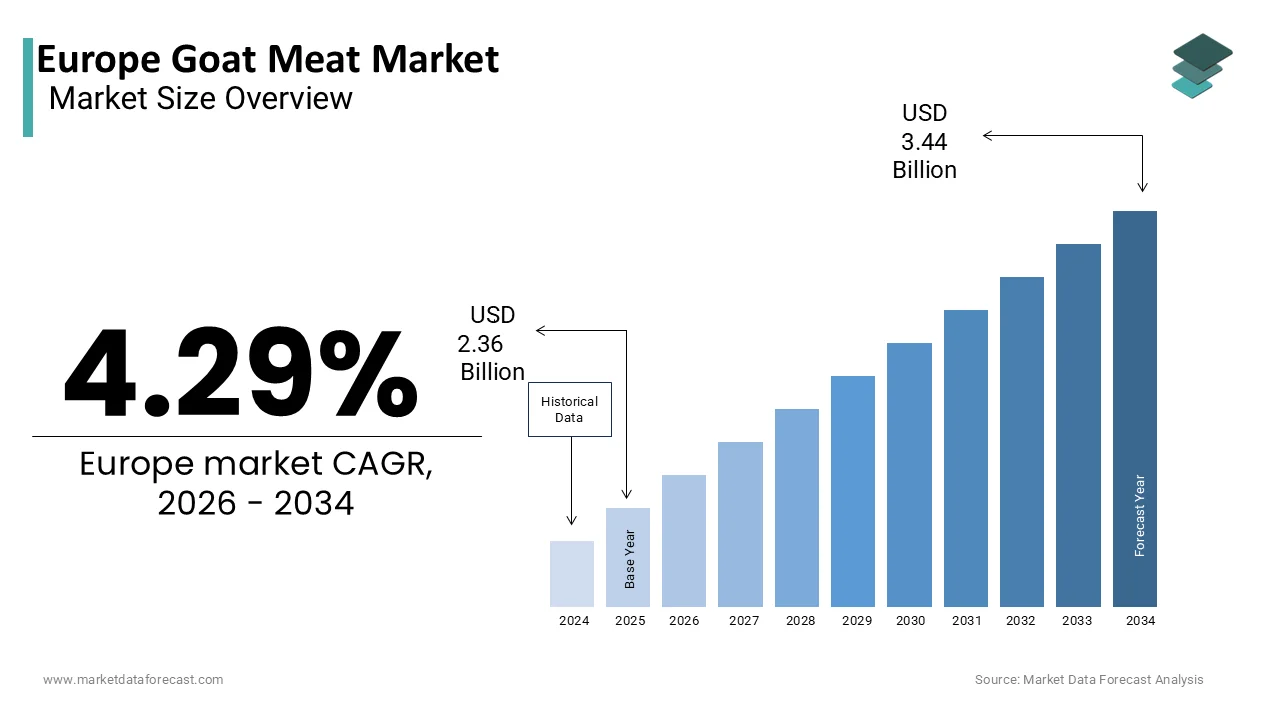
The goat meat is a dual structure comprising traditional extensive grazing systems in Southern and Eastern Europe and niche artisanal production in Western regions. As per data from Eurostat, the European Union maintains a goat population of approximately 10 million heads, with significant concentrations in Greece, Spain, and Romania, reflecting the animal's adaptation to diverse climatic conditions. The European Environment Agency notes that goat farming contributes significantly to biodiversity conservation by preventing scrub encroachment and reducing wildfire risks in Mediterranean ecosystems. Furthermore, the Food and Agriculture Organization of the United Nations highlights that goat meat is the most consumed red meat globally, yet in Europe, it remains a culturally specific commodity often tied to religious festivals and ethnic communities. Meanwhile, the World Health Organization emphasizes the nutritional profile of goat meat as being lower in fat and cholesterol compared to beef or pork, aligning with modern dietary guidelines.
MARKET DRIVERS
Expanding Demographic Diversity and Ethnic Consumption Patterns
The increasing cultural diversity by transforming it from a niche ethnic product into a staple is boosting the growth of Europe goat meat market. Migration flows from Africa, the Middle East, and South Asia have established robust consumer bases in major urban centers across the United Kingdom, France, Germany, and the Netherlands, where goat meat is a dietary cornerstone. As per data from the European Commission, the non-EU migrant population in Europe has risen steadily, with specific communities maintaining strong culinary traditions that prioritize caprine protein for daily meals and religious celebrations. Data from national census bureaus in countries like the United Kingdom reveal that cities with high South Asian and Caribbean populations exhibit per capita goat meat consumption rates significantly higher than the national average. Furthermore, the second generation of immigrants often retains these dietary preferences while integrating them into mainstream food culture, expanding the customer base beyond first-generation migrants. Retailers in multicultural neighborhoods increasingly stock fresh and frozen goat cuts to cater to this demand, normalizing its availability. The celebration of festivals, such as Eid al-Adha, generates massive spikes in demand, prompting importers and local farmers to scale up production specifically for these events.
Rising Health Consciousness and Nutritional Superiority Perception
The escalating consumer focus on health and wellness, as shoppers seek leaner red meat alternatives to beef and pork,k is additionally elevating the growth of the European goat meat market. Goat meat is increasingly recognized by nutritionists and health advocates for its superior lipid profile, containing less total fat, saturated fat, and cholesterol while offering comparable protein levels and essential minerals like iron and potassium. As per the European Food Safety Authority, public health campaigns encouraging the reduction of saturated fat intake have led consumers to re-evaluate their protein sources, with goat meat emerging as a favorable option. This shift is particularly evident among fitness enthusiasts and older adults managing cardiovascular health who wish to retain red meat in their diets without the associated health risks. The perception of goat meat as a "cleaner" protein, often associated with free-range and grass-fed farming practices, further enhances its appeal to the clean-label movement.
MARKET RESTRAINTS
Persistent Cultural Stigma and Lack of Culinary Familiarity
The deep-seated cultural perceptions and a lack of culinary knowledge among the native European population contribute to the widespread adoption of goat meat outside specific ethnic enclaves, which is hampering the growth of the European goat meat market. In many Northern and Central European countries, goat is historically viewed as a subsistence animal or associated with poverty, leading to a stigma that discourages mainstream consumers from purchasing it. As per a survey conducted by the European Consumer Organisation, over 50% of respondents in countries like Germany and Sweden expressed hesitation to buy goat meat due to unfamiliarity with cooking methods and concerns about a strong gamey flavor. This lack of familiarity results in low trial rates, as consumers prefer known quantities like chicken or beef. The absence of goat meat in standard school canteens and corporate catering menus further limits exposure and normalization among younger generations. Data from national dietary surveys in Italy and France show that while consumption exists, it is heavily concentrated in older demographics and specific rural regions, failing to translate into a broad urban trend. Furthermore, the limited availability of ready-to-cook goat products in mainstream retail channels reinforces the perception that it is difficult to prepare.
Fragmented Supply Chain and Limited Industrial Scale Production
The structural fragmentation of the goat farming sector and the lack of large-scale industrial processing infrastructure to meet consistent demand efficiently are also hindering the growth of the European goat meat market. Unlike the highly consolidated cattle and pig industries, European goat farming is predominantly composed of smallholder farms with limited herd sizes, often operating in remote or difficult terrains with minimal mechanization. As per data from the European Milk Board, the average goat farm in Southern Europe holds fewer than 50 animals, making it difficult to achieve the economies of scale necessary for competitive pricing and standardized supply. This fragmentation leads to inconsistencies in carcass quality, weight, and availability, complicating the logistics for large retailers and food service operators who require uniform products year-round. Statistics from the European Commission indicate that the slaughterhouse capacity dedicated specifically to small ruminants is insufficient in many regions, forcing farmers to transport animals over long distances, which increases costs and animal stress. The lack of specialized processing lines for value-added goat products, such as marinated cuts or sausages, limits the sector's ability to innovate and capture higher margins. These structural inefficiencies keep production costs high and limit the market's responsiveness to growing consumer interest.
MARKET OPPORTUNITIES
Development of Value-Added and Convenience Product Formats
The creation of value-added and convenience-oriented goat meat products to overcome culinary barriers and attract time-poor modern consumers is creating new opportunities for the growth of the European goat meat market. By introducing ready-to-cook meals, marinated kebabs, minced meat blends, and cured sausages, producers can eliminate the perceived difficulty of preparing whole cuts and extend the shelf life of the product. This strategy allows manufacturers to standardize flavor profiles, masking any potential gamey notes that deter new consumers, while offering portion-controlled options suitable for smaller households. Data from Nielsen IQ suggests that 60% of European shoppers prioritize convenience when purchasing meat, yet the goat sector remains heavily reliant on fresh whole or half carcasses. Innovations such as pre-marinated goat legs for roasting or spiced goat mince for quick stir-fries can bridge the gap between traditional butchery and modern lifestyle needs. Furthermore, the growth of online grocery shopping provides a direct channel for niche brands to distribute these specialized products to a wider audience without relying on physical shelf space in conservative supermarkets.
Expansion of Sustainable and Regenerative Agriculture Narratives
The growing consumer and regulatory emphasis on sustainability to position itself as a leader in regenerative agriculture and environmental stewardship is expanding the growth of the European goat meat market. Goats are uniquely suited for grazing on marginal lands, controlling invasive vegetation, and reducing wildfire fuel loads by making them essential tools for landscape management in the Mediterranean and mountainous regions. As per the European Green Deal, there is increasing political and financial support for farming practices that enhance biodiversity and sequester carbon, areas where extensive goat farming excels compared to intensive grain-fed livestock systems. This alignment allows producers to market goat meat not just as food but as an eco-friendly choice that supports rural vitality and ecosystem health. Data from the Organic Farmers Europe association shows that consumer willingness to pay a premium for sustainably sourced meat has increased by 30%, creating a niche for certified organic and regenerative goat products. Brands that highlight the low carbon footprint of goat farming and its role in preventing desertification can appeal to environmentally conscious millennials and Gen Z consumers. Furthermore, the integration of goat farming into agroforestry systems offers additional revenue streams and ecological benefits, strengthening the business case for expansion. Leveraging these sustainability credentials can differentiate European goat meat from imported alternatives and justify higher price points in premium market segments.
MARKET CHALLENGES
Vulnerability to Climate Change and Food Security
The increasing volatility of climate patterns threatens the stability of feed supplies and the productivity of extensive grazing systems, posing a challenging factor for the growth of the European goat meat market. While goats are hardy animals, prolonged droughts, heatwaves, and unpredictable rainfall in Southern Europe directly impact the availability and quality of natural forage, forcing farmers to rely on expensive supplemental feed. As per the Intergovernmental Panel on Climate Change, the Mediterranean basin is identified as a climate change hotspot, with projected water scarcity and vegetation loss severely affecting pastoral livelihoods. Data from the Joint Research Centre of the European Commission indicates that fodder yields in key goat-rearing regions have fluctuated by up to 25% in recent years due to extreme weather events, driving up production costs and squeezing farmer margins. The reliance on imported soy and cereals for supplementation exposes the sector to global commodity price shocks and supply chain disruptions, further eroding profitability. Furthermore, heat stress affects goat reproduction rates and milk production, indirectly impacting the supply of kids for meat. The inability to predict seasonal grass growth complicates herd management planning, leading to potential shortages during peak demand periods. Adapting to these climatic realities requires significant investment in irrigation, resilient forage varieties, and shelter infrastructure, which many smallholder farmers cannot afford, threatening the long-term viability of the sector.
Complex Regulatory Compliance and Animal Welfare Standards
The navigation of the intricate web of European Union regulations regarding animal welfare, traceability, and hygiene is another attribute amplifying the growth of the European goat meat market. As per the European Commission, the implementation of new animal welfare strategies and the Farm to Fork legislation demands higher standards for housing, transport, and slaughter, necessitating costly upgrades to facilities and practices. Data from the European Court of Auditors reveals that non-compliance penalties and the complexity of subsidy applications under the Common Agricultural Policy have led some smallholders to exit the sector by reducing overall production capacity. The requirement for full traceability from farm to fork involves sophisticated tracking systems that are difficult to implement in extensive grazing systems, where animals roam over large areas. Furthermore, varying national interpretations of EU rules create trade barriers within the single market, complicating cross-border sales of live animals and carcasses. The high cost of certification for organic or protected geographical indication labels, while potentially rewarding, acts as a barrier to entry for many traditional producers.
REPORT COVERAGE
| REPORT METRIC | DETAILS |
| Market Size Available | 2025 to 2034 |
| Base Year | 2025 |
| Forecast Period | 2026 to 2034 |
| Segments Covered | By Product Type, Distribution Channel, End-User, and Region. |
| Various Analyses Covered | Global, Regional, and Country-Level Analysis, Segment-Level Analysis, Drivers, Restraints, Opportunities, Challenges; PESTLE Analysis; Porter’s Five Forces Analysis, Competitive Landscape, Analyst Overview of Investment Opportunities |
| Countries Covered | UK, France, Spain, Germany, Italy, Russia, Sweden, Denmark, Switzerland, Netherlands, Turkey, Czech Republic, Rest of Europe |
| Market Leaders Profiled | Tönnies Holding, Vion Food Group, Danish Crown AmbA, Groupe Bigard, Cooperl Arc Atlantique, Hilton Food Group plc, Cranswick plc, HKScan Oyj, Westfleisch SCE, Irish Country Meats, The Scottish Goat Meat Company |
SEGMENTAL ANALYSIS
By Product Type Insights
The fresh goat meat segment held a dominant share of the Europe goat meat market by holding a significant share of the Europe goat meat market in 2025, with the deep-rooted cultural preference in Southern and Eastern Europe for purchasing whole or half carcasses directly from butchers or farms to ensure maximum freshness and quality for traditional festive preparations. As per data from the European Commission, over 70% of goat meat consumption in countries like Greece, Spain, and Romania occurs during these specific peak periods, driving a massive demand for fresh supply chains that can deliver live or freshly slaughtered animals. The perception among native European consumers, particularly in Mediterranean regions, that fresh meat offers superior texture and flavor compared to frozen options, which are often associated with lower quality or long storage times. Furthermore, the short supply chain from local extensive farms to regional butchers minimizes the need for freezing, preserving the "local" and "artisanal" image that appeals to both ethnic and gourmet consumers.
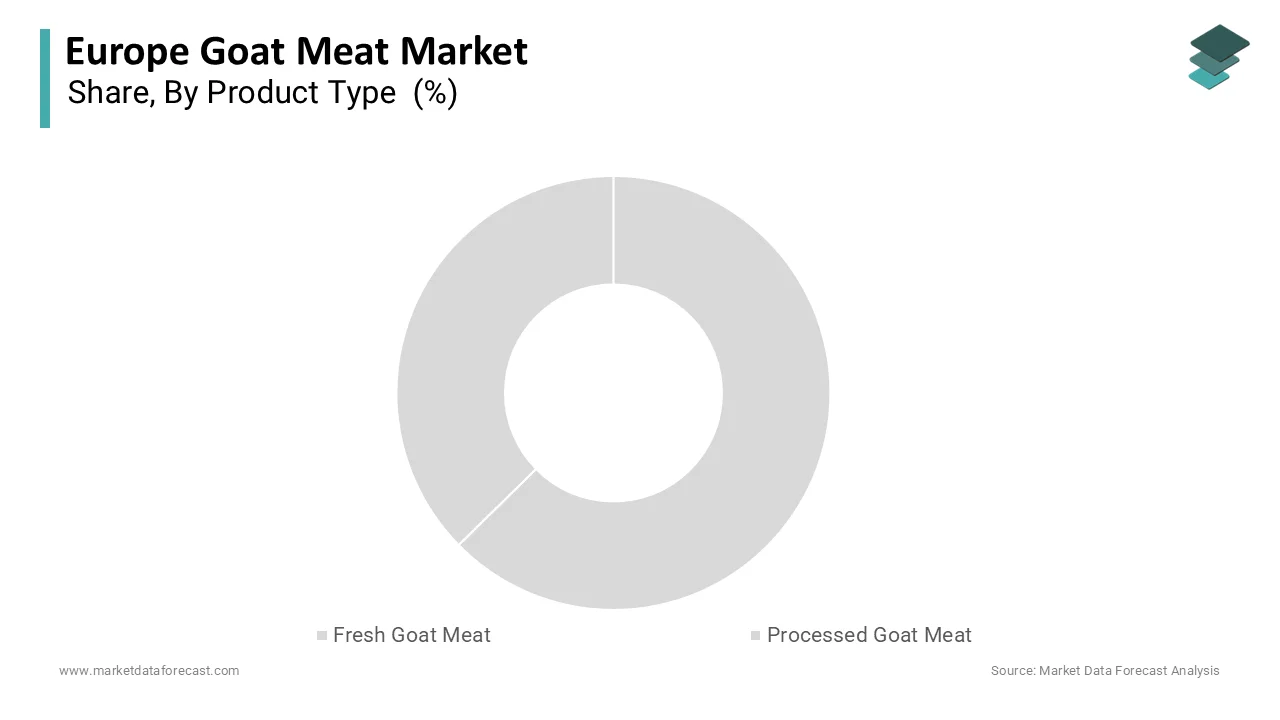
The processed goat meat segment is projected to expand at the fastest CAGR of 7.8% throughout the forecast period, owing to the strategic shift toward convenience and the efforts of manufacturers to overcome culinary barriers by offering ready-to-cook and value-added formats. The ability to process standardized flavor profiles and mask the strong gamey taste that often deters first-time buyers, thereby expanding the consumer base beyond traditional ethnic communities. Data from Mintel reveals that many non-ethnic European consumers are more likely to try goat meat if it is presented in a familiar format like a sausage or burger rather than a raw chop. Furthermore, the extension of shelf life through curing, smoking, or vacuum packing allows retailers to stock goat products year-round, smoothing out the seasonal volatility inherent in the fresh market. The rise of online grocery shopping also favors processed formats that are easier to ship and store, creating new distribution avenues.
By Distribution Channel Insights
The specialty stores and local butchers channel segment was the largest by holding 52.3% of the European goat meat market share in 2025, with the trust and expertise that traditional butchers provide, which is crucial for a niche protein that requires specific cutting techniques and culinary advice. The strong relationship between ethnic communities and local halal butchers or specialized meat shops that cater specifically to their dietary laws and cultural preferences by ensuring a steady and loyal customer base is leveraging the growth of the European goat meat market. The ability of specialty stores to offer custom cutting services by allowing customers to purchase specific parts of the animal or whole carcasses tailored to their festive needs, a service rarely available in standardized retail environments. Furthermore, the perceived higher quality and traceability of meat sourced from known local suppliers reinforce consumer confidence, especially among older demographics who prioritize traditional shopping experiences.
The online retail channel is anticipated to grow at a CAGR of 11.2% throughout the forecast period, owing to the digital transformation of the grocery sector and the emergence of specialized e-commerce platforms dedicated to delivering ethnic and premium meats directly to consumers' doorsteps. As per reports from Eurostat, e-commerce sales of food and beverages in the European Union grew by 35% in the last three years, with niche meat categories seeing exceptional uptake due to improved cold-chain logistics and insulated packaging solutions. The ability of online retailers to aggregate demand from scattered minority communities by making it economically viable to source and distribute goat meat to areas where physical stores cannot sustain inventory. Data from the Digital Commerce Association shows that many millennials and Gen Z consumers from South Asian and African backgrounds prefer ordering their festival meats online to avoid crowds and ensure home delivery. Additionally, online platforms often provide detailed information about the origin, farming methods, and halal certification of the meat, addressing transparency concerns that drive purchasing decisions. The subscription models offered by some online butchers for regular deliveries of minced or marinated goat further enhance customer retention.
By End-User Insights
The household consumption segment accounted for a significant share of the European goat meat market in 2025, owing to the deeply ingrained tradition of home cooking within ethnic communities, where goat meat is prepared for family gatherings, weekly meals, and significant religious celebrations. The cultural imperative to cook large quantities of meat at home during festivals like Eid al-Adha, where the ritual involves distributing and consuming fresh meat within the family and community, makes external dining less relevant for these specific occasions. The economic advantage of buying whole or half carcasses for home processing, which is significantly cheaper per kilogram than purchasing individual portions in restaurants, appeals to large families seeking cost-effective protein sources. Statistics from national household budget surveys in the United Kingdom and France reveal that expenditure on meat for home consumption peaks dramatically during religious holidays, with goat meat being the primary beneficiary. Furthermore, the desire to control seasoning, spice levels, and cooking methods to achieve authentic flavors encourages consumers to cook at home rather than rely on food service options, which may not meet their specific taste expectations.
The food service industry segment is likely to witness the fastest CAGR of 6.9% during the forecast period, owing to the increasing popularity of ethnic cuisines among the broader European population and the proliferation of restaurants specializing in Middle Eastern, Indian, Caribbean, and Mediterranean dishes. The mainstream acceptance of goat curry, kebabs, and stews as desirable dining options for non-ethnic consumers who seek adventurous and authentic flavor experiences outside the home is also propelling the growth of the European goat meat market. As per data from the European Hospitality Industry, the number of restaurants offering goat meat on their menus has increased by 20% in major European cities over the last five years, driven by consumer demand for diverse culinary offerings. Furthermore, the inclusion of goat meat in high-end gastronomic menus by celebrity chefs aiming to promote sustainable and local ingredients has elevated its status, driving trial among affluent diners. The convenience of enjoying complex, slow-cooked goat dishes without the hassle of home preparation also appeals to busy professionals.
COUNTRY LEVEL ANALYSIS
United Kingdom Goat Meat Market Analysis
The United Kingdom was the top performer of the European goat meat market by capturing 23.8% of the market share in 2025. The sheer size of the British Indian, Pakistani, and Bangladeshi communities, for whom goat meat is a dietary staple consumed weekly and in massive quantities during festivals like Eid, is escalating the growth of the market. As per data from the Office for National Statistics, these ethnic groups constitute a significant portion of the UK population by creating a resilient domestic market that absorbs both locally produced and imported goat meat. Statistics from the Agriculture and Horticulture Development Board indicate that while domestic production is limited, the UK is a major importer of goat meat from Ireland, Spain, and overseas,s with its role as a consumption hub. Furthermore, the growing interest in sustainable and lean meats among the native British population is slowly expanding the consumer base beyond ethnic lines.
Spain Goat Meat Market Analysis
Spain's goat meat market was ranked second by holding a significant share in 2025, with its significant domestic production capacity and a strong indigenous culture of goat consumption that predates modern migration trends. The traditional Spanish culinary heritage,e where goat meat, known as "cabrito," is celebrated in local festivals and roasted as a delicacy, ensures steady demand from native consumers alongside immigrant communities. As per data from the Spanish Ministry of Agriculture, Fisheries and Food, Spain boasts one of the largest goat herds in the European Union, producing hundreds of thousands of tons of meat annually, much of which is consumed domestically. The second significant driver is the tourism industry, which exposes millions of visitors to Spanish goat dishes, reinforcing its status as a gastronomic icon and boosting sales in the hospitality sector. Statistics from the Spanish Association of Small Ruminants highlight that per capita consumption in rural areas remains high, driven by traditional recipes and local availability. Furthermore, the export of high-quality Spanish kid goat to neighboring countries like France and Portugal enhances the market's regional influence.
France Goat Meat Market Analysis
France's goat meat market growth is likely to grow with a large North and West African diaspora to drive substantial consumption volumes, particularly in urban centers. The presence of a vast network of halal butchers and ethnic grocery stores that serve as the primary distribution points for goat meat, catering to the specific dietary needs of Muslim populations, who consume it regularly and during major religious events. The increasing recognition of goat meat by French chefs and gourmets as a premium, sustainable alternative to lamb has led to its appearance in high-end restaurants and gourmet food shops. Statistics from the French Interprofessional Office for Livestock and Meat indicate that while imports are necessary to meet peak demand, domestic production of kid goat is highly valued for its quality and fetches premium prices. Furthermore, government support for local livestock farming helps maintain production levels despite economic pressures.
Germany Goat Meat Market Analysis
Germany's goat meat market growth is likely to grow with its large Turkish, Arab, and African communities, who have transformed goat from a niche product into a sought-after commodity. The market status is defined by a heavy reliance on imports to meet demand, as domestic production is relatively small compared to other livestock sectors, yet the consumption rate is among the highest in Northern Europe. As per data from the Federal Statistical Office of Germany, the migrant population from goat-consuming nations has grown steadily, directly correlating with increased imports of fresh and frozen goat meat from neighboring EU countries and beyond. Statistics from the German Agricultural Society highlight that while cultural barriers remain among the native population, the visibility of goat meat in urban food scenes is rising, aided by the popularity of Döner kebab variations and Middle Eastern street food. Furthermore, the strict hygiene and quality standards of German retailers ensure that available products meet high safety benchmarks, building consumer trust.
Italy Goat Meat Market Analysis
Italy's goat meat market growth is likely to grow with the strong tradition of pastoral farming in its southern regions and islands, coupled with a growing demand from recent immigrant populations. The market status is defined by the coexistence of artisanal local production, where "capretto" is a cherished ingredient in traditional Easter and Christmas dishes, and the emerging needs of North African and South Asian communities. The deep-rooted culinary culture in regions like Sicily, Sardinia, and Calabria ensures that goat meat is integral to local identity and festivities by ensuring a stable baseline of consumption among native Italians. As per data from the Italian National Institute of Statistics, these regions maintain significant goat herds, and local consumption patterns remain resilient despite broader shifts in meat-eating habits. The second critical driver is the increasing diversity of the Italian population, with new communities establishing demand channels in northern industrial cities like Milan and Turin, prompting retailers to diversify their meat offerings. Statistics from the Italian Association of Breeders indicate that while overall meat consumption has fluctuated, goat meat retains a loyal following due to its perceived health benefits and cultural significance.
COMPETITIVE LANDSCAPE
The competition in the European goat meat market is characterized by a highly fragmented landscape comprising smallholder farmers, specialized halal butchers, and large retail chains vying for market share. Unlike consolidated beef or pork sectors, this market relies heavily on informal networks and ethnic-specific supply chains that create distinct regional dynamics. Dominant players leverage their extensive distribution capabilities and private label offerings to capture mainstream attention while niche operators compete on authenticity and traditional cutting services. The market witnesses rivalry based on product freshness, halal certification credibility, and the ability to supply consistent volumes during peak religious festivals. Retailers are increasingly differentiating themselves by sourcing locally to reduce carbon footprints and support rural economies, appealing to sustainability-minded consumers. Price sensitivity remains a critical factor, especially among large immigrant families who often purchase in bulk, forcing suppliers to optimize logistics and minimize waste. The rise of online meat delivery services has introduced new competitors who offer convenience and a wider variety, challenging traditional brick-and-mortar butchers. Consolidation is slow due to the scattered nature of production, yet strategic alliances between dairies and meat processors are emerging to maximize value from each animal.
KEY MARKET PLAYERS
Some of the companies that are playing a dominating role in the global Europe Goat Meat Market include
- Tönnies Holding
- Vion Food Group
- Danish Crown AmbA
- Groupe Bigard
- Cooperl Arc Atlantique
- Hilton Food Group plc
- Cranswick plc
- HKScan Oyj
- Westfleisch SCE
- Irish Country Meats
- The Scottish Goat Meat Company
TOP LEADING PLAYERS IN THE MARKET
- Lactalis Group stands as a global dairy giant with a significant influence on the European goat sector through its extensive network of cheese production, which drives demand for goat meat byproducts. The company contributes to the global market by setting high standards for dairy quality and integrating sustainable farming practices across its supply chain. In Europe, Lactalis supports thousands of goat farmers who supply milk for its renowned cheese brands, creating a stable ecosystem where male kids are raised for meat. Recent actions to strengthen its market position include investing in specialized breeding programs to improve herd productivity and launching initiatives to promote the consumption of goat meat as a sustainable protein source. The firm has also partnered with local butchers and retailers to develop value-added meat products that utilize the entire animal, reducing waste.
- Savencia Fromage & Dairy operates as a leading international cheese manufacturer with a deep footprint in the European goat milk industry, indirectly shaping the goat meat market through its sourcing requirements. The corporation plays a vital role globally by championing artisanal cheese traditions and promoting the nutritional benefits of goat products. In Europe, Savencia works closely with dedicated goat farms to secure premium milk supplies, which necessitates efficient management of the entire her,d including meat production from young males. Recent actions to strengthen its market position include acquiring niche dairy cooperatives to expand its raw material base and implementing traceability systems that verify the ethical treatment of animals from farm to table. The company has also launched marketing campaigns highlighting the dual purpose of goat farming to educate consumers about the sustainability of meat derived from dairy operations.
- Carrefour Group is a multinational retail powerhouse that significantly impacts thEuropeanpe goat meat market by providing essential distribution channels for both fresh and processed goat products. The company contributes to the global food system by prioritizing diverse protein sources and supporting local agriculture through its sourcing policies. In Europe, Carrefour has expanded its assortment of goat meat to cater to growing ethnic demographics and health-conscious consumers seeking lean red meat alternatives. Recent actions to strengthen its market position include launching private label ranges of marinated and ready-to-cook goat dishes to simplify preparation for customers. The retailer has also established direct partnerships with farmer groups in Spain and France to ensure a steady supply of locally sourced goat meat that meets strict quality and welfare standards. Additionally, Carrefour utilizes its digital platforms to offer home delivery of specialty meats, increasing accessibility for urban shoppers.
TOP STRATEGIES USED BY KEY MARKET PARTICIPANTS
Key players in the Europe goat meat market primarily employ vertical integration strategies to control the supply chain from breeding to retail, ensuring consistent quality and availability. Companies heavily invest in product diversification by developing value-added formats such as marinated cuts and ready meals to appeal to broader consumer bases. Another major strategy involves forming strategic partnerships with ethnic communities and halal certification bodies to build trust and secure loyalty among core demographic segments. Firms also focus on sustainability narratives by promoting goat farming as an eco-friendly land management tool to attract environmentally conscious buyers. Additionally, participants prioritize expanding distribution networks through online platforms and specialty butcher collaborations to enhance market reach. These combined approaches enable market leaders to navigate cultural nuances and drive growth in a fragmented industry.
MARKET SEGMENTATION
This research report on the europe goat meat market is segmented and sub-segmented into the following categories.
By Product Type
- Fresh Goat Meat
- Processed Goat Meat
By Distribution Channel
- Specialty Stores & Local Butchers
- Supermarkets/Hypermarkets
- Online Retail
By End-User
- Household Consumption
- Food Service Industry
By Country
- United Kingdom
- Spain
- France
- Germany
- Italy
- Rest of Europe
Related Reports
Access the study in MULTIPLE FORMATS
Purchase options starting from
$ 2000
Didn’t find what you’re looking for?
TALK TO OUR ANALYST TEAM
Need something within your budget?
NO WORRIES! WE GOT YOU COVERED!
Call us on: +1 888 702 9696 (U.S Toll Free)
Write to us: sales@marketdataforecast.com