- Product Description Description
- Table of Contents TOC
- List of Table & Figure LOT
- Get Free Sample PDF Sample PDF
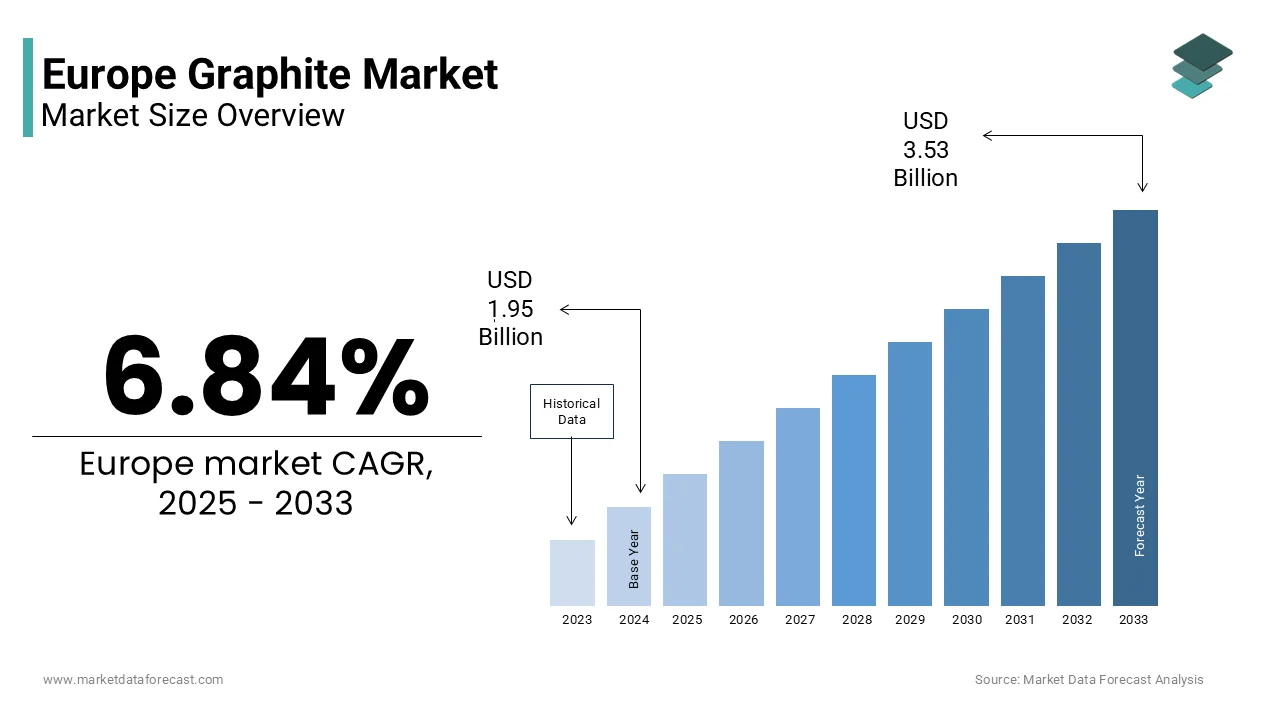
Market Size, 2025
$2.10 BnMarket Estimate, 2026
$2.24 BnMarket Forecast, 2034
$3.80 BnCAGR, 2026–2034
6.84%Europe Graphite Market Size
The Europe graphite market size was valued at USD 2.10 billion in 2025 and is projected to reach USD 3.80 billion by 2034 from USD 2.24 billion in 2026, growing at a CAGR of 6.84%.
Graphite is a naturally occurring or synthetic form of crystalline carbon prized for its unique properties, including electrical and thermal conductivity, lubricity, and high-temperature resistance. The market encompasses natural graphite, mined and processed from flake, amorphous, and vein deposits, and synthetic graphite, produced by high-temperature treatment of petroleum coke or coal tar pitch. Europe’s graphite demand is primarily driven by advanced manufacturing sectors, including lithium-ion battery anodes, refractories for steelmaking, foundry facings, and expanded graphite for fuel cells and thermal management. Unlike commodity metals, graphite’s strategic importance has intensified due to its role in the energy transition. It constitutes a significant share of the total weight of a lithium-ion battery, with anode material requiring high-purity spherical graphite. According to the European Commission, the EU will need several times more graphite by 2030 than it consumed in 2020 to meet battery production targets under the European Battery Alliance. As per Eurostat, a notable share of Europe’s current graphite supply is imported, predominantly from China, Turkey, and Brazil, creating significant supply chain vulnerability. The designation of graphite as a Critical Raw Material under the EU Raw Materials Initiative further emphasises its economic and strategic relevance, which positions the European graphite market at the nexus of industrial policy, clean technology, and resource security.
MARKET DRIVERS
Expansion of Lithium-Ion Battery Gigafactories Across Europe
The rapid deployment of lithium-ion battery gigafactories is among the key drivers of the European graphite market. This is directly tied to the continent’s electric vehicle and energy storage ambitions. As of May 2025, according to the European Battery Alliance (EBA), approximately 30 announced gigafactory projects are in the EU. The projected total capacity by 2030 for these announced projects is around 1.3 terawatt-hours (TWh) annually. Approximately 1,100 metric tons of graphite anode material are needed for every gigawatt hour (GWh) of Li-ion cell production. Major automakers have secured long-term offtake agreements with anode producers, accelerating upstream investment. Northvolt’s gigafactory in Sweden, for instance, has partnered with Finnish and Norwegian graphite developers to source European feedstock. This industrial mobilisation transforms graphite from a niche industrial mineral into a foundational material for Europe’s decarbonization strategy, with battery anodes expected to account for a share of regional graphite consumption by 2027.
Growth in Refractory and Steel Production Modernisation
The region’s steel industry remains a major consumer of graphite, particularly in the form of refractory bricks and carbon raisers used in electric arc furnace steelmaking, which further accelerates the expansion of the European graphite market. "According to industry reports, electric arc furnaces accounted for approximately 41-45% of EU crude steel production in 2023, reflecting a structural shift toward lower carbon steelmaking. Each ton of steel produced in an electric arc furnace requires 1.5 to 2.5 kilograms of graphite electrodes and carbon additives to maintain temperature and adjust carbon content. As per the European Steel Technology Platform (ESTEP), modern high-power arc furnaces operate at currents typically exceeding 44,000 amperes, demanding ultra-high power graphite electrodes with exceptional thermal shock resistance. Apart from these, the EU’s Carbon Border Adjustment Mechanism incentivises domestic steelmakers to improve energy efficiency, which further drives adoption of high-performance graphite refractories that extend lining life and reduce downtime. The transition to low-carbon steel production in Europe still relies heavily on graphite to drive effective and productive metallurgical outcomes.
MARKET RESTRAINTS
Heavy Reliance on Extra EU Graphite Imports and Supply Chain Vulnerability
Overwhelming dependence on imports restricts the growth of the European graphite market. Over 95 per cent of natural graphite and 70 per cent of synthetic graphite are sourced from outside the European Union, as per the European Commission’s 2023 Critical Raw Materials Communication. China alone supplies nearly 65 per cent of Europe’s total graphite, creating significant geopolitical and logistical risk. The Chinese government’s 2023 export controls on gallium and germanium signalled its willingness to leverage critical mineral dominance for strategic purposes, raising alarms about potential graphite restrictions. According to research, Europe has some active natural graphite mines, including the Kaisersberg mine in Austria (which produces amorphous graphite) and the Kropfmühl mine in Germany (which produces flake graphite), and the Skaland mine in Norway (Europe's largest crystalline flake graphite producer, though Norway is not an EU member state). This import dependency is exacerbated by the lack of downstream processing capacity. Most European battery anode producers still rely on spherical graphite manufactured in China or Japan. Europe's clean technology goals cannot achieve true resilience until it scales its own domestic mining and value-added processing capabilities.
Stringent Environmental Regulations on Mining and Processing
Graphite development in the region is constrained by rigorous environmental and permitting frameworks that inhibit the expansion of the European graphite market. The EU’s Environmental Impact Assessment Directive requires comprehensive studies on water use, dust emissions, and habitat disruption for any proposed mining project, with public consultation periods often exceeding years. The EU Taxonomy for Sustainable Activities does not currently classify natural graphite mining as environmentally sustainable, limiting access to green financing. These environmental safeguards, while essential for ecological protection, inadvertently reinforce import dependency by stifling local supply development.
MARKET OPPORTUNITIES
Development of European Spherical Graphite and Anode Production Capacity
Vertical integration of spherical graphite and anode manufacturing reduces reliance on Asian supply chains and captures higher value within the battery materials ecosystem, which creates new opportunities for the growth of the European graphite market. Companies are advancing projects to produce spherical graphite from European flake feedstock, leveraging hydro power for low-carbon processing. Northvolt’s Revolt recycling plant in Sweden already recovers graphite from spent batteries, creating a circular input stream. Europe is set to become an active participant in the global graphite value chain, no longer a passive consumer. This transformation will be driven by the decisive advantage of being able to supply local, auditable, and low-carbon anode material to its burgeoning gigafactories.
Recycling of Graphite from End-of-Life Lithium-Ion Batteries
The emergence of lithium-ion battery recycling offers a key opportunity to the European graphite market. This development helps to establish a secondary supply of graphite in Europe, enhancing resource security and supporting circular economy objectives. According to research, the volume of end-of-life lithium-ion batteries in Europe is rising rapidly, which creates growing demand for efficient recycling infrastructure and material recovery technologies. Graphite represents a notable portion of total battery mass and can be reclaimed through hydrometallurgical or direct recycling techniques by offering a significant opportunity for resource circularity. Moreover, upcoming European regulatory frameworks require minimum recycled content targets for key materials such as cobalt, lithium, and nickel, with graphite likely to be included in subsequent policy updates. Advanced recycling facilities in Sweden are already achieving high-purity graphite recovery, which proves the technical feasibility of circular anode material production within the region. This closed-loop model not only reduces primary mining pressure but also lowers the carbon intensity of battery production, which aligns with Europe’s climate and industrial policy goals.
MARKET CHALLENGES
Lack of Integrated Downstream Processing Infrastructure
Absence of integrated infrastructure for upgrading raw graphite into high-value products, like spherical graphite and coated anode materials, slows the growth of the European graphite market. Europe holds significant flake graphite resources in countries like Sweden, Finland, and Austria, but the absence of domestic purification and spheronization facilities means these deposits are predominantly undeveloped. Building such infrastructure requires significant capital and access to low-cost, stable energy, which remains uncertain amid Europe’s energy transition. Besides, the technical expertise for consistent particle size distribution and surface coating is concentrated in Asia, creating a knowledge gap. Europe will forfeit economic value and strategic control in the battery supply chain by continuing to export raw materials and import finished products, unless there is coordinated investment in midstream processing.
Geopolitical Competition for Global Graphite Resources
The region faces intensifying geopolitical competition for access to high-quality graphite resources, particularly from China and the United States, and this challenges the expansion of the European graphite market. These are securing long-term offtake agreements and equity stakes in mining projects worldwide. The US Inflation Reduction Act further distorts the market by offering tax credits only for batteries using minerals sourced from free trade agreement countries, excluding key European allies and redirecting investment flows. The European Commission’s 2025 Raw Materials Diplomacy Strategy acknowledges that Europe is “significantly outpaced” in securing upstream assets. European battery and steel manufacturers need a coordinated foreign investment and trade policy to secure reliable, ethical, and affordable graphite. Otherwise, the continent’s industrial sovereignty and clean energy transition will be threatened.
REPORT COVERAGE
| REPORT METRIC | DETAILS |
| Market Size Available | 2025 to 2034 |
| Base Year | 2025 |
| Forecast Period | 2026 to 2034 |
| CAGR | 6.84% |
| Segments Covered | By Product, Application, and Region |
| Various Analyses Covered | Global, Regional, & Country Level Analysis; Segment-Level Analysis; DROC, PESTLE Analysis; Porter’s Five Forces Analysis; Competitive Landscape; Analyst Overview of Investment Opportunities |
| Regions Covered | UK, France, Spain, Germany, Italy, Russia, Sweden, Denmark, Switzerland, Netherlands, Turkey, and the Czech Republic |
| Market Leaders ProfiledRiton | n Minerals, Syrah Resources, NOVONIX, Northern Graphite, Nippon Carbon, Graphite India, AMG Advanced Metallurgical Group, Tokai Carbon Co Ltd, Focus Graphite Inc, Talga Group Ltd, Mason Resources Inc, GrafTech International Ltd, Resonac Holdings Corp, and SGL Group. |
SEGMENTAL ANALYSIS
By Product Insights
In 2025, the synthetic graphite segment led the European graphite market and accounted for a 58.2% share in 2025. The dominance of the synthetic graphite segment is primarily driven by its irreplaceable role in ultra-high power applications requiring exceptional purity, thermal stability, and electrical conductivity. In electric arc furnace steelmaking, which produces millions of metric tons of steel in the EU, synthetic graphite electrodes are essential for sustaining temperatures above 3,000 degrees Celsius. Each ton of steel consumes kilograms of these electrodes, with no viable large-scale substitute. Furthermore, synthetic graphite is preferred in high-performance lithium-ion battery anodes for premium electric vehicles due to its consistent particle morphology and cycle life stability. Regulatory factors also favour synthetic graphite. The EU Industrial Emissions Directive classifies its production under strict but manageable controls, whereas natural graphite purification using hydrofluoric acid faces greater environmental scrutiny. The accelerating trends of green steelmaking and battery manufacturing underscore, rather than diminish, the strategic and central role of synthetic graphite within Europe's industrial base.
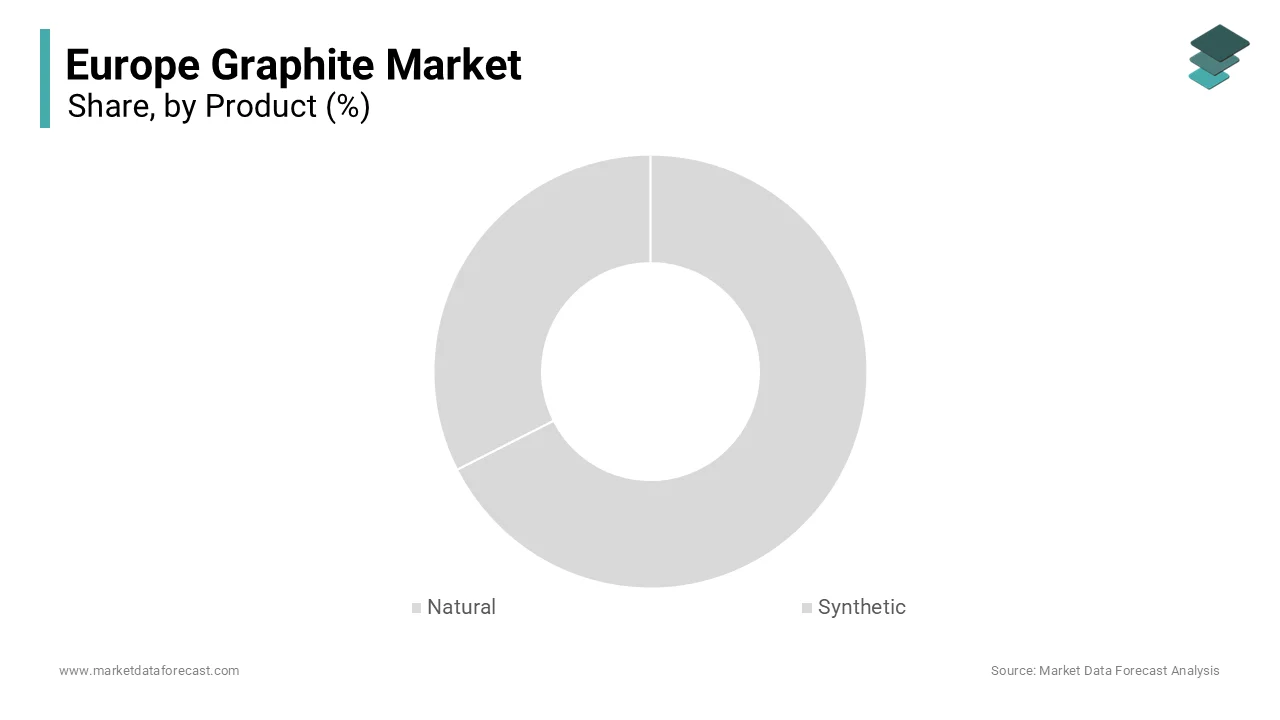
The natural graphite segment is predicted to witness the highest CAGR of 19.3% from 2026 to 2034 due to the urgent need cost-effective, scalable anode material to supply Europe’s expanding battery gigafactory network. Natural flake graphite, when processed into spherical form, offers a lower production cost than synthetic alternatives while meeting performance requirements for standard range electric vehicles. Exploration projects in Sweden and Finland are advancing rapidly. Apart from these, the EU Raw Materials Initiative has fast-tracked permitting for critical mineral projects, which reduces approval timelines. Europe's efforts to decrease dependence on Chinese supply chains and lower battery costs have made responsibly sourced natural graphite a key strategic focus.
By Application Insights
The refractories segment remained the largest segment in the European graphite market by capturing 32.7% share in 2025. This prominence of the refractories segment is attributed to graphite’s unmatched ability to withstand extreme temperatures and thermal shock in high-intensity industrial processes, particularly steelmaking. Magnesia carbon and alumina carbon refractory bricks, containing graphite, are standard in electric arc furnace linings, ladles, and tundishes across European steel plants. The European Steel Technology Platform emphasises that modern high productivity furnaces cannot operate without graphite-enhanced refractories, which extend campaign life compared to non-carbon alternatives. Furthermore, the EU’s Carbon Border Adjustment Mechanism incentivises energy efficiency, pushing steelmakers toward longer-lasting, high-performance linings. Refractories are poised to remain the primary and most stable use for graphite in Europe, a trend driven by the steel industry's shift towards electric arc technology for decarbonization.
The batteries segment is projected to advance at a compound annual growth rate of 34.7% during the forecast period, owing to the ontinent’s electric mobility and energy storage ambitions. Each electric vehicle battery requires 50 to 100 kilograms of graphite anode material, and with the EU mandating 100 per cent centzero-emissionn car sales by 2035, demand is surging. The European Commission estimates that 38 battery gigafactories will be operational by 2030, requiring over 1.5 million metric tons of graphite annually—up from less than 50,000 tons in 2020. Northvolt, ACC, and Verkor are already sourcing anode material through long-term agreements with European and global suppliers. The EU Battery Regulation further accelerates adoption by requiring supply chain transparency and recycled content, pushing producers toward auditable, low-carbon graphite sources. A 2025 study by the International Energy Agency found that Europe’s battery graphite demand will surpass that of refractories by 2028. As the cornerstone of the clean energy transition, batteries are transforming graphite from an industrial mineral into a strategic energy material.
REGIONAL ANALYSIS
Germany Market Analysis
Germany dominated the European graphite market by accounting for 24.3% in 2025. The domination of Germany is attributed to its position as Europe’s largest steel producer and a hub for automotive and battery manufacturing. Germany produced millions of metric tons of crude steel, with a portion from electric arc furnaces requiring graphite electrodes and refractories. Simultaneously, it hosts major battery initiatives demanding high-purity anode material. The German government has allocated funds to secure critical mineral supply chains, including graphite offtake agreements with producers from other countries. Besides, German steelmakers are piloting hydrogen-based direct reduced iron processes that still require graphite recarburizers. Germany functions as the primary hub for graphite consumption and innovation within Europe. This is a position bolstered by its robust heavy industry, advanced manufacturing, and strategic resource policies.
Sweden Market Analysis
Sweden is the next major region in Europe and captured a 18.2% share in 2025. The growth of Sweden is because to its dual role as a producer of high-grade natural flake graphite and a leader in sustainable battery production. Sweden hosts Europe’s only active graphite mine at Woxna, operated by Graphite One Europe, with proven reserves exceeding millions of metric tons. More significantly, it is home to Northvolt’s Ett Gigafactory and the Revolt recycling facility that recovers graphite from end-of-life cells. The government’s Critical Minerals Strategy has fast-tracked environmental permits for mining projects that meet strict sustainability criteria. A combination of abundant clean electricity, strong exploration programs, and vertical integration within the battery sector is positioning Sweden as Europe's most vital graphite hub.
France Market Analysis
France is expected to be the most lucrative region in the European graphite market. Its advanced nuclear-powered steel industry and ambitious battery industrial policy have significantly contributed to the expansion of France. ArcelorMittal’s Fos-sur-Mer plant relies heavily on graphite electrodes for its electric arc operations, which produce millions of metric tons annually, as per sources. France is also a core member of the European Battery Alliance, hosting gigafactories with notable capacity of gigawatt hours. The French government has allocated funds to secure battery raw materials, including partnerships with graphite developers in Madagascar and Canada. Furthermore, research institutions like CEA are pioneering direct recycling techniques to recover graphite from spent batteries. These industrial, policy, and scientific synergies ensure France’s sustained prominence in both traditional and emerging graphite applications.
Italy Market Analysis
Italy is moving ahead steadfastly in the European graphite market due to its specialised steel sector, particularly in stainless and speciality alloys, and growing electric vehicle component manufacturing. Marcegaglia, Riva Group, and other Italian steelmakers operate electric arc furnaces, which consume significant volumes of graphite electrodes and recarburizers. The rise of automotive suppliers like Marelli and Brembo in EV thermal and braking systems has also increased demand for expanded graphite in heat dissipation and friction products. The National Recovery and Resilience Plan includes millions of euros for critical raw material security, with graphite listed as a priority. Italy’s strategic location in the Mediterranean further facilitates import logistics from North Africa and Turkey. These industrial traditions and policy supports sustain Italy’s relevance in Europe’s graphite landscape.
Netherlands Market Analysis
The Netherlands is anticipated to grow in the European graphite market from 2026 to 2034 due to its role as Europe’s primary logistics and trading hub for industrial minerals. The Port of Rotterdam handles a share of EU graphite imports, serving as the entry point for the material before distribution. Dutch companies operate advanced processing facilities that upgrade imported concentrate into value-added products for refractories and lubricants. Apart from these, the Netherlands hosts key battery supply chain actors, including anode producer Silbat and recycling startup BatX Energies. The Netherlands is the entry point for graphite into Western Europe, a role facilitated by its exceptional infrastructure, regulatory predictability, and seamless integration into industrial networks across the continent.
COMPETITIVE LANDSCAPE
KEY MARKET PLAYERS
Some of the notable key players in the European graphite market are
- Triton Minerals
- Syrah Resources
- NOVONIX
- Northern Graphite
- Nippon Carbon
- Graphite India
- AMG Advanced Metallurgical Group
- Tokai Carbon Co Ltd
- Focus Graphite Inc
- Talga Group Ltd
- Mason Resources Inc
- GrafTech International Ltd
- Resonac Holdings Corp
- SGL Group
TOP STRATEGIES USED BY THE KEY MARKET PLAYERS
Key players in the European graphite market pursue strategies centred on vertical integration, sustainability certification, and strategic alignment with EU industrial policy. They invest in downstream processing capabilities—such as spheronization and coating—to capture higher value within the battery anode supply chain. Companies prioritise low-carbon production by leveraging renewable energy and closed-loop water systems to meet the EU Battery Regulation’s environmental footprint requirements. Strategic partnerships with gigafactories, steelmakers, and recycling firms ensure long-term offtake and circular material flows. Active participation in the European Raw Materials Alliance and national critical mineral strategies enhances access to funding and fast-tracked permitting. Besides, firms are developing traceability platforms to provide full supply chain transparency from mine to end user, addressing both regulatory mandates and customer ESG expectations in a geopolitically sensitive market.
COMPETITION OVERVIEW
The European graphite market features a dynamic yet constrained competitive landscape shaped by import dependency, regulatory rigour, and strategic industrial policy. Competition is dominated by a few integrated players like SGL Carbon and Imerys, which leverage decades of processing expertise and established customer relationships in steel and andspecialityy applications. However, the market is increasingly influenced by new entrants focused on battery-grade natural graphite, such as Graphite One Europe and Talga Resources, who position themselves as ethical, low-carbon alternatives to the Chinese supply. The absence of large-scale domestic mining creates a structural imbalance, with most companies acting as processors or traders rather than primary producers. Barriers to entry remain high due to capital intensity, environmental permitting complexity, and the technical challenges of consistent anode-grade production. Meanwhile, global giants from China and the United States exert pricing and supply pressure through dominant upstream control. Success in this market hinges on securing auditable feedstock, achieving regulatory compliance, and embedding within Europe’s battery and steel decarbonization ecosystems.
TOP PLAYERS IN THE MARKET
- SGL Carbon SE is a leading European manufacturer of synthetic graphite and carbon-based products with a strong global footprint in battery materials, automotive, and industrial applications. Headquartered in Germany, the company supplies ultra-high power graphite electrodes to major steel producers and anode materials to European battery gigafactories. SGL Carbon has strengthened its position by expanding its anode production capacity at its facility in Meitingen through a joint venture with Samsung SDI, focusing on low-carbon synthetic graphite. The company also invests in recycling technologies to recover graphite from spent batteries, aligning with EU circular economy mandates. Its deep integration with automotive OEMs and participation in the European Battery Alliance reinforce its role as a strategic enabler of Europe’s clean industrial transition.
- Imerys Graphite & Carbon, a Swiss subsidiary of the Imerys Group, is a key player in natural and synthetic graphite processing for refractories, lubricants, and battery applications across Europe. The company operates advanced purification and micronisation facilities in Switzerland and the Netherlands by serving high-value industrial sectors with tailored graphite solutions. Imerys has reinforced its market presence by launching a low-carbon natural graphite anode product line processed using renewable hydropower, certified under the EU Battery Regulation’s environmental criteria. It also collaborates with research institutes on expanded graphite for hydrogen fuel cells. Through sustainable processing, technical expertise, and compliance with stringent European environmental standards, Imerys positions itself as a trusted supplier of speciality graphite materials.
- Graphite One Europe AB, the European arm of Graphite One Inc., is emerging as a strategic developer of natural flake graphite resources in Sweden. Graphite One Europe has strengthened its position by securing offtake discussions with European battery and steel manufacturers seeking non-Chinese, auditable supply chains. It is also developing a downstream spheronization pilot plant in partnership with Swedish research agencies to produce spherical graphite for anodes. By focusing on European-sourced, ESG-compliant graphite aligned with the Critical Raw Materials Act, the company aims to reduce import dependency and support regional battery and steel decarbonization goals.
MARKET SEGMENTATION
This research report on the European graphite market has been segmented and sub-segmented based on categories.
By Product
- Natural
- Synthetic
By Application
- Refractories
- Foundries
- Batteries
- Friction Products
- Lubricants
- Recarburizing
- Others
By Country
- UK
- France
- Spain
- Germany
- Italy
- Russia
- Sweden
- Denmark
- Switzerland
- Netherlands
- Turkey
- Czech Republic
- Rest of Europe