- Product Description Description
- Table of Contents TOC
- List of Table & Figure LOT
- Get Free Sample PDF Sample PDF
Market Size, 2025
$306.32 MnMarket Estimate, 2026
$329.51 MnMarket Forecast, 2034
$590.74 MnCAGR, 2026–2034
7.57%Executive Summary: Europe Guar Gum Market
- Market Scope: Comprehensive market analysis of the European guar gum industry covering functions (gelling, thickening, bonding, friction reduction), grades (food, industrial, pharmaceutical), applications (food and beverages, pharmaceuticals, oil and gas, cosmetics, papermaking, mining and explosives), and country-level landscapes across the UK, France, Spain, Germany, Italy, Russia, Sweden, Denmark, Switzerland, Netherlands, Turkey, the Czech Republic, and the Rest of Europe.
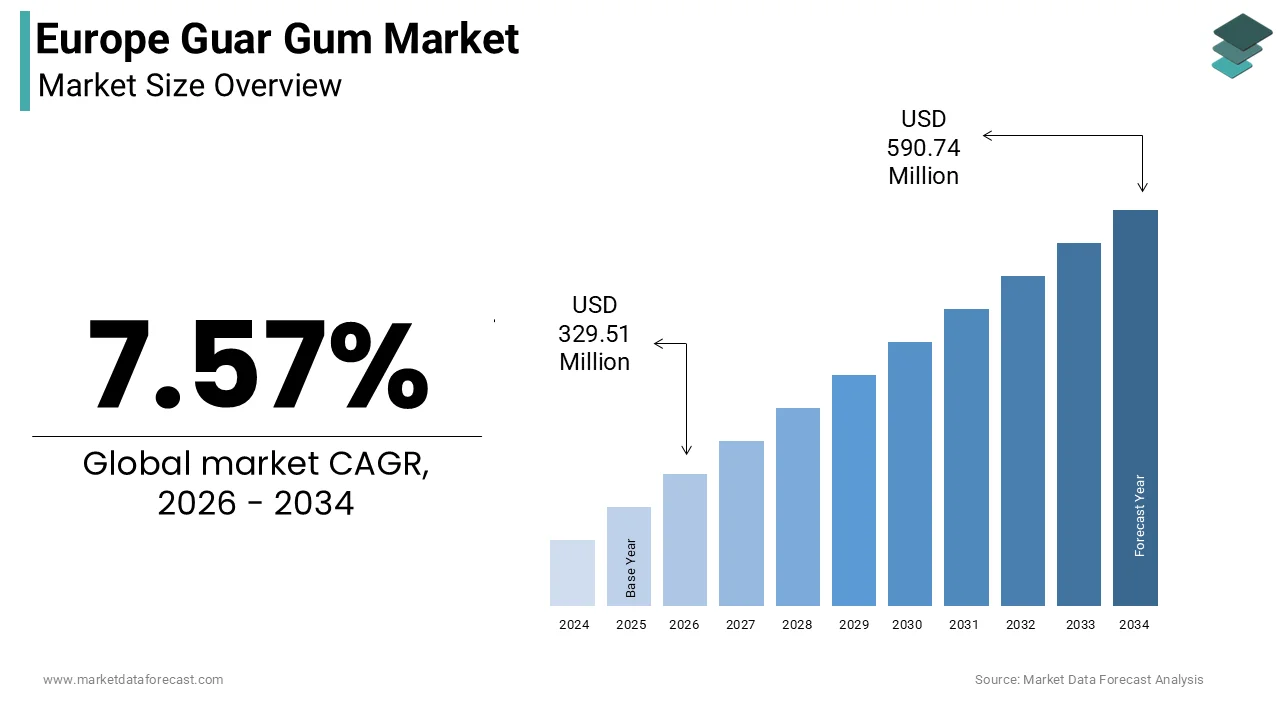
- Market Valuation: Valued at USD 306.32 million in 2025, estimated at USD 329.51 million in 2026, and projected to reach USD 590.74 million by 2034, registering a strong CAGR of 7.57% (2026–2034).
- Primary Growth Drivers: Rising consumer preference for clean label, gluten-free, and plant-based food formulations; revival of industrial demand from unconventional geothermal, shale gas, and oilfield exploration projects; and rapid innovation in high-purity pharmaceutical-grade guar gum for advanced drug delivery systems.
Key Market Segment Metrics (2026–2034)
| Category | Leading Segment / Position | Growth Dynamics |
|---|---|---|
| By Function | Thickening (dominated with a 48.6% share in 2026 due to exceptional viscosity yield and utility in texture modification) | The binding function segment is registering the fastest CAGR of 9.1% driven by natural tablet binders and sustainable agricultural seed coatings. |
| By Grade | Food Grade (captured a leading 62.6% share in 2026, anchored by broad regulatory acceptance under E412 and organic certifications) | The pharmaceutical-grade segment is witnessing the fastest CAGR of 10.3% fueled by ultra-pure polymers for targeted, advanced drug delivery. |
| By Application | Food and Beverages (held the majority share of 58.2% in 2026, supported by clean label trends and dairy alternatives) | The pharmaceuticals application segment is experiencing the fastest CAGR of 10.7% supported by biodegradable, site-specific gut drug release systems. |
Major Market Players & Market Structure
Market Structure: Dual-structure marketplace featuring global ingredient giants and specialized regional processors, characterized by high import dependency from India and strict adherence to EFSA and European Pharmacopoeia standards.
Key Companies: Cargill Incorporated, Ingredion Incorporated, JRS Pharma, Jai Bharat Gum and Chemicals Ltd, Hindustan Gum & Chemicals Ltd., Gum Industries Limited Branch, Shree Ram Industries, Dabur India Ltd., Tiku Ram Gum & Chemicals Pvt Ltd, Sarda Gums & Chemicals, Guangrao Liuhe Chemicals Co. Ltd., Europe Gums & Chemicals Pvt. Limited, and Supreme Gums Pvt. Limited.
Europe Guar Gum Market Size
The Europe Guar Gum Market size was calculated to be USD 306.32 million in 2025 and is anticipated to be worth USD 590.74 million by 2034, from USD 329.51 million in 2026, growing at a CAGR of 7.57% during the forecast period.
Guar gum, also known as guaran, is a natural, water-soluble polysaccharide extracted from the seeds of the guar plant (Cyamopsis tetragonoloba), a drought-resistant legume primarily cultivated in India and Pakistan. Unlike synthetic thickeners, guar gum is valued for its high viscosity at low concentrations, biodegradability, and compatibility with a wide pH range. EU import volumes for plant-based thickeners like guar gum have continued to grow, with major northern maritime ports acting as the central gateways for distribution across European processing networks. Authorities consistently recognize guar gum as a safe additive for a wide range of food products, including those tailored for specialized dietary needs, provided it meets established purity standards. Beyond foo,d it serves critical roles in pharmaceutical tablet binding, oilfield fracturing fluids, and textile printing. As a naturally derived polymer, guar gum generally avoids the standard chemical registration process in Europe, though it remains subject to rigorous quality controls for potential environmental and biological impurities. This dual identity, as both a food ingredient and an industrial hydrocolloid, shapes its regulatory and commercial trajectory across diverse European sectors.
MARKET DRIVERS
Rising Demand for Clean Label and Plant-Based Food Formulations Drives Food Grade Guar Gum Adoption
European consumers’ growing preference for transparent and natural ingredients has significantly elevated demand for guar gum in food manufacturing, which acts as a major driver of the Europe guar gum market. European consumers are showing increased awareness and concern regarding food additives like preservatives and flavorings, with many expressing a preference for more natural food options. The prevalence of celiac disease is rising within the European Union, leading to a higher demand for gluten-free products and improved diagnostic procedures. This shift aligns with the European Commission’s Farm to Fork Strategy, which encouragesthe reduction of artificial additives in processed foods. In the gluten-free sector, guar gum is indispensable, providing elasticity and moisture retention in bread and pasta formulations. The market for gluten-free products in the EU is expanding, driven by both diagnosed celiac patients and consumers seeking healthier lifestyles. Companies like Dr Oetker and Barilla now use guar gum as a primary hydrocolloid in their gluten-free lines. Additionally, its synergy with other fibers enhances texture in plant-based dairy alternatives. This convergence of dietary trends, regulatory support, and functional necessity solidifies guar gum’s role in Europe’s clean-label food revolution.
Expansion of Unconventional Oil and Gas Exploration Revives Industrial Demand for Guar Gum
Localized demand for guar gum in industrial applications persists, despite the region’s green energy transition, due to geothermal and shale gas pilot projects, which fuel the expansion of the Europe guar gum market. Several European nations are exploring hydraulic fracturing specifically for developing deep geothermal energy, distinct from traditional fossil fuel extraction. This method for enhancing geothermal energy requires specific fluids to carry materials into the ground. A plant-based thickener is favored for this application because it is both cost-effective and behaves predictably under pressure. Geothermal operations use significant quantities of this food-grade thickener to manage materials during the injection process. The materials utilized in geothermal applications are crucial for energy infrastructure, even as large-scale unconventional gas extraction faces regulatory limitations. Furthermore, oilfield service companies like Schlumberger maintain European stockpiles for offshore well stimulation in the North Sea, where legacy fields require enhanced recovery techniques. This niche but technically irreplaceable industrial use ensures steady baseline demand even amid broader decarbonization efforts.
MARKET RESTRAINTS
Heavy Reliance on Imports from Geopolitically Volatile Regions Creates Supply Chain Vulnerability
The region’s guar gum supply is overwhelmingly dependent on India, which restrains the growth of the Europe guar gum market. This country accounts for a significant share of global production and supplies substantial metric tons to the EU in 2026. This concentration creates acute vulnerability to monsoon variability, export restrictions, and logistical disruptions. Unlike commodities with diversified sourcing, guar gum has no economically viable large-scale alternative crop in temperate climates. Attempts to cultivate guar in Spain and southern Italy have yielded fewer hectares cumulatively due to low seed viability and poor gum yield. Furthermore, the lack of strategic reserves means any policy shift in New Delhi immediately cascades into European food and pharma production lines. Europe's industries face volatile input costs and inconsistent formulations due to reliance on external sourcing, a vulnerability that will persist until regional cultivation or vertical integration is achieved.
Stringent Contaminant Regulations Increase Compliance Burden and Rejection Rates
European authorities enforce rigorous safety standards for guar gum, particularly regarding microbial and chemical contaminants, which impedes the expansion of the Europe guar gum market. Regulatory bodies monitor guar gum imports to ensure compliance with quality standards for microbial presence and chemical contaminants. Reports indicate instances of guar gum shipments being rejected at borders due to issues involving excessive microbial loads or pesticide residues. Stringent standards are applied to food-grade batches regarding safety and contamination levels. Guar gum imports are subject to ongoing surveillance regarding food safety and quality control. These incidents stem from inconsistent post-harvest handling in source regions where smallholder farmers often dry guar beans on open roads, exposing them to dust, animal feces, and vehicle emissions. Compliance requires costly interventions such as gamma irradiation or ethylene oxide treatment, processes restricted under EU organic regulations. Pharmaceutical-grade guar gum faces even stricter scrutiny under the European Pharmacopoeia, which mandates residual solvent testing and endotoxin limits. Small and medium importers lacking in-house quality control frequently face shipment delays or destruction, adding to landed costs. This regulatory friction disproportionately impacts agile players and stifles innovation in natural ingredient adoption.
MARKET OPPORTUNITIES
Development oHigh-Purity Pharmaceutical-Gradede Guar Gum for Advanced Drug Delivery Systems
The pharmaceutical sector offers a major opportunity for specialized guar gum derivatives in the region, which is predicted to boost the growth of the Europe guar gum market. According to sources, numerous authorized medicinal products list guar gum as an excipient for its swelling and controlled release properties in oral tablets. Recent advances in purification technology now enable the production of ultra-low endotoxin guar gum meeting Ph Eur monograph requirements for parenteral and ophthalmic use. Pharmaceutical developers are increasingly adopting enzymatically modified natural polysaccharides, such as guar gum, to achieve targeted drug delivery within the colon based on microbial degradation. Research into guar gum nanoparticles suggests they can improve the absorption profiles of medications that have limited solubility. Significant funding initiatives are actively supporting the development of drug delivery systems based on natural polymers to advance them toward clinical application. Innovations in high-purity guar gum are redefining its application from simple binding to advanced, next-generation therapeutics, meeting the urgent demand for chronic disease management in Europe’s aging society.
Integration of Guar Gum in Sustainable Textile and Paper Manufacturing Processes
The region’s push toward circular industrial systems is opening new avenues for guar gum in eco-friendly manufacturing, which is anticipated to contribute to the expansion of the Europe guar gum market. The application of natural thickeners in textile production is increasing to replace synthetic alternatives that are difficult to process in wastewater, a shift driven by brand-mandated requirements for suppliers. In the paper industry, natural binders are replacing petroleum-based products to enhance dry strength. The inclusion of natural additives allows for the reduction of raw materials in packaging board while maintaining structural integrity, supported by sustainability criteria that favor bio-based alternatives. Additionally, guar gum’s flocculating properties are being tested in municipal sludge dewatering, reducing polymer chemical use in wastewater treatment. These cross-sectoral applications leverage guar gum’s renewability and non-toxicity, aligning with the EU Green Deal’s vision for bio-based industrial ecosystems.
MARKET CHALLENGES
Price Volatility Due to Speculative Trading and Crop Yield Fluctuations Disrupts Budgeting and Formulation Stability
Guar gum prices in the region exhibit extreme volatility driven by climatic uncertainty in India and speculative activity on commodity exchanges, which challenges the growth of the Europe guar gum market. According to European market analysts, guar gum prices across the continent experienced a notable decline during the middle of the year, primarily influenced by shifting demand from major industrial buyers and cooling export values from global production hubs. This instability forces food and pharma manufacturers to either absorb margin pressure or reformulate, a costly and time-consuming process requiring new regulatory submissions. Unlike starches or cellulose gums, guar gum’s unique rheological profile makes substitution difficult without compromising product texture or dissolution rate. Industry reports from European specialty ingredient federations indicate that while price instability remains a concern, the market is currently driven by a consistent rise in demand for natural stabilizers in processed and gluten-free food sectors. Contractual hedging is limited because guar gum is not traded on major EU futures markets. This financial uncertainty discourages long term investment inguar-based innovation and pushes risk-averse companies toward less effective but more stable alternatives despite consumer preference for natural ingredients.
Lack of Standardized Grading and Viscosity Classification Across EU Member States Hinders Technical Consistency
National standards for guar gum quality remain fragmented, despite EU harmonization efforts. This creates technical friction for multinational formulators, and thereby holds back the expansion of the Europe guar gum market. Existing standardization guidelines for natural stabilizers often provide broad frameworks, leaving critical quality parameters like viscosity, impurity thresholds, and particle composition open to interpretation by individual national bodies. Divergent methodologies for testing key physical properties, such as using different viscometer types and temperature settings, result in non-comparable data between jurisdictions. Variations in regional quality standards lead to inconsistencies in ingredient assessment, potentially causing batch rejection for products produced in one location but tested in another. Identical ingredient batches may pass or fail internal quality control checks depending on the regional interpretation of technical specifications. Differing limits on moisture content between jurisdictions can create logistical and quality compliance challenges for international production. The absence of a unified European reference material further complicates calibration. The lack of standardized EN ISO compliance across the EU leads to fragmented processes, causing redundant testing, inventory buildup, and formulation inconsistencies, hindering overall productivity.
REPORT COVERAGE
| REPORT METRIC | DETAILS |
| Market Size Available | 2026 to 2034 |
| Base Year | 2026 |
| Forecast Period | 2026 to 2034 |
| CAGR | 7.57% |
| Segments Covered | By Function, Grade, Application, And Region |
| Various Analyses Covered | Global, Regional & Country Level Analysis; Segment-Level Analysis; DROC, PESTLE Analysis; Porter’s Five Forces Analysis; Competitive Landscape; Analyst Overview of Investment Opportunities |
| Regions Covered | UK, France, Spain, Germany, Italy, Russia, Sweden, Denmark, Switzerland, Netherlands, Turkey, and the Czech Republic |
| Market Leaders Profiled | Jai Bharat Gum and Chemicals Ltd, Hindustan Gum & Chemicals Ltd., Gum Industries Limited Branch, Shree Ram Industries, Dabur India Ltd., Tiku Ram Gum & Chemicals Pvt Ltd, Sarda Gums & Chemicals, Guangrao Liuhe Chemicals Co. Ltd., Ingredion Incorporated, Europe Gums & Chemicals Pvt. Limited and Supreme Gums Pvt. Limited. |
SEGMENTAL ANALYSIS
By Function Insights
The thickening function segment dominated the Europe guar gum market by accounting for a 48.6% share in 2026. The dominance of the thickening function segment is driven by guar gum’s exceptional viscosity yield, producing thousands of centipoise at just a portion of concentration in water, making it ideal for texture modification across food and industrial applications. In addition, this segment is helped by its irreplaceable role in gluten-free and plant-based food systems. Rising awareness of gluten-related disorders is driving demand for functional ingredients that replicate the elasticity and structure of wheat gluten. The search for effective gluten replacements in bakery applications highlights various plant-based colloids, with guar gum showing potential for improving moisture retention and dough stability. Formulation studies indicate that guar gum contributes to desired crumb structure and moisture retention, often requiring lower usage levels compared to alternative stabilizers. Studies suggest that lower concentrations of guar gum can achieve functional outcomes similar to higher, alternative gum applications in gluten-free products. Evidence suggests that specific hydrocolloids can enhance the shelf-life and texture of bread by managing crumb softness. Similarly, in dairy alternatives, oat and almond milk producers rely on guar gum to prevent sedimentation and delivera creamy mouthfeel without synthetic stabilizers. One more reason for growth here is its cost efficiency in industrial processes. In textile printing, guar gum’s pseudoplastic behavior allows sharp pattern definition while reducing water consumption during washing. This dual advantage, functional superiority in food and environmental compliance in industry, cements thickening as guar gum’s core application in Europe.
The binding function segment is estimated to register the fastest CAGR of 9.1% between 2026 and 2034 due to the rising demand for natural tablet binders in solid oral dosage forms. The use of guar gum as a binding agent in authorized medicines is increasing due to its swelling properties and compatibility with various active pharmaceutical ingredients. Pharmaceutical manufacturers are shifting toward plant-derived alternatives in response to initiatives emphasizing sustainable, green chemistry. High-purity guar gum is being employed in the reformulation of certain medications to address excipient toxicity while maintaining necessary disintegration performance. The European Pharmacopoeia’s updated monograph now includes stricter endotoxin limits enabling parenteral applications. A different key driver is its adoption in sustainable agrochemical formulations. Guar gum is increasingly used to improve the adhesion and controlled release of active ingredients in seed coatings. Newer biopesticide applications utilize this ingredient to enhance field persistence. Regulatory shifts regarding pesticide use are accelerating the adoption of natural binders in agriculture. Innovation in high-purity grades is expanding in various European regions. Natural binders are transitioning to become essential components in sustainable seed treatment strategies.
By Grade Insights
The food-grade segment led the Europe guar gum market by capturing a share of 62.6% share in 2026. The leading position of the food-grade segment is attributed to guar gum’s widespread use as a thickener, stabilizer, and fiber supplement in processed foods under the E number E412. An additional key factor is regulatory acceptance and consumer trust. Guar gum is widely integrated into diverse food sectors, including baked goods, dairy products, and specialized dietary items. Recent safety reviews indicate that the additive does not present significant concerns regarding genetic or reproductive health under standard consumption patterns. The substance is permitted across a broad spectrum of product categories, provided it adheres to established usage limits. Updated evaluations continue to support the inclusion of this ingredient in the general food supply based on current exposure data. This scientific endorsement enables consistent formulation across multinational brands. Companies like Nestlé and Danone routinely use guar gum to improve texture in low-fat yogurts and high-fiber breads, meeting both nutritional and sensory expectations. A different driver is aligned with clean label trends. Retailers like Carrefour and Edeka now mandate plant-derived hydrocolloids in private-label products. Additionally, food-grade guar gum qualifies for organic certification under EU Regulation 2018/848 when sourced from certified non-GMO crops, a growing segment in Germany and Scandinavia. This combination of regulatory clarity, consumer preference, and organic eligibility ensures food-grade guar gum remains the anchor of European demand.
The pharmaceutical-grade segment is anticipated to witness the fastest CAGR of 10.3% during the forecast period, owing to the development of advanced drug delivery systems requiring ultra-pure natural polymers. Guar gum is recognized for its potential in targeted drug delivery systems, particularly for addressing inflammation within the colon. Research indicates that utilizing guar gum in a nanoparticle formulation can enhance the absorption of certain medications that are typically difficult for the body to process. These innovations require guar gum with endotoxin levels below 0.1 EU per milligram, a standard now achievable through membrane filtration and gamma sterilization. This segment is further growing due to the EU’s Green Deal for Pharmaceuticals, which incentivizesthe replacement of synthetic excipients with biodegradable alternatives. Companies like BASF and JRS Pharma have launched pharma-grade guar gum lines compliant with Ph Eur monographs and ISO 13485 quality management. With Europe’s aging population driving demand for chronic disease management, this high-value segment is poised for sustained expansion beyond traditional binder roles.
By Application Insights
The food & beverages application segment held the majority share of 58.2% of the Europe guar gum market in 2026. The supremacy of the food & beverages application segment is credited to guar gum’s multifunctional role in texture modification, dietary fiber enrichment, and clean label formulation. This segment is further pushed by the explosive growth ofgluten-freee and plant-based products. In dairy alternatives, guar gum prevents phase separation in oat and soy beverages without altering flavor, a critical requirement for mainstream acceptance. Additionally, its status as a soluble fiber allows health claims under EFSA guidelines, with 5 grams daily intake shown to reduce postprandial glucose spikes. Also strengthening this segment is regulatory stability and consumer familiarity. Retailers like Aldi and Lidl now feature guar gum prominently in ingredient lists as a mark of naturalness. This trust, combined with functional versatility, ensures food and beverages remain the bedrock of guar gum demand across all EU member states.
The pharmaceuticals application segment is likely to experience the fastest CAGR of 10.7% between 2026 and 2034. The rapid growth of the pharmaceuticals application segment is propelled by guar gum’s unique biodegradability, as site-specific degradation in the human gut. Its ability to swell and form gels in aqueous environments enables zero-order drug release, critical for cardiovascular and diabetes medications. This segment sees further growth from the EU’s strategic shift toward sustainable excipients. Regulatory updates for pharmaceutical ingredients have introduced more rigorous cleanliness requirements for microbial and endotoxin levels, facilitating the use of specific natural materials in parenteral and ophthalmic products. Research indicates that natural polymer microparticles can improve the performance of nasal vaccine formulations by enhancing adhesion to mucosal surfaces. Increased funding initiatives for natural polymer therapeutics are accelerating the transition from passive binding agents to active, specialized drug delivery systems in pharmaceutical applications. The industry is shifting toward high-value, specialized natural polymer production, specifically leveraging advancements in guar gum applications within key manufacturing regions.
COMPETITION OVERVIEW
Competition in the Europe guar gum market is characterized by a dual structure involving global ingredient giants and specialized regional processors. Large multinational corporations compete on scale, logistics, and regulatory compliance, offering integrated hydrocolloid portfolios that include guar gum alongside xanthan and cellulose derivatives. In contrast, niche European players differentiate through high-purity pharmaceutical grades, organic certification, and technical formulation support. The market is highly sensitive to raw material volatility as Europe imports over 95 percent of its guar gum from India, creating vulnerability to monsoon failures and export policies. Regulatory scrutiny is intense with EFSA REACH and Ph Eur standards dictating permissible grades across food, industrial, and pharma applications. Innovation is increasingly focused on viscosity stabilization, clean label positioning, and health functionality rather than price alone. Success requires balancing supply chain transparency, scientific validation, and application expertise in a landscape where trust and consistency outweigh cost in premium segments.
Top Strategies Used by the Key Market Participants
Key players in the Europe guar gum market are investing in traceability technologies such as blockchain to verify ethical sourcing and comply with EU deforestation and food safety regulations. They are developing non-irradiated and organic certified grades to meet clean label and natural product demands from food and cosmetics brands. Companies are enhancing viscosity stability through proprietary processing to counteract raw material variability from climatic disruptions in India. Strategic partnerships with research institutions support clinical validation of guar gum’s health benefits, enabling future functional food and pharmaceutical claims. Additionally, firms are expanding GMP and EFSA-compliant production capacity within Europe to reduce import dependency and ensure supply chain resilience against geopolitical and logistical risks.
Leading Players in the Europe Guar Gum Market
- Cargill Incorporated maintains a significant presence in the Europe guar gum market through its specialty ingredients division, supplying food-grade and industrial guar derivatives to manufacturers across Germany, France, and the Netherlands. The company sources raw guar splits from India under long-term ethical sourcing agreements and processes them in EU-certified facilities to meet EFSA and REACH compliance standards. It also invested in viscosity stabilization technology to ensure batch consistency despite climatic variability in origin regions. These actions reinforce Cargill’s role as a reliable global supplier, adapting to Europe’s stringent sustainability and transparency expectations.
- Ingredion Incorporated serves the European market with a diversified portfolio of texturizing solutions, including high-purity guar gum for food, pharmaceutical, and personal care applications. The company operates application labs in Barcelona and Frankfurt, where it co-develops customized formulations for gluten-free baked goods and controlled-release tablets. It also partnered with European universities to study guar gum’s prebiotic effects, supporting future health claim submissions. By combining technical service with scientific validation, Ingredion strengthens its position as an innovation partner beyond commodity supply.
- JRS Pharma, headquartered in Germany, specializes in pharmaceutical-grade guar gum for solid oral dosage forms and advanced drug delivery systems. The company produces ultra-low-endotoxin guar derivatives compliant with European Pharmacopoeia monographs and ISO 13485 quality standards. It also expanded its GMP-certified production capacity in Rosenberg to meet rising demand from European generic and biotech firms. Through deep regulatory expertise and R&D collaboration with academic institutions, JRS Pharma has established itself as a critical enabler of sustainable pharmaceutical innovation in Europe and globally.
MARKET SEGMENTATION
This research report on the Europe guar gum market has been segmented and sub-segmented based on function, grade, application, and region.
By Function
- Gelling
- Thickening
- Bonding
- Friction Reduction
- Others
By Grade
- Food Grade
- Industrial Grade
- Pharmaceutical Grade
By Application
- Oil and Gas
- Food and Beverages
- Mining and Explosives
- Papermaking
- Pharmaceuticals
- Cosmetics
- Others
By Region
- UK
- France
- Spain
- Germany
- Italy
- Russia
- Sweden
- Denmark
- Switzerland
- Netherlands
- Turkey
- Czech Republic
- Rest of Europe