- Product Description Description
- Table of Contents TOC
- List of Table & Figure LOT
- Get Free Sample PDF Sample PDF
Market Size, 2025
$12.23 BnMarket Estimate, 2026
$13.10 BnMarket Forecast, 2034
$22.71 BnCAGR, 2026–2034
7.12%Europe Harvester Market Size, Growth, Trends & Forecast (2026–2034)
The Europe harvester market size was calculated at USD 12.23 billion in 2025, is estimated to reach USD 13.10 billion in 2026, and is anticipated to be worth USD 22.71 billion by the end of 2034, registering a compound annual growth rate (CAGR) of 7.12% during the forecast period from 2026 to 2034. Driven by an aging agricultural workforce intensifying mechanization demands, stringent Stage V emission regulations, and the rapid rise of digital precision agriculture, the market is positioned for robust growth.
Key Executive Metrics (At-a-Glance)
- 2025 Base Valuation: USD 12.23 Billion
- 2026 Current Valuation: USD 13.10 Billion
- 2034 Forecast Valuation: USD 22.71 Billion
- Compound Annual Growth Rate (CAGR): 7.12% (2026–2034)
- Largest Type Segment: Combine Harvesters (57.9% share in 2025)
- Fastest-Growing Type Segment: Forage Harvesters (6.8% CAGR)
- Largest Automation Level Segment: Semi-Automatic Harvesters (52.3% share in 2025)
- Fastest-Growing Automation Level Segment: Automatic Harvesters (9.2% CAGR)
- Largest Propulsion Type Segment: Internal Combustion Engine (ICE) Powered
- Fastest-Growing Propulsion Type Segment: Electric Harvesters (24.5% CAGR)
- Largest Regional Market: Germany (22.7% share in 2025)
- Fastest-Growing Country Markets: France / Netherlands / United Kingdom
Core Market Drivers
- Ageing Agricultural Workforce: Long-term demographic shifts reducing rural labor availability, compelling farms to invest in automated and GPS-guided harvesting platforms.
- Emission Standards Compliance: Enforcement of EU Stage V regulations and Farm to Fork objectives forcing fleet renewal toward next-generation low-emission harvesters.
Primary Market Restraints & Challenges
- High Initial Capital Outlay: Substantial equipment costs deterring small-scale farms (under 5 hectares) from upgrading legacy infrastructure.
- Land Fragmentation: Spatial constraints and irregularly shaped rural holdings restricting the operational throughput of large-scale commercial machinery.
Europe Harvester Market Segmentation Breakdown
| Segment Category | Largest / Dominant Segment | Fastest-Growing Segment |
|---|---|---|
| By Type | Combine Harvesters (57.9%) | Forage Harvesters (6.8% CAGR) |
| By Automation Level | Semi-Automatic Harvesters (52.3%) | Automatic Harvesters (9.2% CAGR) |
| By Propulsion Type | Internal Combustion Engine (ICE) | Electric Harvesters (24.5% CAGR) |
| By Region | Germany (22.7%) | France / Netherlands / UK |
Major Industry Players Profiled
Key enterprises shaping the Europe harvester market include CLAAS KGaA mbH, John Deere, AGCO Corporation (Fendt, Massey Ferguson), CNH Industrial N.V. (New Holland), Kubota Corporation, SDF Group (Deutz-Fahr), Rostselmash, Kuhn Group, and Yanmar Co. Ltd.
Europe Harvester Market Size
The Europe harvester market size was calculated to be USD 12.23 billion in 2025 and is anticipated to be worth USD 22.71 billion by 2034, from USD 13.10 billion in 2026, growing at a CAGR of 7.12% during the forecast period.
Harvester refers to the mechanical harvesting equipment designed for efficient crop collection across diverse agricultural landscapes. This includes combine harvesters, forage harvesters, and specialized machinery tailored for cereals, oilseeds, and root crops prevalent in European farming systems. The region’s agricultural sector is characterized by high mechanization rates, stringent environmental regulations, and a strong emphasis on precision farming. According to Eurostat, agricultural land covered 38.8% of the EU's total land area in 2022. A different Eurostat source reported that the utilized agricultural area in 2020 was 157.4 million hectares. Furthermore, as per Eurostat, the EU's harvested cereal production in 2023 was approximately 271.6 million tonnes. The market is shaped not only by technological adoption but also by demographic shifts in rural populations and evolving Common Agricultural Policy directives that influence farm economics and equipment investment cycles.
MARKET DRIVERS
Ageing Agricultural Workforce Intensifies Demand for Mechanisation
The region’s farming population is experiencing a pronounced demographic shift that directly fuels the growth of the Europe harvester market. The aging cohort faces increasing physical limitations and reduced capacity to perform labor-intensive harvesting tasks manually, thereby accelerating reliance on automated solutions. In countries like Italy and Greece, where small to medium-sized farms dominate, the scarcity of younger successors has led to consolidation and mechanization as survival strategies. Consequently, farmers are investing in advanced harvesters equipped with GPS guidance and yield monitoring systems to compensate for dwindling manual labor. This structural workforce deficit is not transient but a long-term trend, ensuring sustained demand for harvesting equipment that delivers operational efficiency with minimal human intervention across the continent.
Stringent Emission Regulations Drive Adoption of Next-Generation Harvesters
Environmental policy frameworks in the region are compelling manufacturers and farmers to transition toward cleaner harvesting technologies, which boosts the expansion of the Europe harvester market. The European Union’s Stage V emission standards for non-road mobile machinery, fully enforced since 2021, mandate significant reductions in particulate matter and nitrogen oxide emissions from agricultural equipment. In addition, original equipment manufacturers such as Claas and John Deere have introduced harvesters featuring diesel particulate filters, selective catalytic reduction systems, and hybrid powertrains. Apart from these, the EU’s Farm to Fork Strategy, which aims to make food systems more sustainable, indirectly incentivizes investment in compliant machinery through subsidy eligibility criteria. Farmers seeking to align with green financing schemes or public procurement requirements are increasingly replacing legacy harvesters, and thereby stimulating market renewal cycles and elevating demand for technologically advanced, low-emission harvesting platforms across member states.
MARKET RESTRAINTS
High Initial Investment Deters Small-Scale Farmers from Upgrading Equipment
The substantial capital outlay required for modern harvesting machinery is a formidable obstacle to the Europe harvester market growth. According to the European Commission’s Farm Structure Survey, two-thirds of EU farms are smaller than 5 hectares, with limited financial buffers to absorb equipment costs that often exceed significant euros for a mid-range combine harvester. Also, the disparity discourages timely equipment renewal, particularly in some regions, where a portion of harvesters in use are older, as per sources. Moreover, the depreciation curve for harvesters is steep, with residual values dropping over the years, which amplifies perceived financial risk. Consequently, many smallholders resort to shared machinery cooperatives or second-hand markets, which delays adoption of productivity-enhancing and emission-compliant models, and thereby constrains overall market growth despite technological readiness.
Fragmented Land Holdings Limit the Operational Efficiency of Large Harvesters
The prevalence of small and irregularly shaped agricultural plots affects the economic viability of deploying large-scale harvesting equipment, and this impedes the expansion of the Europe harvester market. In mountainous or historically parcelled regions such as parts of Portugal and Italy, field fragmentation is acute, with farms often comprising multiple non-contiguous plots separated by roads, rivers, or natural barriers. The spatial constraint forces farmers to opt for smaller, less productive machines or manual harvesting by reducing economies of scale. Limited demand for large-scale equipment leads manufacturers to concentrate on compact designs, which sacrifices output for ease of movement and slow the distribution of modern harvesting technology in these areas.
MARKET OPPORTUNITIES
Digital Integration and Precision Agriculture Offer New Revenue Avenues
The convergence of harvesting machinery with digital farming ecosystems offers a key opportunity for the growth of the Europe harvester market. Modern machines increasingly integrate yield mapping sensors, moisture analyzers, and cloud-based analytics platforms that enable variable-rate harvesting and post-harvest decision support. Moreover, the policy tailwind encourages original equipment manufacturers to embed Internet of Things-enabled components into harvesters, transforming them from mere collection tools into data generation hubs. Such integration not only enhances operational efficiency but also unlocks subscription-based service models, allowing manufacturers to generate recurring revenue beyond hardware sales and fostering deeper customer engagement across the agricultural value chain.
Expansion of Bioeconomy Initiatives Stimulates Demand for Specialized Harvesters
Region’s strategic pivot toward a circular bioeconomy is driving demand for harvesting equipment tailored to non-traditional biomass feedstocks, which in turn creates new opportunities for the expansion of the Europe harvester market. As per studies, the EU’s strategy focuses on promoting sustainable and circular use of biomass, prioritizing high-value applications and waste utilization. This target necessitates large-scale harvesting of lignocellulosic crops such as miscanthus, switchgrass, and short-rotation coppice willow, which require fundamentally different machinery than conventional grain harvesters. Forage harvesters retrofitted with high-throughput chopping and baling systems are increasingly deployed for energy crop collection. Original equipment manufacturers like Krone and Fendt have responded with modular harvester platforms capable of switching between cereal and biomass modes, opening new market segments. This diversification reduces reliance on volatile grain markets and positions harvester producers at the nexus of Europe’s decarbonization and rural development agendas.
MARKET CHALLENGES
Supply Chain Volatility Disrupts Production and Delivery Timelines
Persistent instability in global supply chains continues to impede the timely production and distribution of harvesting machinery, which challenges the growth of the Europe harvester market. As per studies, shortages of semiconductor components and specialty steel alloys delayed the assembly of agricultural machines in the EU, including a significant share of harvesters. Lead times for critical subsystems such as electrohydraulic control units and Tier 4 Final compliant engines extended to weeks, according to research. Geopolitical tensions, particularly the ongoing conflict in Eastern Europe, have further disrupted the sourcing of raw materials like palladium and nickel, essential for emission control systems. These disruptions not only inflate acquisition costs for farmers but also jeopardize delivery before critical harvest seasons, compelling some to defer purchases or extend the use of aging equipment. Volatility will continue to impede market responsiveness and customer satisfaction unless supply networks build greater regional resilience through nearshoring or strategic stockpiling.
Rapid Technological Obsolescence Erodes Resale Value and Consumer Confidence
The accelerating pace of innovation in harvesting technology is shortening equipment lifecycles and affecting residual value stability, and thereby dampening purchasing confidence among European farmers and expansion of the Europe harvester market. Machines lacking these features are increasingly perceived as obsolete, even if mechanically sound. Furthermore, software-dependent functionalities require continuous updates and compatibility assurances, creating uncertainty about long-term support from manufacturers. A harvester's high degree of specialization makes any technological flaw an especially costly problem, unlike the lower-risk, multi-purpose nature of a tractor. This dynamic discourages early adoption of new models and encourages extended use of existing fleets, which ultimately slows the diffusion of efficiency-enhancing innovations and fragments the installed base with heterogeneous technology generations across the region.
REPORT COVERAGE
| REPORT METRIC | DETAILS |
| Market Size Available | 2025 to 2034 |
| Base Year | 2025 |
| Forecast Period | 2026 to 2034 |
| CAGR | 7.12% |
| Segments Covered | By Type, Automation level, Propulsion Type, and Region |
| Various Analyses Covered | Global, Regional & Country Level Analysis; Segment-Level Analysis; DROC, PESTLE Analysis; Porter’s Five Forces Analysis; Competitive Landscape; Analyst Overview of Investment Opportunities |
| Regions Covered | UK, France, Spain, Germany, Italy, Russia, Sweden, Denmark, Switzerland, Netherlands, Turkey, and the Czech Republic |
| Market Leaders Profiled | John Deere, CNH Industrial N.V., AGCO Corporation, CLAAS KGaA mbH, Kubota Corporation, SDF Group, Deutz-Fahr, Rostselmash, Kuhn Group, Yanmar Co. Ltd, New Holland Agriculture, Fendt, Massey Ferguson |
SEGMENTAL ANALYSIS
By Type Insights
The combine harvesters segment was the prominent segment of the Europe harvester market and accounted for 57.9% share in 2025. The growth of the combine harvester segment is driven primarily by the continent’s extensive cereal cultivation and policy support for grain self-sufficiency. The dominance is further reinforced by the widespread adoption of large-scale arable farming in countries like France, Germany, and Poland, where farm sizes exceed notable hectares, making combine harvesters economically viable. Besides, technological advancements such as on-board grain loss sensors and automated header height control have enhanced operational precision by reducing post-harvest losses. These innovations align with the EU’s Farm to Fork Strategy, further justifying investment in modern combine platforms across the region.
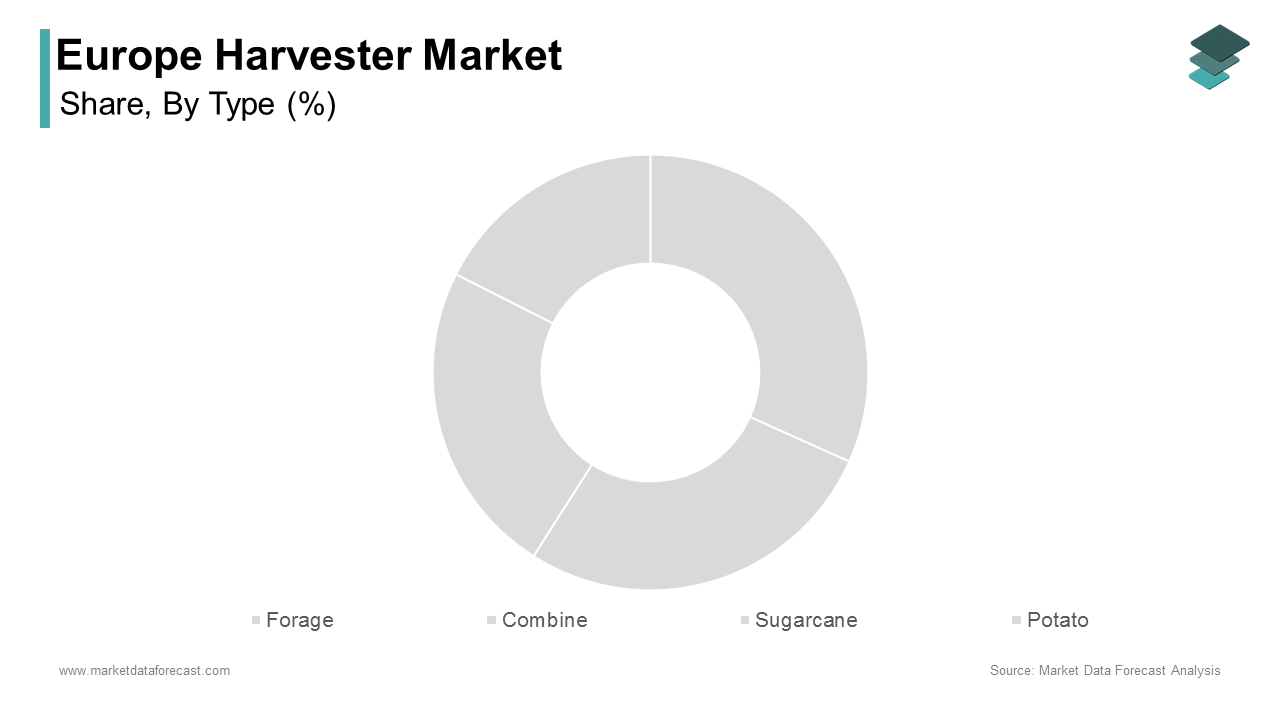
The forage harvesters segment is anticipated to witness the fastest CAGR of 6.8% from 2026 to 2034 due to the expansion of the dairy and livestock sectors alongside bioenergy mandates. As per research, the EU maintains a dairy herd of millions of cows, requiring a consistent supply of high-quality silage and maize forage, particularly in Germany, France, and the Netherlands. The shift toward year-round intensive dairy farming has increased reliance on mechanized forage collection. Manufacturers such as Krone and Claas have responded with self-propelled forage harvesters featuring throughput rates exceeding 300 tons per hour, enabling rapid field clearance and supporting this accelerated growth trajectory.
By Automation Level Insights
The semi-automatic harvesters segment captured the largest share of 52.3% of the Europe harvester market. A pragmatic balance between cost efficiency and technological capability suited to the region’s heterogeneous farm structures propels the expansion of the semi-automatic harvesters segment in the regional market. Semi-automatic machines offer features such as auto header float control, basic GPS guidance, and manual override options, which make them adaptable to both large arable fields and smaller, fragmented plots prevalent in Southern Europe. This segment also benefits from EU rural development programs that subsidize partial automation upgrades. The flexibility and incremental adoption pathway offered by semi-automatic harvesters align with the financial and operational realities of Europe’s diverse farming landscape.
The automatic harvesters segment is likely to experience the fastest CAGR of 9.2% during the forecast period, owing to labor scarcity, precision agriculture mandates, and integration with digital farm management ecosystems. As per research, the agricultural labor force in the EU declined, with Eastern and Southern member states reporting notable vacancy rates during peak harvest seasons. In addition, large-scale farms are increasingly adopting fully automatic harvesters equipped with LiDAR-based obstacle detection, real-time yield mapping, and remote diagnostics. Furthermore, the EU has committed funds to smart farming pilots, many of which require automation in harvesting to qualify for funding. These converging factors position automatic harvesters as the vanguard of Europe’s transition toward resilient and data-driven agricultural operations.
By Propulsion Type Insights
In 2025, the internal combustion engine-powered harvesters segment led the European market and captured a substantial share 2025. The dominance of the internal combustion engine-powered harvesters segment is attributed to their proven reliability, high power density, and established refueling infrastructure across rural areas. As per studies, a portion of the large number of agricultural tractors and harvesters in active use across the EU in 2023 relied on diesel engines, which reflects the deep entrenchment of ICE technology in farming operations. The dominance is further sustained by the demanding power requirements of harvesting tasks; combine harvesters typically require 300 to 600 horsepower, a range where battery electric alternatives remain commercially unviable due to weight and runtime constraints. Furthermore, Stage V compliant diesel engines achieve particulate low emissions per kilowatt hour, as per sources, mitigating environmental concerns that once threatened ICE viability. Until battery energy density improves and rural charging networks expand, ICE will remain the propulsion backbone of European harvesting operations.
The electric harvesters segment is on the rise and is expected to be the fastest-growing segment in the global market by witnessing a CAGR of 24.5% from 2026 to 2034. The rapid expansion of the electric harvesters segment is propelled by decarbonization policies, urban proximity farming, and advances in battery technology. Pilot deployments are already underway in regions with high environmental sensitivity. Battery costs have also declined significantly. The electric harvester market, while small today, is positioned for exponential growth as advances in solid-state batteries and opportunity charging unlock new applications beyond current low-power uses.
REGIONAL ANALYSIS
Germany Harvester Market Analysis
Germany dominated the Europe harvester market in 2025 and occupied 22.7% share of the regional market. The prominence of Germany is mainly driven by its advanced agricultural engineering sector and high mechanization intensity. The country is home to global harvester manufacturers such as Claas and Fendt, which collectively account for a portion of EU harvester exports, as per sources. Large-scale farming operations across Europe continue to drive steady demand for high-capacity harvesting machinery, particularly in cereal and oilseed production systems, according to sources. Machinery investment levels among German farms remain comparatively strong, indicating solid financial capacity and sustained confidence in agricultural technology, as per research. Germany’s agricultural policy framework emphasizes digital transformation, encouraging broader adoption of connected equipment and integrated harvesting solutions, according to sources. This combination of industrial capability, farm economics, and policy support solidifies Germany’s position as the continent’s harvester innovation and adoption hub.
France Harvester Market Analysis
France was the second largest region in the Europe harvester market by capturing 18.1% share in 2025. The growth of France is driven by its status as the EU’s top cereal producer and a strong cooperative farming model. According to sources, France maintains one of the largest agricultural machinery fleets in Europe, ensuring strong harvesting capacity across its cereal-growing regions. The cooperative machinery system in the country continues to support widespread access to modern harvesting technologies, which helps farmers improve efficiency and equipment renewal rates, as per research. According to sources, environmental incentives in France are encouraging the adoption of low-emission harvesting engines, aligning the sector with national sustainability goals. Apart from these, the expansion of maize silage for dairy feed in regions like Brittany has boosted forage harvester demand, with sales rising. France’s blend of production scale, cooperative infrastructure, and green incentives sustains its dominance in the regional harvester landscape.
Italy Harvester Market Analysis
Italy is also a key region in the Europe harvester market due to a dual structure of large Po Valley arable farms and small Mediterranean holdings. The country’s harvester fleet is notably aged; a portion of the machines is more than 15 years old, according to sources. Italy’s agricultural machinery association, which has created a pent-up replacement demand accelerated, allocating a notable amount for machinery modernization. In Southern Italy, compact potato and vegetable harvesters are gaining traction due to fragmented land plots. Furthermore, Italy’s focus on high-value crops like durum wheat for pasta export ensures consistent investment in precision harvesting to maintain grain quality. This regional duality and policy-driven renewal cycle emphasize Italy’s significant market presence.
United Kingdom Harvester Market Analysis
The United Kingdom witnessed moderate expansion in the Europe harvester market owing to post-Brexit agricultural reforms and a shift toward sustainable intensification. As per research, cereal production in the United Kingdom continues to support strong demand for advanced harvesting machinery, particularly high-efficiency combines. As per studies, sales of harvesting machinery in the United Kingdom have continued to rise, which reflects equipment renewal cycles and support from targeted subsidy programs. According to sources, the growing number of bioresource and energy recovery facilities across the country has also increased the need for forage harvesters used in silage production. Despite labor shortages and economic uncertainty, the UK’s policy pivot toward productivity and sustainability continues to support steady harvester market activity.
Netherlands Harvester Market Analysis
The Netherlands is likely to grow in the European harvester market during the forecast period due to its hyper efficient and technology-intensive agricultural sector. Despite having large hectares of utilized agricultural area, the country is Europe’s second-largest agricultural exporter by value, which necessitates precision harvesting for high-value crops like potatoes, sugar beets, and vegetables. Furthermore, close collaboration between Wageningen University and manufacturers like Vervaet has yielded innovations such as soil compaction reducing track systems, enhancing equipment appeal. This fusion of export orientation, policy support, and agritech integration ensures the Netherlands’ outsized influence in the regional harvester market.
COMPETITION OVERVIEW
The Europe harvester market exhibits intense competition characterized by technological differentiation, service excellence, and regulatory responsiveness among established players. Dominant manufacturers leverage decades of engineering expertise to offer highly customized solutions suited to the continent’s diverse agro climatic and farm size conditions. Competition extends beyond hardware to digital ecosystems where data-driven insights and fleet management platforms increasingly influence purchasing decisions. Regional specialization is evident with some firms excelling in cereal harvesting while others lead in tuber or forage segments. New entrants face high barriers due to capital intensity certification requirements and entrenched customer relationships. However, competitive pressure drives continuous innovation in areas such as fuel efficiency, autonomous operation, and circular design. The market also sees tactical pricing and financing schemes, especially targeting small and medium farms to broaden adoption. Overall, rivalry remains dynamic yet consolidated, with innovation and sustainability serving as primary battlegrounds.
KEY MARKET PLAYERS
A few dominating players of the Europe Harvester Market include
- John Deere
- CNH Industrial N.V
- AGCO Corporation
- CLAAS KGaA mbH
- Kubota Corporation
- SDF Group
- Deutz-Fahr
- Rostselmash
- Kuhn Group
- Yanmar Co. Ltd
- New Holland Agriculture
- Fendt
- Massey Ferguson
Top Strategies Used by the Key Market Participants
Key players in the Europe harvester market employ several strategic approaches to maintain a competitive advantage. Product innovation remains central with companies consistently integrating automation, digital connectivity, and emission reduction technologies into new models. Strategic partnerships with agritech firms and research institutions enable the co-development of precision harvesting solutions tailored to regional crop profiles. Expansion of after-sales service networks through remote diagnostics and mobile maintenance units enhances customer retention. Geographic diversification within Europe, particularly into Eastern and Southern markets, addresses fragmented demand patterns. Apart from these, firms actively align product roadmaps with EU regulatory frameworks such as Stage V emissions and the Green Deal to secure subsidy eligibility and future-proof their offerings against policy shifts.
LEADING PLAYERS IN THE EUROPE HARVESTER MARKET
Claas
Claas is a leading agricultural machinery manufacturer headquartered in Germany with a strong legacy in harvester innovation. The company has significantly shaped the global market through its development of high-capacity combine and forage harvesters that integrate precision farming technologies. In recent years, Claas has expanded its digital ecosystem by enhancing its Telematics platform to provide real-time machine diagnostics and field data analytics.
John Deere
John Deere maintains a formidable presence in the Europe harvester market through its technologically advanced and highly automated harvesting solutions. The company contributes substantially to the global sector by pioneering autonomous harvesting systems and embedding artificial intelligence into yield monitoring processes. It also introduced its fully electric small-scale forage harvester prototype in collaboration with research institutes, demonstrating its commitment to sustainable mechanization aligned with EU decarbonization targets.
AGCO Corporation
AGCO Corporation leverages its diverse portfolio of brands, including Fendt, Massey Ferguson, and Gleaner, to serve varied European farming needs. The company plays a pivotal role in the global harvester landscape by offering scalable solutions from compact potato harvesters to high-throughput combines. It also launched the IDEAL combine series with integrated carbon footprint tracking software in response to the EU’s Farm to Fork Strategy, reinforcing its focus on sustainability and digital integration across the region.
MARKET SEGMENTATION
This research report on the Europe harvester market has been segmented and sub-segmented based on type, automation level, propulsion type, and region.
By Type
- Forage
- Combine
- Sugarcane
- Potato
By Automation Level
- Automatic
- Manual
- Semi-Automatic
By Propulsion Type
- ICE
- Electric
By Region
- UK
- France
- Spain
- Germany
- Italy
- Russia
- Sweden
- Denmark
- Switzerland
- Netherlands
- Turkey
- Czech Republic
- Rest of Europe