- Product Description Description
- Table of Contents TOC
- List of Table & Figure LOT
- Get Free Sample PDF Sample PDF
Market Size, 2025
$6.81 BnMarket Estimate, 2026
$7.41 BnMarket Forecast, 2034
$14.55 BnCAGR, 2026–2034
8.8%Executive Summary: Europe Industrial Robotics Market
- Market Scope: Comprehensive European industrial robotics industry analysis covering application types (handling, assembling & disassembling), robot architecture (articulated robots), regional leadership frameworks, strategic corporate developments, and competitive landscapes.
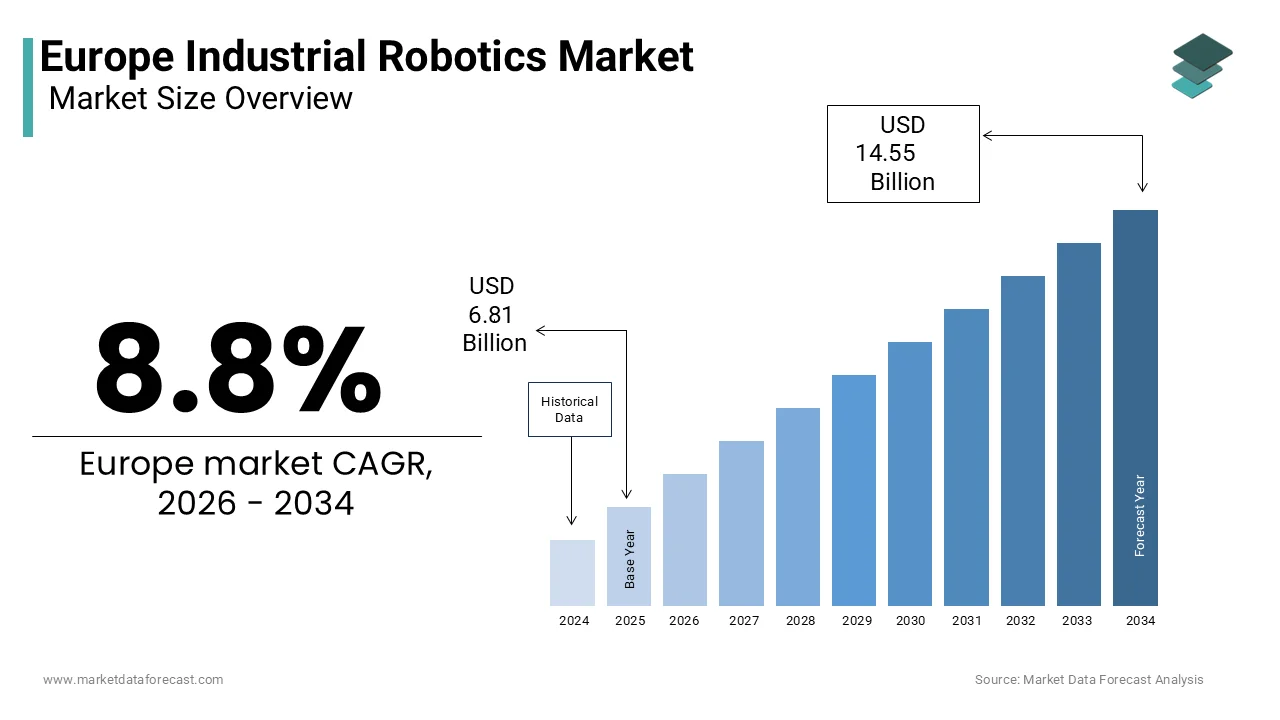
- Market Valuation: Valued at USD 6.81 billion (2025), estimated at USD 7.41 billion (2026), and projected to reach USD 14.55 billion by 2034, registering a solid CAGR of 8.8% (2026–2034).
- Primary Growth Drivers: Persistent labor shortages (EU job vacancy rates at 2.6% in Q1 2025), EV production expansion, Industry 4.0 digital transformation, Digital Europe Programme initiatives, AI-enabled robotics, and collaborative robot integration. Restraints include high upfront capital costs for SMEs and fragmented regulatory compliance.
Key Market Segment Metrics (2026–2034)
| Category | Leading Segment / Region (Position) | Fastest-Growing Segment |
|---|---|---|
| By Application & Type | Handling application (dominated with 38.3% share in 2025) & Articulated robots (dominant by type across manufacturing environments) | Assembling and disassembling application (witnessing fastest CAGR of 12.4% from 2025 to 2033 via EV battery complexity) |
| By Industrial Integration | Automotive, food & beverage, and e-commerce fulfillment material movement requirements | Circular economy remanufacturing and AI-enabled collaborative automation cells |
| By Region / Country | Germany (led regional market with 31.5% share in 2025 via automotive & machinery sectors) | France (high growth potential supported by France 2030 semiconductor, aerospace, and EV investments) |
Major Market Players & Market Structure
Market Structure: Highly competitive European automation ecosystem driven by strategic partnerships with local system integrators, continuous R&D investments in AI and machine vision, and expansion of regional application support centers.
Key Companies: ABB Ltd, KUKA AG, FANUC Corporation, Mitsubishi Electric Corporation, Yaskawa Electric Corporation, Comau SpA, Kawasaki Heavy Industries Ltd, Seiko Epson Corporation, Staubli International AG, and Universal Robots (AS).
Europe Industrial Robotics Market Size
The europe industrial robotics market was valued at USD 6.81 billion in 2025, is estimated to reach USD 7.41 billion in 2026, and is projected to reach USD 14.55 billion by 2034, growing at a CAGR of 8.8% from 2026 to 2034.
Industrial robotics is programmable automated machines designed to perform complex manufacturing tasks with high precision, repeatability, and reliability across sectors such as automotive, electronics, food and beverage, and pharmaceuticals. These systems operate autonomously or semi-autonomously, often integrated with advanced sensors, vision systems, and artificial intelligence to enhance operational efficiency. As per the International Federation of Robotics, Europe accounted for approximately 17 percent of global robot installations in 2023, while Germany installed over 28,000 (28,355) industrial robots that year. According to Eurostat, the manufacturing sector in the European Union employed nearly 30 million people in 2023, emphasizing the scale of industrial activity that drives automation adoption. As per research, a portion of manufacturers in the EU have already integrated some form of robotics into their production lines, which reflects a structural shift toward smart factories. This transformation is further accelerated by initiatives under the EU’s Digital Europe Programme and Horizon Europe framework, which prioritize advanced manufacturing technologies. The market’s evolution is not merely technological but also socio-economic, shaped by labor dynamics, regulatory frameworks, and industrial policy priorities unique to the European context.
AI is transforming Europe’s industrial robotics landscape by enabling robots to adapt, self-optimize, and collaborate safely with humans. Through machine learning, computer vision, and real-time analytics, AI-driven robots deliver greater precision, speed, and autonomy.
EU initiatives such as Digital Europe and Horizon Europe accelerate AI adoption by supporting automation R&D and SME-friendly robotics deployment.
AI-powered robotics is now a core enabler of Europe’s shift toward smart, connected, energy-efficient manufacturing.
MARKET DRIVERS
Persistent Labor Shortages Intensify Automation Adoption
-
Labor shortages are a major driver, with the EU’s job vacancy rate reaching 2.6% in Q1 2025 and manufacturing facing persistent workforce gaps.
-
Aging workforce challenges: By 2030, workers aged 55–64 will make up 30%+ of Europe’s labor market.
-
Eastern European markets (Poland, Czech Republic) are adopting robotics at double-digit growth rates due to wage convergence and industry modernization.
Overall, structural labor constraints are increasing long-term automation demand.
Persistent labor shortages across European manufacturing and logistics sectors have emerged as a driver for the growth of the Europe industrial robotics market. According to studies, the overall job vacancy rate for the EU in Q1 2025 was 2.6%, and for "industry and construction," it was approximately 2.5% in Q1 2025. This structural deficit is exacerbated by demographic pressures. By 2030, workers aged 55-64 are expected to make up 30% or more of the total workforce in many countries. The share of older workers (55 and over) active in the labour market has already risen to above 40 million by 2025, a significant and growing share of the total workforce. In response, companies are increasingly turning to robotics to maintain output levels and ensure production continuity. These trends are particularly pronounced in Eastern Europe, where wage convergence with Western Europe has reduced the cost advantage of manual labor, prompting firms in Poland and the Czech Republic to adopt robotic solutions at double-digit annual growth rates. The labor market imbalance thus functions not as a temporary disruption but as a structural driver permanently reshaping capital investment patterns across European industry.
MARKET RESTRAINTS
High Initial Capital Expenditure Constrains SME Adoption
-
High capital costs for acquisition, integration, software licensing, and training limit adoption among SMEs.
-
Lack of skilled technical personnel slows the evaluation and deployment of robotics.
-
Even in advanced economies like France, smaller firms face financing and capability gaps.
The result is uneven robotics penetration across the continent.
The substantial upfront investment required for industrial robotics remains a barrier to the expansion of the European industrial robotics market. This is particularly for small and medium enterprises that constitute a notable share of all businesses in the European Union. According to research, the widespread adoption of robotics in the EU is largely driven by large enterprises in industrialized regions; by contrast, SMEs in the EU's southern and eastern peripheries have historically implemented fewer robots, stymied by barriers such as prohibitive costs and insufficient expertise. Even in technologically advanced economies like France, the Banque de France reports that access to financing for automation projects remains limited for firms with fewer than 250 employees. Moreover, the total cost of ownership extends beyond acquisition to include maintenance, software licensing, and workforce retraining, which can add to initial outlays over time, as per sources. Small and medium enterprises (SMEs) are often deterred from adopting robotic systems because, unlike large corporations with in-house R&D and economies of scale, they typically lack the technical expertise needed for evaluating or customizing such technologies. Consequently, while the industrial robotics market expands in aggregate, its penetration remains heavily skewed toward large enterprises, which creates a dual-track automation landscape that risks widening productivity disparities across the European industrial base.
MARKET OPPORTUNITIES
Expansion of Collaborative Robotics Non-Traditional Sectors
-
Rapid growth in collaborative robots (cobots) creates opportunities in non-traditional sectors:
-
Food processing
-
Pharmaceuticals
-
Packaging
-
Agriculture
-
-
Cobots offer lower cost, smaller footprint, easy programming, and safe human-robot interaction, ideal for SMEs.
This expands automation into high-mix, low-volume production environments.
The proliferation of collaborative robots, or cobots, is providing new opportunities for the growth of the European industrial robotics market. Industrial automation in sectors previously considered unsuitable for traditional robotics gives major prospects due to space constraints, product variability, or human-centric workflows. Unlike conventional industrial robots that operate in isolated cages, cobots are designed to work safely alongside human operators by offering flexibility, ease of programming, and lower deployment costs. This growth is particularly evident in non-traditional domains such as food processing, pharmaceutical packaging, and precision agriculture. The modularity of cobots allows SMEs to start with single-unit deployments and scale incrementally, aligning capital expenditure with operational gains. This shift signifies a fundamental redefinition of industrial robotics from a heavy industry tool to a versatile enabler across Europe’s diverse economic fabric.
MARKET CHALLENGES
Fragmented Regulatory and Safety Compliance Across Member States
-
Fragmented regulatory frameworks across EU member states increase compliance complexity.
-
GDPR restrictions on data usage create uncertainty for AI-driven robotic systems.
-
Safety and electrical standards differ from country to country, increasing deployment cost and integration time.
This fragmentation slows cross-border scalability and impedes a unified digital manufacturing ecosystem.
The absence of harmonized regulatory frameworks for industrial robotics across European Union member states introduces significant complexity and cost in deployment, particularly for multinational manufacturers and robotics integrators, which in turn impedes the expansion of the European industrial robotics market. These discrepancies increase compliance costs. Moreover, the General Data Protection Regulation imposes stringent constraints on data collected by smart robots, yet enforcement practices differ markedly between data protection authorities in Sweden and Italy, creating legal uncertainty. The lack of unified standards also hampers interoperability; a robot certified in Poland may require re-engineering to meet Belgium’s electrical safety norms. Consequently, companies face not only financial burdens but also strategic hesitation in scaling robotic solutions across borders, impacting the EU’s objective of a single digital market for advanced manufacturing technologies.
REPORT COVERAGE
| REPORT METRIC | DETAILS |
| Market Size Available | 2025 to 2034 |
| Base Year | 2025 |
| Forecast Period | 2026 to 2034 |
| Segments Covered | By Application, and Region. |
| Various Analyses Covered | Global, Regional, and Country-Level Analysis, Segment-Level Analysis, Drivers, Restraints, Opportunities, Challenges; PESTLE Analysis; Porter’s Five Forces Analysis, Competitive Landscape, Analyst Overview of Investment Opportunities |
| Countries Covered | UK, France, Spain, Germany, Italy, Russia, Sweden, Denmark, Switzerland, Netherlands, Turkey, Czech Republic, and the Rest of Europe |
| Market Leaders Profiled | ABB Ltd, KUKA AG, FANUC Corporation, Mitsubishi Electric Corporation, Yaskawa Electric Corporation, Comau SpA, Kawasaki Heavy Industries Ltd, Seiko Epson Corporation, Staubli International AG, Universal Robots (AS) |
SEGMENTAL ANALYSIS
By Application Insights
Handling – Largest Segment (38.3% in 2025)
-
Dominates due to widespread use across automotive, e-commerce, food & beverage, and pharma.
-
Supports intralogistics optimization amid rising labor costs and space constraints.
-
Advanced vision and force-sensing technologies enable handling of fragile items such as pharmaceutical glass vials.
Assembling & Disassembling – Fastest-Growing (12.4% CAGR, 2025–2033)
-
Driven by electronics miniaturization and the EU’s circular economy initiatives.
-
EV battery assembly accelerates adoption due to precision and safety needs.
-
Requires sub-millimeter accuracy and consistent quality control.
AI Impact Across Applications
AI enhances:
-
Precision
-
Speed
-
Real-time optimization
-
Predictive maintenance
-
Human-robot collaboration
across every major application segment.
The handling segment was the largest segment of the European industrial robotics market by accounting for 38.3% share in 2025. The dominance of the handling segment is driven by the pervasive need for material movement across diverse manufacturing environments, particularly in automotive, food and beverage, and e-commerce fulfillment centers. A further driver of this segment is the intensifying pressure to optimize intralogistics amid rising labor costs and space constraints. Apart from these, the proliferation of high-mix production necessitates flexible handling solutions capable of managing variable payloads and geometries without retooling. The integration of vision systems and force sensing has further enhanced the precision of handling tasks, enabling robots to manage fragile items such as glass vials in pharmaceutical packaging lines. This convergence of economic, operational, and technological imperatives strengthens handling as the cornerstone application in Europe’s industrial automation landscape.
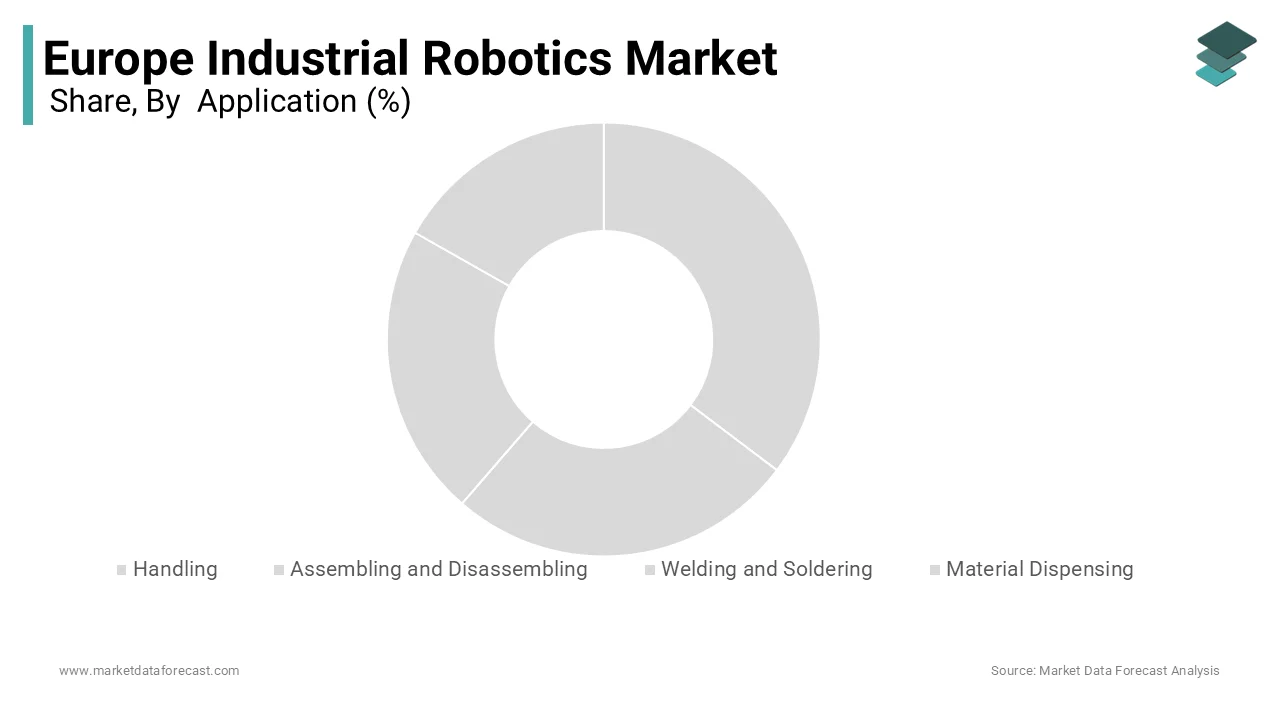
The assembling and disassembling segment is expanding at the fastest pace in the European industrial robotics market, projected to grow at a compound annual growth rate of segment is anticipated to witness the fastest CAGR of 12.4% from 2025 to 2033. The rapid expansion of the assembling and disassembling segment is primarily fueled by the rise of electronics manufacturing and circular economy mandates requiring product disassembly for recycling. In the electronics sector, miniaturization trends necessitate sub-millimeter accuracy unattainable through manual labor. Furthermore, electric vehicle battery production has emerged as a key growth vector, with each battery pack requiring precise assembly steps. These regulatory and technological synergies position assembling and disassembling as the most dynamic application frontier.
COUNTRY LEVEL ANALYSIS
Germany Industrial Robotics Market Analysis
31.5% Share (2025)
-
Europe’s leading robotics market is supported by the automotive and machinery industries.
-
Strong government backing through Industrie 4.0.
-
Growing automation demand in battery cell and EV manufacturing.
Germany was the top performer in the European industrial robotics market by accounting for a 31.5% share in 2025. The prominence of Germany is primarily propelled by its position as the continent’s foremost hub for advanced manufacturing. This dominance is anchored in the country’s robust automotive and machinery sectors, which together account for a portion of national robotic installations, according to research. The federal government’s sustained commitment to Industrie 4.0 has created a fertile ecosystem for robotics adoption, with public-private initiatives like the Plattform Industrie 4.0 facilitating interoperability standards and digital twin integration. Key drivers include acute labor shortages and stringent occupational safety laws that incentivize automation in repetitive tasks. Moreover, the presence of global robotics leaders enables rapid technology transfer and localized support. The expansion of battery cell production under the European Battery Alliance further amplifies demand.
Italy Industrial Robotics Market Analysis
31.5% Share (2025)
-
Europe’s leading robotics market is supported by the automotive and machinery industries.
-
Strong government backing through Industrie 4.0.
-
Growing automation demand in battery cell and EV manufacturing.
Italy followed closely in the European industrial robotics market by capturing a 14.2% share in 2025. The growth of Italy is attributed to its specialization in agile automation for small batch, high variety production typical of its machinery, ceramics, and food processing industries. Unlike mass production economies, Italian manufacturers prioritize modular robotic cells that can be rapidly reconfigured. The country installed a large number of industrial robots, with a portion deployed in handling and packaging applications within the food and beverage sector, according to sources. A key enabler is the government’s Industry 4.0 Tax Credit. Besides, Italy’s prominence in ceramic tile production, accounting for a portion of global exports, drives demand for robotic glazing and sorting systems that ensure micron-level surface consistency. This blend of policy support, sectoral specialization, and SME adaptability sustains Italy’s outsized influence in Europe’s automation landscape despite its relatively smaller industrial base.
France Industrial Robotics Market Analysis
High Growth Potential
-
Supported by France 2030, focused on semiconductors, aerospace, EVs, and healthcare tech.
-
Low-cost nuclear energy supports automation in energy-intensive industries.
France is expected to be the most lucrative region in the European industrial robotics market due to the state-led industrial policy to reduce dependency on foreign supply chains and revitalize domestic manufacturing. The French government’s France 2030 investment plan has allocated funds for robotics and automation in strategic sectors, including semiconductors, aerospace, and health technologies. This initiative has already spurred the installation of industrial robots, an increase from the previous year. A major growth driver is the expansion of electric vehicle production. Furthermore, France’s strong nuclear energy infrastructure provides low-cost, stable electricity, making energy-intensive automated facilities economically viable. These structural advantages, combined with targeted public investment, position France as a rising force in high-value robotic manufacturing.
United Kingdom Industrial Robotics Market Analysis
Steady Adoption
-
Post-Brexit supply chain pressures increase automation demand.
-
Strong robotics uptake in pharmaceuticals, biologics, and precision engineering.
-
Growing medtech automation, especially in Scotland.
United Kingdom expanded steadily in the European industrial robotics market, with growth driven by post-Brexit supply chain recalibration and pharmaceutical innovation. Following its departure from the EU, UK manufacturers have prioritized automation to offset increased customs friction and labor mobility restrictions. The life sciences sector is a standout performer, with the UK hosting Europe’s largest concentration of vaccine and biologic production facilities. Despite economic headwinds, the UK’s strength in high-precision engineering and regulatory alignment with global pharma standards continues to attract automation investment, particularly in Scotland’s emerging medtech corridor, where robotic cell installations grew.
Sweden Industrial Robotics Market Analysis
Sustainable Robotics Leader
-
Prioritizes ergonomic, green manufacturing with strong cobot integration.
-
Home to Northvolt’s Gigafactory, driving robotics demand in battery production.
-
Strong education and industrial culture support advanced automation.
Sweden is likely to grow in the European industrial robotics market owing to its integration of automation with sustainability and worker well-being objectives. The country’s industrial strategy emphasizes green manufacturing. A defining feature is the widespread adoption of collaborative robots in human-centric workflows. The Swedish Work Environment Authority mandates that automation projects undergo ergonomic impact assessments, fostering designs that augment rather than replace human roles. Furthermore, Sweden’s prominence in battery innovation, home to Northvolt’s flagship Gigafactory, drives demand for ultra-clean room robotic systems that handle electrode coating with nanometer precision. Supported by strong vocational training in mechatronics and a culture of industrial dialogue, Sweden exemplifies a balanced automation model that aligns productivity with social and environmental values.
COMPETITIVE LANDSCAPE
The European industrial robotics market features intense competition characterized by technological differentiation, strategic alliances, and localized service capabilities. While global giants dominate the high-end segment, regional specialists and agile startups are gaining traction through niche applications in food processing, pharmaceuticals, and small batch manufacturing. Competition is no longer solely based on hardware performance but increasingly on software intelligence, ease of integration, and total cost of ownership over the robot’s lifecycle. European manufacturers demand solutions that comply with stringent environmental and data governance regulations, which compel vendors to embed compliance into product architecture. The convergence of robotics with edge computing and 5G further blurs tradiboundariesnndaries prompting established players to acquire software firms and AI startups. This dynamic landscape fosters continuous innovation but also raises barriers to entry for new participants lacking deep domain expertise or regulatory familiarity.
KEY MARKET PLAYERS
Some of the leading companies operating in the europe industrial robotics market include
- ABB Ltd
- KUKA AG
- FANUC Corporation
- Mitsubishi Electric Corporation
- Yaskawa Electric Corporation
- Comau SpA
- Kawasaki Heavy Industries Ltd
- Seiko Epson Corporation
- Staubli International AG
- Universal Robots (AS)
TOP LEADING PLAYERS IN THE MARKET
- ABB is a pivotal force in the European industrial robotics market with a legacy of engineering excellence and innovation. The company supplies a comprehensive portfolio of robotics, tic arms, and collaborative a nd software solutions tailored for automotive electronics and logistics sectors. In recent years, ABB has intensified its focus on digital integration, launching its RobotStudio simulation platform enhancements to support virtual commissioning and AI-driven path optimization. The company also expanded its robotics production capacity at its facility in Västerås, Sweden, to meet surging European demand for sustainable automation. These initiatives reinforce ABB’s role as a technology enabler in Europe’s smart manufacturing transformation.
- KUK, a company headquartered in Augsburg,rg Germ, is deeply embedded in the European industrial automation ecosystem. The company specializes in high-precision robotic systems for automotive and battery manufacturing and has pioneered lightweight collaborative robots for flexible production environments. Recently, KUKA launched its iiQKA.OS operating system designed to simplify robot programming and enable seamless integration with third-party AI and vision tools. It also partnered with major European gigafactories to deploy modular robotic cells for electric vehicle battery assembly. These moves emphasize KUKA’s commitment to advancing agile and scalable automation aligned with Europe’s green industrial policies.
- Yaskawa Europe, though a subsidiary of a Japanese parent, maintains a strong operational footprint across Germany, Italy, and the Netherlands. The company is renowned for its MOTOMAN series of industrial robots, widely used in welding, handling, a nd precision assembly. To strengthen its European position, Yaskawa recently inaugurated a new robotics application center in Düsseldorf,f focuse on training and co-development with local manufacturers. It also introduced energy-efficient servo drives integrated with its robotic controllers to support EU sustainability mandates. These strategic investments enhance Yaskawa’s responsiveness to regional technical demands and regulatory frameworks.
TOP STRATEGIES USED BY THE KEY MARKET PARTICIPANTS
Key European industrial robotics players employ several core strategies to sustain competitive advantage. They prioritize strategic partnerships with local system integrators to ensure rapid deployment and customization for diverse industrial needs. Continuous investment in research and development fuels innovation in artificial intelligence, machine vision, and human-robot collaboration. Companies are expanding regional application centers to provide hands-on training and technical support, enhancing customer adoption. Product portfolios are being aligned with European sustainability standards through energy-efficient designs and circular economy principles. Apart from these, firms are leveraging digital twins and cloud-based simulation tools to shorten implementation cycles and improve predictive maintenance capabilities across manufacturing sites.
MARKET SEGMENTATION
This research report on the europe industrial robotics market is segmented and sub-segmented into the following categories.
By Application
- Handling
- Assembling and Disassembling
- Welding and Soldering
- Material Dispensing
- Others
By Country
- Germany
- Italy
- France
- United Kingdom
- Sweden
- Rest of Europe