- Product Description Description
- Table of Contents TOC
- List of Table & Figure LOT
- Get Free Sample PDF Sample PDF
Market Size, 2025
$41.12 BnMarket Estimate, 2026
$42.35 BnMarket Forecast, 2034
$53.56 BnCAGR, 2026–2034
2.98%Executive Summary: Europe Laptop Market
- Market Scope: Comprehensive Europe laptop market analysis covering product types, end-user segments, screen sizes, country-level frameworks, and sustainability/regulatory challenges.
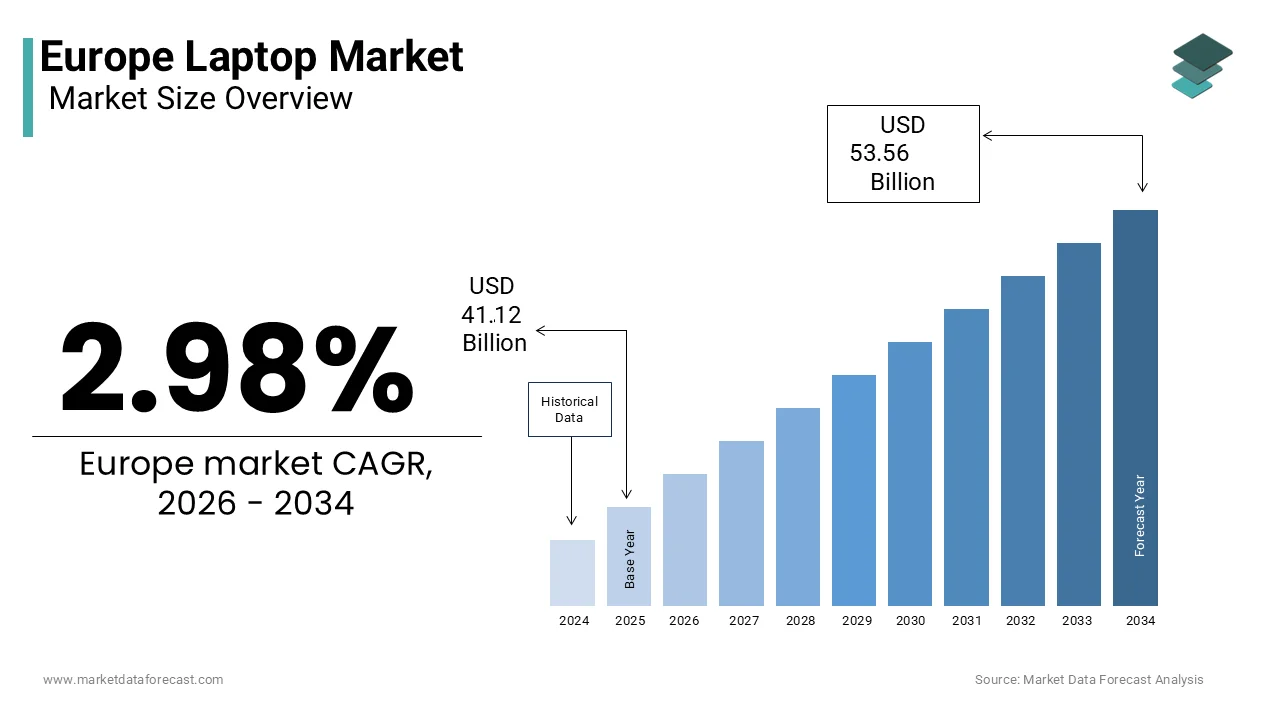
- Market Valuation: Valued at USD 41.12 billion (2025), estimated at USD 42.35 billion (2026), and projected to reach USD 53.56 billion by 2034, registering a steady CAGR of 2.98% (2026–2034).
- Primary Growth Drivers: Widespread adoption of hybrid work models, continued investments in digital education infrastructure, increasing demand for AI-capable laptops, and a growing emphasis on sustainable and repairable computing devices. Key challenges include stringent right-to-repair regulations and semiconductor supply chain disruptions.
Key Market Segment Metrics (2026–2034)
| Category | Leading Segment (2025 Position) | Fastest-Growing Segment |
|---|---|---|
| By Product Type & Screen Size | Notebooks and 14–15 Inch screen size models (led shipment volume owing to standard enterprise and consumer utility) | Gaming Laptops and AI-capable lightweight 11–13 Inch devices |
| By End User | Individual Consumers and enterprise users (accounted for the largest market share) | Healthcare and digital education institutions upgrading IT infrastructure |
| By Country | Germany (dominated due to a strong enterprise IT ecosystem and extensive hybrid work practices) | United Kingdom, France, Italy, and the Netherlands (accelerating via digitalization initiatives and AI adoption) |
Major Market Players & Market Structure
Market Structure: Highly competitive personal computing landscape characterized by continuous product innovation, AI-enabled computing capabilities (integrated NPUs), sustainability-focused product design, and compliance with European repairability and environmental regulations.
Key Companies: Lenovo Group Ltd., HP Inc., Dell Technologies Inc., Apple Inc., ASUS, Acer Inc., Samsung Electronics, Microsoft Corporation, MSI, and Huawei Technologies Co., Ltd.
Europe Laptop Market Size
The europe laptop market was valued at USD 41.12 billion in 2025, is expected to have a 2.98% CAGR from 2026 to 2034, and be worth USD 53.56 billion by 2034 from USD 42.35 billion in 2026.
A laptop refers to a portable computing device used for professional education and personal purposes across the European Union and associated nations. These devices range from entry-level notebooks to high-performance mobile workstations and premium ultrabooks tailored to diverse user needs. The market is shaped by evolving digital infrastructure, remote work, and regulatory frameworks governing energy efficiency and electronic waste. According to Eurostat, in 2025, a significant share of households in the EU owned at least one laptop, reflecting deep digital penetration. Furthermore, as per the European Environment Agency, large metric tons of waste electrical and electronic equipment were collected in 2023, with laptops accounting for a portion of small IT equipment by weight. The European Commission’s Ecodesign for Sustainable Products Regulation, which mandates repairability, battery replaceability, and material disclosure from 2025, is redefining product architecture across the sector. These socio-technical and policy-driven dynamics position the European laptop market as a convergence point of digital inclusion, circular economy mandates, and user-centric innovation, distinct from global counterparts.
MARKET DRIVERS
Pervasive Hybrid Work Models Sustain Steady Demand for Professional Laptops
The institutionalization of hybrid work across European corporations and public sector organizations encourages the growth of the European laptop market. This trend has created durable demand for reliable, secure, high-performance laptops. According to research, remote work has become a prevalent practice among employees across the European Union, with a significant increase in regular remote work engagement over recent years. This structural shift necessitates employer-provided devices that support video conferencing, cloud collaboration,n and data security. As per studies, Large enterprises in countries such as Germany, France, and the Netherlands are maintaining cybersecurity standards and software compatibility by routinely renewing employee laptops on a defined cycle. Moreover, the General Data Protection Regulation incentivizes organizations to issue managed devices rather than permit personal hardware for work use. As per studies, concerns over data breaches involving unsecured personal devices have led to the adoption of stricter corporate procurement policies, which reflect heightened focus on data security and risk management in the workplace. This institutional reliance on standardized professional laptops ensures consistent commercial segment demand independent of consumer market fluctuations and anchors the European laptop market in enterprise digital transformation.
Expansion of Digital Education Infrastructure Drives Institutional Procurement
Public investment in digital education across European schools and universities has boosted the expansion of the European laptop market. According to studies, a large majority of upper secondary schools across the European Union are now providing students with personal learning devices, with laptops being preferred for their versatility. National programs in countries like France and Germany are investing significantly in distributing laptops and upgrading classroom technology. These programs prioritize durability, long battery life, and compatibility with educational software. As per research, public procurement policies emphasize device repairability and long-term security updates to ensure sustainable use. Furthermore, accessibility regulations require publicly funded laptops to support features such as screen readers and voice control, demonstrating a commitment to inclusive digital education environments. This regulatory and budgetary commitment transforms education into a predictable high-volume channel that shapes product design and lifecycle expectations across the European laptop market.
MARKET RESTRAINTS
Stringent Right to Repair Legislation Increases Manufacturing Complexity
The growing burden from the EU’s Right to Repair framework, which mandates design changes that affect conventional manufacturing and cost structures, thereby restricting the growth of the European laptop market. As per sources, new regulations in the European Union require laptops to be designed for easier repairability, including user-replaceable batteries, screens, and storage without specialized tools, along with guaranteed availability of spare parts for several years. The high cost of implementing these new standards stems from the need to significantly redesign many current laptop models, along with the subsequent design modifications and inventory management changes. Apart from these, manufacturers must publish repair manuals and diagnostics software, which conflicts with proprietary system architectures used by many brands. The effort to lengthen product lifespans has the unintended consequence of slowing innovations and disproportionately burdening smaller companies that lack R&D resources. This regulatory burden, while aligned with circular economy goals, introduces operational friction that constrains innovation speed and pricing flexibility.
Geopolitical Disruptions in Semiconductor Supply Chains Limit Availability
Global semiconductor shortages and export controls are delaying production and inflating costs, which in turn hamper the expansion of the European laptop market. According to studies, lead times for advanced processors used in premium laptops have increased due to capacity constraints in East Asia and export restrictions. Europe's heavy reliance on semiconductor imports and limited domestic advanced fabrication facilities contributes to supply vulnerability. The slow development of advanced packaging facilities further restricts near-term supply resilience. These barriers disproportionately affect high-end segments. These factors have resulted in significant delays in laptop deliveries, particularly impacting IT procurement in sectors like finance and engineering. Such supply-side volatility affects inventory planning, enterprise deployment schedules, and consumer confidence, thereby acting as a persistent structural restraint on market fluidity.
MARKET OPPORTUNITIES
Rising Demand for orAI-Capable Laptops Opens Premium Product Avenues
The integration of on-device artificial intelligence is creating a new growth opportunity in the European laptop market. Professionals and creators are seeking hardware capable of running local AI models for productivity and content generation. According to research, a share of software developers and data analysts in Western Europe expressed interest in laptops with dedicated neural processing units. This demand is supported by Microsoft’s rollout of Windows Studio Effects and Adobe’s AI-powered Creative Cloud tools, which require minimum NPU performance thresholds. In response, manufacturers are launching AI-ready devices featuring processors from Intel, AMD, and Qualcomm with integrated NPUs. In 2025, benchmark studies have shown that laptops with 40 TOPS or higher NPU performance often significantly reduce AI inference latency compared to CPU-only systems. Furthermore, the European Commission’s AI Office has endorsed on-device processing as a privacy-preserving alternative to cloud-based AI, aligning with GDPR principles. This convergence of software innovation, n regulatory preference, and user need is causing a premium segment that redefines performance expectations and justifies higher price points in a maturing market.
Growth of Circular IT Procurement in Public Sector Fuels Refurbished Market
The expansion of sustainable public procurement policies across European governments is accelerating demand for certified refurbished and remanufactured laptops, which provides fresh prospects for the expansion of the European laptop market. According to sources, public procurement policies across the European Union increasingly prioritize environmental sustainability and total cost of ownership when acquiring IT equipment, favoring products with recycled content or certified reuse. The Netherlands has led these efforts by mandating a significant portion of government laptop purchases be refurbished. Similarly, Swedish municipalities are adopting refurbished laptops with warranties and data security certifications. These devices are sourced from specialized vendors like Back Market and Eve, who adhere to the EU’s new Common Specifications for Reuse. Certified refurbished laptops contribute substantially to reducing carbon emissions, which reflects a growing commitment to circular economy principles in public sector technology procurement. This policy-driven shift not only reduces e-waste but also creates a structured secondary market that extends product utility and offers cost-effective solutions for budget-constrained institutions.
MARKET CHALLENGES
E Waste Management Costs and Compliance Burden Strain Retailers
Retailers and distributors in the region are facing escalating costs and administrative complexity, which challenge the growth of the European laptop market. This is due to extended producer responsibility obligations under the EU’s Waste Electrical and Electronic Equipment Directive. As per sources, producers in the European market are increasingly responsible for financing the collection, treatment, and recycling of laptops, with penalties for non-compliance enforcing accountability. This mandate forces retailers to integrate reverse logistics systems even for small-scale operations. According to research, independent electronics retailers in countries such as Italy and Spain face significant costs related to compliance reporting and product take-back coordination. Moreover, the upcoming introduction of Digital Product Passports will require detailed tracking of material composition and carbon footprints, introducing additional data management requirements. These regulatory layers, while environmentally necessary, increase operational overhead, particularly for small and medium enterprises, and thereby limit market entry and distort competitive parity in favor of large vertically integrated brands with dedicated sustainability departments.
Consumer Skepticism Over Green Claims Affects Sustainable Innovation
Consumers often distrust sustainability claims made by laptop manufacturers, which leads to hesitation in adopting premium eco-labeled devices, and thereby hinders the expansion of the European laptop market. According to a study, many consumers encounter unclear or unverified environmental terms such as “eco-friendly” or “green tech” on laptop packaging, often lacking standardized metrics. This confusion is exacerbated by the absence of a unified EU ecolabel for IT products. Only a small proportion of laptops on the market display consistent and quantifiable environmental data, such as recycled content or repairability scores, according to research. Greenwashing incidents have further eroded trust. Consequently, across countries like France, Germany, and Sweden, consumer trust in environmental claims on electronics remains limited, which emphasizes the demand for greater transparency and verifiable information in the marketplace. This credibility gap suppresses willingness to pay for sustainable features and disincentivizes genuine investment in circular design until harmonized labeling and enforcement mechanisms are fully implemented.
REPORT COVERAGE
| REPORT METRIC | DETAILS |
| Market Size Available | 2025 to 2034 |
| Base Year | 2025 |
| Forecast Period | 2026 to 2034 |
| Segments Covered | By Product Type, End User, Screen Size, and Region. |
| Various Analyses Covered | Global, Regional, and Country-Level Analysis, Segment-Level Analysis, Drivers, Restraints, Opportunities, Challenges; PESTLE Analysis; Porter’s Five Forces Analysis, Competitive Landscape, Analyst Overview of Investment Opportunities |
| Countries Covered | UK, France, Spain, Germany, Italy, Russia, Sweden, Denmark, Switzerland, Netherlands, Turkey, Czech Republic, and the Rest of Europe |
| Market Leaders Profiled | Apple Inc., Samsung Electronics Co., Ltd., Microsoft Corporation, Lenovo Group Ltd., ASUSTeK Computer Inc., HP Inc., Dell Inc., Acer Inc., Micro-Star International Co., Ltd., Razer Inc. |
SEGMENTAL ANALYSIS
By Product Type Insights
In 2025, the notebooks segment was the prominent segment and held 48.3% of the European laptop market share. The growth of the notebooks segment is attributed to their balanced combination of affordability, portability, and general-purpose functionality suited for everyday computing needs. This segment caters to a broad demographic, including students, remote workers, and households seeking reliable secondary devices. According to research, notebooks represent a substantial share of personal computing devices purchased by households in the European Union, with average replacement cycles extending over multiple years. A further driver of this segment is institutional procurement under public digital inclusion programs. As per studies, programs distributing laptops to low-income families and adult education centers predominantly supply standard notebooks priced affordably, supporting digital inclusion efforts. Besides, manufacturers optimize this category for repairability and longevity to comply with the EU’s Ecodesign Regulation. The majority of new notebooks launched in Western Europe incorporate user-replaceable components such as RAM and storage drives, signaling a growing trend toward enhanced repairability and user customization in the market, according to sources. This regulatory alignment, combined with cost effectiveness and widespread software compatibility, ensures notebooks remain the backbone of the European laptop market across consumer and public sectors.
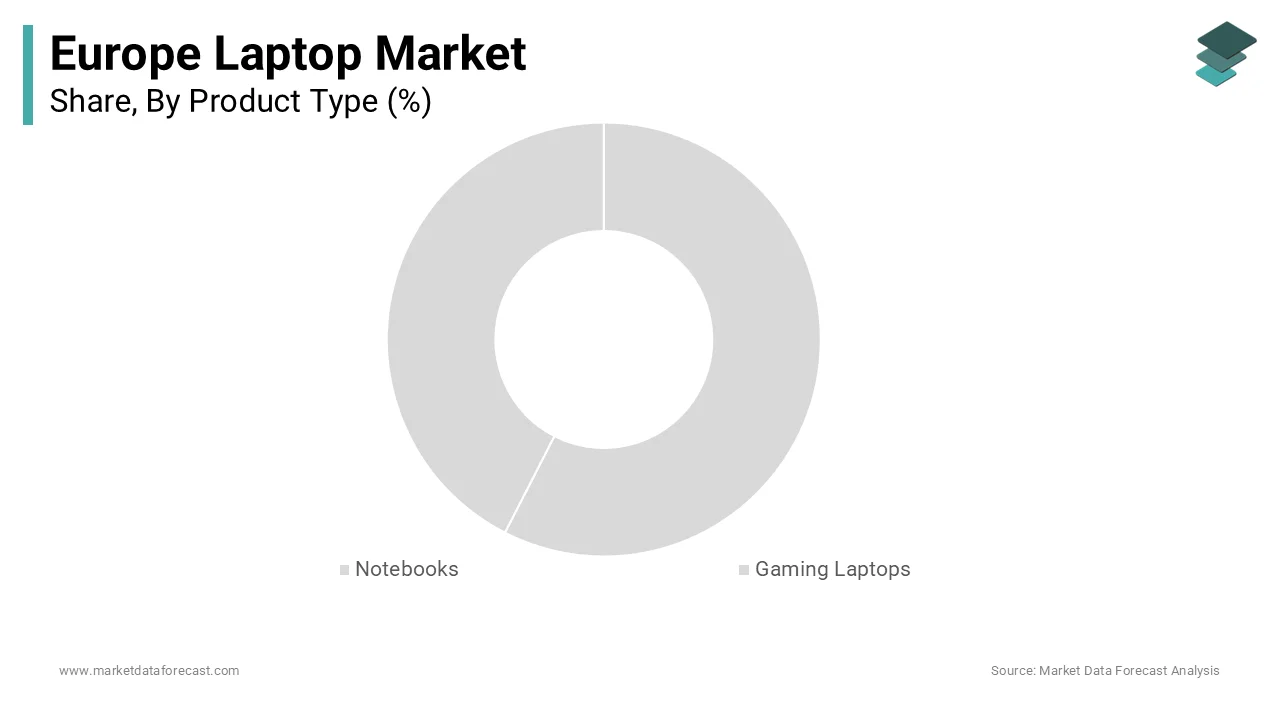
The gaming laptops segment is anticipated to witness the fastest CAGR of 11.3% from 2025 to 2033. The rapid expansion of the gaming laptops segment is led by the convergence of entertainment, professional creative work, and hardware innovation. A different growth factor is the rising demand from creative professionals who require high refresh rate displays, powerful GPUs, and thermal efficiency for 3D rendering, video editing, and AI-assisted design. Furthermore, advancements in GPU efficiency have reduced power consumption. These dual-use capabilities, supported by robust esports infrastructure and streaming culture, position gaming laptops as a high-growth segment transcending traditional entertainment boundaries.
By End User Insights
The individual consumers segment led the European laptop market and captured 52.6% of the regional market share in 2025. The prominence of the individual consumers segment is mainly propelled by high digital literacy, widespread remote work adoption, and personal computing needs for education, entertainment, and communication. According to sources, a portion of EU citizens aged 16 to 74 used a computer at least once a week, with laptops being the preferred device due to mobility and space efficiency in urban dwellings. In addition, the cultural shift toward multi-device ownership is another factor fuelling this dominance of the segment. Furthermore, the rise of subscription-based software such as Microsoft 365 and Adobe Creative Cloud has increased reliance on personal devices for seamless access. The European Data Protection Board’s 2025 guidance on personal data processing further encourages individuals to use dedicated devices rather than shared systems. This behavioral and regulatory environment ensures consistent demand from the individual segment, independent of institutional procurement cycles.
The healthcare segment is likely to experience the fastest CAGR of 9.8% over the forecast period, owing to digital transformation in clinical workflows, telemedicine expansion, and mobile point of care requirements. According to research, many hospitals in the EU implemented electronic health record systems requiring secure portable devices for bedside documentation. The deployment of mobile clinical carts and nurse stations equipped with ruggedized laptops that support barcode scanning, biometric authentication, and real-time data entry also propels the growth of this segment. Furthermore, the EU’s Cross-Border Healthcare Directive mandates interoperable digital records, which necessitate standardized secure hardware. Sustained growth in healthcare laptop adoption is ensured by two key trends in Europe: an aging population and the increasing demand for decentralized care driven by chronic disease management.
By Screen Size Insights
The laptops with 14 to 15 inch screens segment was the largest segment and occupied 56.2% share of the European laptop market in 2025. The growth of the laptops with 14 to 15 inch screens segment is because of their optimal balance between screen real estate, portability, and battery efficiency, making them ideal for both professional and educational use. According to studies, this screen size minimizes neck strain during prolonged use while fitting comfortably on standard European train tray tables and office desks. Furthermore, enterprise standardization is among the drivers of this segment. Apart from these, this size aligns with EU energy labeling requirements. As per the European Commission, laptops in this category run for notable hours of video playback on a single charge. Educational institutions also favor this range for student devices due to backpack compatibility and classroom visibility. These functional, ergonomic, and regulatory advantages cement the 1415-inch segment as the default choice across multiple user groups.
The 11 to 13 inch screen size segment is on the rise and is expected to be the fastest growing segment in the global market by witnessing a CAGR of 8.6% from 2025 to 2033 due to urban mobility demands, ultraportable professional lifestyle,,s and policy-driven lightweight device initiatives in education. Portable computing devices continue to gain popularity, particularly for use while traveling. As of 2025, Eurostat data shows rising internet usage among EU citizens. Moreover, the rise of digital nomadism also encourages the expansion of this segment. The number of digital nomad and remote worker visa programs within Europe increased significantly through 2025 and 2025, as per sources. This growing trend indicates a move towards more flexible and location-independent work. Furthermore, national education ministries are prioritizing lightweight devices for younger students. Technological advances also enable performance parity. According to sources, newer, more power-efficient mobile processors from Intel, like the Core Ultra series, offer significant performance improvements over previous generations by allowing for comparable or superior productivity performance in more compact, thin-and-light laptops. These converging lifestyle, regulatory, and technical factors position compact laptops as a high-growth category in Europe’s dense and mobile urban ecosystems.
COUNTRY LEVEL ANALYSIS
Germany Laptop Market Analysis
Germany dominated the European laptop market in 2025 and accounted for a 23.6% share in 2025. The domination of Germany is primarily driven by a robust industrial base, strong corporate IT spending, and advanced digital infrastructure. The country’s emphasis on engineering precision and data security drives demand for high-performance, durable devices across manufacturing, ng fina, and public administration. According to sources, millions of laptops were sold domestically, allied with enterprise procurement, accounting for a notable share of value. A further defining feature is strict compliance with national and EU cybersecurity standards. Besides, Germany leads in circular IT adoption. These regulatory and industrial dynamics ensure Germany remains a high-value market, shaping product standards across Europe.
United Kingdom Laptop Market Analysis
The United Kingdom followed closely in the European laptop market by capturing 9.6% share in 2025. The growth of the United Kingdom is largely fuelled by high consumer tech adoption, agile startup ecosystems, and strong digital education policies. Despite post-Brexit trade adjustments, the UK maintains robust demand through a culture of personal device ownership and remote work flexibility. According to the Office for National Statistics, in 202,4, 91 percent of UK households owned at least one laptop, op with an average replacement occurring every 3.8 years. A different driver is the government’s EdTech Strategy, which allocated notable funds to provide 11 to 16-year-olds with personal learning devices. Furthermore, the UK’s vibrant creative sector fuels demand for premium ultrabooks and 2 1 devices. This blend of public investment, private innovation, and urban seeds sustains the UK’s leading market position.
France Laptop Market Analysis
France saw a gradual rise in the European laptop market, with state-led digital inclusion programs, strong emphasis on data sovereignty, and support for domestic tech manufacturing. According to research, a share of public sector laptop purchases complied with the France Relance criteria for local value addition. A different factor is the regulatory push for digital autonomy. The National Cybersecurity Agency of France requires all public administration devices to run on certified operating systems with auditable code, as per increased adoption of Linux-based laptops from vendors like Star Labs. Furthermore, urban density drives demand for compact devices. These policy-driven and spatial dynamics position France as a unique market prioritizing sovereignty, sustainability, and urban adaptability.
Italy Laptop Market Analysis
Italy is moderately expanding in the European laptop market and is driven by a large student population, expanding SME digitization, and growing demand for mobile creative tools. According to studies, millions of laptops were sold, with education and individual segments accounting for a portion of the volume. A distinguishing trend is the rise of hybrid learning in secondary schools, where students require durable, lightweight devices for both classroom and home use. Apart from these, Italy’s strong fashion and design industries fuel demand for premium ultrabooks and 2 1 laptops. These cultural, economic, and policy elements create a diverse and resilient demand base across consumer and professional segments.
Netherlands Laptop Market Analysis
The Netherlands had the highest growth in the European laptop market owing to its high digital maturity, circular economy prominence, and logistics-driven corporate demand. A further defining characteristic is the institutional commitment to sustainable IT. Besides, the Netherlands serves as a European logistics and data hub, hosting the headquarters of multinational corporations that require standardized, secure fleets. This combination of environmental policy, corporate sophistication,n and digital infrastructure cements the Netherlands as a forward-looking high-compliance market in Europe.
COMPETITIVE LANDSCAPE
The European laptop market features intense competition among global OEMs, regional specialists, and emerging sustainable brands. Differentiation is increasingly driven by regulatory compliance, eee-repairability,bon transparency, and alignment with public procurement standards rather than price or raw performance alone. Major players leverage local assembly partnerships with recyclers and development with European research institutions to meet the EU’s stringent environmental and digital sovereignty requirements. The rise of device-as-a-service models has shifted competition toward total cost of ownership lifecycle management and data security. Meanwhile, niche vendors focusing on Linux-based devices, or ultra-low-power designs ca, ccan apture segments underserved by mainstream brands. Regulatory milestones such as the Ecodesign Regulation and Digital Product Passport mandate continuous innovation in design and supply chain transparency.
KEY MARKET PLAYERS
Some of the major companies active in the europe laptop market include
- Apple Inc.
- Samsung Electronics Co., Ltd.
- Microsoft Corporation
- Lenovo Group Ltd.
- ASUSTeK Computer Inc.
- HP Inc.
- Dell Inc.
- Acer Inc.
- Micro‑Star International Co., Ltd.
- Razer Inc.
TOP LEADING PLAYERS IN THE MARKET
- Lenovo maintains a strong presence in the European laptop market through its diverse portfolio spanning consumer ThinkPad, business Yogaa, a premium, um, and Legion gaming lines. The company leverages localized R&D centers in Germany and France to tailor devices to European regulatory and ergonomic standards. It also expanded its Device as a Service offering across Nordic and Benelux countries, enabling corporate clients to manage fleets with embedded sustainability metrics. Lenovo’s global supply chain integration and commitment to circular design principles enhance its competitiveness in Europe while influencing global standards for repairable and energy-efficient computing devices.
- HP Inc. is deeply embedded in the European laptop market through its focus on sustainable innovation and public sector partnerships. The company sources a significant portion of its recycled plastics and metals from European waste streams and assembles key models in its facility in Sant Cugat, Spain. HP’s Planet Partners take-back program now operates in EU member states, offering free collection and certified recycling. These initiatives support its dominance in circular electronics and position it as a preferred vendor for environmentally conscious institutional buyers across the region.
- Dell Technologies plays a pivotal role in the European laptop market by integrating advanced security, enterprise manageability, ty and carbon transparency into its Latitude and XPS portfolios. The company works closely with EU data protection authorities to ensure hardware-level compliance with GDPR through features like secure boot and hardware root of trust. It also partnered with Germany’s Fraunhofer Institute to develop a digital product passport prototype that tracks material origin, carbon footprint, and repair history in alignment with upcoming EU regulations. Dell’s emphasis on secure, sustainable, and future-ready computing strengthens its appeal among corporate and public sector clients while shaping global best practices for responsible IT deployment.
TOP STRATEGIES USED BY THE KEY MARKET PARTICIPANTS
Key players in the European laptop market prioritize compliance with EU ecodesign and right to repair regulations by engineering modular devices with replaceable components and longer software support. They expand device-as-a-service and leasing models to align with circular economy principles and institutional procurement preferences. Companies invest in local assembly and the use of regionally sourced recycled material to reduce their carbon footprint and meet public tender criteria. Strategic partnerships with educational and healthcare institutions ensure large-scale deployment with embedded accessibility and security features. Furthermore, they integrate AI capabilities and digital product passports to anticipate regulatory shifts and differentiate premium offerings in a maturing market.
MARKET SEGMENTATION
This research report on the europe laptop market is segmented and sub-segmented into the following categories.
By Product Type
- Notebooks
- Gaming Laptops
By End User
- Individual Consumers
- Healthcare
By Screen Size
- 14–15 Inches
- 11–13 Inches
By Country
- Germany
- United Kingdom
- France
- Italy
- Netherlands
- Rest of Europe