- Product Description Description
- Table of Contents TOC
- List of Table & Figure LOT
- Get Free Sample PDF Sample PDF
Market Size, 2025
$6.15 BnMarket Estimate, 2026
$6.81 BnMarket Forecast, 2034
$15.45 BnCAGR, 2026–2034
10.78%Europe Legal Tech Market Size, Growth, Trends & Forecast (2026–2034)
The Europe Legal Tech Market size was calculated to be USD 6.15 billion in 2025, is anticipated to be worth USD 6.81 billion in 2026, and is projected to expand to USD 15.45 billion by 2034, registering a compound annual growth rate (CAGR) of 10.78% during the forecast period from 2026 to 2034. Driven by the urgent need to reduce judicial backlogs, escalating regulatory compliance demands (such as GDPR and the AI Act), and the integration of generative AI and document automation, the market is rapidly shifting toward modern, data-driven legal operations.
Key Executive Metrics (At-a-Glance)
- 2025 Base Valuation: USD 6.15 Billion
- 2026 Current Valuation: USD 6.81 Billion
- 2034 Forecast Valuation: USD 15.45 Billion
- Compound Annual Growth Rate (CAGR): 10.78% (2026–2034)
- Leading Regional Market: United Kingdom (holding the highest regional market share)
- Key Growth Hubs: United Kingdom, Germany, France, and the Netherlands
Core Market Drivers
- Judicial Efficiency & Backlog Reduction: Pressures on European courts to accelerate civil and commercial proceedings through e-justice and digital case management.
- Escalating Regulatory Complexity: Surging compliance obligations (AML, sustainable finance, GDPR, and AI regulations) driving adoption of automated RegTech solutions.
- Generative AI Integration: Advanced contract analytics and large language models drastically reducing drafting and review times.
Primary Market Restraints & Challenges
- Cultural Resistance: Deep-seated traditionalist mindsets and skepticism toward AI-driven legal advice among legal practitioners.
- Fragmented Cross-Border Landscape: Absence of harmonization in legal procedures, civil codes, and language requirements across European member states.
Market Segmentation: Largest and Fastest-Growing Segments
| Segment Category | Largest Segment | Fastest-Growing Segment |
|---|---|---|
| By Solution Type | Document Automation | Legal Analytics (23.2% CAGR) |
| By Firm Size | Large Enterprise | Medium-Sized Law Firms (19.4% CAGR) |
| By End User | Law Firms | Corporate Legal Departments (21.2% CAGR) |
| By Region | United Kingdom | Sweden, Germany, & The Netherlands |
Major Industry Players Profiled
Key market participants shaping the Europe legal tech landscape include Relativity, Clio, Thomson Reuters, Wolters Kluwer, LexisNexis, DISCO (CS Disco, Inc.), iManage, Everlaw, Luminance, ContractPodAi, LEVERTON, Legatics, LawGeex, Rocket Lawyer, and DocuSign.
Europe Legal Tech Market Size
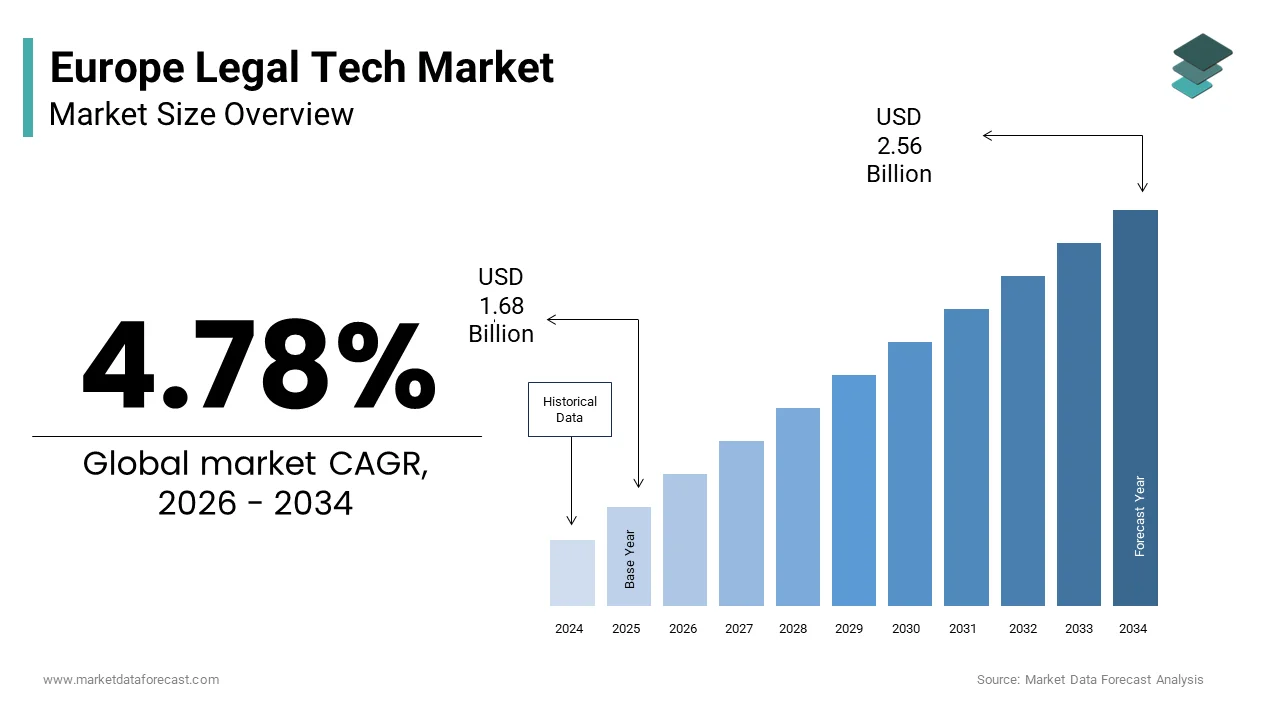
The Europe legal tech market size was calculated to be USD 6.15 billion in 2025 and is anticipated to be worth USD 15.45 billion by 2034, from USD 6.81 billion in 2026, growing at a CAGR of 10.78% during the forecast period.
Legal tech encompasses a dynamic ecosystem of software, platforms, and services designed to automate, optimize, and transform the delivery of legal services across the continent. This sector includes solutions for document automation, e-discovery, contract lifecycle management, legal research, and online dispute resolution, serving law firms, corporate legal departments, and public sector entities. The operational landscape is uniquely defined by the tension between a deeply rooted tradition of civil and common law practices and an urgent imperative to modernize through digital innovation. As per Eurostat, enterprises across the European Union with ten or more employees widely utilize cloud computing services, which are creating a foundational infrastructure that supports the deployment of sophisticated legal technologies. Furthermore, according to the European Commission, the duration of civil and commercial proceedings varies significantly across member states, with some jurisdictions experiencing lengthy delays that have prompted a systemic push toward efficiency tools. The General Data Protection Regulation imposes rigorous standards on data handling, forcing legal tech providers to embed privacy by design into their architectures. As per the Council of Bars and Law Societies of Europe, the number of practicing lawyers is very high, yet access to justice remains a challenge for many citizens, which is driving the adoption of automated tools to bridge the gap. This convergence of regulatory complexity, efficiency demands, and access imperatives shapes a market where technology acts as the critical enabler for a more agile and equitable legal system.
MARKET DRIVERS
Urgent Need to Reduce Case Backlogs and Improve Judicial Efficiency
The rising pressure on judicial systems to address massive case backlogs and accelerate dispute resolution is primarily driving the expansion of the Europe legal tech market. As per the European Commission’s EU Justice Scoreboard, several member states face significant challenges with the length of proceedings, where first-instance courts often take over 400 days to resolve civil and commercial cases. This inefficiency undermines economic activity and erodes public trust in the rule of law. In response, governments and court administrations are investing in digital case management systems, automated scheduling tools, and online filing platforms to streamline workflows. Artificial intelligence is increasingly used for preliminary document review and triage, allowing judges and clerks to focus on complex reasoning rather than administrative tasks. The EU’s push for “e-justice” initiatives mandates digitization of court records and video conferencing for hearings, practices that became standard during the pandemic and remain central today. This structural necessity to modernize the judiciary drives substantial demand for legal tech solutions that promise measurable reductions in processing times and operational costs.
Escalating Regulatory Complexity and Compliance Demands
The expanding web of regulations governing business operations in Europe that compels corporations and law firms to adopt advanced compliance and monitoring technologies is further contributing to the Europe legal tech market growth. As per the European Banking Authority, financial institutions alone must comply with hundreds of distinct regulatory requirements ranging from anti-money laundering directives to sustainable finance disclosures. The sheer volume and frequency of legislative changes make manual tracking unsustainable, which is fuelling demand for RegTech solutions integrated within legal tech platforms. These tools leverage natural language processing to scan new legislation, assess impacts on existing contracts, and automatically update compliance protocols. The GDPR and the upcoming AI Act further complicate the landscape, requiring meticulous records of data processing and algorithmic decision-making. Corporate legal departments are shifting toward proactive risk management, relying on software for continuous audits and real-time reporting. Given the high cost of non-compliance, investment in automated legal tools is justified, which ensures legal tech becomes indispensable across the European single market.
MARKET RESTRAINTS
Deep-Seated Cultural Resistance and Traditionalist Mindsets
The conservative culture within the European legal profession is hampering the expansion of the Europe legal tech market. As per the Law Society of England and Wales, many solicitors express skepticism about AI-driven legal advice and fear that automation may devalue their expertise. Senior partners in established firms often resist efficiency tools that disrupt billable hour models. The lack of mandatory technology training in many European law schools perpetuates a skills gap, which is leaving younger lawyers ill-equipped to champion digital transformation. Furthermore, the fragmented nature of the legal market, with thousands of solo practices, means adoption decisions are highly individualized. The perception that legal services require a human touch for nuanced interpretation creates psychological barriers to automation. Overcoming this inertia requires demonstrating clear ROI and reframing lawyers’ roles from document drafters to strategic advisors as a transition progressing slowly across the continent.
Fragmented Regulatory Landscape and Cross-Border Incompatibility
The absence of harmonization in legal procedures and data regulations across European member states is further impeding the regional market expansion. As per the European Parliament, each country maintains distinct civil codes, court rules, and language requirements, which makes it difficult for vendors to develop single-platform solutions that work seamlessly across borders. A contract automation tool designed for German law may be incompatible with French or Italian frameworks due to differences in clause structures and mandatory provisions. This fragmentation forces legal tech companies to build localized versions for each jurisdiction, which increases development costs and time to market. Varying interpretations of GDPR by national authorities further complicate cross-border data flows essential for cloud-based services. Without a unified “digital single market” for legal services, successful pilots in one country cannot easily be replicated elsewhere. This patchwork discourages venture capital investment in pan-European legal tech startups and limits economies of scale, which is restraining overall market growth.
MARKET OPPORTUNITIES
Expansion of Access to Justice Through Online Dispute Resolution (ODR)
The persistent gap in access to justice for individuals and small businesses is a promising opportunity in the Europe legal tech market. As per the European Commission, many consumers and SMEs avoid legal action due to the high costs and complexity of traditional litigation, leaving grievances unresolved. Legal tech providers can address this by developing user-friendly, automated platforms that guide users through mediation, arbitration, and small claims processes without requiring expensive legal representation. Algorithms can analyse case facts, suggest fair settlements, and facilitate binding agreements, drastically reducing time and expense. The EU’s existing ODR platform for consumer disputes provides a foundation, but there is vast potential to extend these capabilities to employment, family, and landlord-tenant issues. By democratizing access to legal remedies, these tools align with public policy goals of social equity and judicial efficiency. Governments are increasingly open to partnering with private tech firms to pilot such initiatives, which is creating a lucrative growth avenue. Serving the “missing middle” of the legal market represents a massive untapped revenue stream.
Integration of Generative AI for Advanced Contract Analytics
Generative AI offers unprecedented opportunities to revolutionize contract lifecycle management and legal research. As per Gartner, generative AI can reduce drafting and review time by up to 50% while improving accuracy and consistency. European legal tech firms can leverage large language models trained on specific jurisdictions to draft complex clauses, identify hidden risks, and negotiate terms in real time. This enables law firms and corporate legal departments to handle higher volumes of work with existing staff, shifting the value proposition from hours billed to outcomes delivered. Generative AI also allows the extraction of insights from vast repositories of historical contracts, helping organizations optimize negotiating positions. Furthermore, it can translate legal documents across multiple European languages with high fidelity, breaking down linguistic barriers in cross-border transactions. Early adopters gain a competitive advantage which is offering premium services that were previously impossible. As regulatory clarity improves, generative AI integration will become a standard expectation, driving investment and innovation.
MARKET CHALLENGES
Ethical Concerns and Liability Regarding AI-Driven Legal Advice
The deployment of AI in legal decision-making raises profound ethical and liability challenges to the growth of the Europe legal tech market. As per the European Group on Ethics in Science and New Technologies, concerns persist about the “black box” nature of AI algorithms, where the reasoning behind recommendations may be opaque. If AI provides incorrect advice leading to financial loss or penalties, liability between the vendor, law firm, and lawyer becomes complex. Algorithmic bias further complicates matters, as historical training data may perpetuate discrimination in sentencing or hiring recommendations. European regulators are scrutinizing AI applications under the Artificial Intelligence Act, potentially classifying certain legal tech tools as high-risk and subjecting them to rigorous conformity assessments. This regulatory uncertainty creates hesitation among adopters. Ensuring transparency, explainability, and human oversight requires significant technical and governance investments, making it a persistent hurdle for the industry.
Cybersecurity Risks and Protection of Privileged Client Data
Legal tech platforms concentrate highly sensitive client information, which is making them prime targets for cybercriminals and further challenging the expansion of the Europe legal tech market. As per the European Union Agency for Cybersecurity, ransomware attacks and breaches in the legal sector have sharply increased, exploiting vulnerabilities in cloud-based practice management and document-sharing systems. A single breach can expose confidential merger details, intellectual property, and personal data, leading to catastrophic reputational damage and loss of attorney-client privilege. Law firms, often perceived as weaker in cybersecurity compared to financial institutions, are increasingly targeted as entry points to compromise corporate clients. Strict confidentiality requirements mean any breach can result in lawsuits or disbarment. Legal tech providers must invest heavily in encryption, zero-trust architectures, and continuous monitoring, raising operational costs. Third-party integrations and supply chain dependencies expand the attack surface further. Balancing accessibility for remote work with ironclad security remains a critical and costly challenge for all market participants.
REPORT COVERAGE
| REPORT METRIC | DETAILS |
| Market Size Available | 2025 to 2034 |
| Base Year | 2025 |
| Forecast Period | 2026 to 2034 |
| CAGR | 10.78% |
| Segments Covered | By Solution Type, Firm Size, End User, And Region |
| Various Analyses Covered | Global, Regional & Country Level Analysis; Segment-Level Analysis; DROC, PESTLE Analysis; Porter’s Five Forces Analysis; Competitive Landscape; Analyst Overview of Investment Opportunities |
| Regions Covered | UK, France, Spain, Germany, Italy, Russia, Sweden, Denmark, Switzerland, Netherlands, Turkey, and the Czech Republic |
| Market Leaders Profiled | Relativity, Clio, Thomson Reuters, Wolters Kluwer, LexisNexis, DISCO (CS Disco, Inc.), iManage, Everlaw, Luminance, ContractPodAi, LEVERTON, Legatics, LawGeex, Rocket Lawyer, DocuSign |
SEGMENTAL ANALYSIS
By Solution Type Insights
The document automation segment led the market by commanding the highest share of the Europe legal tech market in 2025. The dominance of the document automation segment is majorly driven by the fundamental need to streamline the creation of high-volume legal documents while minimizing human error. The critical imperative for law firms and corporate legal departments to eliminate time-consuming manual drafting processes that are prone to costly errors is further contributing to the dominance of the dominance of document automation segment in the regional market. According to the Law Society of England and Wales, lawyers dedicate significant portions of their billable time to document preparation and review. Automated solutions allow practitioners to generate complex agreements in minutes by populating pre-approved templates with client data, ensuring consistency and adherence to the latest regulatory standards. In jurisdictions with strict liability for clerical mistakes, such as Germany and France, the ability of software to enforce logical rules and prevent contradictory clauses provides a significant risk mitigation benefit. The integration of these tools with existing case management systems further accelerates workflow, which is enabling firms to handle higher volumes of work without proportional increases in headcount. As European businesses face increasing transaction speeds, the demand for instant, accurate document generation becomes non-negotiable.
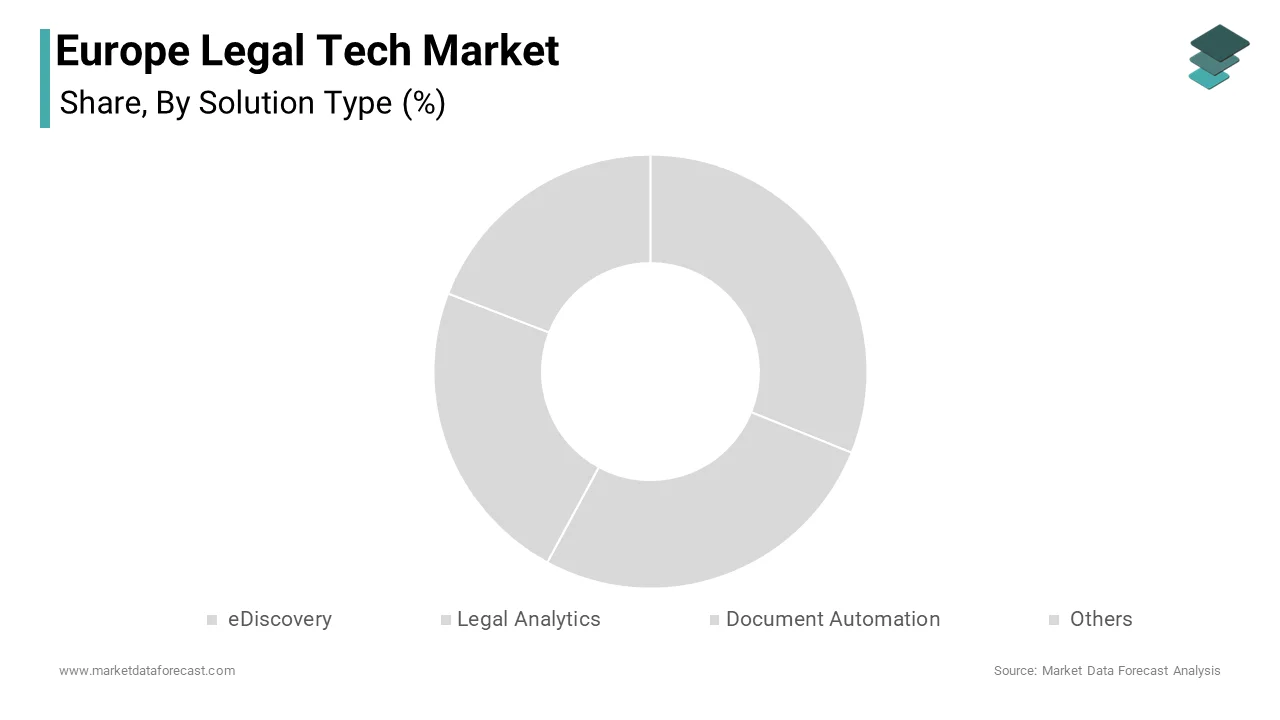
The legal analytics segment is poised to grow at a CAGR of 23.2% over the forecast period in the European market, owing to the increasing demand from clients and general counsels for predictive insights regarding litigation risks and potential case outcomes. According to Gartner, organizations leveraging data analytics for legal strategy can significantly reduce litigation costs by making informed decisions about whether to settle or proceed to trial. Advanced algorithms analyse vast repositories of historical case law, judge rulings, and opposing counsel behaviours to forecast probabilities with remarkable accuracy. In Europe, where litigation can be protracted and expensive, the ability to quantify risk empowers businesses to allocate resources more effectively and manage expectations. Law firms are also adopting these tools to refine their billing strategies and demonstrate value to clients through data-backed arguments. The shift from intuition-based advice to evidence-based counselling represents a paradigm shift in the profession, driving rapid adoption of analytics platforms. As courts increasingly digitize their records, the availability of structured data for analysis expands, further accelerating the utility and uptake of these sophisticated tools across the region.
By Firm Size Insights
The large enterprise segment had the major share of the Europe legal tech market in 2025. The growth of the large enterprises segment in the European market can be credited to their substantial financial resources, complex operational scales, and the competitive necessity to lead in innovation. The significant capital reserves of large firms that allow for aggressive investment in cutting-edge legal technologies and comprehensive digital transformation initiatives are further contributing to the dominance of the large firms segment in the regional market. According to the Global Law Report, the top law firms in Europe account for a disproportionate share of total legal revenue. These firms operate dedicated innovation labs and employ chief technology officers to oversee the integration of artificial intelligence, cloud computing, and advanced security protocols. The scale of their operations, often spanning multiple countries and practice areas, necessitates robust enterprise-grade solutions to manage workflows, knowledge, and client relationships efficiently. Large firms view technology not merely as a support function but as a core competitive differentiator to attract top-tier clients who demand speed and precision. The ability to pilot emerging technologies and absorb the risks associated with early adoption further solidifies their position as the primary consumers of high-end legal tech.
The medium-sized law firms segment is expected to exhibit a CAGR of 19.4% in the European market during the forecast period, owing to the urgent need to compete with larger rivals and the increasing accessibility of scalable, cost-effective legal tech solutions. The intense competitive pressure to match the efficiency and service levels of large enterprise firms without possessing equivalent resources is also favouring the expansion of the medium-sized segment in the European market. According to the Legal Services Board, mid-tier firms are losing market share to both magic circle firms and agile new entrants. By adopting cloud-based practice management and document automation tools, these firms can deliver high-quality work at faster speeds and lower costs, effectively punching above their weight class. The availability of subscription-based software models has lowered the barrier to entry, allowing medium-sized firms to access enterprise-grade capabilities without massive upfront capital expenditure. These firms are increasingly realizing that technology is essential for survival and growth, leading to a cultural shift where digital adoption is prioritized at the partnership level. The desire to differentiate themselves through niche expertise supported by specialized tech stacks drives rapid procurement cycles. This strategic pivot to technology as a core competency ensures that the medium-sized segment will outpace larger firms in growth rate as they aggressively modernize their operations.
By End User Insights
The law firms segment accounted for the largest share of the Europe legal tech market in 2025. Law firms are serving as the primary adopters of technology due to their direct reliance on billable hours, the complexity of their caseloads, and the competitive dynamics of the legal services industry. The dominance of the law firms segment is also driven by the fundamental economic model of the legal profession, where maximizing billable utilization and profitability is paramount. According to the Thomson Reuters Institute, law firms face increasing pressure to do more with less as clients resist rising hourly rates. Legal tech tools such as time-tracking automation, matter management systems, and document assembly directly impact the bottom line by reducing non-billable administrative time and accelerating matter turnover. The ability to automate routine tasks allows lawyers to focus on high-value strategic work, thereby increasing realized rates and overall firm profitability. In a highly competitive market, firms that fail to adopt these efficiencies risk being undercut by more technologically advanced competitors. The drive to optimize every minute of a lawyer's day ensures continuous investment in tools that enhance productivity. Furthermore, the need to accurately capture all billable activities through automated tracking prevents revenue leakage. This relentless pursuit of operational excellence and financial performance cements law firms as the largest end-user segment in the legal tech ecosystem.
The corporate legal departments segment is predicted to register a promising CAGR of 21.2% over the forecast period in the European market, owing to the transformation of in-house teams into strategic business partners and the need to manage escalating regulatory burdens internally. According to the Association of Corporate Counsel, general counsels are increasingly expected to contribute to business strategy, risk management, and operational efficiency. Legal tech enables these teams to automate routine contract reviews, monitor compliance obligations, and manage litigation portfolios with greater agility, freeing up time for high-level strategic input. The ability to visualize legal data through dashboards allows GCs to communicate risks and opportunities effectively to the C-suite, elevating the stature of the legal function within the organization. The shift towards preventing legal issues rather than just resolving them drives investment in predictive analytics and automated monitoring systems. As businesses become more complex, the demand for legal functions to operate with the same speed and efficiency as commercial units intensifies. This strategic elevation of the in-house role ensures that corporate legal departments will be the fastest-growing segment for legal tech investment.
REGIONAL ANALYSIS
United Kingdom Legal Tech Market Analysis
The United Kingdom dominated the legal tech market in Europe in 2025 with the highest share of the European market. The dominance of the UK in the European market is attributed to its status as a global legal hub, its common law system, which is highly adaptable to technology, and a vibrant ecosystem of legal tech startups. The mature convergence of world-class law firms, innovative vendors, and supportive government initiatives is propelling the UK market expansion. According to Statista, the UK plays a central role in European legal tech investment. London serves as the epicenter, hosting numerous legal tech accelerators and venture capital firms dedicated to the sector. The Solicitors Regulation Authority has been proactive in fostering innovation through regulatory sandboxes, allowing firms to test new technologies in a controlled environment. The high concentration of international disputes and finance deals in the UK drives demand for sophisticated e-discovery and contract analytics tools. Furthermore, the strong tradition of commercial law and the English language advantage facilitate the export of UK-developed legal tech solutions globally.
Germany Legal Tech Market Analysis
Germany occupied a promising share of the Europe legal tech market in 2025. The growth of Germany in the European market is attributed to its robust industrial base, strict regulatory environment, and a growing emphasis on digitizing its civil law system. The nation benefits from a large number of mid-sized enterprises and corporate legal departments that are increasingly adopting technology to manage complex compliance requirements. As per the German Federal Ministry of Justice, the Justice Digitization Act has spurred investment in court technology and legal software. German law firms, traditionally conservative, are rapidly embracing document automation and compliance tools to navigate the intricate web of EU and national regulations. The strong manufacturing and automotive sectors drive demand for specialized legal tech solutions related to intellectual property and supply chain contracts. The presence of major software companies in Germany also fosters a culture of technical excellence and integration. The push for data sovereignty and GDPR compliance creates a unique market for local vendors who can guarantee secure, on-premise or sovereign cloud solutions.
France Legal Tech Market Analysis
France is estimated to hold a prominent share of the market during the forecast period. Factors such as strong government support for legal innovation, a thriving startup scene in Paris, a concerted effort to modernize its civil code through technology, and the Tech for Good initiative that includes legal tech as a key component of digital sovereignty are driving the French market expansion. According to the French Ministry of Justice, the deployment of predictive justice tools and online dispute resolution platforms has been accelerated to reduce case backlogs and improve access to justice. French law firms are increasingly investing in legal analytics and AI to compete internationally, particularly in areas of corporate law and arbitration. The presence of major global law firms in Paris drives the adoption of international best practices and technologies. The government's push for open data in the legal sector provides fertile ground for developers to create innovative applications.
Netherlands Legal Tech Market Analysis
The Netherlands is anticipated to account for a notable share of the Europe legal tech market over the forecast period. The high English proficiency, progressive regulatory approach, role as a testing ground for cross-border legal tech solutions, a culture of openness to innovation, and a highly digitized public sector that sets the pace for private adoption are driving the market expansion in the Netherlands. According to the Netherlands Bar Association, Dutch lawyers actively use legal tech tools for research and document management. The country's strategic location and role as a hub for international trade and arbitration drive demand for multilingual and cross-jurisdictional legal tech platforms. The Dutch government's commitment to e-justice has resulted in fully digital court procedures for many case types, creating a seamless ecosystem for legal tech integration. The presence of numerous multinational headquarters in Amsterdam fuels the demand for sophisticated corporate legal management tools.
Sweden Legal Tech Market Analysis
Sweden is estimated to command a noteworthy CAGR in the Europe legal tech market during the forecast period, owing to its advanced digital infrastructure, high internet penetration, and a societal willingness to embrace automation and AI in professional services. The country is home to several successful legal tech unicorns and has a culture that prioritizes efficiency and transparency. As per Statistics Sweden, internet usage is widespread, and the legal profession is no exception, with the adoption of cloud-based practice management and AI-driven research tools. Swedish law firms and corporate legal departments are early adopters of technologies that enhance remote collaboration and automate routine tasks, driven by a shortage of legal professionals and high labor costs. The government's proactive stance on digitalization includes initiatives to make legal data more accessible and machine-readable, fueling innovation. Stockholm has become a hotspot for legal tech startups developing niche solutions for contract analysis and compliance.
COMPETITION OVERVIEW
The competition within the Europe legal tech market is intense and characterized by a rivalry between established global information providers, agile specialized startups, and traditional software vendors expanding into the legal space. Large incumbents leverage their vast proprietary databases and brand trust to offer comprehensive suites while niche players compete on innovation, specific functionality, and superior customer service. The market sees frequent mergers and acquisitions as companies seek to fill capability gaps in artificial intelligence and e-discovery quickly. Differentiation increasingly depends on the ability to guarantee data residency within European borders, comply with evolving regulations, and provide localized content for multiple jurisdictions. Price competition remains fierce, particularly in the document automation segment, where commoditization pressures margins. The shortage of legal tech talent has intensified the war for skilled developers and legal engineers, making retention strategies critical. Customers demand higher levels of integration and transparency, leading to a shift from standalone tools to interconnected ecosystems. This dynamic environment requires continuous innovation and strategic agility to maintain market relevance and capture growth opportunities in a fragmented yet lucrative landscape.
KEY MARKET PLAYERS
A few major players of the Europe legal tech market include
- Relativity
- Clio
- Thomson Reuters
- Wolters Kluwer
- LexisNexis
- DISCO (CS Disco, Inc.)
- iManage
- Everlaw
- Luminance
- ContractPodAi
- LEVERTON
- Legatics
- LawGeex
- Rocket Lawyer
- DocuSign
Top Strategies Used by Key Market Participants
Key players in the Europe legal tech market primarily focus on integrating artificial intelligence and machine learning to automate document review and enhance legal research accuracy. Companies are aggressively expanding their local data center infrastructure to ensure strict compliance with European data sovereignty laws and General Data Protection Regulation requirements. Another major strategy involves forming strategic partnerships with local bar associations and law firms to tailor solutions to specific jurisdictional nuances. Providers are developing modular platforms that allow clients to customize workflows and integrate third-party applications seamlessly. Firms are also investing heavily in cybersecurity measures to protect sensitive client data and maintain attorney-client privilege. There is a significant push toward offering subscription-based pricing models to make advanced tools accessible to small and medium-sized practices. Finally, companies are prioritizing user experience improvements to drive adoption among traditionally conservative legal professionals.
Leading Players in the Europe Legal Tech Market
- LexisNexis stands as a preeminent force in the Europe legal tech market by providing comprehensive legal research, analytics, and practice management solutions to professionals across the continent. The company contributes significantly to the global market through its vast database of case law and legislation, which sets the standard for legal information retrieval. LexisNexis recently strengthened its European position by integrating advanced artificial intelligence capabilities into its research platforms to offer predictive insights and faster document review. The firm actively collaborates with European bar associations to ensure its tools comply with local regulations and ethical standards. Strategic investments in natural language processing allow users to query complex legal concepts with unprecedented accuracy. By focusing on seamless integration with existing workflows, LexisNexis enhances productivity for lawyers and corporate counsel. These initiatives solidify its reputation as a trusted partner for navigating the intricate European legal landscape.
- Thomson Reuters operates as a leading global provider of business information services with a profound impact on the Europe legal tech sector through its Westlaw and Practical Law offerings. The company drives global innovation by combining deep legal content with cutting-edge technology to solve complex regulatory challenges. Thomson Reuters has recently accelerated its growth in Europe by launching specialized compliance modules tailored to the General Data Protection Regulation and other regional mandates. The corporation leverages machine learning to automate routine legal tasks such as contract abstraction and due diligence, freeing professionals for high-value work. Their commitment to data security and sovereignty resonates strongly with European clients concerned about privacy. Thomson Reuters continues to expand its network of local experts to ensure content relevance across diverse jurisdictions. By delivering integrated solutions that bridge research and workflow, the company reinforces its status as an essential infrastructure provider for the modern legal profession.
- Relativity maintains a formidable presence in the Europe legal tech market as the gold standard for e-discovery and legal document review software used in complex litigation and investigations. The group plays a vital role in the global market by enabling organizations to uncover truth and protect data through scalable cloud-based solutions. Relativity recently enhanced its European footprint by establishing dedicated data centers in key locations to meet strict data residency requirements under European law. The firm focuses heavily on artificial intelligence features that accelerate the identification of relevant evidence while reducing manual review costs. Recent actions include partnerships with major European law firms to deploy custom workflows for cross-border investigations. Relativity emphasizes user training and certification to maximize the utility of its platform among legal teams. These strategic moves ensure that Relativity remains the preferred choice for handling massive volumes of sensitive legal data securely and efficiently.
MARKET SEGMENTATION
This research report on the Europe legal tech market has been segmented and sub-segmented based on solution type, firm size, end user & region.
By Solution Type
- eDiscovery
- Legal Analytics
- Document Automation
- Others
By Firm Size
- Large Enterprise Law Firms
- Medium-Sized Law Firms
- Others
By End User
- Law Firms
- Corporate Legal Departments
- Government Agencies
- Alternative Legal Service Providers
By Region
- UK
- France
- Spain
- Germany
- Italy
- Russia
- Sweden
- Denmark
- Switzerland
- Netherlands
- Turkey
- Czech Republic
- Rest of Europe