- Product Description Description
- Table of Contents TOC
- List of Table & Figure LOT
- Get Free Sample PDF Sample PDF
Market Size, 2025
$11.27 BnMarket Estimate, 2026
$12.53 BnMarket Forecast, 2034
$29.21 BnCAGR, 2026–2034
11.16%Europe Life Science Analytics Market Size
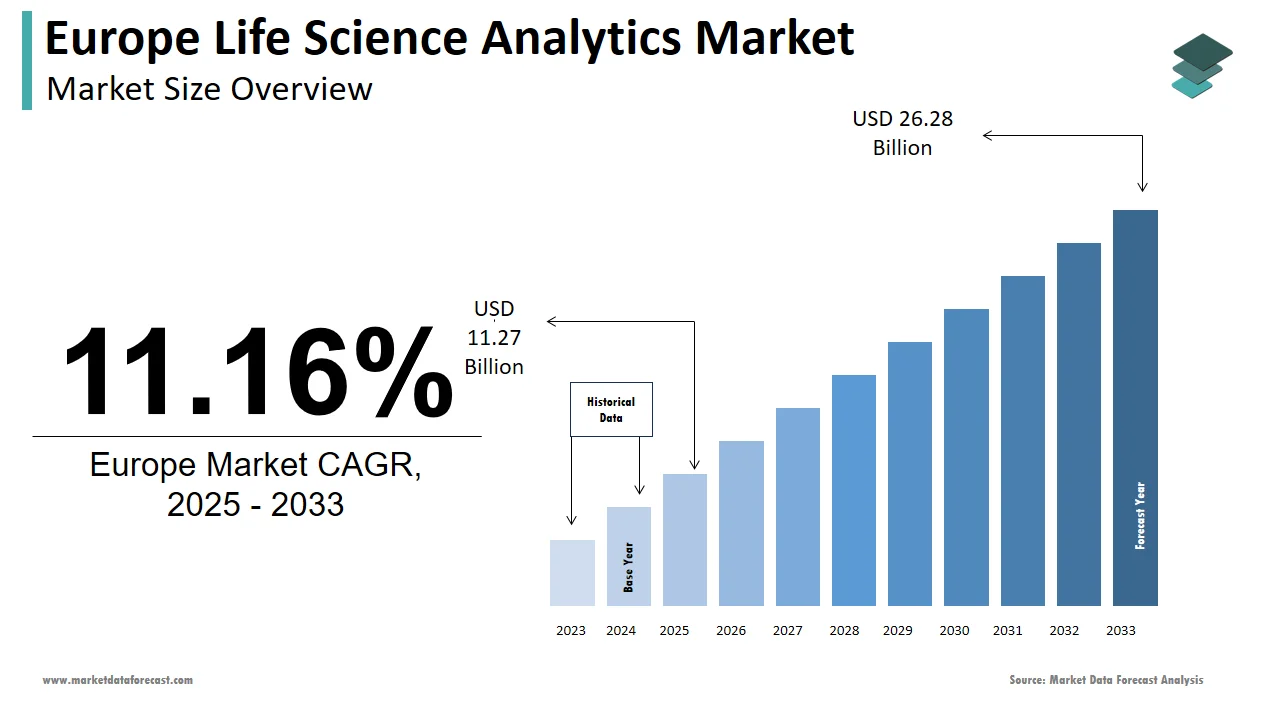
The life science analytics market size in Europe was valued at USD 11.27 billion in 2025. The European market is estimated to be worth USD 29.21 billion by 2034 from USD 12.53 billion in 2026, growing at a CAGR of 11.16% from 2026 to 2034.
Life Science Analytics is the application of advanced data analytics, artificial intelligence, and real-world evidence platforms to accelerate drug discovery, optimize clinical development, enhance pharmacovigilance, and support regulatory and commercial decision-making across the pharmaceutical, biotechnology, and medical device sectors.
MARKET DRIVERS
Regulatory Mandates for Real World Evidence Integration
The European regulatory authorities have increasingly mandated the use of real-world evidence derived through advanced analytics to support drug approvals, label expansions, and post-marketing safety monitoring is majorly prompting the growth of the Europe Life Science Analytics Market. This shift is formalized under the EU’s Clinical Trials Regulation and the upcoming Pharmaceutical Strategy for Europe, which explicitly encourages the use of analytics to reduce clinical trial burden and accelerate access to innovative therapies. Furthermore, national health technology assessment bodies such as Germany’s GBA and England’s NICE now require real-world cost-effectiveness models as part of reimbursement dossiers.
Proliferation of Multi Omics and Precision Medicine Initiatives
The expansion of large-scale genomic and multi-omics programs across Europe is generating unprecedented volumes of complex biological data that necessitate sophisticated analytics for interpretation and clinical translation, which is accelerating the growth of the Europe life science analytics market. Companies like Sophia Genetics and Owkin have developed federated learning platforms that enable hospitals to collaboratively train predictive models without sharing raw patient data, complying with GDPR.
MARKET RESTRAINTS
Fragmented Health Data Ecosystem Across Member States
The lack of interoperable and standardized health data infrastructure across EU member states is hindering the growth of the Europe life science analytics market. Although the European Health Data Space aims to establish common data models by 2025, which is implementation remains voluntary and underfunded in many member states.
Stringent and Evolving Data Privacy Regulations
The world’s most rigorous data protection regimes, with the General Data Protection Regulation imposing significant compliance burdens that substantially decline the growth of Europe life science analytics market. The GDPR’s strict requirements for explicit consent, purpose limitation, and data minimization complicate the reuse of historical clinical and real-world data for secondary analytics.
MARKET OPPORTUNITIES
Adoption of Federated Learning in Clinical Trial Optimization
The federated learning is emerging with collaborative model training across decentralized data sources without transferring raw patient records, which is enhancing the growth of the Europe life science analytics market. Startups such as Owkin and MDClone provide secure analytics sandboxes that allow researchers to query distributed datasets using standardized algorithms, with audit trails satisfying EMA inspection requirements.
Integration of AI-Powered Pharmacovigilance Systems
The automation of adverse event detection and signal management through artificial intelligence driven by regulatory expectations and rising pharmacovigilance workloads is solely to create new opportunities for the growth of the Europe life science analytics market. Companies like IQVIA and ArisGlobal have deployed AI engines that process multilingual adverse event data from electronic health records, social media, and literature by achieving 92 % concordance with human reviewers in EMA validation exercises.
MARKET CHALLENGES
Shortage of Cross-Disciplinary Talent in Analytics and Life Sciences
The availability of professionals who combine deep domain expertise in biology or medicine with advanced data science and regulatory knowledge is hindering the growth of the Europe life science analytics market. This talent deficit forces companies to invest heavily in upskilling, with Roche and Sanofi each spending over 5 million euros annually on internal analytics academies. The shortage is particularly acute in specialized areas such as real-world evidence methodology and AI model validation for regulatory submission, where missteps can lead to rejected dossiers.
Lack of Standardized Validation Frameworks for AI Models
The absence of harmonized regulatory standards for validating artificial intelligence models in life science applications is another challenging factor for the growth of the Europe life science analytics market. The EMA’s reflection paper on AI, published in 2023, outlines principles but lacks binding technical specifications, which is leaving companies to interpret validation requirements inconsistently.
REPORT COVERAGE
| REPORT METRIC | DETAILS |
| Market Size Available | 2025 to 2034 |
| Base Year | 2025 |
| Forecast Period | 2026 to 2034 |
| Segments Covered | By Analytics Type, Component, Delivery Mode, Application, End-user, and Region. |
| Various Analyses Covered | Global, Regional, and Country-Level Analysis, Segment-Level Analysis, Drivers, Restraints, Opportunities, Challenges; PESTLE Analysis; Porter’s Five Forces Analysis, Competitive Landscape, Analyst Overview of Investment Opportunities |
| Countries Covered | UK, France, Spain, Germany, Italy, Russia, Sweden, Denmark, Switzerland, Netherlands, Turkey, Czech Republic, and the Rest of Europe. |
| Market Leaders Profiled | IQVIA, Accenture, Hensoldt, Thales Group, Capgemini, Atos SE, Siemens Healthineers, Roche, Novartis, Oracle Health Sciences, SAS Institute, and AstraZeneca. |
SEGMENTAL ANALYSIS
By Analytics Type Insights
The descriptive analytics segment held 48.3% of the Europe life science analytics market share in 2024, with its foundational role in regulatory reporting, clinical trial monitoring, and post-marketing surveillance, where historical data summarization is mandatory. Additionally, the EU Clinical Trials Regulation requires sponsors to provide real-time descriptive summaries of trial recruitment and protocol deviations via the Clinical Trials Information System. Academic medical centers across France and the Netherlands also depend on descriptive tools to comply with national research transparency laws.

The prescriptive analytics segment is lucratively growing with an anticipated CAGR of 18.7% in next coming years. In commercial operations, companies like Novartis use prescriptive engines to simulate pricing and reimbursement scenarios across 27 EU health systems, improving market access strategy accuracy. Furthermore, the European Health Data Space’s trusted research environment supports prescriptive model deployment under strict governance, fostering adoption in public health.
By Delivery Mode Insights
The on-demand or cloud-based delivery segment was the largest by occupying 63.3% of Europe's life science analytics market share in 2024, with the need for scalable infrastructure, rapid deployment, and cost efficiency in an era of data-intensive research. The European Commission’s Cloud Strategy for Health explicitly endorses GAIA-X-compliant cloud services for life science data processing, ensuring sovereignty and GDPR alignment. Major cloud providers such as AWS and Microsoft Azure have established dedicated life science zones in Frankfurt and Amsterdam with pre-validated analytics modules for pharmacovigilance and biomarker discovery.
The On-demand delivery is the fastest-growing segment with an expected CAGR of 16.2 % from 2026 to 2034, from legacy infrastructure amid tightening innovation timelines. The European Health Data Space’s implementation framework designates cloud environments as the default for cross-border research, with federated query capabilities enabling secure analytics without data movement. Startups such as Owkin and Sensyne Health leverage cloud elasticity to run thousands of parallel AI experiments on genomic datasets, a feat impossible on fixed on-premises systems.
By Application Insights
The clinical and preclinical trials segment was the largest by capturing 34.2% of the Europe life science analytics market share in 2024. The regulation mandates centralized data repositories and real-time dashboards, which is compelling sponsors to deploy descriptive and predictive analytics at scale.
The pharmacovigilance segment is likely to grow at a noteworthy CAGR of 19.4 % in next coming years with the exponential increase in adverse event reporting and the European Medicines Agency’s push for AI enabled signal detection. National competent authorities such as France’s ANSM now require sponsors to submit AI-generated signal detection outputs as part of periodic safety update reports. Additionally, the EU’s PRAC committee has mandated proactive risk identification for all new molecular entities, which is creating recurring demand for predictive safety analytics.
By End User Insights
The pharmaceutical and biotechnology companies segment was accounted in holding a dominant share of the Europe life science analytics market share in 2024 with their extensive use of analytics across the entire product lifecycle from target identification and clinical development to market access and post authorization safety. Regulatory compliance is a major driver; the European Medicines Agency requires sponsors to submit real world evidence and risk management plans supported by robust analytics.
The biomedical research centers segment is likely to experience the fastest CAGR of 17.8 % from 2026 to 2034, with the large scale public research initiatives and the European Commission’s emphasis on data-driven discovery. National institutes such as Germany’s Helmholtz Zentrum München and France’s Institut Pasteur have established dedicated data science cores to support collaborative research under the 1+ Million Genomes Initiative. Furthermore, EU structural funds have allocated 300 million euros to upgrade high-performance computing infrastructure at academic medical centers in Eastern Europe.
COUNTRY LEVEL ANALYSIS
Germany Life Science Analytics Market Analysis
Germany was the largest contributor in the Europe life science analytics market with 24.2% of share in 2024, with its world class pharmaceutical industry, advanced healthcare infrastructure, and strong public research ecosystem. Germany hosts global R&D centers for Bayer, Merck KGaA, and Boehringer Ingelheim, all of which operate integrated analytics platforms for drug discovery and pharmacovigilance. Additionally, the German Medical Informatics Initiative has established four national data integration centers that standardize and anonymize patient data for research, complying with GDPR while enabling large-scale analytics.
United Kingdom Life Science Analytics Market Analysis
The United Kingdom was ranked second in the Europe life science analytics market by accounting for 19.3% of share in 2024. With the European Union, the UK maintains a vibrant life science sector driven by academic excellence, regulatory agility, and public-private partnerships. The Medicines and Healthcare products Regulatory Agency has pioneered the use of real-world analytics for rapid vaccine safety monitoring, processing over 30 million patient records during the pandemic. Companies like BenevolentAI and Exscientia leverage UK talent pools to develop AI-driven drug discovery platforms used globally.
France Life Science Analytics Market Analysis
France life science analytics market held 15.3% of the share in 2024, with health data governance and ambitious national digital health strategies. This infrastructure supports large-scale real-world studies mandated under the French National Strategy for Artificial Intelligence. Pharmaceutical giants like Sanofi operate advanced analytics centers in Paris and Lyon, focused on predictive safety and clinical trial optimization.
COMPETITIVE LANDSCAPE
Competition in the Europe life science analytics market is characterized by a sophisticated interplay between global technology giants, specialized life science vendors, and emerging AI startups, all operating under stringent regulatory and ethical constraints. Differentiation is not based on generic analytics capabilities but on domain-specific validation, regulatory credibility, and integration with European health data infrastructures. Established players leverage decades of experience in clinical and safety data standards to offer compliant, auditable solutions that meet EMA and national authority expectations.
KEY MARKET PLAYERS
Some of the companies that are playing a dominating role in the Europe life science analytics market include
- IQVIA
- Accenture
- Hensoldt
- Thales Group
- Capgemini
- Atos SE
- Siemens Healthineers
- Roche
- Novartis
- Oracle Health Sciences
- SAS Institute
- AstraZeneca
TOP PLAYERS IN THE EUROPE LIFE SCIENCE ANALYTICS MARKET
- IQVIA is a global leader in advanced analytics, technology solutions, and contract research services with a deep footprint in the Europe life science analytics market. In 2023, the company launched its Orchestrated Customer Engagement platform in Germany and France, enabling personalized omnichannel engagement for life science commercial teams. It also expanded its AI-powered safety signal detection system across EU regulatory submissions, which is aligning with EMA guidelines. These initiatives reinforce IQVIA’s role as a strategic partner in Europe’s data driven healthcare transformation.
- Oracle Health Sciences delivers cloud-based analytics and clinical data management solutions tailored to the regulatory and operational needs of European life science organizations. Its unified platform integrates clinical, safety, and commercial data to accelerate trial execution and post-marketing surveillance. Oracle has strengthened its European presence by enhancing its Health Sciences Cloud with GDPR compliant data residency options in Frankfurt and Amsterdam. In 2023, the company introduced AI enabled risk-based monitoring modules that automatically flag protocol deviations and site performance anomalies in real time.
- SAS Institute is a prominent analytics software provider with a long-standing presence in the Europe life science sector, offering advanced statistical, machine learning, and visual analytics solutions for drug discovery, clinical development, and pharmacovigilance. The company’s Viya platform supports validated workflows that meet EU regulatory requirements for auditability and reproducibility. SAS has deepened its European engagement by collaborating with the European Medicines Agency on AI model validation frameworks and with national health agencies on real-world evidence methodologies.
TOP STRATEGIES USED BY THE KEY MARKET PARTICIPANTS
Key players in the Europe life science analytics market pursue a strategic triad of regulatory alignment, technological innovation, and ecosystem collaboration. Companies prioritize compliance with EMA guidelines and GDPR by embedding data governance, audit trails, and model explainability into their platforms. Strategic partnerships with academic medical centers, national health agencies, and cloud providers facilitate access to high-quality data and co-development of validated use cases. Vendors are also shifting toward integrated end to end platforms that unify clinical, safety, and commercial analytics to support holistic product lifecycle management.
MARKET SEGMENTATION
This Europe life science analytics market research report is segmented and sub-segmented into the following categories.
By Analytics Type
- Descriptive Analytics
- Predictive Analytics
- Prescriptive Analytics
By Component
- Software
- Services
By Delivery Mode
- On-demand
- On-premises
By Application
- Clinical and Preclinical Trials
- Research and Development
- Regulatory Compliance
- Sales and Marketing
- Supply Chain Management
- Pharmacovigilance
By End-User
- Pharmaceutical and Biotechnology Companies
- Medical Device Companies
- Biomedical Research Centers
- Third-party Administrators (TPA)
By Country
- UK
- France
- Spain
- Germany
- Italy
- Russia
- Sweden
- Denmark
- Switzerland
- Netherlands
- Turkey
- Czech Republic
- Rest of Europe